Summary
Table of Content

U.S. Remote Patient Monitoring Market
Get a free sample of this report
Form submitted successfully!
Error submitting form. Please try again.
Thank you!
Your inquiry has been received. Our team will reach out to you with the required details via email. To ensure that you don't miss their response, kindly remember to check your spam folder as well!
Request Sectional Data
Thank you!
Your inquiry has been received. Our team will reach out to you with the required details via email. To ensure that you don't miss their response, kindly remember to check your spam folder as well!
Form submitted successfully!
Error submitting form. Please try again.
U.S. Remote Patient Monitoring Market Size
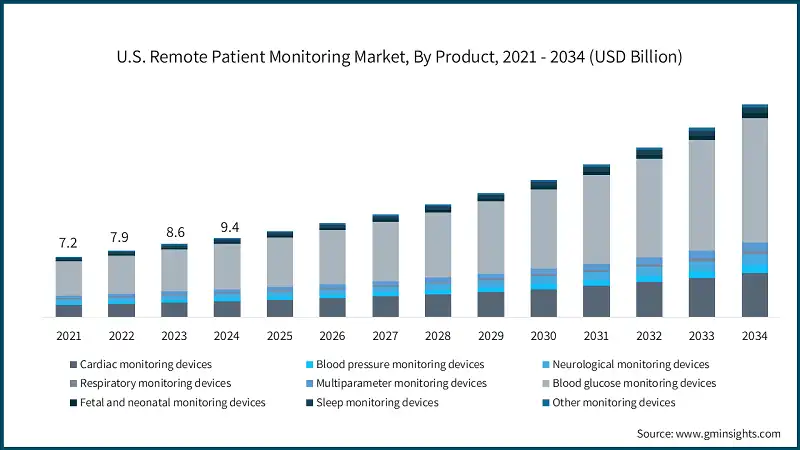
The U.S. remote patient monitoring market (RPM) was valued at USD 9.4 billion in 2024 and is projected to grow from USD 10.2 billion in 2025 to USD 25.2 billion by 2034, expanding at a CAGR of 10.6% according to Global Market Insights. This steady growth is stimulated by various factors such as growing prevalence of chronic diseases one of which is prevalence of diabetes across the U.S., policy and reimbursement support. Major companies in the industry include Abbott Laboratories, Dexcom, Medtronic, Koninklijke Philips, and Boston Scientific.
U.S. Remote Patient Monitoring Market Key Takeaways
Market Size & Growth
- 2024 Market Size: USD 9.4 Billion
- 2025 Market Size: USD 10.2 Billion
- 2034 Forecast Market Size: USD 25.2 Billion
- CAGR (2025–2034): 10.6%
Key Market Drivers
- Rising incidence of chronic diseases.
- Growing disposable income and healthcare expenditure.
- Growing adoption of remote patient monitoring devices.
Challenges
- High cost of devices.
- Stringent regulatory framework.
Opportunity
- Integration of AI and smart ecosystems.
Key Players
- Market Leader: Medtronic led with over 34% market share in 2024.
- Leading Players: Top 5 players in this market include Abbott Laboratories, Dexcom, Medtronic, Koninklijke Philips, Boston Scientific, which collectively held a market share of 70% in 2024.
Get Market Insights & Growth Opportunities
The U.S. Remote Patient Monitoring Market has seen tremendous growth, increasing from USD 7.2 billion in 2021 to USD 8.6 billion in 2023, due to rising prevalence of chronic conditions such as diabetes, cardiovascular diseases, and hypertension. These conditions necessitate continuous monitoring and timely interventions to prevent complications, hence making RPM solutions indispensable. For example, diabetes is the leading cause of this trend. In the U.S., there were 38.4 million people of all ages who had diabetes in 2023, with 11.6% of the population, including 38.1 million adults aged 18 years or older, accounting for 14.7% of all U.S. adults. This large patient base underlines the urgent need for effective disease management tools. And with a growing number of people suffering from chronic diseases, health systems are increasingly adopting proactive, technology-driven care models.
RPM platforms enable the tracking of critical parameters like blood glucose, blood pressure, and heart rate by patients themselves from the comfort of their homes, thereby reducing hospitalization and enhancing outcomes. Therefore, the increasing burden of chronic diseases accelerates the adoption and development of RPM solutions, with the latter turning into a cornerstone for contemporary chronic care management.
The remote patient monitoring (RPM) market encompasses medical technologies designed to collect, transmit, and analyze patient health data outside of traditional clinical settings. This includes a wide range of devices that monitor vital signs, chronic conditions, and other health metrics, enabling healthcare providers to track patient status remotely. The market also includes integrated software platforms that facilitate data collection, analysis, and communication between patients and providers. Additionally, it covers compatible monitoring devices developed by manufacturers to work seamlessly with proprietary RPM software solutions, ensuring interoperability and efficient remote care delivery.

To get key market trends
U.S. Remote Patient Monitoring Market Trends
- The market is standing at the edge of transformation driven by technological innovation, change in care models, and increase in demand for chronic disease management.
- There are rapid developments in the fields of AI, IoT, and biosensor technologies that offer continuous and real-time data collection and predictive analytics. These tools will permit clinicians to identify the early signs of deterioration, enable early intervention, and reduce hospital readmissions.
- For example, AI-driven algorithms analyze trends in blood pressure, glucose levels, and respiratory rates to predict complications and improve patient outcomes and operational efficiency.
- In addition, strategic partnerships between device manufacturers and digital health companies, academic institutions, and providers help not only foster flexible innovative and scalable solutions but also ensure that the products meet regulatory standards laid out in the U.S. Such partnerships provide opportunities for clinical validation and further integration with EHR, telehealth, and pharmacy systems to form one smooth ecosystem around the remote care monitoring market.
U.S. Remote Patient Monitoring Market Analysis
Learn more about the key segments shaping this market
Based on product, the U.S. market is divided into cardiac monitoring devices, blood pressure monitors, neurological monitoring devices, multiparameter monitoring devices, blood glucose monitoring devices, fetal and neonatal monitoring devices, sleep monitoring devices, and other monitoring devices. The cardiac monitoring devices segment held a significant market share of 19.6% in 2024.
- Growth in this segment is driven mainly by the high prevalence of cardiovascular diseases in the U.S. and the growing requirement for continuous real-time monitoring to enable early diagnosis and timely intervention.
- There are significant technological improvements in cardiac RPM devices, including precision and reliability. AI-powered analytics and deep sensor integrations have made tracking of heart rhythms, heart rate variability, and other vital cardiac metrics possible with accuracy.
- These innovations are especially important in arrhythmia, atrial fibrillation, and early signs of cardiac distress, thus supporting preventive care and avoiding emergency hospital visits.
- The leading U.S. manufacturers are presenting advanced solutions for remote cardiac monitoring. Thus, Medtronic's LINQ II insertable cardiac monitor includes an algorithm called AccuRhythm AI because it is designed to provide more precise arrhythmia detection.
- This device provides long-term monitoring for patients with unexplained syncope or suspected arrhythmia, allowing for clinician decision-making based on continuous data. The Abbott Confirm Rx, powered by SharpSense technology, wirelessly sends cardiac data over Bluetooth to a patient’s smartphone, allowing real-time data sharing and increasing patient engagement along with clinical responsiveness.
- With value-based care and home-based monitoring on the rise within U.S. healthcare systems, cardiac RPM devices are increasingly becoming critical tools in chronic disease management, post-operative recovery, and elderly care.
Based on application, the U.S. remote patient monitoring market is bifurcated into cardiovascular diseases, cancer, diabetes, neurological disorders, infectious diseases respiratory diseases, and other applications. The diabetes segment held a significant market share of 56.4% in 2024 driven by the rise in diabetes prevalence and the increasing need for continuous, real-time disease management.
- The CDC estimated that over 38 million Americans have diabetes, and of those, 90-95% have Type 2 diabetes. Though adults over age 45 are most affected by this condition, diagnoses among younger populations are increasing, making accessible and effective monitoring solutions ever more important.
- Management of diabetes involves frequent monitoring of blood glucose, administration of insulin, and other metabolic parameters, hence making RPM devices highly essential for improving patient outcomes by reducing complications. Technological advancement has greatly improved the management of diabetes through RPM.
- Modern devices boast of high-accuracy sensors, AI-powered analytics, and cellular connectivity, thus allowing seamless transmission of data and early detection of complications such as hypoglycemia and hyperglycemia.
- RPM solutions also support personalized care by analyzing individual health data over time to tailor interventions to each patient’s unique needs. This approach improves adherence and patient satisfaction, particularly for elderly individuals, those with comorbidities, and patients in remote or underserved areas.
- As U.S. healthcare systems embrace value-based care and home-based monitoring, blood glucose RPM devices are becoming essential tools in chronic disease management. Their ability to deliver accurate, real-time insights and facilitate proactive care is accelerating adoption across hospitals, specialty clinics, and home care settings. Combined with strong reimbursement support through RPM-specific CPT codes, this segment is poised for sustained growth in the coming years.

Learn more about the key segments shaping this market
Based on end use, the U.S. remote patient monitoring market is bifurcated into home-care settings, long-term care, and other end users. Among these, the home-care settings segment accounts for 69.8% of the total market share.
- There has been a significant growth in the adoption of home-based monitoring devices in the market, driven by an increasing preference for decentralized care and aging in place. Thus, it has resulted in empowering patients to take proactive health management while considering reducing the frequency of visits to the hospitals, hence making it align with the country's approach toward value-based care and digital health transformation.
- Technology has smoothed out many of the usability and accuracy issues with RPM devices, making them accessible for in-home usage. With modern solutions, there is real-time tracking of vital signs, automated alerts, and easy data sharing with healthcare providers. Many systems integrate with smartphones and digital health platforms for easy tracking of health metrics and data sharing by patients.
- COVID-19 accelerated a switch to home-based healthcare solutions in the U.S., with patients looking to minimize their exposure to clinical environments. This has continued into post-pandemic times and further engrained RPM's role in decentralized healthcare delivery. The aging U.S. population, along with a growing preference to age in place, is expanding the segment of home care.
- With personalized, real-time insights in care coordination becoming increasingly prioritized, home-based RPM devices are fast cementing their place as cornerstones in modern healthcare delivery throughout U.S. healthcare systems.
U.S. Remote Patient Monitoring Market Share
- Top 5 companies such as Abbott Laboratories, Dexcom, Medtronic, Koninklijke Philips, and Boston Scientific dominate the U.S. RPM market with a collective market share of 70% through advanced product portfolios, strong provider partnerships, and continuous innovation. Their offerings span cardiac monitoring, continuous glucose monitoring, multiparameter devices, and integrated digital platforms, enabling real-time data sharing and proactive care management.
- Emerging players and niche innovators are gaining traction by introducing AI-powered analytics, wearable biosensors, and smartphone-integrated RPM solutions. These companies focus on user-friendly designs and interoperability, appealing to tech-savvy patients and supporting decentralized care models.
- To strengthen market position, top players actively engage in partnerships, acquisitions, and technology collaborations. These strategies accelerate product development, enhance connectivity with EHR and telehealth platforms, and expand RPM capabilities for chronic disease management and hospital-at-home programs.
U.S. Remote Patient Monitoring Market Companies
Few of the prominent players operating in the U.S. remote patient monitoring industry include:
- Abbott Laboratories
- Baxter International
- BIOTRONIK SE & Co. KG
- Boston Scientific
- Dexcom
- F. Hoffmann-La Roche Ltd
- GE Healthcare
- Johnson & Johnson
- Koninklijke Philips N.V.
- Medtronic
- OMRON
- Sotera Wireless
- VitalConnect
- Dexcom
Dexcom is a leading player in remote patient monitoring for diabetes care, offering advanced continuous glucose monitoring solutions such as the Dexcom G7 CGM system. This device provides real-time glucose readings and trend data to support timely treatment decisions and improve patient outcomes.
Abbott Laboratories is a leading player in remote patient monitoring, recognized for its innovations in diabetes care through continuous glucose monitoring technologies. Its FreeStyle Libre 2 system is the only FDA-cleared integrated CGM for adults and children aged 4 years and older, providing up to 14 days of continuous glucose readings with exceptional accuracy. Abbott focuses on user comfort, connectivity, and digital integration, enabling real-time data sharing and proactive management of chronic conditions.
Boston Scientific is a leading innovator in cardiac remote patient monitoring, offering solutions such as the HeartLogic Heart Failure Diagnostic system. This advanced platform enables early detection of worsening heart failure by combining multiple physiologic sensors into a single index. It aggregates data such as thoracic impedance, heart sounds, respiration rate, and physical activity into actionable alerts, allowing clinicians to intervene proactively and improve patient outcomes.
U.S. Remote Patient Monitoring Market Report Attributes
| Key Takeaway | Details |
|---|---|
| Market Size & Growth | |
| Base Year | 2024 |
| Market Size in 2024 | USD 9.4 Billion |
| Market Size in 2025 | USD 10.2 Billion |
| Forecast Period 2025 - 2034 CAGR | 10.6% |
| Market Size in 2034 | USD 25.2 Billion |
| Key Market Trends | |
| Drivers | Impact |
| Rising incidence of chronic diseases | The growing prevalence of diabetes, hypertension, heart failure, and COPD is driving demand for continuous monitoring solutions. RPM enables early detection of complications, reduces hospital readmissions, and supports value-based care initiatives. |
| Growing disposable income and healthcare expenditure | Higher spending capacity and increased healthcare budgets encourage adoption of advanced RPM platforms and connected devices, improving patient engagement and enabling providers to invest in scalable remote care programs. |
| Growing adoption of remote patient monitoring devices | Wider acceptance among providers and patients accelerates integration into clinical workflows, enhances data-driven decision-making, and strengthens payer reimbursement models for chronic disease management. |
| Pitfalls & Challenges | Impact |
| High cost of devices | Limits accessibility for patients, especially in underserved or low-income populations. |
| Stringent regulatory framework | Slows down product approvals and market entry, affecting innovation and availability. |
| Opportunities: | Impact |
| Integration of AI and smart ecosystems | AI-driven analytics enable predictive alerts, personalized care plans, and automated triage, improving clinical efficiency and patient outcomes. |
| Market Leaders (2024) | |
| Market Leaders |
34% market share |
| Top Players |
|
| Competitive Edge |
|
| Future outlook |
|
What are the growth opportunities in this market?
U.S. Remote Patient Monitoring Industry News:
- In May 2025, Boston Scientific Corporation received FDA approval for LATITUDE 6.0, a software upgrade to its LATITUDE Patient Management system that enhances remote monitoring by offering expanded patient follow-up data history. This upgrade strengthened the company’s digital health portfolio and supports improved clinician efficiency and patient management.
- In April 2023, Abbott received U.S. FDA for its FreeStyle Libre 3 integrated continuous glucose monitoring (iCGM) system, the world’s smallest, thinnest, and most discreet 5 glucose sensor in diabetes management. Such product approvals strengthened the company’s foothold in the diabetes care market.
The U.S. remote patient monitoring market research report includes in-depth coverage of the industry with estimates and forecast in terms of revenue in USD Million and from 2021 - 2034 for the following segments:
Market, By Product
- Cardiac monitoring devices
- Blood pressure monitoring devices
- Neurological monitoring devices
- Respiratory monitoring devices
- Multiparameter monitoring devices
- Blood glucose monitoring devices
- Fetal and neonatal monitoring devices
- Sleep monitoring devices
- Other products
Market, By Application
- Cardiovascular diseases
- Cancer
- Diabetes
- Neurological disorders
- Infectious diseases
- Respiratory diseases
- Other applications
Market, By End Use
- Home-care settings
- Long-term care
- Other end use
Frequently Asked Question(FAQ) :
What is the market size of the U.S. remote patient monitoring market in 2024?
The market size was USD 9.4 billion in 2024, with a CAGR of 10.6% expected through 2034, driven by the increasing prevalence of chronic diseases, particularly diabetes, and supportive policy and reimbursement frameworks.
What is the projected value of the U.S. remote patient monitoring market by 2034?
The market is expected to reach USD 25.2 billion by 2034, fueled by advancements in technology, such as AI and IoT, and the growing demand for real-time chronic disease management.
What is the projected size of the U.S. remote patient monitoring market in 2025?
The market is expected to reach USD 10.2 billion in 2025.
How much revenue did the cardiac monitoring devices segment generate?
The cardiac monitoring devices segment held a significant market share of 19.6% in 2024.
What was the market share of the diabetes application segment?
The diabetes segment accounted for 56.4% of the market share in 2024, driven by the rising prevalence of diabetes and the need for continuous, real-time disease management.
Which end-use segment leads the U.S. remote patient monitoring market?
The home-care settings segment led the market, accounting for 69.8% of the total market share in 2024.
What are the upcoming trends in the U.S. remote patient monitoring industry?
Key trends include the integration of AI, IoT, and biosensor technologies for real-time data collection and predictive analytics, enabling early intervention and reducing hospital readmissions. Additionally, AI-driven algorithms are being used to analyze trends in vital signs, improving patient outcomes and operational efficiency.
Who are the key players in the U.S. remote patient monitoring market?
Key players include Abbott Laboratories, Baxter International, BIOTRONIK SE & Co. KG, Boston Scientific, Dexcom, F. Hoffmann-La Roche Ltd, GE Healthcare, Johnson & Johnson, and Koninklijke Philips N.V.
U.S. Remote Patient Monitoring Market Scope
Related Reports