Summary
Table of Content

U.S. Natural Fiber Insulation Materials Market
Get a free sample of this report
Form submitted successfully!
Error submitting form. Please try again.
Thank you!
Your inquiry has been received. Our team will reach out to you with the required details via email. To ensure that you don't miss their response, kindly remember to check your spam folder as well!
Request Sectional Data
Thank you!
Your inquiry has been received. Our team will reach out to you with the required details via email. To ensure that you don't miss their response, kindly remember to check your spam folder as well!
Form submitted successfully!
Error submitting form. Please try again.
U.S. Natural Fiber Insulation Materials Market Size
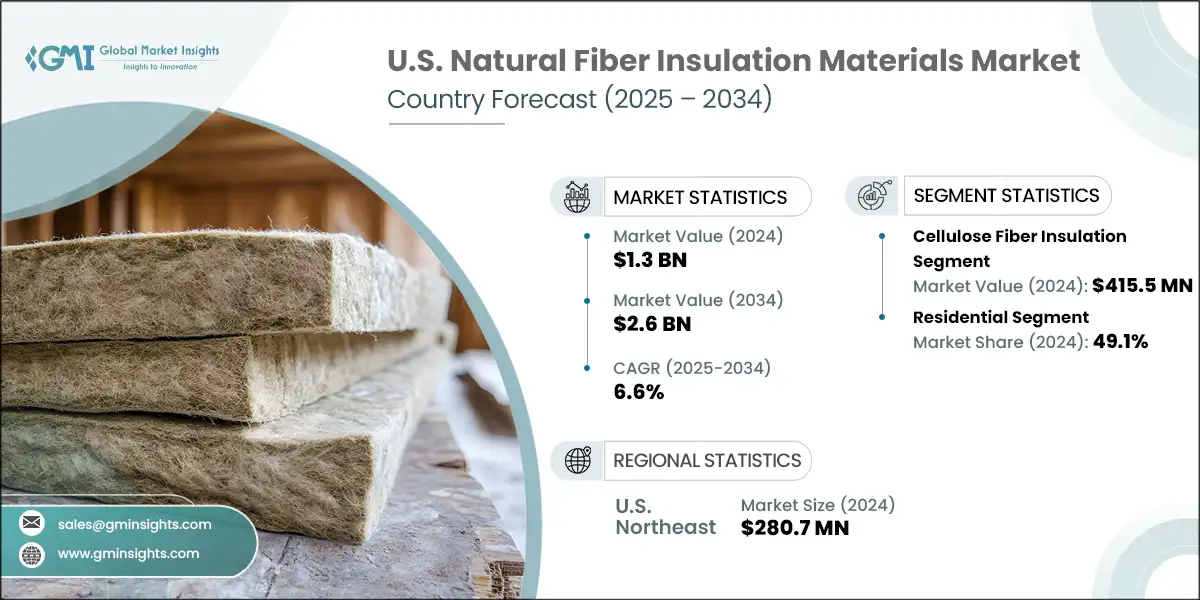
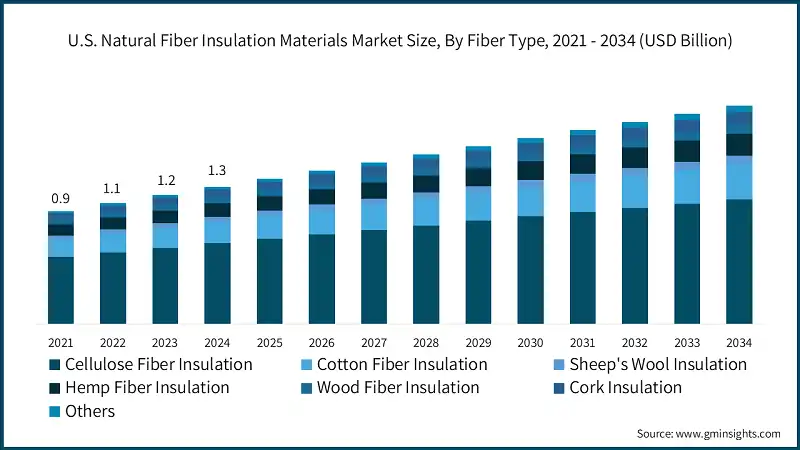
According to a recent study by Global Market Insights Inc., the U.S. natural fiber insulation materials market was valued at USD 1.3 billion in 2024. The market is expected to grow from USD 1.5 billion in 2025 to USD 2.6 billion in 2034 at a CAGR of 6.6%.
U.S. Natural Fiber Insulation Materials Market Key Takeaways
Market Size & Growth
- 2024 Market Size: USD 1.3 Billion
- 2034 Forecast Market Size: USD 2.6 Billion
- CAGR (2025–2034): 6.6%
Regional Dominance
- Largest Market: Southeast Region
- Fastest Growing Country: Northeast Region
Key Market Drivers
- Growing Sustainability Awareness and Green Building Trends.
- Stringent Energy Efficiency Regulations and Building Codes.
- Health and Indoor Air Quality Concerns.
Challenges
- Higher Initial Costs Compared to Synthetic Alternatives.
Opportunity
- Government Incentives for Green Building Materials.
Key Players
- Market Leader: Saint Gobain led with over 10.1% market share in 2024.
- Leading Players: Top 5 players in this market include BASF, Owens Corning, Saint-Gobain, Knauf Insulation, Havelock Wool, which collectively held a market share of 45% in 2024.
Get Market Insights & Growth Opportunities
- The rise in global concerns about issues such as climate change and depletion of resources has been one of the major drivers for natural fiber insulation materials. Consumers and builders, along with developers, are becoming more interested in practices and materials that promote sustainability and lower their environmental footprints. Natural fiber insulation products match this trend perfectly. A few of the very common kinds of insulation made of foam are petroleum-based and extremely energy-intensive in production; on the contrary, natural fibers are renewable resources, many of which sequester carbon during their growth phase. An example can be cited with recycled denim insulation, which diverts huge amounts of textile waste away from landfills and lends credence to a circular economy model.
- In addition, these materials often tend to be biodegradable, which cuts down the long-term environmental impact even further. The push for "green" buildings that emphasize energy efficiency and environmental responsibility throughout their lifecycle is converting stakeholders into natural fiber options of insulation, for which sustainability becomes a significant competitive advantage and a major market driver. This general environmental consciousness is now filtering down from the other end of the construction spectrum-the do-it-yourself homeowner-to the professionals who actually see it all going on, thus making the ability to select sustainable materials an important criterion for any purchase.
- These days, one spends most of the time indoors, bringing indoor air quality to the fore with regards to its impact on health. Insulation materials made with synthetic chemicals and binders are notorious for off-gassing VOCs and formaldehyde, which can trigger respiratory illness, allergic reactions, and many other health issues. Natural fiber insulation generally manages to be non-toxic, not containing harmful chemicals, and not off-gas toxic compounds. Materials such as sheep wool and cellulose can actually help manage moisture in a way that reduces common allergens and irritants like molds and mildew. This very breathability and non-toxicity further create a healthier indoor environment, appealing to health-inspired consumers, families with young ones, and people suffering from either chemical sensitivities or respiratory complications. The perception of a "healthy home," capable of enhancing the well-being of its occupants, is no longer an idle thought, but rather has entered the circles of augmented demand for building materials that will help improve indoor air quality and general occupant health, thereby making natural fiber insulation its prime choice.
To get key market trends
U.S. Natural Fiber Insulation Materials Market Trends
- Growing Demand for Eco-Friendly Insulation Materials - The market for natural fiber insulation materials in the U.S. is becoming increasingly in demand owing to an increase in environmental sustainability awareness. Consumers and builders are looking for healthy options when it comes to the impact on health and ecological perspectives rather than using insulated products such as fiberglass or foam. Natural fibers are gaining momentum for being renewable, biodegradable, and having lower embodied energy. This is further propelled by the local government through policies and building codes that encourage using sustainable materials for reducing carbon footprint and promoting environments for healthier construction. Naturally, many manufacturers are coming up with innovations in natural fiber insulation products, which will comply with sustainability standards that are in line with emerging consumer preferences and regulatory requirements.
- Technological Advancements Enhance Performance and Application - Advancements in manufacturing technologies are improving the performance and versatility of natural fiber insulation materials. Innovations such as improved fiber bonding, fire-retardant treatments, and moisture resistance for these materials enhance their suitability for a whole range of applications in residential, commercial, and industrial buildings. Moreover, the development of hybrid insulation systems combining natural fibers with other eco-friendly materials provides improvements in thermal and acoustic insulation functionality. Continued technological developments greatly address the challenges posed by durability and fire safety against using natural fiber insulation in construction as a more competitive option for builders and homeowners. Continuous development in the area is projected to accelerate growth within the market and allow for the drifting of natural fibers from niche markets to common construction.
- Rising Consumer Awareness and Market Penetration - Consumerism has engaged itself in health-related awareness, indoor air quality consciousness, and sustainable living, which significantly pushes the natural fiber insulation material adoption. Eco-labeling, public education campaigns, and certifications like LEED (Leadership in Energy and Environmental Design) are helping promote eco-friendly insulation alternatives among building owners and contractors. In addition, the growing interest in DIY home improvement projects and availability of natural fiber insulation products through retail markets are further advancing the outreach of this growing market. With increasing levels of awareness, developers and architects will be looking to incorporate more natural fiber into their building designs to meet green building standards, hence catering to an environmentally conscious clientele. This growing penetration into the market is likely to maintain the upward trends of the natural fiber insulation materials market within the United States for the foreseeable future.
U.S. Natural Fiber Insulation Materials Market Analysis
Learn more about the key segments shaping this market
In terms of fiber type, the market is segmented as cellulose fiber insulation, cotton fiber insulation, sheep's wool insulation, hemp fiber insulation, wood fiber insulation, cork insulation, and others. The cellulose fiber insulation segment generating USD 415.5 million in 2024.
- Cellulose fiber insulation is the one which is cost-effective and largely abundant; therefore, it dominates the very few natural fiber insulation options available in the market today. Its economy has made cellulose insulation an ideal choice among builders and homeowners who may wish to consider a more sustainable insulation scheme without increasing project costs. Cellulose insulation also performs wonderfully in thermal and acoustic applications for many building types. It is an environmentally acceptable system given its composition of recycled paper products and therefore appeals to eco-consumers and regulators. Ease of installation and good filling properties when it comes to nooks and crannies make it even more sought-after. Therefore, cellulose fiber insulation becomes the ideal choice among the natural fiber insulation options.
- Cellulose fiber insulation has a time-tested manufacturing route and has proved its worth for decades. The durability and fire-resistant treatments have seen great improvement over time, increasing safety and reliability; this product, further, benefits from a certain amount of market pull from green building initiatives and energy efficiency standards. Hence, the manufacturers are increasing their investment in cellulose insulation to meet the growing demand. This combination of affordability, performance, and green credentials is what keeps cellulose fiber insulation ahead of any other natural fiber in the market.
Learn more about the key segments shaping this market
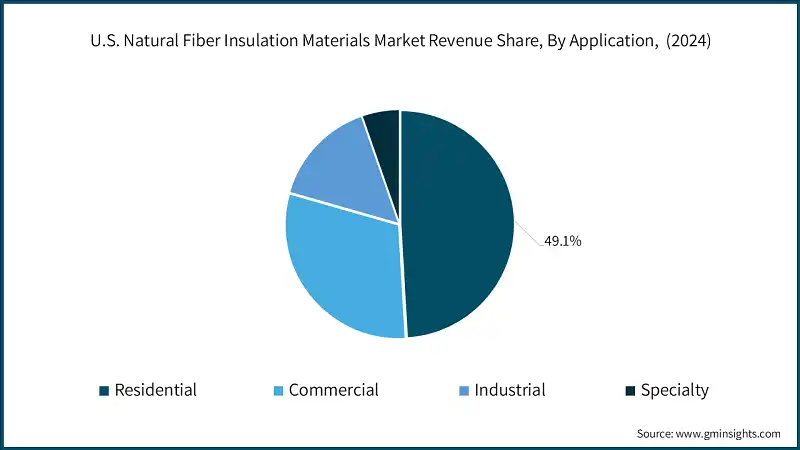
With respect to application, the market is segmented as residential, commercial, industrial and specialty. The residential applications dominated the 49.1% share of the U.S. natural fiber insulation materials market in 2024.
- In the U.S., the natural fiber insulation market is dominated by residential applications because homeowners focus on energy efficiency and savings. House insulation will keep heating and cooling costs low, which is highly significant for many families. Natural fiber insulations are preferred for residential work for their sustainability and lack of impact on indoor air quality. An increasing number of homeowners are opting for sustainable materials to make their homes healthier and environmentally friendly. Also, the recent building code and energy standards assistance and promote the usage of green insulation materials for newly constructed and renovated homes. These reasons are responsible for residential buildings being the largest market sector for natural fiber insulation.
- The other reason for the dominance of residential applications is the general growth of new and renovation activities occurring everywhere in the country. Perhaps with increased awareness of sustainability and energy conservation, homeowners are looking at natural fiber insulation. The natural fiber insulation trend is supported by a new range of inexpensive and easily installed insulation products. Builders and contractors, in response to consumer preferences and green building certifications, are increasingly recommending eco-friendly insulation options for residential projects. This ongoing growth within the residential sector has fortified the greatest market share of natural fiber insulation.
Looking for region specific data?
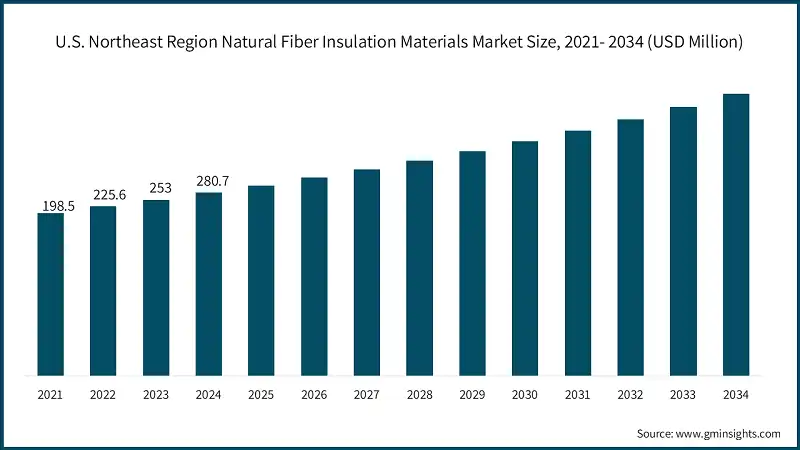
Regarding the region landscape, the U.S. northeast region natural fiber insulation materials market is anticipated to depict a CAGR of 7.1% from 2025 to 2034. The northeast region accounted for USD 280.7 million worth of revenue in 2024.
- Northeast has high demand for natural fiber insulation due to the cold climate which calls for effective thermal insulation in order to maintain indoor comfort. With increasing awareness on eco-friendly building materials, many states promote sustainable construction practices which further enhance usage. Old buildings undergoing renovation also require such insulation upgrades; hence there is an increase in demand. Stringent energy efficiency standards and green building certifications enhance preference to natural fibers further. For example, the reduction of energy costs and carbon footprint encourage adoption in the region. Furthermore, state encouragement as regards sustainable building material positively influences market growth. Safety, efficiency, and environmental aspects are the major demand drivers here.
The natural fiber insulation materials market in southeast region of U.S. is expected to experience significant and promising growth from 2025 to 2034.
- The warm climate permits use of insulation in the Southeast mainly to achieve energy efficiency during hot summer months. Rapid urbanization and activity of construction projects in the region have made people demand more sustainable building material. Insulation that uses fiber from nature has a rising market acceptance due to greater awareness of its health benefits. Government measures at a state level intended to boost green building practices are also making it popular. The development and renewal of the ideals of reduced energy consumption and promoting eco-friendly options in the region further drive demand. The working presence of many older buildings under retrofitting gives impetus for insulation upgrades. Overall, these diverse factors have made natural fiber insulation.
The natural fiber insulation materials market in Midwest region is expected to experience significant growth from 2025 to 2034.
- The Midwest requires adequate natural fiber insulation since its climate varies and therefore insulation must be done for hot summer and cold winter conditions. Renovation is taking place in older structures with green insulation materials. Recognition of green materials in building projects at state and local government level would augment the market at hand. With construction and manufacturing industries thriving, so is demand for cheap eco-friendly insulating materials. Farmers and people working in agriculture also want insulation using natural fibers, which adds value to the market. Overall, climate variability and sustainability initiatives are key demand drivers here.
The natural fiber insulation materials market in Southwest is expected to experience significant growth from 2025 to 2034.
- The desert, dry, warm climate of the Southwest region necessitates the household installation of insulation that would cool down the house and reduce costs for air-conditioning. Rapid population growth makes it necessary to increase demand for sustainable insulation options. Many builders prefer to use natural fiber materials for the green building standards and lower environmental impact. Water scarcity and drought cause an inclination towards eco-friendly construction in the region. Energy conservation and sustainability initiatives are within the region and well supportive of the spread of natural fiber insulation.
The natural fiber insulation materials market in West Region is expected to experience significant and promising growth from 2025 to 2034.
- Policies and incentives in the region are progressive in encouraging eco-friendly and energy-efficient building materials. Demand also increases with greater urbanization and building of new communities, especially the environmentally conscious ones. Though most areas have milder climates requiring less insulation, the high energy costs still use it beneficial. Popularity of sustainable living and the consumer behavior of being environmentally-conscious encourages market growth. Furthermore, a high number of renovation projects focus on upgrading to greener insulation options. Effectively, both environment awareness and progressive policies constitute the key demand drivers in the West.
U.S. Natural Fiber Insulation Materials Market Share
Top 5 companies in the U.S. natural fiber insulation materials industry are BASF SE, Owens Corning Corporation, Saint-Gobain, Knauf Insulation, and Havelock Wool. Together these companies hold around 45% share in the market. These recognized firms have substantial distribution networks by virtue of which they command high market share. Innovation and product development aimed at offering environmentally sustainable, high-performance insulation in compliance with stringent energy and safety criteria are therefore considered by these players as essential tools of business. The players involved use strategic partnerships and acquisitions to broaden their product portfolio and geographic presence. Marketing and sustainability are other major areas where investments are made to gain competitive advantage in attracting a more environmentally concerned customer base.
Smaller companies and new entrants attempting to carve out their own market share tend to be focused on providing specialized or niche products that tend to be organic and sustainable. These entities compete on claims of natural and health benefits to appeal to a green consumer base and builders alike. Such entities often find opportunities in the renovation of old buildings or in areas with strict environmental regulations. As the demand for green building materials grows, the competition among companies is most likely to increase.
U.S. Natural Fiber Insulation Materials Market Companies
Major players operating in the U.S. natural fiber insulation materials industry are:
- BASF
- Owens Corning
- Saint-Gobain
- Knauf Insulation
- Havelock Wool
BASF: BASF SE is one of the leading global chemical companies based in Germany with a strong portfolio of innovative materials and chemicals. The company promotes sustainable building solutions, like green insulation products, to meet the increasing demand for energy-efficient and environment-safe products. Heavy investments are made by BASF in research and development to manufacture state-of-the-art insulation solutions that comply with tough regulations. Its excellent global base and pervasive distribution network enable it to serve customers in various parts of the world.
Owens Corning Corporation: Owens Corning is a renowned manufacturer of insulation, roofing, and composite fiberglass materials. It has a long tradition of making outstanding energy-efficient insulation products. Owens Corning is committed to sustainability and offers another environmentally friendly product line with natural fiber insulation among them. It remains on the cutting edge of the expanding natural fiber insulation market because of its strong focus on innovation and meeting customer requirements.
Saint-Gobain: Saint-Gobain S.A. is a French multinational corporation that plans for the production of building materials in addition to insulation products. The company promotes sustainable construction and environmentally friendly solutions through the active development of insulation product materials based on natural fiber. In its efforts toward research, extensive advances have been made by Saint-Gobain in the creation of advanced insulation products consistent with the energy efficiency standards of the world.
Knauf Insulation: Knauf Insulation is a German company that produces several insulation materials for residential, commercial, and industrial applications. They are committed to sustainable production practices, offering eco-friendly products while including natural fiber insulation. The company invests money into research to create high-performance, environmentally safe products that conform to global energy standards. A favorable distribution network and a firm standing on customer satisfaction support the company’s competitive place.
Havelock Wool: Havelock Wool is a U.S. based company specializing in the production of natural, sustainable wool insulation products. Havelock Wool is eco-friendly and health conscientious, making insulation products from 100% natural sheep's wool materials that are sound and thermal performing. The company is committed to environmentally sustainable production practices and healthier indoor ecosystems. Therefore, the products of Havelock Wool appeal to environmentally conscious consumers and builders looking for natural insulation.
U.S. Natural Fiber Insulation Materials Market Report Attributes
| Key Takeaway | Details |
|---|---|
| Market Size & Growth | |
| Base Year | 2024 |
| Market Size in 2024 | USD 1.3 Billion |
| Forecast Period 2025 - 2034 CAGR | 6.6% |
| Market Size in 2034 | USD 2.6 Billion |
| Key Market Trends | |
| Drivers | Impact |
| Growing Sustainability Awareness and Green Building Trends | Growing sustainability awareness and green building trends are driving increased demand for natural fiber insulation as eco-friendly alternatives |
| Stringent Energy Efficiency Regulations and Building Codes | Stringent energy efficiency regulations and building codes are compelling builders to adopt high-performance insulation solutions |
| Health and Indoor Air Quality Concerns | Health and indoor air quality concerns are boosting consumer preference for natural, non-toxic materials |
| Pitfalls & Challenges | Impact |
| Higher Initial Costs Compared to Synthetic Alternatives | Higher initial costs compared to synthetic options pose a challenge to widespread adoption |
| Opportunities: | Impact |
| Government Incentives for Green Building Materials | Opportunities lie in government incentives for green building materials that can offset costs and accelerate market growth. |
| Market Leaders (2024) | |
| Market Leaders |
10.1% market share |
| Top Players |
Collective market share in 2024 is 45% |
| Competitive Edge |
|
| Regional Insights | |
| Largest Market | Southeast Region |
| Fastest growing market | Northeast Region |
| Emerging states | Maine, New Hampshire, Vermont |
| Future outlook |
|
What are the growth opportunities in this market?
U.S. Natural Fiber Insulation Materials Market News
- In February 2024, Saint-Gobain announces the strategic acquisition of International Cellulose Corporation (ICC), a leading manufacturer of sustainable spray insulation products and thermal as well as acoustic finishing systems in view of cementing Saint-Gobain leadership in light and sustainable construction.
- In January 2023, Owens Corning launched its expanded line of insulation products, The expanded line of Owens Corning in insulation manufacturing also includes the spray foam products of the Natural Polymers, LLC, sourced by the company. The innovations were showcased at the International Builders' Show (IBS) from January 31 to February 2, 2023, held at the Las Vegas Convention Center. The new spray foam products, among which are Ultra-Pure Low VOC spray foam, with Odor Scavenger technology, will align well with the latest energy codes and indoor air quality standards. According to Owens Corning, these solutions further position the company as a leader in multifunctional green building insulation.
- In May 2023, UPM Biochemicals collaboration with URSA has developed an all-new type of sustainable insulation that promises the world construction industry a revolution. The insulation makes buildings much more environmentally friendly and have drastically reduced carbon footprints. This collaboration will foster the design of innovations that are not only environmentally friendly but also abide by very stringent energy and sustainability standards.
The U.S. natural fiber insulation materials market research report includes in-depth coverage of the industry, with estimates & forecast in terms of revenue (USD Billion) & volume (Units) from 2021 to 2034, for the following segments:
Market, By Fiber Type
- Cellulose fiber insulation
- Loose-fill cellulose
- Dense-pack cellulose
- Wet-spray cellulose
- Cotton fiber insulation
- Recycled denim/cotton bats
- Virgin cotton insulation
- Cotton loose-fill
- Sheep's wool insulation
- Wool batts and rolls
- Wool loose-fill
- Wool rigid boards
- Hemp fiber insulation
- Hemp batts
- Hempcrete blocks
- Hemp loose-fill
- Wood fiber insulation
- Wood fiber boards
- Wood wool cement boards
- Wood fiber batts
- Cork insulation
- Cork boards
- Cork granules
- Others
Market, By Application
- Residential applications
- New construction
- Single-family homes
- Multi-family housing
- Manufactured homes
- Retrofit and renovation
- Attic insulation
- Wall insulation
- Basement and crawl space insulation
- New construction
- Commercial applications
- Office buildings
- Retail establishments
- Educational facilities
- Healthcare facilities
- Hospitality sector
- Industrial applications
- Manufacturing facilities
- Warehouses and distribution centers
- Cold storage facilities
- Specialty applications
- Acoustic insulation
- Fire-resistant applications
- High-temperature applications
Market, By Installation Method
- Professional installation
- Contractor-installed systems
- Specialized installation services
- DIY installation
- Homeowner-friendly products
- Retail channel sales
- Hybrid installation models
The above information is provided for the following regions and countries:
- Northeast Region
- New England States
- Maine
- New Hampshire
- Vermont
- Massachusetts
- Rhode Island
- Connecticut
- Mid-Atlantic States
- New York
- New Jersey
- Pennsylvania
- New England States
- Southeast Region
- South Atlantic States
- Delaware
- Maryland
- Virginia
- West Virginia
- North Carolina
- South Carolina
- Georgia
- Florida
- East South-Central States
- Kentucky
- Tennessee
- Alabama
- Mississippi
- South Atlantic States
- Midwest Region
- East North Central States
- Ohio
- Indiana
- Illinois
- Michigan
- Wisconsin
- West North Central States
- Minnesota
- Iowa
- Missouri
- North Dakota
- South Dakota
- Nebraska
- Kansas
- East North Central States
- Southwest Region
- West South-Central States
- Arkansas
- Louisiana
- Oklahoma
- Texas
- West South-Central States
- West Region
- Mountain States
- Montana
- Idaho
- Wyoming
- Colorado
- New Mexico
- Arizona
- Utah
- Nevada
- Pacific States
- Washington
- Oregon
- California
- Alaska
- Hawaii
- Mountain States
Frequently Asked Question(FAQ) :
What is the market size of the U.S. natural fiber insulation materials in 2024?
The market size was USD 1.3 billion in 2024, with a CAGR of 6.6% expected through 2034 driven by growing sustainability awareness and green building trends.
What is the projected value of the U.S. natural fiber insulation materials market by 2034?
The U.S. natural fiber insulation materials market is expected to reach USD 2.6 billion by 2034, propelled by stringent energy efficiency regulations and health concerns about indoor air quality.
How much revenue did the cellulose fiber insulation segment generate in 2024?
Cellulose fiber insulation generated USD 415.5 million in 2024, dominating the market due to its cost-effectiveness and abundance.
What was the market share of residential applications segment in 2024?
Residential applications held 49.1% market share in 2024, fueled by homeowners' focus on energy efficiency and sustainability preferences.
What is the growth outlook for the Northeast natural fiber insulation materials market from 2025 to 2034?
The Northeast region is projected to grow at a 7.1% CAGR through 2034, due to cold climate demands and stringent energy standards.
Which region leads the U.S. natural fiber insulation materials market?
U.S. northeast natural fiber insulation materials market is anticipated to depict a CAGR of 7.1% from 2025 to 2034.
What are the key market trends in natural fiber insulation materials?
Key trends include growing demand for eco-friendly materials, technological advancements enhancing performance, and rising consumer awareness about health and indoor air quality benefits.
Who are the key players in the U.S. natural fiber insulation materials market?
Key players include BASF, Owens Corning, Saint-Gobain, Knauf Insulation, Havelock Wool, Bonded Logic, TimberHP, Depicture, Greenfiber, CertainTeed.
U.S. Natural Fiber Insulation Materials Market Scope
Related Reports