Summary
Table of Content

U.S. Insulin Pen Market
Get a free sample of this report
Form submitted successfully!
Error submitting form. Please try again.
Thank you!
Your inquiry has been received. Our team will reach out to you with the required details via email. To ensure that you don't miss their response, kindly remember to check your spam folder as well!
Request Sectional Data
Thank you!
Your inquiry has been received. Our team will reach out to you with the required details via email. To ensure that you don't miss their response, kindly remember to check your spam folder as well!
Form submitted successfully!
Error submitting form. Please try again.
U.S. Insulin Pen Market Size
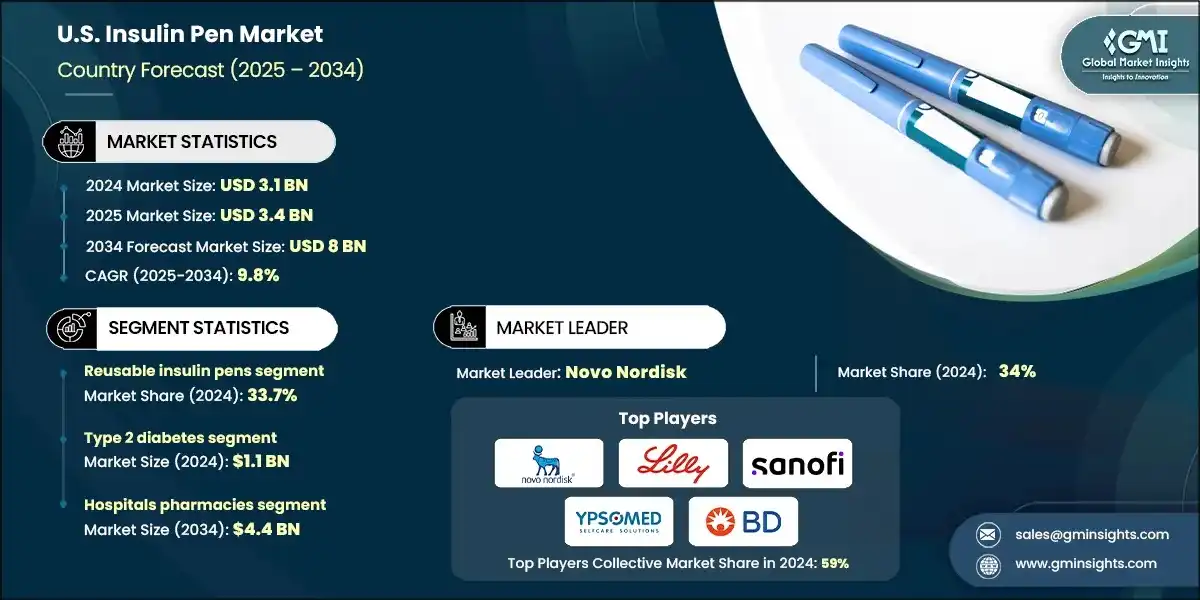
The U.S. insulin pen market size was valued at USD 3.1 billion in 2024 and is projected to grow from USD 3.4 billion in 2025 to USD 8 billion by 2034, expanding at a CAGR of 9.8% according to the latest report published by Global Market Insights Inc. This steady growth is stimulated by various factors such as growing prevalence of diabetes across the U.S., rising favorable reimbursement policies, and increasing technological advancements in insulin pen. Major companies in the industry include, Novo Nordisk, Eli Lilly and company, Sanofi, Becton, Dickinson and Company, and Ypsomed.
To get key market trends
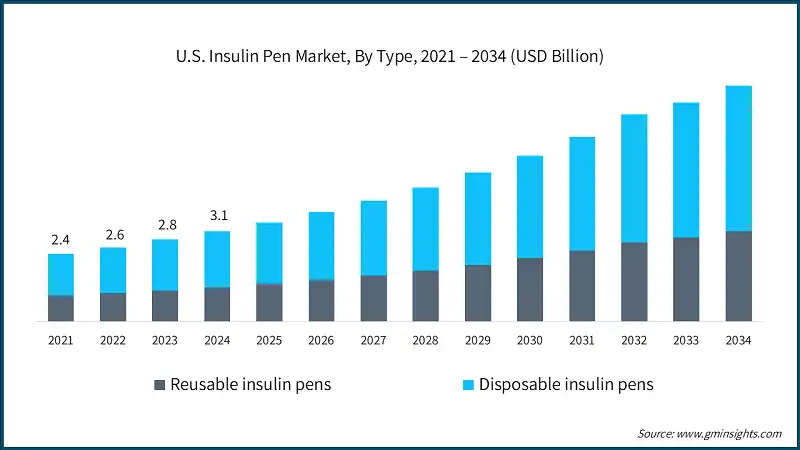
The U.S. market grew from USD 2.4 billion in 2021 to USD 2.8 billion in 2023, largely due to favorable reimbursement policies. These policies play a crucial role in growth by improving financial burdens for both patients and healthcare providers. By covering a substantial portion of costs through insurance and government initiatives, they broaden access to advanced insulin delivery solutions. Furthermore, this reimbursement support promotes the use of premium and smart insulin pens, driving innovation and enhancing treatment adherence. Thus, strong reimbursement frameworks are vital for accelerating market penetration and ensuring sustained growth in the insulin pen market.
Further, the increasing prevalence of diabetes in U.S. is further driving the market growth. For instance, according to the Centers for Disease Control and Prevention, in the U.S., 38.4 million people of all ages, representing 11.6% of the total population, were living with diabetes. Among them, 38.1 million adults aged 18 and older accounted for 14% of all U.S. adults. Thus, these rising healthcare burden is driving demand for timely and accurate treatment solutions, which in turn is accelerating the growth of the U.S. market across the country.
An insulin pen is a device that delivers insulin to diabetics with precision and ease. It features an insulin cartridge, a dose adjustment dial, and a disposable injection needle.
U.S. Insulin Pen Market Report Attributes
| Key Takeaway | Details |
|---|---|
| Market Size & Growth | |
| Base Year | 2024 |
| Market Size in 2024 | USD 3.1 Billion |
| Market Size in 2025 | USD 3.4 Billion |
| Forecast Period 2025 – 2034 CAGR | 9.8% |
| Market Size in 2034 | USD 8 Billion |
| Key Market Trends | |
| Drivers | Impact |
| Growing prevalence of diabetes across U.S. | Drives higher demand for insulin pens as more patients require regular insulin administration. |
| Increasing favorable reimbursement policies | Facilitates wider access to insulin pens by reducing cost barriers for patients and healthcare providers. |
| Rising technological advancements in insulin pen | Enhances treatment accuracy and convenience through smart features like dose tracking and app integration, improving patient adherence. |
| Pitfalls & Challenges | Impact |
| High cost of devices | Limits adoption among low-income patients and slows market penetration. |
| Stringent regulatory framework | Delays product approvals and innovation, reducing market growth. |
| Opportunities: | Impact |
| Integration of AI and smart technologies | Enables predictive dosing and personalized treatment plans, positioning smart pens as premium solutions in diabetes care. |
| Market Leaders (2024) | |
| Market Leaders |
34% Market Share |
| Top Players |
Collective market share in 2024 is 59% |
| Competitive Edge |
|
What are the growth opportunities in this market?
U.S. Insulin Pen Market Trends
- The significant advancement in insulin pen technology is the introduction of smart insulin pens equipped with bluetooth connectivity, enabling seamless synchronization with mobile applications.
- Devices such as NovoPen 6 by Novo Nordisk and InPen by Medtronic allow real-time dose tracking, reminders, and data sharing with healthcare professionals. These features provide accurate dosing history, improve treatment adherence, and help clinicians make informed decisions for personalized diabetes management.
- Modern insulin pens also incorporate memory functions that store previous dose information. For example, NovoPen Echo offers memory recall for the last dose and time, which is essential for preventing missed or double doses. This advancement enhances patient safety and convenience, significantly reducing human error and improving overall glycemic control.
- In addition, insulin pens have evolved to deliver superior accuracy and precision in dosing. Advanced dial mechanisms and micro-dosing capabilities cater to pediatric patients and individuals requiring highly sensitive insulin adjustments, ensuring optimal treatment outcomes.
- Smart insulin pens are increasingly leveraging data analytics and artificial intelligence (AI). For instance, InPen’s app uses AI-driven algorithms to analyze usage patterns, predict insulin needs, and provide actionable insights for optimizing treatment plans. These innovations empower patients and clinicians to make proactive decisions, improving long-term health outcomes and further driving market growth.
U.S. Insulin Pen Market Analysis
Learn more about the key segments shaping this market
The U.S. market was valued at USD 2.4 billion in 2021. The market size reached USD 2.8 billion in 2023, from USD 2.6 billion in 2022.
Based on type, the U.S. market is segmented into reusable and disposable insulin pens. The reusable insulin pens segment accounted for 33.7% of the market in 2024 due to their durability, ability to use multiple cartridges, and long-term cost efficiency compared to disposable pens. The segment is expected to exceed USD 3.1 billion by 2034, growing with the fastest CAGR of 9.9% during the forecast period. On the other hand, disposable insulin pen segment is expected to grow at CAGR of 9.8%.
- Disposable insulin pens dominate the insulin delivery market due to their convenience and ease of use. Their prefilled, ready-to-use format, pre-measured doses, and simple operation make daily injections hassle-free. Patients seeking comfort and efficiency often prefer these pens.
- The user-friendly design of disposable pens significantly reduces the learning curve for both patients and caregivers. Their intuitive functionality makes them suitable for home use as well as clinical settings, contributing to widespread adoption worldwide.
- For instance, Sanofi’s Lantus SoloSTAR is a disposable, single-patient-use, prefilled insulin pen designed to deliver long-acting insulin for diabetes management. Preloaded with insulin, it eliminates the need for manual filling and ensures accurate, convenient self-administration.
- Therefore, disposable insulin pens continue to lead the market due to their simplicity, ease of use, and strong support from healthcare systems, making them a reliable choice for effective and accessible diabetes management.
Based on the indication, the insulin pen market is segmented into type 1 diabetes, type 2 diabetes and gestational diabetes. The type 2 diabetes segment accounted for a revenue of USD 1.1 billion in 2024.
- Type 2 diabetes is a chronic condition characterized by the body’s resistance to insulin or insufficient insulin production. While it traditionally develops in adults, its incidence among younger populations is rising rapidly.
- The growing prevalence of type 2 diabetes is driving demand for convenient and user-friendly insulin delivery solutions. Smart and disposable insulin pens are gaining traction due to their ease of use, accuracy, and ability to simplify daily management.
- For instance, according to the Centers for Disease Control and Prevention, more than 38 million Americans have diabetes, with 90-95% of cases being type 2 diabetes. Although it primarily affects adults over 45, cases among young are increasing at an alarming rate.
- Insulin pens offer precise dosing and simple handling, enabling patients to manage blood glucose effectively, reduce complications, and improve treatment adherence. Thus, the rising prevalence of type 2 diabetes continues to accelerate the adoption of insulin pens worldwide.
Learn more about the key segments shaping this market
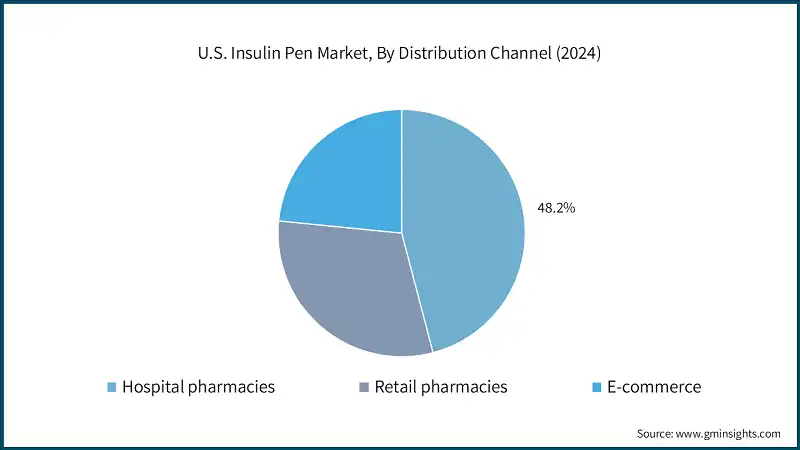
Based on distribution channels, insulin pen market is classified into hospital pharmacies, retail pharmacies and e-commerce. The hospitals pharmacies segment dominated the market in 2024 and is expected to reach USD 4.4 billion by 2034.
- Hospital pharmacies are deeply integrated with physicians and diabetes care teams, enabling personalized insulin therapy. They monitor patient progress, adjust prescriptions promptly, and ensure compatibility with other medications, an essential advantage for patients with complex health conditions.
- With robust infrastructure and expertise, hospitals are equipped to manage challenging cases, such as gestational diabetes and critically ill patients in intensive care units. Their ability to deliver complete care using insulin pens reinforces their strong influence in the market.
- Hospital pharmacies follow stringent storage and handling protocols for insulin pens, ensuring product integrity and reducing risks associated with improper storage. They also help enforce compliance with treatment plans through scheduled refills and follow-up consultations.
- Therefore, due to their comprehensive infrastructure, skilled medical personnel, and access to advanced technologies, hospitals dominate the U.S. market.
U.S. Insulin Pen Market Share
- Leading companies such as Novo Nordisk, Eli Lilly, Sanofi, Ypsomed, and Becton Dickinson & Company dominate the U.S. market through advanced product lines, strong distribution channels, and continuous innovation. Their offerings include disposable and smart insulin pens, which is estimated to reach USD 1.9 billion by 2032 often integrated with digital platforms for personalized diabetes care. Collectively, these top five companies account for 59% of the market share.
- Novo Nordisk stands out in the insulin pen market through its commitment to patient-centric innovation and engineering excellence. Their pens combine intuitive design with advanced features such as memory functions, half-unit dosing for precision, and smart connectivity for automatic dose tracking. With a broad portfolio, including durable pens such as NovoPen 6 and disposable options such as FlexTouch, Novo Nordisk ensures accurate, comfortable, and convenient insulin delivery.
- New entrants in the insulin pen space are gaining traction by focusing on innovation and flexibility. These companies are launching connected, user-friendly devices that appeal to tech-savvy users and often collaborate with digital health providers to build trust and accelerate adoption.
- To strengthen their market position, companies frequently engage in partnerships, licensing deals, and acquisitions. These strategies help expand product capabilities, integrate new technologies, and enhance competitiveness in the growing insulin pen market.
U.S. Insulin Pen Market Companies
Few of the prominent players operating in the U.S. insulin pen industry include:
- Becton, Dickinson and Company
- Biocon Biologics
- Eli Lilly and Company
- Gan & Lee Pharmaceuticals
- Haselmeier
- Julphar
- Medtronic
- Medmix
- Novo Nordisk
- Owen Mumford
- Sanofi
- Valeritas
- Ypsomed
- Becton, Dickinson and Company
BD specializes in pen needles and collaborates with insulin pen manufacturers to enhance delivery systems, contributing to the usability and safety of insulin pens.
Ypsomed develops innovative insulin pens such as YpsoPen, focusing on ergonomic design and smart connectivity, often partnering with pharma companies for broader reach.
Owen Mumford is known for developing innovative insulin delivery solutions such as the AutoPen. Their focus on ergonomic design and ease of use makes their pens suitable for a wide range of patients, supporting consistent and comfortable insulin administration.
U.S. Insulin Pen Industry News:
- In February 2023, Sanofi announced a strategic partnership with Glooko Inc., a global digital health company, to integrate SoloSmart a connected cap for SoloStar and DoubleStar insulin pens into the Glooko platform. This smart device records insulin dose, date, and time, enabling patients to track and share data seamlessly with healthcare providers through the Glooko app. The collaboration aims to advance connected diabetes care and improve overall insulin management.
The U.S. insulin pen market research report includes in-depth coverage of the industry with estimates and forecast in terms of revenue in USD Billion and from 2021 - 2034 for the following segments:
Market, By Type
- Reusable insulin pens
- Disposable insulin pens
Market, By Indication
- Type 1 diabetes
- Type 2 diabetes
- Gestational diabetes
Market, By Distribution Channel
- Hospital pharmacies
- Retail pharmacies
- E-commerce
Frequently Asked Question(FAQ) :
Who are the key players in the U.S. insulin pen market?
Key players include Novo Nordisk, Eli Lilly and Company, Sanofi, Ypsomed, Becton, Dickinson and Company, Owen Mumford, Medtronic, Biocon Biologics, Haselmeier, and Valeritas.
Which company leads the U.S. insulin pen market?
Novo Nordisk leads the market with a 34% share in 2024, supported by its comprehensive product portfolio, including NovoPen 6, FlexTouch, and Echo models featuring smart connectivity, memory recall, and precision dosing capabilities.
Which distribution channel segment accounted for the largest share in 2024?
The hospital pharmacies segment dominated the market in 2024 and is projected to reach USD 4.4 billion by 2034, owing to their robust infrastructure.
Which indication segment generated the highest revenue in 2024?
The type 2 diabetes segment led the market with USD 1.1 billion revenue in 2024, as the rising incidence of lifestyle-related diabetes.
Which type segment dominated the U.S. insulin pen industry in 2024?
The disposable insulin pen segment dominated the market, attributed to its ease of use, prefilled design, and minimal maintenance. However, the reusable insulin pen segment is expected to grow at the fastest CAGR of 9.9%, surpassing USD 3.1 billion by 2034.
What is the estimated market size of the U.S. market in 2025?
The market is projected to reach USD 3.4 billion in 2025, as smart and disposable insulin pens continue to gain traction for their convenience, precision, and app-based dose monitoring capabilities.
What is the projected value of the U.S. insulin pen market by 2034?
The market is expected to reach USD 8 billion by 2034, growing at a CAGR of 9.8%, supported by increasing adoption of smart insulin pens.
What is the market size of the U.S. insulin pen market in 2024?
The market size was USD 3.1 billion in 2024, driven by the rising prevalence of diabetes across the U.S., favorable reimbursement policies, and technological advancements in insulin delivery devices.
U.S. Insulin Pen Market Scope
Related Reports