Summary
Table of Content

U.S. Insulin Delivery Devices Market
Get a free sample of this report
Thank you!
Your inquiry has been received. Our team will reach out to you with the required details via email. To ensure that you don't miss their response, kindly remember to check your spam folder as well!
Form submitted successfully!
Error submitting form. Please try again.
Request Sectional Data
Thank you!
Your inquiry has been received. Our team will reach out to you with the required details via email. To ensure that you don't miss their response, kindly remember to check your spam folder as well!
Form submitted successfully!
Error submitting form. Please try again.
U.S. Insulin Delivery Devices Market Size
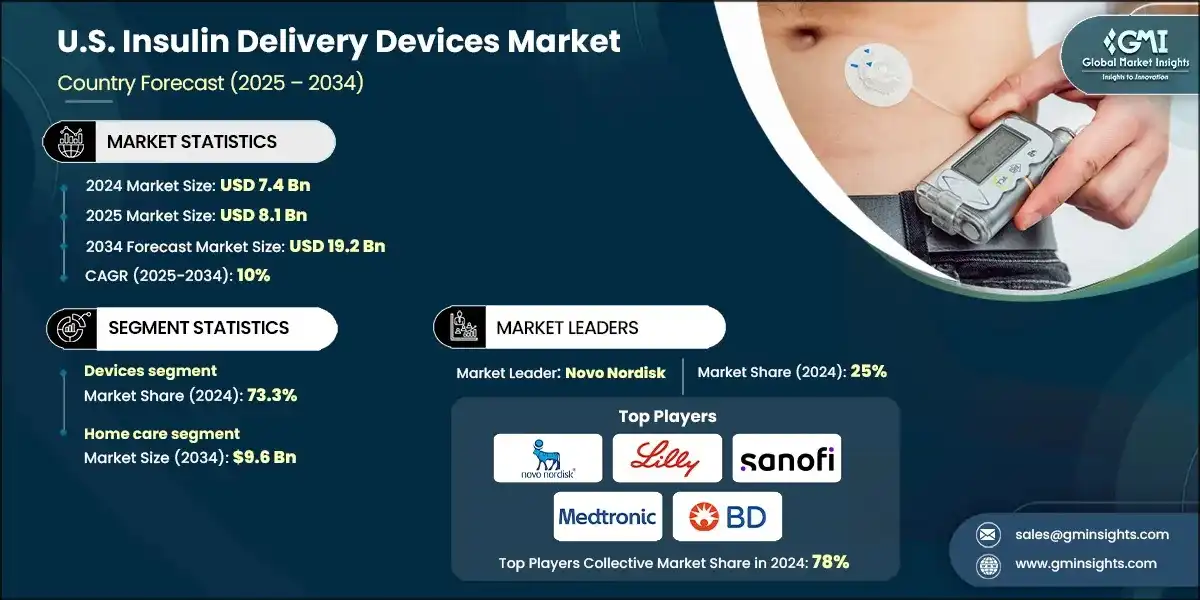
The U.S. insulin delivery devices market was valued at USD 7.4 billion in 2024 and is projected to grow from USD 8.1 billion in 2025 to USD 19.2 billion by 2034, expanding at a CAGR of 10%, according to the latest report published by Global Market Insights Inc.
To get key market trends
This steady growth is stimulated by various factors such as growing prevalence of diabetes across the country, increasing diabetes care expenditure, and technological advancements in insulin delivery devices. Insulin delivery devices are medical tools designed to administer insulin to individuals with diabetes in a safe, accurate, and convenient manner. Major companies in the industry include Novo Nordisk, Eli Lilly and Company, Sanofi, Medtronic, and Becton, Dickinson and Company (BD).
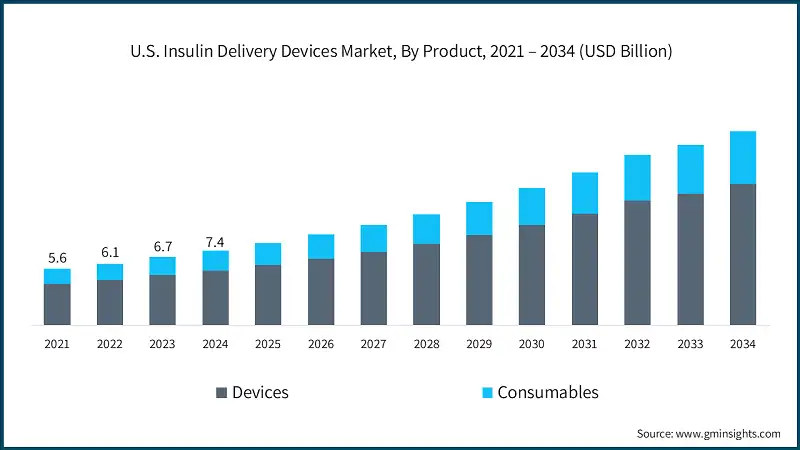
The market grew from USD 5.6 billion in 2021 to USD 6.7 billion in 2023, primarily due rising prevalence of diabetes across the U.S. which have significantly expanded the demand for effective monitoring and management solutions, as more individuals are diagnosed with diabetes the need for advanced care devices such as insulin delivery system, and digital health platform continue to grow driving innovation and investment in the country.
For instance, according to the data from the Centers for Disease Control and Prevention (CDC) in 2021, in the U.S. alone, 38.4 million people of all ages, equivalent to 11.6% of the U.S. population, had diabetes, among them 38.1 million were adults of 18 years or older, representing 14.7% of the U.S. adult population. This substantial patient base underscores the urgent need for scalable diabetes care technology. Therefore, the rising prevalence of diabetes is accelerating the adoption of technologically advanced diabetic management devices, such as insulin delivery devices, thereby accelerating market growth.
Moreover, the growing diabetes expenditure in the U.S. is significantly influencing the adoption of advanced insulin delivery technologies. For instance, according to data published by the National Library of Medicine, in 2022, the total estimated cost of diagnosed diabetes reached USD 412.9 billion, including USD 306.6 billion in direct medical costs and USD 106.3 billion in indirect costs. Diabetes care accounts for one in every four healthcare dollars spent in the U.S., with 61% of these costs directly linked to diabetes management.
On average, individuals with diabetes incur USD 19,736 in annual medical expenses, of which approximately USD 12,022 is attributable to diabetes alone. Therefore, the rising cost of diabetes care in the country is not only highlighting the urgency of effective disease management, but also accelerating the widespread adoption of advanced insulin delivery devices across the U.S. healthcare landscape.
Insulin delivery devices are specialized medical tools used to administer insulin safely, accurately, and conveniently for individuals with diabetes. These devices are essential for effective diabetes management, helping patients regulate their blood sugar levels when their bodies cannot produce enough insulin on their own.
U.S. Insulin Delivery Devices Market Report Attributes
| Key Takeaway | Details |
|---|---|
| Market Size & Growth | |
| Base Year | 2024 |
| Market Size in 2024 | USD 7.4 billion |
| Market Size in 2025 | USD 8.1 billion |
| Forecast Period 2025 - 2034 CAGR | 10% |
| Market Size in 2034 | USD 19.2 billion |
| Key Market Trends | |
| Drivers | Impact |
| Growing prevalence of diabetes across U.S. | Driving higher demand for insulin delivery solutions across all care settings. |
| Increasing diabetes care expenditure in the country | Supports market expansion through improved access and affordability. |
| Technological advancements in insulin delivery devices | Enhancing device efficiency, user experience, and adoption in both clinical and home care environments. |
| Pitfalls & Challenges | Impact |
| High cost of insulin pumps | Limits accessibility for many patients, especially in low-income groups. |
| Stringent regulatory requirement | Slow down product approvals and market entry, affecting innovation and availability. |
| Opportunities: | Impact |
| Integration of AI and smart ecosystems | Enhance personalization, predictive insights, and real-time decision-making in diabetes management. |
| Market Leaders (2024) | |
| Market Leaders |
25% |
| Top Players |
Collective market share in 2024 is 78% |
| Competitive Edge |
|
| Regional Insights | |
| Future outlook |
|
What are the growth opportunities in this market?
U.S. Insulin Delivery Devices Market Trends
- Recent years have witnessed significant technological advancements in insulin delivery devices, transforming the way diabetes is managed. Innovations such as smart insulin pens, tubeless insulin pumps, and integrated continuous glucose monitoring (CGM), which is estimated to reach USD 47.1 billion by 2034, systems have enhanced precision, convenience, and patient adherence.
- For instance, the GanleePen is a reusable insulin pen developed by Gan & Lee Pharmaceuticals, offering patients a convenient and precise way to administer insulin. It allows accurate dosing in 1-unit increments, with a range of 1 to 60 units, making it suitable for a wide variety of patient needs. The pen is engineered for ease of use, with a user-friendly interface that supports better adherence to insulin therapy. Its reusable nature also makes it a cost-effective and environmentally conscious option for long-term diabetes management.
- Additionally, integrating Bluetooth and mobile app connectivity with insulin pumps enables real-time data tracking, dosage reminders, and remote monitoring by healthcare providers, thereby improving overall treatment outcomes. These advancements are playing a crucial role in expanding the insulin delivery devices market. Thus, as patients and providers increasingly prioritize ease of use, accuracy, and personalization, modern insulin delivery devices are meeting these expectations more effectively than traditional methods.
- Moreover, the growing adoption of digital health platforms and AI-powered analytics is enabling predictive insights and automated insulin dosing, further boosting market growth.
- Additionally, user-friendly designs and wearable insulin delivery devices make them more accessible to pediatric, geriatric, and active populations, thereby stimulating market growth.
U.S. Insulin Delivery Devices Market Analysis
Learn more about the key segments shaping this market
Based on product, the U.S. insulin delivery devices market is divided into devices and consumables. The devices segment accounted for 73.3% of the market in 2024 primarily due to their widespread adoption among patients seeking convenient, accurate, and user-friendly alternatives to traditional insulin administration methods. The segment is expected to reach USD 14 billion by 2034, growing with a CAGR of 9.9% during the forecast period. On the other hand, consumables segment is expected to grow to a CAGR of 10.1%. The growth of this segment is primarily driven by the recurring demand for essential components such as testing strips, pen needles, syringes, and insulin pump consumables.
- Devices include insulin pumps, pens, and other insulin-delivery devices, each designed to deliver insulin safely and in a controlled manner. These tools are essential for diabetes management, offering patients more autonomy and precision in their treatment. These devices have significantly contributed to market growth by offering more convenient, accurate, and user-friendly solutions for insulin administration.
- Moreover, their ease of use, portability, and reduced discomfort make them especially popular among patients and healthcare providers.
- Additionally, technological advancements have further accelerated the growth of the insulin delivery devices segment. Innovations such as smart insulin pens and the integration of continuous glucose monitoring (CGM) systems with insulin pumps have transformed diabetes management. CGMs provide real-time glucose data, which, when integrated with insulin pumps, enable automated insulin delivery that closely mimics the natural function of the pancreas.
- For instance, Medtronic's MiniMed 780G is a leading hybrid closed-loop system that integrates an insulin pump, a CGM, and an advanced algorithm. It features SmartGuard technology and meal detection, which automatically adjusts insulin delivery based on real-time glucose trends. It can predict glucose levels hours in advance and adjust basal, and bolus doses every 5 minutes.
- Therefore, such technologically advanced insulin delivery devices are propelling adoption among healthcare providers and patients, accelerating the segment's growth.
Learn more about the key segments shaping this market
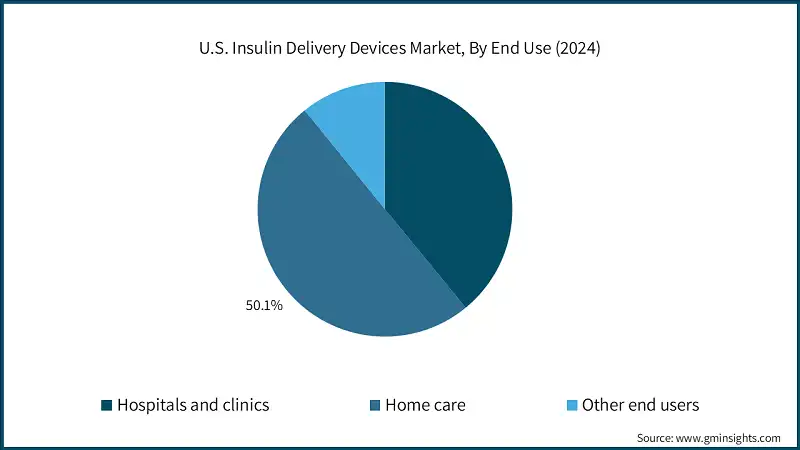
Based on end use, the U.S. insulin delivery devices market is segmented into hospitals and clinics, home care, and other end users. The home care segment dominated the market in 2024 and is expected to reach USD 9.6 billion by 2034.
- The home care segment has emerged as the primary end use segment due to increasing diabetes cases and patients' preference for self-management. This shift reflects patients' desire to manage their condition independently, reducing hospital visits while improving their quality of life.
- The market offers user-friendly devices, including insulin pens, patch pumps, and smart glucose monitors, specifically designed for home use. These devices incorporate simple interfaces, require minimal training, and provide portability, making them accessible to patients across age groups, particularly older individuals, and those with limited mobility.
- The Omnipod 5 by Insulet demonstrates this trend with its tubeless, wearable insulin patch pump design. The device automatically adjusts insulin delivery every five minutes using CGM data, while its SmartAdjust technology predicts glucose trends and modifies dosing. The system offers smartphone control without tubing, providing a practical solution for home use.
- Thus, such technological advancements continue to support the home care segment growth. Innovations such as connected insulin pumps, mobile app integration, and real-time data transmission to healthcare providers enable patients to manage their insulin doses accurately and safely.
- Thus, the home care segment maintains its dominant position in the market by addressing patient requirements for independence, accessibility, and individualized care.
U.S. Insulin Delivery Devices Market Share
- The U.S. market is defined by a mix of dominant companies and regionally focused innovators, creating a highly competitive landscape. Novo Nordisk leads the market with the largest share, followed by Eli Lilly and company, Sanofi, Medtronic, and Becton, Dickinson and Company (BD). These top 5 players hold around 78% of the market share in the U.S. market. These firms offer a wide range of solutions including insulin pens, insulin pumps, and automated insulin delivery systems, often integrated with digital platforms and AI-driven analytics to enhance personalized diabetes care.
- Emerging players are gaining traction by focusing on wearable, connected, and user-friendly insulin delivery devices that appeal to tech-savvy consumers. These companies often collaborate with digital health platforms, clinicians, and patient advocacy groups to build trust and accelerate adoption, especially in the growing homecare segment.
- To strengthen their market presence, companies frequently engage in strategic partnerships, licensing deals, and acquisitions. These efforts help them integrate complementary technologies, expand product offerings, and improve competitiveness in a rapidly evolving landscape.
U.S. Insulin Delivery Devices Market Companies
Few of the prominent players operating in the U.S. insulin delivery devices industry include:
- B. Braun Melsungen
- Becton, Dickinson and Company
- Eli Lilly & Company
- F. Hoffmann-La Roche
- Gan & Lee Pharmaceuticals
- Haselmeier
- Insulet
- Medtronic
- MicroPort
- Nipro
- Novo Nordisk
- Owen Mumford
- Sanofi
- Terumo
- Wockhardt
- Sanofi
Sanofi plays a key role in the insulin delivery devices market, particularly through its widely adopted insulin pens. The company emphasizes long-acting insulin formulations and device simplicity, making its products accessible and suitable for a diverse patient population.
Medtronic is a leading name in the insulin delivery systems market, recognized for its advanced medical technologies and expertise in diabetes care. Its focus on innovative insulin pump solutions and integrated care models has established it as a trusted provider. Through strategic partnerships and technology-driven initiatives, Medtronic continues to enhance access and improve outcomes for individuals managing diabetes.
Owen Mumford contributes to the U.S. market through its ergonomic and patient-friendly self-injection devices. The company is recognized for its focus on comfort, usability, and environmental responsibility. With growing adoption in clinical and home care settings, Owen Mumford supports broader access to self-injection devices and enhances the overall patient experience in the region.
U.S. Insulin Delivery Devices Industry News:
- In March 2023, Sanofi announced a significant insulin pricing reform, reducing the list price of Lantus by 78% and capping out-of-pocket costs at USD 35 for insured patients, aiming to improve affordability and access. This initiative reflects the company’s commitment to addressing long-standing concerns around insulin pricing and supporting broader healthcare equity.
The U.S. insulin delivery devices market research report includes in-depth coverage of the industry with estimates and forecast in terms of revenue in USD Million and from 2021 - 2034 for the following segments:
Market, By Product
- Devices
- Insulin pumps
- Tubed pumps
- Tubeless pumps
- Pens
- Reusable
- Disposable
- Other insulin delivery devices
- Insulin pumps
- Consumables
- Testing strips
- Pen needles
- Standard
- Safety
- Syringes
- Insulin pump consumables
Market, By End Use
- Hospitals and clinics
- Home care
- Other end use
Frequently Asked Question(FAQ) :
What is the market size of the U.S. insulin delivery devices in 2024?
The market size was USD 7.4 billion in 2024, with a CAGR of 10% expected through 2034, driven by technological advancements, rising diabetes prevalence, and increasing adoption of user-friendly insulin delivery devices.
What is the projected value of the U.S. insulin delivery devices market by 2034?
The market is expected to reach USD 19.2 billion by 2034, fueled by innovations in smart insulin pens, tubeless insulin pumps, and integrated continuous glucose monitoring (CGM) systems.
What is the projected size of the U.S. insulin delivery devices market in 2025?
The market is expected to grow to USD 8.1 billion in 2025.
How much revenue did the devices segment generate in 2024?
The devices segment accounting for 73.3% of the market share, driven by their widespread adoption for convenience and accuracy.
What was the valuation of the consumables segment in 2024?
The consumables segment is expected to grow at a CAGR of 10.1% during the forecast period, driven by recurring demand for essential components like pen needles and insulin pump consumables.
Which end-use segment leads the U.S. insulin delivery devices market?
The home care segment dominated the market in 2024 and is projected to reach USD 9.6 billion by 2034, driven by the increasing preference for at-home diabetes management solutions.
What are the upcoming trends in the U.S. insulin delivery devices industry?
Key trends include advancements in smart insulin pens, integration of continuous glucose monitoring (CGM) systems, and the development of environmentally sustainable reusable devices.
Who are the key players in the U.S. insulin delivery devices market?
Key players include B. Braun Melsungen, Becton, Dickinson and Company, Eli Lilly & Company, F. Hoffmann-La Roche, Gan & Lee Pharmaceuticals, Haselmeier, Insulet, Medtronic, MicroPort, Nipro, and Novo Nordisk.
U.S. Insulin Delivery Devices Market Scope
Related Reports