Summary
Table of Content

U.S. Home Standby Gensets Market
Get a free sample of this report
Form submitted successfully!
Error submitting form. Please try again.
Thank you!
Your inquiry has been received. Our team will reach out to you with the required details via email. To ensure that you don't miss their response, kindly remember to check your spam folder as well!
Request Sectional Data
Thank you!
Your inquiry has been received. Our team will reach out to you with the required details via email. To ensure that you don't miss their response, kindly remember to check your spam folder as well!
Form submitted successfully!
Error submitting form. Please try again.
U.S. Home Standby Gensets Market Size
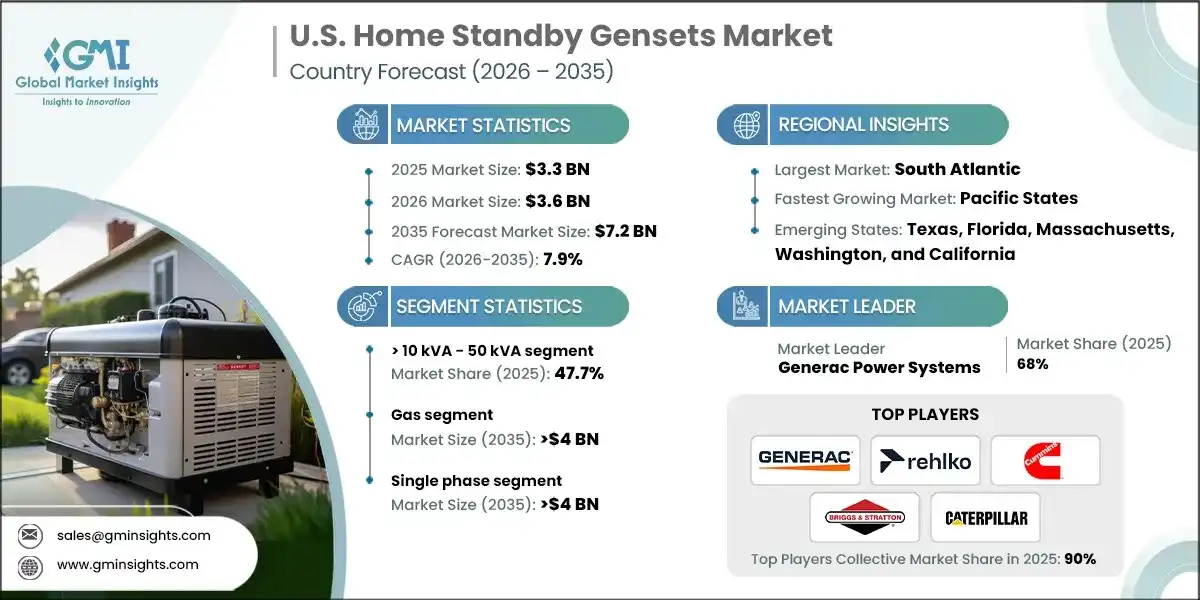
According to a recent study by Global Market Insights Inc., the U.S. home standby gensets market was estimated at USD 3.3 billion in 2025. The market is expected to grow from USD 3.6 billion in 2026 to USD 7.2 billion by 2035, at a CAGR of 7.9%.
U.S. Home Standby Gensets Market Key Takeaways
Market Size & Growth
- 2025 Market Size: USD 3.3 Billion
- 2026 Market Size: USD 3.6 Billion
- 2035 Forecast Market Size: USD 7.2 Billion
- CAGR (2026–2035): 7.9%
Key Market Drivers
- Surging intensity of weather-related disasters.
- Unreliable grid infrastructure & ongoing refurbishment of T&D networks.
- Extensive investments across the real estate sector.
Challenges
- High operation & maintenance cost.
- Increasing proportion of renewable based power generation.
Opportunity
- Integration of smart home technologies.
- Expansion of hybrid energy systems.
- Development of low-emission genset models.
- Emergence of subscription-based service models.
Key Players
- Market Leader: Generac Power Systems led with over 68% market share in 2025.
- Leading Players: Top 5 players in this market include Generac Power Systems, Rehlko, Cummins, Briggs & Stratton, Caterpillar, which collectively held a market share of 90% in 2025.
Get Market Insights & Growth Opportunities
- Growing investments toward the replacement of traditional power generating technologies coupled with advanced sustainable and clean solutions will stimulate the industry dynamics. Rising consumer inclination toward reliable backup power in tandem with smart monitoring capabilities will accelerate product adoption.
- Home standby gensets are fixed backup power systems designed to automatically deliver electricity to homes whenever the main grid fails. These generators are permanently connected to the household’s electrical network and typically run on fuels such as natural gas, propane, or diesel.
- For instance, in June 2024, ARPA-E announced an allocation of approximately USD 11.5 million under its new IGNIITE 2024 program, aimed at empowering early-career scientists and engineers to transform breakthrough concepts into impactful energy technologies.
- Increasing focus on eco-friendly generator set designs together with stringent emission compliance will reshape manufacturing priorities. Expanding integration of IoT-enabled control systems in association with predictive maintenance features will enhance operational reliability. Surge in demand for natural gas-powered gensets coupled with cleaner energy preferences will redefine fuel selection trends.
- Rising penetration of automated transfer switches in tandem with advanced control technologies will improve system efficiency. Increasing adoption of compact and modular genset designs coupled with simplified installation processes will boost consumer convenience. Development of gensets with faster start-up times in association with improved load acceptance will strengthen emergency response capabilities.
- Growing preference for turnkey installation services together with streamlined commissioning will enhance customer experience. Advancements in battery-assisted genset systems coupled with energy storage integration will enable seamless power continuity. Increasing focus on aesthetic appeal in tandem with space-saving designs will influence genset placement in modern homes.
- For reference, in February 2024, Generac announced plans to invest USD 300 to 400 million in next-generation residential energy technologies, including home standby and portable generators, to meet rising outage-driven demand.
- Surge in demand for high-performance engines together with extended service intervals will reduce maintenance costs. Rising popularity of subscription-based maintenance plans in association with digital service platforms will transform aftermarket dynamics.
- The home standby gensets market was valued at USD 2.6 billion in 2022 and grew at a CAGR of approximately 6% through 2025. Continuous advancements in noise attenuation technologies in line with urban residential requirements will influence product development. Growing emphasis on hybrid genset configurations together with renewable energy integration will create sustainable backup solutions.
- Growing adoption of advanced sound attenuation systems in line with urban noise regulations will drive enclosure innovation. Development of gensets compatible with bi-fuel operation in tandem with flexible fuel-switching capabilities will enhance versatility. Surge in demand for compact gensets together with limited space availability in urban homes will shape engineering priorities.
- Rising emphasis on cybersecurity for connected gensets in association with smart home ecosystems will become a critical design consideration. Growing trend toward eco-friendly lubricants together with extended oil life technologies will reduce environmental impact.
- Increasing collaboration between genset manufacturers and home automation providers in tandem with smart grid initiatives will expand functional synergies. Development of gensets with faster start-up times coupled with improved load acceptance will enhance emergency response capabilities.
To get key market trends
U.S. Home Standby Gensets Market Trends
- Growing intensity of hurricanes, winter storms, heat waves, and wildfire-driven Public Safety Power Shutoffs coupled with longer outage durations is elevating household resilience priorities. Increasing frequency of extreme weather events in tandem with localized grid instability is pushing homeowners toward permanent, automatic backup solutions.
- Rising insurance and property risk assessments together with resilience-focused building codes is reinforcing genset preference in high-risk counties. Expanding adoption of whole-home coverage in association with automatic transfer switches is ensuring uninterrupted operation of HVAC, refrigeration, medical devices, and connectivity.
- For illustration, in November 2024, Whitestone Development, in collaboration with Empower Community Development announced the launch of Berry Square, a new residential construction community. This project marks a significant milestone as it becomes the first community to feature whole-home generators in every property.
- Aging transmission and distribution assets coupled with deferred maintenance cycles is sustaining outage exposure across legacy neighborhoods. Ongoing refurbishment programs in tandem with load growth and electrification pressures is creating intermittent reliability gaps that heighten backup power needs.
- Grid congestion during peak demand together with voltage fluctuations is steering households toward standby solutions that stabilize critical loads. Increasing transformer and line replacement schedules in association with planned service interruptions is encouraging preemptive genset installations.
- For citation, in June 2024, EcoFlow announced the launch of its DELTA Pro 3, an advanced portable power station engineered to deliver robust home backup capabilities with enhanced convenience and reliability.
- Rising construction of single-family homes coupled with premium community developments is embedding backup power readiness into modern design standards. Growth in build-to-rent and master-planned communities in tandem with amenities-focused positioning is elevating genset pre-wiring and turnkey offerings.
- Increasing adoption of smart-home ecosystems together with integrated energy management platforms is streamlining standby generator control and visibility. Expansion of energy-resilient features in association with HOA guidelines and developer specifications is normalizing ATS and essential-circuit provisioning.
U.S. Home Standby Gensets Market Analysis
Learn more about the key segments shaping this market
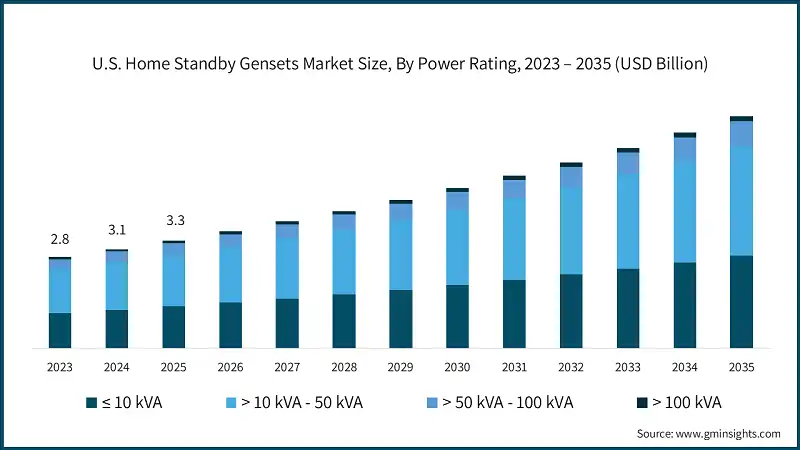
- Based on power rating, the industry is segmented into ≤ 10 kVA, > 10 kVA - 50 kVA, > 50 kVA - 100 kVA, and > 100 kVA. The > 10 kVA - 50 kVA rated home standby gensets holds a share of 47.7% in 2025. Integration of intelligent load management coupled with prioritized circuits is enabling HVAC, cooking, and EV-charger compatibility. Rising popularity of hybrid genset–battery solutions together with solar-ready frameworks is optimizing cost and sustainability.
- The ≤ 10 kVA rated home standby gensets market is set to exceed USD 2.5 billion by 2035. Continuous innovation in modular and simpler design coupled with compact footprints is aligning with small homes, condos, and essential-circuit coverage. Increasing preference for plug-and-play configurations in tandem with simplified wiring solutions is accelerating first-time installations.
- For instance, in August 2025, Rockwell Automation announced a strategic plan to invest over USD 2 billion over the next five years to strengthen its manufacturing facilities, workforce capabilities, and digital infrastructure.
- The > 50 kVA - 100 kVA rated segment will witness a CAGR of over 7.5% by 2035. Rising demand for multi-zone HVAC continuity in tandem with pool equipment, elevators, and advanced appliances is shaping sizing decisions. Advancements in sound attenuation in line with stringent neighborhood noise standards are enabling big-power installs without community pushback.
- The > 100 kVA rated segment was valued at USD 82 billion in 2025. Increasing preference for natural gas supply in association with long-duration resilience is supporting uninterrupted operation during prolonged outages. Rising integration with advanced energy management systems in tandem with large EV fleets, high-demand kitchens, and elevator banks is dictating robust sizing.
Learn more about the key segments shaping this market
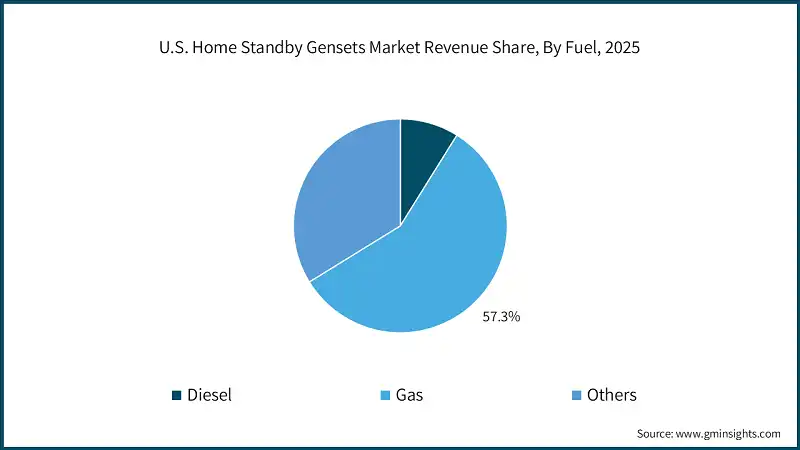
- Based on fuel, the industry is divided into diesel, gas, and others. The gas segment holds a share of 57.3% in 2025 and is set to exceed USD 4 billion by 2035. Increasing integration of smart control systems together with remote diagnostics is improving reliability and user convenience. Rising popularity of propane-ready units coupled with flexible siting options is supporting installations in rural and suburban markets.
- For reference, in June 2025, Green Bay Packaging announced a significant expansion of its manufacturing operations in Morrilton, Arkansas, with a capital investment exceeding USD 1 billion.
- The diesel fueled home standby gensets segment will witness a CAGR of over 4.5% by 2035. Continuous innovation in high-efficiency diesel engines coupled with optimized combustion systems is improving performance for extended outages. Growing emphasis on low-emission technologies in tandem with advanced after-treatment solutions is aligning with stringent environmental norms.
- Based on phase, the industry is divided into single phase and three phase. The single phase home standby gensets market holds a share of 60.5% in 2025 and is set to exceed USD 4 billion by 2035. Rising adoption of natural gas and propane units coupled with clean-burn engine architectures is aligning with environmental compliance.
- Expansion of financing and subscription-based maintenance models coupled with dealer partnerships is improving accessibility for budget-conscious households. Increasing penetration in retrofit applications together with resilience-focused housing trends is reinforcing single-phase genset relevance.
- For illustration, in May 2025, Kraft Heinz announced a strategic investment of USD 3 billion to modernize and upgrade its manufacturing operations across the U.S.
- The three phase home standby gensets segment will witness a CAGR of over 7% by 2035. Growing integration with smart home ecosystems in tandem with energy management platforms is redefining user experience. Continuous improvement in paralleling capabilities together with digital twin modeling is supporting complex electrical layouts in luxury properties.
- Development of corrosion-resistant enclosures coupled with weatherproofing solutions is enhancing durability in coastal and wildfire-prone regions. Rising emphasis on noise reduction in line with stringent municipal codes is influencing acoustic engineering for three-phase gensets.
Looking for region specific data?
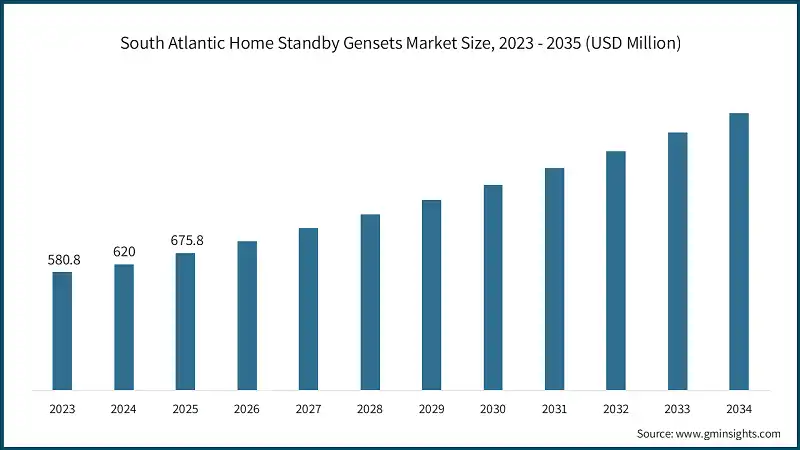
- The South Atlantic dominated the home standby gensets market in U.S. with around 20.3% share in 2025 and generated USD 675.8 million in revenue. Rising exposure to hurricanes and coastal storms coupled with resilience-focused housing trends is shaping genset adoption strategies. Increasing demand for corrosion-resistant enclosures in tandem with saline air conditions is influencing material innovation.
- The North East home standby gensets market is projected to hit USD 1 billion by 2035. Growing adoption of natural gas units in tandem with heating continuity requirements is reinforcing fuel selection trends. Advancements in cold-weather start systems together with insulated enclosures are improving operational reliability.
- For citation, in 2025, the U.S. Department of the Interior announced a USD 71 million investment, funded through the Inflation Reduction Act, to expand electricity access across 31 Tribal communities.
- The East North Central home standby gensets industry is set to grow at a rate of over 7% by 2035. Advancements in voltage regulation together with EV-charging compatibility are refining circuit prioritization strategies. Expansion of financing and subscription maintenance models coupled with resilient living trends is broadening accessibility.
- The West South Central home standby gensets market holds a share of 6% in 2025. Growing emphasis on natural gas supply in tandem with extended outage scenarios is sustaining whole-home continuity. Development of rugged enclosures coupled with wind and hail resilience is enhancing durability in storm-prone corridors.
- For instance, in December 2024, the U.S. Department of Agriculture announced a USD 4.73 billion commitment under the Empowering Rural America Program to advance clean energy initiatives.
- The Pacific States home standby gensets market was valued at USD 461 million in 2025. Expansion of remote monitoring and predictive maintenance in association with large geography and variable terrain is improving service coverage. Increasing use of digital twin and pre-commissioning simulations together with complex electrical layouts is elevating installation precision.
U.S. Home Standby Gensets Market Share
- The top 5 players in U.S. home standby gensets industry are Generac Power Systems, Rehlko, Cummins, Briggs and Stratton, and Kirloskar, contribute around 90% of the market share in 2025. The market is highly competitive, led by established players with strong brand recognition and extensive distribution networks.
- Generac Power Systems dominates the home standby gensets market across U.S. with a strong brand presence and extensive dealer network. The company’s portfolio spans a wide range of power ratings, offering natural gas, propane, and bi-fuel options tailored for residential applications. Generac leverages advanced technologies such as remote monitoring, smart load management, and mobile app integration to enhance user convenience and reliability.
- Rehlko positions itself as a niche player in the market, focusing on customized solutions for residential and light commercial applications. The company emphasizes engineering flexibility, offering modular designs and compact footprints suitable for space-constrained installations. Rehlko’s strength lies in delivering tailored systems with advanced acoustic enclosures and noise attenuation technologies, meeting stringent urban zoning requirements.
- Cummins emphasizes compliance with stringent emission standards through clean-burn engine architectures and catalytic after-treatment systems. Its strong dealer network and comprehensive service programs provide end-to-end support, from installation to lifecycle maintenance. Recent innovations include compact designs and hybrid-ready platforms, reflecting Cummins’ commitment to sustainability and energy resilience.
- Briggs & Stratton leverages its long-standing reputation in power equipment to compete effectively in the market. The company offers a diverse range of natural gas and propane-powered units designed for essential-circuit and whole-home applications. Briggs & Stratton focuses on affordability and ease of installation, making its products attractive to middle-income households.
- Kirloskar positions itself as a niche player in the U.S. home standby generator segment, leveraging its engineering expertise and reputation for durable power solutions. While the market is dominated by established U.S. and global brands, Kirloskar differentiates through cost-effective offerings and robust performance tailored for residential backup needs.
U.S. Home Standby Gensets Market Companies
- Cummins reported third-quarter 2025 revenues of USD 8.3 billion, reflecting a 2% decline compared to the same period in 2024. Net income attributable to Cummins stood at USD 536 million, translating to USD 3.86 per diluted share, versus USD 809 million or USD 5.86 per diluted share in the prior year. In line with its commitment to shareholder returns, the company increased its quarterly cash dividend on common stock from USD 1.82 to USD 2.00 per share.
- Caterpillar delivered strong third-quarter 2025 results, with sales and revenues rising 10% to USD 17.6 billion. Reported profit per share was USD 4.88, while adjusted profit per share reached USD 4.95. The company also returned USD 1.1 billion to shareholders through dividends and share repurchases during the quarter, reinforcing its commitment to capital deployment and shareholder value.
- Generac Power Systems reported third-quarter 2025 net sales of USD 1.11 billion, down 5% from USD 1.17 billion in the prior-year period. Core sales, excluding the impact of acquisitions and foreign currency, declined approximately 6%. Residential product sales decreased about 13%, totaling USD 627 million compared to USD 723 million in the same quarter last year.
Major players operating in the U.S. home standby gensets market are:
- Absolute Generators
- Atlas Copco
- Aurora Generators
- Blue Star Power Systems
- Briggs and Stratton
- Caterpillar
- Champion Power Equipment
- Cummins
- Eaton
- FG Wilson
- FIRMAN Power Equipment
- Generac Power Systems
- Gillette Generators
- HIMOINSA
- HIPOWER SYSTEMS
- Honda Motor
- Honeywell International
- Kirloskar
- KUBOTA Corporation
- Multiquip
- Rehlko
- Westinghouse Electric Corporation
- WINCO
- Xylem
U.S. Home Standby Gensets Market Report Attributes
| Key Takeaway | Details |
|---|---|
| Market Size & Growth | |
| Base Year | 2025 |
| Market Size in 2025 | USD 3.3 Billion |
| Market Size in 2026 | USD 3.6 Billion |
| Forecast Period 2026-2035 CAGR | 7.9% |
| Market Size in 2035 | USD 7.2 Billion |
| Key Market Trends | |
| Drivers | Impact |
| Surging intensity of weather-related disasters | Increasing frequency of hurricanes, storms, and extreme weather events is amplifying the need for reliable residential backup power solutions. |
| Unreliable grid infrastructure & ongoing refurbishment of T&D networks | Aging transmission and distribution systems coupled with frequent outages are accelerating genset installations across U.S. households. |
| Extensive investments across the real estate sector | Rising construction of residential properties together with premium housing developments is creating sustained demand for home standby gensets. |
| Pitfalls & Challenges | Impact |
| High operation & maintenance cost | Elevated expenses associated with fuel, servicing, and component replacement are impacting affordability for homeowners. |
| Increasing proportion of renewable based power generation | Growing adoption of solar and battery storage systems is reducing dependency on conventional standby gensets. |
| Opportunities: | Impact |
| Integration of smart home technologies | Growing adoption of connected devices coupled with IoT-enabled genset solutions will create advanced control and monitoring opportunities. |
| Expansion of hybrid energy systems | Rising interest in combining standby gensets in tandem with solar and battery storage will open pathways for sustainable backup solutions. |
| Development of low-emission genset models | Increasing focus on eco-friendly designs together with compliance with stringent environmental norms will drive innovation in product portfolios. |
| Emergence of subscription-based service models | Growing preference for hassle-free maintenance in association with digital platforms will transform aftermarket revenue streams. |
| Market Leaders (2025) | |
| Market Leaders |
68% market share |
| Top Players |
|
| Competitive Edge |
|
| Regional Insights | |
| Largest Market | South Atlantic |
| Fastest Growing Market | Pacific States |
| Emerging Country | |
| Future Outlook |
|
What are the growth opportunities in this market?
U.S. Home Standby Gensets Industry News
- In August 2025, Caterpillar launched the Cat D1500 DG set featuring a compact and efficient 32.1 L Cat C32B engine. The new model sets a benchmark in power density by delivering high output within a significantly smaller and lighter design. Compared to previous models with the same power rating, the Cat D1500 reduces floor space requirements by up to 13% and weight by as much as 32%, making it ideal for installations where space and structural load capacity are critical. This optimized design translates into lower shipping and installation costs, along with simplified setup and reduced support requirements.
- In April 2025, Generac Power Systems announced a 7% to 8% price adjustment on its home standby generators, citing increased costs driven by recent tariff measures. Company executives anticipate tariffs could add approximately $125 million in expenses during the second half of 2025. To mitigate this impact, Generac is implementing strategic pricing actions and exploring cost optimization initiatives. Despite these headwinds, the company remains committed to delivering dependable energy solutions while navigating a dynamic economic environment.
- In May 2024, DEUTZ completed the acquisition of Blue Star Power Systems, positioning the brand as a key contributor to decentralized power generation under the DEUTZ portfolio. With a proven track record in delivering reliable power solutions, Blue Star strengthens DEUTZ’s ability to offer integrated systems for distributed energy, reinforcing both companies’ commitment to innovation and energy resilience.
- In March 2024, HIMOINSA announced the acquisition of Powersil, a Portuguese company specializing in generator sets and the design, installation, and maintenance of automated electrical panel systems. This move aligns with HIMOINSA’s inorganic growth strategy, strengthening its presence in the power generation sector. Powersil also operates as a mechanical, electrical, and acoustic engineering contractor, delivering comprehensive solutions for critical facilities such as hospitals, data centers, and large commercial complexes.
The U.S. home standby gensets market research report includes in-depth coverage of the industry with estimates & forecast in terms of revenue (USD Million) and volume (Units) from 2022 to 2035, for the following segments:
Market, By Power Rating
- ≤ 10 kVA
- > 10 kVA - 50 kVA
- > 50 kVA - 100 kVA
- > 100 kVA
Market, By Fuel
- Diesel
- Gas
- Others
Market, By Phase
- Single Phase
- Three Phase
Market, By Product
- Air cooled
- Liquid cooled
The above information has been provided for the following regions & states:
- East North Central
- Illinois
- Indiana
- Michigan
- Ohio
- Wisconsin
- West South Central
- Arkansas
- Louisiana
- Oklahoma
- Texas
- South Atlantic
- Delaware
- Florida
- Georgia
- Maryland
- North Carolina
- South Carolina
- Virginia
- West Virginia
- Washington D.C.
- North East
- Connecticut
- Maine
- Massachusetts
- New Hampshire
- Rhode Island
- Vermont
- New Jersey
- New York
- Pennsylvania
- East South Central
- Alabama
- Kentucky
- Mississippi
- Tennessee
- West North Central
- Iowa
- Kansas
- Minnesota
- Missouri
- Nebraska
- North Dakota
- South Dakota
- Pacific States
- Alaska
- California
- Hawaii
- Oregon
- Washington
- Mountain States
- Arizona
- Colorado
- Utah
- Nevada
- New Mexico
- Idaho
- Montana
- Wyoming
Frequently Asked Question(FAQ) :
What is the market size of the U.S. home standby gensets in 2025?
The market size was USD 3.3 billion in 2025, with a CAGR of 7.9% expected through 2035 driven by rising investments in replacing conventional power systems with advanced, cleaner, and more sustainable solutions.
What is the projected value of the U.S. home standby gensets market by 2035?
The U.S. home standby gensets market is expected to reach USD 7.2 billion by 2035, propelled by weather-related disasters, unreliable grid infrastructure, and extensive real estate sector investments.
What is the current U.S. home standby gensets market size in 2026?
The market size is projected to reach USD 3.6 billion in 2026.
How much revenue did the > 10 kVA - 50 kVA power rating segment generate in 2025?
The > 10 kVA - 50 kVA segment held 47.7% market share in 2025, leading the market with integration of intelligent load management and HVAC compatibility.
What was the valuation of gas-fueled gensets segment in 2025?
Gas-fueled gensets held 57.3% market share in 2025 and are set to exceed USD 4 billion by 2035.
What is the growth outlook for diesel-fueled gensets from 2026 to 2035?
Diesel-fueled home standby gensets are projected to grow at a 4.5% CAGR till 2035, due to high-efficiency engines and low-emission technologies with advanced after-treatment solutions.
Which region leads the U.S. home standby gensets market?
South Atlantic held 20.3% share with USD 675.8 million in 2025. Rising exposure to hurricanes and coastal storms fuel the region's dominance.
What are the upcoming trends in the U.S. home standby gensets market?
Key trends include integration of IoT-enabled control systems, development of hybrid energy systems with solar and battery storage, and increasing adoption of low-emission genset models for environmental compliance.
Who are the key players in the U.S. home standby gensets market?
Key players include Generac Power Systems, Rehlko, Cummins, Briggs and Stratton, Kirloskar, Caterpillar, Champion Power Equipment, Eaton, Honda Motor, Honeywell International, KUBOTA Corporation, Westinghouse Electric Corporation, and others.
U.S. Home Standby Gensets Market Scope
Related Reports