Summary
Table of Content

US Electric Vehicle Market
Get a free sample of this report
Form submitted successfully!
Error submitting form. Please try again.
Thank you!
Your inquiry has been received. Our team will reach out to you with the required details via email. To ensure that you don't miss their response, kindly remember to check your spam folder as well!
Request Sectional Data
Thank you!
Your inquiry has been received. Our team will reach out to you with the required details via email. To ensure that you don't miss their response, kindly remember to check your spam folder as well!
Form submitted successfully!
Error submitting form. Please try again.
US Electric Vehicle Market
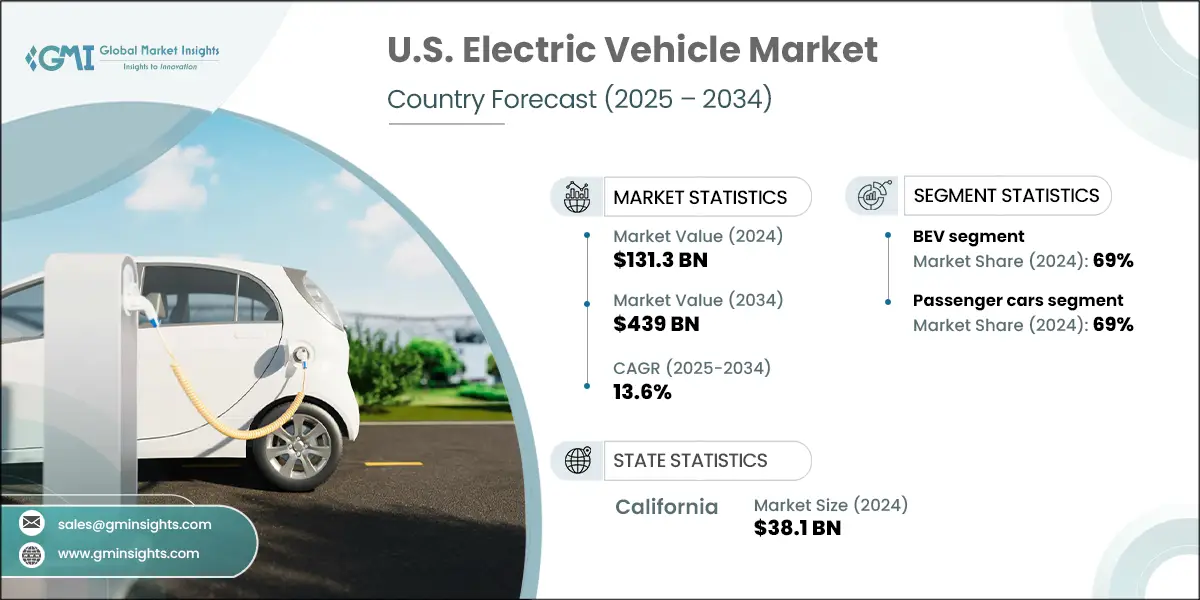
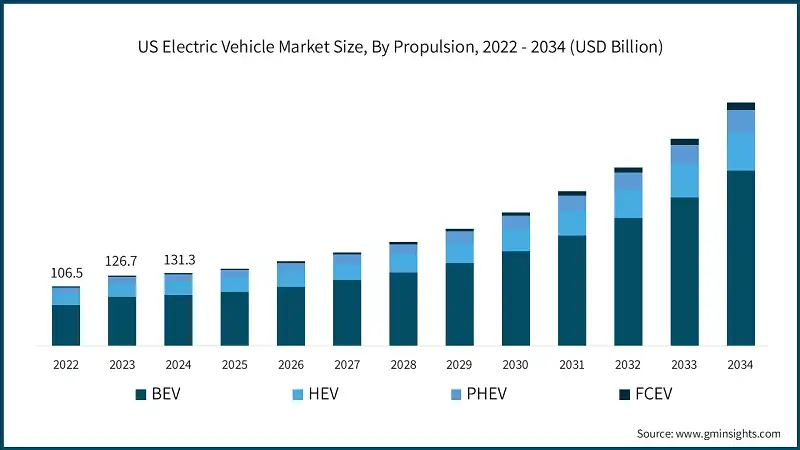
The US electric vehicle market size was estimated at USD 131.3 billion in 2024. The market is expected to grow from USD 139.6 billion in 2025 to USD 439 billion in 2034, at a CAGR of 13.6%.
To get key market trends
- The US electric vehicle (EV) market is booming due to key factors such as government incentives, the proliferation of charging infrastructure, and growth of consumer awareness regarding sustainability. Automotive companies are paying more attention to the innovation of EVs to have a long range of batteries, a higher charging speed, and even more advanced features of driver assistance to gain more users. Sound policy on the federal and state levels is offering a legal framework to assist EV use.
- Investments in battery manufacturing, software-defined vehicles, and fleet electrification are key drivers. Major OEMs are partnering with startups and tech companies to scale EV production and offer connected mobility solutions tailored to American consumers.
- Though the EV industry had to grapple with supply chain issues caused by the pandemic in 2020 and 2021, the industry rebounded firmly in 2022, with pent-up consumer demand and consistent policy efforts - including the Inflation Reduction Act. The evolution of pickup and SUV EVs, in line with the desires the US consumers have, is also driving faster adoption in the suburbs and rural areas.
- In May 2025, General Motors introduced the next generation Ultium EV platform with advanced connectivity, bi-directional charging capabilities, as well as ability to drive autonomously. The major developments in EV registrations and infrastructure development are in California, Texas, and New York with the support of local mandates and private investments.
- American firms, led by tech companies, are advancing EV battery technology, smart charging, and over-the-air software. Companies like Rivian, Tesla, and ChargePoint are driving electrification, while the convergence of utilities, tech, and automakers is fostering a national zero-emission transport ecosystem.
US Electric Vehicle Market Report Attributes
| Key Takeaway | Details |
|---|---|
| Market Size & Growth | |
| Base Year | 2024 |
| Market Size in 2024 | USD 131.3 Billion |
| Forecast Period 2025 - 2034 CAGR | 13.6% |
| Market Size in 2034 | USD 439 Billion |
| Key Market Trends | |
| Drivers | Impact |
| Federal and state-level incentives | Lowers purchase cost for consumers and fleets, accelerating EV adoption across segments. |
| Expansion of EV charging infrastructure | Improves convenience and range confidence, making EVs more practical for daily and long-distance use. |
| Advancements in battery technology | Enhances vehicle range, reduces charging time, and lowers overall EV costs, improving consumer appeal. |
| Rising fuel prices and environmental awareness | Encourages shift from internal combustion engine (ICE) vehicles to cleaner, cost-efficient electric alternatives. |
| OEM investments and diverse EV model launches | Expands consumer choice with EV options across categories (SUVs, trucks, sedans), appealing to US preferences. |
| Electrification of corporate and government fleets | Drives bulk demand and establishes infrastructure, setting an example for private sector and consumer adoption. |
| Pitfalls & Challenges | Impact |
| Limited charging infrastructure in rural areas | Slows EV adoption outside major urban centers due to range anxiety and lack of access. |
| High upfront vehicle cost | Despite incentives, EVs remain more expensive than ICE vehicles for many consumers, limiting mass-market penetration. |
| Opportunities: | Impact |
| Development of fast-charging networks | Reduces charging time, increases convenience, and supports wider adoption of EVs across regions. |
| Integration with renewable energy sources | Enables clean energy-powered EV charging, contributing to decarbonization goals and sustainable mobility. |
| Growth of EV-as-a-Service and subscription models | Offers flexible ownership options, attracting cost-sensitive consumers and commercial users. |
| Vehicle-to-Grid (V2G) technology adoption | Allows EVs to supply power back to the grid, supporting grid stability and creating new value streams for owners. |
| Market Leaders (2024) | |
| Market Leaders |
51% market share |
| Top Players |
Collective market share in 2024 is 61% |
| Competitive Edge |
|
| Regional Insights | |
| Largest Market | Western US |
| Fastest growing market | Southern US |
| Emerging regions | Texas, Florida, Washington, Colorado, Georgia, Nevada |
| Future outlook |
|
What are the growth opportunities in this market?
US Electric Vehicle Market Trends
- In 2023, the major automakers in the automobile industry of the United States, such as Tesla, Ford, and General Motors, augmented the embedded connectivity functionalities, including predictive maintenance, over-the-air (OTA) software updates done remotely, and real-time vehicle diagnostics. The technologies have become ubiquitous in most EV offerings to meet the increased customer desire to have better digital and maintenance experience.
- Federal rules and safety initiatives in the US through organizations like the National Highway Traffic Safety Administration (NHTSA), are increasingly focused on systems of advanced driver assistance systems (ADAS), like automatic emergency braking, and lane departure warning. V2X is not yet nationwide, but there are a handful of states currently testing V2X technology implementation to increase safety on the roads.
- In 2024, some states, such as California, Texas, New York, are already ramping up 5G and V2X infrastructure initiatives, generally with Federal grants through the Bipartisan Infrastructure Law. These projects are supposed to help establish vehicle to infrastructure (V2I) communication, with wider implementation likely to be seen by 2027 to better manage and make road traffic safer.
- US based automakers are proficiently establishing alliances with technology companies like Ford collaborating with Google Cloud and GM with Microsoft- to design software defined vehicles with the cloud-based infotainment system, AI-based vehicle personalization and security OTA update systems. In this manner, it can provide continuous enhancement and tailored digital services.
- After 2023, the demand in the usage of connected telematics solutions will increase at the scale of logistic and fleet companies since the EVs will provide much-needed EVs management. Systems such as those of Verizon Connect and Geotab emphasize energy efficiency, predictive maintenance, and cybersecurity in a way that helps with electrifying the fleet.
- As documented by the International Energy Agency (IEA), in 2024, electric vehicle (EV) sales in the United States exceeded around 1.6 million vehicles, claiming more than 10 percent of the total light-duty vehicle market. Notwithstanding the slowing growth trends compared to previous years, EVs have been sustaining the net growth of the automobile market, when the overall market remains stagnant in terms of selling other forms of vehicles, which are powered by internal combustion engines. This trend points to the fast-growing pace of the electrification trend.
US Electric Vehicle Market Analysis
Learn more about the key segments shaping this market
Based on propulsion, the US electric vehicle market is divided into BEV, HEV, PHEV, and FCEV. The BEV segment dominated the market, accounting for around 69% in 2024 and is expected to grow at a CAGR of around 14% through 2025 to 2034.
- The Battery Electric Vehicle (BEV) segment is the leader in the U.S. electric vehicle market due to its zero-emission potential, expanding charging infrastructure, and strong consumer demand for fully electric powertrains. Car manufacturers focus on BEV to comply with stricter emissions-reduction policies and increasing need for eco-friendly transportation.
- For instance, in March 2024, General Motors revealed that all its new electric vehicles, such as Chevrolet Silverado EV and Cadillac Lyriq, would use the Ultium battery platform. The given strategy places a focus on the fact that platforms that focus on BEVs are becoming central to the lineups of the major OEMs in the US.
- The most rapidly developing propulsion type is Plug-in Hybrid Electric Vehicle (PHEV), which is expected to keep CAGR of more than 12% in the period of 2025-2034. PHEV use a combination of electric motor and internal combustion engines providing their flexibility that attracts buyers shifting out of the traditional vehicles, and buyers worried about charging infrastructure.
- Upgrade of battery, software, and charging solutions infrastructures all contribute to the pre-existing and rapid growth of BEV and PHEV. The OEMs use the innovations to increase the driving range, perform over-the-air updates and provide better performance for vehicles in a highly competitive market.
- Hybrid Electric Vehicles (HEV) are less dominant but still have been established with lower costs and fuel efficiency with no need of external charging. The popular Ford Escape Hybrid vehicle has been claiming a large share of this market segment.
- In combination with FCEV that are beginning to emerge, BEV, PHEV and HEV contribute to the propulsion EV market in the US providing the consumers with choices according to their range, price and green interests. Nevertheless, BEV are evidently market leaders and spearhead the process of electric mobility in the country.
Learn more about the key segments shaping this market
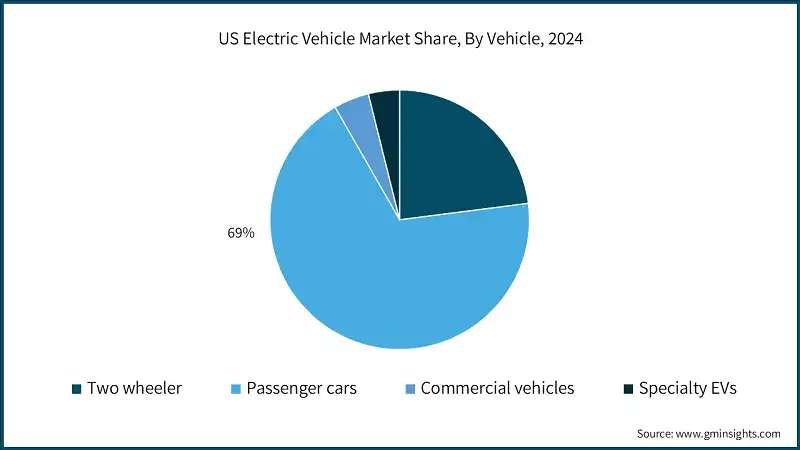
Based on vehicles, the US electric vehicle market is segmented into two-wheelers, passenger cars, commercial vehicles, and specialty EVs. The passenger cars segment dominates the market with 69% share in 2024, and the segment is expected to grow at a CAGR of over 13% from 2025 to 2034.
- The passenger cars segment leads the US electric vehicle market as there is an increase in consumer preference in vehicles with top-of-the-line infotainment, improved safety-related features, and streamline connectivity requirements. Vehicle manufacturers are moving fast towards incorporating digital technologies to satisfy the demand by technologically advanced drivers who want intelligent and efficient driving experience.
- The wave of EV sales at the household level in America is also facilitated by federal and state incentives, the expansion of the charging network, and the presence of the present popular electric cars such as Tesla Model Y, Ford Mustang Mach-E, and Hyundai IONIQ 5. Such vehicles match the performance with connected capabilities such as over-the-air updates, voice assistance, and real-time navigation.
- The electric two-wheeler market in the US is growing slowly but steadily, in urban commuting and leisure driving. Bicycles (e-bikes), scooters, and motorcycles are becoming popular because of their cheap operation and environmentally friendly nature. Connected car solutions via mobile are finding their way into these vehicles in the areas of navigation, theft monitoring, and ride analytics.
- Electric commercial vehicles are increasingly connected to enhance efficiency, reduce emissions, and provide real-time fleet visibility. Companies like Rivian, Ford (E-Transit), and BrightDrop (GM) offer electric vans and trucks with telematics for routing, diagnostics, and driver behavior analysis. In 2024, Amazon reported that its Rivian electric vans, operating in 1,800+ US cities, are linked to its logistics cloud, reflecting the growing adoption of electric fleets driven by last-mile delivery demand, ESG regulations, and high fuel costs.
- Specialty electric vehicles, such as electric ATVs, UTVs, and LSEVs, cater to industrial, agricultural, and recreational sectors. Features like GPS tracking and geofencing enhance performance and security. Brands like Polaris and Club Car offer connected dashboards and apps for fleet owners and off-road users. Despite smaller volumes, demand is growing as resorts, campuses, and municipal services adopt these vehicles for specialized needs.
Based on drivetrain, the market is segmented into front-wheel drive, rear-wheel drive, and all-wheel drive. The front-wheel drive segment is expected to dominate the market.
- Front-wheel drive is the most popular drivetrain layout in the electric vehicle (EV) market in the US, especially with low-cost and small electric vehicles. It is suitable for affordable electric cars and city transportation since the living cost is lower, and its simpler mechanics and efficiency make it affordable. Companies such as Chevrolet and Nissan remain the vanguards of FWD EV.
- In 2024, the Nissan Leaf, which has long enjoyed its popularity, is still based on the FWD platform, as such a design is cost-effective and shows constant performance in a city with its traffic conditions. FWD design also accommodates additional interior space, which enables the design to be applied in small cars that target cost-saving customers.
- Rear-drive, especially in the mid-range and high-performance EV, is becoming a more popular feature as the automakers want more performance and handling capabilities. RWD systems provide an improved proportion of weight and driving dynamics, which are significant in electric cars where batteries are instead placed on the floor.
- In April 2024, Tesla introduced a revised model of the Model 3, being offered in a more efficient RWD, striking performance and range competitive balance at relatively lower prices compared to the AWD models. On the same note, brands such as BMW and Hyundai are also offering RWD in some of their newer EVs since they need to attract drivers to want a sportier drive.
- The advantages of AWD saw the technologies grow in popularity in the luxury and utility car markets because of its enhanced traction among very bad weather, or over rough terrain. In the United States, AWD configurations are popular options by buyers in the north and mountainous areas on electric SUVs and crossovers.
- In February 2024, Ford introduced the Mustang Mach-E AWD to meet rising demand in snow-prone states. Rivian's R1S and R1T also target adventure-focused customers. The AWD segment is expected to grow significantly through 2026 due to increasing demand for versatile EVs.
Based on battery, the US electric vehicle market is segmented into Sealed lead acid, Nickel metal hydride (NiMH), and Lithium Ion. The sealed lead acid segment is expected to dominate the market.
- The low price and mature supply chain mean that sealed lead acid (SLA) batteries prevail in the US electric two-wheeler market. Such batteries are best used in low-cost scooters, and low speed bikes. As an example, some entry-level e-scooters deployed in last-mile delivery are nevertheless using SLA batteries to remain affordable and easy to replace.
- For instance, in March 2024, US based mobility company Razor released a refresh of its popular electric scooter the E300, sticking with a sealed lead acid battery because of its affordability and availability. The brand focused on the advantages of SLA of a younger and entry-level rider where greater acceleration and mileage is less important than cost and safety.
- NiMH batteries are less popular but applied at some hybrid and mid-range two wheelers electric vehicles where higher performance and safety is preferred. They are usable in urban commuter e-bikes, and as an alternative to SLA due to their much higher energy density; however, they are gradually being replaced by lithium-ion batteries.
- Lithium-ion are gaining popularity in high-performance e-bikes and electric motorcycles, where low weight and rapid charge and long cycle life are sought. For instance, in May 2024, LiveWire (Harley-Davidson) said it has upgraded its battery pack, now increasing the city range of its S2 Del Mar model, which runs on higher-level lithium-ion technology.
Looking for region specific data?
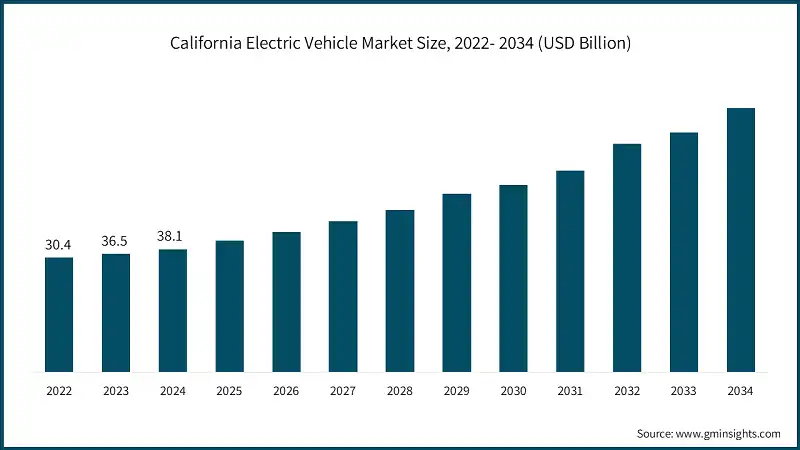
California in Western US dominated the electric vehicle market with around 71% market share and generated around USD 38.1 billion revenue in 2024.
- California has been leading the electric vehicle market for a long time owing to good regulatory momentum such as ambitious zero-emission vehicle (ZEV) mandates, hefty consumer subsidies, and robust charging infrastructural stations. In 2024, the EV market in California is estimated to be USD 38.1 billion, indicating that it is the single biggest market in the state.
- California's clean transportation policies and programs like CVRP and ACC drive EV adoption, while its tech hubs support advancements in connected and autonomous EV systems, ensuring market growth. Moreover, California has access to several technology firms and centers of innovation that contribute to the advancement of systems related to connected and autonomous EVs that will solidify their future market growth.
- While California leads the charge, states like Washington, Oregon, and Nevada are also witnessing a burgeoning EV market, albeit on a smaller scale. These states have rolled out numerous incentives and bolstered public charging infrastructure, making EVs more accessible in both urban and suburban locales. For instance, echoing California's bold climate ambitions, Washington State has legislated a ban on fossil fuel vehicle sales by 2030, underscoring the steady, albeit gradual, rise of EV adoption across the Western US.
- In April 2024, California's market prowess is epitomized by the unwavering supremacy of Tesla. Tesla disclosed that more than 50% of its US deliveries for the month were made to Californian customers. This underscores California's dual significance as a pivotal manufacturing hub and a key consumer market. Tesla's Gigafactory, situated in Fremont, remains instrumental in both local and national EV production, steering the nation towards electrification.
The electric vehicle market in New York (Northeast region) is expected to experience significant and promising growth from 2025 to 2034.
- The New York version of the electric vehicle market is set to gain substantially over the years 2025 to 2034 with a CAGR of 14% because of the intensive policies of the state and growth of charge points, along with high consumer demand. The presence of large targets by New York in relation to zero-emission vehicles, such as the intention to cease the sale of gas-powered cars by 2035, allows fostering a favorable environment concerning EV adoption.
- Public and private charging networks are expanding rapidly, ensuring access in urban and suburban areas. New York's focus on sustainable transport and connected technologies is driving demand for electric cars with advanced features. State-backed clean energy, like solar-plus-storage systems, supports green EV charging.
- Massachusetts, New Jersey, Connecticut, and other Northeast states are also promoting their electric vehicle ecosystems by having robust regulatory environments, rebates, and infrastructure improvements. These states are part of a dynamic regional marketplace, with automakers scouting the states to establish pilot programs to prep for fleets that will be electrified, as well as innovation in urban mobility.
- For instance, in February 2025, New York State announced a partnership with ChargePoint to install over 10,000 new EV charging stations statewide by 2030. This initiative aims to ease range anxiety and support the growing EV population, demonstrating New York’s leadership role in driving electric vehicle growth in the Northeast.
The electric vehicle market in Texas (Southern region) is expected to experience strong growth from 2025 to 2034.
- Texas, a key player in the Southern US, is poised for significant growth in its electric vehicle (EV) market between 2025 and 2034. Bolstered by supportive state policies, rising consumer interest, and an expanding charging infrastructure, Texas is leading the charge. Major urban centers like Houston, Dallas, and Austin, driven by heightened environmental awareness and a robust demand for electric trucks and SUVs, are witnessing rapid EV adoption.
- Texas is rapidly emerging as a pivotal hub for electric vehicle (EV) and battery manufacturing, drawing significant investments from leading companies. For instance, in January 2024, Tesla's Gigafactory in Texas ramped up its production capacity, driven by surging demand for its electric pickup, the Cybertruck.
- Other Southern US states like Florida, Georgia and North Carolina are also becoming significant markets to electric vehicles beyond Texas. The following states have an advantage of the rising urban population, rising investment in EV infrastructure, and state-level incentives that stimulate EV adoption. With its reliance on metropolitan regions and eco-friendly tourism needs, Florida has especially experienced a large rise in EV sales.
- With the Southern region growing its EV ecosystem, including consumer adoption, developing manufacturers and charging infrastructure, the region is positioned to help the US shift toward clean transportation. The demographic tendencies, industrial investments, and the development of the South infrastructure enjoy a good perspective in terms of continuing the growth of the EV market in the region.
The electric vehicle market in Illinois (Midwest region) is expected to experience high growth from 2025 to 2034.
- The Illinois electric vehicle market is showing strong progress, contributing an estimated USD 5.3 billion in revenue in 2024. Driven by the supportive policies on the state level, the investments in charging network, and an increasing number of EV-makers. Illinois has been strategically positioned and has a good logistic system that makes it a desirable state to have EV production and deployment.
- Illinois has a steady roadmap to achieve 1 million EVs on the road by 2030, and in the name of this long-term objective, large investments in public charging points are being rolled out across the state, particularly in the interstate routes. Cooperations with car producers and energy corporations are putting the background for smart, grid-connected mobility. Also, laws and policies like the Climate and Equitable Jobs Act (CEJA) are leading to the integration of clean energy and EV expansion is a major part of it.
- For instance, in May 2024, Rivian Automotive, based in Normal, Illinois, announced plans to expand its capacity to produce EV to keep up with increased regional and national demand. The company has focused on the significance of the manufacturing ecosystem and the labor force in Illinois to develop a sustainable system of transportation.
- In other Midwest states, such as Michigan, Indiana, and Ontario, EV activity is also on the rise outside of Illinois. Michigan traditional leaders in the automotive industry are moving into EVs with massive investments in battery production and software-defined autos. Indiana and Ohio are reinforcing public-private collaboration to increase the EV charging points and provide manufacturing rewards to lure clean mobility corporations.
- Collectively, the Midwest is turning into an EV innovation corridor on a national scale as it balances its history and legacy as an automotive leader and an electric vehicle-ready ecosystem. By 2034, the region should be a leading driver of EV expansion in the US, with a combination of manufacturing capabilities, the development of infrastructure, and demand.
US Electric Vehicle Market Share
- The top 7 companies in the US electric vehicle industry are Tesla, Ford, Mercedes-Benz, BMW, Hyundai, Audi and Chevrolet contributing around 63% of the market in 2024.
- As of 2024, Tesla would continue to lead the US EV industry. Popularity of such models as the Model 3 and Model Y and the large number of Superchargers contribute to its further success. Through its vertically integrated supply chain and software updates via the air, Tesla stands out in terms of technology and range performance and automated driving characteristics and represents the standard US electric mobility.
- Ford is gaining traction in the EV market with the F-150 Lightning and Mustang Mach-E, securing notable market share in 2024. Investments in BlueOval City and battery partnerships are strengthening its production and competitiveness against Tesla in SUVs and pickups.
- Mercedes-Benz has solidified its presence in the luxury EV market with its EQ lineup, including the EQS and EQE sedans. In 2024, it expanded US charging partnerships and introduced technologies like the MBUX Hyperscreen and over-the-air updates, appealing to affluent EV buyers.
- In 2024, BMW expanded its US electric vehicle presence with models like the i4 and iX, introducing new variants and boosting North American production capacity. Its focus on performance, driving dynamics, and digital experience drives success in the luxury EV market.
- Hyundai has strongly upped its game with IONIQ 5 and IONIQ 6, now fielding a competitive EV with plenty of range, quick charging speeds and a striking look. In 2024, Hyundai gained massive market shares because of its affordability, good warranty, and novelty in the application of vehicle-to-load (V2L) technology. Its production of EV in Georgia and price-aggressive approach has made it appealing to wide American buyers.
- Audi's e-tron lineup, including the Q4 and Q8 e-tron, is driving its growth in the US EV market in 2024, targeting tech-savvy, luxury-focused buyers with premium features like quattro all-wheel drive and advanced infotainment.
- Chevrolet has gone great with its Bolt EV and Bolt EUV, in providing low priced compact electric cars. In 2024, General Motors introduced the renewed status of Bolt and the integration of Ultium batteries as part of the optimization of production and costs. As new models such as the Silverado EV and Equinox EV are being launched, Chevrolet is targeting to expand its client reach in terms of both budget and utility in the EV industry.
US Electric Vehicle Market Companies
Major players operating in the US electric vehicle industry are:
- Audi
- BMW
- Chevrolet
- Ford
- Harley-Davidson
- Hyundai
- Mercedes-Benz
- Nissan
- Tesla
- Volkswagen
- Zero Motorcycles
- Audi, leveraging its MMI touch response and Audi connect solutions, taps into the US EV market, offering real-time traffic updates, vehicle maintenance alerts, and over-the-air (OTA) software enhancements. Meanwhile, BMW, through its ConnectedDrive and iDrive 9, emphasizes AI-centric infotainment, cloud-based personalization, and 5G integration, all while prioritizing cybersecurity in its electric vehicles like the i4 and iX.
- Chevrolet uses OnStar and myChevrolet app for remote diagnostics, tracking, and energy management in EVs. Ford employs FordPass Connect and SYNC 4 for remote control, EV charging, Alexa integration, and ensures US based data protection.
- Harley-Davidson's LiveWire models offer H-D Connect for real-time updates, GPS tracking, and mobile performance settings. Hyundai's Bluelink and Kia Connect focus on EV features like battery status, remote climate control, and charging navigation with strong cloud support.
- Mercedes-Benz, with its MBUX system, champions intuitive AI controls and immersive infotainment across its EQ models, all while ensuring stringent data governance. Meanwhile, Nissan, through NissanConnect, provides real-time charging insights and remote access in its EVs, such as the Ariya, emphasizing user-friendliness and cloud-centric services.
- Tesla focuses on connected mobility with its native OS, autopilot, OTA updates, and diagnostics, ensuring user data control and minimal third-party reliance. Volkswagen utilizes VW. OS and We Connect to enhance EV experiences with digital cockpits, app-based controls, and scalable AI-driven cloud frameworks.
US Electric Vehicle Industry News
- In July 2025, Ford unveiled plans for a breakthrough, affordable EV platform dubbed a “Model T moment” with official reveal scheduled for August 11, 2025. Designed to launch sub $30k models, the platform leverages lithium-iron phosphate batteries and domestic manufacturing upgrades.
- In June 2025, Rivian partnered with WeaveGrid to pilot grid-integrated smart charging solutions. This partnership supports bidirectional charging for grid services, enabling fleet and individual owners to monetize flexibility while stabilizing local electricity networks.
- In June 2025, Tesla launched its robotaxi service in Austin, Texas, using a fleet of invitation-only Model Y vehicles with human safety monitors onboard. The service represents a key step toward Tesla’s autonomous ride-hailing ambitions and is expected to expand to other cities if regulatory approval is granted.
- In May 2025, A coalition formed by BMW Group, Ford, Honda, and later Nissan created ChargeScape an EV charging platform linked with Leap, a Virtual Power Plant (VPP) provider. This venture enables smart charging and vehicle-to-grid (V2G) services across California’s wholesale energy market and beyond.
- In December 2024, GM partnered with ChargePoint to deploy up to 500 DC fast-charging ports across the US by the end of 2025, under the GM Energy branding. These high-speed stations, supporting both CCS and Tesla’s NACS connectors, aim to broaden EV charging access nationwide.
The US electric vehicle market research report includes in-depth coverage of the industry with estimates & forecasts in terms of revenue ($ Bn) and shipment (Units) from 2021 to 2034, for the following segments:
Market, By Propulsion
- BEV
- HEV
- PHEV
- FCEV
Market, By Vehicle
- Two-wheelers
- Electric scooters
- E-bikes
- Electric mopeds
- Passenger cars
- Sedan
- SUV
- Hatchback
- Commercial vehicles
- Light
- Medium
- Heavy
- Specialty EVs
- Off-road EVs (ATVs, UTVs)
- Golf carts
- Utility EVs
Market, By Drivetrain
- Front-wheel drive
- Rear-wheel drive
- All-wheel drive
Market, By Battery
- Sealed lead acid
- Nickel metal hydride (NiMH)
- Lithium Ion
Market, By Range
- Less than 100 km
- 100 km to 200 km
- 200 km to 300 km
- Above 300 km
Market, By Price Range
- Below USD 10,000
- USD 10,000 to USD 30,000
- USD 30,000 to USD 50,000
- Above USD 50,000
Market, By End Use
- Personal
- Commercial
- Ride-sharing & ride-hailing
- Logistics & delivery
- Corporate fleets
- Government
- Public transportation
- Utility fleets
- Law enforcement
- Private
- Universities
- Industrial campuses
The above information is provided for the following countries:
- Northeast
- Maine
- Massachusetts
- New Jersey
- New York
- Pennsylvania
- Midwest
- Illinois
- Indiana
- Michigan
- Ohio
- Wisconsin
- Iowa
- Kansas
- Minnesota
- Missouri
- Nebraska
- North Dakota
- South Dakota
- South
- Florida
- Georgia
- North Carolina
- South Carolina
- Virginia
- West Virginia
- Alabama
- Kentucky
- Mississippi
- Tennessee
- Arkansas
- Louisiana
- Oklahoma
- Texas
- West
- Arizona
- Colorado
- Idaho
- Montana
- Nevada
- New Mexico
- Utah
- Wyoming
- Alaska
- California
- Oregon
- Washington
Frequently Asked Question(FAQ) :
What is the growth outlook for the passenger cars segment from 2025 to 2034?
The passenger cars segment, which held a 69% market share in 2024, is set to expand at a CAGR of over 13% through 2034.
How much revenue did the Plug-in Hybrid Electric Vehicles segment generate in 2024?
Plug-in Hybrid Electric Vehicles (PHEVs) segment is likely to observe around 12% CAGR up to 2034.
How much revenue did California generate in the US electric vehicle sector?
California generated approximately USD 38.1 billion in revenue in 2024, dominating the market with a 71% share.
What are the upcoming trends in the US electric vehicle market?
Key trends include ADAS integration, V2X technology, 5G infrastructure, connected telematics, and partnerships for software-defined vehicles.
What is the market size of the US electric vehicle in 2024?
The market size was estimated at USD 131.3 billion in 2024, with a CAGR of 13.6% expected through 2034. Key drivers include government incentives, expanding charging infrastructure, and growing consumer awareness of sustainability.
What is the projected value of the US electric vehicle market by 2034?
The market is poised to reach USD 439 billion by 2034, driven by advancements in EV technology, supportive policies, and increasing adoption of electric vehicles.
What was the market share of the BEV segment in 2024?
The Battery Electric Vehicle (BEV) segment accounted for 69% of the market in 2024 and is expected to witness over 14% CAGR till 2034.
Who are the key players in the US electric vehicle industry?
Key players include Audi, BMW, Chevrolet, Ford, Harley-Davidson, Hyundai, Mercedes-Benz, Nissan, Tesla, Volkswagen, and Zero Motorcycles.
US Electric Vehicle Market Scope
Related Reports