Summary
Table of Content

U.S. Biomedical Refrigerators and Freezers Market
Get a free sample of this report
Form submitted successfully!
Error submitting form. Please try again.
Thank you!
Your inquiry has been received. Our team will reach out to you with the required details via email. To ensure that you don't miss their response, kindly remember to check your spam folder as well!
Request Sectional Data
Thank you!
Your inquiry has been received. Our team will reach out to you with the required details via email. To ensure that you don't miss their response, kindly remember to check your spam folder as well!
Form submitted successfully!
Error submitting form. Please try again.
U.S. Biomedical Refrigerators and Freezers Market Size
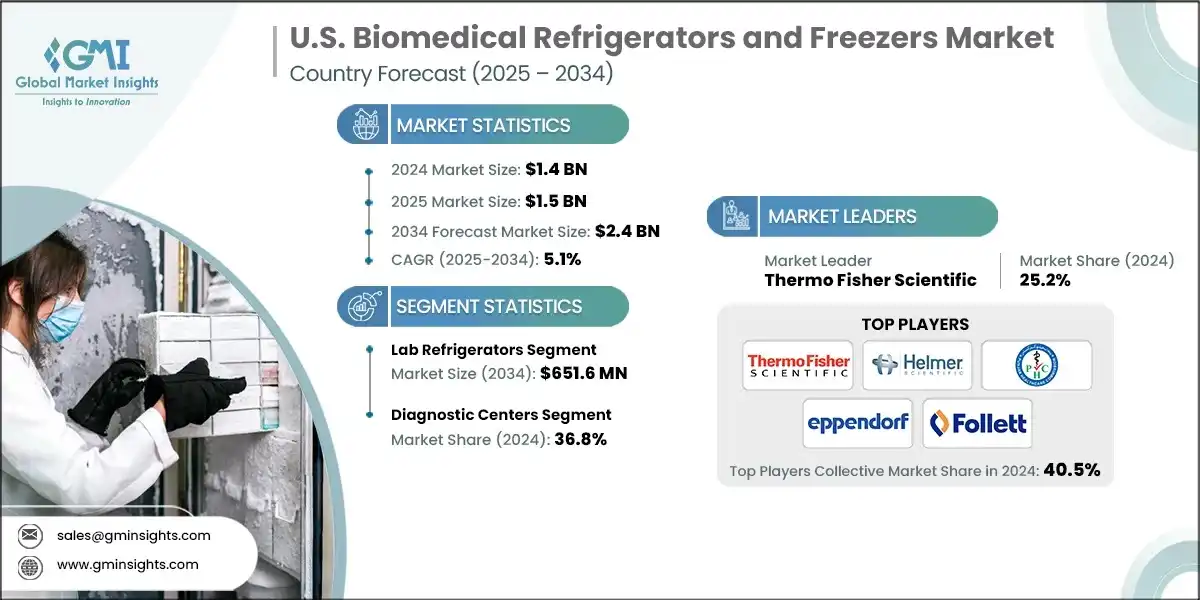
The U.S. biomedical refrigerators and freezers market was valued at USD 1.4 billion in 2024 and is projected to grow from USD 1.5 billion in 2025 to USD 2.4 billion by 2034, expanding at a CAGR of 5.1%, according to the latest report published by Global Market Insights Inc. This steady growth is stimulated by various factors, including rising government support for research activities and clinical trials in the U.S., a growing geriatric population, technological advancements in biomedical refrigerators and freezers, and increasing advancement in biopharmaceuticals.
U.S. Biomedical Refrigerators and Freezers Market Key Takeaways
Market Size & Growth
- 2024 Market Size: USD 1.4 Billion
- 2025 Market Size: USD 1.5 Billion
- 2034 Forecast Market Size: USD 2.4 Billion
- CAGR (2025–2034): 5.1%
Key Market Drivers
- Rising government support for research activities and clinical trials in the U.S..
- Increasing geriatric population base.
- Technological advancements in biomedical refrigerators and freezers.
- Rising advancements in biopharmaceuticals.
Challenges
- High cost of biomedical refrigerators and freezers.
- Release of hydrofluorocarbons from refrigerators and freezers have deleterious impact on environment.
Opportunity
- Integration with smart technologies.
Key Players
- Market Leader: Thermo Fisher Scientific led with over 25.2% market share in 2024.
- Leading Players: Top 5 players in this market include Thermo Fisher Scientific, Helmer Scientific, PHC Corporation, Eppendorf, Follett Products, which collectively held a market share of 40.5% in 2024.
Get Market Insights & Growth Opportunities
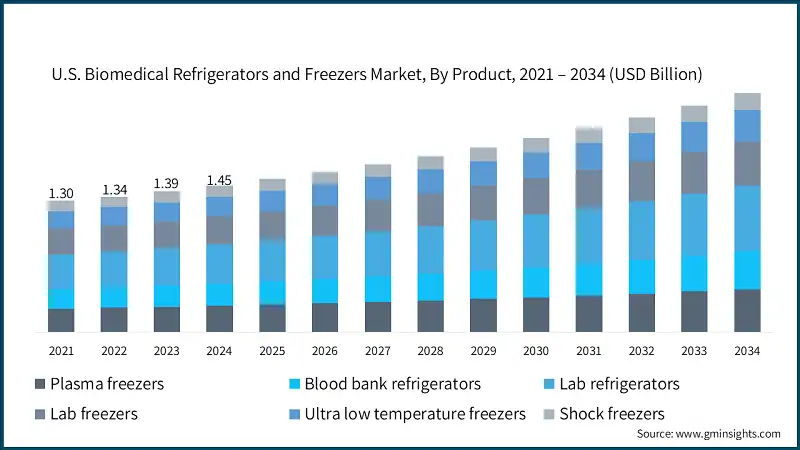
The U.S. biomedical refrigerators and freezers market grew from USD 1.30 billion in 2021 to USD 1.39 billion in 2023. This growth is primarily driven by the increasing demand for temperature-sensitive biologics, vaccines, and blood components, along with the expansion of research labs, biobanks, and healthcare infrastructure. Stringent regulatory standards and the growing adoption of advanced cold storage technologies further support this growth. Major companies in the market, including Thermo Fisher Scientific, Helmer Scientific, PHC Corporation, Eppendorf, and Follett Products, are focusing on innovation, energy efficiency, and smart monitoring solutions to meet evolving market needs.
Rising government support for research activities and clinical trials is a key factor driving the growth of the U.S. biomedical refrigerators and freezers market. Federal agencies, such as the National Institutes of Health (NIH), continue to invest billions annually in biomedical research and development, including clinical trials that require precise and reliable cold storage solutions for biological samples, vaccines, and investigational drugs. This sustained funding not only accelerates innovation in life sciences but also increases the demand for advanced refrigeration technologies that ensure the integrity of temperature-sensitive materials.
Further, the growing aging population in the U.S. is another major driver of the U.S. biomedical refrigerators and freezers market. Older adults are more prone to chronic illnesses such as diabetes, cancer, and cardiovascular diseases, which often require treatments involving temperature-sensitive medications, vaccines, and biological samples. As demand for geriatric care rises, healthcare providers are investing in advanced cold storage solutions to maintain the safety and effectiveness of these treatments. For example, in 2022, the U.S. had approximately 57.8 million adults aged 65 and older, highlighting a demographic shift that is fueling the need for long-term care facilities and outpatient clinics, all of which rely on biomedical refrigeration to store critical medical supplies. This trend is significantly contributing to the expansion of the biomedical refrigerators and freezers market.
Biomedical refrigerators and freezers are essential equipment used across the pharmaceutical research and healthcare sectors. They are designed to store vaccines, medications, biological samples, and other temperature-sensitive materials, ensuring they remain stable and effective by maintaining precise and controlled environmental conditions. These devices help preserve the integrity and potency of critical substances used in medical treatments and scientific research.
To get key market trends
U.S. Biomedical Refrigerators and Freezers Market Trends
- Technological innovations are significantly transforming biomedical refrigerators and freezers, enhancing their functionality, reliability, and appeal across healthcare and research sectors. Features such as IoT-enabled monitoring, real-time temperature tracking, automated alerts, and cloud integration enable centralized control and compliance, reducing risks of spoilage or contamination.
- These smart systems also provide remote access and data logging, which are particularly valuable for large hospitals and research labs. Additionally, modern units are becoming more energy-efficient and environmentally friendly, helping institutions reduce operational costs and meet sustainability goals.
- Advancements in temperature uniformity, backup power systems, and predictive maintenance further enhance dependability, driving broader adoption in applications such as vaccine storage, cancer treatment, and biobanking. For instance, PHC Corporation’s VIP ECO SMART series, designed for ultra-low temperature storage in cell and gene therapy, combines energy-efficient compressors, natural refrigerants, and smart controls to optimize performance while minimizing energy consumption.
- Thus, these advancements are propelling the market forward by making biomedical cold storage solutions more reliable, sustainable, and widely applicable.
U.S. Biomedical Refrigerators and Freezers Market Analysis
Learn more about the key segments shaping this market
The U.S. market was valued at USD 1.30 billion in 2021. The market size reached USD 1.39 billion in 2023, from USD 1.34 billion in 2022.
Based on the product, the market is segmented into plasma freezers, blood bank refrigerators, lab refrigerators, lab freezers, ultra-low temperature freezers, and shock freezers. The lab refrigerators segment dominated the market in 2024, holding the largest share due to the widespread adoption across research laboratories, diagnostic centers, and hospitals for storing reagents, samples, and other temperature sensitive materials.
This segment was valued at USD 388.5 million in 2024 and is projected to reach USD 651.6 million by 2034, growing at a CAGR of 5.4%. In comparison, the blood bank refrigerators segment, valued at USD 217.8 million in 2024, is expected to grow to USD 372.2 million by 2034, with a CAGR of 5.6%.
- Laboratory refrigerators are specialized cooling units designed to store temperature-sensitive materials, such as biological samples, reagents, and chemicals, in research, medical, and scientific environments. They maintain precise and consistent temperatures, which are essential for preserving sample integrity and supporting accurate lab operations.
- These refrigerators represent a leading segment in the U.S. biomedical refrigerators and freezers market due to their widespread use in clinical laboratories, research institutes, and pharmaceutical settings. Their versatility and reliability make them suitable for both small clinics and large research facilities.
- Technological advancements have further enhanced their utility. Modern lab refrigerators feature minimal noise, low energy consumption, smart alarms, and eco-friendly refrigerants, improving both performance and sustainability. For instance, Thermo Scientific’s TSV Series offers dependable short- to medium-term storage for lab essentials, combining advanced features with environmental responsibility.
- Additionally, lab refrigerators are available in various sizes and configurations, including undercounter, upright, and modular designs, allowing them to meet diverse spatial and operational needs. This flexibility helps to optimize workflow efficiency and space utilization across different healthcare and research settings.
Learn more about the key segments shaping this market
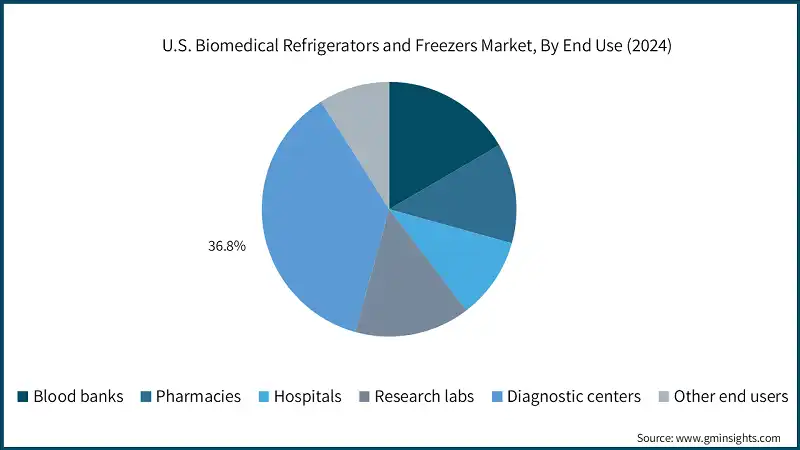
Based on end use, the U.S biomedical refrigerators and freezers market is segmented into blood banks, pharmacies, hospitals, research labs, diagnostic centers, and other end users. The diagnostic centers segment accounted for the highest market share of 36.8% in 2024.
- Diagnostic centers handle biological samples such as blood, urine, and tissue specimens that require precise temperature control to maintain sample integrity. Biomedical refrigerators and freezers store these samples under optimal conditions, reducing the risk of degradation and ensuring accurate test results.
- With the growing demand for quick diagnostics, especially in infectious disease detection and chronic condition monitoring, reliable cold storage is essential. Advanced refrigeration systems help diagnostic centers preserve reagents, test kits, and samples efficiently, ensuring a steady workflow.
- In addition, smart refrigeration systems with IoT integration and automated alerts enable centralized monitoring and predictive maintenance. These systems reduce downtime, improve sample safety, and enhance overall operational efficiency in diagnostic workflows.
- Furthermore, the increasing number of diagnostic centers, driven by rising healthcare awareness and demand for preventive care, is fueling the need for advanced biomedical refrigeration solutions. Their widespread adoption significantly contributes to the growth of the biomedical refrigerators and freezers market.
U.S. Biomedical Refrigerators and Freezers Market Share
- Leading companies in the biomedical refrigerators and freezers market, such as Thermo Fisher Scientific, Helmer Scientific, PHC Corporation, Eppendorf, and Follett Products, collectively hold around 40.5% of the market share. These companies dominate the market through extensive product portfolios, strategic partnerships, regulatory compliance, and ongoing innovation, offering tailored solutions for hospitals, research laboratories, and diagnostic centers.
- Helmer Scientific’s biomedical refrigerators and freezers are designed for precise and reliable cold storage of sensitive medical and research materials. With features such as advanced temperature uniformity, energy-efficient cooling systems, and compliance with healthcare standards, products such as the GX Solutions line support critical applications, including vaccine and medication storage in clinical and laboratory settings.
- Additionally, new entrants are gaining traction by targeting applications such as blood banks and gene therapy labs, where specialized storage needs provide opportunities for differentiation. By leveraging innovations such as IoT-enabled monitoring, cloud connectivity, and energy-efficient systems, and offering competitively priced products with strong after-sales support and sustainability features, these players are enhancing market appeal and driving adoption.
U.S. Biomedical Refrigerators and Freezers Market Companies
Few of the prominent players operating in the U.S. biomedical refrigerators and freezers industry include:
- Aegis Scientific
- Azbil Corporation
- Arctiko
- B Medical Systems
- Cardinal Health
- Eppendorf
- Follett Products
- Helmer Scientific
- Haier Biomedical
- Migali Scientific
- NuAire
- PHC Corporation
- So-Low Environmental Equipment
- Stirling Ultracold
- Thermo Fisher Scientific
- Eppendorf
Eppendorf is known for its CryoCube ULT freezers, which feature advanced insulation, energy-efficient cooling systems, and digital monitoring through VisioNize. These units provide reliable long-term storage for high-value biological samples, making them ideal for clinical, pharmaceutical, and research applications.
Thermo Fisher Scientific’s biomedical refrigerators and freezers are distinguished by advanced cooling technologies and energy-efficient designs, such as the TSX Series with V-drive technology. These systems ensure precise temperature control, regulatory compliance, and sustainable performance, making them ideal for critical sample storage in healthcare and research settings.
B Medical Systems specializes in medical refrigeration and vaccine cold chain solutions, offering high-performance refrigerators, freezers, and transport boxes for hospitals, labs, and humanitarian missions. Products such as the Laboratory Refrigerator L290 provide precise cooling and reliable storage for vaccines, blood, and biological samples, supported by eco-friendly systems and remote monitoring.
U.S. Biomedical Refrigerators and Freezers Market Report Attributes
| Key Takeaway | Details |
|---|---|
| Market Size & Growth | |
| Base Year | 2024 |
| Market Size in 2024 | USD 1.4 Billion |
| Market Size in 2025 | USD 1.5 Billion |
| Forecast Period 2025 - 2034 CAGR | 5.1% |
| Market Size in 2034 | USD 2.4 Billion |
| Key Market Trends | |
| Drivers | Impact |
| Rising government support for research activities and clinical trials in the U.S. | The increasing demand for high-performance cold storage systems ensures the safe storage of biologics, medications, and diagnostic samples, thereby accelerating market growth. |
| Increasing geriatric population base | Drives the need for chronic disease management and temperature-sensitive treatments, leading to higher adoption of biomedical refrigeration in healthcare settings. |
| Technological advancements in biomedical refrigerators and freezers | Improved energy efficiency, safety, and reliability make these systems more attractive to hospitals, labs, and research centers, thus expanding the market. |
| Rising advancements in biopharmaceuticals | Necessitates strict storage compliance, boosting demand for certified and specialized refrigeration units tailored to sensitive biological products. |
| Pitfalls & Challenges | Impact |
| High cost of biomedical refrigerators and freezers | Limits adoption among small clinics and low-resource healthcare settings, slowing market growth. |
| Release of hydrofluorocarbons from refrigerators and freezers have deleterious impact on environment | Raise environmental concerns, prompting stricter regulations and demand for eco-friendly alternatives. |
| Opportunities: | Impact |
| Integration with smart technologies | Real-time monitoring, automation, and data logging create new value propositions, enhancing product appeal and driving innovation in the market. |
| Market Leaders (2024) | |
| Market Leaders |
25.2% market share |
| Top Players |
Collective market share in 2024 is 40.5% |
| Competitive Edge |
|
What are the growth opportunities in this market?
U.S. Biomedical Refrigerators and Freezers Industry News:
- In February 2023, PHC Corporation introduced the VIP ECO SMART ultra-low temperature freezer series, targeting medical institutions, universities, and pharmaceutical companies. This launch strengthened PHC’s market position by providing energy-efficient and high-performance storage solutions tailored for advanced research and clinical needs.
The U.S. biomedical refrigerators and freezers market research report includes in-depth coverage of the industry with estimates and forecast in terms of revenue in USD Million and from 2021 - 2034 for the following segments:
Market, By Product
- Plasma freezers
- Blood bank refrigerators
- Lab refrigerators
- Lab freezers
- Ultra-low temperature freezers
- Shock freezers
Market, By End Use
- Blood banks
- Pharmacies
- Hospitals
- Research labs
- Diagnostic centers
- Other end users
Frequently Asked Question(FAQ) :
What was the market size of the U.S. biomedical refrigerators and freezers market in 2024?
The market size was valued at USD 1.4 billion in 2024, with a CAGR of 5.1% expected through 2034, driven by government support for research activities, a growing geriatric population, and advancements in technology and biopharmaceuticals.
What is the projected value of the U.S. biomedical refrigerators and freezers market by 2034?
The market is expected to reach USD 2.4 billion by 2034, fueled by technological innovations, energy-efficient solutions, and increasing demand from healthcare and research sectors.
What is the projected size of the U.S. biomedical refrigerators and freezers market in 2025?
The market is projected to grow to USD 1.5 billion in 2025.
How much revenue did the diagnostic centers segment generate in 2024?
The diagnostic centers segment accounted for the highest market share of 36.8% in 2024.
What was the valuation of the blood bank refrigerators segment in 2024?
The blood bank refrigerators segment was valued at USD 217.8 million in 2024 and is expected to grow at a CAGR of 5.6% through 2034.
Which segment is expected to grow significantly in the U.S. biomedical refrigerators and freezers market?
The segment featuring IoT-enabled monitoring, real-time temperature tracking, and cloud integration is projected to grow from USD 388.5 million in 2024 to USD 651.6 million by 2034, at a CAGR of 5.4%.
What are the upcoming trends in the U.S. biomedical refrigerators and freezers market?
Key trends include IoT-enabled monitoring, real-time temperature tracking, cloud integration, energy-efficient designs, and environmentally friendly solutions to reduce operational costs and meet sustainability goals.
Who are the key players in the U.S. biomedical refrigerators and freezers market?
Key players include Aegis Scientific, Azbil Corporation, Arctiko, B Medical Systems, Cardinal Health, Eppendorf, Follett Products, Helmer Scientific, Haier Biomedical, Migali Scientific, NuAire, and PHC Corporation.
U.S. Biomedical Refrigerators and Freezers Market Scope
Related Reports