Summary
Table of Content

US 800V Electric Vehicle Architecture Market
Get a free sample of this report
Form submitted successfully!
Error submitting form. Please try again.
Thank you!
Your inquiry has been received. Our team will reach out to you with the required details via email. To ensure that you don't miss their response, kindly remember to check your spam folder as well!
Request Sectional Data
Thank you!
Your inquiry has been received. Our team will reach out to you with the required details via email. To ensure that you don't miss their response, kindly remember to check your spam folder as well!
Form submitted successfully!
Error submitting form. Please try again.
US 800V Electric Vehicle Architecture Market Size
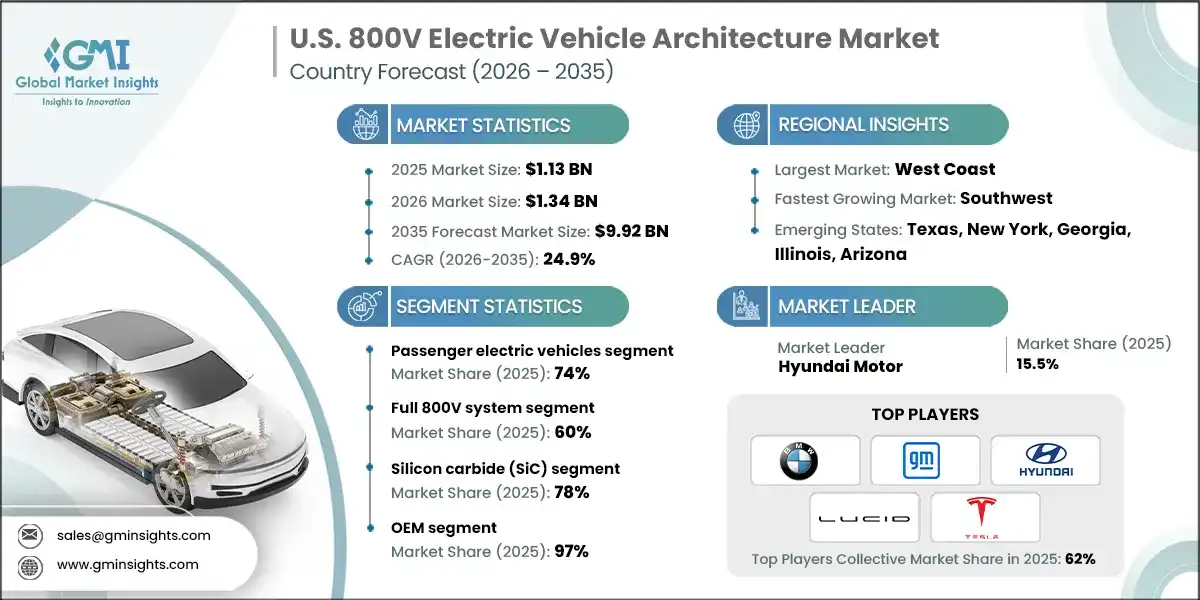
The US 800V electric vehicle architecture market size was valued at USD 1.13 billion in 2025. The market is expected to grow from USD 1.34 billion in 2026 to USD 9.92 billion in 2035 at a CAGR of 24.9%, according to latest report published by Global Market Insights Inc.
US 800V Electric Vehicle Architecture Market Key Takeaways
Market Size & Growth
- 2025 Market Size: USD 1.13 Billion
- 2026 Market Size: USD 1.34 Billion
- 2035 Forecast Market Size: USD 9.92 Billion
- CAGR (2026–2035): 24.9%
Regional Dominance
- Largest Market: West Coast
- Fastest Growing Country: Southwest
Key Market Drivers
- Rise in demand for faster charging and extended driving range.
- Surge in production of high-performance electric vehicles.
- Increase in government incentives and regulatory support for EVs.
- Growth in collaboration between OEMs and semiconductor suppliers.
Challenges
- High cost of 800V components and integration.
- Limited availability of compatible charging infrastructure.
Opportunity
- Surge in investment toward next-generation battery technologies.
- Increase in demand for 800V-ready autonomous and connected vehicles.
- Expansion of EV manufacturing in emerging economies.
- Growth in R&D toward lightweight, efficient power electronics.
Key Players
- Market Leader: Hyundai Motor led with over 15.5% market share in 2025.
- Leading Players: Top 5 players in this market include BMW, General Motors, Hyundai Motor, Lucid Motors, Tesla, which collectively held a market share of 62% in 2025.
Get Market Insights & Growth Opportunities
The demand for EVs with ultra-fast DC charging capabilities and longer ranges has increased from consumers, resulting in many OEMs implementing the Electric City (800 volts) architecture into their manufacturing processes to allow for less charging time and efficient energy usage. The consumer's need for relieving anxiousness regarding their range and provides convenience, created a push towards High-Voltage Systems and Ultra-Fast Charging stations that will be compatible with Next-Gen Electric Vehicle (NG-EV) products.
In 2025, Lucid Motors began shipping the Lucid Gravity SUV manufactured utilizing an 800-volt or higher electrical system that allows for very fast (i.e., 200 miles added to an EV in about 11 minutes on very fast CCS charging stations) and long-range (450 mile) capabilities. The introduction of the Gravity demonstrates an increasing trend of using high-voltage (800 volt or more) electrical systems in the American market for premium electric vehicles.
The three major manufacturers based out of the US i.e. Lucid Motors, Tesla Corporation, and Stellantis announced or started to introduce and increase production of 800-volt capable electric vehicle models that highlight the attributes of high-performance and the capability of being rapidly charged. In addition to providing consumers and OEM with better acceleration and Thermal Efficiency at 800V, these electric vehicles will support consumers and OEM in differentiating products in premium markets and increasing competitiveness.
In addition to EV market supplies being bolstered by federal government initiatives, such as the National Electric Vehicle Infrastructure Program (NEVI) and the broader electrification policies included in the Inflation Reduction Act, which will support the development of EV's adoption as a whole, there will be an indirect increase in the Number of Manufacturers adopting 800V Systems with Ultra-Fast Charge Stations. The actions by federal authorities serve to eliminate or reduce barriers that prevent OEM's from pursuing high-voltage Electric Vehicle deployment.
By 2025, major automotive manufacturers entered expanded partnerships with manufacturers of Silicon Carbide (SiC) and Wide Bandgap (WBG) Semiconductor manufacturers to develop High-Voltage Power Electronics Together. The collaborations created by automotive manufacturers and semiconductor chip manufacturers has helped facilitate the building of supply chains for 800-V power modules and inverters that enable the support of rapid charging, greater efficiency, and advanced performance of EV powertrain systems.
To get key market trends
US 800V Electric Vehicle Architecture Market Trends
Automakers are adopting 800V architectures in their vehicles to provide faster charging, higher efficiency and lower thermal losses for greater range and performance in both battery electric vehicles (BEVs) and plug-in hybrid electric vehicles (PHEVs).This trend is growing rapidly with auto manufacturers launching new vehicles and work with original equipment manufacturers (OEMs) on the development of the next generation of high-voltage components.
In 2025, Lucid Motors began deliveries of the Lucid Gravity SUV, which is based on an 800 volt (or more) electrical system, allowing for ultra-fast charging (around 200 miles in around 11 minutes with high-power CCS chargers) and long range (around 450 miles). The Gravity is representative of the increasing use of high-voltage systems in premium, mass-market electric vehicles in the United States.
EV manufacturers are integrating silicon carbide (SiC) and gallium nitride (GaN) semiconductor devices into their inverters and DC-DC converters, they are optimizing efficiency and reducing overall weight of the systems. This trend is further enhancing the energy density, streamlining the overall system, and allowing the systems to utilize the industry's shift to lighter-weight, more compact, and thermally stable 800V architecture of EVs.
Charging networks are deploying ultra-fast chargers rated at 350 to 450 KW that can charge 800V EVs, thereby reducing the time for charging to around 15 to 20 minutes. This trend addresses range anxiety for consumers and continues to support OEM's accelerated rollout of EV programs in both urban and highway corridors.
The use of 800V architecture is now being extended beyond passenger vehicle applications to include commercial trucks, buses, and delivery vehicles. This trend reflects a broader electrification push across mobility segments, driven by sustainability targets and government incentives for low-emission fleets.
US 800V Electric Vehicle Architecture Market Analysis
Learn more about the key segments shaping this market
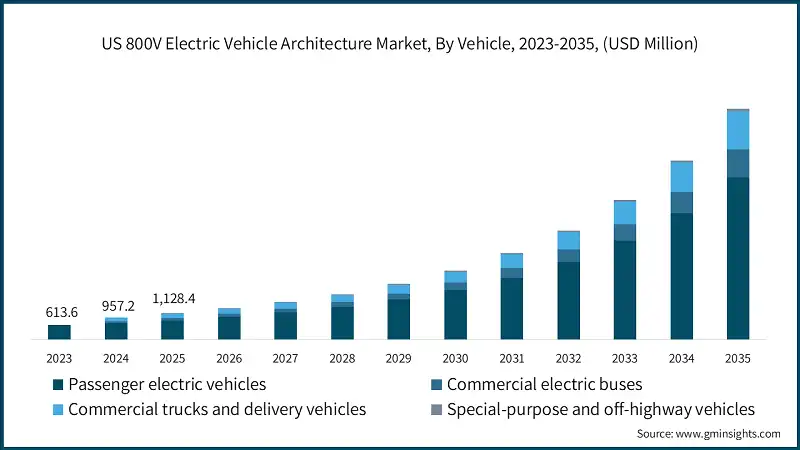
Based on vehicle, the US 800V electric vehicle architecture market is divided passenger electric vehicles, commercial electric buses, commercial trucks and delivery vehicles and special purpose and off-highway vehicles. Passenger electric vehicles dominated the market, accounting for 74% in 2025 and are expected to grow at a CAGR of 24.4% through 2026 to 2035.
- Electric vehicles (EVs) with an 800-volt architecture, are increasingly used for passenger transportation, with EVs having ultra-fast charging, longer range, and increased efficiency. In addition, automotive original equipment manufacturers (OEMs) have begun to make available BEVs with a focus on high performance and luxury. In contrast, most urban consumers prefer to purchase vehicles that are sustainable, connected, and energy efficient.
- Electric bus manufacturers are integrating 800V systems to support high-capacity batteries, reduce charging downtime, and improve fleet efficiency. Many transit agencies are adopting zero-emission buses to help achieve regulatory requirements and reduce their operating costs by establishing fast-charging depots and optimizing their operations in urban and rural intercity areas.
- High-voltage architectures for trucks and delivery vehicles enable quicker charging times, greater payload efficiency, and longer operational ranges. Fleet operators are increasingly deploying BEVs and PHEVs capable of 800 volts for their last-mile logistics and regional logistics due to sustainability goals as well as cost-efficiency. In addition, stricter emissions regulations have led fleet operators to deploy many of these zero-emission vehicles along major logistical corridors in the US.
- Industries such as construction, mining, and agriculture are actively adopting 800-volts to produce highly powerful, thermally efficient electric vehicles with reduced emissions. As environmental regulations become stricter and the need for more sustainability-related initiatives and operationally efficient vehicles continues to evolve, the adoption of 800-volt architectures in niche industrial vehicle segments is likely to continue growing at a steady rate.
Learn more about the key segments shaping this market
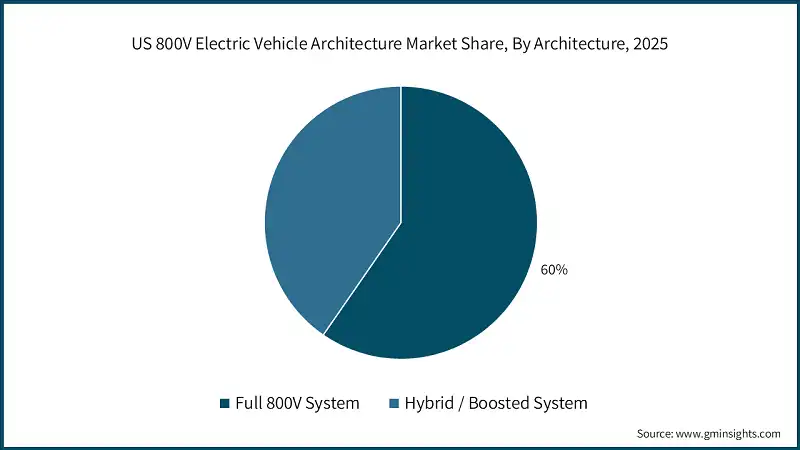
Based on architecture, the US 800V electric vehicle architecture market is segmented into full 800V system and hybrid / boosted system. Full 800V system segment dominates the market with 60% share in 2025, and the segment is expected to grow at a CAGR of 23.8% from 2026 to 2035.
- OEMs are embracing 800V architectures for their premium/performance EV offerings. OEMs are doing this to enable the ultrafast charging, longer-range, and more efficient batteries incorporated into their premium/performance EVs. Furthermore, these types of systems will enable better thermal management and integration of high-powered drivetrains into a wider range of configurations (i.e., passenger and commercial EVs).
- For instance, Hyundai Ioniq 5, which utilizes an 800V high-voltage architecture to allow for ultrafast DC charging (charging from 10-80% in ~18-20 mins with 350 kW chargers). This illustrates how full 800V systems significantly improve the convenience of charging and provide longer-range capabilities in mass-market EVs.
- The rollout of charging infrastructure throughout the world will lead to an increase in the number of DC fast chargers ranging in capacity from 350-450 kW. This, in turn, accelerates the adoption of full 800V systems due to the significantly shorter amount of time it takes to charge an EV, and hence the greater acceptance of these types of EVs, both in urban and intercity applications.
- Hybrid or boosted 800V systems emerging within the mid-range EVs; thus, while using lower-voltage components, they are utilizing high-voltage boost converters to strike a balance between performance, cost, and efficiency. A hybrid 800V system provides a compelling reason to support mass-market adoption due to the lower complexity of coming together and the compatibility with lower-voltage chargers.
- OEMs are implementing hybrid 800V systems to provide partial fast charging capabilities and make incremental steps towards the commercial fleet and passenger EV applications to gradually transition to high-voltage architecture.
Based on technology, the US 800V electric vehicle architecture market is segmented into Silicon carbide (SiC), Gallium nitride (GaN) and Hybrid SiC + GaN systems. The Silicon carbide (SiC) segment dominates the market with 78% share in 2025, and the segment is expected to grow at a CAGR of 24.8% from 2026 to 2035.
- The use of silicon carbide (SiC) in power electronics is becoming increasingly common in electric vehicles (EVs) that operate at voltages greater than 800V due to its improved thermal efficiency and lower overall weight compared to traditional silicon-based devices.
- Automobile manufacturers (OEMs) including Tesla, General Motors, and Hyundai, are beginning to incorporate SiC in their inverter and DC-DC converter designs, making it possible to provide more rapid charge times, increased range, and higher power output, especially for premium and commercial electric vehicles.
- Gallium nitride (GaN) is utilized in high-frequency and compact size for EV onboard chargers and converters. These devices have the benefit of providing higher efficiency at faster switching speeds than other technological options while taking up less space. As a result, OEMs and charging infrastructure suppliers have been able to implement GaN in their 800V systems, which enables lighter and more energy-efficient systems.
- Hybrid SiC and GaN in EV power electronics optimizes overall system efficiency at higher switching speeds with lower thermal management requirements than traditional silicon-based power systems. OEMs are exploring hybrid SiC/GaN systems for use in high voltage 800V platforms that will allow them to create a balanced approach to pricing, performance, and efficient design.
- These hybrid designs will enable OEMs to deliver electric vehicles in the luxury and high-performance classes as well as provide an avenue for the development of next-generation fast-charge equipment.
Based on application, the US 800V electric vehicle architecture market is segmented into OEM and aftermarket. The OEM segment is expected to dominate the market with a share of 97% in 2025.
- OEM are developing electric vehicles using an 800V architecture giving them the ability to provide ultra-rapid charging, extended ranges, and high-performance drivetrains in the premium and commercial EV markets, making them less likely to fail compared to competitors.
- OEM are working closely with silicon carbide (SiC) and gallium nitride (GaN) power electronics producers to co-develop the most modern, reliable, and cost-effective high-voltage inverter and converters for their newest generation of electric vehicles.
- Aftermarket companies provide aftermarket products, replacing electric power inverters, chargers, etc. with high-efficiency, rapid-charge, high-voltage products.
- As there will be many electric vehicle users in commercial fleets, there is a need for after-market DC chargers that support ultra-fast charging (ie an 800V charger) to be installed and maintained by an aftermarket company in the regions where they are most likely to be used.
Looking for region specific data?
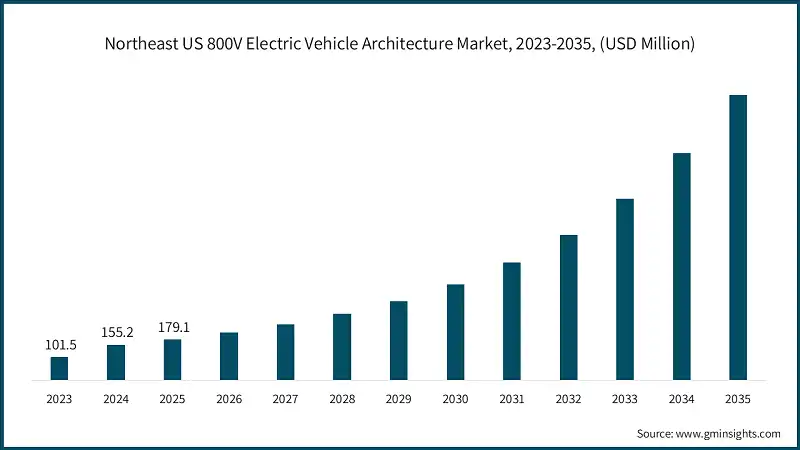
The Northeast US 800V electric vehicle architecture market reached USD 179.1 million in 2025, growing from USD 155.2 million in 2024.
- Electric vehicle manufacturers are taking advantage of strong EV incentives and regulations supporting the zero-emissions vehicle market to sell EVs with 800-volt systems. To support ultrafast charging, metropolitan areas are placing emphasis on the development of ultrafast DC charger stations and electrification of major highways.
- Many public transportation agencies and commercial fleet operators in New York, Massachusetts, and New Jersey are in the process of transitioning to battery-operated electric buses and delivery trucks. Therefore, manufacturers of high-voltage vehicle systems will also be in high demand. High-voltage systems will enable both rapid depots charging as well as greater charge cycles needed for public transport and urban delivery electric vehicle infrastructure.
- Many public and private investors are currently establishing 350-kilowatt direct current fast chargers along I-95 and major urban areas. With more charging stations available, there is an increased level of confidence in EVs with the capability of charging with 800-volt systems and a higher willingness to purchase EVs within the passenger vehicle and light commercial vehicle segments.
New York 800V electric vehicle architecture market accounted for a share of 46.8% and generated revenue of USD 83.9 million in 2025.
- In New York, the large population density and strong incentives to purchase these vehicles, are the reason for strong growth of this architecture.
To meet the demands of consumers for ultra-fast charging and the ability to drive longer distances, manufacturers are building high-performance battery electric vehicles and vehicles designed for use with 800 Volt electrical systems. - Transit companies and fleets that deliver goods are switching out diesel powered buses and vans for electric powered options. The use of 800 Volt systems provides the ability to charge buses overnight at the bus depot while at the same time providing drivers with additional operational range and eliminating significant energy loss, which will accelerate the electrification of the regional fleets.
- Facilities are being built on major roadways including I-87 and I-95 as well as through urban centers that will provide 350 to 450 kW DC chargers. As a result of these facilities, customers will have increased confidence to purchase 800 Volt Electric Vehicle due to decreased downtime waiting for their vehicles to charge and able to make long-distance trips at a much greater speed.
Southeast US 800V electric vehicle architecture market accounted for a share of 19.6% and generated revenue of USD 221.4 million in 2025.
- These states characteristically known as warm weather states, such as Florida, Georgia and North Carolina, show increased registration volume of electric vehicles in these states. Automotive manufacturers and dealerships are marketing models that support 800 V capabilities, which are meeting the regional demand for extended range and thermal efficiency, thereby meeting the consumer expectation for high voltage electric vehicles in warm weather state environments.
- Commercial delivery and ride-hailing fleets are currently testing electric vehicles with high voltage systems, which will assist in reducing their operational expenses. Finally, 800 V electric vehicle systems enable faster turn-around-charging, therefore increasing the efficiency of route performance, which in turn supports the development of regional electrification strategies for electric vehicle fleets.
- Some partnerships have created incentives to invest in the development of electrification corridors (i.e., fast charging highway systems along I-75 and I-95) through state and utility partnerships, which include high-power 800 V-ready charging stations, reducing the worry of where to charge and providing support for long-distance travel for electric vehicle owners.
Florida 800V electric vehicle architecture market is estimated to grow with a CAGR of 25.3% from 2026 to 2035.
- The rise in electric vehicle registrations within Florida indicates an increase in long-range, 800 V capable EVs, which meet a demand for high-performance vehicles that can operate in hotter climates.
- EV buyers from both the passenger and light commercial sectors are seeking higher-performance options, which may include heat-resistant 800 V EVs that maximize performance and battery lifespan. Major ridesharing and delivery service companies are using 800 V enabled EVs to reduce operational expenses and time between deliveries and ride requests.
- The benefits of high voltage systems is that they provide faster charging and greater efficiency, also enable quicker and easier payment processing for customers in urban and suburban networks.
West Coast dominates the 800V electric vehicle architecture market, showcasing strong growth potential, with a CAGR of 23.6% from 2026 to 2035.
- The US West Coast states lead the country in electric vehicle (EV) adoption and in creating stringent emissions standards. Advanced policies, combined with incentives offered by the states of California, Oregon, and Washington, are accelerating the uptake of both premium and performance EVs, equipped with ultra-fast charging capabilities, and the consumer and fleet uptake of 800 V EVs.
- The extensive deployment of high-powered Charging Stations along I-5 and U.S. Highway 101 "allows" for a greater utilization of 800V EVs by all users through robust investment by Utilities and Private Networks in charging infrastructure for long-distance travel and reduced charging times.
- In 2025, Revel launched a high-speed EV charging hub in San Francisco’s Mission District with 12 DC fast chargers (320 kW) capable of charging vehicles to ~80% in about 20 minutes, supporting fast-charging adoption for 800 V ready EVs and urban electrification goals.
- West Coast Ports and Tech Ecosystem attract EV Original Equipment Manufacturers (OEMs) and Battery Supply Chains by being located near to key suppliers, allowing for the Local Research and Development (R&D) of Silicon Carbide (SiC) and Gallium Nitride (GaN) high-voltage power electronics needed for the Regional Competitiveness of 800 Volts (V) EV Technologies.
- Between Aug 2024–Feb 2025, California added over 26,000 public EV chargers, a ~17% increase in infrastructure, significantly expanding the network available for high-voltage EVs and reducing range anxiety for West Coast drivers.
California 800V electric vehicle architecture market is anticipated to grow at the highest CAGR of 23.9% from 2026 to 2035.
- The rigorous emissions and ZEV regulations imposed by California are motivating OEMs across both premium and mainstream markets to enter into the high voltage EV segment with ultra rapid charging capabilities that support the climate goals of the State and contribute to a sustainable urban environment.
- As a result of the establishment of an extensive 350-450kW public charging infrastructure throughout California (including I-5, US-101, and urban areas), there are many opportunities for the effective use of 800v EVs by consumers, businesses, and fleets.
- The state's close physical proximity to technology and battery supply chains provides an ideal environment for research and development for higher voltage power electronics, e.g., silicon carbide (SiC) and gallium nitride (GaN) inverters as well as modular 800v EV systems, which will result in enhanced vehicle performance and operating efficiency, and enhanced reliability of the domestic supply of 800v products.
The Midwest and Central 800V electric vehicle architecture market is anticipated to grow at the highest CAGR of 25.0% from 2026 to 2035 and generated revenue of USD 132.7 million in 2025.
- Midwestern states are dominating in the electrification of medium and heavy-duty trucks with a strong manufacturing and logistics industry. The 800 V architecture will support high power needs for both trucks and delivery vans.
- In 2025, GM, EVgo, and Pilot expanded their DC fast charging network to 130 locations across 25 states, including the Midwest region such as routes that connect Minneapolis, Milwaukee, Detroit, and Cleveland. This network will enable 350 kW fast charging at key travel routes for 800 V EVs to be adopted easily.
- These states (Illinois, Ohio, and Minnesota) have invested in EV charging for intercity corridors. The availability of full 800 V compatible charging stations will help to alleviate the long-distance travel anxiety associated with long-haul trucking and increase consumer and commercial EV adoption in the Midwest.
- The increasing popularity of electric vehicles used off-highway and in industrial applications creates a need for high-voltage systems. High-performance 800 V powertrains offer huge performance and efficiency for the specialized equipment used in many of the region's agricultural and industrial operations.
Illinois 800V electric vehicle architecture market is estimated to grow with a CAGR of 25.8% from 2026 to 2035.
- Fleets in the region that provide logistics and delivery services are beginning to utilize electric trucks and vans (at least) with an 800 V electrical system to reduce emissions, increase efficiency, and enable longer duty cycles in urban and intercity travel.
- Electric utility companies are installing high power DC fast charging stations along I-90 and I-88 in Chicago and the surrounding area, enabling long-distance travel and helping boost consumer confidence in electric vehicles (EVs).
- In Illinois, industries such as manufacturing, agriculture and construction are investigating the possibility of using 800 V EVs for their off-highway and industrial applications, supporting efforts to reduce emissions and improve operational efficiency in specialized applications.
Southwest US 800V electric vehicle architecture market shows lucrative growth over the forecast period.
- Significant growth in electric vehicle (EV) ownership is occurring in Texas, Arizona and New Mexico, largely due to urban sprawl and lower EV ownership costs. EV manufacturers (OEM's) are introducing 800-volt capable models to meet regional market demands for ultra-fast charging and long motorist range; thereby enabling long-distance motorist travel needs.
- Higher electricity use on interstate highways like I-10 and I-40 will allow for effective travel of long distances due to 800-volt capable fast chargers providing quick chargers at all hours.
- Public and private heightened investment in high-powered charging stations throughout the I-10 and I-40 corridors is helping eliminate range anxiety for travelers located in rural areas.
Texas 800V electric vehicle architecture market is estimated to grow with a CAGR of 29.7% from 2026 to 2035 and reach USD 1.5 billion in 2035.
- In Texas there is developing growth in passenger adoption of electric vehicles (EVs) due to the expanding metro areas and frequent long-distance travel between cities. The growth of EV adoption in Texas is evidenced by the increased popularity of 800V architectures, as they provide fast charging capability and a large enough thermal performance.
- The increase in electric truck and delivery vehicle adoption is due to the growth of Texas as the United States’ principal logistics and freight center. The operation of fleets utilizing 800V EVs gives fleet operators support with high payload capacity, rapid charging at depots, and long duty cycles.
- Public and private funding is expanding the development of 350 – 400kW DC fast charging stations on major interstates (I-10, I-35, & I-45) throughout Texas; with this enhanced infrastructure available, 800V electric vehicles will have increased practicality for both consumers and businesses and promote electric mobility both intra-state as well as inter-state.
Rest of US 800V electric vehicle architecture market accounted for USD 1.9 billion in 2025 and is anticipated to show lucrative growth over the forecast period.
- States such as Colorado, Pennsylvania, Virginia, Tennessee, Wisconsin, and Utah are seeing rising EV registrations thanks to broader model availability and improved incentives. While still behind primary hubs, consumers increasingly seek long-range and fast-charging EVs. This rising demand encourages OEMs and dealers to promote high-voltage (800 V-capable) EVs, improving brand presence and accelerating market growth in these mid-penetration regions.
- With increased interest in 800-volt compatible EVs, dealers in these areas are becoming more active in promoting their use through education and test drive events. As a result, awareness of this technology is growing within these secondary markets, leading to increased levels of adoption.
- Federal and state funding from programs like NEVI is enabling deployment of 350 kW+ DC fast chargers in the rest of the U.S., including Missouri, Indiana, Kentucky, Iowa, and Nevada. The growth of high-power corridors reduces regional range anxiety and supports broader adoption of 800 V EVs across long rural distances. As infrastructure densifies, confidence in high-voltage vehicles increases.
US 800V Electric Vehicle Architecture Market Share
The top 7 companies in the US 800V electric vehicle architecture industry are Hyundai Motor, Tesla, Lucid Motors, BMW, General Motors, Porsche (Volkswagen Group) and Audi, contributing 75% of the market in 2025.
- Hyundai Motor is positioned as a leader in the U.S. Market for 800 Volt electric vehicles due to its first mover advantage and E-GMP (Electric Global Modular Platform) implementation throughout its brands, Hyundai and Kia. Models such as the Ioniq 5, Ioniq 6, EV6, and EV9 have placed 800-volt charging technology in the mid-price segment creating the potential for mass market adoption of 800 volts. The company is utilizing vertical integration with its battery supply partners and is forming fast-charging partnerships throughout the US.
- Tesla maintains a strong competitive position through brand leadership, vertical integration, and the industry’s largest fast-charging ecosystem. Its 800V hybrid architecture, showcased in Cybertruck, combines high-voltage battery systems with advanced low-voltage electronics to enhance efficiency and performance. Planned expansion of 800V systems across high-volume platforms strengthens future growth potential, while proprietary power electronics, direct sales, and Supercharger network provide differentiation despite rising competition from diversified OEM portfolios.
- Lucid Motors differentiates through advanced high-voltage technology leadership, employing a 800V architecture delivering industry-leading range and ultra-fast charging. Vertical integration across motors, power electronics, and battery systems enables exceptional efficiency and premium performance. While its focus on ultra-luxury segments limits volume scale, the launch of the Gravity SUV and potential mid-size models expand addressable markets, supported by strong long-term financial backing and technology licensing opportunities.
- BMW utilizes the strong positioning of its luxury brand and the use of its latest generation of eDrive technology as the basis of a core component of their electric vehicle (EV) strategy by implementing 800V architecture on key EV models including the i4, iX and i7.
- GM's Ultium platform has allowed GM to implement an 800V strategy across its Chevrolet, Cadillac and GMC brands, helping GM to scale up in the passenger, luxury and commercial vehicle segments. With modular architecture, significant dealer access and strong relationships with fleet operators, GM can take advantage of increased volume. In addition to forming strategic partnerships with battery production companies and semiconductor manufacturers, GM has established strategic relationships with companies developing charging infrastructure that will allow GM to achieve long-term growth.
- Porsche gained credibility in the 800V marketplace early on with its introduction of the Taycan model, promoting 800V high voltage architecture as the benchmark for premium performance. The ability of Porsche to offer fast charging capability, excellent thermal stability, and superior driving performance reinforces its position as the leader in the luxury performance EV segment.
- Audi's competitive advantage is based on its early adoption of 800V architecture through the e-tron GT and its plan to expand implementation of this technology across the next generation of its All-Electric Vehicle portfolio. Audi plans to capitalize on the synergies between Audi and Volkswagen Group in producing high-performance EVs and targets premium consumers who value performance, design and quick charge capability.
US 800V Electric Vehicle Architecture Market Companies
Major players operating in the US 800V electric vehicle architecture industry are:
- Audi
- BMW
- General Motors
- Hyundai Motor
- Lucid Motors
- Porsche (Volkswagen Group)
- Proterra
- Stellantis
- Tesla
- Thomas Built Buses
- Tesla has one of the largest Supercharger networks available and is rapidly scaling production of the Cybertruck, launching refresh programs for the Model Y, and expanding the deployment of V4 Superchargers that support the new Tesla charging rate of 350kW+. With the established partnerships are focused on using batteries and developing 4680 cells that will help reduce costs and improve performance, but competition from diversified OEMs continues to grow.
- Lucid Motors, with its ultra-luxury differentiation strategy, is focused on creating high-end electric vehicles (EVs) with its proprietary 900V+ electric motor, which offers industry-leading EV driving range, efficiency, and fast-charging capabilities. The vertical integration of Lucid's motors, power electronics, and battery systems provides strong technological leadership. Although Lucid has limited production scale, it anticipates future diversification opportunities through technology licensing agreements.
- BMW and Audi are leveraging their established dealer networks and flexible manufacturing capabilities to defend their premium positions in the automotive industry as they input the 800V architecture into an ever-expanding range of luxury EVs.
- In conjunction with their established brands, BMW and Audi are in the early phases of making significant investments in new dedicated platforms that will allow them to standardize their 800V technology. Porsche and Polestar have also positioned themselves to compete based on superior performance and exceptional high-voltage systems.
US 800V Electric Vehicle Architecture Market Report Attributes
| Key Takeaway | Details |
|---|---|
| Market Size & Growth | |
| Base Year | 2025 |
| Market Size in 2025 | USD 1.13 Billion |
| Market Size in 2026 | USD 1.34 Billion |
| Forecast Period 2026 - 2035 CAGR | 24.9% |
| Market Size in 2035 | USD 9.92 Billion |
| Key Market Trends | |
| Drivers | Impact |
| Rise in demand for faster charging and extended driving range | Accelerates adoption of 800V EVs and expands ultra-fast charging network deployment. |
| Surge in production of high-performance electric vehicles | Boosts market revenue and drives OEM investment in high-voltage architectures. |
| Increase in government incentives and regulatory support for EVs | Stimulates 800V EV adoption and accelerates infrastructure development. |
| Growth in collaboration between OEMs and semiconductor suppliers | Enhances supply chain efficiency and accelerates advanced 800V powertrain deployment. |
| Pitfalls & Challenges | Impact |
| High cost of 800V components and integration | Slows market penetration and limits adoption in mass-market EVs. |
| Limited availability of compatible charging infrastructure | Restricts consumer uptake and regional expansion of 800V EVs. |
| Opportunities: | Impact |
| Surge in investment toward next-generation battery technologies | Enables higher efficiency, faster charging, and market growth. |
| Increase in demand for 800V-ready autonomous and connected vehicles | Expands high-voltage EV adoption in next-gen mobility solutions. |
| Expansion of EV manufacturing in emerging economies | Opens new markets and drives global 800V architecture adoption. |
| Growth in R&D toward lightweight, efficient power electronics | Reduces costs and improves performance, supporting broader market adoption. |
| Market Leaders (2025) | |
| Market Leaders |
15.5% market share |
| Top Players |
|
| Competitive Edge |
|
| Regional Insights | |
| Largest Market | West Coast |
| Fastest growing market | Southwest |
| Emerging states | Texas, New York, Georgia, Illinois, Arizona |
| Future outlook |
|
What are the growth opportunities in this market?
US 800V Electric Vehicle Architecture Industry News
- In September 2025, Volvo Car USA announced that the EX90 - their flagship Electric SUV for 2026 - will have a change in voltage systems from 400V to 800V. This change will allow for peak DC charging of the EX90 at a maximum capacity of approximately 350 kW. In addition, a fully charged EX90 has a maximum range of around 250km (155 miles) from a single 10-minute charge from a compatible charging station.
- In September 2025, Cadillac introduced the 2026 Escalade IQ, which is a large luxury electric SUV powered by a 205-kWh battery, which in daily use uses two 400V battery packs in parallel. On High-Powered Chargers will show a nominal Operating Voltage of an approximate 800V, generating a peak DC charging speed of approximately 352 KW.
- In October 2025, Polestar's 2026 Model 3, which is constructed on the same platform as other Volvo electric products, uses an 800V architecture and allows for charging up to a maximum speed of 350kW. Lastly, they have recently increased the range of the Model 3 with Battery Technology Updates provided by CATL.
- In November 2024, Hyundai Motor Company said that a new plant in Bryan County, Georgia will produce up to 300,000 800V electric vehicle batteries a year, beginning 2025. The 5.5-billion-dollar funding will also support production of battery and electric drive systems as well as continued supply through 2030 from SK On's battery partner.
- In October 2024, GM announced that it has developed an Ultium system that works on a new type of 800V battery and has the capability to charge up to 400kW, which will be available for the Cadillac SUV starting in 2026. GM will also be working with seven other automobile manufacturers to construct a 30,000 high-power direct current charging station network throughout North America.
The US 800V electric vehicle architecture market research report includes in-depth coverage of the industry with estimates & forecasts in terms of revenue ($ Mn/Bn) and shipments (units) from 2022 to 2035, for the following segments:
Market, By Vehicle
- Passenger electric vehicles
- Commercial electric buses
- Commercial trucks and delivery vehicles
- Light commercial vehicles
- Medium commercial vehicles
- Heavy commercial vehicles
- Special-purpose and off-highway vehicles
- Construction equipment
- Mining vehicles
- Agricultural equipment
- Material handling equipment
Market, By Architecture
- Full 800V system
- Hybrid/boosted system
Market, By Technology
- Silicon carbide (SiC)
- Gallium nitride (GaN)
- Hybrid SiC + GaN systems
Market, By Propulsion
- Battery electric vehicles (BEV)
- Plug-in hybrid electric vehicles (PHEV)
- Fuel cell electric vehicles (FCEV)
Market, By Application
- OEM
- Aftermarket
Market, By Component
- Battery pack and thermal management
- Power electronics modules
- Traction inverter
- DC-DC converter
- On-board charger
- Electric motor and drivetrain
Market, By End Use
- Private
- Commercial/Fleet
The above information is provided for the following regions and countries:
- Northeast
- New York
- Massachusetts
- New Jersey
- Pennsylvania
- Maryland
- Connecticut
- Southeast
- Florida
- Georgia
- North Carolina
- Virginia
- Tennessee
- South Carolina
- West Coast
- California
- Oregon
- Washington
- Hawaii
- Nevada
- Colorado
- Midwest & Central
- Illinois
- Ohio
- Minnesota
- Michigan
- Wisconsin
- Missouri
- Southwest
- Texas
- Arizona
- New Mexico
- Utah
- Oklahoma
- New Mexico
- Rest of US
Frequently Asked Question(FAQ) :
What was the market size of the US 800V electric vehicle architecture in 2025?
The market size was valued at USD 1.13 billion in 2025, with a CAGR of 24.9% expected through 2035. Increasing demand for ultra-fast DC charging and longer-range EVs is driving market growth.
What is the projected value of the US 800V electric vehicle architecture market by 2035?
The market is poised to reach USD 9.92 billion by 2035, driven by advancements in high-voltage systems, ultra-fast charging infrastructure, and the adoption of next-generation EVs.
What is the expected size of the US 800V electric vehicle architecture industry in 2026?
The market size is projected to reach USD 1.34 billion in 2026.
What percentage of the market did passenger electric vehicles account for in 2025?
Passenger electric vehicles dominated the market with a 74% share in 2025 and is expected to grow at a CAGR of 24.4% through 2035.
What was the market share of the full 800V system segment in 2025?
The full 800V system segment held a 60% market share in 2025 and is set to expand at a CAGR of 23.8% till 2035.
What was the valuation of the Silicon carbide (SiC) segment in 2025?
The Silicon carbide (SiC) segment accounted for 78% of the market in 2025 and is anticipated to observe around 24.8% CAGR up to 2035.
Which region led the US 800V electric vehicle architecture sector in 2025?
The Northeast US market reached USD 179.1 million in 2025, led by strong EV incentives, zero-emission regulations, and the development of ultrafast DC charging stations.
What are the upcoming trends in the US 800V electric vehicle architecture market?
Adoption of SiC/GaN semiconductors, ultra-fast (350–450 kW) charging, 800V architectures in commercial vehicles, and stronger focus on sustainability and government incentives.
Who are the key players in the US 800V electric vehicle architecture industry?
Key players include Audi, BMW, General Motors, Hyundai Motor, Lucid Motors, Porsche (Volkswagen Group), Proterra, Stellantis, Tesla, and Thomas Built Buses.
US 800V Electric Vehicle Architecture Market Scope
Related Reports