Summary
Table of Content

Underground High Voltage Cable Market
Get a free sample of this report
Form submitted successfully!
Error submitting form. Please try again.
Thank you!
Your inquiry has been received. Our team will reach out to you with the required details via email. To ensure that you don't miss their response, kindly remember to check your spam folder as well!
Request Sectional Data
Thank you!
Your inquiry has been received. Our team will reach out to you with the required details via email. To ensure that you don't miss their response, kindly remember to check your spam folder as well!
Form submitted successfully!
Error submitting form. Please try again.
Underground High Voltage Cable Market Size
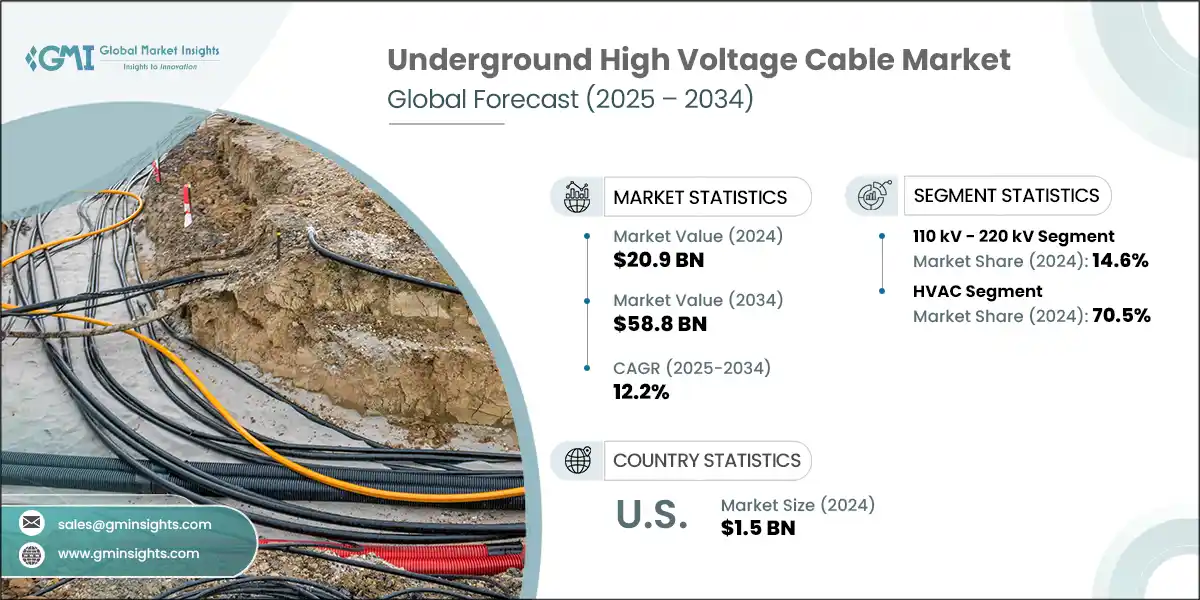
The underground high voltage cable market was estimated at USD 20.9 billion in 2024. The market is expected to grow from 21 billion in 2025 to USD 58.8 billion in 2034, at a CAGR of 12.2%.
To get key market trends
- The increasing pace of urbanization across the globe is shaping the industry outlook owing to rising energy demand, particularly across developed and rapidly industrializing economies. With rising constraints on space and the need for aesthetic and safety considerations in metropolitan regions, utility providers are increasingly opting for underground cable systems over traditional overhead lines.
- This approach mitigates visual clutter, reduces accident risks, and enhances system reliability during extreme weather conditions. For instance, in December 2024, the Authority filed a Priority Transmission Project (PTP) petition with the PSC, which includes the construction of over 178 km long underground/submarine 400kV, 1,300 MW HVDC running between Delaware County and Queens.
- Urban undergrounding is also gaining traction in smart city infrastructure planning, reinforcing its long-term strategic value to governments and utilities alike. In addition, reliability and resilience are becoming non-negotiable priorities in transmission and distribution systems, especially as climate-induced disruptions intensify.
- Underground high voltage cables are being favored for their superior resilience against environmental factors including high winds, wildfires, and ice storms, which frequently damage overhead lines. For instance, during 2023 - 2024, Pacific Gas & Electric (PG&E) in California accelerated its Undergrounding Program, targeting over 10,000 miles of overhead lines in wildfire-prone areas.
- Utility firms globally are adopting similar approaches, witnessing underground HV cables as a critical tool in hardening the grid. The emphasis on resilience is further strengthened by regulatory encouragement and incentives offered by federal and state agencies for infrastructure modernization.
- The underground HV cable market is witnessing growth in tandem with the expansion of renewable energy projects, which in turn is bolstering industry dynamics. These cables are essential for connecting offshore wind farms, remote solar fields, and hydroelectric stations to urban load centers while minimizing land usage and environmental impact.
- For instance, in April 2025, the U.K. government approved the Eastern Green Link 2 project, a major 525kV HVDC underground cable system that will connect wind energy from Scotland to England’s power grid. Similarly, underground cable networks are being deployed to facilitate cross-border interconnectors in Europe and North America.
- The underground HV cable industry is benefiting from significant advancements in material science and digital monitoring technologies. Innovations in cross-linked polyethylene (XLPE) insulation, superconducting cable designs, and distributed temperature sensing (DTS) systems are increasing the lifespan, efficiency, and reliability of underground cable systems.
- The underground high voltage cable market in North America is witnessing steady growth, driven by grid modernization efforts, resilience against extreme weather, and wildfire mitigation strategies. Additionally, government funding through the Infrastructure Investment and Jobs Act (IIJA) is supporting large-scale transmission upgrades, favoring underground systems in densely populated or climate-sensitive areas.
- Europe’s underground high voltage cable market is expanding rapidly due to aggressive renewable energy integration and cross-border transmission projects. The region prioritizes environmental protection and grid stability, making underground cabling a preferred option in urban and ecologically sensitive zones.
Underground High Voltage Cable Market Report Attributes
| Key Takeaway | Details |
|---|---|
| Market Size & Growth | |
| Base Year | 2024 |
| Market Size in 2024 | USD 20.9 Billion |
| Forecast Period 2025 - 2034 CAGR | 12.2% |
| Market Size in 2034 | USD 58.8 Billion |
| Key Market Trends | |
| Drivers | Impact |
| Refurbishment of existing electrical infrastructure | Aging grid systems are being upgraded with underground HV cables to enhance reliability and reduce transmission losses. |
| Growing offshore & underground electrical transmission projects | Rising demand for renewable energy is fueling large-scale offshore and underground cable installations for efficient power delivery. |
| Expansion of micro-grid network | The development of decentralized energy systems is increasing the need for underground HV cables to support localized, resilient power distribution. |
| Pitfalls & Challenges | Impact |
| Slow paced growth in developing economies | Limited infrastructure investment and regulatory challenges in emerging markets hinder the widespread adoption. |
| Opportunities: | Impact |
| Urbanization and smart city development | Rising urban infrastructure projects are driving demand for underground HV cables to support modern, resilient power networks. |
| Renewable energy integration | The global shift toward clean energy sources is creating opportunities for underground HV cables to connect remote generation sites to the grid. |
| Government initiatives and investments | Supportive policies and funding for grid modernization and energy security are accelerating underground HV cable deployments. |
| Market Leaders (2024) | |
| Market Leaders |
12% market share |
| Top Players |
Collective market share in 2024 is 35% |
| Competitive Edge |
|
| Regional Insights | |
| Largest Market | Asia Pacific |
| Fastest growing market | Europe |
| Emerging countries | U.S., Germany, China, India, Indonesia |
| Future outlook |
|
What are the growth opportunities in this market?
Underground High Voltage Cable Market Trends
- Continuous expansion of aging infrastructure along with grid replacement programs is bolstering the demand for underground HV cables. Utilities and transmission operators are shifting toward underground systems as a future-proof alternative during replacement initiatives. The replacement programs are expected to expand in frequency and scope globally, creating long-term demand for the product.
- For instance, in May 2024, Con Edison, invested USD 2.3 billion on infrastructure projects across New York City and Westchester County in the U.S. to strengthened grid reliability across the region. The project includes the installation of 938 sections of underground cables, which in turn will influence the business landscape across the country.
- Favorable regulations and policy support is accelerating the adoption of HV cables across underground installations. Governments worldwide are enacting favorable policies and regulatory frameworks to promote underground cabling as part of broader energy infrastructure development goals.
- Regional transmission organizations (RTOs) and independent system operators (ISOs) are revising planning protocols to prioritize underground transmission in environmentally sensitive or congested corridors. For instance, in July 2024, the government in India in its capita region announced an investment of over USD 11 million for the expansion of underground power line project.
- Various regulatory momentum is providing a conducive environment for underground HV cable manufacturers, EPC contractors, and utility providers to scale up operations and align with national grid reliability and energy transition targets. These trends collectively indicate the underground high voltage cable market is undergoing a paradigm shift, thereby augmenting the market growth.
- The proliferation of data centers, semiconductor facilities, and other energy-intensive industrial operations especially in urban and suburban areas is fueling demand for robust and reliable underground transmission networks. For instance, in April 2025, Meta, a multinational technology company, decided to invest USD around USD 1 billion in setting up for a data center in Wisconsin, which in turn will require the demand of underground HV cable in the forecast timeline.
- Increasing land use restrictions and right-of-way challenges across overhead installations is favoring the underground routes across the globe. In 2024, Germany’s Bundesnetzagentur approved the use of underground HVDC cables for several major cross-country transmission projects, which in turn will increase the demand HV cables across the country, thereby adding to the market growth.
- The rapid electrification of transportation including electric vehicles (EVs), electric rail, and e-bus transit networks is pushing utilities to upgrade urban grids to meet rising load demands. Underground HV cables are playing a central role in this transition, particularly in metropolitan zones where high-power distribution must be integrated with minimal surface disruption.
Underground High Voltage Cable Market Analysis
Learn more about the key segments shaping this market
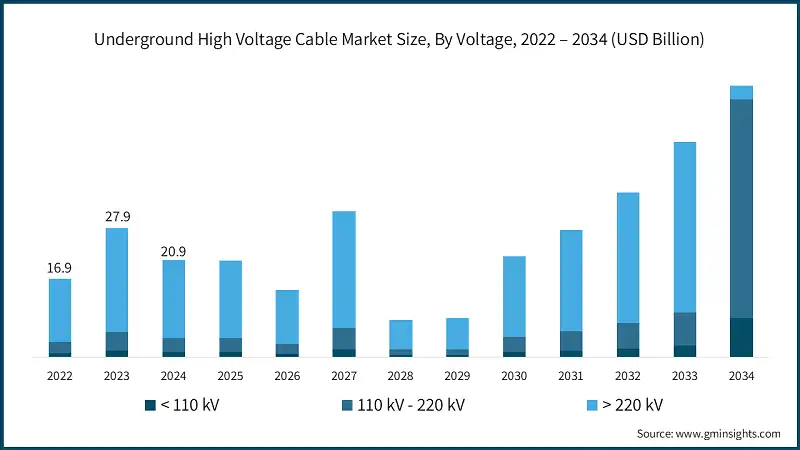
- Based on voltage, the market is trifurcated into < 110 kV, 110 kV - 220 kV and > 220 kV. The 110 kV - 220 kV of underground high voltage cable accounted for around 14.6% share in 2024 and is expected to grow at a CAGR of over 25% through 2034.
- The 110 kV to 220 kV range represents the most widely utilized voltage class in the underground high voltage cable market owing to its versatility across both transmission and high-capacity distribution applications. Utilities favor this range for inter-substation connections, medium-distance power routing, and integration of utility-scale renewables into regional grids.
- The voltage maintains a balance between power handling capability and manageable insulation and cooling requirements, making them suitable for both urban and semi-rural installations. For instance, in 2024, Spain’s Red Eléctrica undertook a major 132 kV underground transmission project to strengthen power flow between Valencia’s inland solar parks and the urban grid.
- Underground HV cables rated below 110 kV will grow at a CAGR of 26% till 2034. These are increasingly being deployed for urban and suburban power distribution networks, particularly in densely populated cities where space constraints, safety concerns, and visual impact are major considerations. These cables are ideal for connecting substations within city grids, supporting commercial zones, residential communities, and institutional campuses.
- The UG HV cable higher than 220 kV will grow at a CAGR of 15% through 2034. These cables are becoming increasingly vital in enabling long-distance, high-capacity power transmission, especially for cross-border and inter-regional grid connectivity. This voltage class is crucial for transporting bulk electricity from remote generation sources including offshore wind farms, hydroelectric dams, and large solar arrays to major consumption centers.
- The growing need for grid interconnectors across continents as witnessed in Europe and the Middle East, has significantly boosted the deployment of underground HV cables in this range. Technological advances in insulation and monitoring systems are further driving the economic feasibility and reliability of these ultra-high voltage installations.
Learn more about the key segments shaping this market
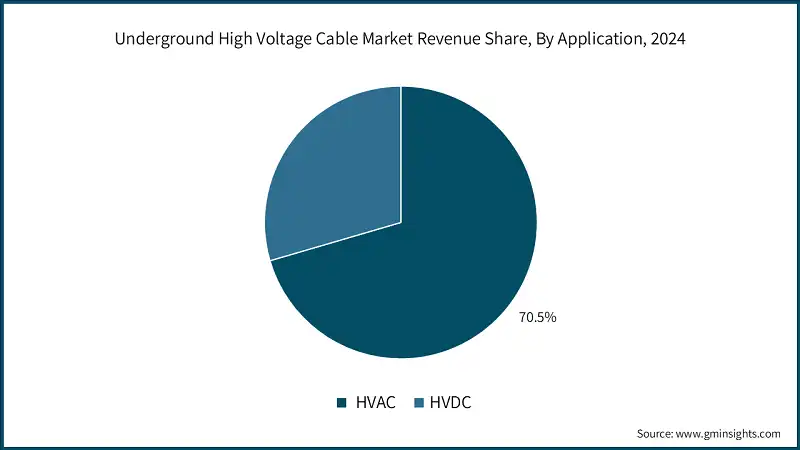
- Based on current, the underground high voltage cable market is segmented into HVAC and HVDC. HVAC dominated the market with 70.5% share in 2024 and is expected to grow at a CAGR of 21% from 2025 to 2034. High Voltage Alternating Current (HVAC) underground cables continue to dominate in medium-range transmission and urban grid applications due to their compatibility with existing AC infrastructure.
- Technological improvements in cable insulation and compact construction have made HVAC cables more cost-efficient and easier to install in congested zones. Additionally, their ability to integrate seamlessly with traditional grid assets without requiring converter stations keeps HVAC a preferred choice for local and regional applications.
- High voltage direct current (HVDC) underground cables will grow at a CAGR of 12.5% till 2034 and are witnessing increasing adoption for long-distance and ultra-high-capacity transmission projects, particularly where overhead lines face public opposition or land constraints.
- HVDC cables offer lower transmission losses over long distances and can transfer bulk power across national or regional boundaries with minimal voltage drop. For instance, in May 2025, TenneT announced large scale HVDC cable tender for offshore grid connections in the North Sea in Germany & Netherlands. The scalability, energy efficiency, and ability to connect asynchronous grids are driving strong investment into HVDC underground cable systems.
- Growing trend is the development of hybrid networks that combine HVAC and HVDC underground cables to optimize transmission over different distances and terrain types. Utilities are adopting mixed systems to balance cost-effectiveness with performance and grid compatibility. For reference, Europe’s onshore sections of offshore wind interconnectors use HVAC cables in urban zones and switch to HVDC for rural or undersea legs.
Looking for region specific data?
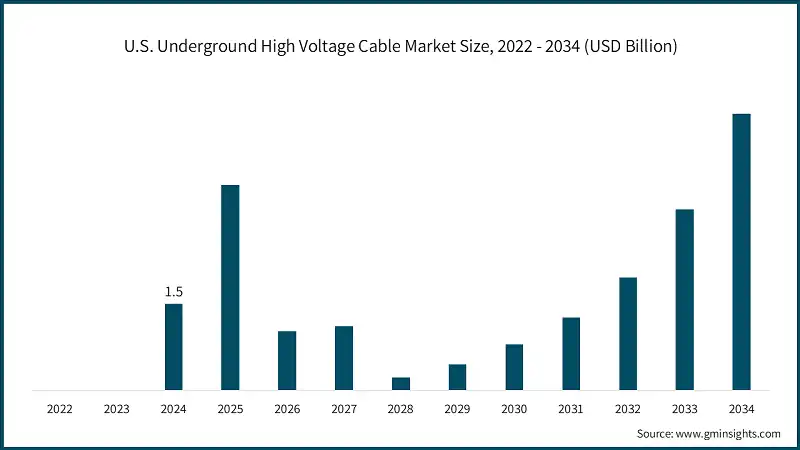
- U.S. dominated the underground high voltage cable market in North America with 50.2% share in 2024 and generated USD 1.5 billion in revenue. The underground high voltage cable market in North America is witnessing robust growth driven by grid modernization initiatives, resilience planning, and increasing urban energy demand.
- Utilities across the U.S. and Canada are shifting toward undergrounding to enhance grid reliability and reduce vulnerability to natural disasters including wildfires and hurricanes. Federal investments through programs like the Infrastructure Investment and Jobs Act (IIJA) are accelerating transmission upgrades that prioritize underground systems in densely populated or high-risk zones.
- Growing demand from data centers, electric vehicle infrastructure, and renewable energy integration is encouraging regional utilities to adopt high-capacity underground cabling to strengthen transmission corridors with minimal environmental or visual disruption.
- Europe HV cable industry will grow at a CAGR of 4% till 2034 fueled by decarbonization goals, inter-country grid interconnection projects, and strong regulatory support. Countries including Germany, UK, France, and the Netherlands are deploying underground HVDC and HVAC systems to enable cross-border energy trade, integrate offshore wind power, and reduce grid congestion in urban centers.
- For instance, in July 2025, Sumitomo Electric commenced the installation of its 525 kV XLPE HVDC underground cable for the corridor A-Nord project in Germany. The project marks an advancement step in the country's most vital energy infrastructure developments. This is further expected to augment the product installation of HV cable in other projects across the Europe region.
- Asia Pacific represented a market share of 62% in 2024 owing to rapid growth, underpinned by urbanization, industrial expansion, and a rising emphasis on grid reliability. Countries across the region with government-led electrification, investments, and smart grid programs are catalyzing the deployment of underground systems in megacities and critical economic corridors.
- For instance, in January 2025, the China State Grid announced an investment of over USD 88 billion to the country’s power grid. The investment will be focused on optimizing the power grid, strengthening distribution infrastructure, along with providing development of renewable power. This in turn will aid in the deployment of underground HV cables, thereby contributing to industry growth.
- The underground high voltage cable market in rest of world is growing steadily, supported by utility transformation projects and large-scale energy infrastructure development. Countries in the Gulf Cooperation Council (GCC), including Saudi Arabia and the United Arab Emirates, are deploying underground cables to ensure reliable power supply for expanding cities, mega projects, and industrial zones.
- New solar and wind power installations in northeast Latin America are increasingly being linked to southern demand centers through a combination of overhead and underground cabling. Furthermore, urban renewal programs and environmental considerations are pushing regional utilities to adopt underground solutions, especially in environmentally sensitive or high-density urban areas.
Underground High Voltage Cable Market Share
- The top 5 companies in the underground high voltage cable industry are Prysmian Group, Nexans, Sumitomo Electric Industries Ltd., LS Cable & System Ltd., and NKT A/S, contributing around 35% of the market in 2024.
- Prysmian Group is a global underground HV cable provider, renowned for its cutting-edge innovations in HVDC technology. The company’s 525 kV HVDC cable system exemplifies its technological prowess, offering thermoplastic insulation that enables high-temperature operation and up to 2GW power transmission capacity for both land and submarine applications.
- Nexans is a key player in the underground HV cable sector, distinguished by its focus on sustainable and high-performance cable solutions. The company has pioneered the development of 525 kV DC SF6 gas-free cable terminations, enhancing safety and environmental sustainability.
- Sumitomo Electric has established itself as a technological frontrunner in the HVDC underground cable market, particularly through its involvement in Germany’s Corridor A-Nord project. This initiative features the deployment of 525 kV XLPE-insulated HVDC cables, setting new industry benchmarks for voltage and environmental performance.
Underground High Voltage Cable Market Companies
Major players operating in the underground high voltage cable industry are:
- alfanar Group
- Brugg Kabel AG
- Ducab
- FURUKAWA ELECTRIC CO., LTD.
- Hellenic Cables
- ILJIN ELECTRIC
- Jeddah Cables
- KEI Industries Limited
- LS Cable & System Ltd.
- Nexans
- NKT A/S
- Prysmian Group
- Power Plus Cables Co. L.L.C.
- Riyadh Cable
- Southwire Company, LLC
- Sumitomo Electric Industries Ltd.
- Taihan Cable & Solution Co., Ltd.
- TF Kable
- Tratos
- Universal Cable Limited
- ZTT
- Prysmian Group, headquartered in Italy, reported a revenue of over USD 19.5 billion in the year 2024. Prysmian’s strategic investments, including over USD 500 million annually in CAPEX for production capacity and new cable-laying vessels underscore its commitment to supporting the energy transition.
- Nexans, headquartered in France, reported a sale of over USD 5 billion by Q2, 2025. Its emphasis on innovation, including collaborations with research institutions to improve HTS (high-temperature superconducting) wire performance, positions the company as a major entity in the global energy landscape.
- LS Cable & System is a South Korean manufacturer with capabilities in power cable technology. The company offers a diverse portfolio that includes extra-high voltage cables for renewable energy, industrial applications, and submarine installations. Its integrated approach spanning manufacturing, marine solutions, and communication networks positions the company in the overall cable market.
Underground High Voltage Cable Industry News
- In July 2025, Sumitomo Electric Industries, Ltd. has installed of its 525kV XLPE HVDC underground cable system for Germany’s Corridor A-Nord project, signaling a major step forward in one of the nation's key energy infrastructure initiatives. This development highlights the company’s role in advancing reliable and efficient power transmission solutions, supporting Germany’s energy transition and grid modernization goals.
- In April 2025, LS Cable & System has secured a major contract with SP PowerAssets Limited to supply 230 kV ultra-high voltage underground cables for a key transmission project in Singapore. The initiative supports the cross-border flow of solar power from Indonesia and aligns with Singapore's strategy to expand its renewable energy mix. Delivered as a turnkey solution, the project includes both manufacturing and installation of the cables, reinforcing LS Cable & System’s position in high-value energy infrastructure amid rising demand for underground grid solutions.
- In December 2024, Hengtong Group commissioned a 380 kV underground cable EPC project for Enel Group at Fusina power plant in Italy. The project underscored the company’s commitment to meeting the project timeline in Italy, which in turn added to the deployment of HV cable across Europe region, adding to the industry growth.
- In November 2024, Prysmian has secured major portions of a three-year supply agreement with France’s Transmission System Operator, RTE, for High Voltage and Extra High Voltage underground cables. This milestone highlights Prysmian’s stronghold in the European power transmission sector and reflects the ongoing strategic partnership between the two entities. The collaboration reinforces efforts to modernize and expand France’s extensive high-voltage infrastructure network.
The underground high voltage cable market research report includes in-depth coverage of the industry with estimates & forecasts in terms of revenue (USD Million) and volume (km) from 2021 to 2034, for the following segments:
Market, By Voltage
- < 110 kV
- 110 kV - 220 kV
- > 220 kV
Market, By Current
- HVAC
- HVDC
The above information is provided for the following regions and countries:
- North America
- U.S.
- Canada
- Europe
- Germany
- UK
- Asia Pacific
- China
- India
- Thailand
- Indonesia
- Rest of world
Frequently Asked Question(FAQ) :
Who are the major players in the underground high voltage cable market?
Major players include Jeddah Cables, KEI Industries Limited, LS Cable & System Ltd., Nexans, NKT A/S, Prysmian Group, Power Plus Cables Co. L.L.C., Riyadh Cable, Southwire Company, LLC, Sumitomo Electric Industries Ltd., Taihan Cable & Solution Co., Ltd., TF Kable, Tratos, Universal Cable Limited, ZTT.
What are the key trends shaping the underground high voltage cable market?
Key trends include advancements in insulation and monitoring technologies, increasing adoption of underground systems for aesthetic and safety reasons, and the integration of renewable energy sources.
Which region held the largest market share in the underground high voltage cable market in 2024?
The U.S. held a 50.2% share and generated USD 1.5 billion revenue in 2024. The grid modernization efforts, resilience planning, and rising urban energy demand are driving the country’s leadership in the market.
Which current type dominated the underground high voltage cable market in 2024?
HVAC dominated the market with a 70.5% share in 2024 and is projected to grow at a CAGR of 21% from 2025 to 2034, due to its compatibility with existing AC infrastructure.
What is the growth outlook for underground HV cables rated below 110 kV?
The underground HV cables rated below 110 kV are expected to grow at a CAGR of 26% through 2034, due to their deployment in urban and suburban power distribution networks.
What was the market share of the 110 kV - 220 kV voltage segment in 2024?
The 110 kV - 220 kV voltage segment accounted for 14.6% of the market in 2024 and is projected to grow at a CAGR of over 25% through 2034.
What is the market size of the underground high voltage cable market in 2024?
The market size was USD 20.9 billion in 2024, with a CAGR of 12.2% expected through 2034, driven by urbanization, renewable energy integration, and grid modernization.
What is the projected value of the underground high voltage cable market by 2034?
The underground high voltage cable market is expected to reach USD 58.8 billion by 2034, fueled by increasing offshore projects, micro-grid expansion, and government investments.
Underground High Voltage Cable Market Scope
Related Reports