Summary
Table of Content

Underfloor Heating Actuator Market
Get a free sample of this report
Form submitted successfully!
Error submitting form. Please try again.
Thank you!
Your inquiry has been received. Our team will reach out to you with the required details via email. To ensure that you don't miss their response, kindly remember to check your spam folder as well!
Request Sectional Data
Thank you!
Your inquiry has been received. Our team will reach out to you with the required details via email. To ensure that you don't miss their response, kindly remember to check your spam folder as well!
Form submitted successfully!
Error submitting form. Please try again.
Underfloor Heating Actuator Market Size
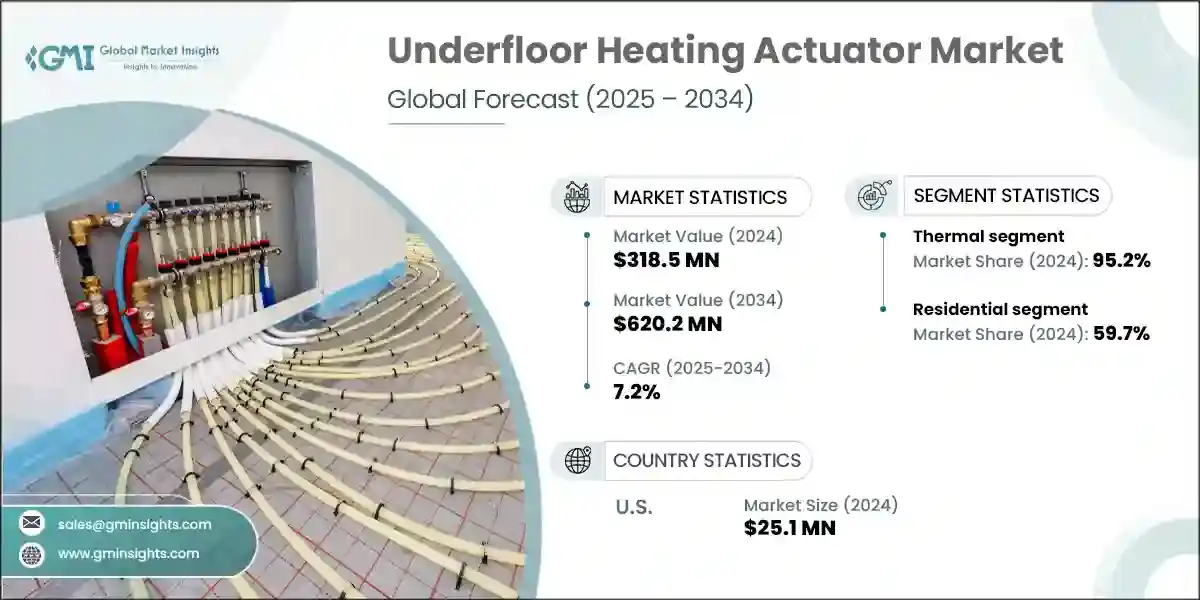
The global underfloor heating actuator market was estimated at USD 318.5 million in 2024. The market is expected to grow from USD 332.8 million in 2025 to USD 620.2 million in 2034, at a CAGR of 7.2%.
Underfloor Heating Actuator Market Key Takeaways
Market Size & Growth
- 2024 Market Size: USD 318.5 Million
- 2034 Forecast Market Size: USD 620.2 Million
- CAGR (2025–2034): 7.2%
Key Market Drivers
- Introduction of energy efficiency standards and enhanced demand for space heating.
- Extreme climatic conditions.
- Increasing standard of living.
Challenges
- High cost of retrofitting in existing buildings.
Opportunity
- Growing energy efficiency and sustainability.
- Integration of smart home & IoT integration.
- Expansion into emerging markets.
Key Players
- Market Leader: Danfoss led with over 13.5% market share in 2024.
- Leading Players: Top 5 players in this market include Honeywell, Uponor, Schneider Electric, Siemens, Danfoss, which collectively held a market share of 53.5% in 2024.
Get Market Insights & Growth Opportunities
- Significant decline in the upfront and installation cost have re-established underfloor heating from luxury to a more mainstream technology. Ongoing technological developments for small-scale, comprising kitchen & bathrooms along with large-scale applications will contribute to the business momentum.
- Actuators form an integral part of the underfloor heating system, which support the manifold with a wide range of functions to ensure both performance & efficiency of the system. Growing requirement of efficient systems to increase productivity & reduce the downtime especially in manufacturing hubs and industrial facilities will complement the demand for actuators.
- Technological advancements including maximum control accuracy, sophisticated functionality, smart control options and long service life have further influenced the product adoption. Shifting consumer trends toward energy efficient heating technologies primarily across the developing economies along with rapid economic growth will create a positive business scenario.
- For reference, In August 2021, SAUTER introduced the AXT4 valve actuator, succeeding the AXT2 series, featuring a stroke indicator for precise control. Built on SAUTER's reliable thermal technology, it ensures energy efficient control precision for various applications, including radiators, underfloor heating, chilled ceilings, and fan coil units, with an elegant design and straightforward fitting process.
- The underfloor heating actuator market was valued at USD 284.1 million in 2019 and grew at a CAGR of approximately 2.3% through 2024. Surging demand for efficient space heating specially in the extreme climatic regions coupled with growing focus on luxury fittings in residential settings will augment the market growth. Rising demand for underfloor heating systems with zoning capabilities, allows users to control heating levels in zones and individual rooms will drive the industry outlook.
- Europe region leads the market supported by product development and minimization of disruptions caused during the installations. Stringent environment regulations to limit carbon emissions and extreme climatic conditions are the key factors complementing the business landscape.
- For instance, in March 2022, Theben launched the Cheops S KNX electromotive actuator for heating and cooling control in KNX building automation. Featuring a maximum actuating force of 220 N and two binary inputs for versatility, it offers enhanced security through KNX Data Secure.
To get key market trends
Underfloor Heating Actuator Market Trends
- The service and IT sectors are expanding at an enormous rate primarily across the developing nations. For instance, in India, the service sector is anticipated to contribute 55.3% to the gross GVA in 2024-2025. In addition, the government is heavily investing toward the infrastructural development, resulting in a positive heating demand from both residential & commercial buildings.
- Increasing demand across hotels owing to rapid growth in the tourism sector will accelerate the product penetration. The growing deployment across luxury apartments on account of more space and design freedom will augment the business landscape.
- For illustration, in August 2022, nVent Electric plc, expanded its partnership with MAPEI, a top manufacturer of building industry chemical products. This collaboration integrates nVent RAYCHEM's high-quality electric underfloor heating technologies with MAPEI's extensive range of flooring installation products.
- The space heating systems market will further witness growth on account of the increasing adoption of the systems across care homes and hospitals. Unlike other heating measures, these systems provide the safest heating solutions for both commercial & residential spaces including bathrooms and kitchens. Therefore, with the growing consumer awareness and availability of competitive pricing, the underfloor heating actuator market will witness a steady growth over the forecast timeframe.
- Better utilization of the systems in small spaces including kitchen and bathrooms will enhance the industry scenario, thereby paving the way for actuators. Additionally, growing adoption of modern & advanced technologies across the smart cities coupled with rising number of green building construction projects will further complement the business dynamics will drive underfloor heating market.
- Considerable reduction in the upfront cost and installation time along with the shifting consumer trend toward better standard of living will catalyze the underfloor heating actuator market growth.
- For illustration, in September 2022, ANDRIANOS has introduced the ENGO E30NC230 thermal actuator for underfloor heating systems. It is designed for use with zone valves or thermostatic manifold valves, allowing users to control room temperature by adjusting the flow of the heating medium in the loop.
- The eminent players operating across the industry including Danfoss, Warmup, Uponor, Möhlenhoff, and Hunt Heating among others manufacture the components used in the manifolds of an underfloor heating system. To further save upon the cost and provide the consumers with competitive product prices, the firms are following backward integration strategies.
- Rising focus toward the adoption of energy efficient heating appliances and central heating systems will drive the product demand. Compliance with ongoing green building standards and government provisions toward the deployment of energy-efficient heating systems across new buildings will lead to underfloor heating actuator market growth.
- For instance, in March 2022, Theben launched the Cheops S KNX electromotive actuator for heating and cooling control in KNX building automation. Featuring a maximum actuating force of 220 N and two binary inputs for versatility, it offers enhanced security through KNX Data Secure.
Underfloor Heating Actuator Market Analysis
Learn more about the key segments shaping this market
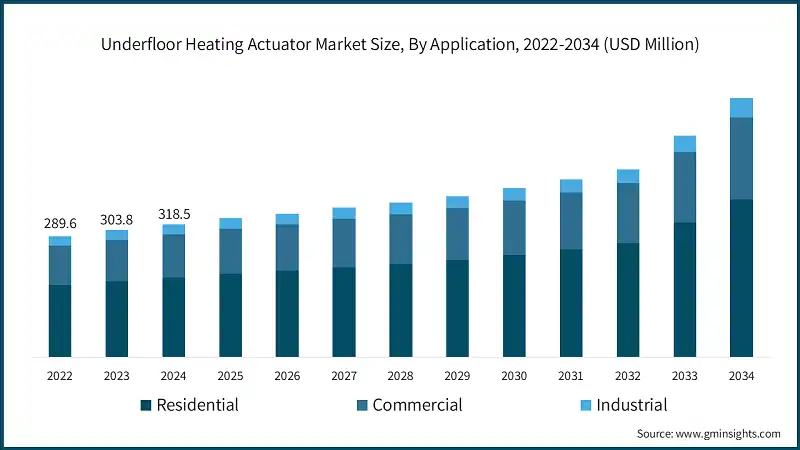
- Based on application, the industry is segmented into residential, commercial & industrial. The residential segment dominated the market accounting for 59.7% share in 2024 and is expected to grow at a CAGR of over 7% through 2034.
- Moreover, the system is utilized amongst the residential consumers owing to even heat distribution and ability to operate at moderate temperatures, thereby enabling cost savings and low power consumption. It regulates the temperature with the help of sensors and thermostats, unlike radiators which operate at 60-700C and cause overheating.
- They can provide zoned heating with the help of Wi-Fi and smart thermostats enabling up to 15% savings in the heating bills. These systems are extremely safe including no exposed heating elements and avoid the flow of dust and allergens in the air making them ideal for multifamily application.
- The commercial underfloor heating actuator market will project at a CAGR of over 6.5% till 2034. Increasing demand across high end buildings and domestic establishments owing to key benefits including comfortable heating and invisible deployment eliminating the limitations while setting the furniture or maintaining the home décor.
- Rising number of green building projects, ongoing construction of commercial areas along with significant cost savings in long run is anticipated to influence the demand for actuators. Furthermore, they are deployed across establishments requiring comfort heating solutions, thereby driving the market growth.
- For reference, in April 2025, Danfoss and Assemblin Caverion Group entered in a framework agreement to accelerate the decarbonization of buildings. Further, the collaboration aims to deliver benefits to customers, including energy savings, a reduced carbon footprint, enhanced end-user satisfaction, optimized building performance and indoor comfort.
- The underfloor heating actuator market in the industrial sector will grow at a rate of 6.6% till 2034. Stringent government policies to check the growing carbon emissions along with long term energy efficiency targets have compelled the industries to adopt sustainable and efficient ways of heating. Growing demand from industries on account of efficient performance and controlled heating further provide a tremendous growth opportunity for the industry.
- The top two segments, residential and commercial collectively account for over 90% of the total market value, signaling a highly concentrated structure on account of rapid industrialization and development of new manufacturing facilities.
Learn more about the key segments shaping this market
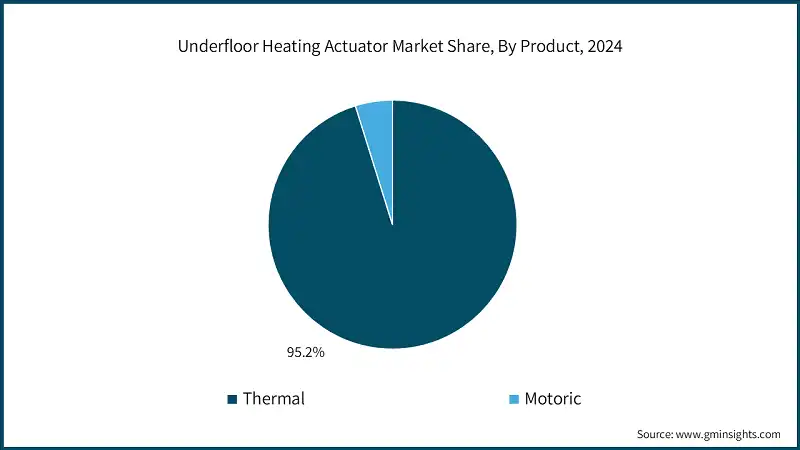
- Based on product, the underfloor heating actuator market is segmented into thermal and motoric. The thermal segment dominates the market with 95.2% share in 2024 and is expected to grow at a CAGR of over 7% from 2025 to 2034.
- Modern features including feedback channel, superior control accuracy, and valve path accuracy along with easy assembly and attractive designs will augment the market landscape. Ongoing R&D activities will further support the industry players in developing the component modular structure, thereby boosting the product adoption.
- The motoric holds 4.8% market share in 2024 with over 7% CAGR till 2034. The motoric actuators are widely adopted owing to their precision control and monitoring, cost effectiveness and greater efficiency. Many leading industry players engage in the manufacture of motoric actuators owing to their growing precedence over thermal and hydraulic actuators.
- Ongoing advancements including improvements in motor performance, communication protocols, and compatibility with other building automation systems will augment the product penetration. In addition, building regulations and standards aimed at improving energy efficiency and comfort will further influence the penetration of motoric actuators.
- For reference, in May 2025, Danfoss along with E.ON One introduced an all-in-one solution for intelligent heating optimization, combining both software and hardware, saving up to 30% energy. It further reduces significant CO2 emissions for new and existing buildings.
Looking for region specific data?
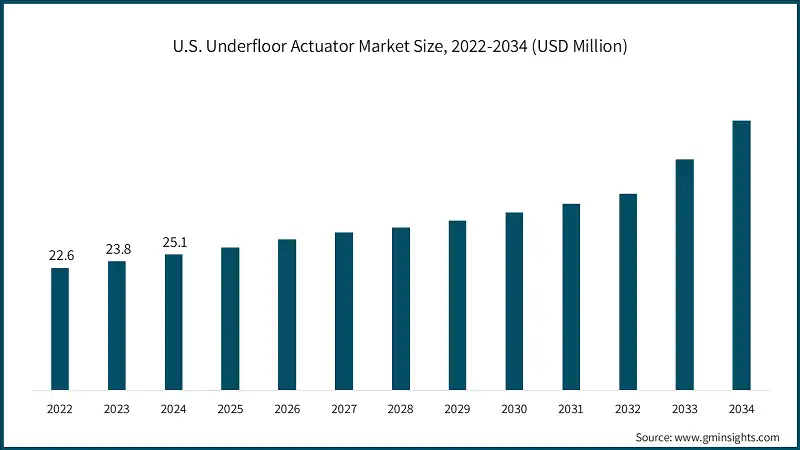
- The U.S. in the underfloor heating actuator market in North America held around 7.9% market share in 2024 and generated USD 25.1 million in revenue. The U.S. government has laid various building codes and directives pertaining to the installation of energy efficient heating systems which will propel the business landscape.
- The North America underfloor heating actuator market is projected to surge over USD 64.2 million by 2034. Growing adoption of renewables to improve the carbon footprint and comply with the government policies will support the business expansion. Rising investments in construction to strengthen the commercial sector along with widespread adoption by the multifamily units across the U.S. and Canada will drive the market growth.
- Increasing consumer spending for the residential renovation projects along with growing customer inclination toward home décor and designing will strengthen the business growth. Rising investments in construction to strengthen the commercial sector along with widespread adoption by the multifamily units across the U.S. and Canada will drive the market growth.
- The Europe underfloor heating actuator market was evaluated at USD 205.6 million in 2024 governed by stringent building standards and codes pertaining to energy efficiency. Increasing concerns toward energy savings and increasing electricity bills have fueled the business growth. Increasing consumer awareness pertaining to the long-term benefits of the system including significant cost savings, low running cost and higher efficiency will drive business growth.
- For reference, In March 2022, Danfoss launched the A5 Series Electronic Valve Actuators including the ABNM A5 and ABRA A5 models. These are further designed to electrically control valves in chilled and hot water systems for reduced energy consumption.
- The Asia Pacific underfloor heating actuator hold a market share of 23.4% in 2024. Ongoing integration with smart home technology coupled with growing requirement for better indoor comfort and energy efficiency across commercial establishments will stimulate the business landscape.
- The China underfloor heating actuator industry holds the largest share in the region on account of its rapid shift to energy efficient building solutions. Further, government incentives supporting various retrofit programs, will boost the demand for underfloor heating systems, thereby driving the business scenario.
- The Middle East & Africa underfloor heating actuator market is set to reach over USD 5 million by 2034. Continuous innovation to improve the design, installation, and performance of the UH systems, including the development of thinner heating mats and easier-to-install systems will drive the market outlook. In addition, increasing competition amongst manufacturers & suppliers will lead to better product offerings, thereby strengthening the market scenario.
Underfloor Heating Actuator Market Share
- The top 5 companies in the underfloor heating actuator industry are Honeywell, Uponor, Siemens, Danfoss and Schneider Electric with around 53.5% of the market in 2024.
- Honeywell has a platform-driven smart building strategy that combines hardware, software, and connected services. The company’s core advantage lies in its interoperable architecture, which allows both its floor heating controllers and actuators to integrate into smart home ecosystems. Further, in 2024 & 2025, the company introduced its intelligent underfloor actuator kits along with deployment of performance-based service models in commercial industry, thereby enhancing its customer base across North America and Europe.
- Continuous investments in research & development to provide units integrated with high-end technology and improved mechanism along with efforts to manufacture efficient and effective systems to reduce the overall operational costs have resulted in ground-breaking innovations in the underfloor heating actuators market. Moreover, reinforcement of stringent designing and testing mandates coupled with the integration of advanced control systems will further complement the business outlook.
- Heatmiser maintains a strategic foothold through its strong global presence in key emerging economies. The company launched its UH8-RF v2 actuator platform to support 8-zone UFH control, equipped with advanced scheduling via app and simplified installation.
- The underfloor heating actuator market is highly diversified with the availability of multiple manufacturers building a range of energy-efficient appliances, enabling significant cost and energy savings. Innovations across the industry are majorly driven by three factors including the introduction of stringent energy efficiency policies, low-cost manufacturing, and reduction in installation time. Furthermore, the advent of digitalization and growing inclination toward the adoption of smart technologies will further lead to the development of innovative heating solutions.
Underfloor Heating Actuator Market Companies
- In 2024, Belimo recorded USD 1.18 billion in net sales, making a 9.9% year-over-year increase, with robust growth in control valves and sustained market leadership in HVAC actuators. Moreover, the company maintained a strong backlog position along with continued investment in cloud-integrated commissioning tools and smart actuator platforms.
- In 2024, Möhlenhoff reported an estimated USD 11.5 million in annual actuator-related orders, representing stable year-over-year performance with growth led by new OEM partnerships and exports to Eastern Europe. In addition, the company expanded its motoric actuator line equipped with enhanced compatibility and energy efficiency along with Modbus protocols, thereby supporting increased demand for smart heating controls.
- In 2024, Danfoss reported USD 10.5 billion in global sales, with contributions from its Climate Solutions segment, which includes smart hydronic balancing systems and thermal actuators. Additionally, in 2025, the company implemented its localization drive in India with more than USD 60 million in investment to scale actuator manufacturing.
Major players operating in the underfloor heating actuator market are:
- Belimo
- Danfoss
- Uponor
- Eberle Controls
- Emerson Electric
- Honeywell International
- Hunt Heating
- Heatmiser
- Intatec
- Johnson Controls
- Möhlenhoff
- Oventrop
- Pentair
- Polypipe
- SMLGHVAC
- Sauter
- Siemens
- Schlüter-Systems
- Schneider Electric
- Warmup
Underfloor Heating Actuator Market Report Attributes
| Key Takeaway | Details |
|---|---|
| Market Size & Growth | |
| Base Year | 2024 |
| Market Size in 2024 | USD 318.5 Million |
| Forecast Period 2025 – 2034 CAGR | 7.2% |
| Market Size in 2034 | USD 620.2 Million |
| Key Market Trends | |
| Drivers | Impact |
| Introduction of energy efficiency standards and enhanced demand for space heating | Drives sustained demand building energy codes and standards to limit the carbon emissions and reduce energy loss across the domestic and commercial establishments. |
| Extreme climatic conditions | Boosts market revenue through surging customer demand for floor space heating. |
| Increasing standard of living | Higher consumer spending along with increasing investments toward technological advancements and product developments. |
| Pitfalls & Challenges | Impact |
| High cost of retrofitting in existing buildings | Poses a long-term threat to the product market share as it depends on the accessibility of the subfloor and the extent to which the floor needs to be removed for installation. |
| Opportunities: | Impact |
| Growing energy efficiency and sustainability | Creates demand for energy‑efficient heating, combined with sustainability goals that optimize heat delivery and minimize wastage. |
| Integration of smart home & IoT integration | Growing integration with smart home ecosystems will support with remote control, and demand response features. |
| Expansion into emerging markets | Drives long-term product adoption owing to rapid urbanization, and new construction projects. |
| Market Leaders (2024) | |
| Market Leaders |
13.5% market share |
| Top Players |
Collective market share in 2024 is 53.5% |
| Competitive Edge |
|
| Regional Insights | |
| Largest Market | Asia Pacific |
| Fastest Growing Market | Middle East & Africa |
| Emerging Country | U.S., China, Saudi Arabia, UAE & Qatar |
| Future outlook |
|
What are the growth opportunities in this market?
Underfloor Heating Actuator Industry News
- In February 2025, Danfoss showcased a wide range of energy efficient solutions including Icon2 and Ally smart heating control ecosystems for multi-zone systems. Further, they are integrated via the Ally App to provide intelligent balancing, enhanced energy efficiency and seamless configuration across the hydronic HVAC systems.
- In April 2025, Schneider Electric South Africa, introduced the full variety of innovative EasyLogic and SpaceLogic actuators and ball valves. These are further designed to optimize HVAC system performance, reducing operational costs and ensuring energy efficiency. Moreover, the products reflect the company’s commitment to excellence and sustainability in energy management.
- In December 2024, Danfoss made USD 5.7 Million investment to ramp up the Make-in-India manufacturing for heat-exchanger components, HVAC compressors, and controls including both motorized and thermal actuators. It will further minimize the company’s dependence on imports for the Indian market. In addition, the company plans to increase local production from 50% to 80–90% by 2025 and further expand its distribution across more than 80 cities to support the regional demand.
- In June 2023, Ambiente exhibited new products to support both cooling and heating circuits. The self-balancing actuator reduces the requirement for a complete system design. Moreover, the additional costs are repaid directly with the installation due to the time savings. Further, it allows the integration of AI, thereby making the installations quicker and easier.
The underfloor heating actuator market research report includes in-depth coverage of the industry with estimates & forecast in terms of revenue and volume (USD Million & ‘000 Units) from 2021 to 2034, for the following segments:
Market, By Product
- Thermal
- Motoric
Market, By Application
- Residential
- Commercial
- Industrial
The above information has been provided for the following regions and countries:
Frequently Asked Question(FAQ) :
What is the market size of the underfloor heating actuator industry in 2024?
The market size was USD 318.5 million in 2024, with a CAGR of 7.2% expected through 2034 driven by technological advancements and energy-efficient heating demand across residential and commercial spaces.
What is the projected value of the underfloor heating actuator market by 2034?
The market is expected to reach USD 620.2 million by 2034, expanding at a, supported by rising smart home integration and green building adoption.
How much revenue did the residential application segment generate in 2024?
The residential segment accounted for 59.7% of the revenue share in 2024, due to high demand for energy-efficient space heating solutions.
What was the valuation of the thermal segment in 2024?
The thermal actuator segment dominated the market with a 95.2% share in 2024, driven by its affordability and high adoption in residential heating systems.
What is the growth outlook for the motoric actuator segment through 2034?
Motoric actuators are expected to grow at over 7% CAGR through 2034, fueled by enhanced energy efficiency, precision control, and compatibility with smart building systems.
Which region leads the underfloor heating actuator market?
The U.S. held 7.9% share, generating USD 25.1 million in 2024, led by energy-efficiency regulations and building codes.
What are the upcoming trends in the underfloor heating actuator market?
Key trends include integration with smart home systems, IoT-enabled remote control, and deployment in green buildings, especially across luxury residential and healthcare sectors.
Who are the key players in the underfloor heating actuator market?
Top players include Belimo, Danfoss, Uponor, Eberle Controls, Emerson Electric, Honeywell International, Hunt Heating, Heatmiser, Intatec, Johnson Controls.
Underfloor Heating Actuator Market Scope
Related Reports