Summary
Table of Content

Ultrasonic Heat Meters Market
Get a free sample of this report
Form submitted successfully!
Error submitting form. Please try again.
Thank you!
Your inquiry has been received. Our team will reach out to you with the required details via email. To ensure that you don't miss their response, kindly remember to check your spam folder as well!
Request Sectional Data
Thank you!
Your inquiry has been received. Our team will reach out to you with the required details via email. To ensure that you don't miss their response, kindly remember to check your spam folder as well!
Form submitted successfully!
Error submitting form. Please try again.
Ultrasonic Heat Meters Market Size
- An ultrasonic heat meter is a device used to measure the amount of thermal energy consumed or transferred through a fluid, typically water, in heating or cooling systems. It operates based on the principle of ultrasonic sound waves to determine the flow rate of the fluid and the temperature difference between two points, which are then used to calculate the thermal energy.
- Development of technologically advanced heating infrastructure to meet the demand for real-time monitoring of heat consumption patterns is set to augment the business landscape. These meters are commonly used in district heating systems, HVAC systems, industrial processes, and residential buildings for energy metering. Furthermore, distinct advantages including presence of no moving parts, high accuracy in flow measurement, minimal maintenance requirements and non-invasive installation will stimulate the product penetration.
- Surging investments in infrastructure along with growing emphasis on renewable heating systems will stimulate the product demand. Key features including precise data measurement along with ongoing adoption of enhanced and sustainable energy systems will reshape the industry dynamics. Furthermore, emphasis on utilizing efficient and sustainable heat management systems, primarily those offering real-time data monitoring will bolster the industry outlook.
The ultrasonic heat meters market was valued USD 2.54 billion in 2025. The market is set to grow from USD 2.65 billion in 2026 and is estimated to USD 4.3 billion by 2035, at a CAGR of 5.5%, according to Global Market Insights, Inc.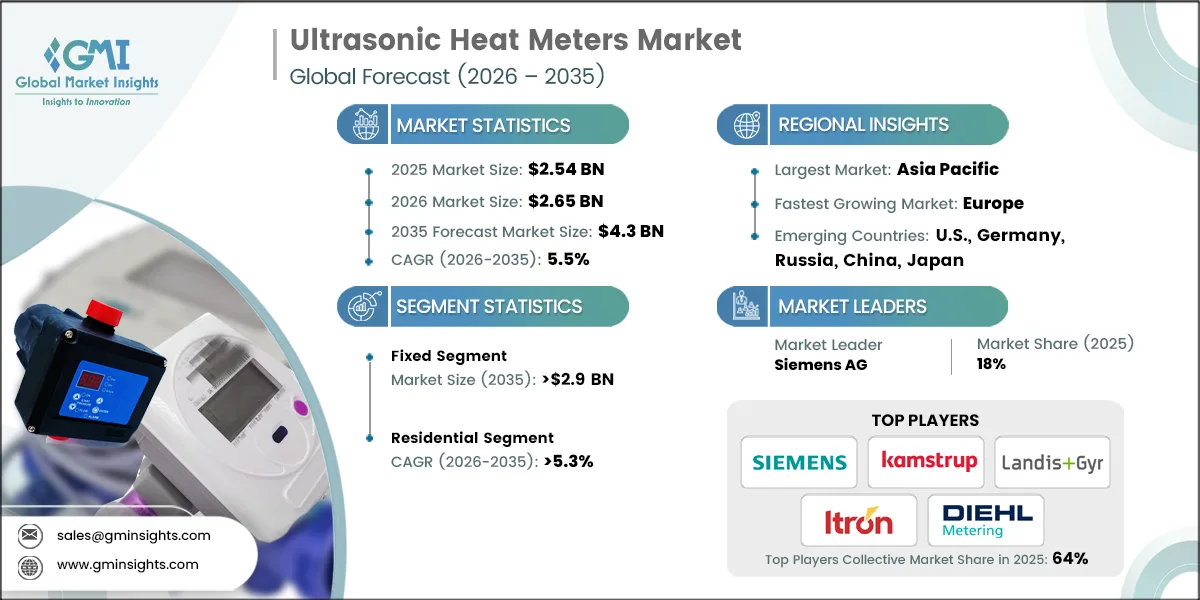
Ultrasonic Heat Meters Market Key Takeaways
Market Size & Growth
- 2025 Market Size: USD 2.54 Billion
- 2026 Market Size: USD 2.65 Billion
- 2035 Forecast Market Size: USD 4.3 Billion
- CAGR (2026–2035): 5.5%
Regional Dominance
- Largest Market: Asia Pacific
- Fastest Growing Region: Europe
Key Market Drivers
- Favorable regulatory framework for carbon emission reduction.
- Modern technological advancements.
- Large scale adoption of district heating systems.
Challenges
- Privacy Concerns.
Opportunity
- Expansion in smart and connected buildings.
- Growth in District Heating and Cooling Networks.
Key Players
- Market Leader: Siemens AG led with over 18% market share in 2025.
- Leading Players: Top 5 players in this market include Siemens AG, Kamstrup, Landis+Gyr, Itron, Diehl Metering, which collectively held a market share of 64% in 2025.
Get Market Insights & Growth Opportunities
To get key market trends
Ultrasonic Heat Meters Market Trends
- Increasing demand for reliable and efficient sub-metering solutions along with strict government policies for the installation of heating units in residential buildings will drive the business scenario. In addition, the advanced design of ultrasonic heat meters, emphasizing cost-effective solutions along with intelligent heating infrastructure, is anticipated to complement the market growth.
Ultrasonic Heat Meters Market Analysis
Learn more about the key segments shaping this market
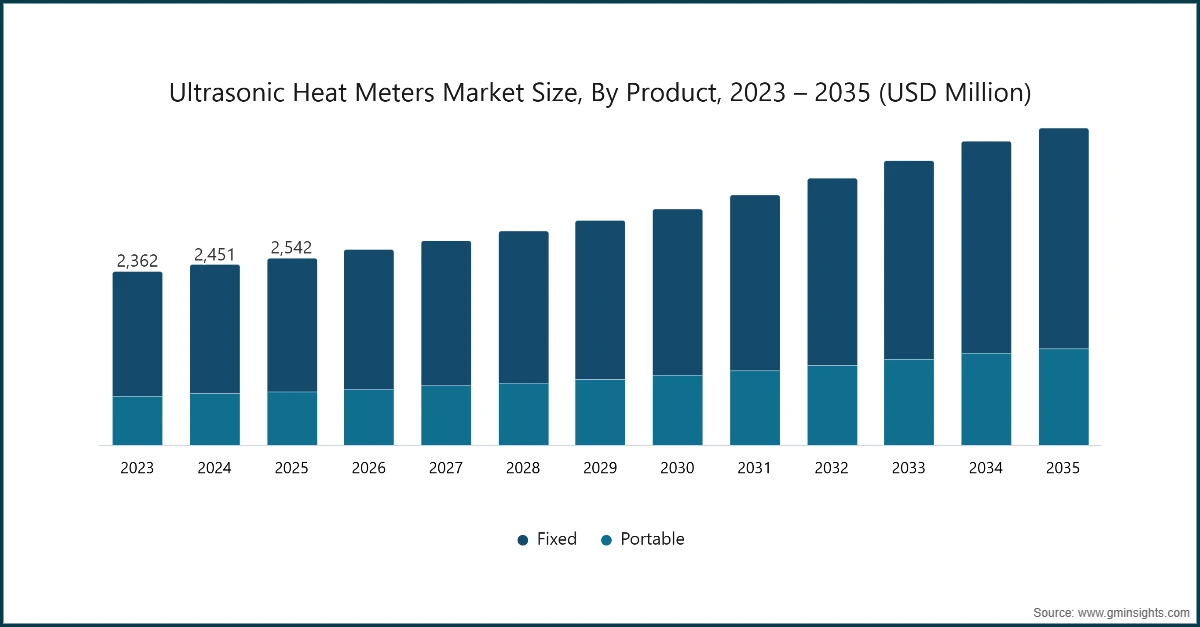
Based on product, the ultrasonic heat meters market is segmented into fixed and portable. Fixed is anticipated to grow over USD 2.9 billion by 2035 on account of key advantages comprising of high precision, enhanced accuracy, easy installation, and no pressure loss.
- Rising investments for advanced energy management technologies along with ongoing construction projects to upgrade the building infrastructure will simulate the product penetration. Moreover, rapid industrialization and shifting manufacturer focus on renewable alternatives including hybrid technologies, will strengthen the market growth.
Learn more about the key segments shaping this market
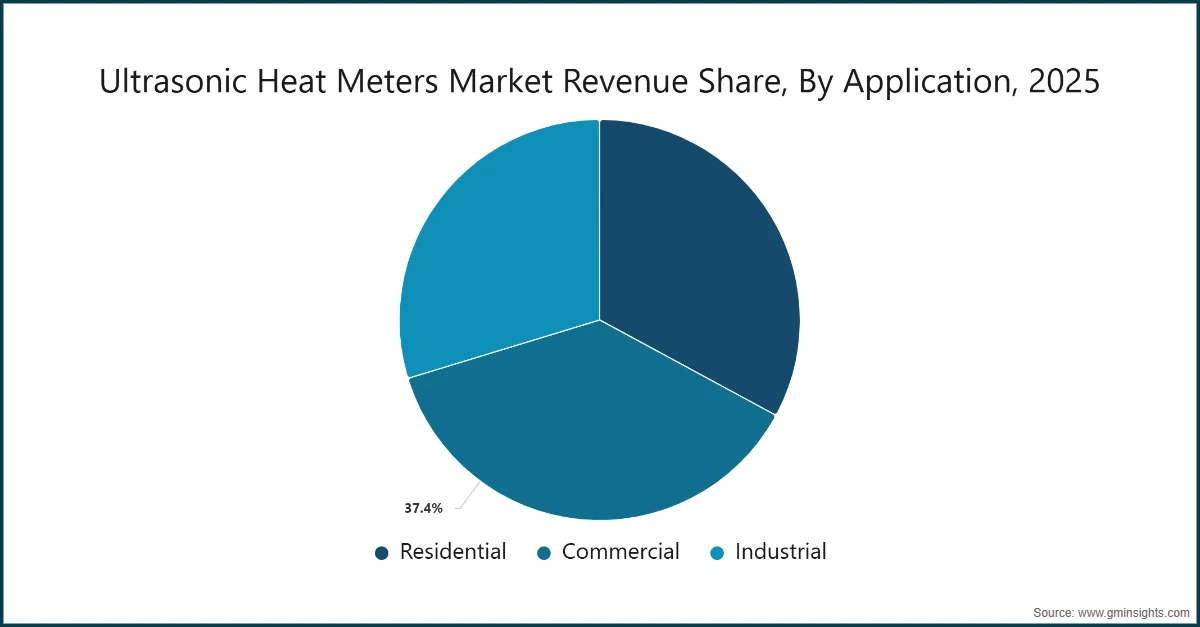
Based on application, the ultrasonic heat meters market is bifurcated into residential, commercial and industrial.
- Residential is anticipated to grow over CAGR 5.3% by 2035. Growing industrialization across the developing economies coupled with new building construction activities will positively impact the business landscape. The residential sector is set to expand, owing to precise planning and monitoring of heat consumption across various single and multi-family apartments. Surging demand for heat monitoring along with focus on personalized billing systems is anticipated to stimulate the market statistics.
Looking for region specific data?
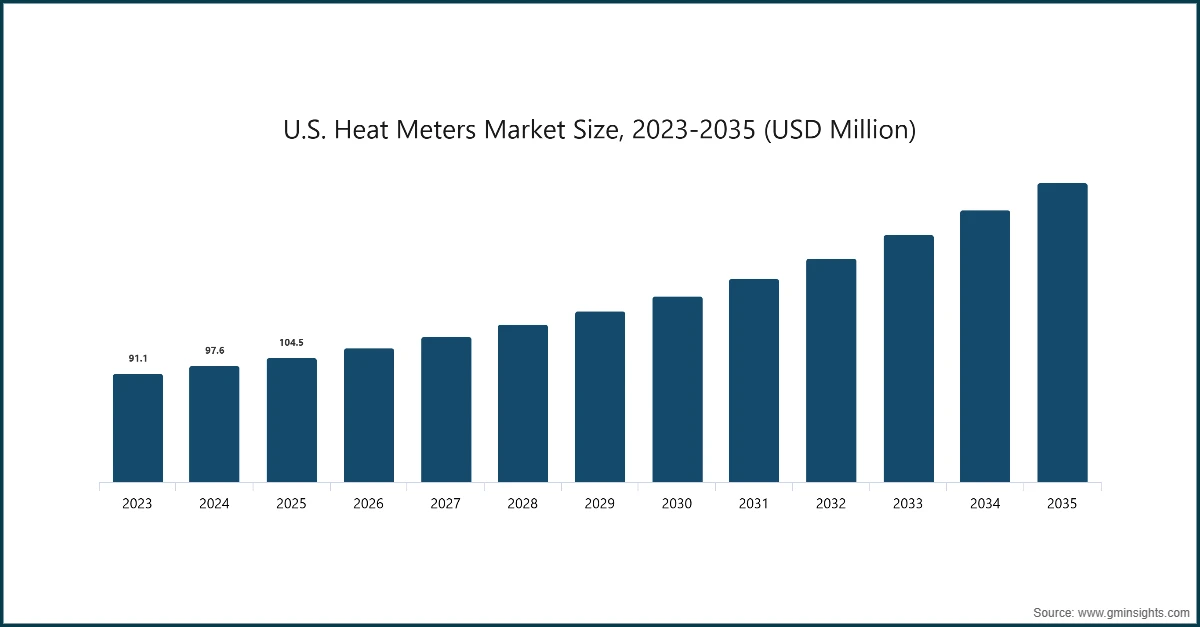
The U.S. ultrasonic heat meters market is anticipated to grow more than USD 160 million by 2035 on account of varying ownership structures and rising energy prices.
- Stringent renewable energy targets and emission control norms set by regulatory authorities will boost investments, augmenting the business landscape. Rising demand for real time data monitoring and individualized billing of heat consumption will encourage the product deployment. Further, the expansion of smart energy management technology will create significant opportunities for the key players, thereby transforming the market landscape.
Ultrasonic Heat Meters Market Share
- Modern technological advancements, regulatory mandates and policies, a global shift towards sustainable energy solutions and increasing energy efficiency demands will drive the market outlook. Ongoing collaboration of governments with private companies to establish and deploy heat metering infrastructure will complement the business landscape. Moreover, surging growth ventures to standardize metering technologies and protocols will ensure scalability and interoperability augmenting the product demand.
Ultrasonic Heat Meters Market Companies
Eminent players operating in the ultrasonic heat meters industry are:
- Apator S.A.
- Axioma Metering UAB
- Badger Meter
- BMETERS
- Caleffi S.p.A.
- Danfoss
- Diehl Stiftung & Co. KG
- Engelmann Sensor GmbH
- GWF MessSysteme
- Honeywell International
- iCenta Controls
- ista Energy Solutions Limited
- Itron
- Kamstrup
- Landis+Gyr AG
- Metron FMC
- QUNDIS GmbH
- Siemens
- Smarthome
- ZENNER International GmbH & Co. KG
Ultrasonic Heat Meters Market Report Attributes
| Key Takeaway | Details |
|---|---|
| Market Size & Growth | |
| Base Year | 2025 |
| Market Size in 2025 | USD 2.54 Billion |
| Market Size in 2026 | USD 2.65 Billion |
| Forecast Period 2026-2035 CAGR | 5.5% |
| Market Size in 2035 | USD 4.3 Billion |
| Key Market Trends | |
| Drivers | Impact |
| Favorable regulatory framework for carbon emission reduction | Government regulations and international standards promoting energy efficiency and carbon reduction will lead to market growth. They enable accurate sub-metering and energy tracking, helping operators comply with these regulations while also reducing operational costs. Further, the regulators increasingly mandate precise energy monitoring in both commercial and residential settings, surging the demand for advanced metering solutions. |
| Modern technological advancements | Recent technological innovations in ultrasonic cooling meters including high-precision flow measurement, non-intrusive installation, and integration with IoT-enabled energy management platforms will complement the business landscape. The adoption of smart meters also enables utilities and facility managers to optimize cooling system performance, reduce wastage, and improve billing accuracy, driving market growth. |
| Large scale adoption of district heating systems | Ultrasonic cooling meters are ideal for these systems because they can measure thermal energy consumption precisely without interfering with the flow of water, even in large networks. Expanding district heating infrastructure across cities and industrial complexes along with growing requirement for reliable energy measurement and fair billing mechanisms will lead to market growth. |
| Pitfalls & Challenges | Impact |
| Privacy Concerns | Ultrasonic heat meters increasingly incorporate IoT connectivity, wireless communication, and cloud-based energy management platforms and collect vast amounts of consumption data. They help utilities optimize energy distribution and enables precise billing, raising significant privacy concerns among consumers. Moreover, as the market shifts toward smart buildings and integrated energy management systems, the volume of data generated grows exponentially, making it increasingly challenging to ensure secure storage, transmission, and processing. |
| Opportunities: | Impact |
| Expansion in smart and connected buildings | The ultrasonic heat meters with integrated digital communication capabilities can provide accurate data for automated energy optimization and predictive maintenance, supporting building owners and facility managers for real-time monitoring and precise control over energy consumption. Growing demand in new construction projects along with retrofit activities will enable manufacturers to provide high-value smart metering solutions that support both energy efficiency and operational cost savings. |
| Growth in District Heating and Cooling Networks | Rapid urbanization and the expansion of district heating and cooling systems create a significant market opportunity for ultrasonic heat meters. Growing investment in sustainable and efficient thermal energy distribution across cities and industrial complexes will enable precise consumption-based billing, improving energy efficiency, and supporting carbon reduction goals, making them an attractive investment for utilities and energy service providers. |
| Market Leaders (2025) | |
| Market Leader |
18% market share |
| Top Players |
Collective market share in 2025 is 64% |
| Competitive Edge |
|
| Regional Insights | |
| Largest Market | Asia Pacific |
| Fastest growing market | Europe |
| Emerging countries | U.S., Germany, Russia, China, Japan |
| Future outlook |
|
What are the growth opportunities in this market?
Ultrasonic Heat Meters Industry News:
- In September 2025, Kamstrup along with BD Smart Forsyning will reinforce its position to provide user-friendly communication and software solutions for the utility sector. BD Smart is further focussed on open communication platforms and compatibility with existing utility systems. Both the companies aim to build a strong platform for innovation and development, providing digital solutions.
- Oulun Energia selected Kamstrup as its supplier for district heating measurement devices and reading services. It will further utilize NB-IoT technology for energy meters along with the company’s READy reading service, to form a secure and forward-looking solution.
- In 2024, Diehl Metering acquired PREVENTIO, a startup majorly focused in leakage management and predictive maintenance. This will enable the company to enhance its Analytics & Services portfolio, complementing its Energy forecast management, thereby providing robust tools to customers to manage resources effectively and efficiently.
- In 2022, Diehl Metering Sweden entered in an agreement with Sinfra, a purchasing agency for heating networks. This framework contract, centered on heat metering products, aiming to enhance the company's presence in the Swedish market.
The ultrasonic heat meters market research report includes an in-depth coverage of the industry with estimates & forecast in terms of revenue and volume in “USD Million and ‘000 Units” from 2022 to 2035, for the following segments:
Market, By Product
- Fixed
- Portable
Market, By Application
- Residential
- Commercial
- College/University
- Office Building
- Government Building
- Others
- Industrial
The above information has been provided for the following regions and countries:
- North America
- U.S.
- Canada
- Europe
- Germany
- Poland
- Sweden
- Denmark
- Finland
- Italy
- UK
- Asia Pacific
- China
- Japan
- South Korea
- Rest of World
Frequently Asked Question(FAQ) :
What was the market size of the ultrasonic heat meters in 2025?
The market size was USD 2.54 billion in 2025, growing at a CAGR of 5.5% through 2035. Growth is driven by the increasing adoption of efficient sub-metering solutions and advancements in intelligent heating infrastructure.
What is the projected value of the ultrasonic heat meters market by 2035?
The market is poised to reach USD 4.3 billion by 2035, fueled by rising demand for cost-effective and precise heating solutions.
What is the expected size of the ultrasonic heat meters industry in 2026?
The market size is projected to reach USD 2.65 billion in 2026.
What is the growth outlook for the fixed ultrasonic heat meters segment by 2035?
The fixed ultrasonic heat meters segment is anticipated to surpass USD 2.9 billion by 2035, supported by advantages such as high precision, enhanced accuracy, easy installation, and no pressure loss.
What is the growth outlook for the residential segment in the market?
The residential segment is expected to grow at a CAGR of 5.3% through 2035, driven by industrialization in developing economies and increased construction of new buildings.
What is the projected growth of the U.S. ultrasonic heat meters sector by 2035?
The U.S. market is set to grow by over USD 160 million by 2035, supported by varying ownership structures and rising energy prices.
What are the key trends in the ultrasonic heat meters market?
Key trends include adoption of intelligent heating infrastructure, cost-effective designs, smart metering integration, and compliance with government policies for heating unit installations in residential buildings.
Who are the key players in the ultrasonic heat meters industry?
Key players include Apator S.A., Axioma Metering UAB, Badger Meter, BMETERS, Caleffi S.p.A., Danfoss, Diehl Stiftung & Co. KG, Engelmann Sensor GmbH, and GWF MessSysteme.
Ultrasonic Heat Meters Market Scope
Related Reports