Summary
Table of Content

Ultrasonic Cooling Meters Market
Get a free sample of this report
Form submitted successfully!
Error submitting form. Please try again.
Thank you!
Your inquiry has been received. Our team will reach out to you with the required details via email. To ensure that you don't miss their response, kindly remember to check your spam folder as well!
Request Sectional Data
Thank you!
Your inquiry has been received. Our team will reach out to you with the required details via email. To ensure that you don't miss their response, kindly remember to check your spam folder as well!
Form submitted successfully!
Error submitting form. Please try again.
Ultrasonic Cooling Meters Market Size
- Ultrasonic cooling meters are used to measure the energy consumption in systems that use water or other liquids as cooling agents. Their operation involves sending and receiving sound waves through the liquid flowing in the system.
- These meters with their precise measurements support in optimizing energy use and monitor and manage energy consumption. Ongoing energy efficiency standards by the government along with the ability to comply with these regulations by providing accurate data on cooling energy usage will stimulate the industry dynamics. Furthermore, integration of ultrasonic cooling meters into smart metering systems allows for real-time monitoring and remote data access will accelerate the industry dynamics.
- Rising digitalization and Internet of Things (IoT) in building management systems will augment the product adoption. They can easily connect to digital platforms to provide comprehensive energy management. Moreover, rapid urbanization in developing countries will complement the business landscape. Increasing adoption of district cooling as part of their sustainability initiatives along with use of ultrasonic meters for large-scale applications including district cooling systems will boost the industry statistics.
The ultrasonic cooling meters market size was valued USD 926.3 million in 2025. The market is anticipated to grow from USD 976.1 million in 2026 to USD 1.65 billion by 2035, at a CAGR of 6.1%, according to Global Market Insights, Inc.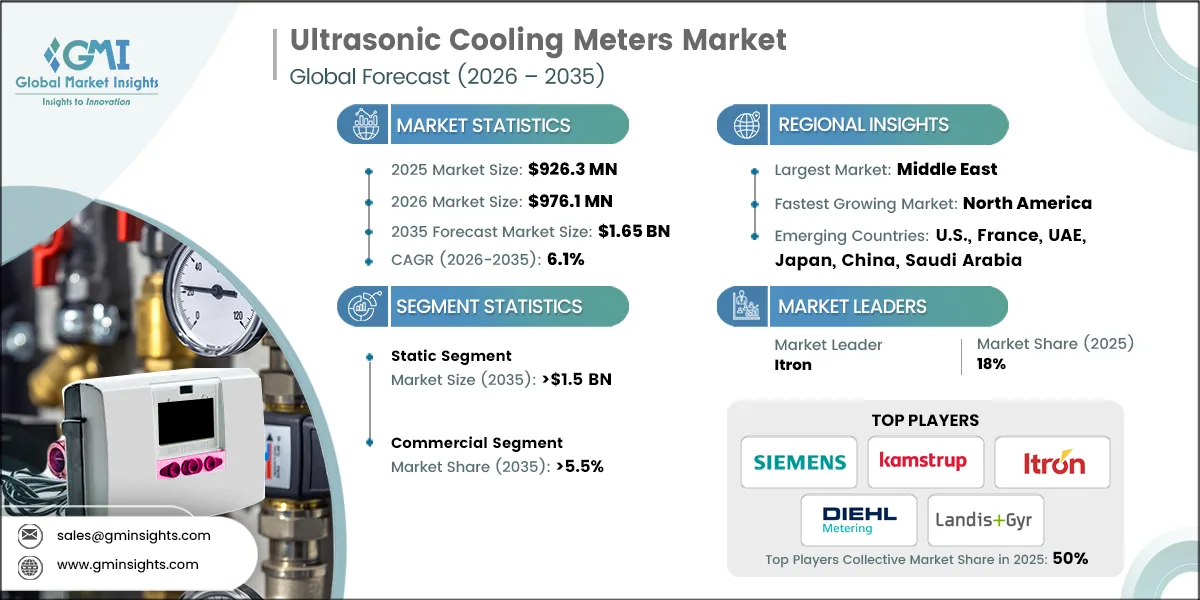
Ultrasonic Cooling Meters Market Key Takeaways
Market Size & Growth
- 2025 Market Size: USD 926.3 Million
- 2026 Market Size: USD 976.1 Million
- 2035 Forecast Market Size: USD 1.65 Billion
- CAGR (2026–2035): 6.1%
Regional Dominance
- Largest Market: Middle East
- Fastest Growing Region: North America
Key Market Drivers
- Technological advancements.
- Growth in district cooling systems.
- Increasing demand for energy efficiency.
Challenges
- High initial costs.
Opportunity
- Smart Home and IoT Integration.
- Expansion in emerging markets.
Key Players
- Market Leader: Itron led with over 18% market share in 2025.
- Leading Players: Top 5 players in this market include Siemens, Kamstrup, Itron, Diehl Metering, Landis+Gyr, which collectively held a market share of 50% in 2025.
Get Market Insights & Growth Opportunities
To get key market trends
Ultrasonic Cooling Meters Market Trends
- Ultrasonic meters have no moving parts and are less prone to wear and tear in comparison to mechanical meters. This leads to lower maintenance costs over longer duration, which will complement the product penetration. Further, enhanced durability, longer operational lifespan, along with reduced frequency of replacements and associated costs, will enhance their cost competitiveness in the long term. Ongoing introduction of subsidies, incentives, and tax breaks to adopt energy-efficient technologies will drive the industry outlook.
Ultrasonic Cooling Meters Market Analysis
Learn more about the key segments shaping this market
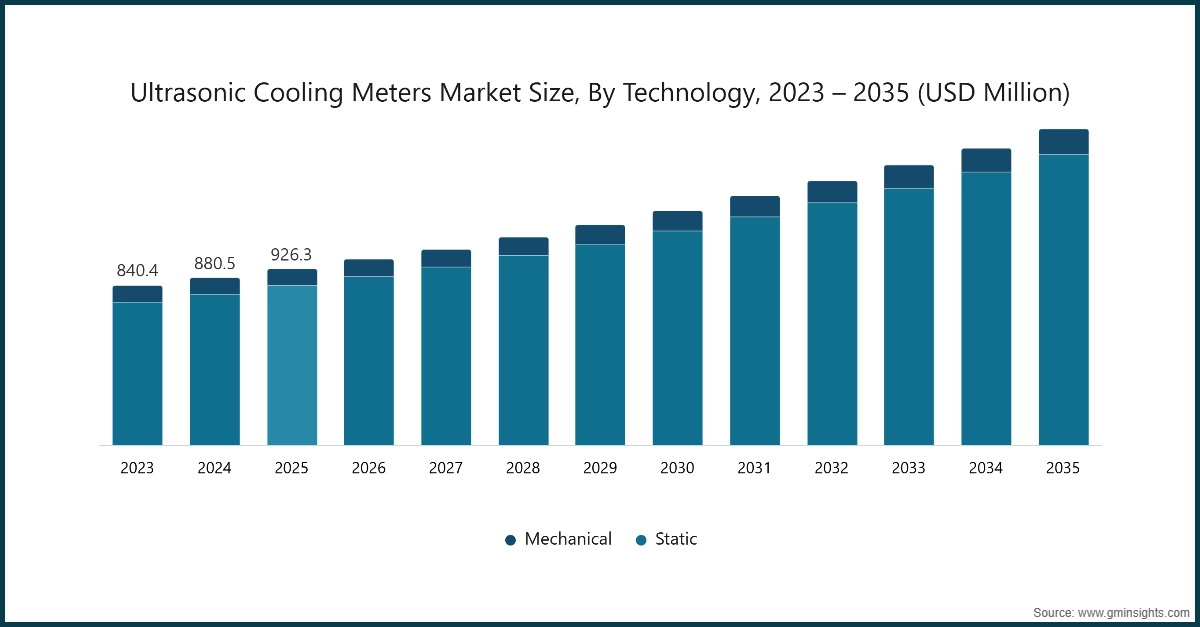
Based on technology, the ultrasonic cooling meters market is segmented into mechanical and static.
- Static is anticipated to grow by more than USD 1.5 billion by 2035 on account of high accuracy in measuring flow and energy consumption. Key factor including high precision is important primarily for district cooling applications which will foster the industry growth. Small inaccuracies in the systems can lead to significant financial losses and inefficiencies.
- Furthermore, the meters are more dependable and have a longer operational life in comparison to mechanical meters. This reliability further enables industries to have consistent and accurate data over extended periods, positively impacting the market growth.
Learn more about the key segments shaping this market
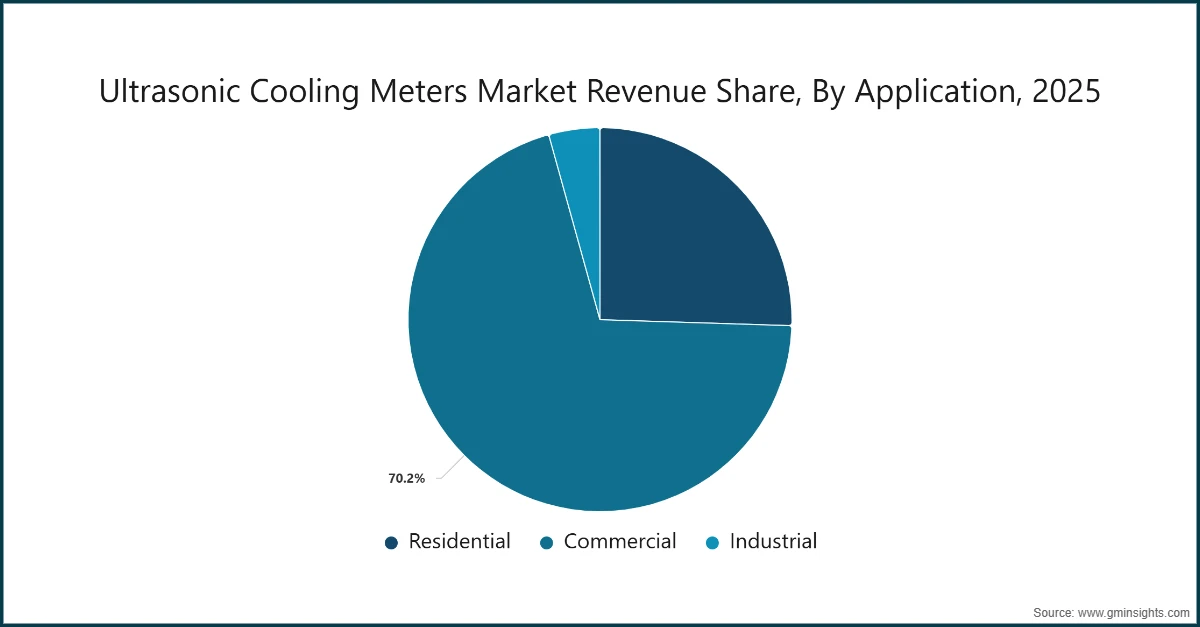
Based on application, the ultrasonic cooling meters market is segmented into residential, commercial and industrial.
- Commercial is set to grow more than 5.5% by 2035. Cooling accounts for a major portion of energy consumption. The meters provide exact data on energy usage, enabling consumers to optimize their HVAC systems, thereby reducing energy waste, and operational costs.
- Growing utilization in energy audits to identify inefficiencies in cooling systems to upgrade equipment or adjust system settings, will lead to enhanced energy performance and better cost savings swaying the industry trends. Additionally, ongoing integration into smart building systems will strengthen the market outlook.
Looking for region specific data?
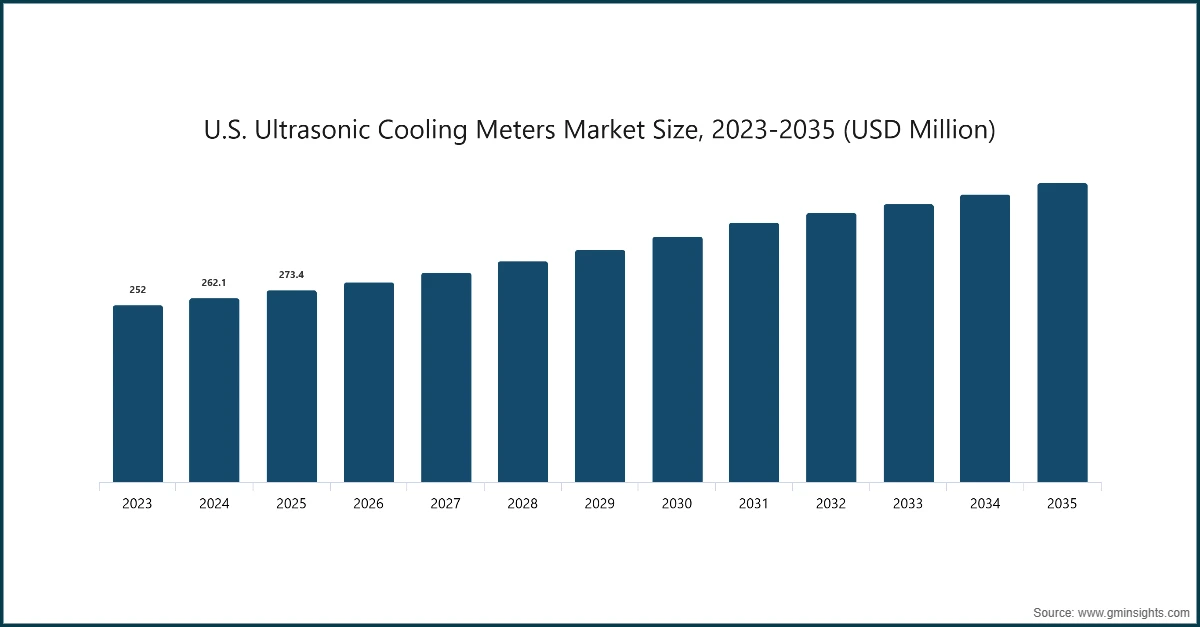
U.S. ultrasonic cooling meters market is set to grow more than USD 425 million by 2035.
- Growing implementation of stringent energy efficiency regulations along with enforcement of building energy codes that mandate the use of precise energy metering, including cooling meters, in commercial and residential buildings will stimulate the industry trend.
- The integration of cooling meters with smart building management systems (BMS) allows for real-time monitoring, automated controls, and data-driven energy optimization will positively impact the industry growth. In addition, rise of IoT (Internet of Things) technologies in the region have accelerated the adoption of smart meters, including cooling meters which will stimulate the industry landscape.
Ultrasonic Cooling Meters Market Share
- The industry is dynamic and rapidly evolving driven by technological advancements, regulatory mandates and policies, increasing focus on energy efficiency and sustainability coupled with rapid technological advancements. Strategic partnerships, acquisition and mergers among the leading players along with extensive development of projects through closed collaborations will sway the business scenario.
Ultrasonic Cooling Meters Market Companies
Eminent players operating in the ultrasonic cooling meters industry are:
- Axioma Metering
- BMETERS Srl
- Diehl Stiftung & Co. KG
- Danfoss
- Engelmann Sensor GmbH
- Honeywell International Inc.
- Ista Energy Solutions
- Itron Inc.
- Kamstrup A/S
- Landis+Gyr
- QUNDIS GmbH
- Secure Meters Ltd.
- Schneider Electric
- Siemens AG
- Sontex SA
- Techem GmbH
- Wasion Group
- Zenner International GmbH & Co. KG
- Zelsius GmbH
Ultrasonic Cooling Meters Market Report Attributes
| Key Takeaway | Details |
|---|---|
| Market Size & Growth | |
| Base Year | 2025 |
| Market Size in 2025 | USD 926.3 Million |
| Market Size in 2026 | USD 976.1 Million |
| Forecast Period 2026-2035 CAGR | 6.1% |
| Market Size in 2035 | USD 1.65 Billion |
| Key Market Trends | |
| Drivers | Impact |
| Technological advancements | Modern ultrasonic meters support real time remote monitoring, cloud connectivity, and smart building integration, enabling utilities and building managers to track consumption, detect leaks, and optimize energy use efficiently. Their compact, non-intrusive design simplifies installation, while features like self-diagnostics and predictive maintenance lower operational costs, augmenting the market growth. |
| Growth in district cooling systems | Hot climates and rising temperatures are increasing the demand for reliable cooling solutions in residential, commercial, and industrial buildings. Cooling meters play a crucial role by monitoring energy use, optimizing system performance, and helping to manage costs, which boosts adoption in these regions. |
| Increasing demand for energy efficiency | Constant efforts to reduce energy consumption, lower carbon emissions, and improve overall building efficiency, by governments, businesses, and property owners will contribute to market growth. Cooling meters support in measuring and tracking the actual amount of energy used for chilled water systems and air conditioning, making it easier to monitor performance and identify waste, driving the business momentum. |
| Pitfalls & Challenges | Impact |
| High initial costs | Ultrasonic meters involve advanced sensors, digital electronics, and smart communication modules, which make their upfront price significantly higher than conventional alternatives. The upfront cost often outweighs perceived operational benefits, restricting the growth despite its advantages in performance and reliability. |
| Opportunities: | Impact |
| Smart Home and IoT Integration | There’s a growing opportunity to integrate residential cooling meters with smart home systems and Internet of Things (IoT) platforms. Connected meters that send real‑time usage data to mobile apps or home automation hubs help homeowners monitor and control cooling energy consumption more effectively. This integration appeals to energy‑conscious consumers and supports demand‑response programs, creating new value beyond simple measurement. |
| Expansion in emerging markets | Rapid urbanization and industrial growth in Asia Pacific, Latin America, and the Middle East are driving the requirement for efficient cooling solutions. Many manufacturers, thus have the opportunity to capture market share by targeting these high growth regions. |
| Market Leaders (2025) | |
| Market Leader |
18% market share |
| Top Players |
Collective market share in 2025 is 50% |
| Competitive Edge |
|
| Regional Insights | |
| Largest Market | Middle East |
| Fastest growing market | North America |
| Emerging countries | U.S., France, UAE, Japan, China, Saudi Arabia |
| Future outlook |
|
What are the growth opportunities in this market?
Ultrasonic Cooling Meters Industry News
- In September 2025, Kamstrup acquired BD Smart Forsyning, known for its flexible communication and integration capabilities. This will support the company provide user-friendly software and communication solutions for the utilities sector. both the companies, through this synergy, will build a strong platform for innovation and development.
- In September 2023, ZENNER International GmbH & Co. KG and Minol ZENNER Connect entered in a partnership agreement with given municipal utilities, energy suppliers, municipalities, and the housing industry with an all-inclusive infrastructure to digitalize the energy conversion.
- In December 2023, Xylem Inc. unveiled a new residential electric meter with progressed grid edge abilities. The Stratus IQ+™ meter from Sensus, is getting the grid to next level smart. Its robust processor and enlarged data set choices enable utilities to pull more system diagnostics than ever before, providing them with a powerful health check of their distribution system and elevated concern about the clientele's electricity usage.
The ultrasonic cooling meters market research report includes an in-depth coverage of the industry with estimates & forecast in terms of volume and revenue in “USD Million & MW” from 2022 to 2035, for the following segments:
Market, By Technology
- Mechanical
- Static
Market, By Application
- Residential
- Commercial
- College/University
- Office Building
- Government Building
- Others
- Industrial
The above information has been provided for the following regions and countries:
- North America
- U.S.
- Canada
- Europe
- Germany
- Poland
- Sweden
- Italy
- France
- Finland
- Austria
- Norway
- Asia Pacific
- China
- Japan
- South Korea
- Singapore
- India
- Middle East
- Saudi Arabia
- UAE
- Qatar
- Oman
- Kuwait
- Rest of World
Frequently Asked Question(FAQ) :
What is the market size of the ultrasonic cooling meters in 2025?
The market size was valued at USD 926.3 million in 2025, with a CAGR of 6.1% expected through 2035. The demand is driven by the adoption of energy-efficient technologies and the advantages of ultrasonic meters over mechanical counterparts.
What is the projected value of the ultrasonic cooling meters market by 2035?
The market is poised to reach USD 1.65 billion by 2035, fueled by increasing integration into smart building systems and the growing need for precise energy metering.
What is the expected size of the ultrasonic cooling meters industry in 2026?
The market size is projected to reach USD 976.1 million in 2026.
What is the growth outlook for the static ultrasonic meters segment by 2035?
The static ultrasonic meters segment is anticipated to grow by more than USD 1.5 billion by 2035, led by high accuracy in measuring flow and energy consumption, particularly in district cooling applications.
What is the growth outlook for the commercial segment by 2035?
The commercial segment is set to grow by more than 5.5% by 2035, supported by the need to optimize HVAC systems, reduce energy waste, and enhance energy performance through energy audits and smart building integration.
What is the projected growth of the U.S. ultrasonic cooling meters sector by 2035?
The U.S. market is expected to grow by more than USD 425 million by 2035, propelled by stringent energy efficiency regulations, building energy codes, and the adoption of IoT technologies for smart metering.
What are the upcoming trends in the ultrasonic cooling meters market?
Trends include energy-efficient technologies, smart building integration, real-time monitoring, automated controls, and IoT-enabled smart meters.
Who are the key players in the ultrasonic cooling meters industry?
Key players include Axioma Metering, BMETERS Srl, Diehl Stiftung & Co. KG, Danfoss, Engelmann Sensor GmbH, Honeywell International Inc., Ista Energy Solutions, Itron Inc., Kamstrup A/S, and Landis+Gyr.
Ultrasonic Cooling Meters Market Scope
Related Reports