Summary
Table of Content

Ultra-Fast EV Charging (350kW+) Systems Market
Get a free sample of this report
Form submitted successfully!
Error submitting form. Please try again.
Thank you!
Your inquiry has been received. Our team will reach out to you with the required details via email. To ensure that you don't miss their response, kindly remember to check your spam folder as well!
Request Sectional Data
Thank you!
Your inquiry has been received. Our team will reach out to you with the required details via email. To ensure that you don't miss their response, kindly remember to check your spam folder as well!
Form submitted successfully!
Error submitting form. Please try again.
Ultra-Fast EV Charging Systems Market Size
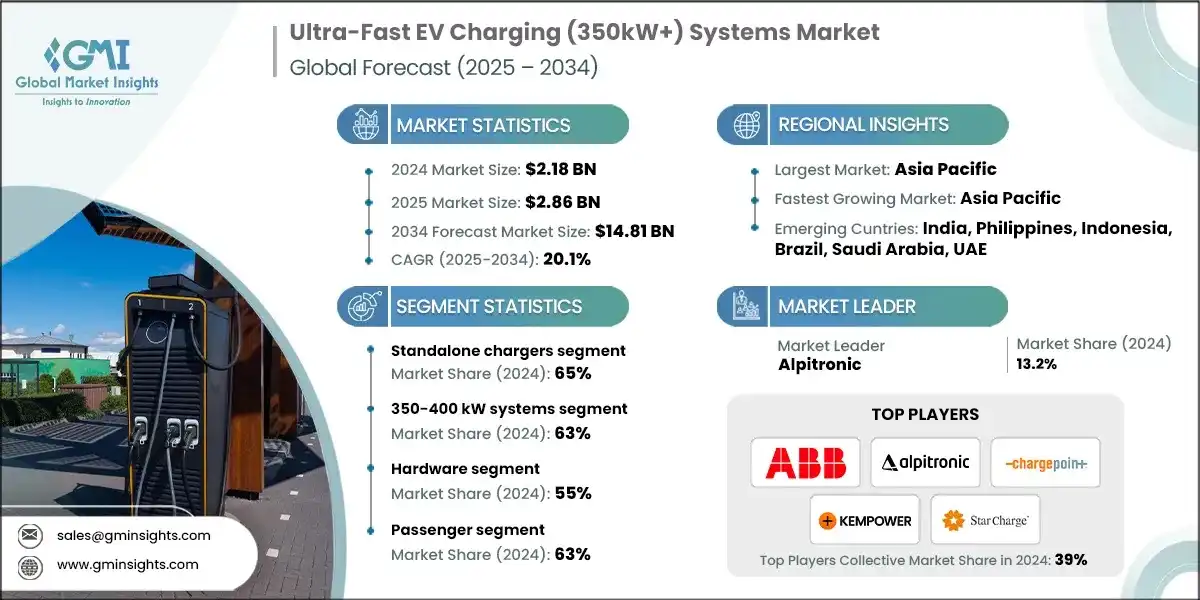
The global ultra-fast EV charging systems market was estimated at USD 2.18 billion in 2024. The market is expected to grow from USD 2.86 billion in 2025 to USD 14.81 billion in 2034, at a CAGR of 20.1%, according to latest report published by Global Market Insights Inc.
Ultra-Fast EV Charging (350kW+) Systems Market Key Takeaways
Market Size & Growth
- 2024 Market Size: USD 2.18 Billion
- 2025 Market Size: USD 2.86 Billion
- 2034 Forecast Market Size: USD 14.81 Billion
- CAGR (2025–2034): 20.1%
Regional Dominance
- Largest Market: Asia Pacific
- Fastest Growing Region: Asia Pacific
Key Market Drivers
- Surge in global EV adoption across passenger and commercial segments.
- Increase in government funding and infrastructure incentives for ultra-fast charging deployment.
- Rise in OEM and charging network collaborations for large-scale rollouts.
- Growth in advancements of power electronics, converters, and thermal management technologies.
Challenges
- High capital expenditure and installation costs for ultra-fast charging infrastructure.
- Limited grid capacity and energy supply challenges in several regions.
Opportunity
- Increase in integration of energy storage and renewables with ultra-fast chargers.
- Rise in ultra-fast charging deployment across emerging and developing markets.
- Growth in demand for dedicated fleet and logistics charging hubs.
- Surge in development of modular, multi-port, and scalable charging systems.
Key Players
- Leading Players: Top 5 players in this market include ABB, Alpitronic, ChargePoint, Kempower, StarCharge, which collectively held a market share of 39% in 2024.
Get Market Insights & Growth Opportunities
The pace of the growth of the ultra-fast EV charging (350kW+) systems market is transforming the electric vehicle infrastructure across the world. These are high power chargers that help the drivers to charge 80 percent of battery in less than 20 minutes in compatible vehicles, thereby cutting down the downtime and enhancing the overall rates of EV adoption. The 350kW+ chargers are essential in both passenger and commercial EV market segments by enabling high-voltage operation, scalable modular designs and efficient thermal management.
As an example, in July 2025, ABB E-mobility and Edison Next have joined forces to advance the retail EV charging experience in Italy. It takes the form of a partnership launching the C50 charger at the Il Castagno retail store, with 50kW power output, branded interface and 100 percent renewed energy, as a component of the Early Adopter Program of ABB.
Moreover, according to the International Energy Agency (IEA), global electric vehicle (EV) sales reached 17 million units in 2024, reflecting the accelerating adoption of EVs worldwide. This surge in EV deployment is directly driving demand for ultra-fast EV charging (350kW+) systems, as high-power chargers are essential to support faster charging times and meet the needs of growing EV fleets.
Charger manufacturers, power electronics suppliers and utility partners are making strategic investments that are simplifying technology integration, lowering cost per installation and enhancing reliability. Firms such as ABB and others like Alpitronic, Kempower, Delta Electronics and StarCharge are currently rolling out modular and multi-port ultra-fast chargers and component suppliers such as Infineon, Siemens and Heliox are supplying inverters, DC/DC converters and thermal management solutions optimized to high-power operation. Combined actions between these stakeholders enhancing energy effectiveness, place scalability and grid accommodability of ultra-fast charging webs all over the world.
For example, in February 2025, EVgo implemented 7,500 ultra-fast DCFC stalls in the United States with charging rates of up to 500 kW to commercial fleet and passenger EVs. Likewise, IONITY increased the range of 350kW+ range of major European highways, allowing EV owners to travel long distances without compromising on reliability and waiting time. Such deployments are establishing the standard of future high-speed charging systems in the world.
The COVID-19 pandemic increased infrastructure development indirectly because governments have focused on low-emission mobility, sustainability, and clean transportation, thus introducing more incentives towards high-power charging networks. Together with the increasing EV adoption, this has led to the need to have 350 kW and above charging systems that can accommodate both the passenger and commercial cars.
The adoption of ultra-fast chargers is the most developed in North America and Europe because of the advanced EV policies, federal and regional incentives, robust OEM alliances, as well as the availability of established networks, including EVgo, ChargePoint, and IONITY. Fleets of companies, such as logistics and delivery trucks, are using ultra-fast charging hubs to their benefit when it comes to efficiency.
The Asia-Pacific is the most rapidly developing market of 350kW+ chargers due to the high rate of EV uptake in China, South Korea, and Japan. Ultra-fast DCFC networks are also being supported by local OEMs and battery manufacturers, such as BYD, NIO, CATL, and LG Energy Solution, to facilitate a large-scale implementation. The ultra-fast EV charging technology is taking a global center in Asia-Pacific due to the cost-efficient local production and massive installations.
To get key market trends
Ultra-Fast EV Charging Systems Market Trends
- Global deployment of ultra-fast charging networks is accelerating, particularly along major highways and metropolitan corridors. Infrastructure providers and governments are prioritizing 350kW+ systems to reduce charging times and support long-distance EV travel. This trend enhances convenience for drivers and expands interoperability between high-power charging stations and next-generation EVs.
- For instance, in March 2025, Chinese EV giant BYD unveiled its “Super e-Platform” with up to 1,000 kW peak charging power, enabling a claimed 400 km (~249 miles) of range from a five-minute charge. BYD also announced plans to build over 4,000 ultra-fast charging stations across China.
- There is a growing shift toward integrating ultra-fast charging systems with renewable power sources like solar and wind. Smart grid integration enables demand balancing, peak load management, and energy storage optimization. This trend aligns decarbonization goals and enhances energy efficiency while reducing reliance on traditional fossil-fuel-based grids.
- Commercial fleet operators, logistics companies, and public transportation providers are rapidly adopting 350kW+ ultra-fast chargers to minimize downtime. Electrification of delivery vans, buses, and heavy-duty trucks drives demand for high-throughput systems. This trend supports fleet efficiency, operational cost savings, and emission reduction in urban and intercity mobility.
- Emerging megawatt-class chargers are revolutionizing charging for electric trucks, buses, and industrial vehicles. These systems, exceeding 350kW, enable ultra-fast turnaround and efficient energy transfer. Technological advancements by key players are setting new standards for heavy-duty EV charging, paving the way for broader commercial electrification globally.
Ultra-Fast EV Charging Systems Market Analysis
Learn more about the key segments shaping this market
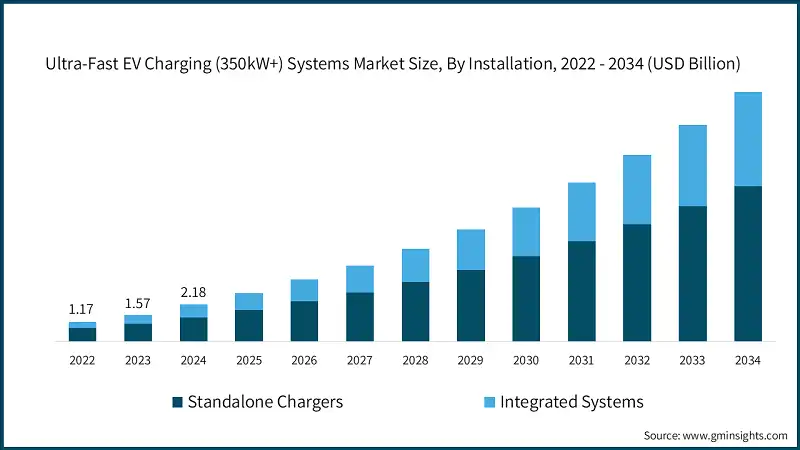
Based on installation, the market is divided into standalone chargers, and integrated systems. The standalone chargers segment accounted for around 65% share in 2024 and is expected to grow at a CAGR of more than 20.5% through 2034.
- The standalone chargers segment dominates the ultra-fast EV charging (350kW+) systems market due to their widespread deployment flexibility, lower installation complexity, and suitability for public and highway charging networks. These chargers can operate independently without requiring integration into large-scale infrastructure systems, making them ideal for deployment across service stations, rest areas, and retail hubs. Their ability to provide ultra-fast charging speeds of 350 kW and above meets the growing demand for quick turnaround times among EV users.
- Furthermore, standalone ultra-fast chargers are increasingly being adopted by charging network operators such as ABB, Siemens, and Tritium, who are focusing on scalable, plug-and-play designs that reduce operational costs. Many government-funded infrastructure projects particularly in Europe, China, and North America are prioritizing standalone systems to accelerate EV adoption and achieve nationwide fast-charging coverage.
- For example, in May 2024, ABB announced the deployment of its Terra HP 350 kW standalone chargers at three public U.S. locations for Electrify America. These future-proof units support vehicles up to 1,000 V and reflect the growing dominance of standalone ultra-fast charging systems in the market.
- The integrated systems segment in the ultra-fast EV charging (350kW+) systems market is expected to grow at a CAGR of over 21.2% through 2034, due to the increasing demand for smart, interconnected, and grid-responsive charging solutions. Integrated systems combine hardware, software, and energy management platforms, allowing real-time monitoring, load balancing, and predictive maintenance. This integration optimizes power distribution and ensures charging stability, especially in large commercial and public networks.
Learn more about the key segments shaping this market
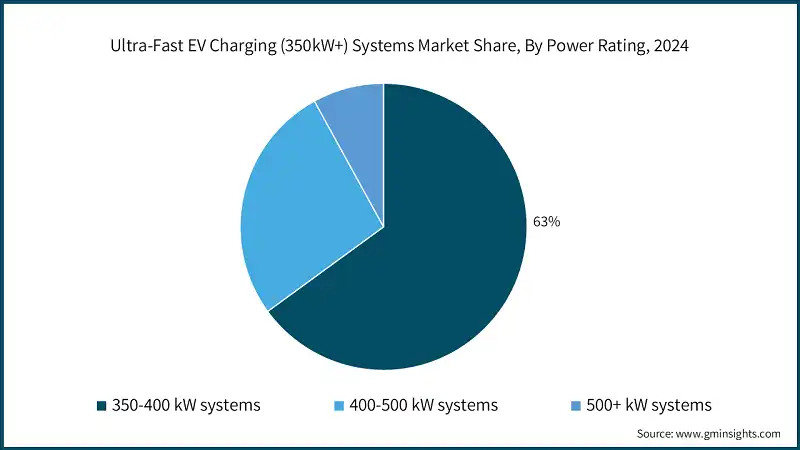
Based on power rating, the ultra-fast EV charging (350kW+) systems market is segmented into 350-400 kW systems, 400-500 kW systems, and 500+ kW systems. The 350-400 kW systems segment dominated around 63% share in 2024 and is expected to grow at a CAGR of over 20.5% from 2025-2034.
- The 350-400 kW systems segment holds the largest market share in the ultra-fast EV charging (350kW+) systems industry due to its balanced cost-performance ratio and compatibility with most 800 V EV architectures. These chargers deliver optimal charging speeds capable of replenishing 70-80% battery capacity in under 20 minutes making them ideal for both passenger and light commercial vehicles. Their ability to serve a broad range of EV models has driven strong adoption across public and highway charging networks globally.
- Additionally, major infrastructure providers such as ABB, Siemens, Kempower, and Tritium are standardizing 350 kW systems as the industry benchmark for ultra-fast charging. Governments and private operators are also prioritizing this range in funding programs and network expansions due to its grid efficiency, reliability, and proven technological maturity compared to higher-capacity systems still under deployment.
- In March 2024, Siemens AG launched its new SICHARGE D 400 kW fast-charger variant, designed for IEC markets. The unit delivers up to 400 kW DC and can charge up to four vehicles simultaneously via one grid connection, targeting highway and public-fast-charging applications.
- The 500+ kW systems segment will grow with a CAGR of more than 22.6% through 2034, owing to the rising deployment of next-generation ultra-fast chargers designed to support high-voltage (800V-1000V) EV architectures used in premium and commercial vehicles. Increasing demand for reduced charging times—targeting sub-10-minute sessions by automakers like Porsche, Hyundai, BYD, and Tesla is accelerating adoption.
Based on component, the ultra-fast EV charging (350kW+) systems market is segmented into hardware, software, and services. The hardware segment dominated with around 55% share in 2024 due to due to the high capital investment and critical role of physical infrastructure such as charging units, power modules, cooling systems, connectors, and grid interfaces.
- The hardware segment dominates the market owing to its essential role in infrastructure development and the significant investment required for physical components such as charging cabinets, power converters, connectors, cooling systems, and dispensers. These elements form the foundation of every ultra-fast charging setup, ensuring safe, efficient, and high-power energy transfer for modern 800V-1000V EV platforms. The cost-intensive nature of these systems makes hardware the largest revenue contributor in the value chain.
- Moreover, global manufacturers such as ABB, Siemens, Kempower, Tritium, and ADS-TEC Energy are advancing innovations in liquid-cooled charging, modular architecture, and grid integration technologies. The rising demand for faster charging times, robust public infrastructure, and highway corridor installations further reinforces hardware’s dominance in the ultra-fast EV charging ecosystem.
- The service segment is expected to expand at a CAGR of more than 22.5% through 2034, due to the growing demand for network management, maintenance, software integration, and remote monitoring solutions across ultra-fast EV charging infrastructure. As charging networks scale globally, operators and utilities increasingly rely on service-based models to ensure system uptime, cybersecurity, and grid efficiency.
Based on vehicle, the ultra-fast EV charging (350kW+) systems market is divided into passenger, and commercial. The passenger segment dominated the market with 63% share in 2024.
- The passenger vehicle segment holds the largest market share due to the rapid electrification of premium and high-performance vehicles and the growing consumer demand for short charging times and long driving ranges. Automakers such as Porsche, Hyundai, BYD, Kia, and Tesla are increasingly adopting 800V architectures, enabling vehicles to utilize 350kW+ chargers for ultra-fast energy replenishment. This technological compatibility drives the expansion of public high-power charging networks across highways and urban areas.
- Additionally, the surge in urban EV ownership, combined with government incentives and expanding cross-border charging corridors, has encouraged infrastructure investments focused on passenger vehicles. Companies like Ionity, Electrify America, and Fastened are prioritizing passenger EV charging solutions to serve the largest and fastest-growing user base in the global ultra-fast charging ecosystem.
- The commercial vehicle segment is expected to expand at a CAGR of more than 21.5% through 2034, due to the increasing electrification of heavy-duty trucks, buses, and delivery fleets that require high-capacity, ultra-fast charging solutions to minimize downtime and support long-haul operations. The adoption of 800V-1000V vehicle architectures and the development of megawatt-class charging standards (MCS) are further accelerating the need for 350kW+ systems.
Looking for region specific data?
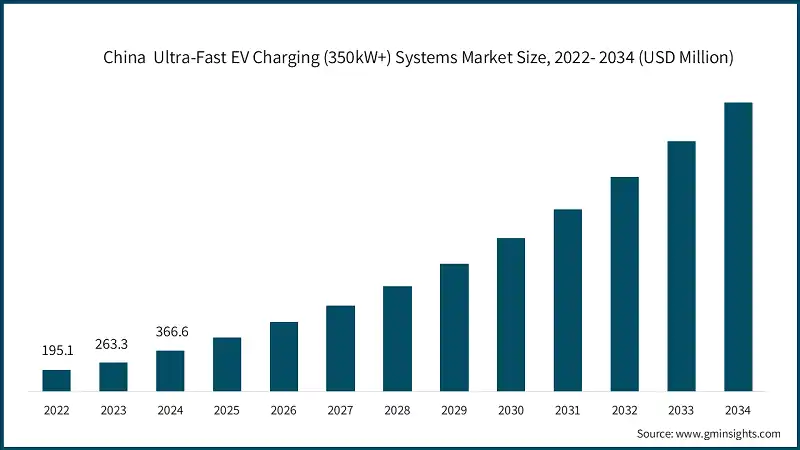
China dominated the ultra-fast EV charging (350kW+) systems market captured 40% share and generated USD 366.6 million revenue in 2024.
- China dominates the ultra-fast EV charging (350kW+) systems due to its massive EV production scale, government-backed infrastructure programs, and cost-efficient manufacturing ecosystem. The Chinese government’s strong policy push, including mandates under the “New Energy Vehicle (NEV)” program and investments exceeding $15 billion in charging infrastructure, has enabled rapid deployment of ultra-fast chargers across major cities and highways.
- Major Chinese companies such as BYD, Star Charge, and CATL are leading innovation with charging technologies up to 1 MW capacity, significantly ahead of global competitors.
- In addition, China’s vertically integrated supply chain spanning batteries, semiconductors, and power electronics provides a significant cost advantage. Domestic network operators like State Grid Corporation and Told New Energy have installed thousands of ultra-fast stations, supporting both public and fleet EV adoption. This large-scale infrastructure rollout positions China as the global hub for ultra-fast EV charging innovation and deployment.
- In January 2025, XPeng Inc. and Volkswagen AG have signed an MoU to jointly build an ultra-fast EV charging network across China, open over 20,000 existing charging piles in 420 cities to each other’s customers, and explore co-branded stations.
- In the Asia-Pacific ultra-fast EV charging (350 kW+) systems market, India is emerging as one of the fastest-growing markets due to strong government incentives under schemes like FAME II and the National Electric Mobility Mission, increasing EV adoption by fleet operators, and rapid investments in highway corridor charging infrastructure by energy majors such as Tata Power, Adani, BPCL, and Indian Oil.
- Additionally, collaborations with global OEMs and the government’s focus on developing 800 V architecture-compatible vehicles are accelerating demand for ultra-fast charging solutions across major cities and intercity routes.
The Germany ultra-fast EV charging (350kW+) systems market is expected to experience significant and promising growth of 17.9% from 2025-2034.
- Europe accounts for over 29% of the market share in 2024 and is expected to grow at a CAGR of around 19.2% through 2034, driven by stringent EU emission targets, the rapid expansion of cross-border charging corridors under programs like AFIR (Alternative Fuels Infrastructure Regulation), and investments by automaker consortia such as IONITY and Mercedes-Benz HPC Europe.
- Germany dominates the ultra-fast EV charging (350 kW+) systems market due to its strong automotive ecosystem, extensive public charging infrastructure, and early adoption of high-voltage (800 V) vehicle platforms by OEMs such as Porsche, Audi, BMW, and Mercedes-Benz. The country benefits from a well-developed grid network and significant government funding through programs like the Federal Charging Infrastructure Expansion Program, which supports nationwide deployment of ultra-fast chargers along highways, logistics hubs, and urban centers.
- Additionally, Germany serves as Europe’s technology hub for e-mobility innovation, hosting leading charger manufacturers like ABB E-Mobility, Siemens, and Alpitronic. Collaborations under initiatives such as IONITY have made Germany central to Europe’s ultra-fast charging corridors, ensuring interoperability, reliability, and scalability that strengthen its market leadership in the 350 kW+ charging segment.
- In December 2023, IONITY has opened one of its largest ultra-fast charging stations near Merklingen, Germany, featuring 24 high-power points and introducing the Italian manufacturer Alpitronic’s HYC400 chargers with dual-outlets up to 200 kW each.
- The U.K. ultra-fast EV charging (350 kW+) systems market is growing steadily due to strong government funding under schemes like the Rapid Charging Fund and OZEV initiatives, combined with rising EV adoption across both consumer and fleet segments. Major energy and infrastructure companies such as BP Pulse, Gridserve, Ionity, and Shell Recharge are expanding high-power charging hubs along motorways and urban corridors.
The U.S. market is expected to experience significant and promising growth of 19.9% from 2025-2034.
- North America accounts for over 20% of the ultra-fast EV charging (350kW+) systems market share in 2024 and is expected to grow at a CAGR of around 20.1% till 2034, owing to strong federal and state-level incentives under programs like the NEVI (National Electric Vehicle Infrastructure) Formula Program and the Inflation Reduction Act (IRA).
- The U.S. dominates the ultra-fast EV charging (350 kW+) systems market due to significant government investment and policy support under the Bipartisan Infrastructure Law and the National Electric Vehicle Infrastructure (NEVI) Program, which together allocate billions for high-speed charging corridor development. The growing network of 350 kW+ chargers by Tesla, Electrify America, and EVgo, combined with the widespread adoption of the NACS standard, has accelerated infrastructure rollout and interoperability across automakers.
- Additionally, the U.S. is home to leading technology developers and EV manufacturers such as Tesla, Lucid Motors, and Rivian, which are advancing 800 V vehicle architectures that require ultra-fast charging capabilities. Collaborations between utilities, oil majors, and charging providers including BP Pulse, Shell Recharge, and ChargePoint are further strengthening the ecosystem and reinforcing the country’s leadership in ultra-fast charging deployment .
- For instance, in August 2025, Electrify America opened a new ultra-fast charging station in Santa Monica featuring 20 350 kW-capable chargers. The site, situated near the I-10 highway, aims to service long-distance EV drivers and is powered using 100% renewable energy.
- Canada is also expected to expand at a CAGR of approximately 21.7% through 2034, due to strong federal and provincial incentives under programs like Natural Resources Canada’s Zero Emission Vehicle Infrastructure Program (ZEVIP) and investing in Canada Infrastructure Program (ICIP). The growth is further fueled by the rising adoption of long-range EVs, cross-border charging corridor projects with the U.S., and investments by utilities and energy companies such as Hydro One, Petro-Canada, and FLO.
The Brazil market in is expected to experience significant and promising growth from 2025-2034.
- Latin America holds around 5% of the ultra-fast EV charging (350kW+) systems market and is growing steadily at a CAGR of around 17.8% driven by the increasing electrification of public transport fleets, particularly in Brazil, Chile, and Mexico, and the growing presence of international charging network providers such as ABB, Enel X Way, and Siemens. Governments are promoting green mobility incentives, renewable-powered charging, and public-private partnerships to build high-power corridors along key highways.
- Brazil dominates the ultra-fast EV charging (350 kW+) systems market in Latin America due to its strong government commitment to e-mobility, robust automotive manufacturing base, and early investments in charging infrastructure by both public and private sectors. The country’s National Electric Mobility Policy and support from ANEEL (Brazilian Electricity Regulatory Agency) have encouraged utilities like Eletrobras and Neoenergia to expand nationwide charging corridors. Major cities such as São Paulo, Rio de Janeiro, and Brasília are also witnessing rapid growth in high-power charging deployments.
- Additionally, global technology leaders like ABB, Siemens, and Enel X Way have partnered with Brazilian energy firms to install 350 kW+ fast chargers along highways and fleet depots. The increasing import and local production of 800 V-compatible EVs by brands like BYD, GWM, and Volkswagen further drives demand for ultra-fast charging systems, consolidating Brazil’s leadership in the regional market.
- For example, in May 2024, Brazil’s infrastructure specialist Osten Group is investing heavily in electric vehicle charging infrastructure, focusing on ultra-fast stations and shopping-mall installations to capitalize on growing EV adoption and government-backed mobility programs. The company emphasizes the need for high-power, reliable charging in urban and highway locations across major Brazilian states.
- The ultra-fast EV charging (350kW+) Systems market in Mexico is growing at a high pace due to strong government policies promoting clean mobility, rising EV adoption driven by both consumer and fleet demand, and strategic infrastructure investments by energy and automotive companies. The Mexican Secretariat of Energy (SENER) and Federal Electricity Commission (CFE) have introduced national charging infrastructure programs connecting key transport corridor.
The UAE market is expected to experience significant and promising growth from 2025-2034.
- MEA holds around 4% of the ultra-fast EV charging (350kW+) systems market and is growing steadily at a CAGR of around 15.9% through 2034, due to rising government initiatives for clean transportation, increasing EV adoption targets, and large-scale infrastructure investments led by energy and utility companies.
- The UAE has been a dominant player in the MEA ultra-fast EV charging (350kW+) systems market due to its strong national focus on clean mobility, advanced infrastructure, and large-scale government-backed EV initiatives. Programs like the UAE Net Zero 2050 Strategy and Dubai Green Mobility Initiative have accelerated the adoption of high-power charging systems across major emirates, including Dubai, Abu Dhabi, and Sharjah.
- The country’s leadership in smart city development and renewable energy integration has also attracted major global players such as ABB, Siemens, and DEWA (Dubai Electricity and Water Authority) to deploy 350 kW+ ultra-fast chargers. Partnerships like ABB-DEWA and Tesla Supercharger expansions further reinforce the UAE’s role as a regional hub for EV innovation and ultra-fast charging technology.
- Saudi Arabia is projected to experience the highest CAGR in the MEA ultra-fast EV charging (350kW+) systems market due to its ambitious Vision 2030 goals, strong government commitment to EV infrastructure, and massive investments in clean mobility and smart cities. The Saudi Ministry of Energy, in collaboration with PIF (Public Investment Fund) and Saudi Electricity Company (SEC), is spearheading initiatives to deploy 350kW+ ultra-fast chargers across major highways and urban centers.
Ultra-FAST EV CHARGING Systems Market Share
- The top 7 companies in the ultra-fast EV charging (350kW+) systems industry are Laptronica, Kempower, ABB, StarCharge, ChargePoint, Huawei, and Delta, contributed around 44% of the market in 2024.
- Laptronica focuses on scaling its Hypercharger platform beyond Europe, emphasizing modular 400kW+ systems, enhanced cooling efficiency, and grid flexibility. The company is strengthening OEM and CPO partnerships while expanding into North America and Asia. Its strategy revolves around premium engineering quality, compact design, and high reliability for urban and highway ultra-fast charging applications.
- Kempower’s strategy centers on scalable, software-driven charging solutions tailored for fleets, depots, and public ultra-fast corridors. It emphasizes dynamic power distribution, data analytics, and remote monitoring to optimize charger utilization. Kempower aims to grow through European public tenders and global partnerships while maintaining a strong sustainability and modular product focus.
- ABB’s strategy focuses on next-generation high-power DC chargers (350-500kW+), liquid-cooled technology, and grid integration capabilities. Through ABB E-mobility, the company is expanding partnerships with automakers, utilities, and oil majors to deploy large-scale charging networks. It also invests in AI-based energy management and service platforms to enhance uptime and charging efficiency.
- StarCharge prioritizes cost-efficient high-power charging (350-480kW), smart grid integration, and global expansion beyond China. Its strategy emphasizes turnkey EV infrastructure, cloud management, and battery storage integration. By collaborating with automakers and governments, StarCharge aims to dominate the Asia-Pacific and Middle East ultra-fast charging segments with affordable, reliable, and intelligent systems.
- ChargePoint’s strategy centers on expanding its ultra-fast public and fleet charging networks with 350kW+ hardware and software-enabled management platforms. The company focuses on interoperability, cloud analytics, and API integrations with automakers and fleets. Strategic acquisitions and North American infrastructure partnerships strengthen its leadership in the smart, connected charging ecosystem.
- Huawei leverages its expertise in power electronics and cloud infrastructure to develop intelligent 600kW+ charging solutions with AI-based power distribution and 5G connectivity. Its strategy targets energy efficiency, cybersecurity, and grid integration, focusing on smart city EV ecosystems and partnerships with utilities and local governments to deploy ultra-fast networks globally.
- Delta’s strategy emphasizes energy-efficient power modules, integrated renewable and storage systems, and modular 350-500kW DC chargers for commercial and highway use. The company focuses on collaborations with OEMs and charge operators, smart energy management, and sustainable, low-carbon technologies, positioning itself as a key supplier for scalable ultra-fast EV charging infrastructure.
Ultra-Fast EV Charging Systems Market Companies
Major players operating in the ultra-fast EV charging (350kW+) systems industry are:
- ABB
- Alpitronic
- ChargePoint
- Delta
- Heliox
- Huawei
- Kempower
- Siemens
- StarCharge
- Tritium
- Technology providers and charging infrastructure manufacturers in the ultra-fast EV charging (350kW+) systems market are increasingly emphasizing advancements in power conversion efficiency, intelligent energy management, and liquid-cooled charging technologies. These innovations are designed to handle the next generation of high-voltage (up to 1000V) EV platforms, ensuring safer, faster, and more efficient power delivery.
- Developments in semiconductor materials such as SiC (Silicon Carbide) and GaN (Gallium Nitride) are enabling compact, energy-efficient charger designs with enhanced thermal control and reliability, reducing operational costs and improving system longevity.
- Strategic alliances between automakers, utility companies, and charging network operators are reshaping the ultra-fast charging ecosystem. Partnerships aim to build interoperable, grid-integrated charging networks, optimize energy load management, and expand coverage across highways and urban centers.
- Collaborations such as those between ABB-Shell, Siemens-Electrify America, and Kempower-Ionity are accelerating deployment of 350kW+ charging corridors, supporting both passenger and commercial EV adoption. These coordinated efforts are crucial for achieving large-scale e-mobility goals, enabling seamless, high-speed charging experiences globally.
Ultra-Fast EV Charging (350kW+) Systems Market Report Attributes
| Key Takeaway | Details |
|---|---|
| Market Size & Growth | |
| Base Year | 2024 |
| Market Size in 2024 | USD 2.18 Billion |
| Market Size in 2025 | USD 2.86 Billion |
| Forecast Period 2025 – 2034 CAGR | 20.1% |
| Market Size in 2034 | USD 14.81 Billion |
| Key Market Trends | |
| Drivers | Impact |
| Surge in global EV adoption across passenger and commercial segments | The exponential growth of electric vehicle sales globally is directly driving demand for ultra-fast charging infrastructure. As EV ownership expands among consumers and fleets, the need for faster, more efficient charging solutions rises. This fuels investments in high-power 350kW+ systems to support both convenience and scalability. |
| Increase in government funding and infrastructure incentives for ultra-fast charging deployment | Governments worldwide are providing strong financial and regulatory support for ultra-fast EV charger rollouts. Initiatives like the U.S. NEVI program and EU AFIR mandate high-power charging corridors. These policies encourage private investment, standardization, and expansion of ultra-fast networks across urban, rural, and interstate routes. |
| Rise in OEM and charging network collaborations for large-scale rollouts | Automakers are partnering with charging network operators to accelerate ultra-fast charger deployment. Collaborations between companies like Tesla, Porsche, and ChargePoint ensure seamless compatibility and enhanced customer experience. Such alliances strengthen infrastructure scalability and reliability while reducing the burden of infrastructure costs on individual stakeholders. |
| Growth in advancements of power electronics, converters, and thermal management technologies | Innovations in semiconductor devices, cooling systems, and power electronics are improving charger efficiency and performance. Silicon carbide (SiC) and gallium nitride (GaN) components enable higher voltage tolerance and reduced losses. These advancements make 350kW+ chargers more compact, durable, and cost-effective, accelerating their global market adoption. |
| Pitfalls & Challenges | Impact |
| High capital expenditure and installation costs for ultra-fast charging infrastructure | Deploying 350kW+ charging systems requires significant investment in hardware, transformers, cabling, and cooling infrastructure. High setup and maintenance costs deter smaller operators. The financial burden increases when integrating renewable energy or upgrading grid connections, slowing large-scale installations, especially in developing and cost-sensitive regions. |
| Limited grid capacity and energy supply challenges in several regions | Ultra-fast chargers demand substantial electrical power, creating strain on existing grids. Inadequate grid capacity and slow permitting processes restrict deployment in many regions. Without parallel investment in grid modernization and energy storage solutions, the scalability of ultra-fast charging networks remains a significant challenge. |
| Opportunities: | Impact |
| Increase in integration of energy storage and renewables with ultra-fast chargers | Combining energy storage systems and renewable power with ultra-fast charging stations creates cost and sustainability benefits. Battery storage can stabilize grid demand, reduce peak load charges, and enable off grid charging solutions. This integration supports carbon-neutral infrastructure and improves overall operational resilience and efficiency. |
| Rise in ultra-fast charging deployment across emerging and developing markets | Emerging economies are rapidly investing in EV infrastructure as part of green mobility initiatives. Countries like India, Thailand, and Brazil are adopting ultra-fast chargers to support growing EV fleets. These markets present vast opportunities for manufacturers, investors, and operators to expand high-power charging networks. |
| Growth in demand for dedicated fleet and logistics charging hubs | Fleet and logistics operators are establishing private ultra-fast charging depots to support large EV fleets. These high-throughput hubs optimize vehicle uptime and operational efficiency. As electrification scales in freight and delivery services, demand for tailored, high-capacity charging infrastructure continues to surge globally. |
| Surge in development of modular, multi-port, and scalable charging systems | Manufacturers are introducing modular and multi-port charging systems that allow flexible upgrades and scalability. These designs reduce initial costs, simplify maintenance, and increase throughput by charging multiple vehicles simultaneously. Modular infrastructure provides adaptability for future power upgrades and evolving EV requirements. |
| Market Leaders (2024) | |
| Market Leaders |
13.2 % market share |
| Top Players |
Collective market share in 2024 is 39% |
| Competitive Edge |
|
| Regional Insights | |
| Largest Market | Asia Pacific |
| Fastest growing market | Asia Pacific |
| Emerging countries | India, Philippines, Indonesia, Brazil, Saudi Arabia, UAE |
| Future outlook |
|
What are the growth opportunities in this market?
Ultra-Fast EV Charging Systems Market News
- In June 2025, Kempower started deliveries of its MORE Power charging solution, enhancing its portfolio beyond the Satellite modular system. Targeting high-demand market segments, the Finnish manufacturer aims to strengthen its competitive position and showcase continued innovation in the rapidly growing ultra-fast EV charging market.
- In June 2025, BYD partnered with TELD and Star Charge to expand its Megawatt Flash Charging network across China. With over 500 stations in 200+ cities and 1MW charging capacity, the initiative accelerates commercial vehicle electrification, enabling 400 kilometers of range in five minutes for Super-e Platform vehicles.
- In May 2025, Gravity launched eight new 500kW DC fast-charging stations in Greater Los Angeles. Featuring UL-listed chargers and proprietary switching matrix technology, the expansion highlights growing deployment of ultra-high-power urban charging infrastructure and Gravity’s strategic focus on high-traffic metropolitan markets.
- In April 2025, Delta Electronics deployed 350kW DC fast chargers in Sweden in partnership with Svensk Fordonsladdning AB and Smedjebacken Energy AB. The project supports Sweden’s electric mobility goals, expanding ultra-fast charging along major corridors and demonstrating Delta’s commitment to European market growth.
- In September 2024, Siemens integrated Heliox into its eMobility division and launched a 400kW ultra-fast charger. Heliox’s expertise in bus charging networks enhances Siemens’ commercial vehicle charging capabilities, strengthening its market position and expanding high-power infrastructure for specialized EV applications.
- In September 2024, ChargePoint introduced an AI-based diagnostics platform to enhance EV charger uptime and reduce maintenance costs. Using machine learning, the platform predicts component failures, enables proactive maintenance, and provides remote troubleshooting, addressing critical reliability and operational efficiency challenges for commercial charging networks.
The ultra-fast EV charging systems market research report includes in-depth coverage of the industry with estimates & forecasts in terms of revenue ($Bn), Shipment (Units) from 2021 to 2034, for the following segments:
Market, By Component
- Hardware
- Power Modules
- Cables & Connectors
- Cooling Systems
- Enclosures & Mounts
- Software
- Energy Management Systems
- Payment & Access Control
- Remote Monitoring & Analytics
- Services
- Installation & Commissioning
- Maintenance & Upgrades
- Network Management
Market, By Installation
- Standalone Chargers
- Integrated Systems
Market, By Power Rating
- 350-400 kW systems
- 400-500 kW systems
- 500+ kW systems
Market, By Vehicle
- Passenger vehicles
- Hatchbacks
- Sedans
- SUV
- Commercial vehicles
- Light commercial vehicles (LCV)
- Medium commercial vehicles (MCV)
- Heavy commercial vehicles (HCV)
Market, By Application
- Public Charging Stations
- Commercial Fleet Charging
- Residential / Private Charging
- Highway and Long-Distance Charging Networks
Market, By Configuration
- Single-port systems
- Multi-port systems (2-4 ports)
- Modular expandable systems
The above information is provided for the following regions and countries:
- North America
- US
- Canada
- Europe
- Germany
- UK
- France
- Italy
- Spain
- Russia
- Asia Pacific
- China
- India
- Japan
- Australia
- South Korea
- Philippines
- Indonesia
- Latin America
- Brazil
- Mexico
- Argentina
- MEA
- South Africa
- Saudi Arabia
- UAE
Frequently Asked Question(FAQ) :
What is the market size of the ultra-fast EV charging systems market in 2024?
The market size was USD 2.18 billion in 2024, with a CAGR of 20.1% expected through 2034, driven by advancements in EV infrastructure and increasing EV adoption globally.
What is the projected value of the ultra-fast EV charging systems market by 2034?
The ultra-fast EV charging systems market is expected to reach USD 14.81 billion by 2034, propelled by government incentives, technological advancements, and growing demand for high-power charging solutions.
What is the current ultra-fast EV charging systems market size in 2025?
The market size is projected to reach USD 2.86 billion in 2025.
How much revenue did the standalone chargers segment generate in 2024?
The standalone chargers segment accounted for approximately 65% of the market share in 2024.
What was the valuation of the hardware segment in 2024?
The hardware segment held 55% market share in 2024, supported by the critical role of physical infrastructure in ultra-fast charging systems.
What is the growth outlook for the integrated systems segment from 2025 to 2034?
The integrated systems segment is projected to grow at a CAGR of over 21.2% through 2034, fueled by demand for smart, interconnected, and grid-responsive charging solutions.
Which region leads the ultra-fast EV charging systems market?
China led the market with a 40% share and generated USD 366.6 million in 2024, driven by strong EV production, government-backed programs, and cost-efficient manufacturing.
What are the upcoming trends in the ultra-fast EV charging systems market?
Key trends include advancements in power electronics, integration of renewable energy and energy storage, modular and scalable charging systems, and collaborations between automakers and charging network operators.
Who are the key players in the ultra-fast EV charging systems market?
Key players include ABB, Alpitronic, ChargePoint, Delta, Heliox, Huawei, Kempower, Siemens, StarCharge, and Tritium.
Ultra-Fast EV Charging (350kW+) Systems Market Scope
Related Reports