Summary
Table of Content

Trenchers Market
Get a free sample of this report
Form submitted successfully!
Error submitting form. Please try again.
Thank you!
Your inquiry has been received. Our team will reach out to you with the required details via email. To ensure that you don't miss their response, kindly remember to check your spam folder as well!
Request Sectional Data
Thank you!
Your inquiry has been received. Our team will reach out to you with the required details via email. To ensure that you don't miss their response, kindly remember to check your spam folder as well!
Form submitted successfully!
Error submitting form. Please try again.
Trenchers Market Size
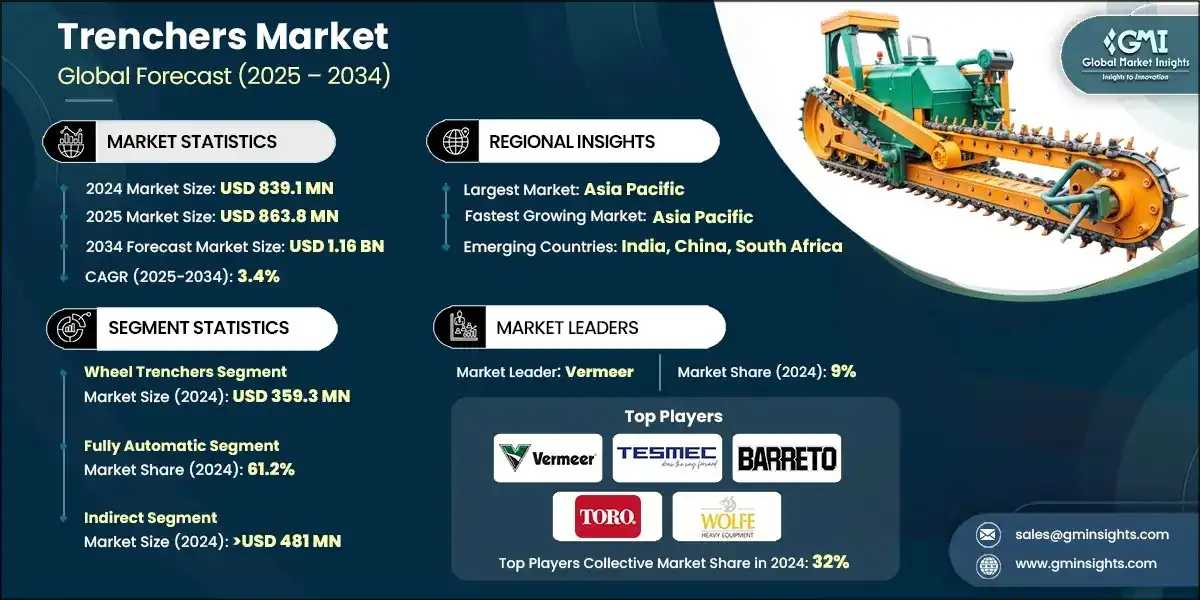
The trenchers market was estimated at USD 839.1 million in 2024. The market is expected to grow from USD 863.8 million in 2025 to USD 1.16 billion in 2034, at a CAGR of 3.4% according to latest report published by Global Market Insights Inc.
Trenchers Market Key Takeaways
Market Size & Growth
- 2024 Market Size: USD 839.1 Million
- 2025 Market Size: USD 863.8 Million
- 2034 Forecast Market Size: USD 1.16 Billion
- CAGR (2025–2034): 3.4%
Regional Dominance
- Largest Market: Asia Pacific
- Fastest Growing Region: Asia Pacific
Key Market Drivers
- Infrastructure development investments.
- Utility installation expansion.
- Fiber optic network deployment.
Challenges
- High equipment costs.
- Skilled labor shortage.
Opportunity
- Rental and leasing services.
- Technological advancements in automation.
Key Players
- Market Leader: Vermeer led with over 9% market share in 2024.
- Leading Players: Top 5 players in this market include Wolfe Heavy Equipment, Toro Company, Barreto Manufacturing, Tesmec Trencher, Vermeer, which collectively held a market share of 32% in 2024.
Get Market Insights & Growth Opportunities
As state and local governments continue to expand their infrastructure through building highways, railroads, and developing urban environments, this has increased the use of trencher machines to create a trench for storm drains, utilities, and foundations. With many governments and local jurisdictions investing billions of dollars in upgrading their transportation networks and developing smart cities, this has created a need for contractors to purchase the newest high-performance trenching machines that will assist them in completing their projects within a short timeframe while reducing labour costs. Manufacturers are responding to this growing demand for high-performance trenching machines with new innovations such as automatic depth control and GPS integration, which allows contractors to create more precise trenches.
With increasing urbanisation and rising need for electricity, water, and natural gas distribution networks throughout rural and urban areas, this will lead to increased use of trenchers by utility companies because trenchers can provide consistent narrow trench depths, thereby reducing risk of disruption of the surface and therefore reducing surface restoration costs to utility companies. As the use of underground cables for the transmission of electricity and because of the increase in demand, there will be an increased demand for versatile trenching machines capable of operating under a wide variety of soil conditions and with a variety of trench widths. As a result of this expansion, this is also leading manufacturers to develop compact and easy to manoeuvre units that can be used in crowded metropolitan areas.
The increase in fiber optic installations for high-speed internet and 5G connectivity is one of the major growth factors for trenchers. For laying fiber cables without damaging installed infrastructure, telecom operators need accurate, shallow trenching solutions. Micro-trenching technology utilizes specialized trenchers to make narrow cuts into pavement and is gaining greater traction as it reduces installation times and costs. Due to increasing demand in digital connectivity for smart cities and remote work, trenchers fitted with micro-trenching and automated guidance systems are in strong demand.
To get key market trends
Trenchers Market Trends
The integration of IoT sensors, artificial intelligence, is revolutionizing operations, transforming traditional reactive maintenance approaches into predictive, data-driven strategies.
- Newly refined techniques such as micro-trenching are becoming more commonly used in fiber optic installation and 5G infrastructure projects as they provide a quicker method of installation with little disruption to the surface area of the roadway compared to traditional divisions of the surface. Micro-trenching is an excellent option for urban installations where access to the job site is tight, and restoration costs will be significant.
- The majority of the trenchers currently being produced utilize GPS technology and telematics systems to increase the accuracy of the machines, improve the operational efficiency of the machines, and provide real-time data about the performance of the machine to the user. Additionally, GPS- and telematics-equipped trenchers enable the user to monitor and adjust the automated depth control function of the machine remotely, increasing operational efficiency and reducing the amount of time that employees require to be on the job site.
- As a result of high equipment prices, rental and leasing options for trenching equipment are experiencing a boom. This is due to many contractors still preferring to rent and lease machines for short periods to complete specific projects rather than spend large amounts of money to purchase new equipment. This trend provides opportunities for OEMs to partner with rental companies or provide rental agreements through their own rental programs.
- With the growing trend of urban development and more congested job sites, there is a growing need for compact trenching machines that are able to perform in limited spaces while maximizing productivity. As a result, the manufacturers of trenching machines are developing a greater variety of products that can adapt to a wide range of soil types and trench widths to accommodate both utility installations as well as landscaping projects.
- With continuing urbanization and jobs being located farther away from where people can access them, there is a need for more compact trenches that do not take up as much space as current machines but would still allow for similar levels of productivity. Many manufacturers are responding by designing multiple versions/types of trenchers that work in different soil conditions and have widths suitable for utility installation and landscaping.
- Another reason for the growth of automation in this type of equipment is the shortage of skilled workers. Trenchers that utilize semi-autonomous technology and have automated steering and depth control will reduce the operator's workload and improve worker safety by allowing operators to concentrate on the operation instead of constantly adjusting their direction and depth settings. This trend coincides with the general movement toward using automated systems and "smart" technology in the overall construction industry.
- There is now also a strong focus on environmental regulations and sustainable construction practices. As a result, many manufacturers are creating new models of trenchers with more efficient engines and significantly less emission pollutants. New types of hydraulic systems and components with reduced friction have also led to a large reduction in fuel usage and enhance overall sustainability performance.
Trenchers Market Analysis
Learn more about the key segments shaping this market
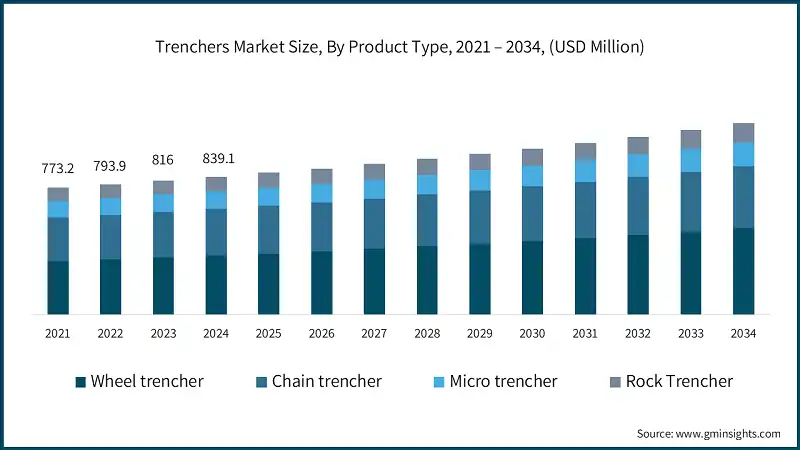
Based on product type, the market is divided into wheel trencher, chain trencher, micro trencher and rock trencher. The wheel trenchers segment generated a revenue of USD 359.3 million in 2024.
- Wheel trenchers hold a dominant position in the market because of their ability to cut through hard surfaces like asphalt, concrete, and compacted soil with high precision and speed. This makes them indispensable for large-scale infrastructure projects such as road construction, utility installations, and fiber optic network deployment. Their design allows for consistent trench depth and width, reducing the need for extensive surface restoration and lowering overall project costs. Contractors favor wheel trenchers for urban projects where minimizing disruption is critical.
- Additionally, wheel trenchers offer superior productivity compared to chain trenchers in certain applications, especially when dealing with paved surfaces or rocky terrain. Their efficiency in creating clean, narrow trenches makes them ideal for telecom and energy projects that require long trench runs. Manufacturers are enhancing these machines with advanced features like GPS guidance and automated depth control, further strengthening their dominance in high-value projects where precision and speed are non-negotiable.
Learn more about the key segments shaping this market
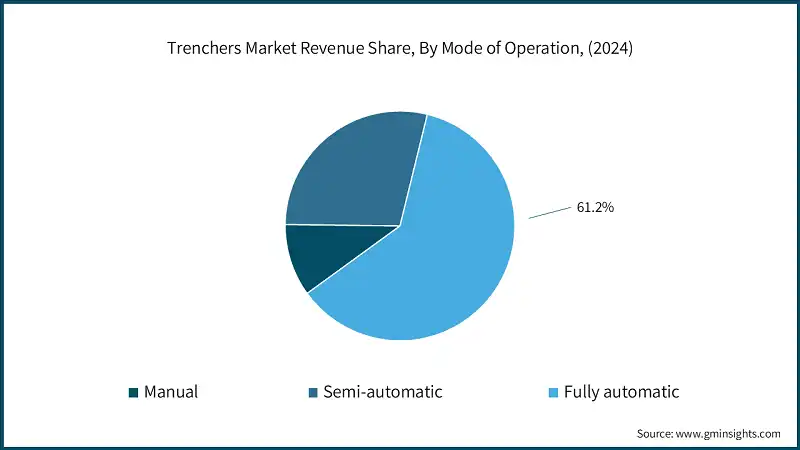
Based on mode of operation, the trenchers market is segmented into manual, semi-automatic and fully automatic. The fully automatic segment held about 61.2% of the market share in 2024.
- The fully automatic mode of operation is becoming a key differentiator in trenching equipment, driven by the need for accuracy, safety, and reduced reliance on skilled labor. Automation ensures consistent trench depth and alignment, minimizing human error and improving overall project quality. Contractors working on fiber optic installations and utility networks increasingly prefer trenchers with automated controls because they streamline operations and reduce downtime, especially in projects with tight deadlines.
- Moreover, the integration of smart technologies such as GPS, IoT sensors, and telematics in fully automatic trenchers enhances real-time monitoring and predictive maintenance capabilities. This not only improves operational efficiency but also lowers long-term maintenance costs. As the construction industry moves toward digitalization and smart infrastructure, trenchers with fully automatic modes are expected to dominate premium segments, offering unmatched precision and productivity.
Based on the distribution channel, the market is segmented into direct and indirect. The indirect segment exceeded USD 481 million in 2024.
- Indirect sales channels, including dealers, distributors, and rental companies, dominate the trenchers market because they provide localized support and flexible access to equipment. High equipment costs make direct purchases challenging for small and mid-sized contractors, so they rely on indirect channels for affordability and convenience. These intermediaries offer financing options, rental services, and after-sales support, making trenchers accessible to a wider customer base and ensuring strong market penetration.
- Additionally, indirect channels play a crucial role in training, maintenance, and regional distribution, which are essential for sustaining customer relationships. Rental companies are gaining prominence as contractors increasingly opt for short-term equipment use to avoid heavy capital expenditure.
Looking for region specific data?
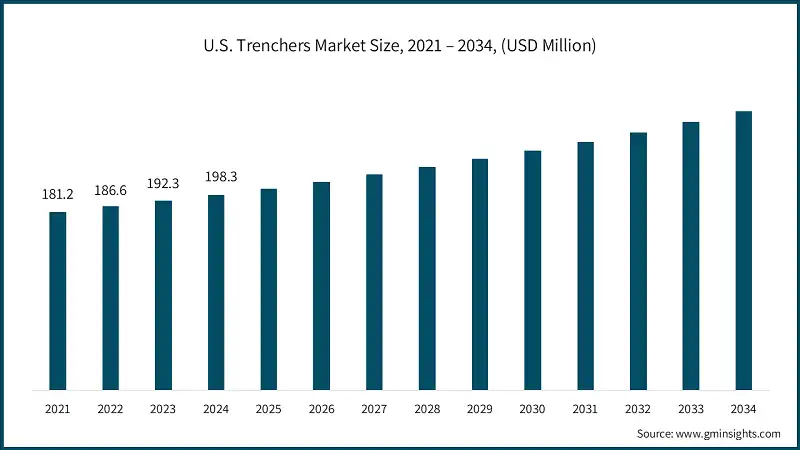
U.S. dominated the North America trenchers market with around 79.5% share and generating USD 198.3 million revenue in 2024.
- The U.S. dominates the trenchers industry due to its large-scale infrastructure modernization projects and extensive fiber optic network deployment. High investments in smart cities, renewable energy pipelines, and utility upgrades drive strong demand for advanced trenching equipment. The presence of leading manufacturers and a well-established rental ecosystem further strengthens its position, making the U.S. a hub for innovation in automated and GPS-enabled trenchers.
In Europe trenchers industry, Germany leads with 19% share in 2024 and is expected to grow at 3.9% CAGR during the forecast period.
- Germany’s dominance stems from its focus on precision engineering and sustainable construction practices. The country’s stringent environmental regulations and commitment to green infrastructure push demand for energy-efficient trenchers with low emissions.
- Additionally, Germany’s advanced telecom and utility sectors require high-performance trenching solutions for underground cabling and fiber optic installations, reinforcing its leadership in technology-driven trenching equipment.
In Asia Pacific China leads with revenue share of around 3% in 2024 and is anticipated to grow with a CAGR of around 4.1% from 2025 to 2034.
- China leads the trenchers market in Asia due to massive infrastructure development and rapid urbanization. Government-backed initiatives for high-speed rail, smart cities, and rural electrification create enormous demand for trenching solutions.
- The country’s aggressive rollout of 5G networks and fiber optic connectivity further accelerates adoption of micro-trenching technologies, positioning China as a key growth engine for both domestic and global manufacturers.
Middle East and Africa market are growing at a CAGR of 2.7% during the forecast period.
- Saudi Arabia’s dominance is driven by large-scale utility and energy projects under its Vision 2030 plan. Investments in oil and gas pipelines, water distribution networks, and renewable energy infrastructure create strong demand for trenchers capable of handling harsh desert conditions.
- The country’s push for smart city development and telecom expansion also supports adoption of advanced trenching equipment, making it a strategic market in the Middle East.
Trenchers Market Share
Vermeer is leading with 9% market share. Vermeer, Tesmec Trencher, Barreto Manufacturing, Toro Company, Wolfe Heavy Equipment collectively hold around 32%, indicating moderately fragmented market concentration. These prominent players are proactively involved in strategic endeavors, such as mergers & acquisitions, facility expansions & collaborations, to expand their product portfolios, extend their reach to a broad customer base, and strengthen their market position.
Trenchers Market Companies
Major players operating in the trenchers industry are:
- Barreto Manufacturing
- Bobcat Company
- Cleveland Trencher Company
- Ditch Witch
- Gravis Robotics
- Inter-Drain
- Mastenbroek Ltd.
- Miah Trenchers
- Simex S.r.l.
- Takeuchi Manufacturing
- Tesmec S.p.A.
- Toro Company
- Trencor
- Vermeer Manufacturing Company
- Wolfe Heavy Equipment
Barreto Manufacturing competitive edge in the trenchers market lies in its focus on durability, simplicity, and hydraulic innovation. Unlike many competitors that rely on belt-driven systems, Barreto uses an all-hydraulic, belt-free design, which significantly reduces maintenance requirements and extends component life.
Toro competitive advantage lies in its diversified portfolio and strong dealer network, which provide extensive coverage across turf, landscape, and underground construction markets. Its focus on operational efficiency, sustainability, and integration of smart technologies positions Toro as a resilient player capable of meeting evolving customer needs in both residential and professional segments.
Wolfe stands out for its specialization in heavy-duty wheel trenchers designed for deep, wide cuts in demanding soil conditions. Its machines feature extremely duty components, ergonomic controls, and advanced grade-control systems, making them ideal for large-scale pipeline and energy projects.
Vermeer competitive edge lies in its innovation-driven approach and broad product portfolio that caters to heavy-duty trenching applications, including pipeline construction and fiber optic installations. Its TEC Plus control system and SmartTEC technology enhance precision and operational efficiency, making Vermeer a leader in automation and digital integration.
Tesmec dominates the niche of high-performance trenchers for rock and hard ground conditions, leveraging its expertise in integrated solutions for energy and telecom infrastructure. Its SmartTrench technology makes it the go-to brand for complex projects like pipeline and fiber optic network installations.
Trenchers Market Report Attributes
| Key Takeaway | Details |
|---|---|
| Market Size & Growth | |
| Base Year | 2024 |
| Market Size in 2024 | USD 839.1 Million |
| Market Size in 2025 | USD 863.8 Million |
| Forecast Period 2025 – 2034 CAGR | 3.4% |
| Market Size in 2034 | USD 1.16 Billion |
| Key Market Trends | |
| Drivers | Impact |
| Infrastructure development investments | As governments and private sectors allocate substantial budgets toward modernizing transportation networks and smart cities, contractors seek efficient, high-performance trenching equipment to meet tight deadlines and reduce labor costs. |
| Utility installation expansion | The growing need for electricity, water, and gas distribution networks across expanding urban and rural areas fuels trenchers’ adoption |
| Fiber optic network deployment | The surge in fiber optic installations for high-speed internet and 5G connectivity is a major growth drive for trenchers. Telecom operators require precise, shallow trenching solutions to lay fiber cables efficiently while avoiding damage to existing infrastructure. |
| Pitfalls & Challenges | Impact |
| High equipment costs | Trenchers are capital-intensive machines, and their high upfront cost often acts as a barrier for small and medium-sized contractors. Advanced models equipped with GPS, automated depth control, and micro-trenching capabilities further increase the price point. |
| Skilled labor shortage | Operating trenchers require specialized skills to ensure safety, efficiency, and compliance with project specifications. However, the construction industry is grappling with a shortage of trained operators, which slows project timelines and increases operational risks. |
| Opportunities: | Impact |
| Rental and leasing services | The high cost of trenchers creates a strong opportunity for rental and leasing businesses. Contractors prefer short-term access to equipment for specific projects rather than incurring heavy capital expenditure. |
| Technological advancements in automation | The push toward automation and smart construction offers a major opportunity for trenchers equipped with advanced features like GPS guidance, telematics, and semi-autonomous operation. |
| Market Leaders (2024) | |
| Market Leaders |
9% market share |
| Top Players |
The collective market share in 2024 is 32% |
| Competitive Edge |
|
| Regional Insights | |
| Largest market | Asia Pacific |
| Fastest growing market | Asia Pacific |
| Emerging countries | India, China, South Africa |
| Future outlook |
|
What are the growth opportunities in this market?
Trenchers Market News
- In September 2025, Ditch Witch introduced smart features like Crab Steering Mode and Coordinated Steering on RT70 and RT125 trenchers for improved maneuverability and operator comfort.
- In April 2025, Ditch Witch Partnered with Mastenbroek to market the Bulldog trencher in the U.S., targeting wildfire-prone regions for underground utility installation.
- In February 2025, Barreto unveiled the 30RTK Track Trencher at the ARA Show, featuring a 31hp Briggs Vanguard engine, 48-inch trenching depth, and adjustable trenching control for high-power applications. This model expands their RTK lineup for heavy-duty trenching jobs.
The trenchers market research report includes in-depth coverage of the industry with estimates & forecasts in terms of revenue (USD Million) and volume (Units) from 2021 to 2034, for the following segments:
Market, By Product Type
- Wheel trencher
- Chain trencher
- Micro trencher
- Rock Trencher
Market, By Mode of Operation
- Manual
- Semi-automatic
- Fully automatic
Market, By Power Source
- Diesel
- Electric
- Gasoline
Market, By Application
- Oil & gas pipeline installation
- Energy cable and fiber optic installation
- Drainage and irrigation
- Road construction
- Agricultural trenching
- Telecom networks construction
- Others (residential utilities, etc.)
Market, By End Use Industry
- Construction
- Agriculture
- Telecommunications
- Oil & gas
- Utilities
- Mining
- Others (Landscaping, etc.)
Market, By Distribution Channel
- Direct
- Indirect
The above information is provided for the following regions and countries:
- North America
- U.S.
- Canada
- Europe
- Germany
- UK
- France
- Italy
- Spain
- Asia Pacific
- China
- India
- Japan
- Australia
- South Korea
- Latin America
- Brazil
- Mexico
- Argentina
- Middle East and Africa
- South Africa
- Saudi Arabia
- UAE
Frequently Asked Question(FAQ) :
What is the market size of the trenchers in 2024?
The market size was USD 839.1 million in 2024, with a CAGR of 3.4% expected through 2034 driven by rising infrastructure development across highways, rail projects, and urban construction.
What is the projected value of the trenchers market by 2034?
The trenchers market is expected to reach USD 1.16 billion by 2034, propelled by fiber optic network deployment, utility installation expansion, and automation-driven technological advancements.
What is the current trenchers market size in 2025?
The market size is projected to reach USD 863.8 million in 2025.
How much revenue did the wheel trenchers segment generate in 2024?
Wheel trenchers generated USD 359.3 million in 2024, dominating the product type segment due to their ability to cut through hard surfaces with high precision and speed.
What was the valuation of the fully automatic segment in 2024?
The fully automatic mode of operation held approximately 61.2% market share in 2024, supported by demand for accuracy, safety, and reduced reliance on skilled labor.
What is the growth outlook for the Europe trenchers market from 2025 to 2034?
Germany leads the Europe trenchers market with a 19% share in 2024 and is projected to grow at a 3.9% CAGR, supported by the country’s strong precision engineering capabilities and emphasis on sustainable construction.
Which region leads the trenchers market?
U.S. dominated 79.5% share with USD 198.3 million in 2024, fueled by major infrastructure upgrades and widespread fiber optic network expansion.
What are the upcoming trends in the trenchers market?
Key trends include adoption of micro-trenching technology for fiber optic installations, integration of GPS and telematics for precision, growth of rental and leasing services, development of compact trenchers for urban sites, semi-autonomous operation, and energy-efficient engines with reduced emissions.
Who are the key players in the trenchers market?
Key players include Vermeer, Tesmec Trencher, Barreto Manufacturing, Toro Company, Wolfe Heavy Equipment, Bobcat Company, Cleveland Trencher Company, Ditch Witch, Gravis Robotics, Inter-Drain, Mastenbroek Ltd., Miah Trenchers, Simex S.r.l., Takeuchi Manufacturing, and Trencor.
Trenchers Market Scope
Related Reports