Summary
Table of Content

Transportation Biofuel Market
Get a free sample of this report
Form submitted successfully!
Error submitting form. Please try again.
Thank you!
Your inquiry has been received. Our team will reach out to you with the required details via email. To ensure that you don't miss their response, kindly remember to check your spam folder as well!
Request Sectional Data
Thank you!
Your inquiry has been received. Our team will reach out to you with the required details via email. To ensure that you don't miss their response, kindly remember to check your spam folder as well!
Form submitted successfully!
Error submitting form. Please try again.
Transportation Biofuel Market Size
- Policy architecture across major markets is moving decisively from broad renewable ambitions toward targeted fuel requirements that embed biofuels into transport decarbonization pathways. The shift is visible in aviation, road, and increasingly maritime, where mandates and eligibility rules define which fuels qualify and under what sustainability criteria.
- As countries transpose and operationalize these frameworks, compliance reporting, default values, and registry systems professionalize the market, creating a rules‑based environment that supports long‑term investment and financing for advanced biofuels and renewable drop‑in fuels.
- For instance, in May 2025, the European Commission/Parliament adopted RED III and issued 2025 guidance to implement transport sub‑targets and RFNBO rules under Directive (EU) 2018/2001 as amended by 2023/2413. This codification reduces policy ambiguity for producers, traders, and offtakers, while aligning supply chains with verification, traceability, and lifecycle accounting.
- Aviation’s limited near‑term alternatives to liquid energy create a pivotal demand pull for SAF, elevating its role as a growth engine for transport biofuels. The regulatory certainty around minimum blends, combined with sustainability and safety standards, catalyzes refinery conversions, co‑processing routes, and greenfield projects across supply chains.
- Airlines, airports and fuel suppliers are integrating procurement, certification, and book‑and‑claim models into commercial operations. As compliance obligations start to apply at scale, SAF transitions from pilots to a routine component of jet fuel supply, anchoring long‑term offtake agreements and stimulating capacity additions and feedstock diversification for approved pathways.
- For reference, in August 2025, the ReFuelEU Aviation Regulation set a minimum supply mandate for Sustainable Aviation Fuels (SAF) in Europe, starting with 2% in 2025 and increasing to 70% in 2050. This will progressively ramp‑up and sub‑targets for synthetic e‑fuels, tied to RED sustainability criteria.
- Country‑level blending programs are scaling biofuels in the road sector by advancing targets, widening eligible feedstocks, and formalizing procurement mechanisms. These programs also align with agricultural policies to stabilize farmer incomes, monetize residues, and reduce import dependence on fossil fuels.
- For reference, in August 2025, India’s Ministry of Petroleum & Natural Gas/PIB documents accelerated ethanol blending policy, feedstock expansion, administered pricing, and logistics/storage measures. As blending shares rise, government ministries, OMCs, and standards bodies coordinate to ensure vehicle compatibility, retail availability, and logistics.
- Convergence of biofuels with electrification in a multi‑vector transition is further accelerating the industry scenario. This convergence reshapes infrastructure planning, with grid, refinery, and terminal operators integrating both electrons and molecules. It also informs corporate fleet strategy, where mixed energy portfolios hedge technology risks and ensure operational continuity across diverse duty cycles and geographies.
- For instance, IEA Renewables 2025 positions road biofuels and renewable electricity as parallel contributors in transport decarbonization. In addition, IRENA World Energy Transitions Outlook 2024 outlined complementary roles of sustainable biomass‑based fuels alongside electrification within a 1.5°C pathway.
The transportation biofuel market was estimated at USD 112.6 billion in 2025. The market is expected to grow from USD 124.9 billion in 2026 to USD 301.4 billion in 2035, at a CAGR of 10.3%, according to a recent study by Global Market Insights Inc.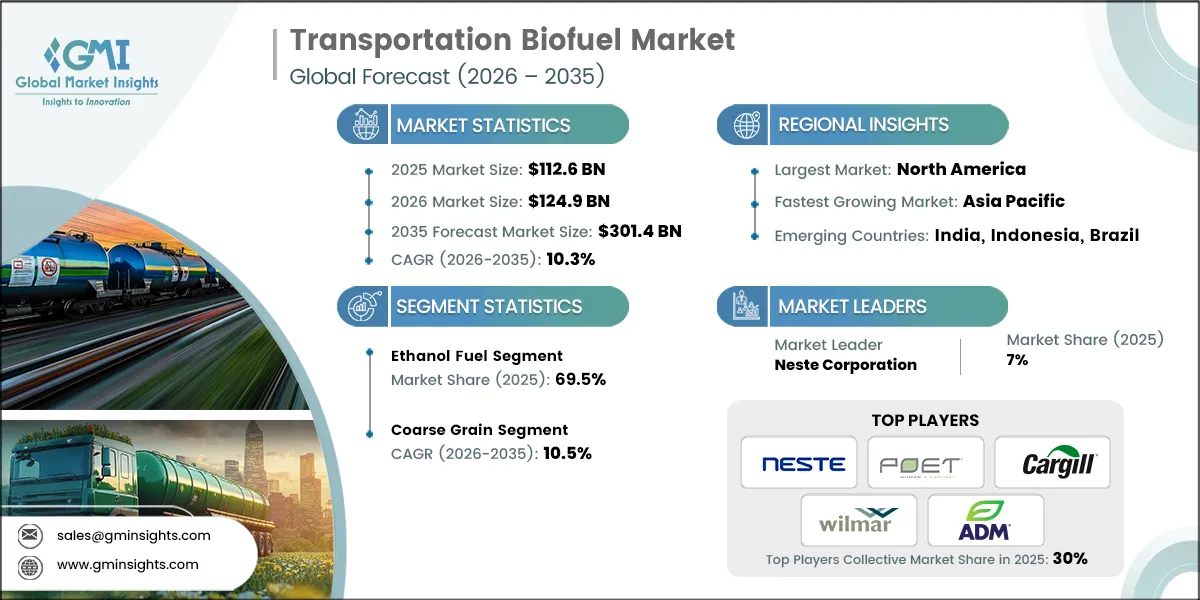
Transportation Biofuel Market Key Takeaways
Market Size & Growth
- 2025 Market Size: USD 112.6 Billion
- 2026 Market Size: USD 124.9 Billion
- 2035 Forecast Market Size: USD 301.4 Billion
- CAGR (2026–2035): 10.3%
Regional Dominance
- Largest Market: North America
- Fastest Growing Region: Asia Pacific
Key Market Drivers
- Increasing popularity as an eco-friendly fuel for road transportation.
- Growing emphasis on reducing greenhouse gas emissions.
Challenges
- High feedstock cost.
Opportunity
- Expansion of advanced and waste‑derived biofuels.
- Rising demand from hard‑to‑electrify sectors.
Key Players
- Market Leader: POET LLC led with over 7% market share in 2025.
- Leading Players: Top 5 players in this market include Neste Corporation, POET LLC., ADM, Cargill, and Wilmar International, which collectively held a market share of 30% in 2025.
Get Market Insights & Growth Opportunities
To get key market trends
Transportation Biofuel Market Trends
- Emerging‑economy’s diesel substitution through biodiesel mandates along with rising corporate decarbonization strategies are accelerating renewable diesel and SAF uptake. Several emerging economies are leveraging biodiesel mandates to bolster energy security, lower fossil diesel imports, and generate rural value addition.
- For instance, in January 2025, the government of Indonesia has set the application of diesel fuel oil (BBM) with a mixture of biodiesel biofuels based on palm oil by 40 percent or B40 starting January 1, 2025. This decree was conveyed directly by the Minister of Energy and Mineral Resources (ESDM) to increase biodiesel from B35 to B40.
- The policy architecture managed by energy ministries links quotas, levy structures, and offtake allocation to ensure steady supply. This diesel substitution dynamic reinforces a floor for biodiesel demand and can reduce demand volatility, creating an investable environment for capacity expansion and associated feedstock logistics.
- Biofuels markets are increasingly governed by lifecycle‑oriented rules that require quantifiable greenhouse‑gas performance, traceable feedstock origins, and robust auditing. Such governance frameworks reduce greenwashing risk, encourage advanced pathways, and reward efficiency improvements.
- For illustration, Brazil’s ANP administers RenovaBio, mandating certification and CBIOs to align biofuel production and distribution with emissions reductions through audited, rules‑based processes. As regulators clarify default values, system boundaries, and reporting obligations, producers and blenders are investing in measurement, data quality, and certification partnerships to maintain market access and premium eligibility.
- Refiners and integrated energy companies are adapting assets to produce renewable diesel through co‑processing and dedicated units, leveraging existing logistics, utilities, and operational expertise. This industrial strategy shortens time‑to‑market relative to greenfield plants and allows for phased scaling as feedstock pools and offtake contracts mature.
- For instance, in December 2025, the Indian Army adopted biodiesel into fuel supply chain. This landmark initiative marks the beginning of the Army’s transition to environmentally responsible fuel alternatives aimed at reducing carbon emissions and strengthening long-term energy sustainability.
- Additionally, it also supports regional production closer to demand hubs, facilitating compliance with regional mandates and reducing supply‑chain risk. Over time, learning curves in catalyst performance, pretreatment, and product slate optimization are expected to improve yield stability and lifecycle performance.
- Biofuels are increasingly integrated into formal carbon policy instruments that monetize verified emissions reductions. Credit generation and retirement systems whether through decarbonization credits, guarantees of origin, or low‑carbon fuel programs enhance revenue stacking and de‑risk investments.
Transportation Biofuel Market Analysis
Learn more about the key segments shaping this market
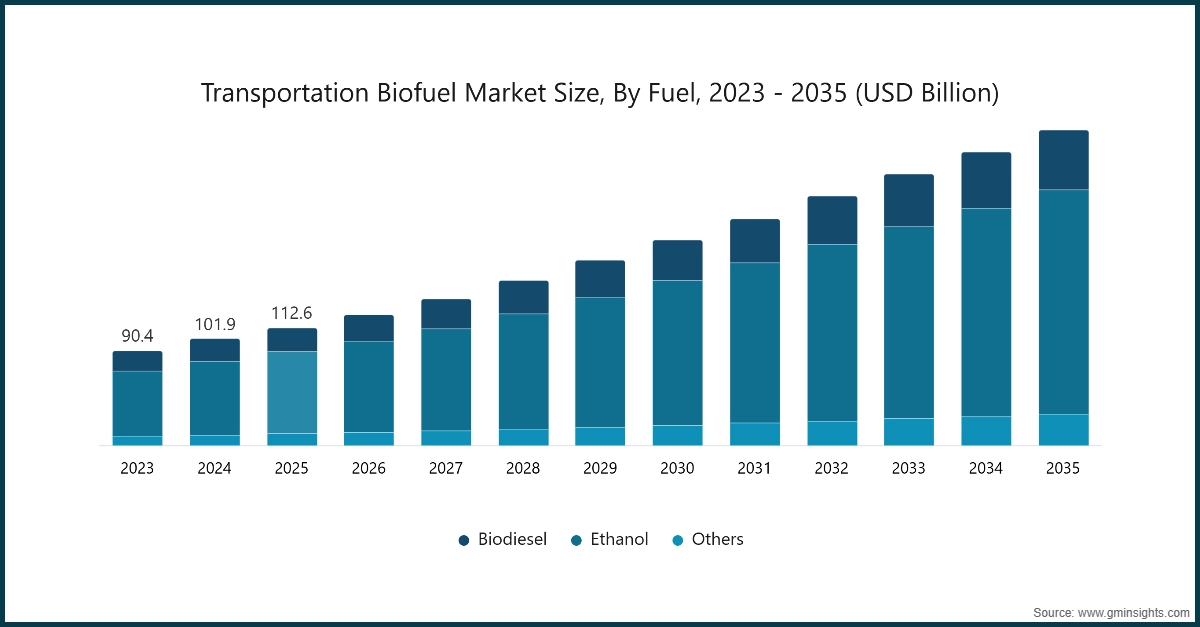
- Based on fuel, the transportation biofuel market is segmented into biodiesel, ethanol, and others. Ethanol fuel industry dominated by 69.5% of the market share in 2025 and is set to grow at a CAGR of 10.5% by 2035. Ethanol’s momentum is underpinned by a convergence of agricultural policy, refinery integration, and transport decarbonization targets that reward low‑carbon octane.
- Governments continue to advance blending programs and expand eligible feedstocks, while automakers validate higher‑blend compatibility and fuel retailers extend availability, lowering adoption frictions across large gasoline markets.
- For instance, in February 2026, the All-India Distillers’ Association (AIDA) assisted on the government to increase ethanol blending in petrol beyond the current E20 standard to address surplus production in the country. The acceleration of its national ethanol blending program with expanded feedstock eligibility, administered pricing, logistics upgrades, and offtake frameworks, underscoring policy‑backed demand and supply readiness at national scale.
- Producers are also investing in process efficiency, carbon intensity reduction, and coproduct optimization to strengthen competitiveness under emerging carbon‑accounting regimes. In parallel, the policy community increasingly links ethanol infrastructure with future e‑fuel and biointermediate routes, positioning biorefineries as flexible decarbonization platforms.
- For instance, in November 2025, France reached the completion of 4,000 E85 filling station, there expanding the low-carbon fuel availability across the country. This will result in the programmatic clarity and multi‑feedstock strategies sustaining growth across diverse geographies including other European regions.
- Biodiesel market will grow at a CAGR of 9.4% by 2035, driven by increasing practical decarbonization lever for compression‑ignition fleets, with policy signals and feedstock strategies. Various countries that depend heavily on middle distillates view biodiesel as a hedging instrument against oil price volatility and import exposure, which keeps demand resilient through cycles.
- For reference, in January 2025, Indonesia’s Ministry of Energy and Mineral Resources (ESDM) formally launched the B40 nationwide mandate effective, signaling sustained diesel substitution through policy and supply coordination in one of the world’s largest biodiesel programs.
- As electrification advances in light‑duty segments, biodiesel’s center of gravity continues to be heavy‑duty road transport, off‑road machinery, and select marine niches where operational familiarity, drop‑in capability, and existing storage infrastructure offer immediate value without vehicle turnover.
Learn more about the key segments shaping this market
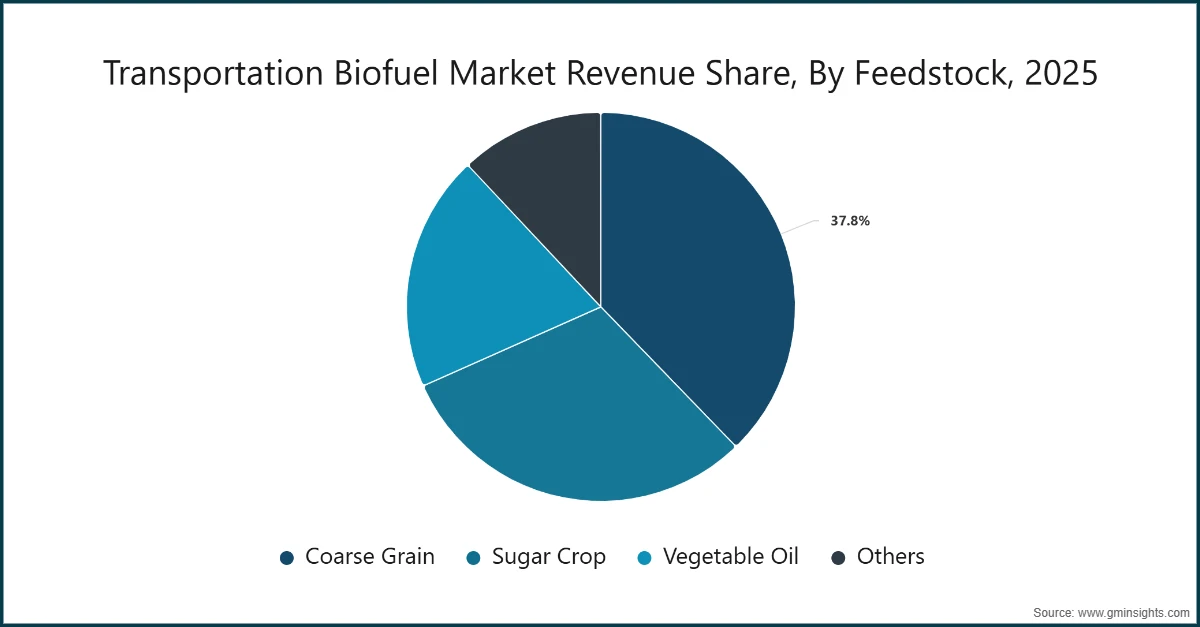
- Based on feedstock, the transportation biofuel market is segmented into coarse grain, sugar crop, vegetable oil, and others. Coarse grain held a market share of 37.8% in 2025 and will grow at a CAGR of 10.5% by 2035. Coarse grains continue to remain vital in the ethanol ecosystem as they combine large, geographically diversified supply with mature conversion technologies and well‑understood coproduct economics.
- For instance, in February 2026, the USDA announced that the export sales of coarse grain across the U.S. witnessed a robust foreign demand through the year 2025. This signifies the increasing use of grains for both domestic consumptions along with the production of ethanol as a clean fuel across the globe.
- In addition, as electrification expands in light‑duty fleets, coarse‑grain ethanol retains a structural role in gasoline pools due to octane value, drop‑in blending, and broad vehicle compatibility, while offering a platform to develop future bio‑intermediates and e‑fuel precursors without stranding assets in the medium term.
- Sugar crop feedstock will grow at a CAGR of 10.9% by 2035, due to its sucrose rich content that enables cost‑effective fermentation and flexible mill operations, that can swing between sugar and ethanol depending on market signals. In addition, ministries and regulators are formalizing mechanisms to divert cane sugar toward ethanol when needed, while safeguarding food supply and price stability.
- For reference, in November 2025, the Food and Agriculture Organization (FAO) projected that sugar production in Indonesia would increase from 2.6 million tons in 2025 to 2.8 million tons in 2026. Indonesia's sugar imports are also expected to rise, from 5.1 million tons in 2025 to 5.4 million tons in 2026.
- Producers are upgrading mills for multi‑feedstock flexibility, investing in vinasse management, and targeting lower lifecycle carbon intensity to meet increasingly stringent sustainability rules. Furthermore, national fuel‑blending trajectories and offtake frameworks are providing clearer demand visibility, which supports mill‑level capex and working capital planning, thereby adding to industry growth.
- Vegetable oil industry will grow at a CAGR of 9.4% through 2035, owing to their foundation for biodiesel/FAME and renewable diesel (HVO) production. These are chemically suited for drop‑in diesel substitutes and leverages existing storage, terminal, and fleet infrastructure.
- Mandate‑driven diesel substitution in emerging economies coupled with scaling renewable diesel/HVO and SAF pathways via asset conversions, co‑processing, and pretreatment investments is lifting structural demand for biodiesel, backed by public financing mechanisms and coordinated distribution.
- For reference, in January 2025, the government of Indonesia implemented nationwide B40 (40% palm‑based biodiesel in diesel), confirming mandate‑backed demand and signaling continued investment in lipid‑based fuel production, blending, and distribution across one of the world’s largest vegetable‑oil‑to‑fuel programs.
Looking for region specific data?
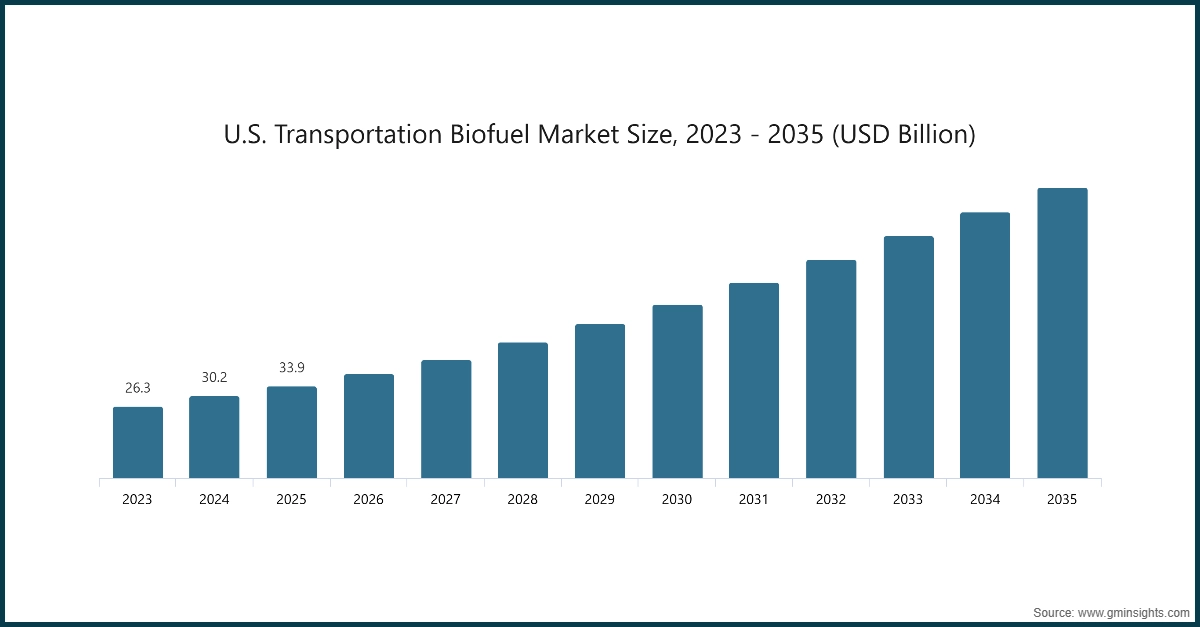
- The U.S. dominated the transportation biofuel market with around 93% share in 2025 and generated USD 33.9 billion in revenue. The regional biofuel landscape is defined by durable compliance architecture, maturing supply chains, and an increasingly granular focus on lifecycle performance.
- The U.S. Renewable Fuel Standard (RFS) remains the market’s institutional backbone, assisting producer and blender behavior through credit markets (RINs), pathway eligibility, and annual standard‑setting, along with shaping investment in cellulosic routes, biogas‑to‑transport, and lower‑carbon ethanol/biodiesel.
- In addition, federal and sub‑national programs continue to refine sustainability measurement and reporting, pushing producers toward process efficiency and carbon‑intensity reduction, often through heat integration, CCS readiness, and feedstock diversification.
- For instance, in November 2025, the U.S. Department of Agriculture announced an investment of USD 7 million, favoring the production of advance biofuel through the Advanced Biofuel Producer Payment Program. The funding is aimed at accelerating the production of American grown biofuel.
- Europe transportation biofuel industry was valued at USD 29.9 billion in 2025. The industry is transitioning from fragmented national policies to an integrated, mandate‑driven regime spanning road and aviation, underpinned by lifecycle sustainability rules. RED III elevates ambition and tightens definitions for fuels and feedstocks, while introducing sub‑targets and RFNBO guidance that clarify accounting and traceability.
- For reference, in May 2025, UK and the U.S. government announced a new trade deal to expand the U.S. ethanol demand across the UK market. The deal will infuse USD 5 billion export for the UK including USD 700 million in ethanol export. The UK being a significant importer of ethanol, will be benefited with the deal, thereby expanding the regional ethanol industry down the line.
- Asia Pacific transportation biofuel industry will reach at USD 65 billion by 2035. The regional growth is increasingly shaped by large, mandate‑anchored markets that blend energy security with decarbonization. In addition, high‑blend biodiesel programs that scale palm‑ or waste‑oil supply chains with traceability upgrades, and ethanol ecosystems that integrate coarse grains, cane is spurring the growth.
- For instance, in October 2025, the government of Indonesia decided plans to open 1 million hectares of agriculture land to cultivate raw materials for ethanol production. The strategic move from the Ministry of Agrarian Affairs and Spatial Planning (ATR) is aimed at supporting its drive for a mandatory 10 percent ethanol blend in all gasoline (E10).
- Middle East & Africa industry will grow at a CAGR of 2% by 2035. The shifting preference from ad‑hoc pilots to formal policies and first‑wave commercial capacity, with aviation acting as a visible catalyst and selective national programs building diesel and gasoline substitutes is augmenting the industry scenario.
- Furthermore, in Africa, regulatory frameworks are being modernized to address price formation, blending, and licensing, thereby enabling bankable offtake and manufacturing decisions that were historically constrained by policy uncertainty,
- For reference, in August 2025, the Government Gazette (No. R.6499) promulgates a Regulated Biofuels Price under the Petroleum Products Act, operationalizing the first phase of the Cabinet‑approved Biofuels Regulatory Framework and clarifying transfer‑price mechanisms for biodiesel/bioethanol.
- Latin America will grow at a CAGR of 8.9% by 2035. The region’s policy frameworks are increasingly market‑oriented and compliance‑driven, where certification regimes, decarbonization credits, and auditable sustainability criteria align biofuel producers with national climate targets while creating investable revenue stream.
- For instance, in October 2025, Vale and Wabtec sign agreement to test the use of ethanol in locomotives on the Vitória-Minas Railway, in Brazil. The goal was to develop studies on ethanol engines as an alternative to diesel, thereby becoming the first locomotive in the world to run on ethanol in the mixture.
Transportation Biofuel Market Share
- The top 5 companies in the transportation biofuel industry Neste Corporation, POET LLC., ADM, Cargill, and Wilmar International held over 30% market share in the year 2025. POET’s extensive production network, strong operational discipline, and growing involvement in carbon capture projects reinforce its position as a leading supplier of low‑carbon ethanol.
- ADM operates with a deeply integrated model that spans from raw material procurement to finished fuel output, offering both cost stability and reliable feedstock access. Its strategic move into renewable diesel and sustainable aviation fuel, supported by collaborative ventures and new technology platform, shows ADM’s intent to broaden its footprint beyond traditional ethanol and capture value across multiple renewable fuel markets.
- Neste leverages sophisticated biorefining expertise and a strong global reputation for sustainability to maintain a significant presence in renewable fuels. Its emphasis on converting waste and residue-based materials aligns well with increasingly strict carbon‑intensity regulations in Europe and North America.
Transportation Biofuel Market Companies
Major players operating in the transportation biofuel industry are:
- ADM
- Borregaard
- BTG Bioliquids
- Cargill
- Chevron Corporation
- Clariant
- COFCO
- FutureFuel
- Inpasa
- Munzer Bioindustrie
- My Eco Energy
- Neste Corporation
- POET
- Praj Industries
- The Andersons
- TotalEnergies
- UPM
- Verbio
- Wilmar International
- Zilor
- Cargill leverages its extensive global supply chain and strong position in agricultural feedstocks to support biodiesel and other renewable fuel production. Its influence as a major supplier of oils and biomass, coupled with ongoing investments in renewable diesel capacity, makes the company an important contributor to the expansion of transportation biofuels.
- ADM maintains a solid foothold in oil‑based biofuels, strengthened by its network of 18 bioethanol plants with a combined output of roughly 1.8 billion gallons annually. The company’s Q2 2025 adjusted earnings of USD 452 million reflect its stability in a volatile market and highlight the value of its continued efforts to streamline and rebalance its portfolio.
- Chevron Corporation is rapidly expanding its renewable diesel and SAF capabilities through upgraded biorefineries and expanded coprocessing operations. With USD 17.7 billion in net income and USD 7.7 billion directed toward low‑carbon and transition‑focused initiatives in 2024, the company is positioning itself as a major player in the next phase of renewable fuel development.
Transportation Biofuel Market Report Attributes
| Key Takeaway | Details |
|---|---|
| Market Size & Growth | |
| Base Year | 2025 |
| Market Size in 2025 | USD 112.6 Billion |
| Market Size in 2026 | USD 124.9 Billion |
| Forecast Period 2026-2035 CAGR | 10.3% |
| Market Size in 2035 | USD 301.4 Billion |
| Key Market Trends | |
| Drivers | Impact |
| Increasing popularity as an eco-friendly fuel for road transportation | Biofuels’ drop‑in compatibility with existing engines and fueling networks enables immediate tailpipe and lifecycle‑emissions reductions without vehicle turnover, driving their appeal for decarbonizing road transport. |
| Growing emphasis on reducing greenhouse gas emissions | Tightening climate policies and lifecycle‑carbon standards are pushing fuel suppliers to blend and procure lower‑CI biofuels to meet compliance targets and corporate net‑zero commitments. |
| Pitfalls & Challenges | Impact |
| High feedstock cost | Volatile prices for oils, sugars, and grains—plus competition from food, feed, and oleochemical markets will compress margins and hinder scale‑up unless secured by long‑term sourcing, waste‑residue integration, and hedging strategies. |
| Opportunities: | Impact |
| Expansion of advanced and waste‑derived biofuels | Growing policy incentives for low‑carbon, residue‑based fuels open new pathways for producers to scale high‑margin advanced biofuels. |
| Rising demand from hard‑to‑electrify sectors | Aviation, heavy‑duty transport, and marine fuels increasingly rely on bio-based alternatives, creating long‑term market opportunities. |
| Market Leaders (2025) | |
| Market Leader |
Market Share of: 7% |
| Top Players |
Collective Market Share of: 30% |
| Competitive Edge |
|
| Regional Insights | |
| Largest Market | North America |
| Fastest growing market | Asia Pacific |
| Emerging countries | India, Indonesia, Brazil |
| Future outlook |
|
What are the growth opportunities in this market?
Transportation Biofuel Industry News
- In January 2026, Government of Canada awarded Advanced Biofuels Canada Association (ABFC) an investment of over USD 97 million to support clean transportation across Canada, including new funding for education and awareness initiatives focused on clean transportation across Canada.
- In December 2025, Inpasa announced an investment of over USD 600 million to construct a new biorefinery and expand an existing operation in the state of Mato Grosso, Brazil The unit is expected to process 2 million metric tons of grains annually, producing 1 billion liters of ethanol.
- In February 2025, POET and Tallgrass have partnered to link POET’s Fairmont, Nebraska bioprocessing plant to the Trailblazer CO₂ pipeline, creating a pathway for long‑term carbon sequestration. This connection will significantly reduce the facility’s carbon intensity and reflects a growing model in the ethanol industry.
This transportation biofuel market research report includes in-depth coverage of the industry with estimates & forecast in terms of revenue (USD Million) and volume (Mtoe) from 2022 to 2035, for the following segments:
Market, By Fuel
- Biodiesel
- Ethanol
- Others
Market, By Feedstock
- Coarse grain
- Sugar crop
- Vegetable oil
- Others
The above information has been provided for the following region and countries:
- North America
- U.S.
- Canada
- Mexico
- Europe
- Germany
- France
- Spain
- UK
- Italy
- Asia Pacific
- China
- India
- Indonesia
- Australia
- South Korea
- Middle East & Africa
- Saudi Arabia
- South Africa
- Latin America
- Brazil
- Argentina
Frequently Asked Question(FAQ) :
What is the market size of the transportation biofuel in 2025?
The market was valued at USD 112.6 billion in 2025, with a CAGR of 10.3% expected through 2035. The market growth is driven by policy shifts toward targeted fuel mandates, increasing adoption of renewable diesel, and advancements in lifecycle governance frameworks.
What is the projected value of the transportation biofuel market by 2035?
The market is poised to reach USD 301.4 billion by 2035, fueled by investments in advanced biofuels, renewable drop-in fuels, and compliance-driven frameworks across major markets.
What is the expected size of the transportation biofuel industry in 2026?
The market size is projected to reach USD 124.9 billion in 2026.
How much revenue did the ethanol fuel segment generate in 2025?
The ethanol fuel segment accounted for 69.5% of the market share in 2025, generating significant revenue and benefiting from agricultural policies, refinery integration, and transport decarbonization targets.
What was the market share of coarse grains in 2025?
Coarse grains held a 37.8% market share in 2025 and are expected to grow at a CAGR of 10.5% by 2035, led by their large, geographically diversified supply and mature conversion technologies.
What is the growth outlook for sugar crop feedstock by 2035?
Sugar crop feedstock is set to expand at a CAGR of 10.9% till 2035, supported by its sucrose-rich content, cost-effective fermentation, and flexible mill operations that can adapt to market signals.
Which region leads the transportation biofuel sector?
The United States dominated the market in 2025, capturing around 93% of the market share and generating USD 33.9 billion in revenue. The region's leadership is attributed to robust compliance frameworks, maturing supply chains, and a focus on lifecycle performance.
What are the upcoming trends in the transportation biofuel market?
Key trends include renewable diesel and SAF adoption, biofuel policy integration, improved catalysts and logistics, and localized production to reduce risks.
Who are the key players in the transportation biofuel industry?
Major players include ADM, Borregaard, BTG Bioliquids, Cargill, Chevron Corporation, Clariant, COFCO, FutureFuel, Inpasa, Munzer Bioindustrie, My Eco Energy, and Neste Corporation.
Transportation Biofuel Market Scope
Related Reports