Summary
Table of Content

Toilet Seat Market
Get a free sample of this report
Form submitted successfully!
Error submitting form. Please try again.
Thank you!
Your inquiry has been received. Our team will reach out to you with the required details via email. To ensure that you don't miss their response, kindly remember to check your spam folder as well!
Request Sectional Data
Thank you!
Your inquiry has been received. Our team will reach out to you with the required details via email. To ensure that you don't miss their response, kindly remember to check your spam folder as well!
Form submitted successfully!
Error submitting form. Please try again.
Toilet Seat Market Size
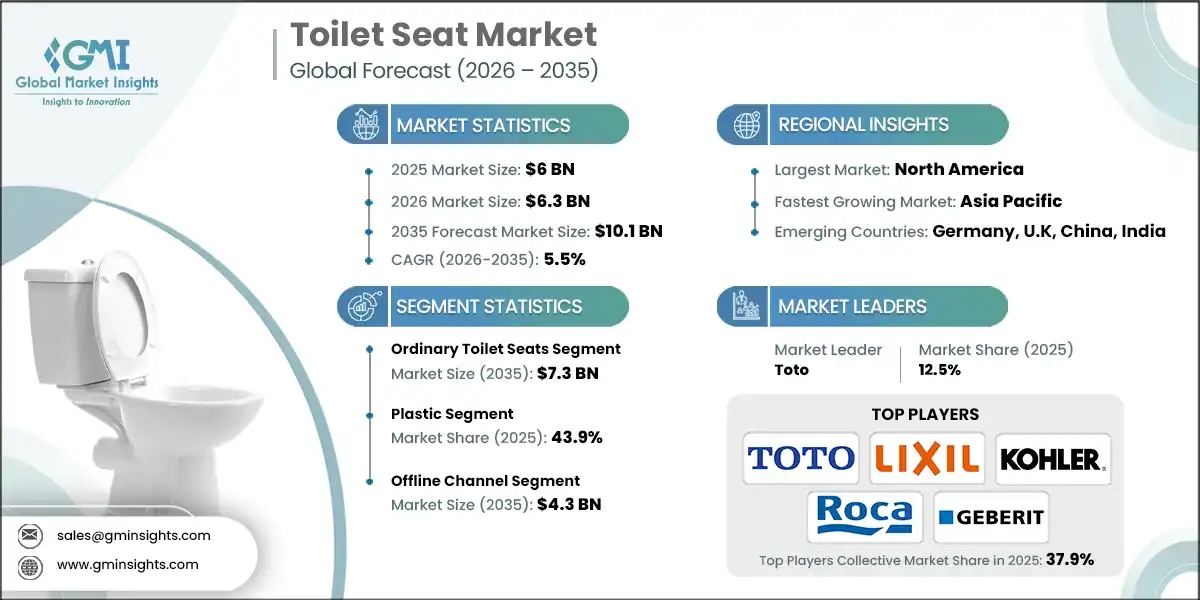
The global toilet seat market was valued at USD 6 billion in 2025. The market is expected to grow from USD 6.3 billion in 2026 to USD 10.1 billion in 2035, at a CAGR of 5.5%, according to latest report published by Global Market Insights Inc.
Toilet Seat Market Key Takeaways
Market Size & Growth
- 2025 Market Size: USD 6 Billion
- 2026 Market Size: USD 6.3 Billion
- 2035 Forecast Market Size: USD 10.1 Billion
- CAGR (2026–2035): 5.5%
Regional Dominance
- Largest Market: North America
- Fastest Growing Region: Asia Pacific
Key Market Drivers
- Increasing awareness about hygiene and sanitation.
- Increase in aging population.
- Rise in disposable incomes.
Challenges
- Rise in cost of smart toilet seats.
- Diverse cultural preferences.
Opportunity
- Rising demand for smart & bidet toilet seats.
- Growth in sustainable & circular-design toilet seats.
Key Players
- Market Leader: Toto led with over 12.5% market share in 2025.
- Leading Players: Top 5 players in this market include Toto, Lixil Group, Kohler, Roca Sanitario, Geberit, which collectively held a market share of 37.9% in 2025.
Get Market Insights & Growth Opportunities
The rise of the toilet seat industry has increased awareness of hygiene and sanitary conditions. According to the World Health Organization (WHO), improved sanitation facilities have become a priority, with global sanitation coverage rising to 74% in 2023. A growing number of consumers require hygienic toilet seats, which has led them to purchase more innovative products that self-clean. The popularity of self-cleaning toilet seats featuring UV Sterilization technology has grown rapidly.
More disposable income means that an increasing number of people have enough money to buy higher-priced, technologically advanced toilets. According to the International Monetary Fund's predictions, there will be an estimated increase of nearly 3.5% in disposable income for persons and families in 2023. Thus, they can now purchase items such as heated toilet seats, toilets with bidets, and toilets with motion sensors. Among others, leading manufacturers of these types of toilets are Toto and Kohler, both of whom manufacture superior, modern toilet seats.
As the global population ages, an increasing number of elderly individuals are poised to play a pivotal role in driving the growth of the toilet seat market.The United Nations estimates that by 2024, there will be approximately 16% of the global population over 60. Therefore, the need for toilet seats suited for this segment of the market will substantially increase. For example, toilet seats that are higher and allow for the installation of grab bars are becoming very important to address the increased number of seniors and the needs of seniors.
In addition, smart toilets with innovative features, including AI integration and remote access and control, contribute to the overall price of the product and limit the overall affordability of the product by the average consumer. For instance, many high-end smart toilets are priced at upwards of USD 1,000, so many consumers will not be able to purchase these items.
Cultural factors play an important role in how the market is developing. For example, in India, a country with a history of using traditional toilets, the uptake of modern toilet technology has been relatively slow. However, the introduction of initiatives such as the Swachh Bharat Mission has raised awareness of sanitation and, therefore, will slowly help to develop a more modern preference for consumers.
To get key market trends
Toilet Seat Market Trends
Changing innovation and technology transformation are important for the growth of the market.
- Growth in the market for toilet seats is attributable to a number of things, including advancements in technology and innovative new technical designs that focus on sustainability. Among the most popular new designs in toilet seats are smart technology models. These models have features like heated seats, active take-off lids, integrated bidets, and automatic cleanings. An example of extreme success with smart technology toilet seats can be found in Japan, where the "Ministry of Land, Infrastructure, Transport and Tourism" reports over 80% of Japanese households have at least one smart technology toilet seat.
- The growth of the toilet seat industry is also heavily influenced by government initiatives. For example, India has adopted modern sanitation methods throughout the country; both urban and rural areas have benefited from the Swachh Bharat Mission, which promotes the adoption of modern sanitation methods, including advanced toilet seats. A similar example is the "Environmental Protection Agency" (EPA), which has developed a program called "WaterSense" to promote the use of water-efficient toilet systems, as well as the promotion of eco-friendly toilet seat designs to conserve water.
- Since the COVID-19 pandemic, companies that sell toilet seats have focused their efforts on developing products with a focus on hygiene. This has resulted in a sharp increase in demand for antimicrobial toilet seats. For example, Kohler and Toto have released product lines that include germ-resistant coatings. These innovative products help to alleviate consumer concerns regarding health and cleanliness, especially when used in public and shared facilities.
- Compact and portable toilet seat products are providing urban areas with limited space and the elderly with additional choices. As the number of urban centres continues to grow and become denser, and as an increasing number of older people continue to live independently, there is a growing demand for both convenience and accessibility in toilet seat designs.
- The adoption of IoT in toilet seat products is one of the most innovative trends emerging in the market. With features like app-controlled settings, health monitoring and water usage tracking, these products help to improve the user experience while also improving the efficiency of operations.
Toilet Seat Market Analysis
Learn more about the key segments shaping this market
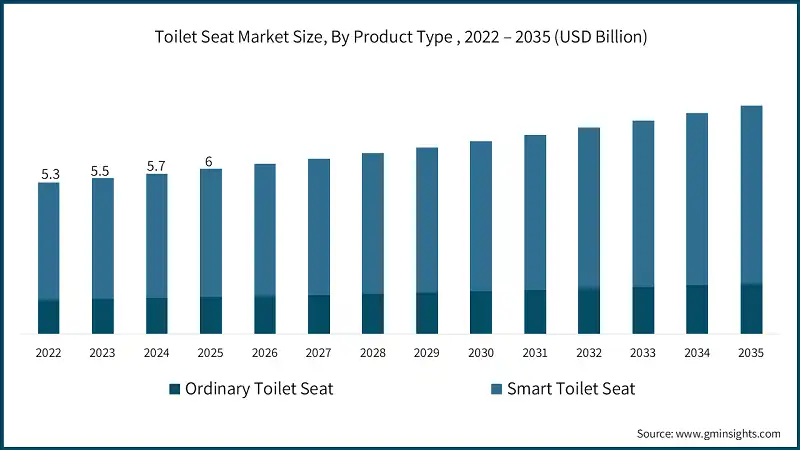
Based on type, the toilet seat industry is segmented into smart toilet seats and ordinary toilet seats. The ordinary toilet seats segment accounts for revenue of around USD 4.5 billion in the year 2025 and is expected to reach USD 7.3 billion by 2035.
- Ordinary toilet seats continue to dominate the toilet seat market due to their affordability and widespread availability. Regular toilet bowls are mainstream products, and they exist primarily within households found in underdeveloped countries that place a priority on cost than technology. As reported in The World Bank, as of 2023, over 40% of the world's population lives in a low-income regions and affordability is the primary factor when purchasing principles.
- Furthermore, ordinary toilet bowls have very simplistic requirements for their installation and maintenance. Both installation and removal of an ordinary toilet bowl can easily be done without any specialized tools & expertise. Therefore, it is often preferred by many consumers therefore in countries such as India or Nigeria where access to skilled labour is lacking, Ordinary toilet bowls are much easier to work with than smart toilet seats or any other type of modernization.
- Governments around the globe have sponsored various programs to promote basic sanitary facilities; thus, creating greater demand for ordinary toilet bowls. For example, in India- the Swachh Bharat Abhiyan (Clean India Mission), which is targeted primarily towards providing villages with affordable options for "assure sanitation" needs. Consequently, due to the primary defining factor behind this program, the cost factor correspondingly creates greater mass adoption of Standard toilet bowls.
- Ordinary toilet seats are more practical than smart toilet seat models because they can be used in standard or regular designs with minimal modifications required. The majority of toilet seats manufactured today are designed to easily fit within existing toilet bowl ranges, hence lower costs associated with converting a toilet seat from a smart to a standard design when comparing these two options.
- In the United States alone, more than 60% of all homes have some form of standard toilet seat as opposed to a smart toilet seat due to the fact that they are better priced and easier for most users to operate. This demonstrates that ordinary toilet seats continue to be a popular choice in both emerging and established markets.
Learn more about the key segments shaping this market
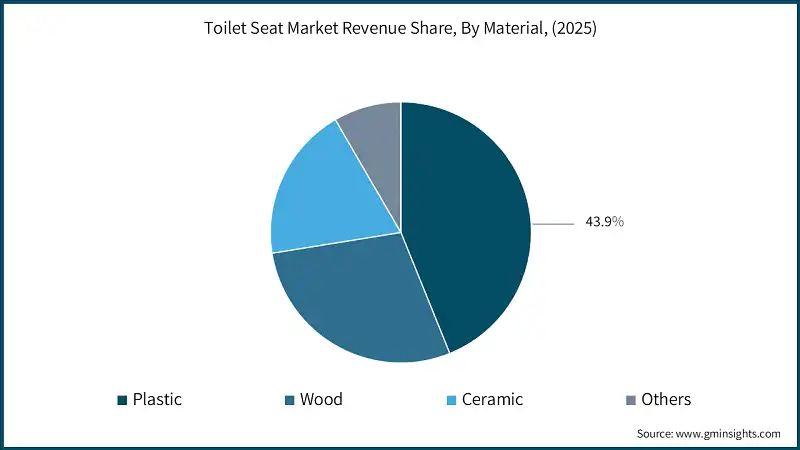
Based on the material, the toilet seat market is bifurcated into plastic, wood, ceramic, and others. The plastic segment held the largest share, accounting for 43.9% of the market in 2025.
- The high level of popularity and significant market share that plastic holds within the toilet seat industry is due in large part to its combination of being cost-effective, long lasting, and having many applications. EPA estimates show that in 2022 plastic production in the U.S. was more than 35 million tons, with a large percentage being used for products like bathroom fixtures, thus illustrating how much larger plastic's share is than all other raw materials combined.
- One key factor contributing to plastic's popularity is its resistance to moisture/humidity, therefore, it makes an excellent material for use in the bathroom. Plastic does not rust, rot, warp, or deteriorate with exposure to humidity/water, as wood and metal would; for example, polypropylene and thermoplastics are two materials that are regularly used to manufacture toilet seats because of their excellent abrasion resistance.
- Plastic toilet seats are also lightweight and easy to install. This reduces labour costs, making them advantageous for use in both residential and commercial situations. Manufacturers can also manufacture them in many different colours and finishes. This means manufacturers are better able to meet their customers' preferences with respect to colour and finish, hence their increased manufacturer acceptance and market share.
- Government programs that support the use of recycled plastic help to maintain plastics' position as the most common toilet seat material. For instance, the European Union supports the production of goods using recycled plastics through its Circular Economy Action Plan, which encourages innovation in creating sustainable toilet seat materials.
- The durability, cost-effectiveness, and visual appeal of plastic have made it an attractive toilet seat material for many companies, including Kohler and Bemis. The continued development of plastics technology and increasing consumer demand for low-cost, high-quality toilet seats will drive continued growth in plastic.
Based on distribution channels, the toilet seat market is segmented into online and offline channels. The offline channel segment held the largest share, generating a revenue of USD 4.3 billion of the global market in 2025.
- Offline distribution channels continue to be the most significant influence on the market because of the preference of consumers to physically inspect the products before they buy them. Most consumers want to evaluate the products design and material before buying the product, and this is made possible only through hands-on experience. Retailers allows customers to check out multiple product models at once, giving them the knowledge and confidence to make an informed decision.
- This pattern is confirmed by government statistics. For example, the US Census Bureau reported that in 2023, approximately 85% of all retail sales made by brick-and-mortar retailers came from brick-and-mortar retail stores, meaning that consumers still have a strong preference for the offline channel. This is especially important for home improvement products, including toilet seats and other bathroom accessories.
- Additionally, many offline retailers offer exclusive promotions and discounts to help attract cost-saving consumers. For example, two of the biggest home improvement retailers, Home Depot and Lowe’s, routinely run special promotions on toilet seats and other bathroom accessories during the holiday seasons, these promotions generate more traffic to the brick-and-mortar stores.
- Another factor in consumer purchasing decisions is the availability of in-store demonstrations and product displays for products such as toilets that feature a soft-close mechanism or bidet functions. Retailers set up displays of units equipped with these features to give consumers an idea of what each unit has to offer, as well as to help them understand the value of these added features. By allowing consumers to experience and touch these products firsthand, retailers play a large role in creating trust in the product and increasing the chances that the consumer will make a purchase.
Looking for region specific data?
North America Toilet Seat Market
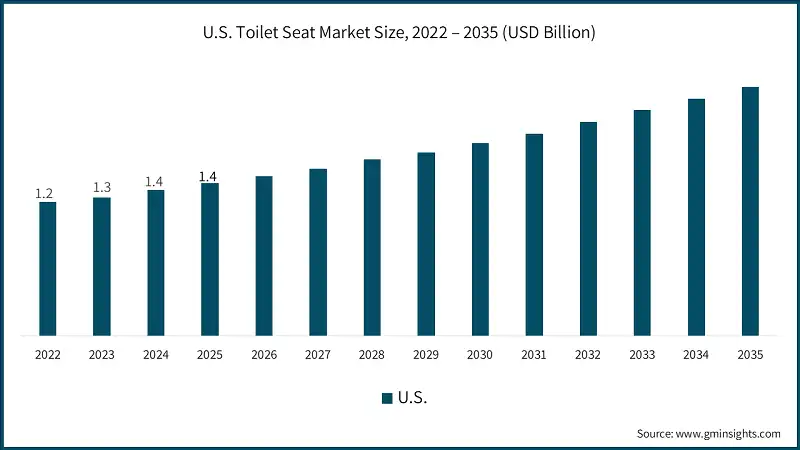
In 2025, the U.S. dominated the market growth in North America, accounting for 72.8% of the share in the region.
- The growth in the region is strongly supported by rising home renovation and remodeling activity across the U.S., fueled by higher household expenditures. The U.S. reported a significant rise in bathroom renovation spending, with the median remodel cost increasing by nearly 13% in 2021, indicating sustained consumer investment in bathroom upgrades.
- Urban development, expanding real estate activity, and the shift toward smart homes are accelerating adoption across the region. Standard and smart toilet seats are gaining traction due to growing preference for ergonomic, water-efficient, and germ-resistant products.
Asia Pacific Toilet Seat Market
Asia Pacific market is expected to grow at 6.6% during the forecast period.
- The Asia Pacific market is expanding due to rapid urbanization and strong government investment in sanitation and water-efficient technologies. India’s national Smart Cities Mission, backed by a USD 7.3 billion allocation, and China’s water-efficiency standards requiring 5 L flush limits are accelerating smart toilet and toilet seat adoption .
Europe Toilet Seat Market
Europe market is expected to grow at 4.6% during the forecast period.
- Market growth in Europe is driven by strong renovation activity supported by government energy-efficiency and building modernization policies. The EU’s Renovation Wave Strategy aims to double renovation rates by 2030, backed by government funding through the Recovery and Resilience Facility-directly boosting demand for upgraded bathroom fixtures, including toilet seats.
Middle East and Africa Toilet Seat Market
Middle East and Africa market is expected to grow at 3.2% during the forecast period.
- The region’s growth is led by infrastructure investments aimed at improving sanitation, urban living conditions, and public health outcomes. Countries across the region are expanding sanitation access, but gaps remain- less than 50% of collected wastewater is safely treated in multiple MENA nations, emphasizing urgent demand for modern sanitation fixtures.
Toilet Seat Market Shares
The top companies in the market include Toto, Lixil Group, Kohler, Roca Sanitario and Geberit and collectively hold a share of 37.9% of the market in 2025. These prominent players are proactively involved in strategic endeavors, such as mergers & acquisitions, facility expansions & collaborations, to expand their product portfolios, extend their reach to a broad customer base, and strengthen their market position.
- TOTO is a global leader in advanced toilet and bidet-seat technology, best known for its WASHLET line offering heated seats, automated cleansing, and high-hygiene performance. It continues to scale production through major expansions such as its new Georgia manufacturing facility to meet rising demand. The company emphasizes sustainability, robotics-driven precision, and premium comfort across its integrated toilet and seat systems.
- LIXIL manufactures a broad range of toilet seats through brands like INAX and American Standard, including smart SpaLet models and antimicrobial soft-close designs. With operations in over 150 countries, it leverages strong water-technology expertise to deliver solutions across all market tiers. LIXIL also drives global sanitation innovation through its SATO brand, providing affordable, water-efficient toilet technologies.
- Kohler offers an extensive lineup of toilet and bidet seats, from soft-close and ergonomic models to advanced electric cleansing seats with heating, UV-sanitization, and app-based personalization. Its KOHLER Konnect ecosystem enables voice control and customized settings for enhanced hygiene and comfort. The brand focuses on durability, premium styling, and elevating wellness through thoughtfully engineered seating solutions .
Toilet Seat Market Companies
Major players operating in the toilet seat industry are:
- American Standard
- Cera Sanitaryware
- Centoco Manufacturing
- Duravit
- Geberit
- Hindware Sanitaryware
- Jaquar
- Kohler
- Lixil Group
- Masco Corporation
- Panasonic
- Pressalit
- Roca Sanitario
- Toto
- Villeroy and Boch
Roca produces a wide variety of toilet seats featuring antibacterial materials, Supralit durability, and soft-closing technology designed for hygiene and long-term performance. Their seats integrate seamlessly with collections such as Ona, Inspira, Meridian, and The Gap for design consistency. With more than 84 global manufacturing facilities, Roca blends century-old craftsmanship with modern engineering and sanitation innovation.
Geberit delivers high-performance toilet seats engineered for comfort, hygiene, and ease of cleaning, offering SoftClosing, QuickRelease, and compatibility with its iCon, Selnova, Acanto, and other WC lines. Its AquaClean attachments enable simple upgrades to shower-toilet functionality for enhanced cleansing. Operated through 26 global production plants, Geberit emphasizes durability, precision design, and sustainable sanitary-technology leadership.
Toilet Seat Market Report Attributes
| Key Takeaway | Details |
|---|---|
| Market Size & Growth | |
| Base Year | 2025 |
| Market Size in 2025 | USD 6 Billion |
| Market Size in 2026 | USD 6.3 Billion |
| Forecast Period 2026 - 2035 CAGR | 5.5% |
| Market Size in 2035 | USD 10.1 Billion |
| Key Market Trends | |
| Drivers | Impact |
| Increasing awareness about hygiene and sanitation | Heightened hygiene consciousness-accelerated by global health events-has boosted demand for toilet seats with antimicrobial surfaces, soft close features, and advanced cleaning technologies. Consumers now prefer products that reduce germ spread and improve bathroom cleanliness. |
| Increase in aging population | An expanding elderly population drives demand for ergonomic, comfort focused toilet seats, including heated, elevated, and bidet equipped models. This segment values accessibility and ease of use, pushing manufacturers to integrate supportive designs. |
| Rise in disposable incomes | Higher disposable incomes encourage consumers to upgrade from basic seats to premium, feature rich models. This shift fuels adoption of smart and aesthetically advanced seats as bathrooms become lifestyle and wellness spaces. |
| Pitfalls & Challenges | Impact |
| Rise in cost of smart toilet seats | Smart toilet seats often carry higher price points due to advanced electronics, sensors, and heating systems, limiting adoption in price sensitive markets. This creates a gap between consumer interest and actual purchase behavior. |
| Diverse cultural preferences | Toilet seat design preferences vary widely across regions such as bidet culture in Japan vs. standard seats in the U.S.. This diversity complicates standardization, increases inventory complexity, and demands market specific product customization. |
| Opportunities: | Impact |
| Rising demand for smart & bidet toilet seats | Growing interest in comfort, hygiene, and tech enabled living drives rapid uptake of bidet and smart seats with warm water cleansing, heating, and auto functions. This segment is expanding globally, especially in urban and luxury segments. |
| Growth in sustainable & circular-design toilet seats | Eco friendly materials, recyclable duroplast, and long life modular designs are becoming key differentiators. Manufacturers adopting circular economy principles gain competitive edge as consumers and regulators prioritize sustainability. |
| Market Leaders (2025) | |
| Market Leaders |
12.5% market share |
| Top Players |
|
| Competitive Edge |
|
| Regional Insights | |
| Largest market | North America |
| Fastest growing market | Asia Pacific |
| Emerging countries | Germany, U.K, China, India |
| Future outlook |
|
What are the growth opportunities in this market?
Toilet Seat Industry News
- In July 2025, Roca Group announced a strategic move into the high-end bathroom category by acquiring a majority stake in Italian luxury design brand Antonio Lupi Design. Although not a direct toilet-seat launch, this acquisition significantly expands Roca’s premium sanitaryware and integrated bathroom technology portfolio- reinforcing its competitive position in high-design smart bathroom solutions.
- In April 2025, during an exclusive launch event at Atlantis The Royal, Dubai, Geberit officially introduced several 2025 sanitary innovations to the Gulf region- including the AquaClean Alba shower toilet a smart bidet-seat style products featuring WhirlSpray technology, TurboFlush performance, app-controlled shower settings, and a soft-close seat. The event also marked the introduction of the ultra-slim Sigma40 actuator plates.
- In March 2025, At ISH 2025, TOTO launched its reimagined NEOREST WX series in striking matte black and matte white finishes, combining integrated WASHLET capability, upgraded ceramics, and premium texture aesthetics. TOTO also introduced enhanced retrofit-friendly toilet-to-WASHLET systems enabling consumers to upgrade seats in under five minutes.
- In February 2025, at the Kitchen & Bath Industry Show (KBIS) 2025, Kohler introduced major additions to its smart-bathroom portfolio, including the PureWash E930 Bidet Seat, alongside new smart toilets such as the Veil Smart Toilet in Honed Black. The showcase emphasized design-led innovation, sustainability, and immersive wellness-focused bathroom solutions.
- In February 2025, TOTO announced the launch of its new WASHLET S2 and WASHLET S5 models at KBIS 2025, featuring a slimmer profile, instantaneous water heating for 38% energy savings, upgraded hygiene tech heated seats, adjustable cleansing, and integrated night lights. These models redefine TOTO’s smart-seat ecosystem with improved sustainability and comfort.
The toilet seat market research report includes in-depth coverage of the industry, with estimates & forecasts in terms of revenue (USD Billion) and volume (Million Units) (from 2022 to 2035), for the following segments:
Market, By Product Type
- Ordinary Toilet Seat
- Smart Toilet Seat
Market, By Bowl Shape
- Elongated
- Round
- Square
- Others (Oval, etc.)
Market, By Material
- Plastic
- Wood
- Ceramic
- Others (Urea Moldings, Compounds, etc.)
Market, By Price Range
- Low
- Mid
- High
Market, By End-Use
- Commercial
- HoReCa
- Hospitals
- Offices
- Malls
- Others (institutions, banquets, etc.)
- Residential
Market, By Distribution Channel
- Online channels
- E-commerce
- Company websites
- Offline channels
- Specialty Stores
- Mega Retail Stores
- Others (Departmental Stores, etc.)
The above information is provided for the following regions and countries:
- North America
- U.S.
- Canada
- Europe
- Germany
- France
- UK
- Italy
- Spain
- Asia Pacific
- China
- Japan
- India
- Australia
- South Korea
- Latin America
- Brazil
- Mexico
- Argentina
- MEA
- Saudi Arabia
- UAE
- South Africa
Frequently Asked Question(FAQ) :
What is the projected value of the toilet seat market by 2035?
The market is expected to reach USD 10.1 billion by 2035, driven by technological advancements, sustainability-focused designs, and government initiatives promoting modern sanitation.
What is the projected size of the toilet seat market in 2026?
The market is expected to reach USD 6.3 billion in 2026.
How much revenue did the ordinary toilet seat segment generate in 2025?
The ordinary toilet seat segment generated approximately USD 4.5 billion in 2025 and is projected to grow to USD 7.3 billion by 2035.
What was the market share of the plastic material segment in 2025?
The plastic segment held the largest share, accounting for 43.9% of the market in 2025.
Which distribution channel led the toilet seat market in 2025?
The offline distribution channel dominated the market, generating USD 4.3 billion in revenue in 2025.
Which region led the toilet seat market in North America in 2025?
The United States led the market in North America, accounting for 72.8% of the regional share in 2025.
What are the upcoming trends in the toilet seat industry?
Key trends include the adoption of smart technology toilet seats with features like heated seating, automatic lids, integrated bidets, and self-cleaning capabilities. Additionally, government initiatives promoting water-efficient and eco-friendly designs are driving market growth.
Who are the key players in the toilet seat market?
Key players include American Standard, Cera Sanitaryware, Centoco Manufacturing, Duravit, Geberit, Hindware Sanitaryware, Jaquar, Kohler, Lixil Group, Masco Corporation, Panasonic, Pressalit, Roca Sanitario, Toto, and Villeroy and Boch.
Toilet Seat Market Scope
Related Reports