Summary
Table of Content

Three Phase Home Standby Gensets Market
Get a free sample of this report
Form submitted successfully!
Error submitting form. Please try again.
Thank you!
Your inquiry has been received. Our team will reach out to you with the required details via email. To ensure that you don't miss their response, kindly remember to check your spam folder as well!
Request Sectional Data
Thank you!
Your inquiry has been received. Our team will reach out to you with the required details via email. To ensure that you don't miss their response, kindly remember to check your spam folder as well!
Form submitted successfully!
Error submitting form. Please try again.
Three Phase Home Standby Gensets Market Size
The growing intensity and growing prevalence of weather related will foster the implementation of these units. The increasing intensity of climate events along with the aging power infrastructure and the increasing grid vulnerability are reinforcing the need to have a reliable source of back-up power to maintain operation and to mitigate risk.
The increased large-scale investments in the real estate industry will greatly impact the demand pattern in the industry. The rapid urbanization and the increasing consumer tendency towards higher reliability of residential use is intensifying business growth. Further, the ever-growing demand of continuous power supply to the critical appliances, medical equipment, and required home services further increases the demand of these systems.
For instance, in 2025, the government presented a housing program to enhance the affordability of homes and increase homeownership by strengthening financing programs. The program aimed at making construction simpler, lowering the total cost of the project and cutting down the time taken in approving projects to spur residential development. It also focused on the development of rental housing, assistance to first-time buyers, and increased liberalization of the restrictive zoning rules.
The three phase home standby gensets market was estimated at USD 3.2 billion in 2025. The market is expected to grow from USD 3.4 billion in 2026 to USD 5.8 billion by 2035, at a CAGR of 6.1%, according to a recent study by Global Market Insights Inc.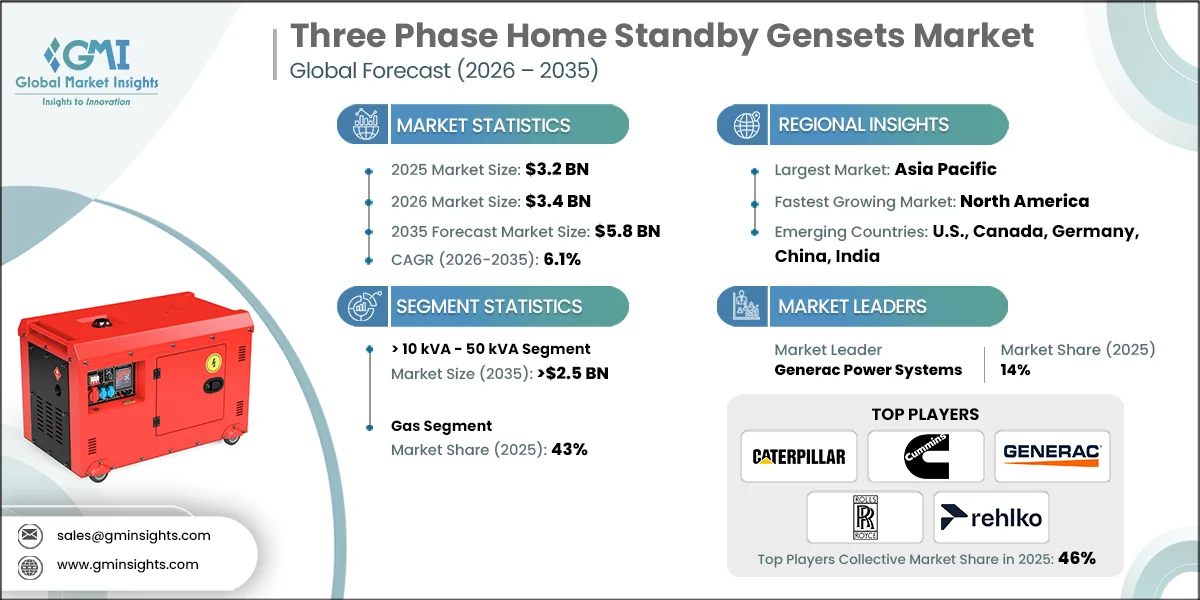
Three Phase Home Standby Gensets Market Key Takeaways
Market Size & Growth
- 2025 Market Size: USD 3.2 Billion
- 2026 Market Size: USD 3.4 Billion
- 2035 Forecast Market Size: USD 5.8 Billion
- CAGR (2026–2035): 6.1%
Regional Dominance
- Largest Market: Asia Pacific
- Fastest Growing Region: North America
Key Market Drivers
- Increasing frequency of extreme weather events.
- Ongoing refurbishment of T&D networks.
- Extensive investments across the real estate sector.
Challenges
- High operation & maintenance cost.
Opportunity
- Growing shift toward smart home integration.
- Rising emphasis on residential energy security.
- Expansion of natural gas infrastructure.
- Increasing adoption of high‑load residential equipment.
Key Players
- Market Leader: Generac Power Systems led with over 14% market share in 2025.
- Leading Players: Top 5 players in this market include Caterpillar, Cummins, Generac Power Systems, Rolls-Royce, Rehlko, which collectively held a market share of 46% in 2025.
Get Market Insights & Growth Opportunities
To get key market trends
Three Phase Home Standby Gensets Market Trends
The areas that use subterranean power lines are susceptible to flooding due to storm surges created by hurricanes and persistent heavy rains, which usually cause extensive power cuts that increase the growth potential in the industry. Extreme weather disruptions and natural hazards have been increasing due to increasing urbanization which has had a big toll in the electricity network and has led to increased demand of home standby gensets.
For instance, in 2025, the Green Climate Fund scaled up its financial endeavor by sanctioning USD 686.8 million, supplemented with co-financing to USD 1.5 billion. The pledge is aimed at supporting climate-prone areas with 11 new endorsed projects in 42 nations, directly benefiting about 115.5 million individuals and allowing the reduction of 45.3 million metric tonnes of CO 2 emissions.
Three Phase Home Standby Gensets Market Analysis
Learn more about the key segments shaping this market
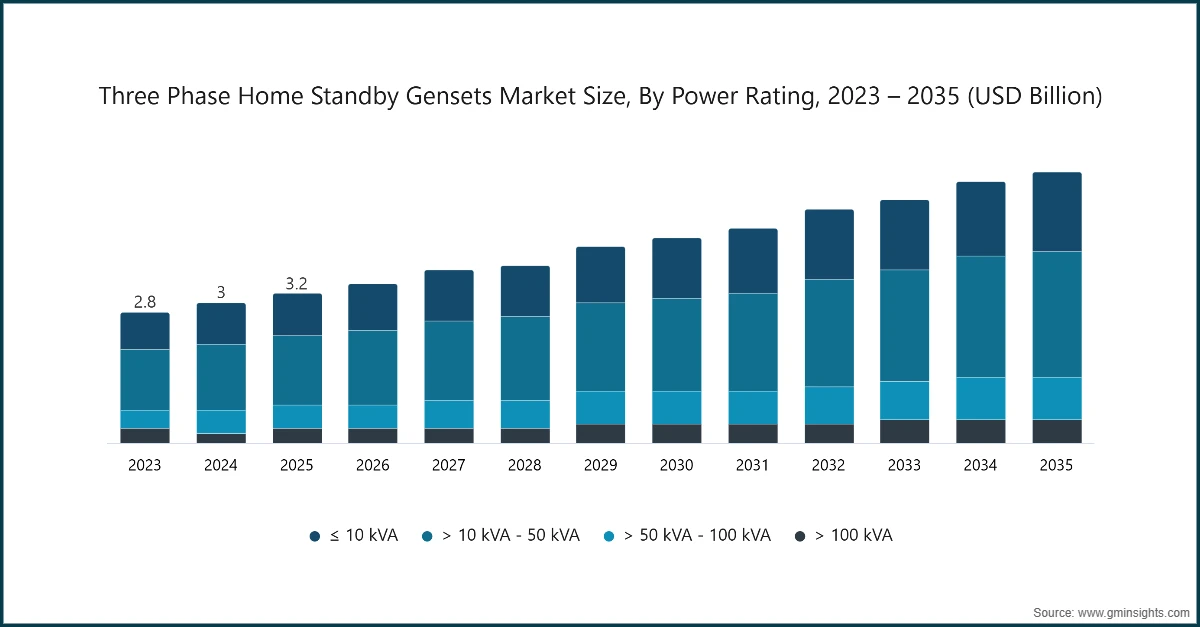
The > 10 kVA - 50 kVA three phase home standby gensets market is set to reach over USD 2.5 billion by 2035. The continued adoption of the product by large numbers of people due to the application of the units to power some of the most important household processes like hot water systems, well pumps and other kitchen appliances is set to drive the product adoption. Such capacity ratings have come out as a strategically significant resolution to unavoidable power deficits that other backup solutions cannot reliably undress.
Learn more about the key segments shaping this market
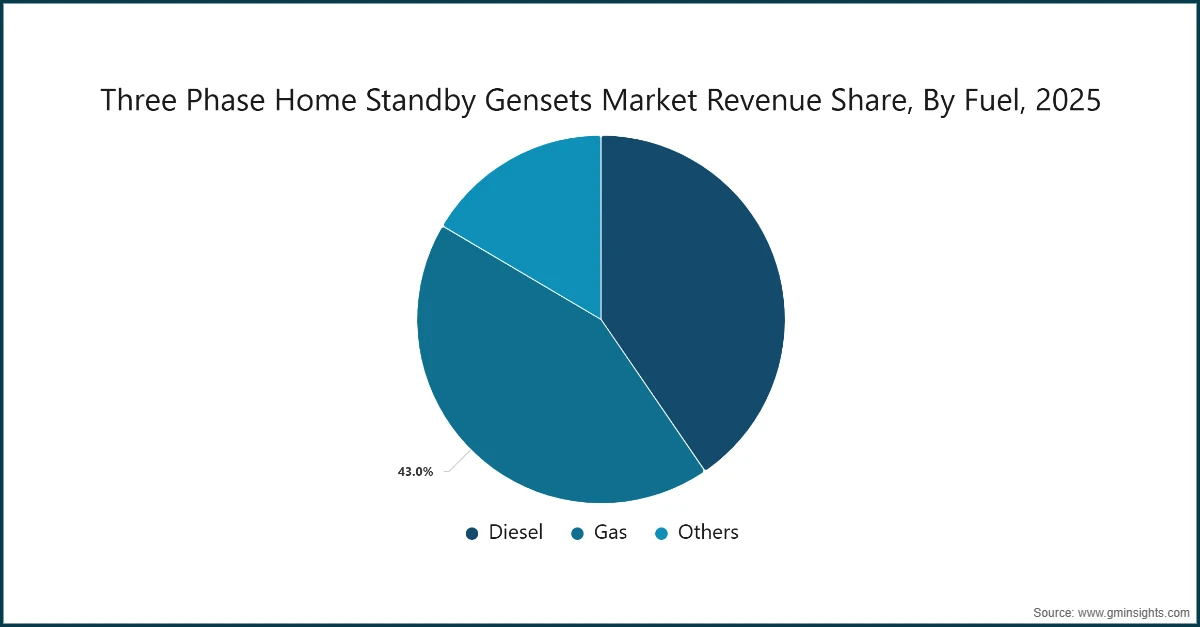
The gas fueled three phase home standby gensets market holds a share of 43% in 2025. The simulating features that will enable these gensets to achieve high business momentum are that they have a long lifespan and ease of handling, which will add value to their business. The strong presence of natural gas as per the tough regulations that are set to control carbon emission remains an additional factor that augurs well with the industry prospective.
For instance, the International Energy Agency has projected that the global demand of natural gas will increase at an average rate of 1.6 percent per year in the coming 2022-2026, indicating that there will be resilience in the natural gas demand trends in the near future. This point of view directly benefits three-phase home standby gensets, which can use fuel supplies that are stable and easily accessible.
Looking for region specific data?
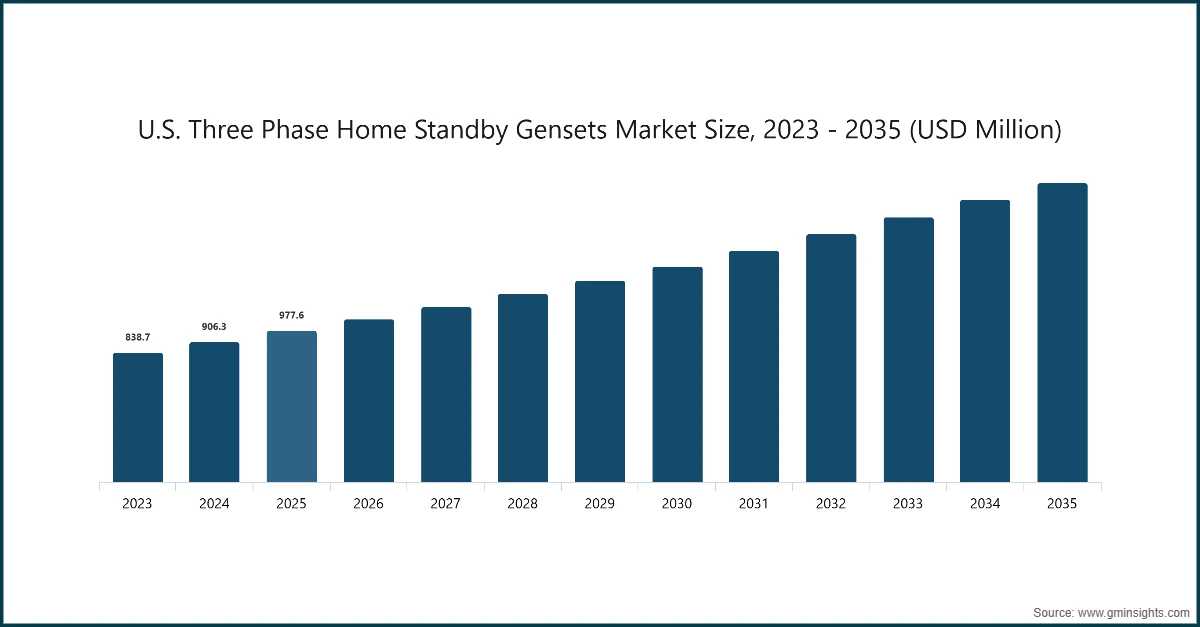
U.S. three phase home standby gensets industry was valued at USD 977.6 million in 2025. The industry is poised to experience growth, which is faster owing to growing dependence on electronic and electrical appliances as well as government-led efforts, which encourage growth in the housing sector. Increasing the activity of real estate development and the increased popularity of smart home technologies are also enhancing product penetration.
For citation, the U.S. economy experienced the best growth in two years in 2025 as the GDP increased by 3.8 percent in the second quarter and 4.4 percent in the third quarter. This continued rising trend shows enhanced economic impetus based on more healthy consumer activity and wider market stability. Furthermore, sequential enhancement of quarterly performance is an indication of a significant recovery in the general economic conditions.
The Asia Pacific region is experiencing an increasing demand of three phase home standby gensets, which is attributed to the rapid urbanization, growing residential construction as well as the increased household reliance on high load electrical systems. The ever-increasing strain on the local power systems, coupled with an increased regulatory focus on energy resilience and reliability is prompting homeowners to consider adopting the powerful standby power systems. Moreover, the adoption of new technologies such as remote monitoring will make business scenario higher.
Three Phase Home Standby Gensets Market Share
The companies within the industry are implementing a balanced portfolio of strategies to enhance their positioning in the market and respond to the changing consumer and regulatory demands. Among the main priorities, one should mention the implementation of smart functions including real-time performance monitoring, IoT-based controllers and automated load-management systems, which will ensure an increased degree of reliability and optimization of operational availability and minimized service downtimes. Another factor driving the growth in the manufacturer service ecosystem is the provision of complete maintenance packages, installer support, end user training and quick/fast repair options which improves customer satisfaction and long term product reliability.
Three Phase Home Standby Gensets Market Companies
The key industry players include:
Ashok Leyland
Briggs and Stratton
Caterpillar
Champion Power Equipment
Cummins
Duromax Power Equipment
Eaton
Echo Group
Generac Power Systems
Gillette Generators
HIMOINSA
HIPOWER
Kirloskar
Mahindra Powerol
Pinnacle Generators
Powerica
PR Industrial
Rehlko
Rolls-Royce
Yamaha Motor
Three Phase Home Standby Gensets Market Report Attributes
| Key Takeaway | Details |
|---|---|
| Market Size & Growth | |
| Base Year | 2025 |
| Market Size in 2025 | USD 3.2 Billion |
| Market Size in 2026 | USD 3.4 Billion |
| Forecast Period 2026-2035 CAGR | 6.1% |
| Market Size in 2035 | USD 5.8 Billion |
| Key Market Trends | |
| Drivers | Impact |
| Increasing frequency of extreme weather events | The growing occurrence of severe storms, heatwaves, and climate‑driven disruptions is amplifying the risk of prolonged power outages, prompting households to adopt reliable standby gensets. The heightened need for uninterrupted electricity supply is positioning three‑phase systems as a critical resilience solution for modern homes. |
| Ongoing refurbishment of T&D networks | Upgrades and modernization of transmission and distribution infrastructure often involve temporary service interruptions and fluctuating power quality, increasing dependence on backup systems. Homeowners are investing in three‑phase standby gensets to ensure stable, high‑capacity power availability during grid maintenance and phased network improvements. |
| Extensive investments across the real estate sector | Rising residential development, premium housing projects, and the proliferation of energy‑intensive smart home ecosystems are strengthening demand for robust standby power solutions. Three‑phase gensets are gaining traction as developers and homeowners prioritize reliability, electrical load management, and long‑term energy security. |
| Pitfalls & Challenges | Impact |
| High operation & maintenance cost | High operation and maintenance costs remain a notable challenge in the home standby gensets market, primarily due to the continuous upkeep required to ensure reliable performance during power outages. These systems are designed to remain on standby for extended periods while maintaining readiness to operate instantly when grid power fails, which necessitates routine inspections, periodic testing, and preventive maintenance. |
| Opportunities: | Impact |
| Growing shift toward smart home integration | The rapid adoption of smart home ecosystems is creating opportunities for gensets equipped with intelligent load‑management, remote diagnostics, and seamless integration with home automation platforms. Consumers are increasingly seeking backup power solutions that complement advanced residential technologies and enhance overall energy resilience. |
| Rising emphasis on residential energy security | Frequent grid disturbances and heightened awareness of power reliability are driving homeowners to invest in high‑capacity standby systems. Three‑phase gensets are gaining traction among households with heavy electrical loads, providing dependable protection against outages and ensuring continuous operation of critical appliances. |
| Expansion of natural gas infrastructure | Broader access to municipal gas networks across urban and semi‑urban regions is boosting demand for gas‑powered three‑phase gensets. Their ability to operate on a stable, uninterrupted fuel supply positions them as a cost‑efficient and environmentally aligned alternative to diesel‑based backup systems. |
| Increasing adoption of high‑load residential equipment | Modern homes are incorporating more energy‑intensive appliances, electric heating solutions, EV chargers, and advanced HVAC systems. This trend is creating opportunities for three‑phase gensets that can support higher electrical loads while maintaining smooth and reliable power delivery during outages. |
| Market Leaders (2025) | |
| Market Leader |
Market Share of 14% |
| Top Players |
Collective Market Share of 46% |
| Competitive Edge |
|
| Regional Insights | |
| Largest Market | Asia Pacific |
| Fastest Growing Market | North America |
| Emerging countries | U.S., Canada, Germany, China, India |
| Future outlook |
|
What are the growth opportunities in this market?
Three Phase Home Standby Gensets Industry News
In August 2025, Caterpillar launched the Cat D1500 DG set, with the small but very efficient Cat C32B engine. The model sets a new standard of power density with it providing a high output in a significantly smaller and lightweight footprint. The Cat D1500, with floor space requirements up to 13 percent less than previous units of the same size and a 32 percent reduction in weight, is also appropriate in installations that have limited space or building structure.
In January 2025, Generac Power Systems launched a new model of home standby generators that include a 28-kW model that is the most powerful air cooled unit on the market. The company has continued to add to its range of trusted, energy-saving generators that now have a range of capacities of 10 kW to 28 kW. These are the newest models to be planned to be easily integrated into the larger Generac system, including some compatibility with smart Eco bee thermostats and PWR cell battery storage solutions.
The three phase home standby gensets market research report includes in-depth coverage of the industry with estimates & forecast in terms of revenue (USD Million) and volume (‘000 Units) from 2022 to 2035, for the following segments:
Market, By Power Rating
≤ 10 kVA
> 10 kVA - 50 kVA
> 50 kVA - 100 kVA
> 100 kVA
Market, By Fuel
Diesel
Gas
Others
Market, By Product
Air cooled
Liquid cooled
The above information has been provided for the following regions and country:
North America
U.S.
Canada
Europe
Russia
UK
Germany
France
Spain
Austria
Italy
Asia Pacific
China
Australia
India
Japan
South Korea
Indonesia
Middle East & Africa
Saudi Arabia
UAE
Qatar
Turkey
Iran
Oman
Africa
Egypt
Nigeria
Algeria
South Africa
Latin America
Brazil
Mexico
Argentina
Frequently Asked Question(FAQ) :
What is the market size of the three phase home standby gensets in 2025?
The market size was USD 3.2 billion in 2025, with a CAGR of 6.1% expected through 2035, driven by increasing frequency of extreme weather events, aging grid infrastructure, and growing residential demand for reliable backup power solutions.
What is the projected value of the three phase home standby gensets industry by 2035?
The three phase home standby gensets market is expected to reach USD 5.8 billion by 2035, propelled by rising adoption of high-load residential equipment including EV chargers and advanced HVAC systems, expanding natural gas infrastructure, and AI-driven predictive maintenance capabilities.
What is the current three phase home standby gensets industry size in 2026?
The three phase home standby gensets market size is projected to reach USD 3.4 billion in 2026, supported rising premium housing development, growing smart home ecosystems, and increasing homeowner focus on energy resilience.
What is the projected size of the >10 kVA - 50 kVA power rating segment by 2035?
The >10 kVA - 50 kVA three phase home standby gensets segment is set to reach over USD 2.5 billion by 2035, driven by its widespread adoption for powering critical household systems including hot water units, well pumps, and kitchen appliances.
What was the market share of the gas-fueled segment in 2025?
The gas-fueled three phase home standby gensets segment held a 43% market share in 2025, supported by natural gas's long lifespan, ease of handling, compliance with carbon emission regulations.
Which region leads the three phase home standby gensets market?
U.S. three phase home standby gensets industry was valued at USD 977.6 million in 2025, owing to growing dependence on electronic and electrical appliances as well as government-led efforts, which encourage growth in the housing sector.
What are the key trends shaping the three phase home standby gensets market?
Key trends include expanding natural gas infrastructure supporting gas-powered genset adoption, and increasing incorporation of AI and cloud-based monitoring platforms for real-time performance tracking.
Who are the key players in the three phase home standby gensets market?
Key players include Generac Power Systems, Caterpillar, Cummins, Rolls-Royce, Rehlko, Briggs & Stratton, Eaton, HIMOINSA, Kirloskar, Mahindra Powerol, Yamaha Motor, and Champion Power Equipment.
Three Phase Home Standby Gensets Market Scope
Related Reports