Summary
Table of Content

Threat Detection Equipment Market
Get a free sample of this report
Form submitted successfully!
Error submitting form. Please try again.
Thank you!
Your inquiry has been received. Our team will reach out to you with the required details via email. To ensure that you don't miss their response, kindly remember to check your spam folder as well!
Request Sectional Data
Thank you!
Your inquiry has been received. Our team will reach out to you with the required details via email. To ensure that you don't miss their response, kindly remember to check your spam folder as well!
Form submitted successfully!
Error submitting form. Please try again.
Threat Detection Equipment Market Size
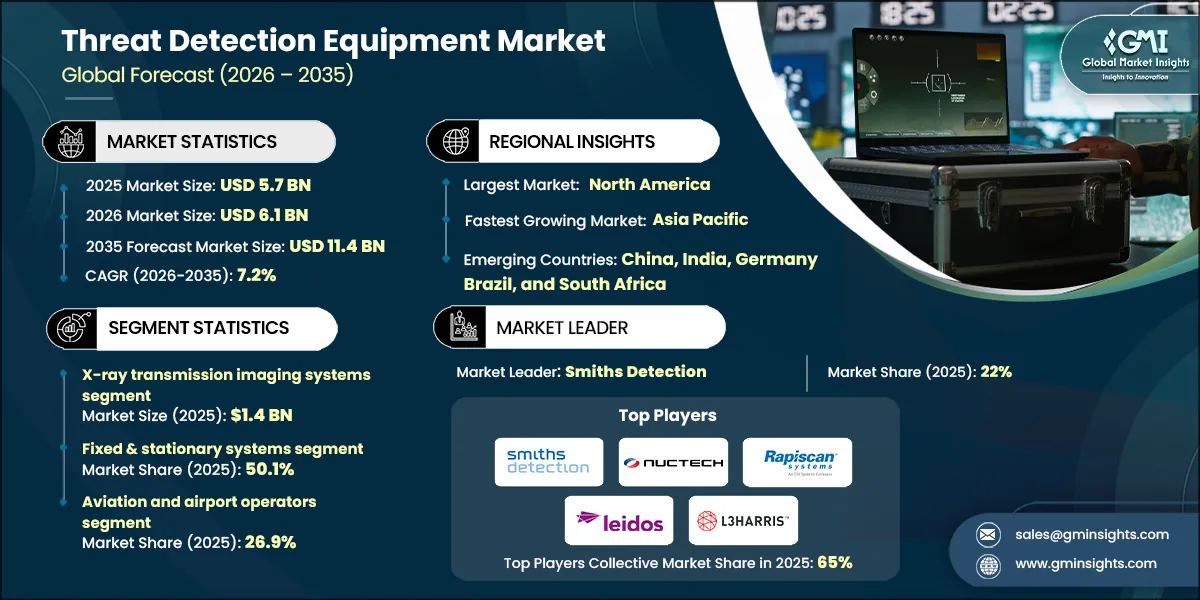
The global threat detection equipment market was valued at USD 5.7 billion in 2025. The market is expected to grow from USD 6.1 billion in 2026 to USD 11.4 billion in 2035, at a CAGR of 7.2% during the forecast period according to the latest report published by Global Market Insights Inc.
Threat Detection Equipment Market Key Takeaways
Market Size & Growth
- 2025 Market Size: USD 5.7 Billion
- 2026 Market Size: USD 6.1 Billion
- 2035 Forecast Market Size: USD 11.4 Billion
- CAGR (2026–2035): 7.2%
Regional Dominance
- Largest Market: North America
- Fastest Growing Region: Asia Pacific
Key Market Drivers
- Stricter aviation security mandates worldwide.
- Urbanization driving smart city surveillance deployments.
- Increased defense and homeland security budgets.
- AI-powered analytics improving detection accuracy.
- Growth in cross-border trade and ports.
Challenges
- False alarms causing operational disruptions.
- Interoperability issues across legacy systems.
Opportunity
- AI retrofits for installed detection systems.
- Public-private security modernization programs.
Key Players
- Market Leader: Smiths Detection led with over 22% market share in 2025.
- Leading Players: Top 5 players in this market include Smiths Detection, Nuctech Company Limited, Rapiscan Systems, Leidos Holdings, Inc., L3Harris Technologies, which collectively held a market share of 65% in 2025.
Get Market Insights & Growth Opportunities
The threat detection equipment market is growing due to stricter aviation security rules at airports, the rise of surveillance systems in fast-developing cities, and ongoing increases in defense and homeland security budgets. The use of AI-powered analytics also boosts detection accuracy and efficiency. Additionally, rising cross-border trade demands better cargo inspection and port security to handle higher risks.
Stricter aviation security mandates worldwide drive the market significantly. Global aviation authorities are reinforcing screening standards for passengers, baggage, and cargo. In October 2024, the International Air Transport Association (IATA) launched the Security Management System (SeMS) Certification Program to improve security measures across airlines and airports, encouraging operators to upgrade their threat detection systems. This move speeds up the purchase of advanced X-ray, explosives, and AI-enabled scanners to meet changing safety targets.
Rising defense and homeland security budgets are another key driver of the market as governments boost spending on advanced security tech. In the FY 2025 Department of Homeland Security appropriations, USD 300 million was allocated specifically for border security technology procurement to enhance autonomous surveillance, ground sensors, and related detection systems. This targeted investment accelerates deployment of threat detection equipment at ports of entry and borders, sustaining long-term modernization and enhanced national security readiness.
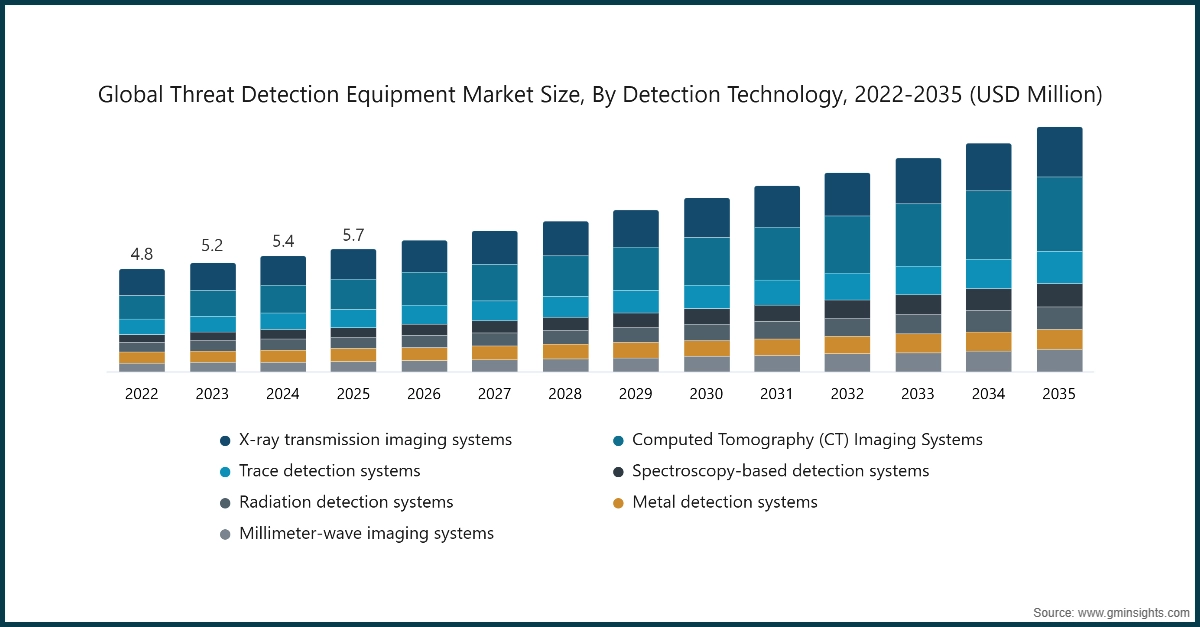
Between 2022 and 2024, the market witnessed considerable growth, increasing from USD 4.8 billion in 2022 to USD 5.4 billion in 2024, supported by heightened global security awareness and accelerated infrastructure upgrades. During this period, airports advanced checkpoint modernization programs, governments prioritized border technology investments, and ports expanded non-intrusive inspection capabilities. Market penetration was further strengthened by growing adoption of automated threat recognition software, replacement of aging screening equipment, and increased deployment of detection systems across public venues and transportation hubs.
To get key market trends
Threat Detection Equipment Market Trends
- The shift toward multi-modal threat detection platforms is reshaping security infrastructure by combining imaging, trace, biometric, and radiation capabilities into unified systems. This trend started around 2021 as operators dealt with congestion and inefficient screening processes. It is expected to continue until 2030 due to the need for scalability and command-center integration. The outcome is faster threat resolution, reduced equipment duplication, and improved operational coordination.
- The use of remote and centralized threat screening is increasing as security teams aim to reduce on-site reliance and improve supervision. Momentum built in 2020 when workforce constraints highlighted operational vulnerabilities. The trend is expected to advance until 2028 as secure networks and edge computing mature. Its impact includes standardized screening quality, lower staffing costs, and enhanced real-time decision control.
- The move toward privacy-preserving threat detection technologies is gaining prominence as public acceptance becomes a procurement factor. This trend gained traction in 2022 following regulatory scrutiny of invasive screening methods. It is expected to persist in the past 2029 as compliance demands tighten. The implication is wider adoption of anonymized imaging, automated threat recognition, and reduced passenger resistance.
Threat Detection Equipment Market Analysis
Learn more about the key segments shaping this market
Based on detection technology, the threat detection equipment market is divided into x-ray transmission imaging systems, computed tomography (CT) imaging systems, trace detection systems, spectroscopy-based detection systems, radiation detection systems, metal detection systems, and millimeter-wave imaging systems.
- The x-ray transmission imaging systems segment dominated the market in 2025 with value accounted USD 1.4 billion due to widespread deployment at airports, border checkpoints, ports, and public venues. These systems are reliable for screening baggage, parcels, and cargo, providing high throughput and regulatory acceptance. Their ability to support continuous operations and training reinforces their lead in high-volume screening environments.
- The computed tomography (CT) imaging systems segment is expected to witness growth at a CAGR of 9.5% during the forecast period, driven by rising use in aviation and cargo security. The growth is due to superior 3D imaging, automated threat detection, and higher accuracy in explosives detection. Regulatory approvals for CT screening of cabin baggage and ongoing airport modernization are pushing deployment, positioning CT systems as the fastest-growing technology in this area.
The threat detection equipment market was valued at USD 4.8 billion and USD 5.1 billion in 2022 and 2023, respectively. The market size reached USD 5.7 billion in 2025, growing from USD 5.4 billion in 2024.
Based on product form factor, the threat detection equipment industry is divided into fixed & stationary systems, portable & transportable systems, handheld devices, vehicle-mounted & mobile systems, and wearable detection systems.
- The fixed & stationary systems segment accounted for 50.1% of the market in 2025. These systems are widely used at airports, border crossings, ports, and critical infrastructure spots. They provide continuous, high-capacity screening with stable performance, supporting security regulations and centralized operations. Their compatibility with command-and-control platforms ensures sustained demand and market leadership.
- The wearable detection systems segment is anticipated to grow at a CAGR of 10.1% over the forecast period. This growth stems from increased use among security personnel, first responders, and military units. The emphasis on personnel safety and quick threat detection supports this trend. Improvements in miniaturization, sensor accuracy, and wireless connectivity are expanding usage, highlighting wearables as a high-growth area.
Learn more about the key segments shaping this market
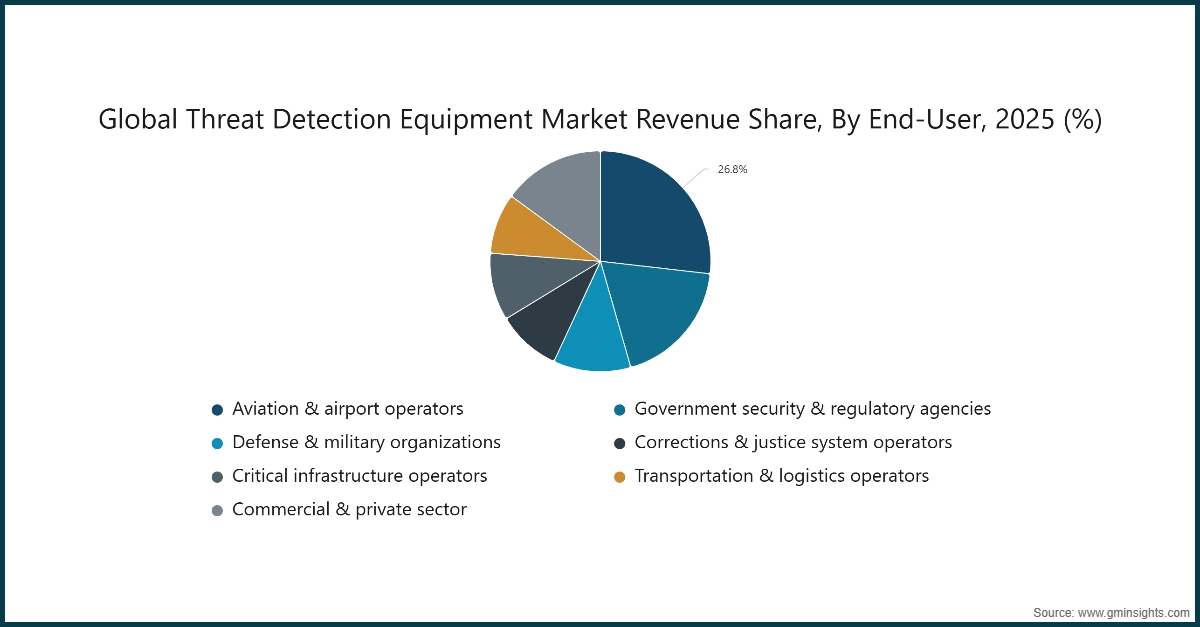
Based on end-user, the threat detection equipment market is divided into aviation & airport operators, government security & regulatory agencies, defense & military organizations, corrections & justice system operators, critical infrastructure operators, transportation & logistics operators, and the commercial & private sector.
- The aviation and airport operators segment led the market in 2025 with a market share of 26.9% as airports represent the most regulated and technology-intensive security environments. Continuous investments in passenger, baggage, and cargo screening systems, coupled with mandatory compliance requirements, sustain high demand. Large passenger volumes and global security standards make aviation the primary revenue-generating end-user for threat detection equipment.
- The transportation & logistics operators segment is expected to witness growth at a CAGR of 10.3% during the forecast period, driven by increasing global trade, e-commerce expansion, and heightened cargo security requirements. Ports, freight terminals, and logistics hubs are deploying non-intrusive inspection and radiation detection systems to secure supply chains, reduce inspection delays, and meet international security regulations, accelerating adoption across this segment.
North America Threat Detection Equipment Market
Looking for region specific data?
North America held a market share of 31% of threat detection equipment industry in 2025.
- In North America, the market is expanding due to stricter security regulations, ongoing funding for homeland security, and the continuous upgrade of screening systems at airports, border crossings, and critical infrastructure. Airports, ports of entry, and public venues are increasingly adopting advanced X-ray, CT, radiation, and biometric technologies to meet changing federal security standards and risk management needs.
- Governments and private operators across the region are investing in AI-enabled threat detection, automated screening, and integrated command-and-control platforms to improve detection accuracy and operational efficiency. North America is likely to continue leading in technology adoption, with upgrades in aviation security, border surveillance programs, and transportation security initiatives driving steady market growth through 2035.
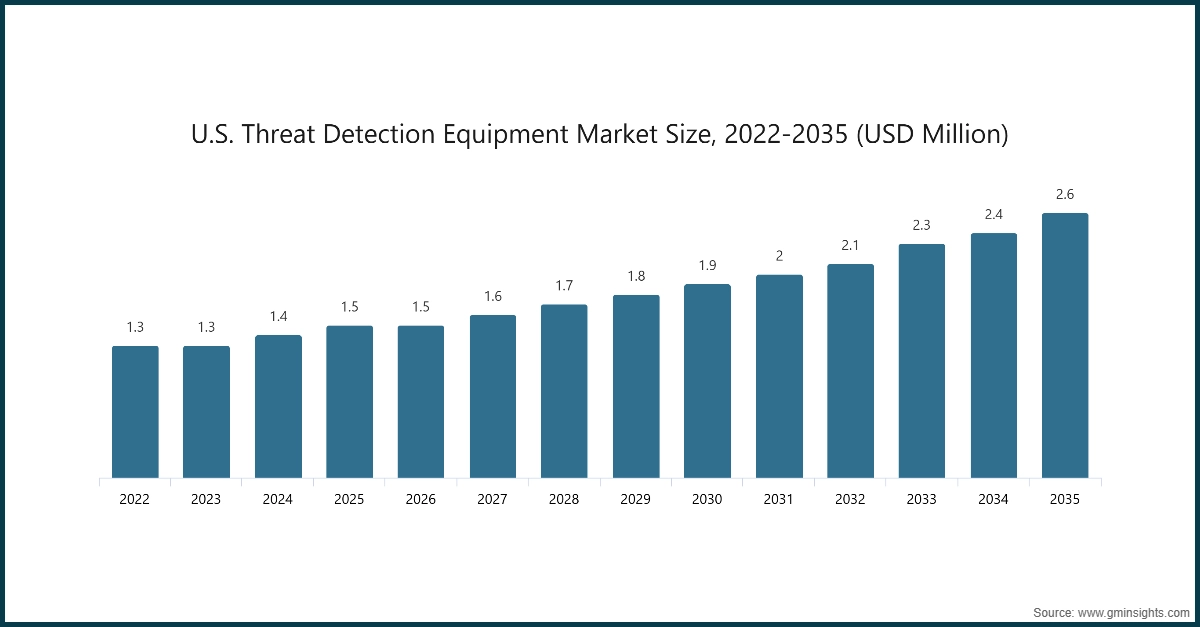
The U.S. threat detection equipment market was valued at USD 1.3 billion in 2023, respectively, and is expected to reach USD 1.5 billion in 2025, growing from USD 1.4 billion in 2024.
- The growth of the threat detection equipment industry in the United States is particularly strong due to major federal procurement programs and technology modernization initiatives. For instance, the Transportation Security Administration (TSA) awarded up to USD 1.3 billion to buy additional Computed Tomography (CT) X-ray scanners for airport checkpoints, which will include hundreds of units deployed at U.S. airports to boost aviation threat screening capabilities.
- In addition to aviation, the U.S. Department of Homeland Security and related agencies are investing in better imaging and inspection technologies. The U.S. operates the largest fleet of advanced screening systems across about 440 commercial airports nationwide, driving widespread adoption of threat detection solutions.
Europe Threat Detection Equipment Market
Europe threat detection equipment industry accounted for USD 1.6 billion in 2025 and is anticipated to show lucrative growth over the forecast period.
- The market is expanding in Europe due to region-specific security frameworks like the EU Aviation Security Regulation (EC No 300/2008) and the phased rollout of CT-based cabin baggage screening in European airports. The implementation of EU Entry/Exit System (EES) and ETIAS border control programs is driving investment in advanced screening, biometric-enabled detection, and automated inspection systems at external borders.
- Countries including France, the UK, and Spain are upgrading airport and rail security infrastructure, ensuring sustained adoption of X-ray, CT, radiation, and trace detection technologies across transportation and border security environments.
Germany dominates the Europe threat detection equipment market, showcasing strong growth potential.
- Germany leads the European threat detection equipment industry due to centralized federal control of aviation and border security under the Federal Ministry of the Interior (BMI) and the Federal Police. It requires certified screening systems at all commercial airports, supporting a wide deployment of CT scanners, explosives detection systems, and metal detection technologies.
- Ongoing modernization at major hubs such as Frankfurt, Munich, and Berlin Brandenburg airports, combined with investments in rail and border inspection systems, positions Germany as a high-value market. Strict compliance enforcement and long-term procurement frameworks promote continuous equipment upgrades nationwide.
Asia Pacific Threat Detection Equipment Market
The Asia Pacific threat detection equipment industry is anticipated to grow at the highest CAGR of 9% during the forecast period.
- The market in Asia Pacific is growing quickly due to significant upgrades in aviation capacity, border infrastructure, and maritime security. APAC accounts for the highest number of new airport constructions and expansions globally, driving demand for checkpoint screening, baggage inspection, and cargo scanning systems.
- Regional governments are enhancing customs and port security to manage increasing passenger and freight volumes, while geopolitical tensions and transnational security risks are pushing for the procurement of advanced non-intrusive inspection, radiation detection, and vehicle screening technologies across airports, ports, and land borders.
India threat detection equipment market is estimated to grow with a significant CAGR, in the Asia Pacific market.
- India is becoming a high-growth market for threat detection equipment due to nationwide investments in airport modernization, multimodal transport security, and border surveillance infrastructure. Programs such as airport privatization and greenfield airport development are driving deployment of modern X-ray, CT, and explosives detection systems at passenger and cargo checkpoints.
- Additionally, India's vast land borders and expanding port network are increasing the need for vehicle inspection, radiation monitoring, and mobile detection systems. Centralized procurement by aviation and security authorities, along with rising passenger numbers, positions India as a rapidly advancing threat detection market in APAC.
Middle East and Africa Threat Detection Equipment Market
Saudi Arabia threat detection equipment market to experience substantial growth in the Middle East and Africa market.
- Saudi Arabia is witnessing strong growth in the threat detection equipment industry driven by Saudi Arabia’s focus on safeguarding energy facilities, smart megaprojects such as NEOM, and high-value government assets is strengthening procurement of integrated threat detection platforms with AI-based analytics and centralized command integration.
- National security initiatives and centralized purchasing by interior and defense authorities are speeding up technology adoption, making Saudi Arabia a key growth center for threat detection equipment in the Middle East and Africa region.
Threat Detection Equipment Market Share
The threat detection equipment industry is led by players such as Smiths Detection, Nuctech Company Limited, Rapiscan Systems, Leidos Holdings, Inc., and L3Harris Technologies, which collectively represent 65% share of global deployments. These companies have strong business foundations built on diverse detection product lines, advanced imaging and sensing technologies, and widespread geographic reach across aviation, border security, defense, and critical infrastructure sectors. Their products include X-ray, CT, radiation, trace, and integrated screening solutions, allowing them to excel in high-security environments.
Their competitive edge is strengthened through ongoing investments in research and development, AI-enabled threat recognition, system integration capabilities, and compliance with evolving regulatory and security needs worldwide. Additionally, long-term government contracts, certification-led procurement, and established service networks create high entry barriers for new entrants. Ongoing airport modernization, border security upgrades, and defense digitization initiatives further strengthen their ability to sustain leadership and capture future demand across regions.
Threat Detection Equipment Market Companies
Prominent players operating in the threat detection equipment industry are as mentioned below:
- Analogic Corporation
- Astrophysics Inc.
- CEIA S.p.A.
- Chemring Group
- FLIR Systems (Teledyne FLIR)
- Garrett Metal Detectors
- Honeywell International
- L3Harris Technologies
- Leidos Holdings, Inc.
- Lockheed Martin
- Nuctech Company Limited
- Rapiscan Systems
- Raytheon Technologies
- Safran Electronics & Defense
- Smiths Detection
- Thales
Smith Detection is a global leader in threat detection equipment, offering advanced X-ray, CT, and trace detection systems for aviation, ports, borders, and urban security. The company emphasizes regulatory-certified solutions, high-throughput screening, and AI-driven threat recognition, enabling large-scale deployment across transportation and critical infrastructure environments.
The company provides a comprehensive range of security inspection systems, including cargo scanners, vehicle inspection platforms, and radiation detection solutions. The company focuses on non-intrusive inspection technologies, scalable system architectures, and strong deployment across border security and trade infrastructure, particularly in Asia-Pacific and emerging markets.
Rapiscan System specializes in checkpoint, baggage, and cargo screening technologies widely used in aviation and transportation security. Its strength lies in proven X-ray and CT imaging platforms, modular system designs, and close alignment with aviation security standards, supporting global airport modernization programs.
Leidos delivers integrated threat detection and security solutions by combining detection hardware, software analytics, and large-scale systems integration. The company’s expertise in government and homeland security programs enables customized deployments that enhance situational awareness, data fusion, and operational efficiency.
The company offers advanced sensing and detection systems for defense, border protection, and national security applications. Leveraging expertise in sensor fusion, signal processing, and ruggedized electronics, the company delivers high-performance threat detection solutions designed for mission-critical and tactical environments.
Threat Detection Equipment Market Report Attributes
| Key Takeaway | Details |
|---|---|
| Market Size & Growth | |
| Base Year | 2025 |
| Market Size in 2025 | USD 5.7 Billion |
| Market Size in 2026 | USD 6.1 Billion |
| Forecast Period 2026-2035 CAGR | 7.2% |
| Market Size in 2035 | USD 11.4 Billion |
| Key Market Trends | |
| Drivers | Impact |
| Stricter aviation security mandates worldwide | Drives 26% growth by compelling airports to upgrade and expand deployment of X-ray scanners, explosives detection systems, body scanners, and checkpoint screening equipment to comply with ICAO, TSA, and regional aviation authority standards. |
| Urbanization driving smart city surveillance deployments | Contributes 21% growth by increasing adoption of fixed and mobile threat detection equipment integrated into transit hubs, public venues, and municipal infrastructure for proactive risk identification. |
| Increased defense and homeland security budgets | Accounts for 24% growth by enabling large-scale procurement of advanced threat detection systems for military bases, borders, ports, and critical infrastructure protection across developed and emerging economies. |
| AI-powered analytics improving detection accuracy | Supports 17% growth by reducing false positives in screening equipment and encouraging replacement and retrofit demand across aviation, border control, and high-traffic public facilities. |
| Growth in cross-border trade and ports | Adds 12% growth by driving demand for cargo inspection systems, radiation detection portals, and non-intrusive inspection equipment to secure freight movement and comply with international trade security protocols. |
| Pitfalls & Challenges | Impact |
| False alarms causing operational disruptions | Restrains market growth as false alarms generated by threat detection equipment disrupt operations at airports, ports, and public venues. High false-positive rates increase secondary screening costs, reduce passenger throughput, and create resistance to large-scale deployment among operators prioritizing efficiency. |
| Interoperability issues across legacy systems | Limits growth due to interoperability issues across legacy systems, where older screening equipment lacks compatibility with modern AI analytics, centralized command platforms, and data-sharing frameworks. This increases integration complexity, upgrade costs, and delays modernization projects for security agencies. |
| Opportunities: | Impact |
| AI retrofits for installed detection systems | Presents strong growth potential by enabling AI retrofits for installed detection systems, allowing operators to enhance threat recognition accuracy, reduce false alarms, and extend equipment lifecycles without full hardware replacement, particularly across airports and border security checkpoints. |
| Public-private security modernization programs | Offers significant opportunity through public-private security modernization programs, where governments collaborate with technology providers to upgrade national security infrastructure. Long-term contracts and funding-backed deployments support large-scale adoption of advanced threat detection equipment across transportation, urban, and critical infrastructure sectors. |
| Market Leaders (2025) | |
| Market Leader |
22% market share in 2025 |
| Top Players |
Collective market share is 65% in 2025 |
| Competitive Edge |
|
| Regional Insights | |
| Largest Market | North America |
| Fastest growing market | Asia Pacific |
| Emerging countries | China, India, Germany, Brazil, and South Africa |
| Future outlook |
|
What are the growth opportunities in this market?
Threat Detection Equipment Industry News
- In December 2025, Nuctech Company Limited’s “Key Technologies and Application of Intelligent Under-Vehicle Inspection Robot” system passed a national scientific appraisal in Beijing, validating its autonomous under-vehicle scanning robotics for customs, border defense, and public security inspections.
- In September 2025, Rapiscan Systems launched the Orion Road 930DX-V mobile X-ray inspection system designed for advanced security operations, including mobile threat screening of vehicles, baggage, and parcels. This system’s dual-view imaging and enhanced detection capabilities extend operational flexibility for customs, border agencies, and VIP/security deployments, reinforcing mobile threat detection adoption worldwide.
- In March 2025, Smiths Detection announced a strategic partnership with Deepnoid to integrate advanced AI-driven threat detection software into its HI-SCAN 6040-2is X-ray screening systems, aimed at enhancing detection speed, precision, and operational efficiency across global aviation and critical infrastructure checkpoints.
The threat detection equipment market research report includes in-depth coverage of the industry with estimates and forecast in terms of revenue (USD Million) and volume (Units) from 2022 – 2035 for the following segments:
Market, By Detection Technology
- X-ray transmission imaging systems
- Computed tomography (CT) imaging systems
- Trace detection systems
- Spectroscopy-based detection systems
- Radiation detection systems
- Metal detection systems
- Millimeter-wave imaging systems
Market, By Threat Category Detected
- Explosives & improvised explosive devices (IEDS)
- Weapons & metallic threats
- Multi-threat detection systems
- Narcotics & contraband
- Biological agents
- Chemical agents & toxic industrial chemicals (TICS)
- Radiological & nuclear materials
Market, By Product Form Factor
- Fixed & stationary systems
- Portable & transportable systems
- Handheld devices
- Vehicle-mounted & mobile systems
- Wearable detection systems
Market, By Deployment Mode
- Checkpoint & access control screening
- Perimeter & standoff detection
- Area & ambient monitoring
- Mobile & patrol-based detection
- Cargo & freight inspection
Market, By End-User
- Aviation & airport operators
- Government security & regulatory agencies
- Defense & military organizations
- Corrections & justice system operators
- Critical infrastructure operators
- Transportation & logistics operators
- Commercial & private sector
The above information is provided for the following regions and countries:
- North America
- U.S.
- Canada
- Europe
- Germany
- UK
- France
- Spain
- Italy
- Russia
- Asia Pacific
- China
- India
- Japan
- Australia
- South Korea
- Latin America
- Brazil
- Mexico
- Argentina
- Middle East and Africa
- South Africa
- Saudi Arabia
- UAE
Frequently Asked Question(FAQ) :
What was the market size of the threat detection equipment in 2025?
The market size was USD 5.7 billion in 2025, with a CAGR of 7.2% expected through 2035. Growth is driven by stricter aviation security regulations, increased surveillance systems in urban areas, and rising defense and homeland security budgets.
What is the projected value of the threat detection equipment market by 2035?
The market is poised to reach USD 11.4 billion by 2035, fueled by advancements in AI-powered analytics, airport modernization, and increasing cross-border trade requiring enhanced cargo inspection and port security.
What is the expected size of the threat detection equipment industry in 2026?
The market size is projected to reach USD 6.1 billion in 2026.
What was the market share of the fixed & stationary systems segment in 2025?
The fixed & stationary systems segment accounted for 50.1% of the market in 2025, led by their widespread use at airports, border crossings, ports, and critical infrastructure for high-capacity and stable performance screening.
What is the growth outlook for the computed tomography (CT) imaging systems segment during the forecast period?
The CT imaging systems segment is expected to grow at a CAGR of 9.5% till 2035.
What is the growth outlook for the transportation & logistics operators segment?
The transportation & logistics operators segment is projected to grow at a CAGR of 10.3% up to 2035.
Which region held the largest market share in the threat detection equipment sector in 2025?
North America held a 31% market share in 2025, propelled by stringent security regulations, ongoing homeland security funding.
What are the upcoming trends in the threat detection equipment market?
Key trends include multi-modal threat detection, centralized and remote screening, privacy-focused security technologies, and advanced CT imaging adoption for aviation and cargo security.
Who are the key players in the threat detection equipment industry?
Key players include Analogic Corporation, Astrophysics Inc., CEIA S.p.A., Chemring Group, FLIR Systems (Teledyne FLIR), Garrett Metal Detectors, Honeywell International, L3Harris Technologies, Leidos Holdings, Inc., and Lockheed Martin.
Threat Detection Equipment Market Scope
Related Reports