Summary
Table of Content

Thermoplastic Vulcanizates Market
Get a free sample of this report
Form submitted successfully!
Error submitting form. Please try again.
Thank you!
Your inquiry has been received. Our team will reach out to you with the required details via email. To ensure that you don't miss their response, kindly remember to check your spam folder as well!
Request Sectional Data
Thank you!
Your inquiry has been received. Our team will reach out to you with the required details via email. To ensure that you don't miss their response, kindly remember to check your spam folder as well!
Form submitted successfully!
Error submitting form. Please try again.
Thermoplastic Vulcanizates Market Size
The special properties of thermoplastic vulcanizates (TPVs) which combine rubber-like elasticity with thermoplastic processing abilities have created a major market increase for this thermoplastic elastomer (TPE) category. FKM thermoplastic vulcanizates exist as synthetic elastomers which provide exceptional protection against high temperature conditions.
Thermoplastic Vulcanizates Market Key Takeaways
Market Size & Growth
- 2025 Market Size: USD 2.9 Billion
- 2026 Market Size: USD 3.1 Billion
- 2035 Forecast Market Size: USD 5.2 Billion
- CAGR (2026–2035): 6.6%
Regional Dominance
- Largest Market: Asia Pacific
- Fastest Growing Region: North America
Key Market Drivers
- Rising demand for sustainable and eco-friendly materials.
- Increasing applications in automotive and medical sectors.
- Advancements in material technology.
Challenges
- High production costs and raw material price volatility.
- Regulatory restrictions and compliance requirements.
Opportunity
- Increasing adoption in medical devices due to biocompatibility and sterilizability.
Key Players
- Market Leader: Celanese Corporation led with over 16.3% market share in 2025.
- Leading Players: Top 5 players in this market include Celanese Corporation, Mitsui Chemicals, Inc., Teknor Apex Company, RTP Company, LCY, which collectively held a market share of 48.7% in 2025.
Get Market Insights & Growth OpportunitiesThe market expands because vehicle manufacturers now require lighter materials which replace heavy rubber parts to achieve better fuel efficiency. TPVs serve multiple purposes in grips handles and appliance parts because they provide both softness and long-lasting performance.
TPVs offer better environmental sustainability than traditional vulcanized rubber because they allow for complete thermal melting and shape transformation which results in less material waste. TPV formulation developments have created materials which now resist high temperature conditions and chemical exposure and ultraviolet radiation which leads to their increased application range.
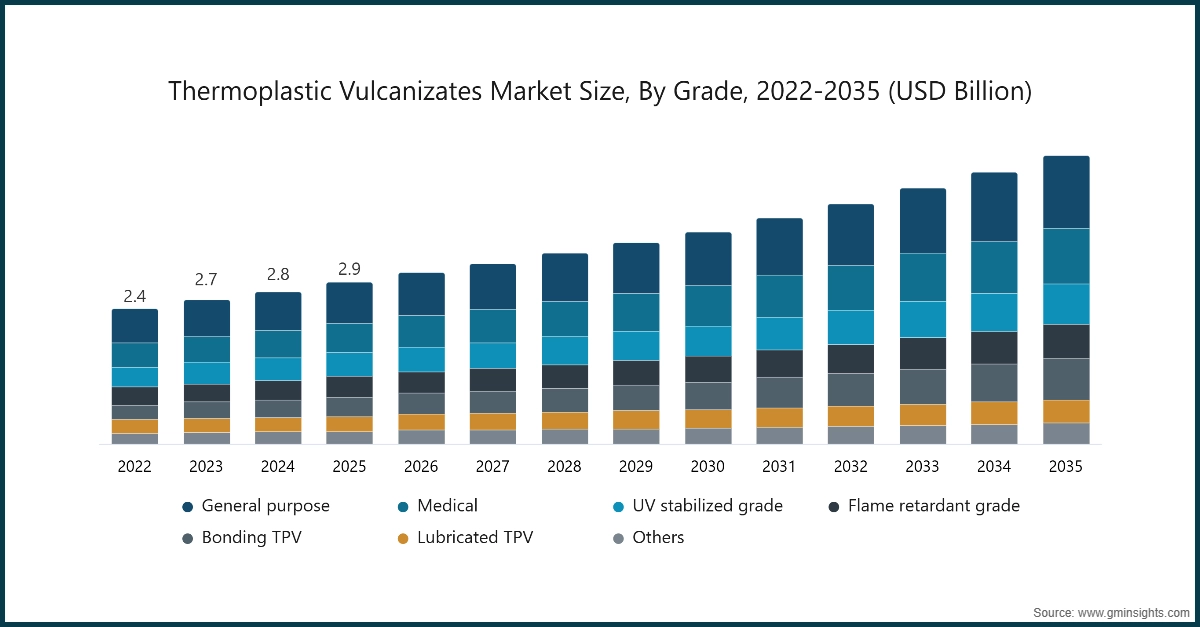
The global thermoplastic vulcanizates market was valued at USD 2.9 billion in 2025. The market is expected to grow from USD 3.1 billion in 2026 to USD 5.2 billion in 2035, at a CAGR of 6.6% according to latest report published by Global Market Insights Inc.
To get key market trends
Thermoplastic Vulcanizates Market Trends
The market experiences significant growth because the automotive sector will continue to operate as its main application sector during the entire forecast period. The automotive industry increasingly utilizes TPVs to manufacture external components which include filler panels and wipers and body seals and gaskets and vibration damping pads.
The latest TPV formulation advancements enable their use in manufacturing under-the-hood parts which include belts and hoses and clamps and fuel lines and buffer blocks. The need for lightweight durable materials with heat resistance properties drives these developments because they improve vehicle performance and fuel efficiency.
The TPV market experiences major shifts because manufacturers search for bio-based alternatives to replace fossil fuel-based materials whereas sustainability becomes a dominant market trend. The combination of rising environmental awareness and changing petroleum prices and strict European and North American regulations increases demand for TPVs produced from renewable resources.
Governmental and institutional bodies establish bio-preferred material procurement rules which require materials to have a minimum renewable content proportion. The current market demand compels TPV manufacturers to create new bio-based products according to global sustainability standards. The market for high-performance elastomers creates a chance to decrease environmental damage through the use of bio-based TPVs.
Thermoplastic Vulcanizates Market Analysis
Learn more about the key segments shaping this market
Based on grade, the market is segmented into general purpose, medical, UV stabilized grade, flame retardant grade, bonding TPV, lubricated TPV and others. General purpose grade dominated the market with an approximate market share of 25.3% in 2025 and is expected to grow with a CAGR of 6.7% by 2035.
The product has multiple uses in automotive and consumer goods and industrial sectors. Medical-grade TPVs are gaining traction because of their biocompatibility and their ability to meet strict healthcare regulations. The demand for UV stabilized grades and flame retardant grades is rising because these materials serve outdoor applications and safety-critical environments.
The industrial and machinery sectors are benefiting from the market growth which bonding and lubricated TPVs provide. The market outlook remains strong because companies introduce new products while following sustainable practices.
Learn more about the key segments shaping this market
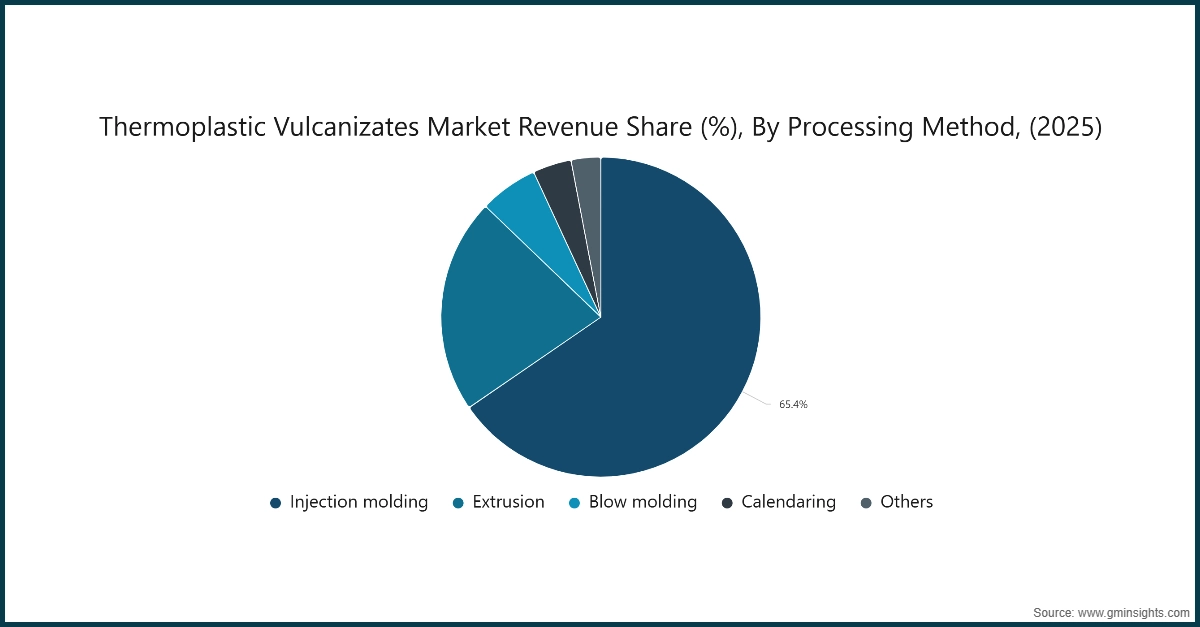
Based on processing method, the thermoplastic vulcanizates market is segmented into injection molding, extrusion, blow molding, calendaring and others. Injection molding held the largest market share of 65.4% in 2025.
Thermoplastic vulcanizates need injection molding as their main processing method because this technique provides efficient, precise, and complicated part creation through its capability to produce high-volume items. The system operates with fast cycle times while its automated functions decrease labor expenses and boost operational efficiency.
Automotive manufacturers use injection molding to produce impact-resistant components which include bumpers and dashboards and interior parts which require detailed design work.
The method also serves the consumer goods sector, producing household appliances, packaging, and other products that require accurate shapes and high-quality finishes. Through its waste reduction capabilities and material recycling options injection molding enables manufacturers to develop environmentally friendly production processes.
Based on application, the thermoplastic vulcanizates market is segmented into automotive parts, consumer products, construction material, industrial applications, electrical wire/cables, medical devices and others.
Automotive parts dominate the market due to their high demand for impact-resistant, lightweight, and durable components, which injection molding efficiently produces with complex geometries. The automotive industry’s shift toward electric vehicles and safety features further fuels innovation and growth in this segment.
Consumer products, including household appliances and packaging, contribute significantly to market growth as injection molding allows for cost-effective mass production of aesthetically appealing and precise parts. The demand for customized and innovative consumer goods drives technological advancements in molding processes.
Construction materials utilizing injection molding are expanding, especially for durable, weather-resistant components. The focus on sustainable and energy-efficient building materials supports this segment’s growth, although it remains secondary to automotive and consumer sectors.
Industrial applications are growing with the need for precision components in machinery and equipment, leveraging injection molding’s ability to produce complex, high-strength parts rapidly.
Electrical wire and cable insulation components are increasingly manufactured via injection molding due to their requirement for high-quality, uniform insulation layers that ensure safety and compliance.
Medical devices benefit from injection molding’s high precision and ability to produce complex, small-scale parts with strict quality standards, supporting innovation in healthcare applications.
Looking for region specific data?
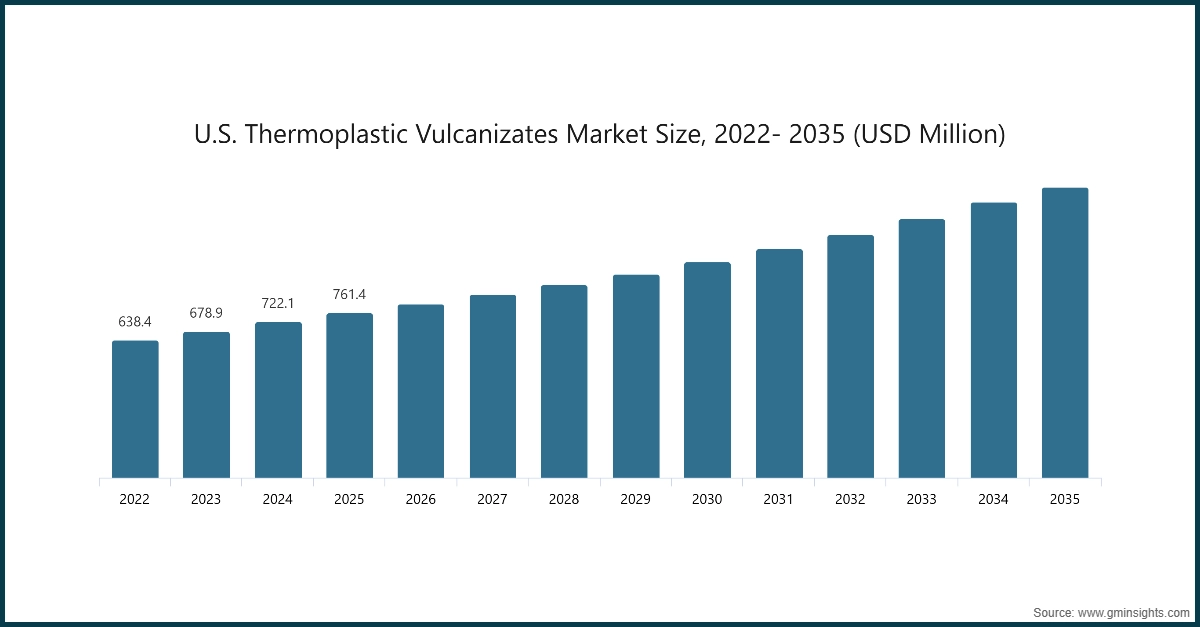
The thermoplastic vulcanizates market in North America will grow at a CAGR from approximately 6.6% between 2026 and 2035.
The automotive sector and packaging sector and consumer goods sector are increasing their use of thermoplastic vulcanizates because these materials provide recycling options and better environmental performance and their demand for environmentally friendly materials grows. The rising environmental impact awareness among consumers together with regulations that promote bio-based and recyclable materials drives manufacturers to create more sustainable product formulations.
The markets in Europe, especially in a few countries like Germany, are expected to grow with a rapid pace in the coming years.
The adoption of eco-friendly bio-based and recyclable vulcanizate solutions is driven by environmental regulations and circular economy principles which manufacturers now follow. The research team continuously improves processing methods through their work on bio-based compatibilizers and biodegradable formulations which now enable new application possibilities in natural extracts and pharmaceuticals and organic farming.
The thermoplastic vulcanizates market in China and India is expected to have lucrative growth between 2026 and 2035, with CAGR 6.8% in the Asia Pacific region.
The combination of urbanization and higher disposable incomes creates a growing need for eco-friendly consumer products and sustainable packaging and biodegradable products which all benefit from recycling technology advancements.
Between 2026 and 2035, the market for thermoplastic vulcanizates in the Middle East is projected to grow significantly during this period.
The expanding tourism and hospitality and wellness industries lead to higher demand for sustainable waste treatment solutions which include the application of eco-friendly vulcanates in food and cosmetic packaging.
Between 2026 and 2035, a promising expansion of the thermoplastic vulcanizates sector is foreseen in the Latin America.
The growing environmental awareness leads industries and consumers to choose eco-friendly materials in cosmetics and functional foods because sustainable waste management practices now become the norm. The development of bio-based and recyclable vulcanizates for food and cosmetic applications receives support from progressive legislation which promotes sustainable agriculture and green extraction methods.
Thermoplastic Vulcanizates Market Share
Market is moderately consolidated with players like Celanese Corporation, Mitsui Chemicals, Inc., Teknor Apex Company, RTP Company and LCY which accounts for 48.7% market share in 2025.
The market consists of such leading companies operating mostly in their regional areas. Their long years of experience with thermoplastic vulcanizates have allowed these companies to maintain a strong market position worldwide. Their product offerings are diverse and majorly supported by production capacities and distribution networks, which can serve the increasing demand for Thermoplastic Vulcanizates in various regions.
Thermoplastic Vulcanizates Market Companies
Major players operating in the thermoplastic vulcanizates industry includes:
- Apar Industries
- Celanese Corporation
- Elastron
- FlexiShine Polyblends
- LCY
- Mitsui Chemicals, Inc.
- RTP Company
- SantopSeal
- Teknor Apex Company
- VKS Plastic Compound Private Limited
Celanese Corporation produces Santoprene TPV which consists of thermoplastic vulcanizates that provide superior flexibility and durability and processability for different industrial and consumer uses.
Mitsui Chemicals creates TPV products which combine sustainable environmental design with enhanced material functions to serve automotive and building and healthcare sectors through their innovative vulcanizate solutions.
Teknor Apex offers a comprehensive collection of thermoplastic vulcanates which includes TPV and TPE products that customers can modify to fit their requirements for elastic properties and chemical resistance and high thermal stability.
RTP Company manufactures a complete selection of customized thermoplastic elastomer compounds which include TPV products to fulfill particular performance requirements which include weather protection and impact defense and processability.
LCY develops advanced thermoplastic vulcanizates which provide high strength and flexibility and sustainability performance for use in automotive and construction and consumer electronics applications.
Thermoplastic Vulcanizates Market Report Attributes
| Key Takeaway | Details |
|---|---|
| Market Size & Growth | |
| Base Year | 2025 |
| Market Size in 2025 | USD 2.9 Billion |
| Market Size in 2026 | USD 3.1 Billion |
| Forecast Period 2026-2035 CAGR | 6.6% |
| Market Size in 2035 | USD 5.2 Billion |
| Key Market Trends | |
| Drivers | Impact |
| Rising demand for sustainable and eco-friendly materials | Drives innovation and adoption of greener thermoplastic vulcanizates, expanding market potential. |
| Increasing applications in automotive and medical sectors | Boosts market growth due to higher demand for specialized, high-performance thermoplastic vulcanizates. |
| Advancements in material technology | Enhances product performance and broadens application scope, fostering market expansion. |
| Pitfalls & Challenges | Impact |
| High production costs and raw material price volatility | Limits profit margins and can hinder manufacturers ability to scale operations. |
| Regulatory restrictions and compliance requirements | May slow market growth and increase costs associated with product development and certification. |
| Opportunities: | Impact |
| Increasing adoption in medical devices due to biocompatibility and sterilizability | Opens new revenue streams and accelerates market development in healthcare applications. |
| Market Leaders (2025) | |
| Market Leader |
Market share: 16.3% |
| Top Players |
Collective market share of top 5 players in 2025: 48.7% |
| Competitive Edge |
|
| Regional Insights | |
| Largest Market | Asia Pacific |
| Fastest growing market | North America |
| Emerging countries | Canada, Brazil, UK |
| Future outlook |
|
| Companies covered: | 10 |
| Tables, Charts & Figures: | 220 |
| Countries covered: | 22 |
| No of Pages: | 180 |
What are the growth opportunities in this market?
Thermoplastic Vulcanizates Industry News
In April 2024, Celanese Corporation announced that it qualified a specialty compounder in China to produce Santoprene TPVs. Celanese also launched its sustainable TPV grades under the ECO R label in October 2023.
In August 2023, Teknor Apex announced the launch of the Starlink TPVs, which contain up to 40% recycled content. The Sarlink RX 3100B Series is a new TPV product that contains Post-Industrial Recycled (PIR) content.
This thermoplastic vulcanizates market research report includes in-depth coverage of the industry, with estimates & forecasts in terms of revenue (USD Billion) and volume (Kilo Tons) from 2022 to 2035, for the following segments:
Market, by Grade
General purpose
Medical
UV stabilized grade
Flame retardant grade
Bonding TPV
Lubricated TPV
Others
Market, by Processing Method
Injection molding
Extrusion
Blow molding
Calendaring
Others
Market, by Application
Automotive parts
Sealing systems
Under-hood components
Electric vehicle (EV) components
Steering & suspension
Interior & exterior components
Others
Consumer products
Footwear
Sporting goods
Personal care
Household products
Others
Construction material
Sealing & waterproofing
Roofing & membranes
Plumbing & drainage
Industrial applications
Electrical wire/cables
Medical devices
Others
The above information is provided for the following regions and countries:
North America
U.S.
Canada
Europe
Germany
UK
France
Spain
Italy
Rest of Europe
Asia Pacific
China
India
Japan
Australia
South Korea
Rest of Asia Pacific
Latin America
Brazil
Mexico
Argentina
Rest of Latin America
Middle East and Africa
- Saudi Arabia
- South Africa
- UAE
- Rest of Middle East and Africa
Frequently Asked Question(FAQ) :
What is the market size of the thermoplastic vulcanizates market in 2025?
The global market size for thermoplastic vulcanizates was valued at USD 2.9 billion in 2025, driven by rising demand for lightweight, recyclable, and high-performance elastomers across automotive, consumer goods, and industrial sectors.
What is the expected market size of the thermoplastic vulcanizates market in 2026?
The market is projected to reach USD 3.1 billion in 2026, supported by increasing adoption in electric vehicles, under-the-hood automotive components, and sustainable product formulations.
What is the projected value of the thermoplastic vulcanizates market by 2035?
The market is expected to reach USD 5.2 billion by 2035, expanding at a CAGR of 6.6% from 2026 to 2035 due to advancements in bio-based TPVs and enhanced heat and chemical resistance properties.
Which grade segment dominates the market?
The general-purpose grade segment led the market with a 25.3% share in 2025 and is projected to grow at a CAGR of 6.7% through 2035.
Which processing method holds the largest share in the market?
Injection molding dominated the market with a 65.4% share in 2025, as it enables efficient, high-volume production of complex, impact-resistant components with minimal material waste.
Which region shows strong growth in the thermoplastic vulcanizates industry?
North America is projected to grow at a CAGR of approximately 6.6% between 2026 and 2035, supported by strong automotive production and sustainability-focused material regulations.
Who are the major players in the thermoplastic vulcanizates market?
Leading companies include Celanese Corporation, Mitsui Chemicals, Inc., Teknor Apex Company, RTP Company, LCY, Apar Industries, Elastron, FlexiShine Polyblends, SantopSeal, and VKS Plastic Compound Private Limited.
Thermoplastic Vulcanizates Market Scope
Related Reports