Summary
Table of Content

Thermal Spray Coating Market
Get a free sample of this report
Form submitted successfully!
Error submitting form. Please try again.
Thank you!
Your inquiry has been received. Our team will reach out to you with the required details via email. To ensure that you don't miss their response, kindly remember to check your spam folder as well!
Request Sectional Data
Thank you!
Your inquiry has been received. Our team will reach out to you with the required details via email. To ensure that you don't miss their response, kindly remember to check your spam folder as well!
Form submitted successfully!
Error submitting form. Please try again.
Thermal Spray Coating Market Size
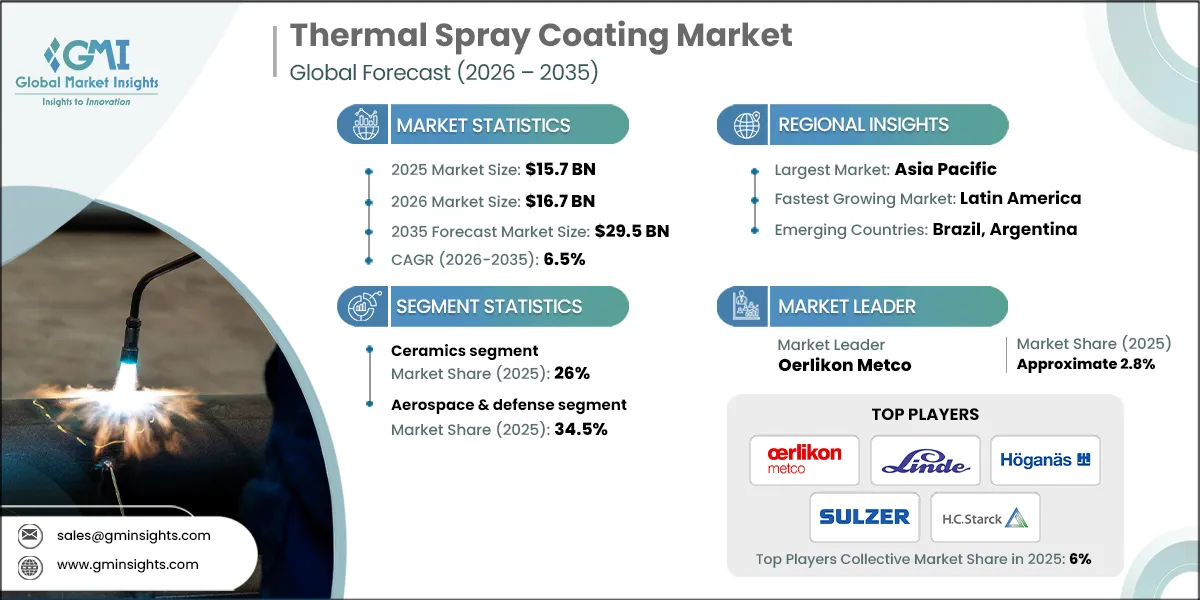
The global thermal spray coating market was valued at USD 15.7 billion in 2025. The market is expected to grow from USD 16.7 billion in 2026 to USD 29.5 billion in 2035, at a CAGR of 6.5% according to latest report published by Global Market Insights Inc.
Thermal Spray Coating Market Key Takeaways
Market Size & Growth
- 2025 Market Size: USD 15.7 Billion
- 2026 Market Size: USD 16.7 Billion
- 2035 Forecast Market Size: USD 29.5 Billion
- CAGR (2026–2035): 6.5%
Regional Dominance
- Largest Market: Asia Pacific
- Fastest Growing Region: Latin America
Key Market Drivers
- Rising Demand from Aerospace and Automotive Industries.
- Increasing Use in Biomedical Implants and Devices.
- Industrial Equipment Refurbishment and Maintenance Boom.
Challenges
- High Capital and Operational Costs.
- Complexity in Coating Process Standardization.
Opportunity
- Penetration into Renewable Energy Sector.
- Expansion in Emerging Markets (Asia-Pacific, LATAM).
Key Players
- Market Leader: Oerlikon Metco led with over 2.8% market share in 2025.
- Leading Players: Top 5 players in this market include Oerlikon Metco, Linde, Höganäs, Sulzer, H.C. Starck, which collectively held a market share of 6% in 2025.
Get Market Insights & Growth Opportunities
- Thermal spray coatings have reached a significant level of acceptance, due to the strong growth of aerospace industries. Aircraft manufacturers have placed greater emphasis on enhancing performance and fuel efficiency, which creates an increased need for thermal spray coatings for the protection of turbine engines, landing gear, and other components exposed to high temperatures, wear and corrosion.
- The continuing growth of the global aerospace market will create a continued demand for the use of thermal spray solutions, particularly plasma-spray and high-velocity oxy-fuel (HVOF) coatings, at a projected CAGR of approximately 5.3% through 2030.
- The industrial gas turbine and automotive sectors are also major contributors to increased demand for thermal spray coatings. There is significant demand for increased durability and performance across many components in the automotive industry including turbochargers, pistons, cylinders, and rotors, leading to an ever-expanding use of thermal sprays.
- Within the automotive industry, the electric vehicle (EV) sub-segment represents a new area of growth as thermal sprays are now being used extensively to coat EV battery components, power electronics and braking systems. The International Energy Agency (IEA) estimates that total EV sales will reach 40 million units by 2030 providing a considerable market for end-use thermal spray coatings.
- Necessity to improve machinery component durability to avoid high replacement cost in several end-use industries including aerospace and energy & power will propel the thermal spray coating market. Superior properties including high corrosion, wear and heat resistance achieved through these flame spray coatings improves the overall machinery lifespan.
- Stringent regulations by REACH, EPA, and OSHA regarding the curtailment of hard chrome plating due to the increasing health issues are influencing the coating manufacturers to adopt sustainable solutions. Also, non-uniformity in the surface along with the inclusion of hexavalent chromium, which is carcinogenic in nature, has led to the replacement of hard chrome plating with thermal spray coatings.
To get key market trends
Thermal Spray Coating Market Trends
- Automation and robotization of thermal spray cells: Industrial users continue shifting to six-axis robots and dual-manipulator cells to stabilize thickness control, improve repeatability, and raise throughput; that’s especially visible in aero hot-section parts and automotive bore coating lines. Closed-loop diagnostics now monitor in-flight particle temperature/velocity and auto-correct feed or torch wear. Plants see cycle times fall from minutes to a few minutes per component, and variation bands tighten to single-digit microns in demanding programs. Short term, automation offsets labor gaps; medium term, it compresses operator training needs; long term, it anchors quality systems that scale across multi-site footprints.
- Advanced TBC/EBC materials and SPS microstructures: Analysis from peer-reviewed work shows high-entropy ceramics and rare-earth zirconates (e.g., Gd2Zr2O7, Y2Zr2O7) cut thermal conductivity versus YSZ and resist CMAS infiltration, while SPS coatings emulate EB-PVD columnar structures at lower installed cost. Furthermore, SPS/zirconates reduce metal temperatures, extend life and allow higher turbine inlet temps; OEM demo runs have validated 1650°C-class operation with improved efficiency.
- Cold spray moves from repair niche to mainstream: Cold spray’s solid-state bonding avoids HAZ and preserves base metal properties—ideal for thin-walled aluminum and titanium. Take the U.S. Air Force case: B-1 panels repaired in days, not weeks, cutting costs from roughly USD 200,000 per replacement to about USD 15,000 per repair and boosting availability rates as repairs are performed in situ. Government guidance and FAA approvals are catching up, with dozens of repairs cleared and more in the pipeline.
Thermal Spray Coating Market Analysis
Learn more about the key segments shaping this market
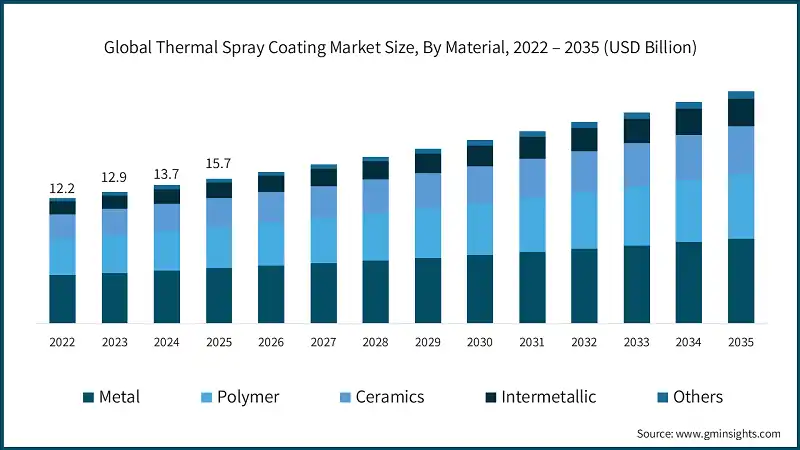
Based on material, the market is segmented into metal, polymer, ceramics, intermetallic, and others. The ceramics segment dominated with an approximate market share of 26% in 2025 and is expected to grow with a CAGR of 6.7% through 2035.
- Excellent adhesion, hardness, high corrosion resistance & thermal barrier are key properties fueling product scope particularly from diesel engine pistons, automotive valves & cylinders. Early adoption of ceramic products in aerospace engine systems, turbine blades and flame tubes due to high heat resistance has enhanced product penetration.
- Benefits, such as low density, high melting point, superior oxidation, high thermal conductivity, and hot corrosion resistance, are driving the intermetallic materials demand in steam generators and coal-fired gas turbines. Polymers are observing significant attention from automotive, petrochemical, and aerospace & defense industries. These materials are applied to protect the surface from corrosion, humidity, and harsh chemical environments.
- Growing needs to protect bridges, large steel structures, offshore oil platforms, and deck from corrosion as well as to provide strong adhesion are key factors driving the metal-based flame spray coatings demand. These materials are mainly used as finishing and engineering coatings in various industries including automotive and healthcare. Finishing coating is further utilized as an anti-corrosion or decorative material, whereas engineering solutions are further utilized as wear-resistant and thermal barrier protection.
Learn more about the key segments shaping this market
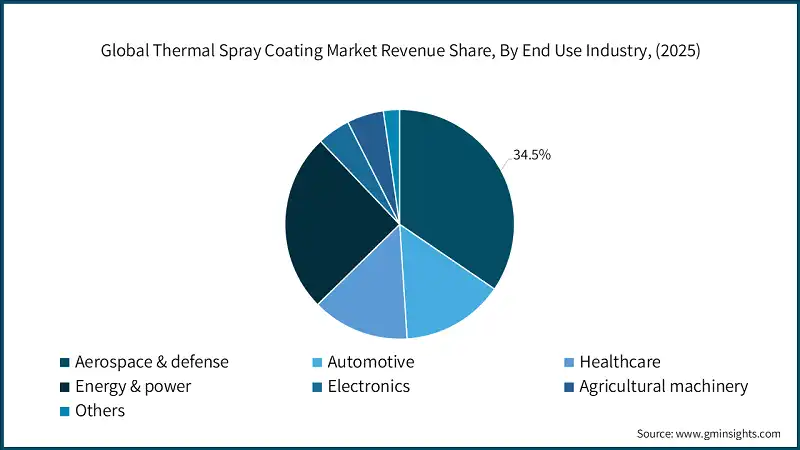
Based on end use industry, the thermal spray coating market is segmented into aerospace & defense, automotive, healthcare, energy & power, electronics, and agricultural machinery, and others. The aerospace & defense held the largest market share of 34.5% in 2025 and is expected to grow at a CAGR of 6.4% during 2026-2035.
- Rising demand for commercial, military and general aviation due to increasing consumer spending on travelling and transportation will drive the thermal spray coating market size. Global annual air traffic is expected to increase in the nearer term. It is the foremost industry, which has adopted thermal spray coatings completely in its manufacturing process.
- The requirement to run components at the optimum level is driving the market demand. Efficient maintenance quality standards, reliability and durability along with cost-effective properties have enhanced product scope in aerospace & defense applications.
- Automotive sector is expected to witness growth of over 8% through 2024. Maintenance of high-quality components, durability, and reliability is driving the product demand. Enhancing the low-cost base material life cycle through advanced functional surfaces has become important in the automotive sector. The profit margins are low, and the optimum cost has become a significant factor in the automotive industry, influencing thermal spray coating market growth.
- Rising need to have biocompatible and corrosion-resistant implants is driving demand in the healthcare industry. Thermal sprayed hydroxylapatite was the foremost joint treated with an artificial bone material. It is also used in the healthcare industry to prevent RFI/EMI between medical equipment.
Looking for region specific data?
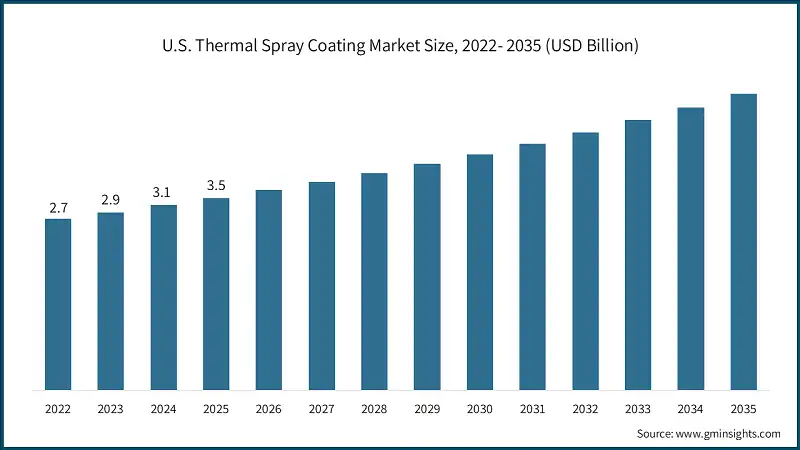
The North America thermal spray coating industry is growing rapidly on the global level with a revenue share of 27.6% in 2025.
- North America’s thermal spray coating market tilts toward aerospace, defense, and industrial gas turbines, with the U.S. contributing a dominant share and Canada anchored by aero and power equipment manufacturing. Cold spray’s adoption across DoD depots and airline MRO centers accelerates field repair for aluminum and titanium structures, cutting turnaround significantly.
U.S. dominates the North America thermal spray coating market, showcasing strong growth potential.
- The U.S. engine MRO ecosystem, plus OEM shops, keep TBC and wear volumes high; cycle-time and quality payoffs from automation are now table stakes. Expect steady growth as power plants pursue high-efficiency upgrades and aero traffic normalizes.
Europe market was worth USD 4.7 billion in 2025 and is anticipated to show lucrative growth over the forecast period.
- Europe’s thermal spray coating market benefits from leadership in automotive bore coatings, strong aero propulsion, and a large installed base of gas turbines. Regulatory pressure (REACH, VOC limits) pushes chrome-replacement and emissions controls, incentivizing HVOF wear stacks and robust environmental systems at coaters. Germany, the UK and France anchor aerospace and automotive programs; SPS and advanced zirconates are gaining attention for high-temp duty in both aero and industrial turbines.
The Asia Pacific thermal spray coating market is anticipated to grow at a CAGR of 6.8% during the analysis timeframe.
- The Asia Pacific market is the largest and the fastest growing as China scales automotive and aerospace ambitions, India ramps defense/MRO and power capacity, and Japan/Korea drive materials and equipment innovation. Automotive volumes and shipbuilding add durable corrosion and wear demand, while turbine upgrades and new builds keep TBC content rising. Look closer and you’ll see EV thermal management and localized aero supply chains expanding the addressable base in China and India.
Latin America thermal spray coating accounted for 7.2% market share in 2025 and is anticipated to show highest growth over the forecast period.
- Latin America, the thermal spray coating market is developing and developing slowly, with support from Oil and Gas and Mining industries, Metal Finishing Companies and Industrial Machinery services of the largest manufacturing companies that do business in each country. Brazil and Mexico have been the two largest users of Thermal Spray Coating Products throughout the Region. Both countries have made large investments in Energy infrastructure and have made significant commitments to making their Manufacturing Sectors more Resilient. The Brazilian Government has introduced energy assets, including the Offshore Drilling equipment of Petrobras, which has been a major application area for Thermal Spray Products to protect against Cavitation and Corrosion.
Middle East & Africa thermal spray coating accounted for 5.9% market share in 2025 and is anticipated to show lucrative growth over the forecast period.
- Middle East & Africa (MEA), the thermal spray coating market is increasing because of a growing focus on Asset Durability in the Oil and Gas industry, the Desalination industry and in the infrastructure industry. Major investments and modernized industrial capabilities are being made in Saudi Arabia and the UAE under their Vision 2030 blueprints using Protective Coatings, along with the need for Advanced Thermal Spray Technologies for Turbine components and Pumps and Offshore Components that operate in Highly Saline and High-Temperature environments. Additionally, with the Emerging Aerospace ambitions and growth of Local Defence Manufacturing that is taking place in the UAE, there are increasingly more High-Performance Wear-Resistant Coating Systems.
Thermal Spray Coating Market Share
The thermal spray coating industry is highly fragmented, with the top five players accounting for approximately 6% of the market share in 2025. Oerlikon Metco holds a leadership position, owing to its integrated model across equipment, powders, and coating services, coupled with deep qualifications in the aerospace and turbine industries. Furthermore, Linde (formerly Praxair Surface Technologies) leverages its industrial gas and process expertise, along with proprietary WC-CoCr powders. Additionally, Höganäs provides a broad portfolio of metal powders; and H.C. Starck specializes in refractory metals.
Competitive dynamics hinge on qualification scope, turnaround time, and application engineering. In aerospace, Nadcap/AS9100 credentials and OEM approvals create meaningful barriers that support pricing. In oil & gas and industrials, HVOF density and chrome-replacement performance win jobs against plating, while arc/flame prevail in cost-per-square-meter corrosion protection. Cold spray expertise is emerging as a differentiator for MROs and defense depots where fieldable systems enable in-situ structural repairs, cutting logistics and downtime.
- Oerlikon Metco: Oerlikon Metco, operating within the OC Oerlikon Group, is Together with Thermal Spray Coating Solutions & Advanced Thermal Spray Systems Global Leader in Niche Industry for Surface Solutions. Thermal Spray Technologies Supplied by Oerlikon Metco consist of various Thermal Spray Coating Techniques such as Plasma Spray Coating, Hvof (High Velocity Oxygen Fuel), Arc Wire, etc., plus unique engineered materials design and manufacture of Thermal Spray Coatings including Metal-Ceramic Composite Materials. Oerlikon Metco heavily invests in R&D (Research & Development) of Coating and Material Innovative design of Coating Products and Projects for Aerospace/Aviation, Energy Generation, and Transportation Auto products. Constantly evolving and introducing digitally-based processes into the Thermal Spray Coating Industry to improve on long-term success.
- Linde: The company is a major player in the Manufacturing of Top-Quality Thermal Barrier Coating as well as Corrosion Resistant Coating for the Aerospace & Industrial Gas Turbine Business Units. Linde Offers High-Performance Thermal Barrier Coating (TBC) and Corrosion Resistant Coating Applications by using both Plasma Spray and High-Velocity Oxygen Fuel (Hvof). The Company invests significant capital in developing a network of strategic alliances with key industrial Manufacturers, plus expanding their manufacturing facilities in markets that are experiencing significant growth, such as North America.
- Bodycote: UK-based Bodycote is a Global Manufacturer of Integrated Thermal Processing Services, such as Thermal Spray Coating, Heat Treatment, Hot Isostatic Pressing (HIP), and others. Bodycote provides these services to customers in various industries including Aerospace, Energy Generation, and Defense. Within the last few years, Bodycote has focused its efforts on Serving Customers by developing an EV Components Product Offering and serving these newly-created markets through their Global Network of Operations / Service Points to deliver Optimal Lead Times to Customers.
- Saint-Gobain Coating Solutions: Using advanced material science capabilities, Saint-Gobain creates advanced thermal spray materials made of ceramics and composites. We recognize that the market for these materials will continue to grow in the areas of electronics and semiconductors, where thermal management and precision are critical to product quality. Additionally, our commitment to sustainability involves the use of recyclable and environmentally friendly products.
- Flame Spray Technologies B.V.: Flame Spray Technologies B.V., located in the Netherlands, provides turnkey thermal spray systems and associated consumables. As a company, we have focused our efforts on creating simple-to-use and modular systems, as well as providing customer support. We have recently begun to introduce automated robotic coating lines used by turbine, offshore, and mining operations, which are a cost-effective solution for mid-sized companies.
Thermal Spray Coating Market Companies
Major players operating in the thermal spray coating industry include:
- A&A Coatings
- ASB Industries, Inc.
- Bodycote plc
- Cincinnati Thermal Spray, Inc.
- Curtiss-Wright Surface Technologies
- Flame Spray Technologies B.V.
- Fusion Inc.
- Höganäs AB
- IMR Test Labs
- Metallisation Ltd.
- Oerlikon Metco
- Plasma-Tec, Inc.
- Polymet Corporation
- Linde
- Progressive Surface
- Saint-Gobain Coating Solutions
- Surface Technology Inc.
- Thermion, Inc.
- TST Coatings, Inc.
- Wall Colmonoy Corporation
Thermal Spray Coating Market Report Attributes
| Key Takeaway | Details |
|---|---|
| Market Size & Growth | |
| Base Year | 2025 |
| Market Size in 2025 | USD 15.7 Billion |
| Market Size in 2026 | USD 16.7 Billion |
| Forecast Period 2026 - 2035 CAGR | 6.5% |
| Market Size in 2035 | USD 29.5 Billion |
| Key Market Trends | |
| Drivers | Impact |
| Rising Demand from Aerospace and Automotive Industries | Drives large-scale adoption due to lightweighting and high-performance needs. |
| Increasing Use in Biomedical Implants and Devices | Propels market by ensuring biocompatible, wear-resistant coatings in healthcare. |
| Industrial Equipment Refurbishment and Maintenance Boom | Fuels growth through cost-effective re-engineering solutions for aging assets. |
| Pitfalls & Challenges | Impact |
| High Capital and Operational Costs | Limits adoption among small to mid-sized enterprises due to upfront investment. |
| Complexity in Coating Process Standardization | Leads to inconsistency in quality and performance across industries. |
| Opportunities: | Impact |
| Penetration into Renewable Energy Sector | Opens new markets via applications in wind turbines, fuel cells, and solar plants. |
| Expansion in Emerging Markets (Asia-Pacific, LATAM) | Drives rapid regional growth through industrialization and infrastructure upgrades. |
| Market Leaders (2025) | |
| Market Leaders |
Approximate Market Share of 2.8% in 2025 |
| Top Players |
|
| Competitive Edge |
|
| Regional Insights | |
| Largest Market | Asia Pacific |
| Fastest growing market | Latin America |
| Emerging countries | Brazil, Argentina |
| Future outlook |
|
What are the growth opportunities in this market?
Thermal Spray Coating Industry News
- In November 2025, Oerlikon Metco expanded cold spray capacity in Houston for aero MRO—two high-pressure systems and cleanroom infrastructure added.
- In October 2025, Linde and Georgia Tech reported SPS TBCs with 25–30% lower thermal conductivity versus APS while maintaining durability.
- In September 2025, Mitsubishi Heavy Industries validated 4,000-hour advanced TBC run on M501JAC demo, supporting 1650°C-class operation.
- In August 2025, VRC Metal Systems won USD 8.5 Million U.S. Navy award for portable cold spray on shipboard aluminum/Cu-Ni components.
- In July 2025, Höganäs unveiled nanostructured WC powders with higher hardness and fracture toughness (HVOF-optimized).
- In May 2025, Saint-Gobain partnered with Siemens Energy on EBCs for CMC turbine components.
This thermal spray coating market research report includes in-depth coverage of the industry, with estimates & forecasts in terms of revenue (USD Billion) and volume (Kilo Tons) from 2026 to 2035, for the following segments:
Market, By Material
- Metal
- Nickel
- Stainless steel
- Aluminum
- Tribological materials
- Molybdenum
- Titanium
- Others
- Polymer
- PTFE
- Polyethylene
- Polyester
- Others
- Ceramic
- Zirconia
- Titania
- Alumina
- Chromia
- Yttria
- Others
- Intermetallic
- Ti-Al
- Ni-Ti
- Ni-Al
- Fe-Al
- Others
- Others
Market, By Technique
- Combustion flame
- Low velocity
- High velocity
- HVOF
- HVAF
- HVLP
- Detonation
- Electric energy
- Arc spray
- Plasma spray
- Cold spray
Market, By End Use Industry
- Aerospace & defense
- Turbine blades
- Flame tubes
- HPT outer stationery seal
- Automotive
- Turbochargers
- Oxygen sensors
- Alternator covers
- Healthcare
- Medical products packaging
- Instrument coating
- Energy & power
- Industrial gas, steam & water turbines
- Pumps & shafts
- Electronics
- Semiconductor capital equipment
- Dielectric coatings
- Agricultural machinery
- Threshing equipment
- Turbo compressors
- Others
The above information is provided for the following regions and countries:
- North America
- U.S.
- Canada
- Europe
- Germany
- UK
- France
- Spain
- Italy
- Rest of Europe
- Asia Pacific
- China
- India
- Japan
- Australia
- South Korea
- Rest of Asia Pacific
- Latin America
- Brazil
- Mexico
- Argentina
- Rest of Latin America
- Middle East and Africa
- Saudi Arabia
- South Africa
- UAE
- Rest of Middle East and Africa
Frequently Asked Question(FAQ) :
What is the market size of the thermal spray coating in 2025?
The market size was USD 15.7 billion in 2025, with a CAGR of 6.5% expected through 2035 driven by rising demand from aerospace and automotive industries.
What is the projected value of the thermal spray coating market by 2035?
The thermal spray coating market is expected to reach USD 29.5 billion by 2035, propelled by automation, green technologies, and expansion into electric vehicles, biomedical, and renewable energy sectors.
What is the current thermal spray coating market size in 2026?
The market size is projected to reach USD 16.7 billion in 2026.
How much revenue did the ceramics material segment generate in 2025?
Ceramics held 26% market share in 2025 and is expected to grow at a CAGR of 6.7% through 2035.
What was the market share of the aerospace & defense segment in 2025?
Aerospace & defense held the largest market share of 34.5% in 2025 and is expected to grow at a CAGR of 6.4% during 2026-2035.
What is the growth outlook for the Asia Pacific thermal spray coating market from 2026 to 2035?
Asia Pacific market is anticipated to grow at a CAGR of 6.8% during the forecast period, led by China's automotive and aerospace ambitions, India's defense/MRO expansion, and Japan/Korea's materials innovation.
What are the upcoming trends in the thermal spray coating market?
Key trends include automation and robotization of thermal spray cells, advanced TBC/EBC materials with high-entropy ceramics, and cold spray moving from repair niche to mainstream applications for field repairs.
Who are the key players in the thermal spray coating market?
Key players include Oerlikon Metco, Linde, Höganäs, Sulzer, H.C. Starck, Bodycote, Saint-Gobain Coating Solutions, Flame Spray Technologies B.V., A&A Coatings, ASB Industries, Cincinnati Thermal Spray, Curtiss-Wright Surface Technologies, Fusion Inc., IMR Test Labs, Metallisation Ltd., Plasma-Tec, Polymet Corporation, Progressive Surface, Surface Technology Inc., Thermion, TST Coatings, and Wall Colmonoy Corporation.
Thermal Spray Coating Market Scope
Related Reports