Summary
Table of Content

Telematics Semiconductors Market
Get a free sample of this report
Form submitted successfully!
Error submitting form. Please try again.
Thank you!
Your inquiry has been received. Our team will reach out to you with the required details via email. To ensure that you don't miss their response, kindly remember to check your spam folder as well!
Request Sectional Data
Thank you!
Your inquiry has been received. Our team will reach out to you with the required details via email. To ensure that you don't miss their response, kindly remember to check your spam folder as well!
Form submitted successfully!
Error submitting form. Please try again.
Telematics Semiconductors Market Size
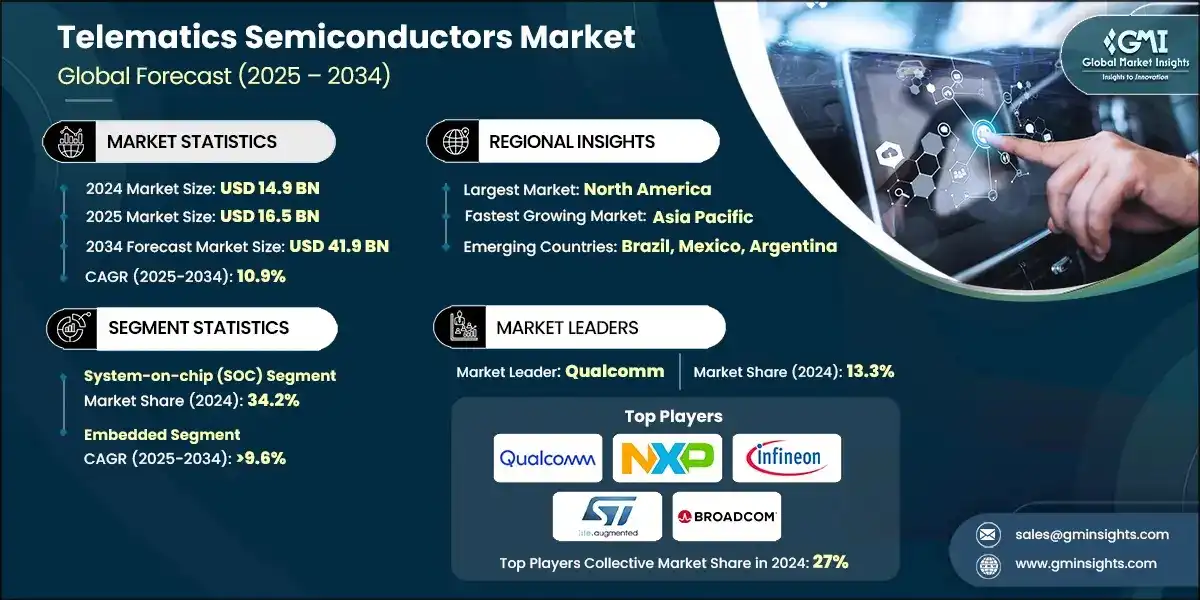
The global telematics semiconductors market was estimated at USD 14.9 billion in 2024. The market is expected to grow from USD 16.5 billion in 2025 to USD 41.9 billion in 2034, at a CAGR of 10.9%, according to latest report published by Global Market Insights Inc.
Telematics Semiconductors Market Key Takeaways
Market Size & Growth
- 2024 Market Size: USD 14.9 Billion
- 2025 Market Size: USD 16.5 Billion
- 2034 Forecast Market Size: USD 41.9 Billion
- CAGR (2025–2034): 10.9%
Key Market Drivers
- Rapid connected vehicle adoption.
- Regulatory push for safety and compliance.
- OEM focus on operational efficiency.
- Rising Demand for OTA and Cloud-Integrated Systems.
Challenges
- High development and integration costs.
- Cybersecurity and data privacy risks.
Opportunity
- Emerging markets & regional expansion.
- Integration with EV and autonomous platforms.
- Shift to software-defined vehicles.
- Growth of Mobility-as-a-Service (MaaS) and Fleet Telematics.
Key Players
- Market Leader: Qualcomm led with over 13.3% market share in 2024.
- Leading Players: Top 5 players in this market include Qualcomm, NXP Semiconductors, Infineon Technologies, STMicroelectronics, Broadcom, which collectively held a market share of 27% in 2024.
Get Market Insights & Growth Opportunities
Growth in the telematics semiconductors market is strong, accelerated by the increased acceleration of connected vehicle platforms, AI-enabled telematics control units (TCUs), vehicle-to-everything (V2X) communication chips, and embedded GNSS modules. Growing industry concerns safety and measures of fleet safety, real-time tracking of vehicles, and vehicles' compliance with regulatory frameworks, coupled with automakers' emphasis on warranty savings and over-the-air (OTA) software updates, is presenting a demand for higher-performing telematics SoCs, low-power wireless transceivers, and automotive-grade microcontrollers.
Telematics semiconductors are now increasingly featured alongside mobility-as-a-service models, intelligent transportation systems, and digital vehicle lifecycle management as part of the overall automotive digital transformation wave across the globe. For example, the National Highway Traffic Safety Administration (NHTSA) in the United States stated plans to require Vehicle-to-Everything (V2X) communication features in new vehicles before 2026.
The automotive telematics semiconductor market faced initial setbacks owing to global chip shortages and production shutdowns resulting from COVID-19 and the unwillingness of many OEM and Tier-1 suppliers to redesign validated electronic control units in the wake of COVID-19, resulting in freeze spending plans.
Both organizations and OEMs have quickly ramped up investments in next-generation telematics semiconductors that support AI-based predictive maintenance, real-time driver behavior detection and analytics, and secure in-vehicle data processing for shorter design cycles, reduced cybersecurity risk, and improved centralized governance of fleet data.
The automotive telematics semiconductor market is experiencing particularly rapid growth in the Asia-Pacific region due to rapid vehicle digitalization and government-supported intelligent transport mandates coupled with increasing demand for electric and connected vehicles. In terms of maturity and early-stage deployment, China, Japan, and South Korea are leading the regional landscape with well-established automotive electronics supply chains.
To get key market trends
Telematics Semiconductors Market Trends
The growth of the telematics semiconductor industry is supported by the continuously growing connected vehicle ecosystem worldwide. The proliferation of automotive-grade semiconductor fabrication, AI-enabled telematics control unit (TCU), and R&D centers in major regions North America, Europe, and Asia-Pacific is robust and has seen significant investment over the last one-to-two-year period.
Instead of relying on disconnected regional design networks the automobile manufacturers and Tier-1 suppliers are now creating centralized electronics and telematics development hubs. These centralized platforms address reduced design cycles, standardized safety-compliance architecture, and regard to government-led incentives associated with intelligent transport and digitization in the automotive space.
The telematics semiconductor ecosystem is rapidly upset by digital technologies. Companies utilize Artificial Intelligence (AI), Machine Learning (ML), and embedded edge computing to remove data analytics capabilities, predictive maintenance algorithms, and driver insights analytics, directly in-vehicle. AI-enabled telematics chipsets will improve data throughput, decrease power consumption, and enable over-the-air (OTA) software updates, all while bringing telematics to be the vehicle architectural layer of intelligence connected by data.
Automotive telematics systems using modular semiconductor designs are increasingly viewed as a top strategic priority by OEMs. Governments and auto manufacturers are investing in standardized chipset platforms, plug-and-play connectivity modules, and open API-based telematics ecosystems. This service-based and scalable telematics business model enables OEMs to leapfrog traditional car architectures, improve time-to-market for connected mobility services, and drive down the cost of transforming electronics from premium vehicles to the mass market.
Telematics Semiconductors Market Analysis
Learn more about the key segments shaping this market
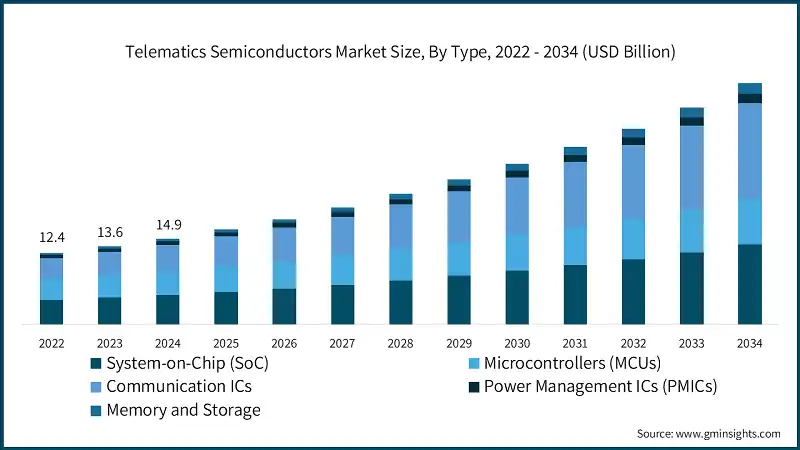
Based on type, the telematics semiconductors market is divided into microcontrollers (MCUS), system-on-chip (SOC), communication ICS, power management ICS (PMICS) and memory and storage. The system-on-chip (SOC) segment dominated the market, accounting for around 34.2% in 2024 and is expected to grow at a CAGR of 10.5% through 2025 to 2034.
- The System-on-Chip (SoC) segment is the largest market share holder. This is largely due to their multiple functions (processor, connectivity, and security) integrating into a single chip. This is allowing for lighter weight, less power consumption, and more performance for telematics systems
- The need for SoC has increased due to more automotive OEMs adopting connected vehicle platforms since SoC designs are normally more scalable, have lower latency, and better real-time data processing is needed for telematics services, such as predictive maintenance, vehicle tracking, and over-the-air updates.
- For example, Renesas announced R-Car X5H in November 2024 that is a version of its fifth-generation R-Car family incorporating chiplet technology to enable scalable AI and graphics processing for advanced driver assistance systems (ADAS), infotainment and gateway applications. Therefore, SoC are clearly the choice for automakers to future-proof connected vehicle architectures.
Learn more about the key segments shaping this market
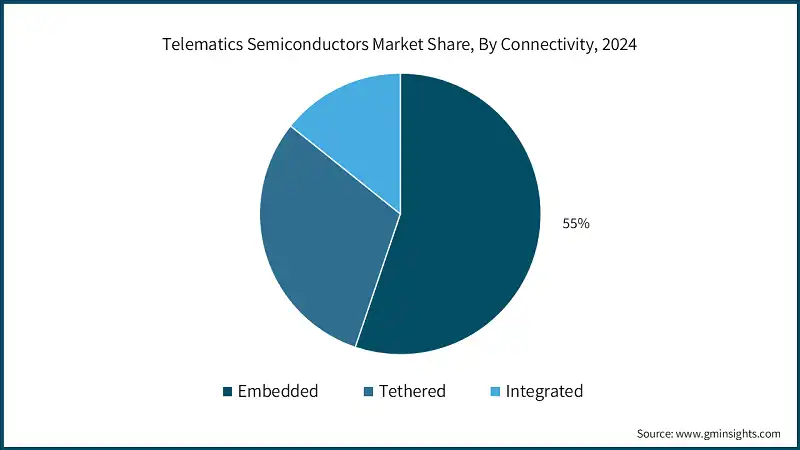
Based on connectivity, the telematics semiconductors market is segmented into Embedded, Tethered and Integrated. The embedded segment dominates the market with 55% share in 2024, and the segment is expected to grow at a CAGR of over 9.6% from 2025 to 2034.
- Larger automotive OEMs and fleet operators mainly leverage embedded telematics solutions because of their sophisticated vehicle electronics systems, requirement for data-security protocols, and for many of them, the need to track their vehicle fleets in real-time. These fleets require telematics modules that are very reliable, contain built-in or factory-installed telematics modules and are scalable across multiple vehicle models and geography.
- The increasing emphasis on areas such as connected vehicle technologies, regulatory compliance and predictive fleet maintenance is causing automotive organizations to consider partnering with established semiconductor vendors that provide embedded SoCs, integrated communication ICs, and AI-enabled telematics platforms. This enables these organizations to acquire real-time insights from vehicles, minimize delays of entering data to processing, and ultimately optimize efficiencies across a fleet or general product range.
- In October 2024, Qualcomm worked with BMW to deploy its Snapdragon Automotive 5G embedded platform in select BMW models to enable real-time vehicle-to-cloud communication, over-the-air updates, and AI-assisted predictive diagnostics. This is a great example of how large OEMs implement high-level embedded telematics solutions to enhance vehicle connectivity, improve safety, and attain operational excellence.
- While tethered and integrated telematics modules are being accepted (particularly in aftermarket solutions, and new software-defined vehicles) the embedded segment continues to be the standard for the deployed solutions owing to its reliability, security, and direct integration in vehicle systems that place it as the premier connected solution for a connected mobility ecosystem at scale.
Based on vehicles, the telematics semiconductors market is segmented passenger vehicle, commercial vehicle and electric & hybrid vehicles. The passenger vehicle segment is expected to dominate the market.
- The passenger vehicle segment is forecasted to remain the largest segment in the telematics semiconductors market because passenger cars, sport utility vehicles (SUVs), and other consumer vehicles typically have the largest global production volumes, and have the greatest for telematics integration across infotainment, navigation, connectivity, and vehicle tracking systems, among other telematics systems.
- Connected car technologies, over-the-air (OTA) updates, the adoption of artificial intelligence (AI), and the platform managers that utilize AI-enabled telematics systems for other uses are accelerating the demand for scalable semiconductor-based solutions in the passenger vehicles segment. Leading semiconductor providers are developing high-performance, automotive-grade, system-on-chip (SoC) processors as well as embedded telematics modules specific to passenger cars to further improve vehicle performance, driver experience, and safety compliance.
- For instance, in October of 2024, Qualcomm partnered with BMW to deploy Qualcomm's Snapdragon Automotive 5G embedded platform on select BMW-made passenger vehicle models that will enable real-time vehicle-to-cloud communication, AI-assisted predictive diagnostics, and OTA updates.
- Commercial vehicles, and electric and hybrid vehicle consumer segments are also adopting telematics semiconductors based on their business needs related to fleets and connectivity that allows for energy-optimized connectivity, and fleet-based telematics integration
- However, unless there is a substantial demand for telematics solutions in commercial or electric and hybrid vehicles based on fleet demand, the passenger vehicle segment will continue to dominate due to its tremendous numbers (volume), adoption of connectivity features across owner segments, and higher use of integrated telematics systems in passenger vehicles.
Based on applications, the telematics semiconductors market is segmented fleet management systems, passenger vehicle telematics, aftermarket telematics devices, asset tracking systems, emergency call (ECALL) systems, usage-based insurance (UBI) and vehicle-to-everything (V2X) communication. The fleet management systems segment is expected to dominate the market.
- The fleet management systems category is likely to be the most significant in the telematics semiconductors market, as logistics, transportation and commercial fleets anticipating real-time vehicle tracking, predictive maintenance, fuel monitoring, and driver behavior analytics.
- The demand for telematics semiconductor solutions rated for reliability or scalability is increasing along with the greater adoption of connected fleet technologies, such as AI-assisted predictive maintenance, and cloud-based fleet management software. Large suppliers of semiconductors are also crafting automotive-grade SoCs, communications ICs, and embedded modules for fleet telematics to promote operational efficiencies and safety and enable regulatory compliance.
- While telematics applications for passenger vehicles, V2X communications, and various other applications are also growing rapidly, fleet management systems is still the largest single contributor to increased overall market size because of how many are deployed, the ongoing demand for data, and operational dependency on improved telematics hardware among other factors.
Looking for region specific data?
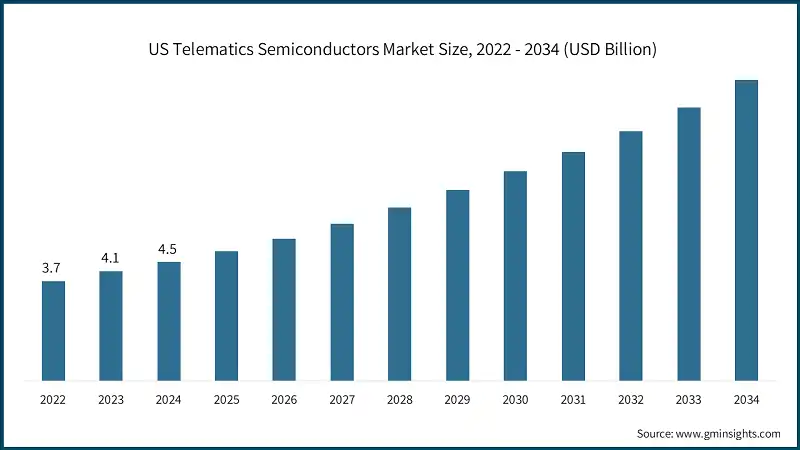
The US dominated the North America telematics semiconductors market with around 83% market share and revenue of USD 4.5 billion in 2024.
- The United States is the largest market for telematics semiconductors in North America, driven by rapid adoption of connected vehicle technologies, advanced automotive electronics infrastructure, and a strong push toward vehicle safety, fleet management, and smart mobility solutions.
- Growing investment in AI-enabled SoCs, embedded telematics modules, and V2X communication ICs has significantly accelerated the deployment of telematics semiconductors across passenger vehicles, commercial fleets, and electric/hybrid vehicles.
- In October 2024, Qualcomm introduced its Snapdragon Automotive 5G embedded platform in the U.S., enabling real-time vehicle-to-cloud communication, predictive maintenance, and over-the-air software updates for enterprise and fleet clients.
The UK dominated the Europe telematics semiconductors market with around 12% market share and revenue of USD 636.6 million in 2024.
- The United Kingdom telematics semiconductors market is expected to experience strong growth, driven by increasing government-backed smart mobility initiatives, stricter vehicle safety and connectivity regulations, and growing adoption of connected vehicle technologies across passenger, commercial, and electric/hybrid vehicles. For example, in March 2025, NXP Semiconductors partnered with Jaguar Land Rover to deploy advanced embedded telematics modules in UK models, enabling predictive maintenance, over-the-air updates, and real-time fleet monitoring.
- Major players investing in the UK market include Qualcomm, NXP Semiconductors, Renesas Electronics, and Tesla, motivated by strong demand for high-performance telematics solutions, expansion of vehicle electronics R&D hubs, and the growing need for connected vehicle compliance with EU and UK regulations.
- Growth is further supported by initiatives such as the UK Intelligent Transport Systems strategy, government incentives for EV adoption, and increasing corporate ESG reporting mandates related to vehicle emissions and safety.
China dominated the Asia Pacific telematics semiconductors market with around 34% market share and revenue of USD 854.4 million in 2024.
- China is the largest telematics semiconductors market in the Asia-Pacific region, driven by rapid adoption of connected vehicle technologies, strong government initiatives promoting smart mobility, and the increasing need for vehicle safety, real-time connectivity, and fleet efficiency. Automotive OEMs, particularly in passenger vehicles, commercial fleets, and electric/hybrid vehicles, are adopting embedded telematics modules, AI-enabled SoCs, and communication ICs to enable predictive maintenance, over-the-air updates, and advanced vehicle-to-everything (V2X) communication.
- Major semiconductor providers investing in China include Qualcomm, NXP Semiconductors, Renesas Electronics, and Tesla, offering localized solutions that integrate AI-powered telematics processors, edge computing modules, and high-speed connectivity ICs. These solutions help automakers and fleet operators improve operational efficiency, predictive analytics, and real-time vehicle monitoring, while supporting China’s push for smart vehicle ecosystems and next-generation mobility platforms.
- Government initiatives, such as EV adoption incentives, connected vehicle mandates, and regional smart mobility programs, further accelerate the adoption of telematics semiconductors. Automakers and fleet operators are leveraging these solutions not only to enhance vehicle performance and safety but also to meet regulatory compliance, improve fleet management, and drive innovation in connected vehicle technologies.
The telematics semiconductors market in Brazil will experience significant growth between 2025 & 2034.
- Brazil leads the Latin American telematics semiconductors market, driven by increasing adoption of connected vehicle technologies, rapid growth in automotive manufacturing, logistics, and fleet management sectors, and rising demand for vehicle safety, real-time monitoring, and efficient fleet operations. Deployment of embedded telematics modules, system-on-chips (SoCs), and communication ICs is being supported by government smart mobility programs, private-sector investments, and corporate modernization initiatives.
- Major semiconductor providers investing in Brazil include Qualcomm, NXP Semiconductors, Renesas Electronics, and Continental AG, motivated by strong demand for scalable, AI-enabled telematics solutions, real-time fleet monitoring, and predictive vehicle analytics. These vendors are expanding regional R&D centers and platform capabilities to meet the growing requirements of automotive OEMs, commercial fleet operators, and electric/hybrid vehicle manufacturers in the region.
- Growth is further fueled by vehicle safety regulations, connected vehicle mandates, and regional smart mobility initiatives. Automakers and fleet operators in Brazil are leveraging telematics semiconductor solutions to enhance operational efficiency, improve vehicle-to-cloud connectivity, strengthen fleet management, and accelerate adoption of advanced telematics technologies across passenger, commercial, and electric/hybrid vehicles.
The telematics semiconductors market in UAE is expected to experience robust growth between 2025 & 2034.
- The UAE telematics semiconductors market is witnessing rapid growth, driven by government-led smart mobility initiatives, adoption of connected vehicle and smart city programs, and increasing demand from passenger vehicles, commercial fleets, and electric/hybrid vehicles. Automotive OEMs and fleet operators are increasingly leveraging embedded telematics modules, AI-enabled SoCs, and communication ICs to enhance vehicle safety, operational efficiency, and real-time connectivity.
- Major semiconductor providers investing in the UAE include Qualcomm, NXP Semiconductors, Renesas Electronics, and Continental AG, offering localized, service-driven telematics solutions that integrate predictive analytics, real-time fleet monitoring, and over-the-air (OTA) update capabilities. These platforms enable automakers and fleet operators to optimize vehicle operations, strengthen connectivity, and manage telematics-related risks effectively across diverse fleets and vehicle types.
- Growth is further supported by government initiatives such as the UAE Smart Government Program, EV adoption incentives, and connected vehicle mandates, which encourage the adoption of advanced telematics semiconductor solutions in both public and private sectors. Automotive organizations are leveraging these solutions to drive operational efficiency, improve vehicle-to-cloud communication, ensure regulatory compliance, and position the UAE as a key hub for telematics innovation in the Middle East.
Telematics Semiconductors Market Share
The top 7 companies in the market are Qualcomm, NXP Semiconductors N.V., Infineon Technologies, STMicroelectronics, Texas Instruments, Broadcom and Renesas Electronics. These companies hold around 30% of the market share in 2024.
- Qualcomm is a dominant force in the telematics semiconductor market, widely recognized for its leadership in wireless connectivity, advanced modem technologies, and automotive-grade system-on-chips (SoCs). The company’s telematics portfolio powers connected vehicle platforms, enabling vehicle-to-everything (V2X) communications, 5G connectivity, and edge processing capabilities.
- NXP Semiconductors is a leading player in the telematics semiconductor market, known for its robust automotive-grade microcontrollers (MCUs), secure connectivity modules, and networking processors. The company focuses on enhancing vehicle communication architectures with telematics control units (TCUs) that support secure over-the-air (OTA) updates, advanced cybersecurity, and high-speed in-vehicle networking. NXP’s strength lies in integrating safety-critical telematics functions with vehicle domain controllers, helping automakers accelerate connected and autonomous vehicle deployment.
- Infineon Technologies plays a crucial role in the telematics semiconductor ecosystem, offering highly reliable power management ICs (PMICs), security chips, and communication components optimized for automotive use. Infineon’s telematics solutions prioritize energy efficiency, robust data security, and functional safety, enabling dependable operation in harsh automotive environments.
- STMicroelectronics is a prominent telematics semiconductor supplier with a strong focus on GNSS positioning chips, MEMS sensors, and microcontrollers used in telematics control systems. The company emphasizes precision, low power consumption, and scalability in its telematics offerings, supporting advanced driver assistance, fleet management, and asset tracking applications.
- Texas Instruments Incorporated holds a strong position in the telematics semiconductor market, known for its wide range of analog ICs, power management solutions, and automotive processors. TI enables high-efficiency power conversion, signal processing, and robust interface solutions in telematics systems, supporting in-vehicle networking, infotainment, and safety communications.
- Broadcom is a key contributor to the telematics semiconductor landscape, specializing in high-speed connectivity components such as Ethernet switches, Bluetooth, Wi-Fi, and GNSS chips. Broadcom’s telematics solutions enable fast, secure in-vehicle data transmission and precise positioning, supporting autonomous driving, real-time fleet management, and connected infotainment.
- Renesas Electronics is an established player in the telematics semiconductor market, offering a comprehensive portfolio of automotive-grade microcontrollers, SoCs, power management ICs, and connectivity solutions. Renesas is known for its highly integrated telematics chipsets that support vehicle connectivity, diagnostics, and data security.
Telematics Semiconductors Market Companies
Major players operating in the telematics semiconductors industry are:
- Analog Devices
- Fibocom Wireless
- Infineon Technologies
- MediaTek
- Murata Manufacturing
- NXP Semiconductors
- Qualcomm
- Renesas Electronics
- STMicroelectronics
- Texas Instruments
- The telematics semiconductors market is intensely competitive, with established players Qualcomm Incorporated, NXP Semiconductors N.V., Infineon Technologies AG, STMicroelectronics N.V., Texas Instruments Incorporated, Broadcom Inc., and Renesas Electronics Corporation occupying primary segments. Qualcomm dominates the sector with its advanced automotive-grade SoCs and 5G-based telematics platforms, focusing on high-speed connectivity, edge computing, and V2X capabilities to power next-generation connected vehicles.
- Infineon competes on reliability and energy efficiency, delivering PMICs, security modules, and communication ICs that ensure stable operation in harsh automotive environments while safeguarding telematics data. STMicroelectronics leverages its GNSS positioning chips, MEMS sensors, and microcontrollers to enable precise navigation, fleet management, and asset tracking, aligning with growing demand for data-driven mobility solutions.
- Meanwhile, Broadcom and Renesas position themselves within similar segments but deliver highly specialized offerings. Broadcom stands out for its high-bandwidth connectivity modules Ethernet, Wi-Fi, Bluetooth, and GNSS which support fast and secure in-vehicle data transfer, enabling real-time telematics and autonomous functionalities. Renesas integrates MCUs, SoCs, and PMICs to deliver comprehensive, low-power telematics platforms with strong functional safety and security compliance, supporting advanced diagnostics, connectivity, and vehicle data processing.
- Overall, the market is marked by intense competition across component types, integration levels, and connectivity standards, with semiconductor manufacturers continually innovating to capture evolving OEM requirements and maintain global leadership in the automotive telematics ecosystem.
Telematics Semiconductors Market Report Attributes
| Key Takeaway | Details |
|---|---|
| Market Size & Growth | |
| Base Year | 2024 |
| Market Size in 2024 | USD 14.9 Billion |
| Market Size in 2025 | USD 16.5 Billion |
| Forecast Period 2025 - 2034 CAGR | 10.9% |
| Market Size in 2034 | USD 41.9 Billion |
| Key Market Trends | |
| Drivers | Impact |
| Rapid connected vehicle adoption | Growing integration of Vehicle-to-Everything (V2X) communication, AI-enabled Telematics Control Units (TCUs), and embedded Global Navigation Satellite System (GNSS) fuels demand for high-performance automotive telematics semiconductors. |
| Regulatory push for safety and compliance | Mandates from agencies like the National Highway Traffic Safety Administration (NHTSA) in the United States and the European Commission are encouraging the adoption of real-time data logging, crash detection, and over-the-air (OTA) update capabilities, driving semiconductor integration. |
| OEM focus on operational efficiency | Automakers and fleet operators are seeking lower warranty costs, enhanced uptime, and predictive maintenance, increasing reliance on AI-powered telematics chipsets for proactive diagnostics and centralized fleet monitoring. |
| Rising Demand for OTA and Cloud-Integrated Systems | The shift to cloud-based diagnostics, OTA software updates, and centralized electronic control is accelerating adoption of high-speed automotive telematics SoCs and connectivity ICs. |
| Pitfalls & Challenges | Impact |
| High development and integration costs | Designing automotive-grade telematics SoCs and wireless transceivers requires significant R&D investment, long qualification cycles, and compliance with stringent safety standards (e.g., ISO 26262), creating barriers for new entrants. |
| Cybersecurity and data privacy risks | Increasing in-vehicle data exchange and cloud connectivity heighten concerns over cyberattacks, data breaches, and compliance with data protection laws, making OEMs cautious about rapid semiconductor upgrades. |
| Opportunities: | Impact |
| Emerging markets & regional expansion | Rapid automotive digitalization in Asia-Pacific led by China, Japan, and South Korea offers strong growth prospects with government-backed smart mobility and intelligent transport initiatives. |
| Integration with EV and autonomous platforms | Rising production of Electric Vehicles (EVs) and autonomous driving systems creates a lucrative market for high-speed data processing, low-power telematics chipsets and edge AI processors. |
| Shift to software-defined vehicles | OEM transition toward software-defined architectures and centralized electronic control units (ECUs) opens demand for modular, OTA-upgradable telematics semiconductor platforms supporting long-term vehicle lifecycle management. |
| Growth of Mobility-as-a-Service (MaaS) and Fleet Telematics | Increasing adoption of shared mobility, logistics, and fleet tracking platforms is boosting demand for real-time telematics data chips and secure communication modules. |
| Market Leaders (2024) | |
| Market Leaders |
13.3% market share |
| Top Players |
Collective Market Share in 2024 is 27% |
| Competitive Edge |
|
| Regional Insights | |
| Largest Market | North America |
| Fastest Growing Market | Asia Pacific |
| Emerging Country | Brazil, Mexico, Argentina |
| Future Outlook |
|
What are the growth opportunities in this market?
Telematics Semiconductors Industry News
- In April 2025, Qualcomm launched its next-generation Snapdragon Automotive 5G embedded platform, integrating AI-enabled telematics processing, V2X communication, and OTA update capabilities. Initial deployments across North America and Europe enhanced vehicle connectivity, predictive maintenance, and fleet management efficiency for passenger and commercial vehicles.
- In March 2025, NXP Semiconductors expanded its telematics SoC portfolio across Asia-Pacific and Europe. The upgraded solutions integrate AI-driven vehicle analytics, secure communication ICs, and real-time telemetry dashboards to improve vehicle performance monitoring, reduce system latency, and enhance safety compliance.
- In February 2025, Renesas Electronics introduced an advanced automotive telematics platform featuring embedded MCUs, power management ICs, and predictive diagnostics modules. Early deployments in the U.S. and Germany demonstrated enhanced telematics reliability, optimized fleet monitoring, and reduced operational costs for OEMs and fleet operators.
- In January 2025, Infineon Technologies unveiled a new EV telematics solution that combines communication ICs, high-efficiency power management, and AI-assisted vehicle monitoring systems. Pilots across Europe and Asia showed improved energy efficiency, better predictive maintenance, and enhanced connectivity for electric and hybrid vehicles.
- In December 2024, STMicroelectronics launched a next-generation telematics semiconductor suite with integrated SoCs, embedded MCUs, and sensor connectivity modules. Initial rollouts in Brazil and Singapore enabled automakers and fleet operators to streamline telematics operations, enhance vehicle-to-cloud communication, and improve real-time data analytics.
- In November 2024, Texas Instruments introduced a hybrid telematics platform integrating AI-based analytics, communication ICs, and real-time embedded processing. Deployments in the Middle East and Europe demonstrated higher adoption rates, improved vehicle monitoring, and stronger fleet management capabilities.
- In October 2024, Continental rolled out an end-to-end automotive telematics solution featuring connected vehicle services, predictive analytics, and safety-aligned telematics modules. Deployed in Germany and the UAE, the platform enabled real-time vehicle monitoring, automated maintenance alerts, and improved operational efficiency for enterprise fleets and OEMs.
The telematics semiconductors market research report includes in-depth coverage of the industry with estimates & forecasts in terms of revenue ($Bn) and Volume (Units) from 2021 to 2034, for the following segments:
Market, By Type
- Microcontrollers (MCUs)
- System-on-Chip (SoC)
- Communication ICs
- Power Management ICs (PMICs)
- Memory and Storage
Market, By Connectivity
- Embedded
- Tethered
- Integrated
Market, By Vehicle
- Passenger Vehicles
- Compact
- Mid-Size
- Luxury
- SUV
- Commercial Vehicles
- Light Commercial Vehicles (LCV)
- Heavy Commercial Vehicles (HCV)
- Buses
- Electric & Hybrid Vehicles
Market, By Application
- Fleet management systems
- Passenger vehicle telematics
- Aftermarket telematic devices
- Asset tracking systems
- Emergency call (eCall) systems
- Usage-based insurance (UBI)
- Vehicle-to-everything (V2X) communication
The above information is provided for the following regions and countries:
- North America
- US
- Canada
- Europe
- Germany
- France
- UK
- Spain
- Italy
- Russia
- Nordics
- Asia Pacific
- China
- India
- Japan
- South Korea
- ANZ
- Southeast Asia
- Latin America
- Brazil
- Mexico
- Argentina
- Middle East and Africa
- UAE
- Saudi Arabia
- South Africa
Frequently Asked Question(FAQ) :
What is the market size of the telematics semiconductors in 2024?
The market size was USD 14.9 billion in 2024, with a CAGR of 10.9% expected through 2034. Growth is driven by the adoption of connected vehicle platforms, AI-enabled telematics control units (TCUs), and V2X communication chips.
What is the projected value of the telematics semiconductors market by 2034?
The market is projected to reach USD 41.9 billion by 2034, fueled by advancements in AI, modular semiconductor designs, and government incentives for intelligent transport systems.
What is the expected size of the telematics semiconductors market in 2025?
The market size is projected to reach USD 16.5 billion in 2025.
How much revenue did the system-on-chip (SOC) segment generate in 2024?
The SOC segment generated approximately 34.2% of the market share in 2024 and is expected to witness over 10.5% CAGR through 2034.
What was the market share of the embedded segment in 2024?
The embedded segment dominated the market with a 55% share in 2024 and is set to expand at a CAGR of over 9.6% till 2034.
Which region leads the telematics semiconductors sector?
North America leads the market, with the United States accounting for 83% of the regional revenue, totaling USD 4.5 billion in 2024. This growth is driven by the rapid adoption of connected vehicle technologies and advanced automotive electronics infrastructure.
What are the upcoming trends in the telematics semiconductors market?
Trends include AI-powered telematics chipsets, modular semiconductor designs, OTA software updates, open API-based ecosystems, and government-led incentives for intelligent transport and digitization.
Who are the key players in the telematics semiconductors industry?
Key players include Analog Devices, Fibocom Wireless, Infineon Technologies, MediaTek, Murata Manufacturing, NXP Semiconductors, Qualcomm, Renesas Electronics, STMicroelectronics, and Texas Instruments.
Telematics Semiconductors Market Scope
Related Reports