Summary
Table of Content

Swimwear Market
Get a free sample of this report
Form submitted successfully!
Error submitting form. Please try again.
Thank you!
Your inquiry has been received. Our team will reach out to you with the required details via email. To ensure that you don't miss their response, kindly remember to check your spam folder as well!
Request Sectional Data
Thank you!
Your inquiry has been received. Our team will reach out to you with the required details via email. To ensure that you don't miss their response, kindly remember to check your spam folder as well!
Form submitted successfully!
Error submitting form. Please try again.
Swimwear Market Size
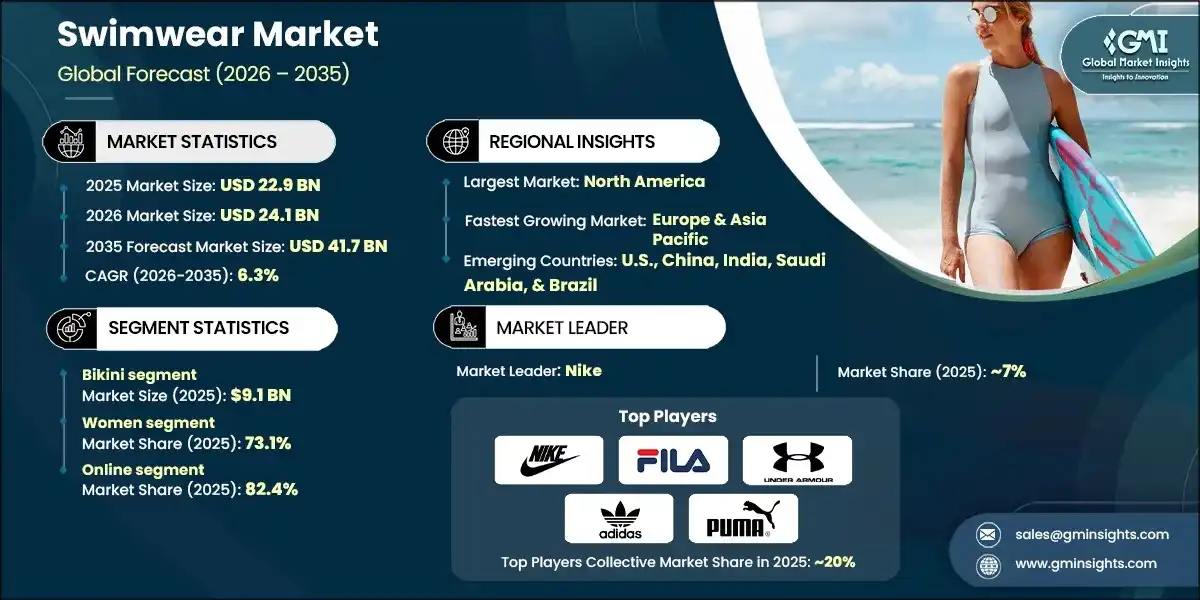
The global swimwear market was estimated at USD 22.9 billion in 2025. The market is expected to grow from USD 24.1 billion in 2026 to USD 41.7 billion in 2035, at a CAGR of 6.3%, according to latest report published by Global Market Insights Inc.
Swimwear Market Key Takeaways
Market Size & Growth
- 2025 Market Size: USD 22.9 Billion
- 2026 Market Size: USD 24.1 Billion
- 2035 Forecast Market Size: USD 41.7 Billion
- CAGR (2026–2035): 6.3%
Regional Dominance
- Largest Market: North America
- Fastest Growing Region: Europe & Asia Pacific
Key Market Drivers
- Heightened awareness of health and fitness.
- Surge in beach and resort tourism.
- Increasing disposable incomes and evolving lifestyles.
- Emphasis on customization and personalization.
Challenges
- Intense competition & swift fashion cycles.
- Fluctuations in costs & supply chain.
Opportunity
- Emphasis on inclusive & customizable designs.
- Growth of e-commerce & digital evolution.
Key Players
- Market Leader: Nike led with over 7% market share in 2025.
- Leading Players: Top 5 players in this market include Nike, FILA, Under Armour, Adidas AG, Puma, which collectively held a market share of 20% in 2025.
Get Market Insights & Growth Opportunities
- As health and fitness gains popularity, it translates into a great benefit to the swimwear market, as more people engage in water sports, including swimming, aqua aerobics, and other forms of fitness-related water activities, leading to an increase in the need for functional swimwear. In addition to this, swimwear is now important to consumers because of the benefits of the fast-drying properties of fabric; UV-blocking fabric; and fabric resistant to chlorine. According to the CDC, swimming is among the four most popular forms of recreation in the United States, with more than 91 million adults and children participating in swimming each year in the U.S.
- This growing popularity translates to more people, striving to stay fit and healthy year-round through swimwear, making it a necessary component to health and fitness through swimming. The increased number of fitness programs and routines has further increased the need for swimwear to be a necessary clothing item throughout the entire year instead of just being a seasonal item.
- With the growing accessibility of leisure travel, the number of tourists visiting beaches/resorts worldwide is on the rise, and so is the increased demand for swimwear products. In today’s world, more consumers are viewing swimwear as an opportunity to showcase their identity and social status, in addition to being a functional piece for swimming/sunbathing. According to the United Nations' World Tourism Organization (UNWTO), international tourist arrivals increased by 20% in 2023 compared to the previous year, which led to an increased demand for a range of swimwear products that are designed to work in both the pool/beach to pool/beach transition.
- As a result, manufacturers are re-designing and re-engineering swimwear products by developing new styles, styles and premium quality fabrics to meet the demands of consumers. Another factor that influences consumers' swimwear selections is the increased prevalence of social media. Social media influences consumers to purchase more stylish, fashionable swimwear options to enhance their social media visibility and attractiveness.
- Growing disposable income and changing lifestyles are both playing a major role in the growth of the swimwear market. Consumers have increased the amount of money they spend on entertainment and fashion, thus giving them more disposable income to spend on higher-quality, branded swimwear products that provide comfort, durability, and style.
- There is also a trend towards personalization and customization within the swimwear industry, as consumers seek out unique styles, tailored to fit their individual body types, and options for inclusion of larger sizes. Brands that offer customers the ability to create their own custom products, as well as those that provide access to unique collections, have a major advantage in this area. In addition to differentiating themselves in a highly competitive market, these brands are also cultivating customer loyalty, providing a platform for long-term future growth opportunities.
To get key market trends
Swimwear Market Trends
- The swimwear industry is rapidly advancing due to advancements in fabric technology and improved functionality and increased consumer interest in these. Modern day swimwear has incorporated many of these advanced features including quick drying fabric, UV protection with specific UPF ratings, and chlorine resistant fabric which has been tested against prolonged chlorine exposure providing for a longer life and better comfort when used for recreational and competitive swimming. These advances meet the growing need for high-performance, high-quality swimming suits, combining style and technical efficiency with the highest possible levels of precise fit.
- Recent advancements in fabric technology have supported the continued growth of this market by introducing innovative, efficient smart materials. The use of lightweight, breathable, highly engineered fabrics that maximize flexibility as well as moisture management (i.e., significant improvements in the moisture loss rates of fabrics) represents an offering that aims to provide the best possible user experience. Advances in technologies, such as the development of compression fabric for muscle placement support and thermal management systems designed for different temperatures of water, continue to be driven by manufacturers focused on positioning swimwear as a distinct and innovative, high-performance category of apparel.
- At the same time as the focus on sustainability continues to grow and change the definition of what is acceptable when buying clothes, there has been a noticeable increase in the number of consumers who are selecting sustainable swimwear options. As a result, brands are incorporating circular business models into their product categories, using closed loop recycling systems and providing full transparency through their supply chains to meet the needs of environmentally conscious customers. Creating a premium price point for sustainable swimwear is not driven solely by consumer demand, but also by the pressing environmental problems associated with the production of swimwear items; therefore, the continued focus on sustainability will define the future direction of the marketplace, as well as establish an ongoing premium segment within the swimwear category.
Swimwear Market Analysis
Learn more about the key segments shaping this market
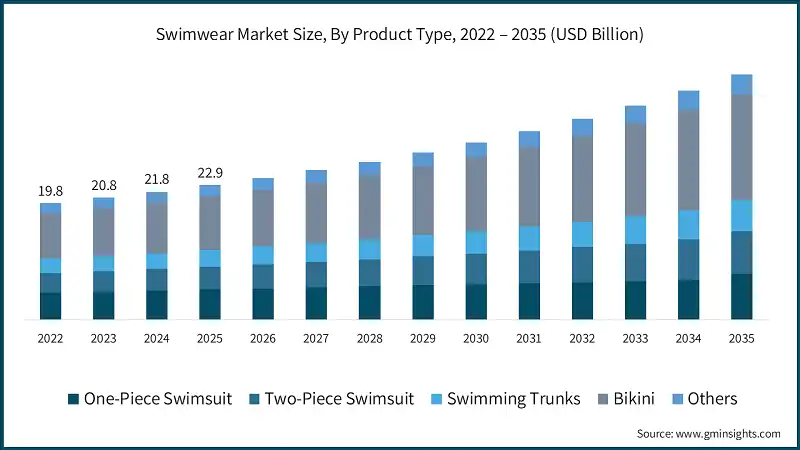
Based on product type, the swimwear market is categorized into one-piece swimsuit, two-piece swimsuit, swimming trunks, bikini, and others. The bikini segment accounted for revenue of around USD 9.1 billion in 2025 and is anticipated to grow at a CAGR of 7.1% from 2026 to 2035.
- Bikinis are widely associated with beachwear and vacation attire, and the rising popularity of beach tourism and resort travel globally is fueling demand. Social media platforms and influencer marketing have amplified trends toward bold designs, vibrant colors, and body-positive styles, making bikinis a fashion statement rather than just functional swimwear.
- Additionally, younger demographics are increasingly embracing minimalistic and versatile swimwear options that can be styled for multiple occasions, including pool parties and leisure activities. The growth of e-commerce has made it easier for consumers to access a wide variety of bikini styles, sizes, and sustainable options, while innovations in fabrics such as quick-drying, UV-protective, and eco-friendly materials enhance comfort and appeal.
Based on end-user of swimwear market consists of men, women and kids. The women emerged as leader and held 73.1% of the total market share in 2025 and is anticipated to grow at a CAGR of 6.7% from 2026 to 2035.
- Women’s swimwear is highly influenced by fashion trends, seasonal collections, and lifestyle changes, making it the most dynamic category in terms of design and innovation. Increasing participation of women in water-based activities such as swimming, aqua fitness, and beach sports, along with a growing culture of wellness and leisure travel, drives demand for stylish and functional swimwear. Social media and influencer marketing play a major role in shaping preferences, with trends like body positivity, bold prints, and versatile designs gaining popularity.
- Additionally, women are more likely to purchase multiple swimwear pieces for different occasions, such as vacations, pool parties, and fitness activities, which boosts overall sales. The rise of e-commerce and customization options further enhances accessibility and convenience, while innovations in fabrics such as quick-drying, UV-protective, and sustainable materials appeal to health-conscious and eco-aware consumers.
Learn more about the key segments shaping this market
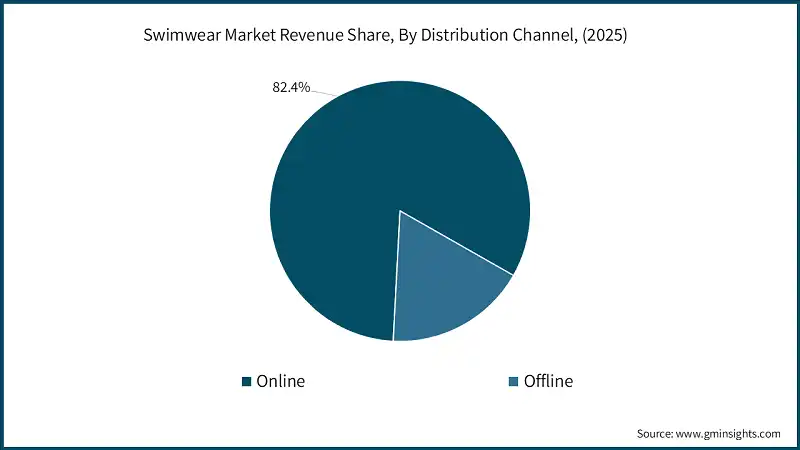
Based on distribution channel of swimwear market consists of online and offline. The online distribution channel emerged as leader and held 82.4% of the total market share in 2025 and is anticipated to grow at a CAGR of 6.8% from 2026 to 2035.
- The rapid expansion of e-commerce platforms has made shopping more convenient, offering consumers access to a wide range of styles, sizes, and brands from the comfort of their homes. Online channels also provide competitive pricing, easy comparison, and frequent discounts, which attract price-sensitive buyers.
- Additionally, the integration of advanced technologies such as virtual try-on tools, size recommendation systems, and augmented reality enhances the online shopping experience and reduces purchase hesitation. Social media and influencer marketing further drive traffic to online stores, creating strong brand engagement and trend awareness. The growing popularity of mobile shopping and secure payment options adds to consumer confidence in online purchases.
Looking for region specific data?
North America Swimwear Market
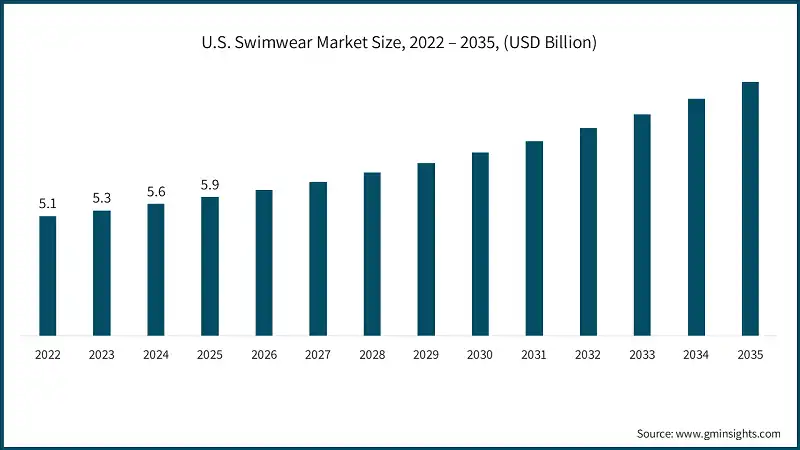
The U.S. dominates an overall North America market and valued at USD 5.9 billion in 2025 and is estimated to grow at a CAGR of 6.3% from 2026 to 2035.
- Growing health and fitness awareness has led to increased participation in water-based activities such as swimming, aqua aerobics, and triathlons, driving demand for performance-oriented swimwear. Rising disposable incomes and a strong culture of beach and resort vacations further boost sales, as consumers seek stylish and versatile swimwear for leisure and travel. Fashion trends emphasizing body positivity, bold designs, and athleisure-inspired looks have also expanded the market appeal.
- Additionally, the rapid growth of e-commerce provides consumers with easy access to a wide range of styles and sizes, while technological innovations in fabrics such as quick-drying, UV-protective, and eco-friendly materials—enhance product quality and sustainability. Social media influence and digital marketing amplify brand visibility, while the increasing number of residential and public swimming facilities encourages everyday swimwear use.
Europe Swimwear Market
In the European market, Germany is expected to experience significant and promising growth from 2026 to 2035.
- The country has a strong culture of wellness and spa tourism, which encourages regular use of swimwear for leisure and health-related activities. Increasing participation in water sports and fitness programs further drives demand for functional and stylish swimwear. German consumers are known for prioritizing quality, durability, and sustainability, leading to a shift toward premium products made from eco-friendly and innovative fabrics like quick-drying and UV-protective materials.
- Fashion trends emphasizing minimalist designs, bold prints, and inclusive sizing are gaining popularity, supported by social media influence and digital marketing. Additionally, the rapid growth of e-commerce provides easy access to a wide variety of swimwear options, enhancing convenience and personalization.
Asia Pacific Swimwear Market
In the Asia Pacific market, the China held 80.4% market share in 2025 and is anticipated to grow at a CAGR of 6.3% from 2026 to 2035.
- Rapid urbanization and rising disposable incomes are enabling consumers to spend more on leisure activities, including beach vacations and water sports. A growing emphasis on health and fitness has increased participation in swimming and aquatic exercise, driving demand for both functional and fashionable swimwear.
- Additionally, the popularity of domestic and international travel to coastal destinations is fueling interest in trendy and versatile swimwear styles. Technological advancements in fabrics such as quick-drying, UV-protective, and chlorine-resistant materials are attracting performance-conscious buyers, while sustainability trends are encouraging brands to introduce eco-friendly options made from recycled materials. The expansion of e-commerce and social media marketing further boosts accessibility and consumer engagement, allowing brands to reach a wider audience and promote new designs effectively.
Middle East and Africa Swimwear Market
In the Middle East and Africa market, Saudi Arabia held 33.5% market share in 2025 promising growth from 2026 to 2035.
- The country’s tourism sector is expanding rapidly under national initiatives that promote beach resorts, luxury hotels, and recreational facilities, creating higher demand for swimwear. Rising disposable incomes and a young, fashion-conscious population are driving interest in stylish and premium swimwear options.
- Additionally, growing awareness of health and fitness has led to increased participation in swimming and water-based activities, supported by government investments in sports infrastructure. Social media influence and global fashion trends are shaping consumer preferences, while e-commerce platforms make a wide range of products easily accessible. Sustainability and innovation in fabrics, such as quick-drying and UV-protective materials, are also appealing to consumers seeking quality and comfort.
Swimwear Market Share
- In 2025, the prominent manufacturers in market are Nike, FILA, Under Armour, Adidas AG, and Puma collectively held the market share of ~20%.
- Nike maintains its edge in the swimwear arena by prioritizing cutting-edge performance innovations. The brand employs advanced fabrics that dry swiftly, shield against UV rays, and resist chlorine, guaranteeing both durability and comfort for athletes and leisure swimmers alike. These fabrics are engineered to withstand prolonged exposure to harsh pool chemicals and sunlight, ensuring long-lasting performance. Committed to sustainability, Nike incorporates recycled polyester and other eco-conscious materials into its designs, alongside adopting water-efficient and low-carbon production methods. Furthermore, the brand delves into hydrodynamic aesthetics and intelligent swim technologies, including suits embedded with sensors to monitor metrics such as stroke count, lap times, and calorie burn, catering to health-conscious and tech-savvy consumers.
- FILA sets itself apart with its intelligent fabric technology and innovative wearables. The brand has rolled out apparel laced with conductive fibers and sensors, tracking biometrics such as heart rate, body temperature, and even hydration levels. These features sync seamlessly with proprietary mobile applications, offering users immediate and detailed feedback on their performance and physical condition. This blend of style and advanced technology positions FILA as a pioneering brand, appealing to consumers who prioritize both performance monitoring and fashion-forward designs. Additionally, FILA’s focus on integrating lightweight, breathable materials ensures comfort during extended use, making it a preferred choice for active individuals.
Swimwear Market Companies
Major players operating in the swimwear market include:
- Adidas AG
- American Apparel Inc.
- Arena SpA (Berkshire Hathaway)
- La Jolla Group
- LVMH Moet Hennessy Louis Vuitton
- Marysia LLC
- Nike Inc.
- Pentland Group
- Perry Ellis International
- Puma
- PVH Corp.
- Quiksilver Inc.
- Swimwear Anywhere Inc. (TYR Sports Inc.)
- Tennor Holding BV (La Perla)
- TJ Swim
Under Armour harnesses its prowess in performance apparel to push boundaries in swimwear. The brand emphasizes compression technology that enhances blood flow and reduces muscle fatigue, moisture-wicking materials that keep swimmers dry and comfortable out of the water, and designs tailored for aquatic athletes with features like ergonomic seams to minimize drag. With substantial investments in research and development, Under Armour crafts swimwear that boosts athletic performance by incorporating athlete-tested prototypes and feedback. This approach ensures its products meet the rigorous demands of competitive swimmers and fitness enthusiasts, offering a blend of functionality and innovation.
Adidas melds performance with sustainability to retain its market edge. Its swimwear boasts hydrophobic coatings that repel water, fabrics engineered to reduce drag for improved speed, and strategically placed compression zones that enhance muscle support and efficiency during swimming. In tune with the rising demand for sustainable fashion, Adidas champions eco-friendly initiatives, notably through collections crafted from recycled ocean plastics, such as ECONYL yarn, which is regenerated from discarded fishing nets and other waste. Collaborations with prominent athletes and influencers, including Olympic swimmers, further bolster its market stature, ensuring its products are both high-performing and aligned with consumer values.
Puma emphasizes style, sustainability, and key partnerships to maintain its foothold in the swimwear domain. By integrating recycled materials such as post-consumer plastics and adopting circular design concepts, Puma's swimwear collections resonate with eco-conscious buyers. The brand also incorporates innovative features like adjustable straps and multi-functional designs, making its swimwear versatile for both athletic and casual use. Capitalizing on its robust fashion reputation, Puma crafts trendy and adaptable swimwear with bold patterns and vibrant colors, particularly appealing to younger audiences. Strategic collaborations with designers and influencers further enhance its appeal, striking a harmonious balance between performance, sustainability, and lifestyle.
Swimwear Market Report Attributes
| Key Takeaway | Details |
|---|---|
| Market Size & Growth | |
| Base Year | 2025 |
| Market Size in 2025 | USD 22.9 Billion |
| Market Size in 2026 | USD 24.1 Billion |
| Forecast Period 2026-2035 CAGR | 6.3% |
| Market Size in 2035 | USD 41.7 Billion |
| Key Market Trends | |
| Drivers | Impact |
| Heightened awareness of health and fitness | Increased participation in swimming and water-based workouts boosts demand for performance-oriented swimwear. |
| Surge in beach and resort tourism | Rising vacation trends create higher demand for stylish, versatile swimwear collections. |
| Increasing disposable incomes and evolving lifestyles | Consumers are willing to invest in premium, branded swimwear, driving market value upward. |
| Emphasis on customization and personalization | Emphasis on customization and personalization |
| Pitfalls & Challenges | Impact |
| Intense competition & swift fashion cycles | Brands face pressure to innovate rapidly and maintain visibility in a crowded market. |
| Fluctuations in costs & supply chain | Rising raw material prices and logistical disruptions impact profitability and timely product launches. |
| Opportunities: | Impact |
| Emphasis on inclusive & customizable designs | Catering to diverse body types and offering personalization opens new customer segments. |
| Growth of e-commerce & digital evolution | Online platforms and virtual try-on tools expand reach and improve shopping convenience globally. |
| Market Leaders (2025) | |
| Market Leaders |
Market share of ~7% |
| Top Players |
|
| Competitive Edge |
|
| Regional Insights | |
| Largest Market | North America |
| Fastest growing market | Europe & Asia Pacific |
| Emerging countries | U.S., China, India, Saudi Arabia, & Brazil |
| Future outlook |
|
What are the growth opportunities in this market?
Swimwear Industry News
- In March 2025, Speedo unveiled the Lookout Short, a hybrid piece tailored for swimming and trail activities. Equipped with Tetra-Flex technology, it boasts a 4-way stretch for free movement, bonded zip pockets for secure storage, and quick-dry recycled nylon fabric, catering perfectly to outdoor enthusiasts.
- In May 2025, Speedo rolled out the Jetstream Collection, a swimwear line echoing retro vibes with its bold color-blocking and heritage designs. Featuring one-piece suits and two-piece sets, the collection is crafted from chlorine-resistant fabrics, ensuring both durability and style for swimmers, whether leisurely or competitive.
- In late 2025, Arena debuted the Vitalife Collection, marking its first swimwear line crafted from bio-based LYCRA EcoMade fiber, with 70% sourced from renewable corn. This collection melds sustainability with performance, boasting features like chlorine resistance, UV protection, and sunscreen resistance.
- In Spring/Summer 2025, Nike Swim dropped a capsule collection, drawing inspiration from its nautical roots tied to the 1987 America’s Cup. The lineup showcases hydrodynamic swimwear adorned with digitally printed yacht graphics, tie-string bikinis, and designs that prioritize both style and performance.
The swimwear market research report includes in-depth coverage of the industry, with estimates & forecast in terms of revenue (USD Billion) and volume (Million Units) from 2022 to 2035, for the following segments:
Market, By Product Type
- One-piece swimsuit
- Two-piece swimsuit
- Swimming trunks
- Bikini
- Others
Market, By Material
- Polyester/Nylon
- Spandex
- Others
Market, By Price
- Low
- Medium
- High
Market, By End Use
- Men
- Women
- Kids
Market, By Distribution Channel
- Online
- E-commerce website
- Company website
- Offline
- Department stores & hypermarkets
- Specialty stores
- Others
The above information is provided for the following regions and countries:
- North America
- U.S.
- Canada
- Europe
- Germany
- UK
- France
- Italy
- Spain
- Asia Pacific
- China
- Japan
- India
- South Korea
- Australia
- Indonesia
- Malaysia
- Latin America
- Brazil
- Mexico
- Argentina
- MEA
- Saudi Arabia
- UAE
- South Africa
Frequently Asked Question(FAQ) :
What was the market size of the global swimwear market in 2025?
The global market was valued at USD 22.9 billion in 2025, with a CAGR of 6.3% projected through 2035, driven by advancements in fabric technology and increasing consumer demand for high-performance swimwear.
What is the projected value of the swimwear market by 2035?
The market is expected to reach USD 41.7 billion by 2035, fueled by innovations in smart materials, UV protection, and moisture management technologies.
What was the revenue generated by the bikini segment in 2025?
The bikini segment generated approximately USD 9.1 billion in revenue in 2025 and is anticipated to grow at a CAGR of 7.1% from 2026 to 2035.
What was the market share of the women’s swimwear segment in 2025?
The women’s swimwear segment held 73.1% of the total market share in 2025 and is projected to grow at a CAGR of 6.7% from 2026 to 2035.
What was the market share of the online distribution channel in 2025?
The online distribution channel accounted for 82.4% of the total market share in 2025 and is expected to grow at a CAGR of 6.8% from 2026 to 2035.
Which region dominated the swimwear market in 2025?
The U.S. led the North American market, valued at USD 5.9 billion in 2025, and is projected to grow at a CAGR of 6.3% from 2026 to 2035.
What are the key trends in the swimwear market?
What are the key trends in the swimwear market?
Who are the major players in the swimwear market?
Major players include Adidas AG, American Apparel Inc., Arena SpA (Berkshire Hathaway), La Jolla Group, LVMH Moet Hennessy Louis Vuitton, Marysia LLC, Nike Inc., Pentland Group, Perry Ellis International, and Puma.
Swimwear Market Scope
Related Reports