Summary
Table of Content

Surgical Navigation Systems Market
Get a free sample of this report
Form submitted successfully!
Error submitting form. Please try again.
Thank you!
Your inquiry has been received. Our team will reach out to you with the required details via email. To ensure that you don't miss their response, kindly remember to check your spam folder as well!
Request Sectional Data
Thank you!
Your inquiry has been received. Our team will reach out to you with the required details via email. To ensure that you don't miss their response, kindly remember to check your spam folder as well!
Form submitted successfully!
Error submitting form. Please try again.
Surgical Navigation Systems Market Size
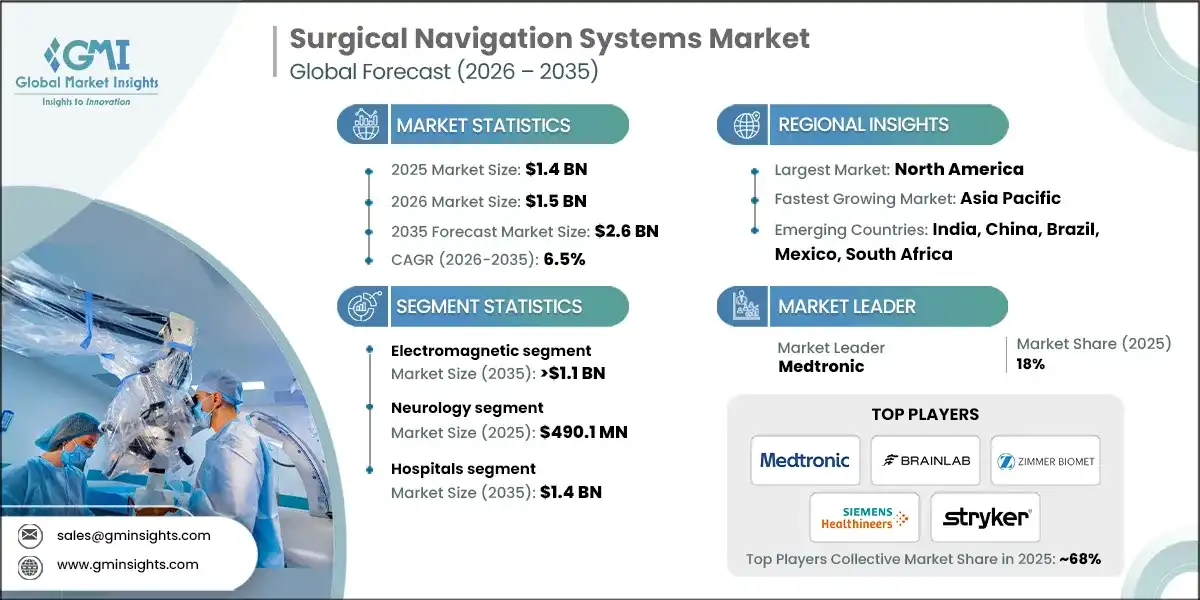
The global surgical navigation systems market was valued at USD 1.4 billion in 2025. The market is expected to reach from USD 1.5 billion in 2026 to USD 2.6 billion in 2035, growing at a CAGR of 6.5% during the forecast period, according to the latest report published by Global Market Insights Inc.
Surgical Navigation Systems Market Key Takeaways
Market Size & Growth
- 2025 Market Size: USD 1.4 Billion
- 2026 Market Size: USD 1.5 Billion
- 2035 Forecast Market Size: USD 2.6 Billion
- CAGR (2026–2035): 6.5%
Regional Dominance
- Largest Market: North America
- Fastest Growing Region: Asia Pacific
Key Market Drivers
- Increasing demand for minimally invasive surgical procedures.
- Technological advancements in surgical navigation systems.
- Rise in orthopedic and neurology disorders.
- Surging target patient pool of ENT disorders.
Challenges
- High instrument and procedural costs.
- Stringent government regulations.
Opportunity
- Expansion in emerging markets.
- Increasing use in non-traditional specialties.
Key Players
- Market Leader: Medtronic led with over 18% market share in 2025.
- Leading Players: Top 5 players in this market include Medtronic, BRAINLAB, Zimmer Biomet, Siemens Healthineers, Stryker, which collectively held a market share of 68% in 2025.
Get Market Insights & Growth Opportunities
The high market growth is attributed to the rising volume of complex surgical procedures, increasing adoption of minimally invasive surgeries (MIS), and technological advancements in imaging and navigation, among other contributing factors.
Surgical navigation systems are computer-assisted technologies that provide real-time, image-guided visualization to help surgeons accurately plan and execute surgical procedures. These systems combine pre-operative or intra-operative imaging with tracking devices to increase accuracy, clinical outcomes, and safety in orthopedic, neurosurgical, ENT, and spinal procedures.
The major players in the global surgical navigation systems market are Medtronic, BRAINLAB, Zimmer Biomet, Siemens Healthineers, and Stryker. These companies maintain their competitive position through ongoing product innovation, global market presence, and substantial investment in research and development.
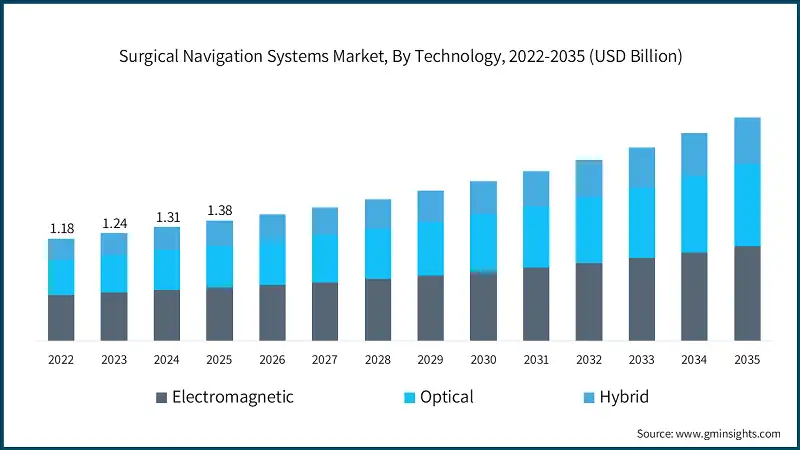
The market has increased from USD 1.2 billion in 2022 and reached USD 1.3 billion in 2024, with the historic growth rate of 5.5%. The market growth was driven by the rising adoption of minimally invasive surgeries, increasing demand for higher surgical accuracy, growing orthopedic and neurosurgical procedure volumes, and continuous advancements in image-guided and robotic-assisted surgical technologies.
Moreover, as neurological, orthopedic, spinal, and ENT disorders become more prevalent, the demand for precise surgical interventions has surged. For instance, according to the World Health Organization (WHO), in 2025, approximately 3 billion individuals were living with a neurological condition, making these disorders the leading cause of illness and disability across the globe.
Additionally, the Centers for Disease Control and Prevention (CDC) reported that in 2021, around 21% of adults in the U.S. had doctor-diagnosed arthritis, a leading cause of orthopedic surgeries. Surgical navigation systems empower surgeons to pinpoint anatomical structures with accuracy, streamlining complex procedures. This precision is paramount, particularly in high-risk and minimally invasive surgeries.
Furthermore, continuous improvements in 3D imaging, AI-enabled software, intraoperative CT/MRI integration, and real-time tracking technologies have enhanced system accuracy and usability. These advancements improve surgical outcomes and workflow efficiency. As a result, healthcare providers are more willing to invest in advanced navigation platforms.
To get key market trends
Surgical Navigation Systems Market Trends
The market is growing considerably with the integration of augmented and virtual reality in healthcare, growing use of robotics and navigation convergence, and focus on cost-effectiveness and value-based healthcare, among other factors collectively driving industry growth.
- AR/VR technologies are being integrated into surgical navigation to offer immersive, real-time visualization of patient anatomy. Surgeons have the capability to directly overlay digital guides onto the surgical field, thus enhancing precision and reducing cognitive load. This trend is enabling surgical planning and intraoperative decision-making to elevate to new levels.
- Manufacturers are developing smaller, lightweight navigation units that are suitable for different surgical environments. Portable systems lessen the time taken for the setup and the footprint of the operating room, thus making advanced navigation accessible to small hospitals and surgical centers. This trend is facilitating broader adoption beyond large, urban medical centers.
- Furthermore, surgical robotics is increasingly paired with navigation systems to guide robotic arms and instruments with high precision. The combined solution improves consistency, reduces human error, and supports complex minimally invasive procedures. This convergence is driving innovation in both robotics and navigation tech, thereby sustaining market growth.
Surgical Navigation Systems Market Analysis
Learn more about the key segments shaping this market
Based on technology, the surgical navigation systems market is segmented into electromagnetic, optical, and hybrid. The electromagnetic segment has asserted its dominance in the market by securing a significant market share of 44.5% in 2025 owing to its high tracking accuracy without line-of-sight limitations, ease of use in complex anatomical regions, and growing adoption in ENT, neurosurgery, and minimally invasive procedures. The segment is expected to exceed USD 1.1 billion by 2035, growing at a CAGR of 6% during the forecast period.
On the other hand, the optical segment is expected to grow with a CAGR of 7.1%. The growth of this segment is driven by its superior spatial accuracy, continuous technological advancements in camera-based tracking systems, and increasing adoption in complex orthopedic and robotic-assisted surgical procedures.
- The electromagnetic segment continues to dominate the market. One of the key features of electromagnetic navigation is that it allows surgeons to see the exact location of the surgical instruments in real-time without the need for direct visual contact. This makes it possible to precisely locate the instruments with respect to the patient's anatomy, even if the surgical area is deep or is blocked by something. The added accuracy is very important for complex procedures such as spine and neurosurgery.
- Electromagnetic (EM) navigation is a technology that can be easily used for small and portable surgical navigation units, unlike large optical systems. Its design makes it easier to be integrated into smaller operating rooms, ambulatory surgery centers, and hybrid surgical environments. As a result, this allows hospitals with limited space or budget to access more.
- The optical segment held a revenue of USD 484.9 million in 2025, with projections indicating a steady expansion at 7.1% CAGR from 2026 to 2035. The segment is driven by rising preference for radiation-free navigation, improved intraoperative visualization, and strong compatibility with advanced imaging and robotic surgery platforms.
- The hybrid segment accounted for significant revenue in 2025 and is anticipated to grow at a CAGR of 6.7% over the forecast period. The segment is driven by the need for higher procedural reliability through combined tracking modalities, reduced intraoperative errors, and increasing adoption in complex multi-specialty surgeries requiring flexibility and redundancy.
Based on application, the surgical navigation systems market is segmented into neurology, orthopedic, ENT, dental, and other applications. The neurology segment dominated the market in 2025, accounting for USD 490.1 million and is anticipated to grow at a CAGR of 5.9% during the forecast period.
- The increasing incidences of brain tumors, epilepsy, stroke, and degenerative neurological diseases are driving the demand for accurate neurosurgical interventions. Surgical navigation systems enable neurosurgeons to precisely localize lesions and avoid critical structures. This accuracy lessens the risk of the operation and enhances clinical outcomes.
- Moreover, neurological surgeries typically take place in the brain where the structures are very delicate, and the margin for error is minimal. Navigation systems offer real-time visualization and guidance, which lowers the chances of the damage to vital brain tissues. The improved accuracy lowers directly the complication rates and results in better postoperative recovery.
- The orthopedic segment accounted for significant revenue in 2025 and is anticipated to grow at a CAGR of 7.4% over the forecast period. The segment is driven by the growing volume of joint replacement and spine surgeries, rising demand for personalized implant alignment, and increasing focus on improving long-term surgical outcomes.
- The ENT segment accounted for significant revenue in 2025 and is anticipated to grow at a CAGR of 6.7% over the forecast period. The segment is primarily driven by the increasing prevalence of sinus and skull, base disorders, the growing adoption of minimally invasive procedures, and the need for the enhanced anatomical precision in the performance of delicate surgeries.
Learn more about the key segments shaping this market
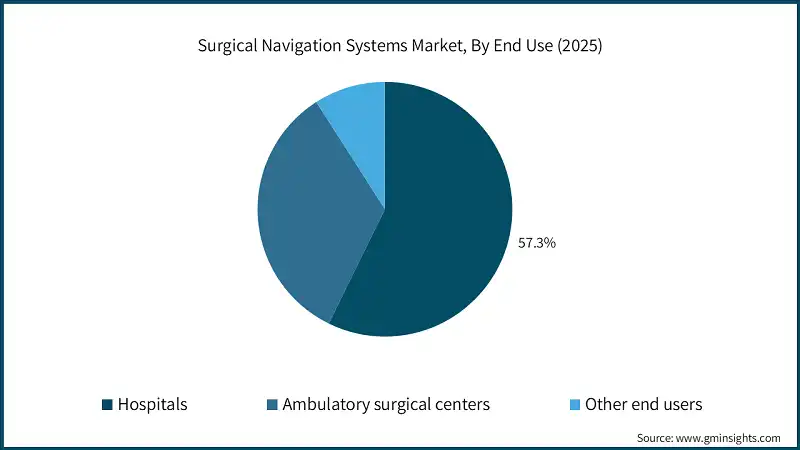
Based on end use, the surgical navigation systems market is classified into hospitals, ambulatory surgical centers, and other end users. The hospitals segment dominated the market with a revenue share of 57.3% in 2025 and is expected to reach USD 1.4 billion within the forecast period.
- Hospitals are increasingly adopting surgical navigation systems to make complex surgeries more precise and to reduce intraoperative errors. These systems contribute to the minimization of complications, the acceleration of recovery times, and the facilitation of quality standards. In addition to these benefits, improved outcomes also lead to greater patient satisfaction and fewer readmissions.
- Hospitals are getting more patients in specialties like orthopedics, neurosurgery, and ENT due to demographic changes and the prevalence of diseases. Surgical navigation systems are the means to the accurate performance of such advanced procedures. The increased number of procedures makes it economically feasible to invest in navigation technology for the efficient handling of the demand.
- The ambulatory surgical centers segment accounted for significant revenue in 2025 and is anticipated to grow at a CAGR of 7% over the forecast period. The segment's growth is attributed to the continuous migration of elective and minimally invasive surgeries to the outpatient settings, the cost, efficiency focus, and the need for a quicker patient turnover while achieving accurate surgical outcomes.
Looking for region specific data?
North America Surgical Navigation Systems Market
North America dominated the market with the highest market share of 38.4% in 2025.
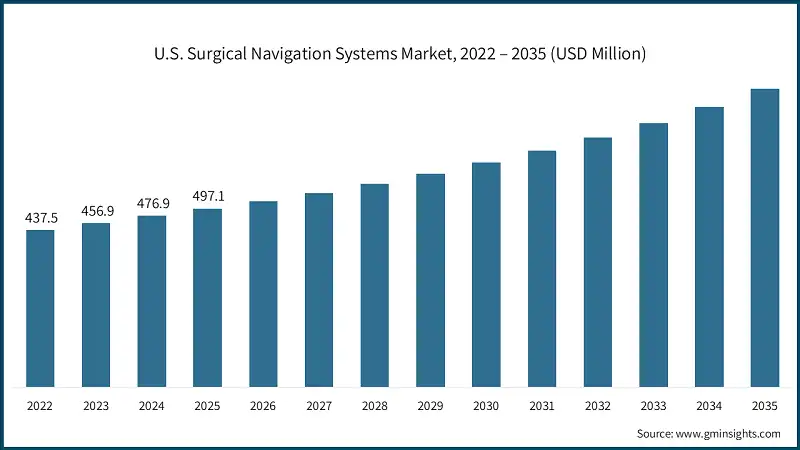
- The U.S. market was valued at USD 437.5 million and USD 456.9 million in 2022 and 2023, respectively. The market size reached USD 497.1 million in 2025, growing from USD 476.9 million in 2024, and is anticipated to grow at a CAGR of 5.4% between 2026 to 2035.
- Healthcare systems in North America focus on minimal invasion and accurate procedures for patients. The usage of navigation systems plays a vital role in making these procedures possible. Since these methods are on the rise, the requirement for navigation systems is also increasing.
- Moreover, the region leads in clinical research and trials involving advanced surgical technologies, validating the effectiveness of navigation systems. Evidence generated from such studies encourages clinicians to adopt navigation tools. This research ecosystem strengthens trust and accelerates uptake.
Europe Surgical Navigation Systems Market
Europe market accounted for USD 384.5 million in 2025 and is anticipated to show lucrative growth over the forecast period.
- European countries are investing in upgrading healthcare infrastructure through national health programs and EU funding. This supports the procurement of advanced surgical technologies like navigation systems. Public hospital modernization drives broader regional adoption.
- In addition, the region demonstrates a strong clinical focus on orthopedics, ENT, and spinal surgeries, driven by aging populations and the prevalence of sports-related injuries. Surgical navigation systems enhance procedural accuracy and outcomes in these specialties, encouraging hospital investments. The presence of specialized surgical centers further supports regional demand.
Asia Pacific Surgical Navigation Systems Market
The Asia Pacific market is anticipated to grow at the highest CAGR of 7.9% during the analysis timeframe.
- Many Asia Pacific countries are heavily investing in building and upgrading hospitals, surgical centers, and specialty care units. These infrastructure developments create demand for advanced surgical technologies like navigation systems. Growing capacity enables broader access to precision surgical tools.
- Countries such as India, Thailand, Singapore, and Malaysia are major medical tourism hubs due to high-quality care at competitive costs. To attract international patients and maintain global standards, hospitals adopt advanced surgical navigation systems. This trend drives technology investment across private and public sectors.
Latin America Surgical Navigation Systems Market
The Latin America market is experiencing robust growth over the analysis timeframe.
- Latin American governments and private healthcare providers are increasing capital expenditure to modernize facilities and upgrade surgical capabilities. Investments are often aimed at acquiring advanced OR technologies like navigation systems. This modernization enhances regional surgical care standards.
- Further, there’s a growing prevalence of orthopedic, spinal, and neurological disorders in Latin America due to aging populations and lifestyle changes. As demand for complex surgeries rises, hospitals seek navigation systems to improve accuracy and outcomes. This clinical demand drives technology adoption.
Middle East & Africa Surgical Navigation Systems Market
The Middle East & Africa market is experiencing robust growth over the analysis timeframe.
- The establishment of new tertiary hospitals and specialty surgical centers in urban hubs is rising across the region. These facilities require state-of-the-art equipment to offer high-quality surgical services. Surgical navigation systems become key assets to attract patients and enhance procedural outcomes.
- Countries like the UAE, Saudi Arabia, and Qatar are positioning themselves as medical tourism destinations with world-class surgical care. To remain competitive and draw international patients, healthcare providers are adopting advanced surgical navigation systems. This strengthens regional demand for precision surgery technologies.
Surgical Navigation Systems Market Share
The global market is competitive and dominated by a few global players offering advanced solutions across multiple surgical specialties. Companies compete on the basis of technological innovation, product accuracy, ease of use, integration capabilities with imaging modalities and customer support.
Continuous investments in R&D, strategic partnerships, and acquisitions are key strategies to strengthen market presence. Key players include Medtronic, BRAINLAB, Zimmer Biomet, Siemens Healthineers, and Stryker, collectively accounting for ~68% of the total market share.
In addition to established players, the market is witnessing the emergence of regional and niche players focusing on cost-effective and portable navigation solutions, particularly for minimally invasive surgeries and emerging economies. Companies are also emphasizing software upgrades, AI integration, and robotic-assisted navigation platforms to differentiate their offerings.
Competitive dynamics are shaped by hospital purchasing decisions, government tenders, and reimbursement policies making innovation, reliability, and clinical support critical factors for maintaining market leadership.
Surgical Navigation Systems Market Companies
A few of the prominent players operating in the surgical navigation systems industry include:
- Amplitude Surgical
- B. BRAUN
- BRAINLAB
- Corin
- Fiagon
- Johnson & Johnson
- KARL STORZ
- Medtronic
- Philips
- Siemens Healthineers
- Smith+Nephew
- Stryker
- Zimmer Biomet
- Medtronic
It offers the StealthStation platform, providing real-time, high-precision navigation for neurosurgery and spine procedures. Its USP lies in comprehensive integration with imaging systems and a wide global service network, enhancing surgical accuracy and adoption.
Known for its NAV3i and Mako robotic-assisted navigation systems, delivering superior orthopedic procedure precision. The USP is seamless integration with robotic solutions and intuitive workflow, reducing intraoperative errors and improving implant alignment.
It provides imaging-driven navigation systems that combine advanced intraoperative imaging with real-time guidance. Its USP is high compatibility with multimodality imaging and surgical planning tools, enabling precise interventions across multiple specialties.
Surgical Navigation Systems Market Report Attributes
| Key Takeaway | Details |
|---|---|
| Market Size & Growth | |
| Base Year | 2025 |
| Market Size in 2025 | USD 1.4 Billion |
| Market Size in 2026 | USD 1.5 Billion |
| Forecast Period 2026 - 2035 CAGR | 6.5% |
| Market Size in 2035 | USD 2.6 Billion |
| Key Market Trends | |
| Drivers | Impact |
| Increasing demand for minimally invasive surgical procedures | This is significantly boosting adoption of surgical navigation systems as hospitals seek improved precision, reduced surgical trauma, shorter recovery times, and better clinical outcomes. |
| Technological advancements in surgical navigation systems | Ongoing innovations such as AI-based guidance, 3D imaging, augmented reality, and robotic integration are enhancing system accuracy and workflow efficiency, thereby accelerating market uptake. |
| Rise in orthopedic and neurology disorders | The growing prevalence of spine, joint, and neurological conditions is increasing the volume of complex surgeries, directly driving demand for advanced navigation-enabled surgical platforms. |
| Surging target patient pool of ENT disorders | The expanding incidence of sinus, skull-base, and ENT-related conditions is supporting higher adoption of navigation systems for enhanced anatomical accuracy and reduced complication risks. |
| Pitfalls & Challenges | Impact |
| High instrument and procedural costs | Elevated capital investment, maintenance expenses, and procedure-related costs are limiting adoption, particularly among small hospitals and healthcare facilities in cost-sensitive regions. |
| Stringent government regulations | Complex approval processes and strict compliance requirements are slowing product launches and technology upgrades, thereby restraining rapid market expansion. |
| Opportunities: | Impact |
| Expansion in emerging markets | Growing healthcare infrastructure, rising surgical volumes, and increasing investments in advanced medical technologies across emerging economies are expected to create strong future demand for surgical navigation systems. |
| Increasing use in non-traditional specialties | Wider adoption in areas such as trauma, maxillofacial, dental, and general surgery is anticipated to expand the application base, driving long-term market growth beyond core orthopedic and neurology segments. |
| Market Leaders (2025) | |
| Market Leaders |
18% market share |
| Top Players |
|
| Competitive Edge |
|
| Regional Insights | |
| Largest Market | North America |
| Fastest growing market | Asia Pacific |
| Emerging countries | India, China, Brazil, Mexico, South Africa |
| Future outlook |
|
What are the growth opportunities in this market?
Surgical Navigation Systems Industry News:
- In September 2025, Brainlab received U.S. FDA 510(k) clearance and launched its Spine Mixed Reality Navigation solution, enabling surgeons to view critical navigation data directly in their field of vision during pedicle screw placement. This innovation enhanced surgical accuracy, ergonomics, and workflow efficiency. The development is expected to support market growth by accelerating adoption of advanced mixed-reality–enabled surgical navigation systems.
- In August 2024, Johnson & Johnson announced the launch of its proprietary dual-use robotics and standalone navigation platform, VELYS Active Robotic-Assisted System (VELYS SPINE), developed in collaboration with eCential Robotics, following U.S. FDA 510(k) clearance. The system was intended for planning and instrumenting spinal fusion procedures across cervical, thoracolumbar, and sacroiliac regions. This development supported market growth by strengthening robotic-navigation integration and expanding advanced spine surgery solutions.
The surgical navigation systems market research report includes an in-depth coverage of the industry with estimates and forecast in terms of revenue in USD Million from 2022 – 2035 for the following segments:
Market, By Technology
- Electromagnetic
- Optical
- Hybrid
Market, By Application
- Neurology
- Orthopedic
- Knee
- Hip
- Shoulder
- ENT
- Dental
- Other applications
Market, By End Use
- Hospitals
- Ambulatory surgical centers
- Other end use
The above information is provided for the following regions and countries:
- North America
- U.S.
- Canada
- Europe
- Germany
- UK
- France
- Spain
- Italy
- Netherlands
- Asia Pacific
- China
- Japan
- India
- Australia
- South Korea
- Latin America
- Brazil
- Mexico
- Argentina
- Middle East and Africa
- South Africa
- Saudi Arabia
- UAE
Frequently Asked Question(FAQ) :
What was the market size of the surgical navigation systems market in 2025?
The market size was USD 1.4 billion in 2025, driven by the rising volume of complex surgical procedures, increasing adoption of minimally invasive surgeries (MIS), and advancements in imaging and navigation technologies.
What is the projected value of the surgical navigation systems market by 2035?
The market is expected to reach USD 2.6 billion by 2035, growing at a CAGR of 6.5% during the forecast period, fueled by technological innovations and broader adoption of navigation systems in diverse surgical environments.
What is the projected size of the surgical navigation systems market in 2026?
The market is projected to reach USD 1.5 billion in 2026, continuing its growth trajectory.
How much revenue did the neurology segment generate in 2025?
The neurology segment generated USD 490.1 million in 2025, dominating the market and expected to grow at a CAGR of 5.9% during the forecast period.
What was the revenue share of the hospitals segment in 2025?
The hospitals segment held a 57.3% revenue share in 2025, with projections indicating it will reach USD 1.4 billion during the forecast period.
Which region leads the surgical navigation systems market?
North America led the market with a 38.4% share in 2025, driven by advanced healthcare infrastructure and high adoption of innovative surgical technologies.
What are the upcoming trends in the surgical navigation systems market?
Key trends include the integration of AR/VR technologies for real-time visualization, the development of portable navigation systems for smaller surgical centers, and the convergence of surgical robotics with navigation systems to enhance precision and efficiency.
Who are the key players in the surgical navigation systems market?
Prominent players include Amplitude Surgical, B. Braun, Brainlab, Corin, Fiagon, Johnson & Johnson, KARL STORZ, Medtronic, Philips, Siemens Healthineers, Smith+Nephew, and Stryker.
Surgical Navigation Systems Market Scope
Related Reports