Summary
Table of Content

Superhydrophobic Coatings Market
Get a free sample of this report
Form submitted successfully!
Error submitting form. Please try again.
Thank you!
Your inquiry has been received. Our team will reach out to you with the required details via email. To ensure that you don't miss their response, kindly remember to check your spam folder as well!
Request Sectional Data
Thank you!
Your inquiry has been received. Our team will reach out to you with the required details via email. To ensure that you don't miss their response, kindly remember to check your spam folder as well!
Form submitted successfully!
Error submitting form. Please try again.
Superhydrophobic Coatings Market Size
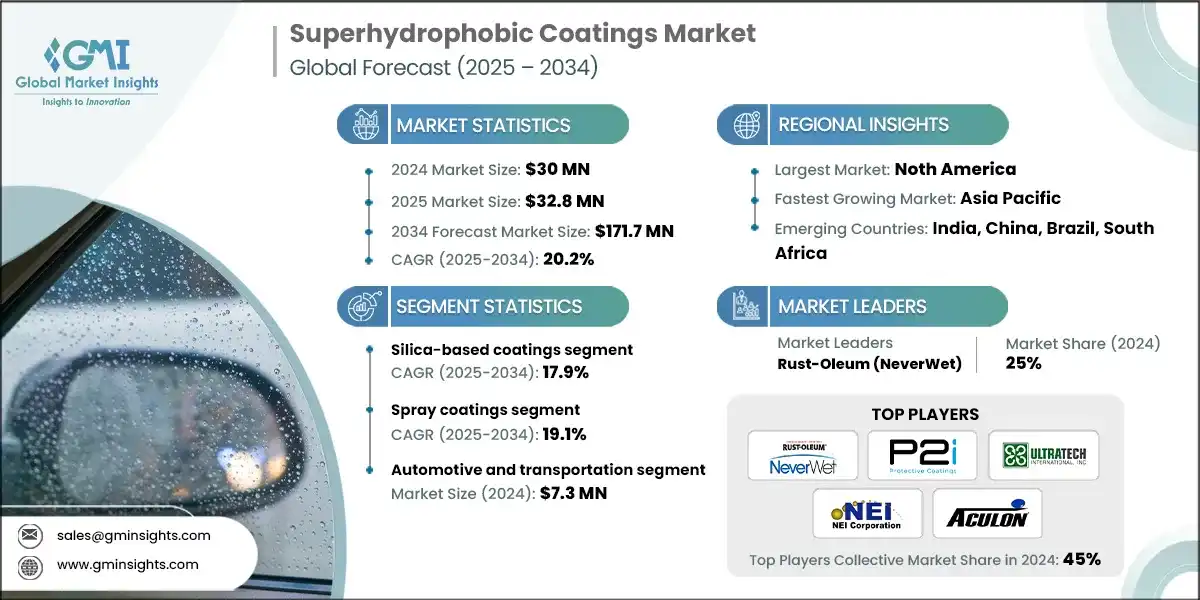
The global superhydrophobic coatings market was estimated at USD 30 million in 2024. The market is expected to grow from USD 32.8 million in 2025 to USD 171.7 million by 2034, at a CAGR of 20.2% according to latest report published by Global Market Insights Inc.
Superhydrophobic Coatings Market Key Takeaways
Market Size & Growth
- 2024 Market Size: USD 30 Million
- 2025 Market Size: USD 32.8 Million
- 2034 Forecast Market Size: USD 171.7 Million
- CAGR (2025–2034): 20.2%
Regional Dominance
- Largest Market: North America
- Fastest Growing Region: Asia-Pacific
Key Market Drivers
- Surge in electronics and wearable device adoption.
- Growing interest in self-cleaning solar panels and glass.
- Stricter PFAS regulations in US and EU.
- Increasing R&D in bio-inspired and graphene-based coatings.
Challenges
- High production and R&D costs for nano-based coatings.
- Durability under abrasion and long-term use is still a concern.
Opportunity
- Growing demand for PFAS-free eco coatings in Europe.
- Expansion into healthcare coatings (anti-fouling, sterilization).
- Application in transportation (anti-icing, anti-fog).
- Smart coating integration with sensors and electronics.
Key Players
- Market Leader: Rust-Oleum (NeverWet) led with over 25% market share in 2024.
- Leading Players: Top 5 players in this market include Rust Oleum (NeverWet), P2i Ltd, UltraTech International Inc., NEI Corporation, Aculon, Inc., which collectively held a market share of 45% in 2024.
Get Market Insights & Growth Opportunities
- The primary growth factors are the considerable uptick in demand for moisture-resistant electronics, anti-icing coatings in transportation, and moving toward self-cleaning solar panels. The medical and healthcare sector is also beginning to adopt superhydrophobic coatings for use in devices which require some level of sterility and liquid resistance, which will further help long term growth.
- The first applications were high-end applications in aerospace and defense industries, as regulatory changes have taken shape and awareness has increased, R&D investment has allowed for industries such as electronics, medical devices, and renewable energy applications to become more familiar with using the technology in their respective fields.
- By type of technology, silica-based coatings represent the largest category, approximately 34% of the market share, because of their low cost and compatibility with multiple substrates. Fluoropolymer based coatings now have approximately 25.2% of market share, though declining gradually as a result of regulation due to environmental concerns (PFAS).
- The largest market segment in North America is the largest regional contributor to the revenues of the market, claiming nearly 32.5% in 2024. The demand is supported by downstream industries such as aerospace, automotive, and healthcare.
- Europe saturated market shares about 20.8% of global revenue in 2024 and sustainability and R&D factors are very supportive of further investment and product adoption, however, R&D use is facing many limitations due to regulatory controls on fluorinated compounds.
- The market is exhibiting rapid growth by increased demand for self-cleaning, anti-corrosion, and water-repellent materials, and drivers across a variety of industries including automotive, electronics, aerospace, and building & construction. The increased environmental regulation surrounding PFAS (per-and polyfluoroalkyl substances) is increasing innovation around non-fluorinated hemisodis or bio-based alternatives and pushing market avenues.
To get key market trends
Superhydrophobic Coatings Market Trends
- Global concerns over per- and polyfluoroalkyl substances (PFAS) have prompted manufacturers to begin using non-fluorinated alternatives. Regulation changes such as the EU REACH restrictions and bans in various states in the U.S. have further aided corrosive coatings moving away from PFAS.
- The need for moisture resistant coatings in smartphones, earbuds and fitness wearables is steadily rising. Also, as 5G and IoT tasks are being developed, manufacturers are integrating ultra-thin, transparent coatings that make sense for micro-devices.
- Solar arrays are using superhydrophobic coatings to assist in the minimization of dust and water retention, thus improving solar panel efficiency up to 5% improvements. The continued investment in green energy, targets for climate improvement for all regions and industries continue to demand, especially in dry and humid regions.
- The next generation of superhydrophobic coatings are incorporating further features such as self-healing, anti-fouling and anti-bacterial coatings. In 2024, approximately 10% of R&D projects relate to functionality including self-healing coatings primarily based in the medical, marine, aerospace and other engineering areas.
- Coatings manufacturers are adopting processes that scale such as spray processes and sol-gel processes. This has resulted in reductions to overall coating costs of about 18% since 2020. These developments in coatings are facilitating industrial applications on a much larger scale in subsequent markets especially in automotive, textiles, and building materials sectors increasing scale of applications.
Superhydrophobic Coatings Market Analysis
Learn more about the key segments shaping this market
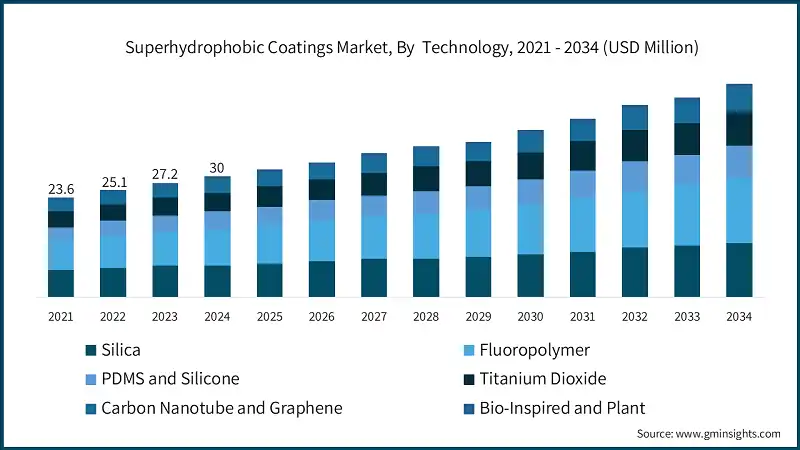
The market is segmented into six core product categories: silica-based, fluoropolymer-based, PDMS/silicone-based, titanium dioxide, carbon nanotube/graphene, and bio-inspired coatings. The silica-based coatings were valued at USD 10.2 million in 2024, and it is anticipated to expand to 17.9% of CAGR during 2025-2034.
- Silica-based coatings continue to hold a majority of the market share of 34% in 2024 largely owing to both their low costs and ease of processing, as well as their compatibility with a much larger range of substrates.
- Fluoropolymer coatings approximate their own past share of 25.2% of available discretional market value but are shrinking. Some major fluoropolymer producers are shifting away from this category by developing more bio-based formulations.
- Carbon nanotube and graphene-based coatings represent the fastest product level with a CAGR of 26.1%. These new coatings represent extreme durability, conductivity, and anti-corrosive performance, and are applicable in aerospace, defense and high-end electronics.
- PDMS and silicone-based coatings have a more contemporary share of the demand (12.6%) and growing acceptance as compliant treatments for soft substrates or medical applications. So called bio-inspired, or plant-based coating solutions are more of the future growing quickly (CAGR – 21.7%) even though they have only 8.1% of the current market or adherence to green chemistry and sustainability mandates.
Based on manufacturing process, the superhydrophobic coatings market is segmented into spray coating, dip coating, sol-gel processing, electrodeposition, and chemical vapor deposition (CVD). The spray coatings were valued at USD 11.1 million in 2024, and it is anticipated to expand to 19.1% of CAGR during 2025-2034.
- Spray coating is the dominant technique, accounting for 37% of market share in 2024. It excels at large-surface area applications such as construction materials, textiles, and automotive parts. While it is an inexpensive and scalable technique, it may struggle to obtain nano-scale uniformity. Overall, spray coating continues to grow steadily with a CAGR of 19.1%.
- Dip coating is primarily undertaken in R&D facilities, and low volume manufacturing such as medical devices and labware. Dip coating is popular due to its straightforward and convenient set-up with strong adhesion but will always struggle with efficiency at industrial levels.
- The Sol-Gel process can put forth a uniform, multi-functional coating and is growing rapidly, accounting for 18.8% of the market share. Sol-gel coatings are often ideal for storage in clear glass jars and can be found in applications of solar panels and electronics where clarity and chemical resistance are critical as well. Sol-gel is expected to have CAGR efficiencies of 22% in the next decade.
- Electrodeposition is typically used in electronics and medical implants. This process provides nano control and good adhesion providing the substrate is conductive. The major limitation includes that it must be strictly applied to conductive substrates, but it is continuing to grow steadily at around 21.9% CAGR for coatings.
- Chemical Vapor Deposition (CVD) is used in high-end aerospace, semiconductor, and precision medical equipment where ultra-thin but tough coatings can be developed. CVD is high energy and expensive but excellent for quality uses. CVD continues to grow into high-tech market segments with a CAGR of 22.3% projected.
Learn more about the key segments shaping this market
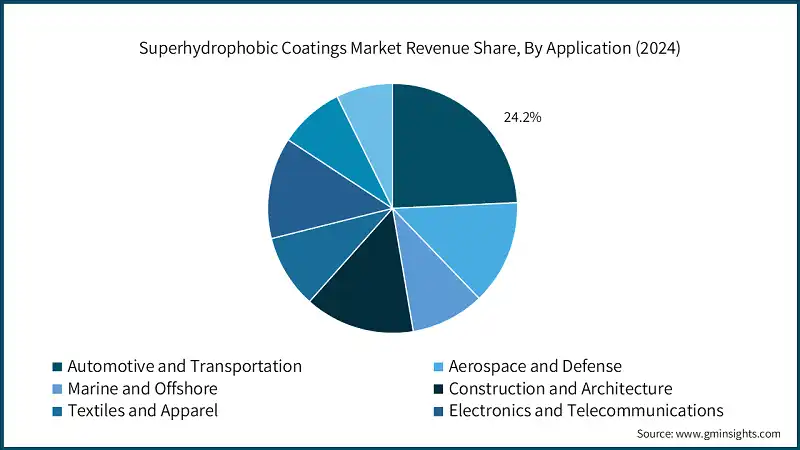
The superhydrophobic coatings market is primarily driven by applications across automotive and transportation, aerospace and defense, marine and offshore construction and architecture, textiles and apparel, electronics and telecommunications, medical and healthcare and solar energy and renewable applications. The automotive and transportation were valued at USD 7.3 million in 2024, and it is anticipated to expand to 19% of CAGR during 2025-2034.
- The automotive and transportation sector is an application area that leads with approximately 24.2% market share in 2024. Superhydrophobic coatings are used significantly for anti-icing, anti-fogging, and self-cleaning properties for vehicle surfaces and their windshields. The growth is moderate because the coatings are adopted steadily within the OEM space and the emerging after market.
- The aerospace and defense are high-performance sector accounts for 13.5% of market value, primarily due to the use of superhydrophobic coatings for anti-corrosion, low-friction, and stealth applications. Superhydrophobic materials are used on the surfaces of many aircraft systems and sensors, and in military equipment used in extreme conditions. The growth is robust, but it is driven heavily by defense modernization programs and heightened rules and protocols for aviation safety.
- Marine and offshore applications represent around 9.5% of the market, primarily in coatings for ship hulls, submerged pipelines, and offshore platforms that discourage biofouling, thus reducing drag when employed, resulting in better fuel economy and maintenance cycles a longer distance apart.
- The construction industry represents 14.25% of the market by 2024, principally via the coatings for self-cleaning glass, exterior paints, and stone surfaces. Build rates are increasing in commercial and residential applications as good practice for green building and reducing maintenance costs through self-cleaning surfaces.
- Textiles and apparel superhydrophobic coatings are being used in water-repellent fabrics, outdoor wear, and performance wear, comprising about 9.5% of the total market. Growth has been slow because of durability issues of the coating in higher volume applications and cost.
- Electronics and telecommunications are likely to be the fastest-growing application, having about 13.1% of the market share in 2024. Coated electronics give protection against moisture damage to mobile devices, sensors, and circuit boards. As miniaturization happens, and more smart devices are adopted, the market will continue to increase.
- Medical and healthcare segments occupy 8.4% of the market share due to demand for antibacterial, anti-biofouling, and anti-wetting coatings in surgical instruments, catheters, and implants. Regulatory compliance for sterile and long-lasting coatings is also encouraging market acceptance.
- Solar power and renewable application are a fast-growing niche market that is forecast to take 7.3% of the energy marketplace by 2024 with a projected CAGR of 23.6%. Solar energy regenerative superhydrophobic coatings support energy not readily available update panel efficiency by preventing dust and water across the surfaces of solar panels, especially in dry and tropical climates. The opportunity fits within the aspirational goals of the global clean energy movement and current relevant infrastructure investments.
Looking for region specific data?
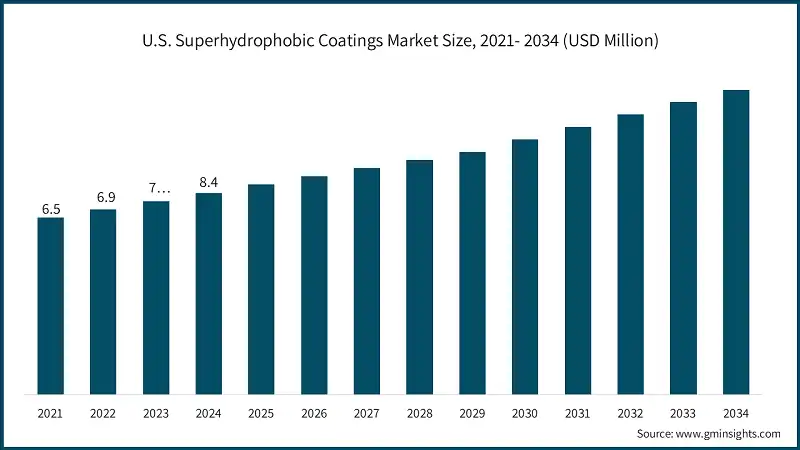
North America captured the largest revenue share of the superhydrophobic coatings market, at about 32.5%, in 2024. The region had already had mature adoptions of superhydrophobic coatings in aerospace, defense, and high-end automotive use cases, and is seeing higher levels of PFAS-free coating innovation and multifunctional coatings as it faces more stringent safety and environmental regulations, particularly for the United States.
- The total R&D investment and presence of some of the largest companies in the space (Rust-Oleum and P2i), have made the North American market control over 32.5% of the total superhydrophobic coatings market share.
Europe achieved a global share of around 20.8% by this period. Growth is principally dominated by sustainability mandates, including in the construction and industrial sectors, particularly given the rising demand for eco-friendly coating.
- European Union-wide bans on PFAS have further augmented the industry shift from PFAS-based coatings to silica- or bio-based coatings including applications in Germany, France and the Nordic markets.
- Slower growth is maintained at CAGR of 19.7%, particularly given the regulatory realities and costs related to the delivery of superhydrophobic coatings to market.
The rapid growth of the Asia-Pacific region is estimated to grow at a CAGR of 20.8% from 2024 to 2034, which is precipitated by the uptake of superhydrophobic coatings among electronics, solar panels, and infrastructure in countries like China, Japan, South Korea, and India.
- Some factors helping to drive growth in the region, along with embracing coatings are that government-backed clean energy targets and smart manufacturing initiatives will help to propel this market. As China's strength of leading the world in solar PV production, combined with India looking for applications of water-repellent coatings for its public infrastructure in a strong way will start to contribute to the evolution of this market space in this region.
Latin America has 10.4% of the global market but is developing a steady interest in industrial and agricultural applications.
- Brazil and Mexico represent the most demand in the region, specifically in construction, waterproofing, and energy. Though the market is still at its infancy level, potential exists for future growth with increasing foreign investments and favorable regional climate conditions.
The Middle East & Africa (MEA) is also 7.9% of the market. The UAE and South Africa are using superhydrophobic coatings chiefly for solar farms, marine coatings and architectural surfaces.
- There is local demand for superhydrophobic coatings due to the extreme weather events and water shortage in both areas; however, overall adoption in these two areas is still at very early stages.
Superhydrophobic Coatings Market Share
- An estimated 25% share in 2024, Rust-Oleum (NeverWet) is expected to play a leading role in the global superhydrophobic coatings market due to its established position (having entered the consumer superhydrophobic market first), brand presence/recognition and ability to produce commercially viable consumer applications.
- Altogether, the top 5 companies (Rust-Oleum, UltraTech International, P2i Ltd, NEI Corporation and Aculon Inc.) are estimated to be jointly responsible for approximately 45% (in total) of the global superhydrophobic coatings market, demonstrating a moderately consolidated structure.
- Rust-Oleum's branding and mass-market-store-level access (Home Depot, Walmart, Amazon) has led to market success, with UltraTech International being second with its proprietary nanocoatings (such as Gentoo and Ultra-Ever Dry and catalog variants, such as fire retardant Ultra-Ever Dry) focused on industrial and commercial applications.
- P2i Ltd, while mostly business-to-business, has consolidated its position in high-end electronics (smartphones, wearables) through partnerships with OEM smartphone manufacturers and wearable tech providers.
- Businesses are implementing a variety of approaches to sustain or enhance their market position. Rust-Oleum and UltraTech focus on pricing and distribution, developing consumer and industrial demand on scale.
- Barriers to entry for these new entrants include patent protected technologies, finding enough raw materials, and meeting eco-compliance to produce given formulations. Balls of innovation are being launched by startups towards niche areas of the market such as graphene-based coatings, which could alter the landscape of market share and market size. The effects of this will not be seen until 2030.
- P2i and NEI Corporation focus on technological differentiation of durable nanocoatings with ultra-thin finishes for electronics and medical devices. Several companies are also investing in green innovation, as they will replace PFAS with coatings based on silica or bio-derived feedstocks to meet new environmental obligations of the EU and U.S.
- This research and development work remains lively, as companies are racing to deliver multifunctional coatings that combine self-healing, anti-bacterial and UV resistant properties. Companies are also leveraging relationships with Original Equipment Manufacturers (OEMs) in the electronics space to build the value of long-term contracts with customers.
Superhydrophobic Coatings Market Companies
The companies in superhydrophobic coatings industry are:
- 3M Company
- Aculon, Inc.
- Advanced NanoTech Lab
- BASF SE
- Cytonix, LLC
- DryWired
- Hydrobead
- Lotus Leaf Coatings, Inc.
- NEI Corporation
- Nanex Company
- NTT Advanced Technology Corp.
- P2i Ltd
- Pearl Nano LLC
- Rust-Oleum (NeverWet)
- The Sherwin-Williams Company
- UltraTech International, Inc.
- Surfactis Technologies
- United Protective Technologies (UPT)
- NanoTech Solutions
- Lotus Nano
- Rust-Oleum (NeverWet): Rust-Oleum (NeverWet) has maintained a strong market position through its flagship NeverWet brand which is available in various mass and specialty retail stores and on many e-commerce platforms. The company focused on mass market and consumer ease of use. In the past two years, they significantly diversified their product offerings with multi-surface use and stronger UV protection. In 2023, Rust-Oleum officially launched a PFAS-free NeverWet solution, in-line with the new environmental compliance standards required in the USA and by the EU.
- UltraTech International Inc.: UltraTech is a specialty chemical company with a sole focus on surface protection and environmental compliance. Their Ultra-Ever Dry product line is still in continual demand in industrial and agricultural applications. Moreover, through their spray-and-dry application technology, UltraTech offers one of the few superhydrophobic technologies that can be quickly applied to the construction site; their technology can be applied to virtually everything in a construction, mining, or manufacturing context. UltraTech continues to expand in Asia-Pacific, where demand for low-cost industrial coatings is on the rise.
- P2i Ltd: P2i Ltd, a UK-based company, the Company specializes in ultra-thin and lightweight nanocoatings for sports, smartphones, earbuds, and wearables configurations. Trade relationships with global OEMs such as Xiaomi and Oppo have expanded their reach throughout the world. Recently, P2i launched a next-gen coating in 2023 with enhanced dielectric properties and anticipating a need for foldable and waterproof smartphones.
- NEI Corporation: NEI based in U.S. and has a teaming agreement with a major defense contractor to pursue development of superhydrophobic coatings with infrared suppression functionalities intended for tactical gear.
- Aculon Inc.: Aculon Inc. targets niche applications in precision electronics and optics in the nanotechnology industry. The Company claims its coatings have high transparency, precise control of adhesion, and optimized hydrophobic/oleophobic performance in one coating. In 2024, Aculon launched a new class of bio-compatible coatings for wearables, health monitors, and wearable health sensors, thereby entering a rapidly growing segment in digital health. The Company continues to innovate and develop with MedTech startups and other industrial automation clients to develop a specific coating solution.
Superhydrophobic Coatings Market Report Attributes
| Key Takeaway | Details |
|---|---|
| Market Size & Growth | |
| Base Year | 2024 |
| Market Size in 2024 | USD 30 Million |
| Market Size in 2025 | USD 32.8 Million |
| Forecast Period 2025 - 2034 CAGR | 20.2% |
| Market Size in 2034 | USD 171.7 Million |
| Key Market Trends | |
| Drivers | Impact |
| Surge in electronics and wearable device adoption | Drives demand for nano moisture-resistant coatings |
| Growing interest in self-cleaning solar panels and glass | Expands use in energy and infrastructure |
| Stricter PFAS regulations in US and EU | Forces innovation in PFAS-free formulations |
| Increasing R&D in bio-inspired and graphene-based coatings | Supports development of multifunctional coatings |
| Pitfalls & Challenges | Impact |
| High production and R&D costs for nano-based coatings | Limits affordability for mass applications |
| Durability under abrasion and long-term use is still a concern | Impacts commercial reliability for harsh environments |
| Opportunities: | Impact |
| Growing demand for PFAS-free eco coatings in Europe | Promotes green innovation and market repositioning |
| Expansion into healthcare coatings (anti-fouling, sterilization) | Enables safer medical device use |
| Application in transportation (anti-icing, anti-fog) | Niche but critical for safety and performance |
| Smart coating integration with sensors and electronics | Opens new IoT and electronics possibilities |
| Market Leaders (2024) | |
| Market Leaders |
25% market share |
| Top Players |
Collective market share in 2024: 45% |
| Competitive Edge |
|
| Regional Insights | |
| Largest Market | North America |
| Fastest growing market | Asia-Pacific |
| Emerging countries | India, China, Brazil, South Africa |
| Future outlook |
|
What are the growth opportunities in this market?
Superhydrophobic Coatings Industry News
- In June 2025, P2i introduced ultra-thin molecular coatings for hearing aid electronics and wearables that provide moisture, corrosion, and sweat protection. Intended for medical-grade functionality, the coatings were made without PFOA and PFAS; therefore, the coatings will meet EU medical device regulations ending mid-2025.
- In 2025, 11 states in the U.S. have established enforceable drinking water limits for PFAS. In addition, New Mexico passed the PFAS Protection Act to prohibit PFAS-based products starting in 2027, with a later transition from PFAS products across the board by 2032. As a result of these increasing regulations, many North American manufacturers are converting to fluorine-free coatings in anticipation of even stricter, nationwide legislation.
- In 2025, BYK, a large specialty additives supplier, noted that its last PFAS-containing additives will be manufactured by the end of 2025. BYK intends to substitute them using lower or non-PFAS variants that provide similar functional performance. This is a much larger strategy of BYK in collaboration with industry actors to meet increasing environmental regulations, while simultaneously committing to a transition to eco-safe coating technologies.
The superhydrophobic coating market research report includes in-depth coverage of the industry with estimates and forecasts in terms of revenue (USD Million) and Units from 2021 to 2034, for the following segments:
Market, By Technology
- Silica-Based Superhydrophobic Coatings
- Fluoropolymer-Based Coatings
- PDMS and Silicone-Based Coatings
- Carbon Nanotube and Graphene-Based Coatings
- Bio-Inspired and Plant-Based Coatings
Market, By Manufacturing Process
- Spray Coating Methods
- Dip Coating Processes
- Sol-Gel Processing
- Electrodeposition Methods
- Chemical Vapor Deposition (CVD)
Market, By Application
- Automotive and Transportation
- Aerospace and Defense
- Marine and Offshore
- Construction and Architecture
- Textiles and Apparel
- Electronics and Telecommunications
- Medical and Healthcare
- Solar Energy and Renewable Applications
The above information is provided for the following regions and countries:
- North America
- U.S.
- Canada
- Europe
- Germany
- UK
- France
- Italy
- Spain
- Asia Pacific
- China
- India
- Japan
- Australia
- South Korea
- Latin America
- Brazil
- Mexico
- Argentina
- Middle East & Africa
- Saudi Arabia
- South Africa
- UAE
Frequently Asked Question(FAQ) :
What is the market size of the superhydrophobic coatings industry in 2024?
The market size was USD 30 million in 2024, with a CAGR of 20.2% expected through 2034, driven by advancements in nanotechnology and increasing demand for durable, eco-friendly coatings.
What is the current superhydrophobic coatings market size in 2025?
The market size is projected to reach USD 32.8 million in 2025.
What is the projected value of the superhydrophobic coatings market by 2034?
The market size for superhydrophobic coatings is expected to reach USD 171.7 million by 2034, fueled by rising applications in electronics, automotive, and renewable energy sectors.
How much revenue did the silica-based coatings segment generate in 2024?
Silica-based coatings generated USD 10.2 million in 2024, accounting for a significant share of the market due to their widespread use in self-cleaning and moisture-resistant applications.
What was the valuation of the spray coatings segment in 2024?
Spray coatings held a valuation of USD 11.1 million in 2024, driven by their ease of application and adaptability across various industries.
Which region leads the superhydrophobic coatings market?
North America led the market with a 32.5% revenue share in 2024. The region's dominance is attributed to mature adoption in aerospace, defense, and automotive sectors, alongside innovation in PFAS-free coatings.
What are the upcoming trends in the superhydrophobic coatings industry?
Key trends include the development of PFAS-free formulations, integration of smart coatings with IoT devices, and advancements in graphene-based and bio-inspired coatings for multifunctional applications.
Who are the key players in the superhydrophobic coatings market?
Key players include Rust-Oleum (NeverWet), P2i Ltd, UltraTech International Inc., NEI Corporation, Aculon, Inc., 3M Company, BASF SE, and The Sherwin-Williams Company.
Superhydrophobic Coatings Market Scope
Related Reports