Summary
Table of Content

Subsea Risers Market
Get a free sample of this report
Form submitted successfully!
Error submitting form. Please try again.
Thank you!
Your inquiry has been received. Our team will reach out to you with the required details via email. To ensure that you don't miss their response, kindly remember to check your spam folder as well!
Request Sectional Data
Thank you!
Your inquiry has been received. Our team will reach out to you with the required details via email. To ensure that you don't miss their response, kindly remember to check your spam folder as well!
Form submitted successfully!
Error submitting form. Please try again.
Subsea Risers Market Size
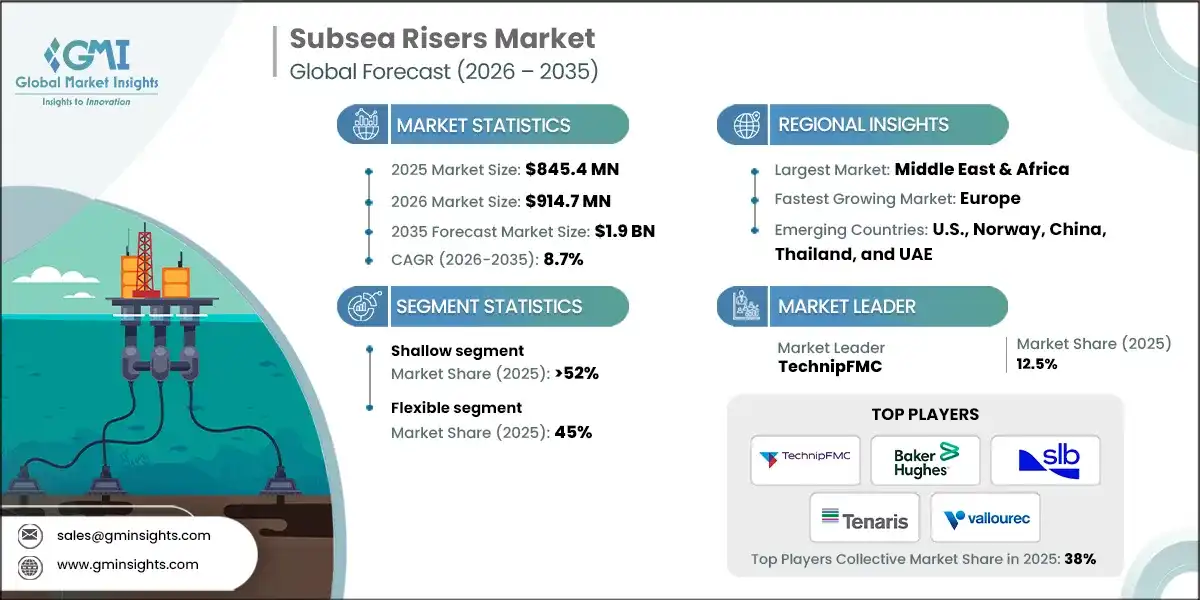
The subsea risers market was estimated at USD 845.4 million in 2025. The market is expected to grow from USD 914.7 million in 2026 to USD 1.9 billion in 2035, at a CAGR of 8.7%, according to a recent study by Global Market Insights Inc.
Subsea Risers Market Key Takeaways
Market Size & Growth
- 2025 Market Size: USD 845.4 Million
- 2026 Market Size: USD 914.7 Million
- 2035 Forecast Market Size: USD 1.9 Billion
- CAGR (2026–2035): 8.7%
Regional Dominance
- Largest Market: Middle East & Africa
- Fastest Growing Region: Europe
Key Market Drivers
- Increasing investments for exploration of deep and ultra-deep oil reserves.
- Shifting focus towards development of marginal fields.
- Rapidly increasing energy demand.
Challenges
- High associated cost with offshore drilling operations.
Opportunity
- Expansion of offshore renewable energy projects.
- Advancements in subsea robotics and automation.
- Integration of digital monitoring and predictive maintenance.
- Development of new materials and lightweight composite technologies.
Key Players
- Market Leader: TechnipFMC led with over 12.5% market share in 2025.
- Leading Players: Top 5 players in this market include TechnipFMC, Baker Hughes, SLB, Tenaris plc, Vallourec, which collectively held a market share of 38% in 2025.
Get Market Insights & Growth Opportunities
- Flourishing investments in deep offshore fields, coupled with paradigm shift toward overcoming technical and operational challenges associated with extracting resources from diverse geological formations will complement business landscape. Growing inclination on developing hydrocarbon reserves in deep and ultra-deepwater environments along with operators pursuing more technically advanced and resource-intensive offshore opportunities will augment industry outlook.
- For instance, in March 2025, the Government of India introduced major policy measures to boost domestic hydrocarbon output and reduce reliance on imports. Central to this effort is the Open Acreage Licensing Policy (OALP), which has significantly expanded exploration activity through extensive seismic surveys and new drilling programs. With multiple bidding rounds completed and OALP Bid Round X underway, the country is advancing its largest initiative to attract investment and accelerate oil and gas exploration.
- Rising floating rig deployments and growing need for reliable systems to transfer hydrocarbons from subsea reservoirs to surface processing facilities will contribute to industry growth. In addition, increasing global energy demand, declining accessible oil reserves coupled with introduction of favorable policies toward encouraging the use of advanced materials and designs that minimize failure risk and reduce maintenance intervention will shape industry dynamics.
- For instance, in September 2025, Sevan Deepwater Technology introduced a new semi-submersible floating production unit concept, broadening its portfolio beyond its well-known cylindrical hull designs. The new FPU is engineered for scalability and adaptability across diverse offshore applications, offering an optimized hull form suitable for varying operational and environmental conditions. It features a double-symmetric hull with a ring pontoon and four octagonal columns while the design delivers enhanced stability and favorable motion performance.
- Growing emphasis on cost-effective solutions, manufacturers are exploring innovative designs and production processes to reduce the overall cost of SURF systems without compromising safety or performance further complement the business dynamics. Technological advancements aimed at improving performance and reliability of these systems including development of new materials, corrosion protection techniques, and integration of digital solutions for real-time monitoring & predictive maintenance will accelerate product deployment.
- For instance, in April 2023, Aquaterra Energy expanded its riser and connector offerings with a completions and workover system suitable for carbon capture and storage applications. The solution enables safe intervention and workover operations in high-pressure, low-temperature CCS environments by mitigating leakage risks.
- Middle East & Africa leads the subsea risers market owing to strong extensive offshore hydrocarbon reserves, continuous expansion of offshore production activities, operators seek to unlock additional reserves and improve long-term energy output. Ongoing investment in deep-water and ultra-deep-water exploration, increased installation of floating rigs and new projects, increasing energy demand and robust development momentum supported by large-scale national energy initiatives is contributing to industry growth.
- For instance, in July 2025, Nabors Industries announced that its Sanad joint venture with Saudi Aramco secured an additional order for five newbuild rigs in Saudi Arabia. Four units are expected to begin operations in 2026, with the final rig following in 2027. This marks the fourth batch awarded under the long term 50 rig programme with Sanad currently operating 12 rigs, with two more were scheduled to start in 2025.
- Europe is one of the emerging markets in subsea risers market owing to increasing energy demand, extensive offshore activity particularly in the North Sea, and Norwegian Sea and paradigm shift toward marginal field development. Rising need to retrofit aging oil and gas infrastructure will accelerate demand for flexible and robust riser systems along with stringent mandates toward reducing emissions from oil & gas infrastructure will shape industry dynamics.
- For instance, in December 2025, OMV Petrom, operator of the Han Asparuh offshore block, together with NewMed Energy, has advanced exploration activities in the area. The first planned well, Vinekh 1, located 200 km east of Varna in approximately 2,000 meters of water, is preparing for drilling by year-end. The two well campaign, valued at USD 198.6 million, will utilize Halliburton for drilling services and SLB for well testing, with operations expected to span five months.
To get key market trends
Subsea Risers Market Trends
- The market is anticipated to grow owing to expansion of shallow-water projects, gradual shift toward deeper reservoirs along with shifting focus to ensure safe hydrocarbon transfer in increasingly challenging conditions. Ongoing investments in engineering methods and qualification testing driven by increasing offshore exploration have accelerated demand for flexible riser systems for fixed platforms and early floating production units, further shaping business dynamics.
- For instance, in November 2025, the Department of Interior announced an order including Unleashing American Offshore Energy, directing the Bureau of Ocean Energy Management to discontinue the existing 2024–2029 offshore leasing program, develop a new and expanded 11th National OCS Oil and Gas Leasing Program by October 2026. The proposed 2026–2031 offshore leasing plan outlines up to 34 lease sales across major U.S. coastal regions and introduces a new South Central Gulf planning area to strengthen domestic energy development.
- Operators prioritizing riser technologies capable of withstanding high pressures, harsh environments, and dynamic loading from floating facilities along with adoption of digital monitoring tools and improved materials, to extend service life and reduce operational risk. Growing emphasis on retrofitting existing risers, optimizing field performance, and adapting designs for marginal fields for cost efficiency and installation flexibility will augment product deployment.
- For instance, in September 2023, Oil States International awarded a significant contract for its Merlin Deepsea Mineral Riser system, designed to support the extraction of vital seabed minerals. The technology will be used to recover resources such as cobalt, manganese, nickel and rare earth elements, which are essential for manufacturing batteries, renewable energy components, electronic devices and other advanced technology applications.
- Increasing research & development expenditures to enable deeper, more remote offshore developments supporting the evolution of subsea processing, autonomous operations, and integrated offshore infrastructures will augment industry outlook. Stringent mandates toward reducing emissions from oil & gas infrastructure along with shifting focus on introduction of advanced technological systems to increase the flow of hydrocarbons to the processing facilities will positively influence business dynamics.
- For instance, in September 2025, Ocean Thermal Energy Conversion (OTEC) was selected for a new DeepStar research initiative evaluating the application of OTEC based baseload renewable energy for deepwater oil and gas operations. DeepStar, supported by major operators such as Chevron, ExxonMobil, and BP, serves as a leading collaborative R&D platform uniting energy companies, technology innovators, and research bodies to advance efficient deepwater production solutions.
Subsea Risers Market Analysis
Learn more about the key segments shaping this market
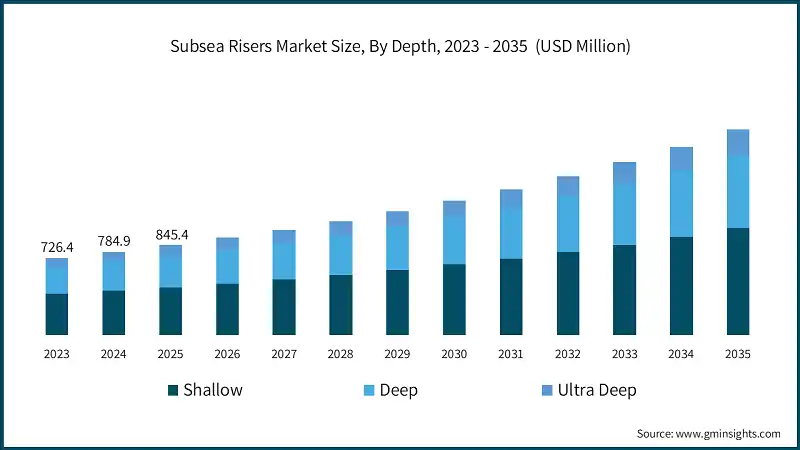
- Based on depth, the industry is segmented into shallow, deep and ultra deep. The shallow segment leads the subsea risers market accounting for over 52% market share in 2025 and is anticipated to grow at a CAGR of over 8% from 2026 to 2035.
- The shallow depth is anticipated to witness significant growth driven by increasing redevelopment of mature offshore fields and the rising demand for cost-efficient exploration activities. Flourishing investments in near-shore blocks by oil companies to increase energy security along with growing inclination toward early-production systems, and new developments of oil fields will further complement industry landscape.
- For instance, in May 2024, Ocean Installer received Subsea Line Modification (SLM) Project from Equinor for Åsgard A, located in central Norwegian Sea at 240-300 meters of water depth. The project involves recovering two risers, installing a new riser and flexible jumper, and adding GRP Covers for jumper protection highlights Ocean Installer's expertise and strong collaboration with Equinor.
- Deep water depth segment across subsea risers market is set to grow at a CAGR of over 8.5% by 2035. Ongoing expansion of significant oil reserves and the continued extraction of hydrocarbons from various water bodies across the globe will complement business landscape. Rising investments in deep water depth oil filed developments by oil & gas operators are further accelerating riser deployment. Moreover, efforts to reduce dependence on imported energy in line with increased capital allocation toward offshore exploration is contributing to industry growth.
- For instance, in May 2025, Subsea7 secured a contract worth more than USD 1.25 billion from Petrobras for the Buzios-11 pre-salt project located in Brazil’s Santos basin. The scope includes engineering, procurement, and installation of 112 km of rigid risers and flowlines in 2,000-meter water depths, supporting 15 wells, eight oil producers and seven water-Alternating-Gas injectors.
- Ultra-deep segment was evaluated at above USD 95 million in 2025. Favorable policies by various government authorities for offshore hydrocarbon exploration in remote and challenging environments along with flourishing investments toward development of oil fields is contributing to industry growth. Increasing energy demand, operators investing in ultra-deepwater projects, seismic surveys, drilling of deepwater wells, installation of subsea infrastructure, floating production facilities, to extract hydrocarbons from challenging deep-sea environments is augmenting industry landscape.
- For instance, in October 2025, Petrobras awarded Allseas a major contract for a rigid-riser subsea system for the Atapu 2 pre-salt development, located 230 km offshore Rio de Janeiro in Brazil. The project involves EPC and installation of 143 km of rigid risers and flowlines in over 2,000 m water depth, connecting 18 wells to a new FPSO. Offshore execution, planned for early 2029, will be performed by the vessel Audacia.
Learn more about the key segments shaping this market
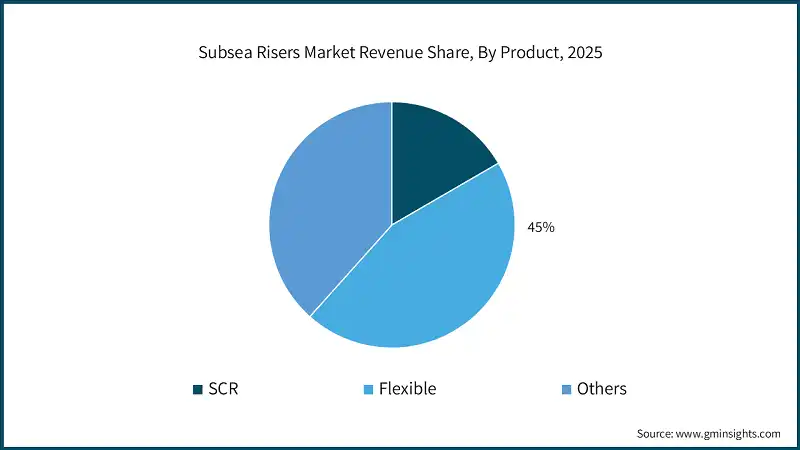
- Based on product the subsea risers market is categorized into SCR, Flexible and others. The flexible segment accounted for 45% of the market share in 2025 and is anticipated to witness a CAGR of over 8% by 2035.
- Shifting focus towards flexible solutions designed to adapt to seabed irregularities and ensure stability across expanded distances is augmenting product demand. Development of sustainable and reliable offshore energy production systems, coupled with focus on adaptability and long-term stability, aligning with growing demand for innovative technologies in offshore energy production will shape business dynamics.
- For instance, in March 2025, Petrobras has entered agreements with Baker Hughes and NOV Flexibles to develop flexible riser solutions capable of addressing stress-corrosion cracking risks associated with supercritical CO2 in Brazil’s pre-salt region, aiming to enhance durability and operational integrity in future subsea applications.
- The subsea risers market from SCR segment is set to witness substantial growth and surpass USD 335 million by 2035, driven by activities in oil fields and natural gas extraction, increased investments in deep and ultra-deep hydrocarbon fields, and rising demand for petrochemical products. Paradigm focuses on enhancing oil and gas production capabilities to meet rising energy demand along with exploration of untapped reserves and advancements in riser technologies, further complementing the business landscape.
- For instance, in November 2025, Allseas announced to construct new deepwater gas and crude oil export systems for Enbridge Offshore Facilities in the central Gulf of Mexico, enhancing regional subsea transport capacity. Each network includes a 3 kilometre SCR (steel catenary riser) connected to floating production units and is designed for future developments and expanded field activity.
Looking for region specific data?
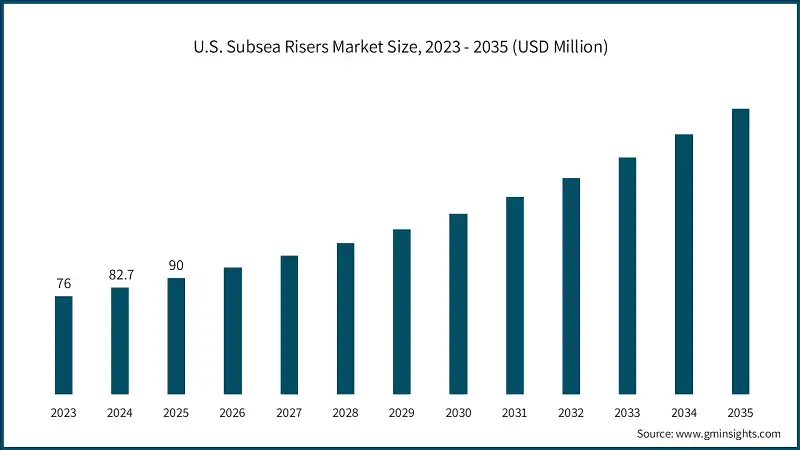
- U.S. dominated the subsea risers market in North America with around 75.3% market share in 2025 and generated around USD 90 million in revenue. Ongoing digitalization and automation across drilling activities, supportive government policies, and ongoing exploration and production initiatives, further driving industry growth. Operators are collaborating to integrate advanced technological systems advanced robotics for process optimization along with deployment of renewable energy projects across deeper water bodies.
- For instance, in June 2025, Nauticus Robotics came into strategic partnership with Open Ocean Robotics to advance autonomous subsea asset management. By integrating Nauticus’ subsea robotic systems with solar-powered uncrewed surface vessels, the collaboration aims to lower inspection and maintenance costs. The combined solution enables continuous, autonomous monitoring of critical offshore infrastructure including pipelines, risers, and subsea manifolds while reducing environmental impact
- North America subsea risers market is anticipated to grow owing to rising investments in energy-intensive industries, rising energy requirements, and extensive presence of offshore oil and gas reserves. Ongoing exploration programs and increasing capital allocation toward hydrocarbon development along with supportive government policies in unconventional resource exploration are further shaping the industry dynamics.
- For instance, in September 2025, BP approved the development of a second production platform in the U.S. Gulf of Mexico within two years, advancing the growth of its upstream portfolio. The final investment decision supports one of the company’s planned major global project start-ups between 2028 and 2030, reinforcing BP’s commitment to expanding output and strengthening long-term deep-water operations.
- Europe subsea risers market is set to grow over USD 338 million by 2035. Increasing investment in offshore hydrocarbon exploration and production, coupled with favorable regulatory frameworks and strategic collaborations among industry stakeholders for development of subsea infrastructure and rising demand for energy security, is shaping industry dynamics. Ongoing development of oilfields particularly in the North Sea and Mediterranean regions, integration of digital monitoring solutions, paradigm shift towards renewable energy projects accelerated subsea infrastructure development further contributing to industry growth.
- For instance, in August 2025, Aker BP completed the exploration campaign of Omega Alfa, located in Norway’s North Sea, an estimated 96–134 million barrels of oil equivalent of recoverable resources in the Yggdrasil area. The multilateral well targeted five prospects and achieved record drilling performance, including three of the longest branches ever on the Norwegian continental shelf, with the deepest reaching 10,666 meters during operations executed by Deepsea Stavanger.
- Asia Pacific subsea risers market accounted for over 8% of the market share in 2025. The region's vast offshore oil and gas reserves, supported by ongoing exploration, increasing energy demand and paradigm shift toward digitalization and automation in drilling operations are driving industry growth. Deepwater projects require specialized, high-capacity risers capable of withstanding extreme environmental conditions, which drives demand for innovative subsea infrastructure. Flexible risers, enhanced durability materials, and digital monitoring systems are increasingly adopted to ensure safety and efficiency in deepwater operations further augmenting business dynamics.
- For instance, in May 2025, CNOOC announced a major oilfield discovery in the Huizhou 196 field, located in eastern South China Sea, with estimated reserves exceeding 100 million tons of oil equivalent. Drilled to 5,415 meters using the Haiyangshiyou 943 rig, the well encountered 127 meters of pay zones while testing confirmed output of 413 barrels of oil and 2.41 million cubic feet of gas daily.
- Middle East & Africa subsea risers market is anticipated to grow owing to region’s robust oil & gas infrastructure, flourishing investments for exploration of newly discovered crude oil reserves and a positive outlook for unconventional resource development. Moreover, growing emphasis on efficient extraction methods innovations in the development of materials to increase the efficiency of the riser systems along with integration of technology for continuous monitoring of the oil & gas systems will augment industry landscape.
- For instance, in December 2024, Shell Nigeria Exploration and Production Co. (SNEPCo) along with its partners approved the deepwater Bonga North development located offshore Nigeria. TechnipFMC secured a contract to supply Subsea 2.0 production systems, while Saipem received a subsea EPCI contract. Located 130 km offshore, Bonga North will connect to the Bonga field FPSO, with Saipem handling the installation of risers, flowlines, subsea umbilicals, and related structures.
Subsea Risers Market Share
- Major 5 players operating across the subsea risers industry include Baker Hughes, SLB, TechnipFMC, Tenaris and Vallourec contribute around 38% of the market share in 2025.
- Companies operating across the market are actively pursuing strategic partnerships and adopting advanced technologies to strengthen competitiveness. Leading players are engaging in mergers, acquisitions, and capacity expansions, while introducing innovative solutions to enhance operational efficiency, and accelerate technological advancement across development of offshore oil & gas infrastructure.
- SLB provides complete marine drilling riser systems from the drill floor to the BOP stack, featuring high-capacity spiders, split designs, and shock-mount gimbals for enhanced safety and flexibility. The Robo-Spider system automates riser flange bolt torquing, reducing time by up to 70% while improving rig floor safety. Components are engineered for durability and operational efficiency in demanding offshore environments.
- TechnipFMC is a leader in subsea infrastructure and has a specific division dedicated to umbilicals, risers, and flowlines (SURF). They provide design and installation services for rigid pipelines, flexible pipes, and connection systems used in the construction of offshore production facilities. Having the expertise of a reliable control system is key. TechnipFMC has the capability of offering technologies that improve the reliability of the assets the expertise of a reliable control system.
- Baker Hughes provides end-to-end solutions for drilling and production risers, providing components, including buoyancy modules, strakes, fairings, and cathodic protection systems. Solutions are also provided for the operating systems for handling, including spiders, lifting & handling, test systems, shipment baskets, and storage solutions to enable effective riser handling and operating systems.
- Vallourec offers a comprehensive portfolio of seamless pipes suited for various riser orientations, providing top-class reliability and economic efficiency. The risers that can resist severe environments, high-pressure conditions, higher temperatures, dynamic environments, and sour environments. The product line covers steel catenary risers and hybrid risers for rigid sections, that meet tough performance and durability criteria in deep-water applications.
Subsea Risers Market Companies
Major players operating in the subsea risers industry are:
- 2H Offshore Engineering Ltd.
- Alleima
- Aquaterra Energy Limited
- ArcelorMittal
- Baker Hughes Company
- Balmoral Comtec Ltd
- HOHN GROUP
- Hunting PLC
- John Wood Group PLC
- NOV
- OCTALSTEEL
- Oil States
- OneSubsea
- SLB
- Subsea 7
- TechnipFMC plc
- Tenaris
- Vallourec
- Weatherford
- Worldwide Oilfield Machine (WOM)
- Baker Hughes offers advanced riser systems engineered for superior fatigue resistance in both drilling and production environments. These solutions include single- and dual-barrier configurations, complete sets of joints and connectors, riser tensioning and guidance systems, as well as integrated surface drilling wellhead assemblies, ensuring reliability and operational efficiency in demanding offshore applications. The company’s reported revenues of USD 20.3 billion for nine months of 2025 and revenue for 2024 was evaluated at USD 27.8 billion.
- SLB offers the only OEM Deepwater MPD System across the industry that includes an integrated MPD Riser Joint, which ranges from Cameron Riser Gas Handling System w/ Annular BOP & Flow Spool, and BT Ring RCD. It is fully integrated into LoadKing riser systems, which improves drilling efficiency and safety in deepwater environments. The company’s revenue for the first 6 months of 2025 was reported at around USD 25.9 billion in 2025.
- TechnipFMC offers a comprehensive integrated solution by leveraging its subsea production systems and subsea umbilicals, risers, and flowlines. This strategic integration enables the company to provide a complete water-column offering, ensuring seamless connectivity and optimized performance for offshore developments. The company reported approximately USD 7.4 billion of revenue for the first six months of 2025.
- TENARIS reported revenue of USD 8.9 billion for the first 9 months of 2025 and complete year revenue of USD 12.5 billion for 2024. The company’s Tenaris Blue Riser is engineered for superior fatigue performance, making it ideal for deepwater top-tensioned and high-pressure drilling risers. The connection ensures exceptional sealability and durability, tested to API 5C5:2017 CAL IV standards and stringent offshore protocols. Widely adopted by leading operators, it delivers proven reliability in challenging environments across the Gulf of Mexico.
Subsea Risers Market Report Attributes
| Key Takeaway | Details |
|---|---|
| Market Size & Growth | |
| Base Year | 2025 |
| Market Size in 2025 | USD 845.4 Million |
| Market Size in 2026 | USD 914.7 Million |
| Forecast Period 2026 - 2035 CAGR | 8.7% |
| Market Size in 2035 | USD 1.9 Billion |
| Key Market Trends | |
| Drivers | Impact |
| Increasing investments for exploration of deep and ultra-deep oil reserves | Growing capital deployment in deepwater exploration enhances demand for advanced riser technologies, stimulates long term project pipelines, by unlocking inaccessible hydrocarbon resources. |
| Shifting focus towards development of marginal fields | Growing emphasis on marginal field development drives adoption of cost efficient subsea riser solutions, increases tieback projects, through production from smaller challenging oil & gas reservoirs. |
| Rapidly increasing energy demand | Increasing energy consumption led operators to accelerate offshore development, expand subsea infrastructure, and deploy reliable riser systems to ensure stable hydrocarbon supply and meet long-term energy demand. |
| Pitfalls & Challenges | Impact |
| High associated cost with offshore drilling operations | High cost associated with drilling limit project viability, delay investment decisions, and reduce offshore development, thereby constraining demand for subsea infrastructure and increasing financial risk for operators and service providers. |
| Opportunities: | Impact |
| Expansion of offshore renewable energy projects | Growing offshore wind and emerging marine energy installations create demand for specialized riser systems to support power transmission, monitoring, and auxiliary functions |
| Advancements in subsea robotics and automation | Increased use of subsea vehicles and robotic intervention enhances installation efficiency, reduces operational risk, and enables deployment of complex riser systems in challenging offshore environments. |
| Integration of digital monitoring and predictive maintenance | Adoption of smart sensing technologies enables continuous riser assessment, optimizing maintenance, reducing downtime, and ensures long‑term subsea infrastructure performance. |
| Development of new materials and lightweight composite technologies | Innovative materials deliver improved fatigue resistance, corrosion protection, and reduced weight, enabling installation in deeper waters. |
| Market Leaders (2025) | |
| Market Leaders |
12.5% market share |
| Top Players |
|
| Competitive Edge |
|
| Regional Insights | |
| Largest Market | Middle East & Africa |
| Fastest Growing Market | Europe |
| Emerging Countries | U.S., Norway, China, Thailand, and UAE |
| Future outlook |
|
What are the growth opportunities in this market?
Subsea Risers Industry News
- In December 2025, TechnipFMC awarded a contract by Ithaca Energy to deliver flexible risers, flowlines and related equipment for the Captain field development in the UK North Sea. The company estimates the award between USD 75–250 million, located 145 km northeast of Aberdeen, Scotland with TechnipFMC supporting earlier expansion work in 2024. TechnipFMC will be responsible for the engineering, fabrication, and installation of risers, flowlines, and subsea equipment for thus project.
- In November 2025, DeepOcean awarded a contract for subsea construction and tie-in work on a development on the UK Continental Shelf, which will be connected via a subsea tieback to an established hosting facility. The project involves the lay of a flexible production riser, flow line, and umbilical, as well as protective systems and commissioning. Engineering and project management will be undertaken from Aberdeen, while the field work will be divided into two phases by the company’s-chartered vessels.
- In October 2025, Tenaris awarded with a contract to provide subsea riser pipes, casings, tubing, and flowlines to the Mexico’s ultra-deep-water Trion project, situated 180 km off the Mexican coast. The Trion Project, being developed by Woodside’s Mexican subsidiary and Pemex, involves areas reaching 2,500 meters deep, with first oil expected in 2028 and a planned 100,000 barrels per day capacity. The scope of work includes about 28,000 tons of premium pipe, including corrosion-resistant subsea riser and flowlines.
- In July 2025, the Marine XII project located in Republic of Congo, progressed to its final phase with the installation of Yoke and Riser, which will form the operational link between the FLNG unit and subsea infrastructure. A heavy-lift vessel positioned the Yoke base on pre-cemented anchor piles, followed by a secondary cementing stage and deployment of stabilizing anchor chains where riser will be connected during FLNG hook-up and commissioning.
The subsea risers market research report includes in-depth coverage of the industry with estimates & forecast in terms of volume “000 Feet” and revenue “USD Million” from 2022 to 2035, for the following segments:
Market, By Depth
- Shallow
- SCR
- Flexible
- Others
- Deep
- SCR
- Flexible
- Others
- Ultra-Deep
- SCR
- Flexible
- Others
Market, By Product
- SCR
- Flexible
- Others
The above information has been provided for the following regions and countries:
- North America
- U.S.
- Canada
- Mexico
- Europe
- UK
- Norway
- Netherlands
- Russia
- Asia Pacific
- China
- India
- Indonesia
- Malaysia
- Thailand
- Australia
- Middle East & Africa
- Angola
- Nigeria
- Egypt
- Qatar
- Saudi Arabia
- UAE
- Latin America
- Brazil
Frequently Asked Question(FAQ) :
What is the subsea risers market size in 2025?
The subsea risers industry size was USD 845.4 million in 2025, supported by rising deep and ultra-deep offshore exploration and increasing deployment of advanced SURF infrastructure.
What is the subsea risers industry size in 2026?
The market is projected to reach USD 914.7 million in 2026, reflecting accelerating investments in deepwater production systems and floating rig deployments.
What is the projected value of the subsea risers market by 2035?
The market is expected to reach USD 1.9 billion by 2035 at a CAGR of 8.7%, driven by expanding offshore hydrocarbon developments and integration of digital monitoring and predictive maintenance.
Which depth segment leads the subsea risers industry?
The shallow-water segment leads the market with over 52% share in 2025, supported by redevelopment of mature fields and growing nearshore exploration activities.
Which product segment dominates the subsea risers market?
The flexible riser segment accounted for 45% of the market share in 2025, benefiting from rising demand for adaptable, fatigue-resistant solutions across complex offshore environments.
Which country leads the subsea risers market?
The U.S. generated around USD 90 million in 2025 with approximately 75.3% share of the North American industry. Growth is driven by digitalization in drilling, supportive government policies, and sustained offshore exploration and production investments.
Which region is the fastest-growing subsea risers industry?
Europe is the fastest-growing region, supported by rising North Sea activity, marginal field developments, and stricter emissions regulations shaping offshore infrastructure investments.
What are the key trends in the subsea risers industry?
Key trends include adoption of smart digital monitoring, development of lightweight composite materials, increased subsea robotics, and growing integration of hybrid riser architectures for deeper and harsher environments.
Who are the leading companies in the subsea risers market?
Key players include TechnipFMC, Baker Hughes, SLB, Tenaris, and Vallourec, collectively holding around 38% of the market share in 2025 through technology innovation and strategic partnerships.
Subsea Risers Market Scope
Related Reports