Summary
Table of Content

Steam Turbine Market
Get a free sample of this report
Form submitted successfully!
Error submitting form. Please try again.
Thank you!
Your inquiry has been received. Our team will reach out to you with the required details via email. To ensure that you don't miss their response, kindly remember to check your spam folder as well!
Request Sectional Data
Thank you!
Your inquiry has been received. Our team will reach out to you with the required details via email. To ensure that you don't miss their response, kindly remember to check your spam folder as well!
Form submitted successfully!
Error submitting form. Please try again.
Steam Turbine Market Size
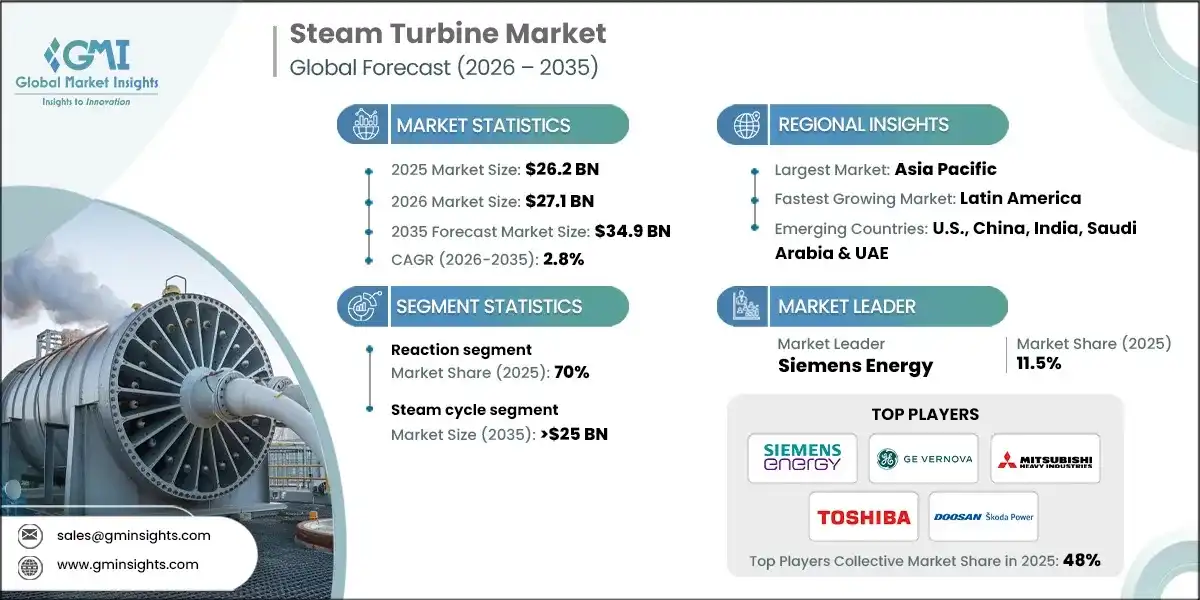
According to a recent study by Global Market Insights Inc., the steam turbine market was estimated at USD 26.2 billion in 2025. The market is expected to grow from USD 27.1 billion in 2026 to USD 34.9 billion by 2035, at a CAGR of 2.8%.
Steam Turbine Market Key Takeaways
Market Size & Growth
- 2025 Market Size: USD 26.2 Billion
- 2026 Market Size: USD 27.1 Billion
- 2035 Forecast Market Size: USD 34.9 Billion
- CAGR (2026–2035): 2.8%
Key Market Drivers
- Growing investment toward generating capacity expansion.
- Rising utilization of cogeneration technology.
- Focus toward combined cycle generation.
Challenges
- High initial investment.
Opportunity
- Expansion of renewable-based thermal projects.
- Modernization of aging power infrastructure.
- Growth in industrial process heating demand.
- Technological advancements in turbine design.
Key Players
- Market Leader: Siemens Energy led with over 11.5% market share in 2025.
- Leading Players: Top 5 players in this market include Siemens Energy, GE Vernova, Mitsubishi Heavy Industries, Toshiba Energy Systems & Solutions, Doosan Škoda Power, which collectively held a market share of 48% in 2025.
Get Market Insights & Growth Opportunities
- Growing demand for reliable, efficient electricity in line with the expansion of new power plant construction will shape the industry growth. Modernization of existing power infrastructure, coupled with rising adoption of energy-efficient technologies, will strengthen the business opportunities.
- A steam turbine is a mechanical system that converts the thermal energy of high-pressure steam into rotational mechanical power. Growing industrial electricity requirements, rising deployment of combined heat and power systems, and the adoption of advanced control technologies are set to boost turbine installations. In addition, the need for high-capacity units for large-scale power generation will strengthen the industry momentum.
- For illustration, in 2024, the International Energy Agency (IEA) released that annual electricity demand to rise by 3.4% by 2026, with global consumption set to grow by 1,080 TWh in 2024 alone. China recorded 8,392 TWh of electricity use in 2023, a 7% increase, while India plans to add 50 GW of coal and biomass capacity by 2030 to support rapidly rising demand.
- The steam turbine market was valued at USD 23.3 billion in 2022 and grew at a CAGR of approximately 1.5% through 2025. Continued investments in power infrastructure to meet expanding energy demand, along with ongoing technological innovations aimed at improving efficiency, will further support industry expansion.
- The industry continues to evolve as industries modernize their power generation infrastructure. Rising global electricity demand, particularly across fast-growing economies, is driving new installations. Continued industrialization, expansion of heavy manufacturing, and integration of cogeneration technologies contribute significantly to the strengthening industry outlook.
- Energy transition policies are reshaping the demand pattern for these turbines. Although coal-based capacity additions have slowed, opportunities are emerging in biomass plants and geothermal projects. These applications favor steam turbines due to high reliability, thermal efficiency, and compatibility with renewable steam-generating technologies, supporting sustainable industry expansion.
- For instance, In June 2025, the U.S. Department of Energy committed USD 475 million to clean energy infrastructure, including initiatives to enhance steam turbine efficiency. At the same time, the European Union’s Green Deal aimed at achieving climate neutrality by 2050, is shaping future priorities and advancements in power generation technologies.
- Industrial sectors such as chemicals, refineries, petrochemicals, and district heating systems increasingly rely on steam turbines for combined heat & power applications. Their ability to extract maximum energy from process steam enhances operational efficiency, which in turn will foster the product penetration.
To get key market trends
Steam Turbine Market Trends
- Technological advancements are helping boost performance and lifecycle efficiency. Modern turbines feature improved blade aerodynamics, advanced materials, digital controls, and predictive maintenance systems. These innovations reduce downtime and enhance flexibility in load management. As operators prioritize energy efficiency and lower operational costs, advanced turbine designs gain increasing acceptance across industries.
- The industry is witnessing increased refurbishment activities as utilities attempt to extend the life of installed assets. Upgrading older turbines with modern components provides substantial efficiency gains at lower capital cost compared to building new plants. Favorable government policies toward energy security and industrial output support strong long-term growth.
- The demand is supported by refinery expansions, petrochemical projects, and desalination facilities, all of which require reliable steam-based power solutions. Steam turbines play a vital role in processing industries, often integrated within captive power plants. Large-scale industrial diversification programs are creating sustainable opportunities for business growth.
- For instance, in July 2024, GE Vernova signed a 25-year service agreement for Asia's first natural gas-hydrogen dual-fuel 9HA plant in China's Guangdong province. The facility operates with 10% hydrogen blend, representing a significant milestone in hydrogen-fired power generation.
- Environmental regulations are influencing technology choices within the steam turbine space. Modern plants are shifting toward supercritical and ultra-supercritical steam cycles to reduce emissions and improve efficiency. Furthermore, increasing adoption of hybrid power architectures along with combining renewable energy, energy storage, and high-efficiency steam cycles will energize the business dynamics.
- Growing interest in small & modular turbine units is expanding market opportunities in decentralized power applications. Industries with low to medium steam loads and small biomass facilities benefit from compact & flexible turbine solutions. These units support faster installation, lower capital expenditure, and scalable energy production, strengthening the technological demand.
- For citation, Indonesia continues to scale its geothermal power portfolio, supported by ongoing modernization of existing plants. Mitsubishi Power’s retrofit of the facility in October 2024 boosted its output from 121 MW to 129 MW, demonstrating the country’s focus on efficiency improvements, renewable energy expansion, and enhanced reliability across its generation infrastructure.
- The rising adoption of digital twins and AI-driven maintenance platforms is transforming operational efficiency in steam turbines. Real-time performance analytics, predictive fault detection, and optimized scheduling reduce downtime and extend equipment life. Utilities operators increasingly invest in these solutions to improve reliability, cut lifecycle costs, and ensure stable power supply.
Steam Turbine Market Analysis
Learn more about the key segments shaping this market
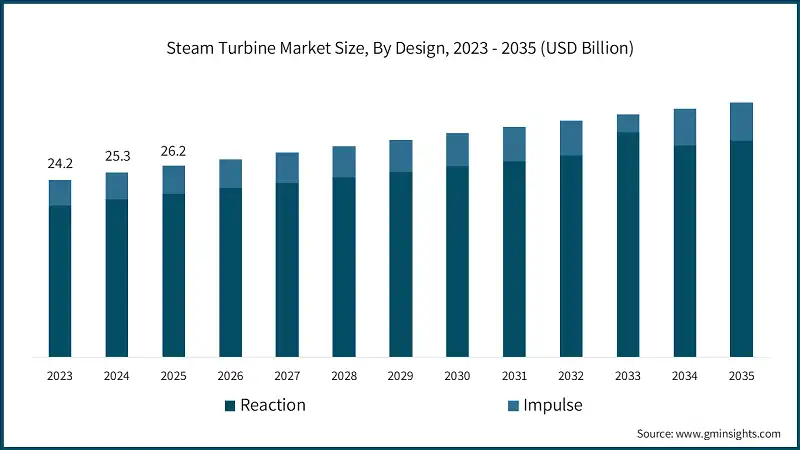
- Based on design, the industry is segmented into reaction and impulse. The reaction steam turbine market holds a share of about 70% in 2025 and is projected to showcase growth rate of over 2.5% through 2035.
- The market is expanding owing to rising power generation needs, modernization of thermal plants, and increasing adoption of combined-cycle systems. Demand is supported by industrial cogeneration and biomass facilities. Advancements in blade aerodynamics and efficiency optimization continue to strengthen product competitiveness across global utility and industrial applications.
- For instance, in August 2024, Mitsubishi Power delivered its cutting-edge M701F gas turbine and steam turbine for the 500 MW gas turbine combined cycle (GTCC) power plant in Malaysia, as part of a contract with Sinohydro Corp. The turbine can co-fire up to 30% hydrogen, designed to minimize emissions.
- The impulse segment is set to exceed USD 5 billion by 2035. The industry is driven by rising demand for compact, robust, and high-efficiency power generation solutions across industrial and utility sectors. Its adoption is increasing due to simpler design, lower maintenance needs, and suitability for high-pressure applications. Growing investments in captive power, refinery operations, and process industries further strengthen long-term business prospects.
Learn more about the key segments shaping this market
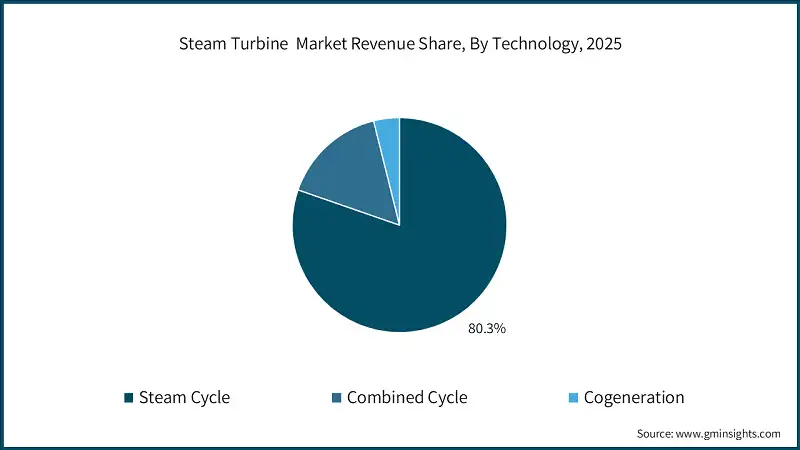
- Based on technology, the industry is divided into steam cycle, combined cycle and cogeneration. The steam cycle turbine market holds a share of 80.3% in 2025 and is set to reach over USD 25 billion by 2035.
- The industry growth is supported by upgrades in coal, biomass, and waste-to-energy plants, alongside combined heat and power adoption. Increasing refurbishment of aging assets and integration of digital diagnostics further enhance market competitiveness and long-term demand.
- Combined cycle segment was estimated at USD 4.1 billion in 2025. The market is growing rapidly as power producers seek higher efficiency, lower emissions, and flexible generation capabilities. Rising deployment of gas-fired plants, supported by cleaner energy policies and grid modernization, drives demand.
- For illustration, China’s ultra-supercritical 660 MW units rely on multi-stage turbines that deliver thermal efficiencies above 45%. Globally, power plants further utilize condensing turbine configurations, typically operating with unit capacities between 500 MW and 1,600 MW, ensuring stable, high-efficiency electricity generation across diverse grid and operational conditions at all times.
- The cogeneration steam turbine market is set to grow at a rate of over 2% from 2026 to 2035. Strong demand from chemical, paper, food processing, and district heating sectors supports growth. Rising fuel cost pressures, sustainability goals, and modernization of captive power facilities further strengthen long-term adoption of cogeneration turbines.
- Based on capacity, the industry is bifurcated into ≤ 3 MW, > 3 MW - 100 MW and > 100 MW. The ≤ 3 MW steam turbine industry will witness a CAGR of 4% by 2035. Its applicability is supported by lower capital costs, compact design, and suitability for renewable and waste-to-energy projects. Modern efficiency enhancements further strengthen competitiveness in distributed generation.
- The > 3 MW - 100 MW segment was valued at USD 3.9 billion in 2025. The industry is expanding owing to growing demand from medium-scale industrial facilities, district heating networks, and biomass or waste-to-energy plants. This range offers an optimal balance of efficiency, flexibility, and cost, supporting modernization of captive power infrastructure and enabling reliable performance across diverse industrial and utility applications.
- The > 100 MW steam turbine market is driven by large utility-scale power plants, including coal, and combined-cycle installations requiring high-efficiency baseload generation. Growth is supported by grid expansion, modernization of aging assets, and development of advanced ultra-supercritical technologies. Long-term service agreements and digital diagnostics further enhance operational reliability and lifecycle performance.
- For instance, Thailand’s plan to develop 5,000 MW of biomass capacity by 2036 emphasizes the use of agricultural residues for cleaner power generation. At the same time, the nation’s 5,300 MW of GTCC capacity supplied by Mitsubishi Power highlights its strong commitment to large-scale combined-cycle installations and high-efficiency thermal power development.
Looking for region specific data?
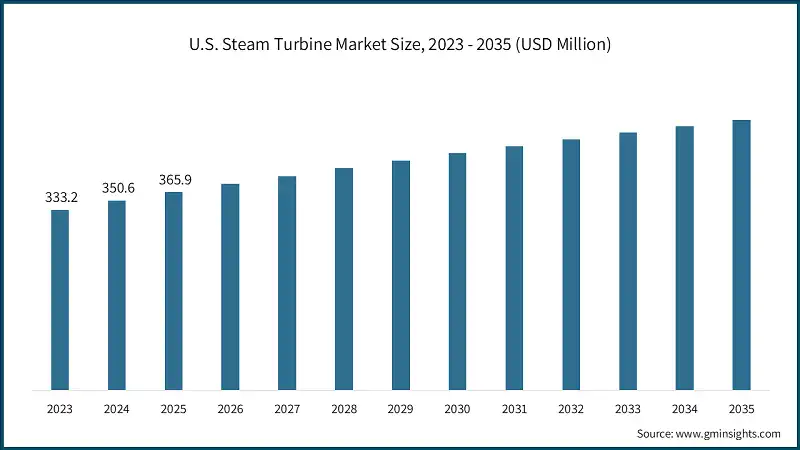
- The U.S. dominated the steam turbine market in North America with around 52% share in 2025 and generated USD 365.9 million in revenue. The robust development of manufacturing facilities coupled with the rising adoption of high-efficiency turbines will accelerate the business growth.
- The North America steam turbine market is projected to surge USD 900 million by 2035. Broader use of these systems in geothermal and biomass power plants will further support technological uptake. Moreover, government programs focused on boosting turbine efficiency and encouraging upgrades, maintenance, and emissions control investments will strengthen the industry outlook.
- The Europe steam turbine market is witnessing steady growth, supported by stringent energy efficiency regulations and a strong focus on decarbonization. Rising investments in biomass, waste-to-energy, and combined heat and power projects drive demand. Modernization of aging thermal plants, along with technological advancements in high-efficiency turbines, further strengthens the business prospects.
- The Asia Pacific steam turbine industry is set to grow at a rate of over 2.5% by 2035. Rising industrialization coupled with government initiatives promoting energy efficiency and renewable integration, supports market growth. Upgrades of existing plants and adoption of advanced turbines further enhance regional opportunities.
- For citation, China’s 2023 electricity consumption of 8,392 TWh is predominantly supported by coal-based steam cycle power plants, reflecting the country’s reliance on conventional generation. India, meanwhile, is pursuing major capacity additions, particularly in coal and biomass segments, to accommodate rapidly rising demand and strengthen grid reliability over the coming years ahead.
- The Middle East & Africa steam turbine market accounts for about 10% of the share in 2025. The region’s transition toward cleaner energy and the integration of renewables with conventional power sources will boost adoption. Additionally, increased infrastructure investments and modernization of existing power plants support the market’s upward momentum.
- For instance, Saudi Arabia’s SATORP complex includes a 475 MW cogeneration system powered by Mitsubishi J-class turbines, highlighting advanced industrial energy integration. Siemens Energy has obtained a contract to supply power equipment and related services.
- The Latin America steam turbine market is expanding as countries invest in modernizing coal and renewable power infrastructure to meet growing energy demand. Increasing electricity demand along with government incentives for efficiency improvements and emissions reduction, is driving market growth. Industrial and utility sectors remain key contributors.
Steam Turbine Market Share
- The top 5 players in steam turbine industry are Siemens Energy, GE Vernova, Mitsubishi Heavy Industries, Doosan Škoda Power and Toshiba Energy Systems & Solutions contribute around 48% of the market share in 2025.
- The market is primarily driven by the growing demand for reliable and efficient electricity generation across the globe. The competitive landscape is dominated by global players offering comprehensive solutions encompassing turbine design, manufacturing, installation, and lifecycle services, while regional manufacturers cater to niche industrial and small-scale power needs.
- Siemens Energy provides steam turbines for utility-scale power plants, including thermal, nuclear, and combined-cycle facilities. Their portfolio spans small to ultra-large capacities, emphasizing high efficiency, flexible operations, and grid integration, along with modernization services to optimize performance and extend plant lifespan.
- GE Vernova supplies steam turbines for large-scale electricity generation in coal, gas, nuclear, and combined-cycle plants. Their products focus on high efficiency, reliability, and integration with gas turbines for maximum output, complemented by lifecycle services and performance optimization to meet evolving power-generation demands.
- Mitsubishi Heavy Industries Offers steam turbines for thermal and nuclear power plants, from mid-sized units to supercritical and ultra-supercritical large-scale turbines exceeding 1,000 MW. MHI emphasizes high efficiency, long-term reliability, and advanced designs for maximizing power output in utility-scale electricity generation.
- Toshiba Energy Systems & Solutions delivers steam turbines for utility power generation, including coal, gas, and geothermal plants. The portfolio ranges from medium to very large capacities with advanced supercritical designs, ensuring high efficiency, grid stability, and suitability for modern power-generation requirements.
- Doosan Škoda Power offers turbines for electricity generation across coal, gas, nuclear, and combined-cycle plants, covering capacities from 5 MW to 1,250 MW. Their offerings include condensing and back-pressure turbines, modernization solutions, and services to improve plant efficiency and overall power output.
Steam Turbine Market Companies
- Siemens Energy reported revenues of about USD 12.1 billion for fiscal year 2025, supported by its global operations in the energy sector. The company posted a net profit of USD 380 million, reflecting disciplined cost management and operational efficiency. These results indicate stable financial performance amid evolving market conditions, underscoring its ability to maintain profitability while navigating industry challenges.
- GE Vernova recorded revenues of approximately USD 27.1 billion for the first nine months of 2025. Within this period, the Power segment contributed USD 14 billion, while the Wind segment generated USD 6.7 billion, and the Electrification segment delivered USD 6.8 billion. These numbers reflect the distribution of revenue across its core business units during the reporting period, highlighting the scale and diversification of its operations.
- Mitsubishi Heavy Industries reported revenues of about USD 13.6 billion for the first six months of 2025. During the same period, the company achieved a net profit of USD 0.8 billion, reflecting its financial performance for the half-year. Moreover, these figures provide insight into the organization’s operational scale and profitability within the reporting timeframe.
Major players operating in the steam turbine market are:
- Ansaldo Energia
- Bharat Heavy Electricals Limited
- Chart Industries
- Dongfang Turbine
- Doosan Skoda Power
- EBARA CORPORATION
- Fuji Electric
- GE Vernova
- Hangzhou Turbine Power Group
- Kawasaki Heavy Industries
- MAN Energy Solutions
- Mitsubishi Heavy Industries
- NCON Turbo Tech
- Shin Nippon Machinery
- Siemens Energy
- Sumitomo Heavy Industries
- Toshiba Energy Systems & Solutions
- Trillium Flow Technologies
- Triveni Turbine
- Turbotech Precision Engineering
Steam Turbine Market Report Attributes
| Key Takeaway | Details |
|---|---|
| Market Size & Growth | |
| Base Year | 2025 |
| Market Size in 2025 | USD 26.2 Billion |
| Market Size in 2026 | USD 27.1 Billion |
| Forecast Period 2026-2035 CAGR | 2.8% |
| Market Size in 2035 | USD 34.9 Billion |
| Key Market Trends | |
| Drivers | Impact |
| Growing investment toward generating capacity expansion | Increasing public and private spending on new power plants and grid upgrades boost demand for steam turbines to support rising electricity needs. |
| Rising utilization of cogeneration technology | Industries adopting cogeneration systems to enhance energy efficiency and reduce fuel costs are driving higher deployment of steam turbines in CHP applications. |
| Focus toward combined cycle generation | Shift toward combined cycle plants for improved efficiency and lower emissions increases demand for steam turbines used in the steam cycle stage. |
| Pitfalls & Challenges | Impact |
| High initial investment | Significant upfront capital required for steam turbine procurement, installation, and supporting infrastructure limits adoption for small utilities and emerging-market industries. |
| Opportunities: | Impact |
| Expansion of renewable-based thermal projects | Increasing development of biomass and geothermal plants creates strong demand for steam turbines supporting sustainable, reliable baseload generation. |
| Modernization of aging power infrastructure | Upgrading old plants with advanced, efficient steam turbines offers significant opportunities for performance improvement, emission reduction, and extended operational life. |
| Growth in industrial process heating demand | Rising industrialization drives deployment of steam turbines for process heat and on-site power, expanding opportunities across wide multitude of industrial applications. |
| Technological advancements in turbine design | Innovations in materials, digital controls, and turbine efficiency enhance performance, enabling new opportunities in high-efficiency and flexible-generation applications. |
| Market Leaders (2025) | |
| Market Leaders |
11.5% market share |
| Top Players |
Collective market share in 2024 is Collective market share of 48% |
| Competitive Edge |
|
| Regional Insights | |
| Largest Market | Asia Pacific |
| Fastest Growing Market | Latin America |
| Emerging Country | U.S., China, India, Saudi Arabia & UAE |
| Future Outlook |
|
What are the growth opportunities in this market?
Steam Turbine Industry News
- In February 2025, Doosan Škoda Power has signed a deal with PAPREC ENGINEERING to supply a 19 MW DST-G10 steam turbine, generator, gearbox, and auxiliary systems for the Pierrefonds plant on Réunion Island. The facility will process up to 148,000 tons of waste annually, generating 121,000 MWh of electricity. The project includes technical advisory services for construction and commissioning, with equipment delivery scheduled for April 2025.
- In February 2025, Siemens Energy has entered a global partnership with Rolls-Royce SMR to supply steam turbines for its Generation 3+ modular nuclear power plants. Under the agreement, the company will deliver fully integrated turbine systems covering design, manufacturing, installation, and commissioning with capacities ranging from 20 MW to 1,900 MW. These turbines will support the rollout of factory-built SMRs designed to provide scalable, low-emission nuclear power to diverse markets worldwide.
- In October 2024, Shin Nippon Machinery has received an order for four steam turbine drivers for Qatar’s North Field South (NFS) LNG expansion project. These turbines, compliant with API 612 standards, will be used to drive boiler feed water pumps, supporting increased LNG production capacity from 110 to 126 MTPA by 2027. The equipment is designed for high reliability and performance in demanding oil and gas environments, contributing to the operational efficiency of the facility.
- In July 2024, Kawasaki Heavy Industries received an order from Nippon Paper Industries for a 5.5 MW steam turbine to be installed at the Soka Mill, replacing a system. The new back-pressure extraction turbine will channel all exhaust steam into papermaking processes, optimizing heat and power usage across multiple facilities. This upgrade reflects a strategic shift in energy balance management within the Nippon Paper Group.
The steam turbine market research report includes in-depth coverage of the industry with estimates & forecast in terms of revenue (USD Million) & volume (MW) from 2022 to 2035, for the following segments:
Market, By Design
- Reaction
- Impulse
Market, By Exhaust
- Condensing
- Non-condensing
Market, By Fuel
- Fossil fuel
- Biomass
- Geothermal
Market, By End Use
- Industrial
- Refinery
- Chemical plant
- Sugar plant
- Pulp & paper
- Others
- Utility
Market, By Capacity
- ≤ 3 MW
- > 3 MW - 100 MW
- > 100 MW
Market, By Technology
- Steam cycle
- Combined cycle
- Cogeneration
The above information has been provided for the following regions and countries:
- North America
- U.S.
- Canada
- Mexico
- Europe
- UK
- France
- Russia
- Germany
- Spain
- Italy
- Asia Pacific
- China
- Japan
- South Korea
- India
- Australia
- Indonesia
- Malaysia
- Thailand
- Middle East & Africa
- Saudi Arabia
- UAE
- Iran
- Egypt
- South Africa
- Nigeria
- Turkey
- Morocco
- Latin America
- Brazil
- Argentina
- Chile
Frequently Asked Question(FAQ) :
What is the market size of the steam turbine in 2025?
The market size was USD 26.2 billion in 2025, with a CAGR of 2.8% expected through 2035 driven by rising demand for reliable, efficient power generation and ongoing power plant expansion.
What is the projected value of the steam turbine market by 2035?
The steam turbine market is expected to reach USD 34.9 billion by 2035, propelled by modernization of power infrastructure, energy-efficient technologies, and combined heat and power adoption.
What is the current steam turbine market size in 2026?
The market size is projected to reach USD 27.1 billion in 2026.
How much revenue did the reaction design segment generate in 2025?
Reaction steam turbines held approximately 70% market share in 2025, driven by rising power generation needs and industrial cogeneration applications.
What was the valuation of steam cycle technology segment in 2025?
Steam cycle turbines held 80.3% market share in 2025 and are set to reach over USD 25 billion by 2035.
What is the growth outlook for cogeneration turbines from 2026 to 2035?
Cogeneration steam turbines are projected to grow at a rate of over 2% through 2035, driven by strong demand from chemical, paper, food processing, and district heating sectors.
Which region leads the steam turbine market?
The U.S. dominated the North America steam turbine market with a 52% share and USD 365.9 million revenue in 2025, supported by expanding manufacturing facilities and growing adoption of high-efficiency turbines.
What are the upcoming trends in the steam turbine market?
Key trends include adoption of supercritical and ultra-supercritical steam cycles, AI-driven predictive maintenance platforms, digital twin technology, and increasing deployment in biomass and geothermal projects.
Who are the key players in the steam turbine market?
Key players include Siemens Energy, GE Vernova, Mitsubishi Heavy Industries, Toshiba Energy Systems & Solutions, Doosan Škoda Power, Ansaldo Energia, Bharat Heavy Electricals Limited, Chart Industries, Dongfang Turbine, EBARA CORPORATION, Fuji Electric, Hangzhou Turbine Power Group, Kawasaki Heavy Industries, MAN Energy Solutions, NCON Turbo Tech, Shin Nippon Machinery, Sumitomo Heavy Industries, Trillium Flow Technologies, Triveni Turbine, and Turbotech Precision Engineering.
Steam Turbine Market Scope
Related Reports