Summary
Table of Content

Static Heat Meters Market
Get a free sample of this report
Form submitted successfully!
Error submitting form. Please try again.
Thank you!
Your inquiry has been received. Our team will reach out to you with the required details via email. To ensure that you don't miss their response, kindly remember to check your spam folder as well!
Request Sectional Data
Thank you!
Your inquiry has been received. Our team will reach out to you with the required details via email. To ensure that you don't miss their response, kindly remember to check your spam folder as well!
Form submitted successfully!
Error submitting form. Please try again.
Static Heat Meters Market Size
- Static heat meters measure the thermal energy consumed or transferred in heating systems. They are solid-state devices without any moving components, whose design enhances durability, accuracy, and reliability over time.
- Rising customer demand for smart metering devices is set to surge the product adoption. Key factors including reduced energy consumption, development of electronic billing technologies, and requirement for long-term stability will drive the business outlook. Growing emphasis on efficient and sustainable heat management systems equipped with real-time data monitoring is set to augment the business landscape. Furthermore, increasing flexibility and reliability of operations, technological advancements and precise data measurements will stimulate the product penetration.
- Strict government regulations to reduce carbon emissions and clean energy directives will stimulate the product demand. Increasing government funding and incentives for adoption of energy-efficient units and requirement to enhance heat management will stimulate the business landscape. Moreover, shifting customer preference for cost-effective metering systems will drive the industry scenario.
The static heat meters market was valued USD 2.6 billion in 2025. The market is set to grow from USD 2.7 billion in 2026 and is estimated to USD 4.7 billion by 2035, at a CAGR of 6.4%, according to Global Market Insights, Inc.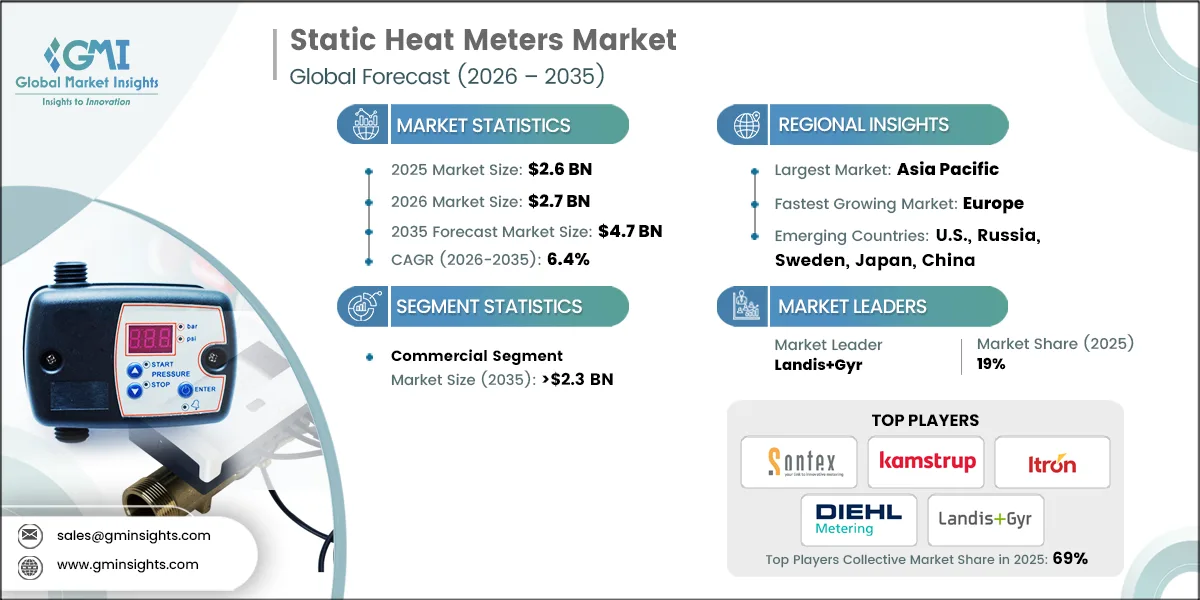
Static Heat Meters Market Key Takeaways
Market Size & Growth
- 2025 Market Size: USD 2.6 Billion
- 2026 Market Size: USD 2.7 Billion
- 2035 Forecast Market Size: USD 4.7 Billion
- CAGR (2026–2035): 6.4%
Regional Dominance
- Largest Market: Asia Pacific
- Fastest Growing Region: Europe
Key Market Drivers
- Favorable regulatory framework and government incentives.
- Growing urbanization & industrialization.
- Rising adoption of sustainable heating alternatives.
Challenges
- Privacy Concerns.
Opportunity
- Integration with smart building and IoT systems.
- Expansion in emerging markets.
Key Players
- Market Leader: Landis+Gyr led with over 19% market share in 2025.
- Leading Players: Top 5 players in this market include Sontex, Kamstrup, Itron, Diehl Metering, Landis+Gyr, which collectively held a market share of 69% in 2025.
Get Market Insights & Growth Opportunities
To get key market trends
Static Heat Meters Market Trends
- Increasing energy efficiency targets, shifting focus on sustainability, and rising requirement for precise billing in district heating systems will complement the market landscape. Many European countries have mandates for the installation of heating equipment, to ensure consumers are billed for their actual energy consumption, thereby minimizing disputes. Moreover, ongoing automation of energy management to boost operational efficiency in heating networks is set to drive the industry statistics.
Static Heat Meters Market Analysis
Learn more about the key segments shaping this market
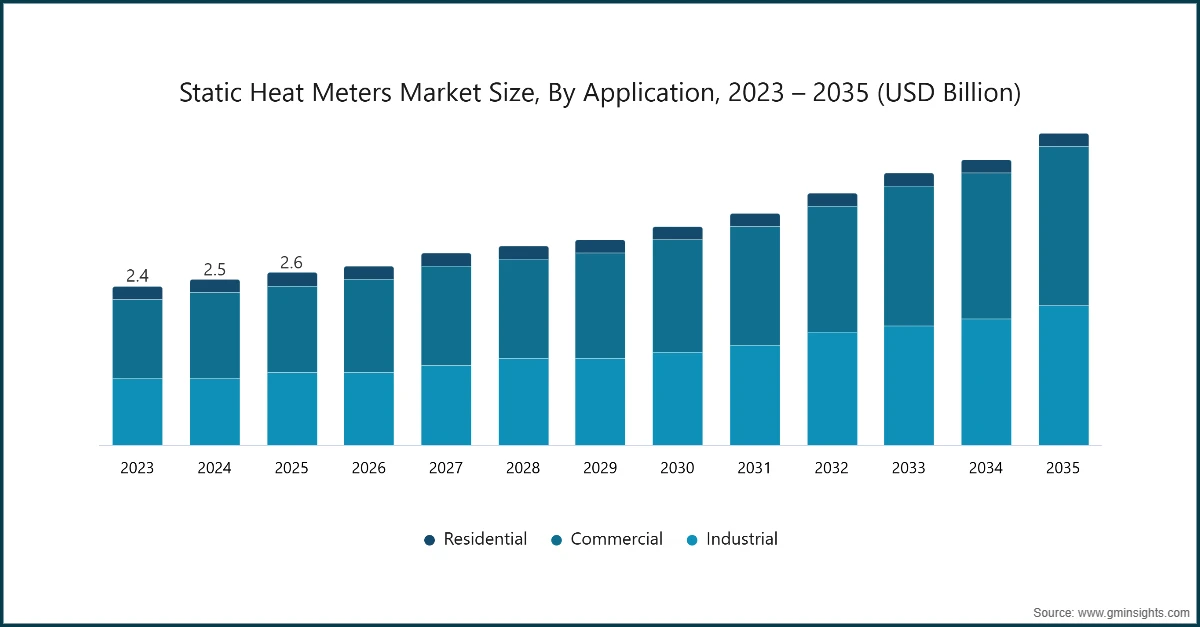
Based on application, the Static heat meters market is bifurcated into residential, commercial and industrial.
- Commercial is anticipated to grow more than USD 2.3 billion by 2035, owing to energy efficiency regulations, the growth of district heating systems, the push toward smart building technologies, and increasing demand for sustainable and transparent energy use. Government regulations mandating the installation of heating units and affordable sub-metering equipment will boost the product demand. Key advantages including robust design, cost-effective and energy efficiency will drive business dynamics. Moreover, accurate measurement of heat consumption coupled with growing requirement for heat monitoring and tailored billing systems will bolster the industry outlook.
- Integration of static meters with advanced building management systems to automatically adjust heating based on real-time data will enhance the overall energy efficiency leading to market growth. Growing demand to manage heat distribution and billing across urban areas coupled with increasing adoption in systems where maximizing accuracy and minimizing maintenance is essential will influence the business dynamics. In addition, development of smart city initiatives, introduction of digitalization, expansion of energy infrastructure in emerging economies will continue to drive the industry momentum.
Learn more about the key segments shaping this market
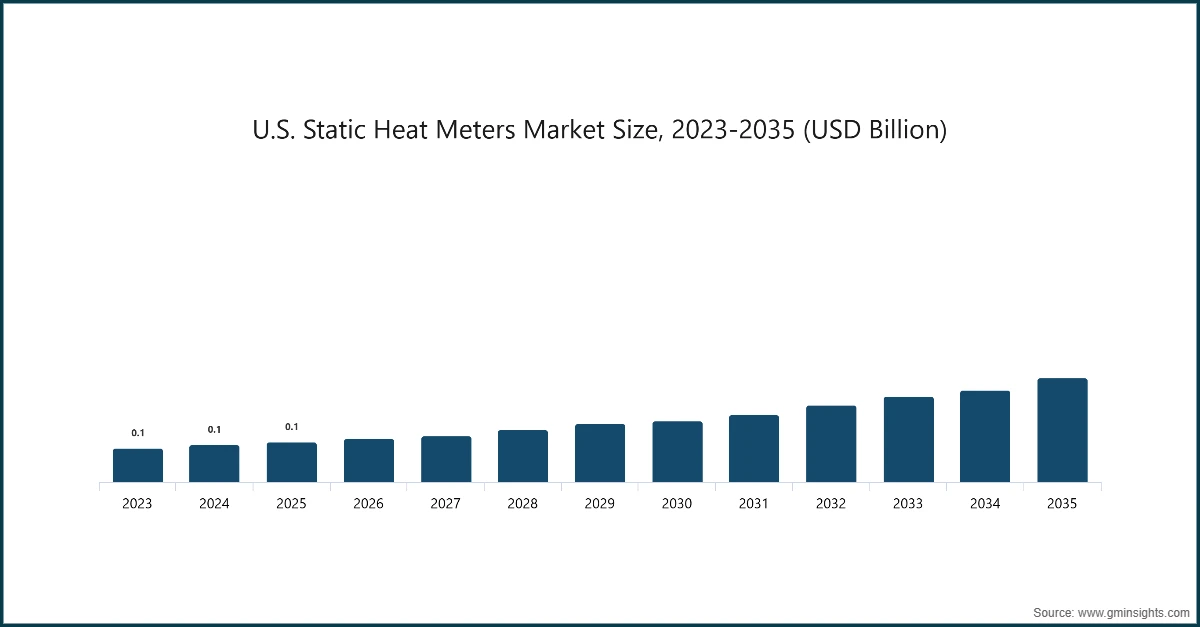
The U.S. static heat meters market is anticipated to grow more than USD 0.3 billion by 2035 on account of growing focus on energy efficiency, increasing sustainability targets, development of regulatory frameworks, along with technological advancements.
- The static heat meters are utilized for district heating systems to ensure accurate billing based on the heat usage to optimize energy distribution. Ongoing integration with smart infrastructure including HVAC systems, thermostats, and energy monitoring platforms will support track the heating usage, reduce waste, and lower energy costs while significantly improving on the occupant comfort, leading to market growth.
Static Heat Meters Market Share
- The industry is moderately concentrated where the global manufacturers hold a significant share and niche players compete in specific geographic markets. The industry has well established global players and regional players, with companies offering a wide range of heating solutions varying in terms of pricing, features, and application suitability. Furthermore, increasing growth ventures to expand their market presence will complement the business landscape.
Static Heat Meters Market Companies
Eminent players operating in the static heat meters industry are:
- ABB
- Apator S.A.
- Axioma Metering UAB
- BMETERS
- Danfoss
- Diehl Stiftung & Co. KG
- Engelmann Sensor GmbH
- Huizhong Instrumentation
- Itron
- Kamstrup
- Landis+Gyr AG
- Metrix Polska
- Micronics
- QUNDIS
- Schneider Electric
- Siemens
- Sensus
- Sontex
- Techem
- ZENNER International
Static Heat Meters Market Report Attributes
| Key Takeaway | Details |
|---|---|
| Market Size & Growth | |
| Base Year | 2025 |
| Market Size in 2025 | USD 2.6 Billion |
| Market Size in 2026 | USD 2.7 Billion |
| Forecast Period 2026-2035 CAGR | 6.4% |
| Market Size in 2035 | USD 4.7 Billion |
| Key Market Trends | |
| Drivers | Impact |
| Favorable regulatory framework and government incentives | Governments worldwide are implementing stricter regulations on energy efficiency and building energy management, often mandating precise sub-metering for heating systems. Incentives including grants, tax benefits, and subsidies for installing energy efficient meters will further encourage product adoption. These regulatory measures make static heat meters an important investment for cost savings and sustainability, thereby driving market growth. |
| Growing urbanization & industrialization | Ongoing expansion of cities and industrial facilities will make complex centralized heating and cooling systems, thus requiring accurate measurement of thermal energy consumption for both billing and efficiency optimization. Static heat meters, with their high precision, low maintenance, and ability to integrate with smart building systems, enable to monitor energy usage effectively across large residential complexes, commercial buildings, and industrial plants. |
| Rising adoption of sustainable heating alternatives | Ongoing shift toward eco-friendly and low-carbon heating solutions requires precise energy monitoring to ensure system efficiency and cost-effectiveness. Static heat meters provide reliable measurement and integration with energy management platforms, making them essential for evaluating performance and enabling sustainable energy practices. Furthermore, growing focus on environmentally responsible heating solutions will encourage the product penetration. |
| Pitfalls & Challenges | Impact |
| Privacy Concerns | They can influence the adoption of static heat meters because these devices often collect detailed data on energy consumption at the individual apartment, office, or industrial unit level. Growing concerns over unauthorized access, cyberattacks, or misuse of personal energy data might hamper the adoption for smart static meters, especially those integrated with IoT or cloud-based monitoring systems. |
| Opportunities: | Impact |
| Integration with smart building and IoT systems | Ongoing development for advanced, connected static meters by manufacturers that can capitalize on the growing demand for smart infrastructure, will support to position these players as essential partners in modern, energy-efficient building ecosystems. Additionally, these meters can provide real-time energy consumption data, predictive analytics, and automated billing, enhancing operational efficiency and enabling tenants or facility managers to make informed decisions about energy usage. |
| Expansion in emerging markets | Emerging economies in Asia-Pacific, Latin America, and parts of Africa are witnessing rapid urbanization, industrial growth, and infrastructure development, creating a vast untapped market for heat metering solutions. Static heat meters, known for their durability, low maintenance, and cost-effectiveness, have strong growth potential in these markets, especially as governments implement energy efficiency regulations and incentivize sustainable energy adoption. |
| Market Leaders (2025) | |
| Market Leader |
19% market share |
| Top Players |
Collective market share in 2025 is 69% |
| Competitive Edge |
|
| Regional Insights | |
| Largest Market | Asia Pacific |
| Fastest growing market | Europe |
| Emerging countries | U.S., Russia, Sweden, Japan, China |
| Future outlook |
|
What are the growth opportunities in this market?
Static Heat Meters Industry News:
- In 2025, kamstrup enetered in an agreement with Jemstech to support the production of metering components for the South African market, thereby strengthening its manufacturing and distribution capabilities in the region.
- In March 2023, Diehl Stiftung & Co. KG entered into a partnership with STACKFORCE GmbH for embedded software for communication of water and thermal energy meters. STACKFORCE also provided LPWAN standard miot, a cutting-edge technology. This will further strengthen their positions across the smart heat meters market.
- In 2022, Kamstrup delivered around 40,000 water and heat meters combined to Silkeborg Forsyning. These modern heat meters featuring wireless communication, network, ensuring high quality data, future proof & accurate reading will be replacing the old meters. This robust system has enabled optimized operations and enhanced the business potential.
The static heat meters market research report includes an in-depth coverage of the industry with estimates & forecast in terms of revenue and volume in “USD Million and ‘000 Units” from 2022 to 2035, for the following segments:
Market, By Application
- Residential
- Commercial
- College/University
- Office Building
- Government Building
- Others
- Industrial
The above information has been provided for the following regions and countries:
- North America
- U.S.
- Canada
- Europe
- Germany
- Poland
- Sweden
- Denmark
- Finland
- Italy
- UK
- Asia Pacific
- China
- Japan
- South Korea
- Rest of World
Frequently Asked Question(FAQ) :
What was the market size of the static heat meters in 2025?
The market size was USD 2.6 billion in 2025, growing at a CAGR of 6.4% through 2035. Growth is driven by rising demand for smart metering devices, reduced energy consumption, and advancements in electronic billing technologies.
What is the projected value of the static heat meters market by 2035?
The market is poised to reach USD 4.7 billion by 2035, supported by technological advancements, sustainability initiatives, and growing adoption of real-time data monitoring systems.
What is the expected size of the static heat meters industry in 2026?
The market size is expected to reach USD 2.7 billion in 2026.
What is the growth outlook for the commercial segment by 2035?
The commercial segment is expected to exceed USD 2.3 billion by 2035, driven by energy efficiency regulations, expansion of district heating systems, and adoption of smart building technologies.
What is the anticipated growth of the U.S. static heat meters sector by 2035?
The U.S. market is projected to surpass USD 0.3 billion by 2035, supported by increasing energy efficiency initiatives, sustainability targets, and advancements in regulatory frameworks.
What are the key trends in the static heat meters market?
Key trends include automation of energy management systems, mandates for accurate billing in district heating networks, and integration of real-time data monitoring for efficient heat management.
Who are the key players in the static heat meters industry?
Key players include ABB, Apator S.A., Axioma Metering UAB, BMETERS, Danfoss, Diehl Stiftung & Co. KG, Engelmann Sensor GmbH, Huizhong Instrumentation, Itron, and Kamstrup.
Static Heat Meters Market Scope
Related Reports