Summary
Table of Content

Spectral Sensor Market
Get a free sample of this report
Form submitted successfully!
Error submitting form. Please try again.
Thank you!
Your inquiry has been received. Our team will reach out to you with the required details via email. To ensure that you don't miss their response, kindly remember to check your spam folder as well!
Request Sectional Data
Thank you!
Your inquiry has been received. Our team will reach out to you with the required details via email. To ensure that you don't miss their response, kindly remember to check your spam folder as well!
Form submitted successfully!
Error submitting form. Please try again.
Spectral Sensor Market Size
The growth of the market is attributed to the increasing adoption of precision agriculture monitoring systems, rising demand for advanced food quality and safety verification technologies, expanding applications of hyperspectral imaging in medical diagnostics and biomedical research, and the growing deployment of spectral sensing solutions in industrial material identification and quality inspection.
Spectral Sensor Market Key Takeaways
Market Size & Growth
- 2025 Market Size: USD 1.6 Billion
- 2026 Market Size: USD 1.7 Billion
- 2035 Forecast Market Size: USD 5.3 Billion
- CAGR (2026–2035): 13.1%
Regional Dominance
- Largest Market: North America
- Fastest Growing Region: Asia Pacific
Key Market Drivers
- Rising precision agriculture adoption for crop health monitoring.
- Rising food safety verification using spectral sensing.
- Growing hyperspectral imaging use in medical diagnostics.
- Increasing industrial quality inspection using spectral analysis.
- Expansion of smart environmental monitoring networks.
Challenges
- High hyperspectral sensor system integration costs.
- Complex spectral data processing requirements.
Opportunity
- Integration with AI-driven spectral data analytics.
- Expansion of wearable non-invasive health monitoring sensors.
Key Players
- Market Leader: Hamamatsu Photonics led with over 18.2% market share in 2025.
- Leading Players: Top 5 players in this market include Hamamatsu Photonics, Teledyne Technologies, Ocean Insight, BaySpec, Headwall Photonics, which collectively held a market share of 63.1% in 2025.
Get Market Insights & Growth Opportunities
The market for spectral sensors is driven by the increasing need for precision agriculture in crop health monitoring. Farmers and agricultural technology companies are increasingly using multispectral and hyperspectral sensors installed on drones and field monitoring systems to monitor crop stress and nutrient deficiency. In 2025, the United States Department of Agriculture awarded USD 0.8 million for the development of the “FogAg” precision agriculture platform with the help of multispectral cameras and AI analytics for the better management of crops and their yields. This is a clear indication of the role of smart farming technologies, which are being promoted by the government for the development of spectral sensor technology for the real-time monitoring of crops and the effective management of agricultural resources.
Moreover, the increasing adoption of hyperspectral sensors in medical diagnostic applications is contributing to the growth of the spectral sensor market. Hyperspectral sensors are being used by medical device manufacturers to improve medical diagnostic capabilities. Researchers are using hyperspectral sensors in medical diagnostic applications to detect tissue abnormalities. In 2025, the National Institutes of Health announced funding of around USD 14.7 million for the Advancing Non-Invasive Optical Imaging initiative for the development of the next generation of light-based biomedical imaging technologies. This funding shows the increasing role of spectral imaging in improving early diagnosis, precision surgery, and clinical imaging capabilities.
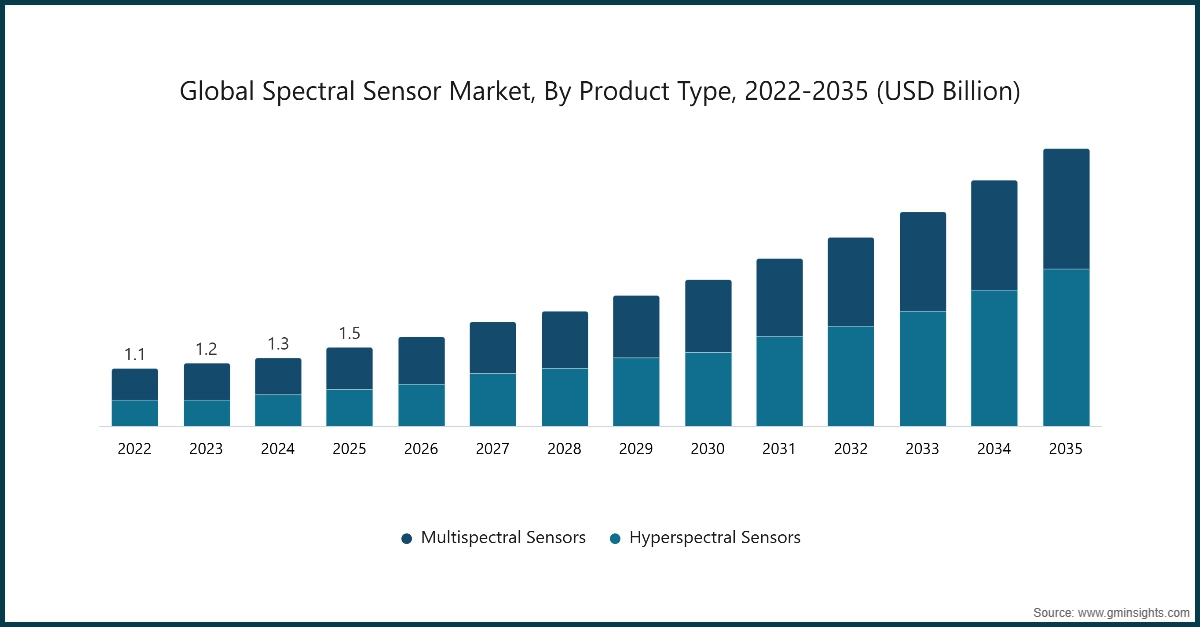
The spectral sensor market increased steadily from USD 1.1 billion in 2022 and reached USD 1.4 billion in 2024. The rising adoption of hyperspectral and multispectral sensing technology in the fields of agriculture, healthcare, and industrial quality assessment has played a major role in the growth of the market. Other factors that have played a role in the growth of the market include the development of miniaturized spectrometer technology, the integration of spectral sensors with drones and remote sensing technology, and the rise of investments in advanced optical sensing technology for research and environment monitoring purposes.
The global spectral sensor market was valued at USD 1.6 billion in 2025. The market is expected to grow from USD 1.7 billion in 2026 to USD 3.2 billion in 2031 & USD 5.3 billion in 2035, at a CAGR of 13.1% during the forecast period according to the latest report published by Global Market Insights Inc.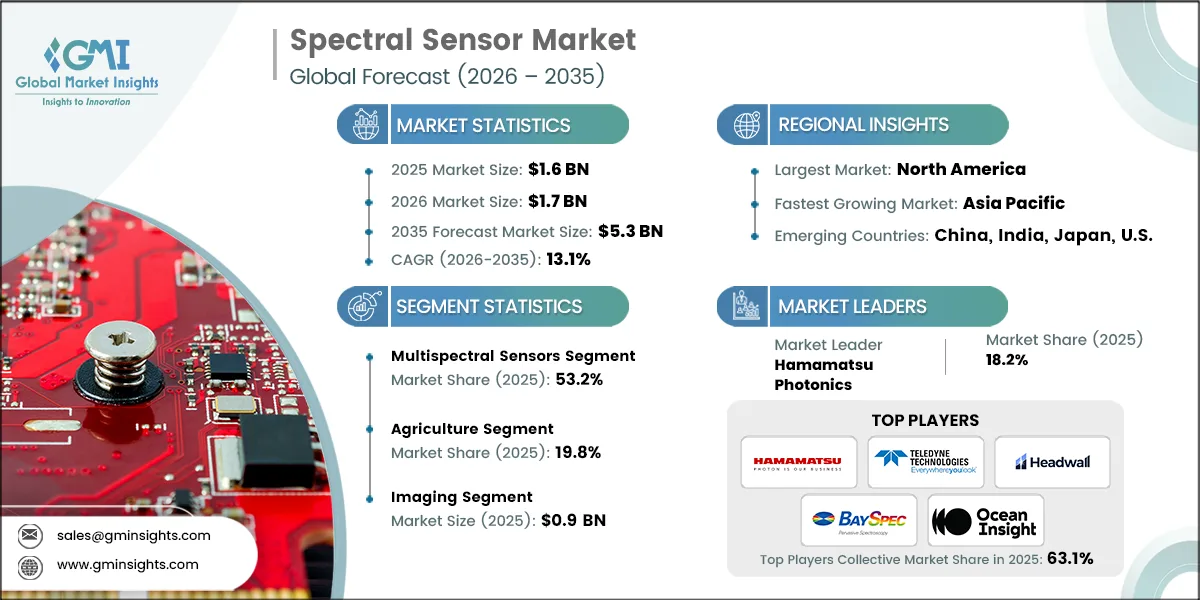
To get key market trends
Spectral Sensor Market Trends
- Innovations in miniaturized spectrometer technology are increasing the pace at which miniaturized spectral sensors are being used. The trend is expected to gain further momentum from around 2021, with semiconductor photonics and MEMS-based optical devices playing an essential role in the development of miniaturized and power-efficient spectrometers. The trend is expected to gain further pace until 2030 as industries require lightweight spectral sensors for embedded devices.
- Integration of spectral sensors with unmanned aerial vehicles (UAVs) and satellite imaging platforms is transforming remote sensing capabilities. The trend strengthened after 2020 as drone-based surveying and earth observation programs expanded in agriculture, mining, and environmental assessment. It is projected to continue through 2032 as governments and enterprises increase investments in geospatial intelligence. This development significantly improves large-area monitoring, enabling faster and more precise resource assessment.
- Growing adoption of spectral sensing in pharmaceutical and chemical process analytics is improving manufacturing transparency and quality control. The trend gained momentum around 2019 when regulatory agencies encouraged real-time process monitoring and analytical technology in drug production. Adoption is expected to increase through 2030 as pharmaceutical manufacturers start automation of quality assurance. This trend increases product consistency, reduces batch failures, and improves compliance with stringent manufacturing standards.
- With the emergence of cloud-based spectral data platforms, there is a significant shift in the way spectral information is processed and exchanged among different industries. The trend is expected to gain further pace from around 2022 with the development and availability of cloud computing infrastructure. The trend is expected to further gain pace until 2030 as organizations require effective spectral information management systems. It will enable centralized spectral libraries, collaborative analysis, and faster deployment of sensing solutions across global operations.
Spectral Sensor Market Analysis
Learn more about the key segments shaping this market
- The multispectral sensors segment led the market in 2025, holding a 53.2% share. Multispectral sensors dominate the market due to their wide deployment in agriculture monitoring, industrial inspection, and environmental analysis. These sensors capture data across selected spectral bands, enabling cost-effective crop health assessment, material identification, and quality control. Their compatibility with drones, satellites, and handheld devices supports large-scale monitoring and operational efficiency, making them the most widely adopted spectral sensing technology across multiple industries.
- The hyperspectral sensors segment is anticipated to grow at a CAGR of 15.2% over the forecast period. This growth is driven by the increasing need for highly detailed spectral information in medical diagnostics, pharmaceutical analysis, and advanced research applications. Hyperspectral sensors capture hundreds of spectral bands, enabling precise chemical and material identification. Their rising integration in biomedical imaging, mineral exploration, and defense surveillance systems is accelerating adoption across high-precision sensing applications.
Based on technology, the global spectral sensor market is divided into imaging and non-imaging technologies.
- The imaging segment dominated the market in 2025 and was valued at USD 0.9 billion due to its extensive use in remote sensing, agriculture monitoring, and industrial inspection. Imaging spectral sensors combine spatial and spectral information, enabling detailed analysis of materials, vegetation health, and surface composition. Their integration with drones, satellites, and laboratory imaging systems supports large-scale monitoring and automated inspection processes, making them essential for high-resolution sensing applications across multiple sectors.
- The non-imaging segment is expected to witness growth at a CAGR of 14.5% during the forecast period due to increasing adoption in portable spectroscopy systems and industrial process monitoring. These sensors provide precise spectral measurement without capturing spatial images, making them suitable for compact devices and embedded sensing systems. Rising demand for handheld analyzers in food testing, pharmaceutical quality control, and chemical composition analysis is accelerating deployment across laboratory and field environments.
Learn more about the key segments shaping this market
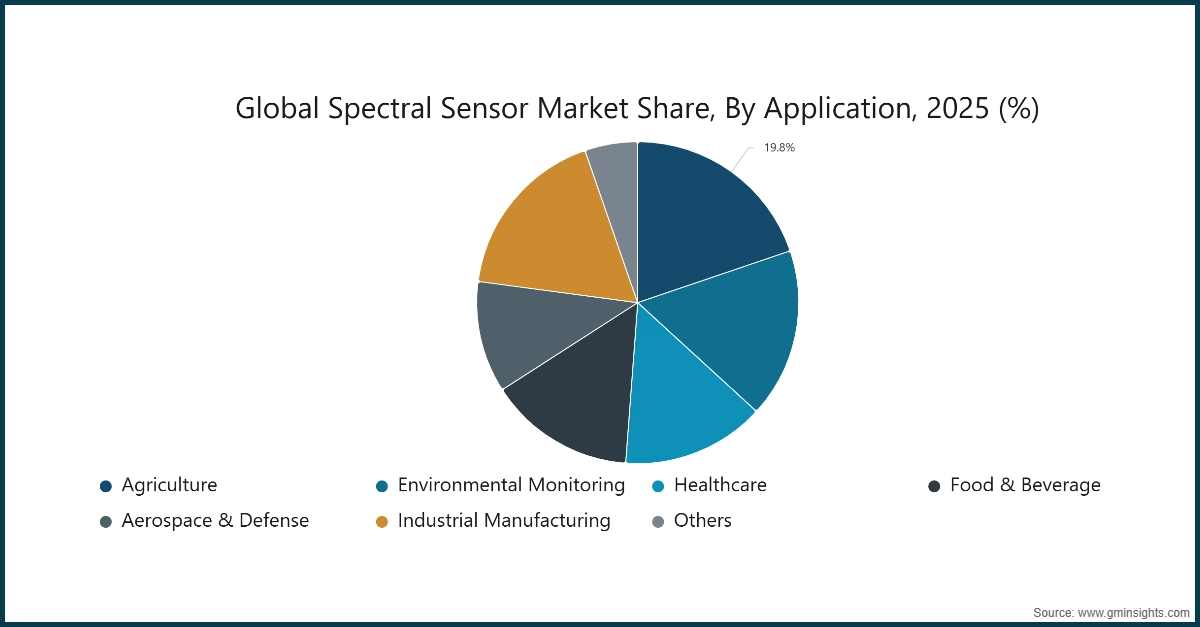
Based on application, the spectral sensor market is divided into agriculture, environmental monitoring, healthcare, food & beverage, aerospace & defense, industrial manufacturing, and others.
- The agriculture segment led the market in 2025 with a market share of 19.8% as spectral sensors find extensive use in crop monitoring, soil conditions, and precision farming. Agritech companies and farmers use spectral sensing technology for crop monitoring, soil conditions, and precision farming. The technology helps detect crop stress, nutrient deficiencies, and pest infestations. Spectral sensing technology helps in crop yield forecasting, efficient use of fertilizers, and promotes sustainable farming, maintaining this segment as the largest segment in the market.
- The environmental monitoring segment is expected to witness growth at a CAGR of 14.8% during the forecast period. The growth of the spectral sensors market in the environmental monitoring segment can be attributed to the increased adoption of spectral sensors for air pollution monitoring, water quality monitoring, and ecosystem monitoring. Governments and research organizations use advanced spectral sensing technology to monitor environmental changes, detect pollutants, and conduct climate research, making it one of the fastest-growing application areas.
Looking for region specific data?
North America Spectral Sensor Market
North America held a share of 31.3% of spectral sensor industry in 2025.
- In North America, the market is witnessing growth due to increasing adoption of advanced optical sensing technology in precision agriculture, biomedical research, and industrial quality inspection. The region is witnessing robust adoption of hyperspectral imaging technology in aerospace, defense, and geospatial applications.
- Additionally, governments, research centers, and private entities are investing in innovation in the field of photonics and remote sensing technologies for better environmental analysis and scientific research. North America will continue to be at the forefront of technology, and the high demand for spectral sensor technology in agriculture, healthcare diagnostics, and defense will ensure the market grows continuously through 2035.
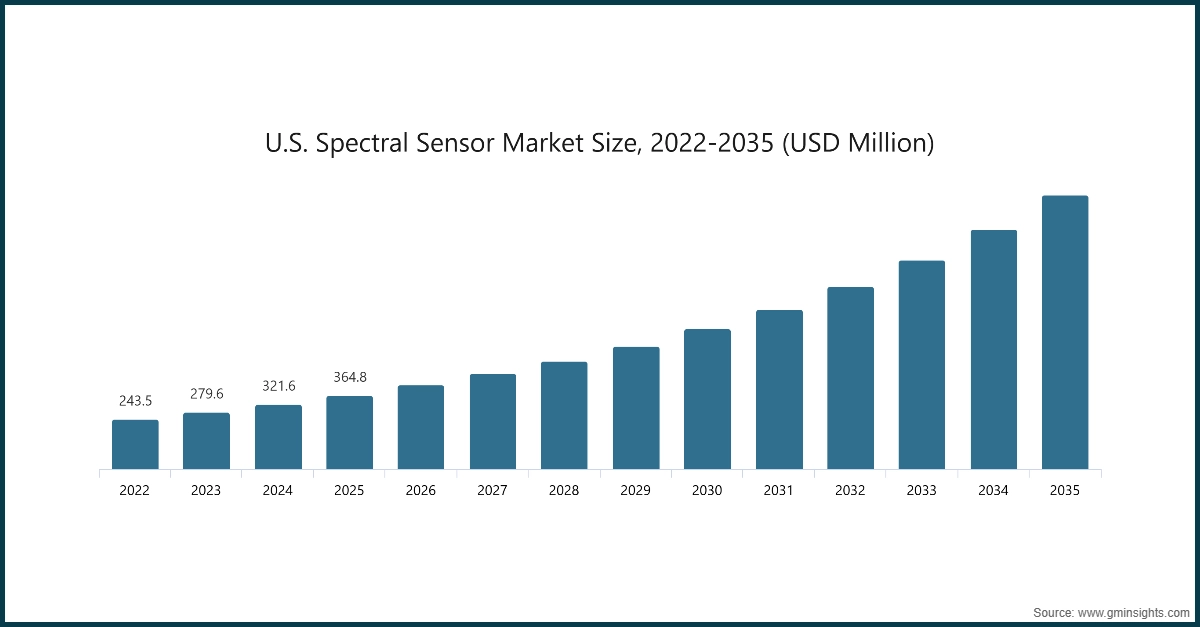
The U.S. spectral sensors market was valued at USD 243.5 million and USD 279.6 million in 2022 and 2023, respectively. The market size reached USD 364.8 million in 2025, growing from USD 321.6 million in 2024.
- The spectral sensor industry in the United States is experiencing strong growth due to major federal investments in advanced sensing technologies for agriculture, climate monitoring, and earth observation. In December 2025, the United States Department of Agriculture announced new research and development priorities for 2026 focused on strengthening agricultural innovation and advanced sensing technologies to improve farm productivity and national food security. These initiatives support the adoption of multispectral and hyperspectral sensing tools for crop monitoring, soil analysis, and environmental data collection.
- At the same time, the National Aeronautics and Space Administration continues expanding hyperspectral earth observation programs that measure vegetation health, geology, and ecosystem dynamics. Together, these large-scale federal programs reinforce the United States as the largest and most technologically advanced spectral sensor industry in North America.
Europe Spectral Sensor Market
Europe spectral sensor industry accounted for USD 351.9 million in 2025 and is anticipated to show lucrative growth over the forecast period.
- Europe’s market is expanding due to strong investments in earth observation, precision agriculture, and industrial spectroscopy technologies supported by regional research programs. The European Space Agency is advancing hyperspectral satellite missions such as CHIME (Copernicus Hyperspectral Imaging Mission for the Environment), which will provide high-resolution spectral data for monitoring vegetation health, soil conditions, and natural resources across Europe.
- In parallel, the European Commission continues to fund photonics and sensing innovation through Horizon Europe, allocating multi-billion-euro funding for advanced optical sensing, spectroscopy, and imaging technologies used in agriculture, healthcare diagnostics, and environmental monitoring. These initiatives are strengthening Europe’s leadership in hyperspectral imaging research and expanding deployment of spectral sensing technologies across scientific, industrial, and geospatial applications.
Germany dominates the Europe spectral sensors market, showcasing strong growth potential.
- Germany represents a major market for spectral sensors in Europe due to strong investments in photonics research, industrial spectroscopy, and hyperspectral imaging technologies. In 2025, the German Federal Ministry of Education and Research continued funding under the “Photonics Research Germany” program, which supports development of advanced optical sensing and spectroscopy systems for industrial manufacturing, healthcare diagnostics, and environmental analysis.
- Germany is also a key participant in the European Space Agency CHIME hyperspectral satellite mission, with German research institutes contributing to imaging spectrometer technologies used for monitoring agriculture, minerals, and ecosystems. These programs strengthen Germany’s position as a leading hub for spectral sensing innovation and deployment across industrial and scientific sectors.
Asia Pacific Spectral Sensor Market
The Asia Pacific spectral sensor industry is anticipated to grow at the highest CAGR of14.8% during the forecast period.
- The Asia Pacific market is witnessing rapid growth with high investments in earth observation programs, precision agriculture technologies, and semiconductor manufacturing quality control. For instance, Japan, South Korea, and Australia are investing more in hyperspectral imaging research and satellite-based monitoring systems. Japan Aerospace Exploration Agency has been actively contributing to hyperspectral earth observation by launching various satellites like the Hyperspectral Imager Suite, allowing the Asia Pacific region to benefit from hyperspectral earth observation, mineral mapping, agricultural monitoring, and environment analysis.
- In addition, the innovation programs sponsored by the government sin Japan and South Korea are driving the photonics and spectroscopy technology for industrial automation, biomedical diagnostics, and material analysis. These initiatives are strengthening Asia Pacific as a rapidly growing hub for spectral sensing technology adoption across scientific, industrial, and geospatial applications.
China spectral sensor market is estimated to grow with a significant CAGR, in the Asia Pacific market.
- China is becoming one of the most prominent markets in the world for spectral sensors with rapid growth potential due to huge investments in hyperspectral satellite observation systems and agricultural sensing systems. The China National Space Administration has launched highly advanced hyperspectral earth observation satellites such as Gaofen-5 to measure the composition of the atmosphere, various environmental pollutants, and land surface characteristics with high spectral resolution.
- In parallel, Chinese research institutes and universities are actively developing spectroscopy-based sensing systems for food quality testing, pharmaceutical analysis, and mineral exploration. Strong domestic manufacturing of optical components and government support for remote sensing infrastructure are accelerating the commercialization of hyperspectral and multispectral sensing technologies across scientific and industrial sectors.
Middle East and Africa Spectral Sensor Market
Saudi Arabia spectral sensor industry to experience substantial growth in the Middle East and Africa.
- Saudi Arabia is witnessing increasing adoption of spectral sensing technologies driven by large-scale investments in remote sensing, mineral exploration, and precision agriculture initiatives. The Saudi Space Agency and national research institutes are expanding satellite-based earth observation programs to monitor land resources, vegetation health, and desert ecosystem changes using advanced imaging and spectroscopy systems.
- In addition, the King Abdulaziz City for Science and Technology is supporting research on hyperspectral imaging for geological surveying and water resource assessment. These initiatives are accelerating the deployment of spectral sensors in mining, environmental mapping, and agricultural monitoring across Saudi Arabia’s rapidly developing technology and research landscape.
Spectral Sensor Market Share
The spectral sensor industry is led by companies such as Hamamatsu Photonics, Teledyne Technologies, Ocean Insight, BaySpec, and Headwall Photonics. These five companies collectively accounted for 63.1% of the market share in 2025. The dominance of these companies over the market can be attributed to their expertise in the field of spectroscopy, photonics engineering, and hyperspectral imaging technology. The wide range of products offered by these firms, including spectrometers, imaging technology, and sensing technology, is also enhancing their market leadership.
Additionally, the constant investments made in the development of optical sensing technology, miniaturization of spectrometers, and the development of data analytics are increasing the growth of these companies considering the rising demand for high-precision spectral analysis technology worldwide. These companies are further growing their market leadership through strategic partnerships with research centers and technology integration firms for the development of their products. The growing investments in hyperspectral imaging technology, portable spectroscopy technology, and AI-based spectral analysis technology also help maintain the market leadership.
Spectral Sensor Market Companies
Prominent players operating in the spectral sensor industry are as mentioned below:
- Avantes
- BaySpec
- Brimrose Corporation of America
- Corning Incorporated
- Hamamatsu Photonics
- Headwall Photonics
- InfraTec GmbH
- Middleton Spectral Vision
- Ocean Insight
- Photonfocus AG
- Resonon Inc.
- Si-Ware Systems
- Spectral Engines
- Teledyne Technologies
- TriEye
- Hamamatsu Photonics
Hamamatsu Photonics develops photonic devices and optical sensing technologies which include high-sensitivity spectral sensors, photodetectors and spectrometer modules used for medical imaging, life sciences and industrial measurement applications. The company develops advanced optoelectronic technologies which enable accurate spectral detection to support biomedical diagnostics, semiconductor inspection and scientific research worldwide.
Teledyne Technologies provides advanced hyperspectral and multispectral sensing solutions through its imaging and instrumentation divisions. The company develops advanced spectral imaging cameras together with remote sensing systems which serve aerospace and defense, environmental monitoring and geospatial intelligence fields. The company provides organizations with a complete data analysis solution which includes both hardware components and analytical tools for handling large data sets and conducting detailed spectral assessments.
Ocean Insight develops compact spectroscopy systems and modular spectral sensing solutions which are used for industrial process monitoring, environmental analysis and academic research. The company provides portable spectrometers together with optical sensors and spectral analysis software enabling users to measure chemical composition, light intensity and material properties in laboratory and field conditions.
BaySpec develops miniaturized Raman and hyperspectral sensing technologies designed for portable analytical instruments and field-deployable spectroscopy systems. Its spectral sensing solutions are widely used in pharmaceutical analysis, chemical detection, and defense applications. The company focuses on compact, high-resolution spectrometers that enable rapid, non-destructive material identification in mobile and industrial environments.
Headwall Photonics designs hyperspectral imaging sensors and optical systems which serve precision agriculture, remote sensing and industrial inspection applications. The company creates high-resolution spectral imaging cameras together with integrated sensing platforms which can capture extensive spectral information for monitoring large areas, analyzing resources and identifying materials in tough outdoor conditions.
Spectral Sensor Market Report Attributes
| Key Takeaway | Details |
|---|---|
| Market Size & Growth | |
| Base Year | 2025 |
| Market Size in 2025 | USD 1.6 Billion |
| Market Size in 2026 | USD 1.7 Billion |
| Forecast Period 2026-2035 CAGR | 13.1% |
| Market Size in 2035 | USD 5.3 Billion |
| Key Market Trends | |
| Drivers | Impact |
| Rising precision agriculture adoption for crop health monitoring | Drives 24% growth as farmers and agritech companies are deploying multispectral and hyperspectral sensing technologies in drones and field devices to optimize fertilizer usage, improve yield forecasting, and support data-driven farm management. |
| Rising food safety verification using spectral sensing | Supports 18% growth through rising use of spectral sensors in food safety verification. Food processing companies and regulatory agencies use spectral analysis to detect contamination, verify product composition, and identify adulteration in meat, dairy, and packaged food products, strengthening quality control and traceability across supply chains. |
| Growing hyperspectral imaging use in medical diagnostics | Contributes 21% growth as spectral sensors enable non-invasive tissue characterization, early cancer detection, and advanced imaging for surgical guidance, increasing their integration into medical imaging devices and diagnostic platforms. |
| Increasing industrial quality inspection using spectral analysis | Accounts for 20% growth because manufacturing sectors such as pharmaceuticals, semiconductors, and chemicals use spectral sensors to detect material defects, ensure chemical composition accuracy, and enable automated process monitoring within advanced production lines. |
| Expansion of smart environmental monitoring networks | Adds 17% growth as spectral sensors are increasingly used to measure atmospheric gases, detect water contamination, and monitor ecosystem changes, supporting climate research, pollution tracking, and regulatory environmental compliance programs. |
| Pitfalls & Challenges | Impact |
| High hyperspectral sensor system integration costs | Restrains market growth as hyperspectral sensor systems involve complex integration with optics, imaging modules, calibration systems, and data processing units. The need for customized hardware configuration, specialized software platforms, and compatibility with existing monitoring systems increases deployment costs and extends implementation timelines for industrial and research users. |
| Complex spectral data processing requirements | Limits growth because spectral sensors generate large volumes of high-dimensional data that require advanced algorithms, calibration models, and computational resources for interpretation. Many end-users lack expertise in spectral data analytics, making data processing, interpretation, and system optimization technically challenging and slowing adoption across smaller organizations. |
| Opportunities: | Impact |
| Integration with AI-driven spectral data analytics | Creates major market opportunity by integrating spectral sensors with artificial intelligence and machine learning platforms capable of automated spectral pattern recognition and predictive analytics. AI-enabled analysis improves accuracy in applications such as disease detection in crops, pharmaceutical composition analysis, and industrial defect identification, significantly expanding real-time decision-making capabilities. |
| Expansion of wearable non-invasive health monitoring sensors | Offers strong growth potential as wearable health technologies increasingly incorporate miniaturized spectral sensors for non-invasive physiological monitoring. Devices capable of measuring biomarkers such as blood oxygen levels, skin composition, and metabolic indicators support applications in personalized healthcare, continuous patient monitoring, and preventive medicine. |
| Market Leaders (2025) | |
| Market Leader |
18.2% market share in 2025 |
| Top Players |
Collective Market Share is 63.1% in 2025 |
| Competitive Edge |
|
| Regional Insights | |
| Largest Market | North America |
| Fastest growing market | Asia Pacific |
| Emerging countries | China, India, Japan, U.S. |
| Future outlook |
|
What are the growth opportunities in this market?
Spectral Sensor Industry News
- In October 2025, Teledyne Technologies showcased new geospatial sensing technologies through its Teledyne Optech division at INTERGEO 2025, including integrated lidar and multispectral imaging systems designed for mapping, marine surveying, and infrastructure inspection applications requiring high-resolution environmental data.
- In June 2025, Avantes released its NIR-Enhanced spectrometers, including the AvaSpec-VARIUS and AvaSpec-NEXOS series. The new instruments provide improved near-infrared detection performance for applications such as biomedical research, materials analysis, and industrial process monitoring, expanding capabilities in challenging spectroscopy environments.
- In March 2025, Hamamatsu Photonics collaborated with KAX Group to present a prototype spectral sensing solution powered by the SpeKtruM software platform for pharmaceutical manufacturing and process analytical technology. The system enhances precision monitoring and real-time analytics in drug production and research environments.
The spectral sensor market research report includes in-depth coverage of the industry with estimates and forecast in terms of revenue (USD Million) from 2022 – 2035 for the following segments:
Market, By Product Type
- Multispectral sensors
- Hyperspectral sensors
Market, By Technology
- Imaging
- Non-imaging
Market, By Application
- Agriculture
- Environmental monitoring
- Healthcare
- Food & beverage
- Aerospace & defense
- Industrial manufacturing
- Others
The above information is provided for the following regions and countries:
- North America
- U.S.
- Canada
- Europe
- Germany
- UK
- France
- Spain
- Italy
- Netherlands
- Asia Pacific
- China
- India
- Japan
- Australia
- South Korea
- Latin America
- Brazil
- Mexico
- Argentina
- Middle East and Africa
- South Africa
- Saudi Arabia
- UAE
Frequently Asked Question(FAQ) :
What was the market size of the spectral sensor in 2025?
The market size was USD 1.6 billion in 2025, with a CAGR of 13.1% expected through 2035. Growth is driven by the adoption of precision agriculture systems, advanced food safety technologies, and hyperspectral imaging in medical diagnostics.
What is the projected value of the spectral sensor market by 2035?
The market is poised to reach USD 5.3 billion by 2035, fueled by advancements in miniaturized spectrometer technology, cloud-based spectral data platforms, and increasing industrial applications.
What is the expected size of the spectral sensor industry in 2026?
The market size is projected to reach USD 1.7 billion in 2026.
What was the market share of the multispectral sensors segment in 2025?
The multispectral sensors segment held a 53.2% market share in 2025, led by its extensive use in agriculture monitoring, industrial inspection, and environmental analysis.
What is the growth outlook for the non-imaging segment during the forecast period?
The non-imaging segment is expected to grow at a CAGR of 14.5% till 2035, propelled by its adoption in portable spectroscopy systems and industrial process monitoring.
How much revenue did the agriculture segment generate in 2025?
The agriculture segment led the market in 2025 with a 19.8% share, owing to the extensive use of spectral sensors in crop monitoring, soil condition analysis, and precision farming.
Which region dominated the spectral sensor sector in 2025?
North America dominated the market with a 31.3% share in 2025, driven by the adoption of advanced optical sensing technologies in precision agriculture, biomedical research, and industrial quality inspection.
What are the key trends in the spectral sensor market?
Key trends include miniaturized spectrometer technology, integration with UAV and satellite imaging, growing use in pharmaceutical and chemical analytics, cloud-based spectral data platforms, and rising demand for portable spectroscopy systems.
Who are the key players in the spectral sensor industry?
Key players include Avantes, BaySpec, Brimrose Corporation of America, Corning Incorporated, Hamamatsu Photonics, Headwall Photonics, InfraTec GmbH, Middleton Spectral Vision, Ocean Insight, Photonfocus AG, and Resonon Inc.
Spectral Sensor Market Scope
Related Reports