Summary
Table of Content

Spare Parts Logistics Market
Get a free sample of this report
Form submitted successfully!
Error submitting form. Please try again.
Thank you!
Your inquiry has been received. Our team will reach out to you with the required details via email. To ensure that you don't miss their response, kindly remember to check your spam folder as well!
Request Sectional Data
Thank you!
Your inquiry has been received. Our team will reach out to you with the required details via email. To ensure that you don't miss their response, kindly remember to check your spam folder as well!
Form submitted successfully!
Error submitting form. Please try again.
Spare Parts Logistics Market Size
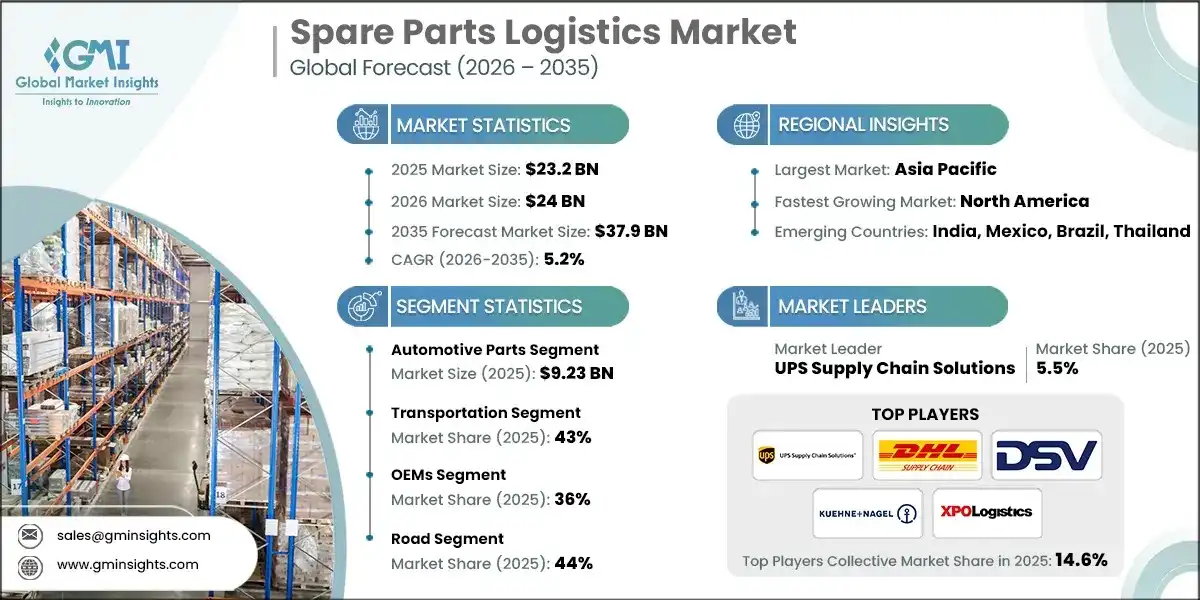
The global spare parts logistics market size was estimated at USD 23.2 billion in 2025. The market is expected to grow from USD 24 billion in 2026 to USD 37.9 billion in 2035, at a CAGR of 5.2% according to latest report published by Global Market Insights Inc.
Spare Parts Logistics Market Key Takeaways
Market Size & Growth
- 2025 Market Size: USD 23.2 Billion
- 2026 Market Size: USD 24 Billion
- 2035 Forecast Market Size: USD 37.9 Billion
- CAGR (2026–2035): 5.2%
Key Market Drivers
- Predictive Maintenance Adoption.
- E-commerce Parts Expansion.
- OEM Vertical Integration.
- Logistics Automation & Robotics.
- Increasing Equipment Electrification & Component Complexity.
Challenges
- High Inventory Complexity.
- Transportation Cost Volatility.
Opportunity
- Additive Manufacturing for Localized Production.
- AI-Driven Demand Forecasting.
- Expansion of Digital Marketplaces.
- Sustainability and Green Logistics.
Key Players
- Market Leader: UPS Supply Chain Solutions led with over 5.5% market share in 2025.
- Leading Players: Top 5 players in this market include UPS Supply Chain Solutions, DHL Supply Chain, DSV, Kuehne + Nagel, XPO Logistics, which collectively held a market share of 14.6% in 2025.
Get Market Insights & Growth Opportunities
The worldwide growth of fleets of automotive, industrial, and electronic equipment will cause many more scheduled and unscheduled maintenance events than previously expected. As this growth continues, the need for reliable spare-parts logistics networks capable of handling very high numbers of SKUs (stock keeping units), time-sensitive deliveries, and multi-tier distribution systems. To reduce operational downtime for businesses, fleets, and end-users.
OEMs (original equipment manufacturers) and logistics providers are accelerating their digital transformation of services to increase visibility, tracking, and forecasting capacity. New technologies, such as cloud platform, IoT sensors, and Real Time Analytics, make it possible to better plan inventory, fulfill orders more quickly, and eliminate errors when placing orders. This leads to improved efficiency and response times in spare-parts logistics and ultimately supports service-level agreements and uptime guarantees.
The current trend of online marketplaces for B2B (business-to-business) and B2C (business-to-consumer) parts has led to rapid shifts in customer demand patterns. In addition, new trends associated with eCommerce have caused logistics providers to begin focusing on providing smaller, more frequent, and geographically dispersed order deliveries. This has resulted in opportunities for faster delivery methods, enhanced last-mile operations, and the establishment of micro-fulfillment centers using advanced technologies to support various categories of parts being sold online.
In January 2024, Kuehne+Nagel acquired the Farrow Group for CHF 168 million, adding 830 employees and 41 locations across Canada and the US thus, strengthening their customs clearance capabilities associated with cross-border movements of spare parts. With this transaction, Kuehne+Nagel will now be able to effectively manage the increasingly complex customs requirements surrounding international shipments of Spare Parts.
IoT telemetry and machine-learning diagnostics are driving industries from a reactive maintenance approach to a more proactive predictive maintenance method. This change allows for early detection of part failures, leading to continued and enhanced proactive demand for spare parts. To meet this new predictive-done forecast, logistics will require improved forecasting accuracy, the use of distributed inventories, and ready access to all critical parts.
To get key market trends
Spare Parts Logistics Market Trends
Customers now expect quick access to critical components, especially in aerospace, automotive, and industrial maintenance. To meet this demand, many logistics companies are expanding their field-stocks locations, utilizing air networks, and developing route-optimization platforms that will allow them to provide same-day or same-hour delivery service. As a result, spare parts operations have transformed into fast-response and high-reliability networks.
In response to the increase of SKU counts and the speed of order processing, warehouses have begun implementing AS/RS systems, utilizing mobile robots, automated picking technology systems, and AI-based inventory placement tools. Automation increases accuracy, decreases labor dependency, and increases throughput; therefore, they are now capable of providing the fastest turnaround time for urgent orders with minimal delay and maximum service level agreements.
In May 2025, CEVA Logistics has reinforced its ongoing relationship with Magneti Marelli by signing a six-year extension for Italy (having been partners since 1993), and signing a five-year extension for Poland (having had a partnership since 2004). CEVA manages approximately 33,000 spare part shipments per year in Italy and over 50,000 different product references in Poland. To enhance both operational efficiencies and accuracy CEVA has made capital investments to develop automated conveyor systems and install mezzanine pick towers.
3D printing is becoming an increasingly popular approach to manufacturing low-volume, complex, and legacy parts and has provided an opportunity to decrease reliance on long-supply chains, especially globally. Localized additive manufacturing permits the shorter lead times for parts production and provides the ability to reduce inventory levels on demand and thus fundamentally changes existing spare parts stocking and distribution models and provides the opportunity for enhanced supply chain resilience.
AI/ML technologies are improving the accuracy of forecasting customer demand & safety stock levels and relying on real-time data generated by equipment sensors, parts consumption patterns, and the flow of logistics, companies can better optimize the location of their inventory to better prepare for service readiness and reduce working capital necessary to support excess inventory of slow-moving or obsolete parts.
Spare Parts Logistics Market Analysis
Learn more about the key segments shaping this market
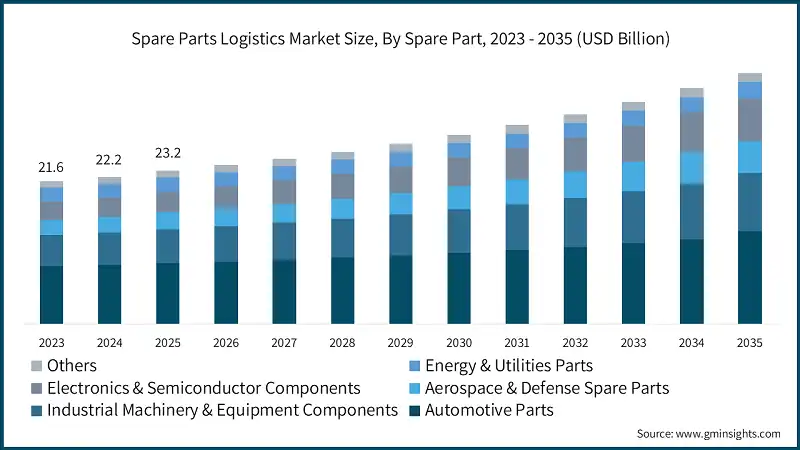
Based on spare part, the spare parts logistics market is segmented as automotive parts, industrial machinery and equipment components, aerospace and defense spare parts, electronics and semiconductor components, energy and utilities parts, others. Automotive parts accounted for USD 9.23 billion in 2025 at a CAGR of 4.5% from 2026 to 2035.
- The automotive parts logistics industry is experiencing growth due to the increasing number of vehicles on the road in the world, the increasing demand for older vehicles, and the rapid growth of online sales through e-commerce. The trend towards digital solutions will require faster shipment of finished goods to customers, more efficient ways to move products from warehouses to customers (i.e., last-mile efficiency), and the ability to use multiple warehouses in multiple locations. Original equipment manufacturers (OEMs) and aftermarket suppliers have heavily invested in developing automated warehousing systems and unified logistic platforms to adapt to evolving distribution models.
- The Industrial Machinery and Equipment Components segment provides vital support for all types of manufacturing, construction, agriculture, and material-handling systems where it is imperative to reduce downtime as much as possible. High-margin aftermarket service offerings create a strong need for streamlined and efficient logistics of spare parts. The growth of predictive maintenance has driven greater need for technologically capable suppliers of service solutions. Manufacturers are expanding their numbers of field stocking locations, vendor managed inventory systems, and rapid response capabilities to reduce equipment downtime while ensuring continued operation.
- Electronics and semiconductor logistics are driven by the rapidly changing product life cycles due to increased product development and obsolescence. Additionally, logistics providers must provide climate-controlled storage, antistatic protection, and precise tracking of components. Because of the high level of online sales activity, logistics providers can support global distribution of highly specialized components.
- The aerospace and defense industry requires extensive documentation, strict handling, and compliance with federal regulations. In cases when commercial aviation fleets need to quickly recover from emergencies resulting from aircraft on the ground, e-commerce logistics providers have responded to demands for rapid, premium logistics. Increasingly commercial aviation recovery efforts and defense fleet modernization have spurred growing demand for replacement parts. Many logistics providers move their parts distribution centers close to commercial airports and military bases to provide immediate support, so they must be reliable and meet all regulatory compliance standards.
Learn more about the key segments shaping this market
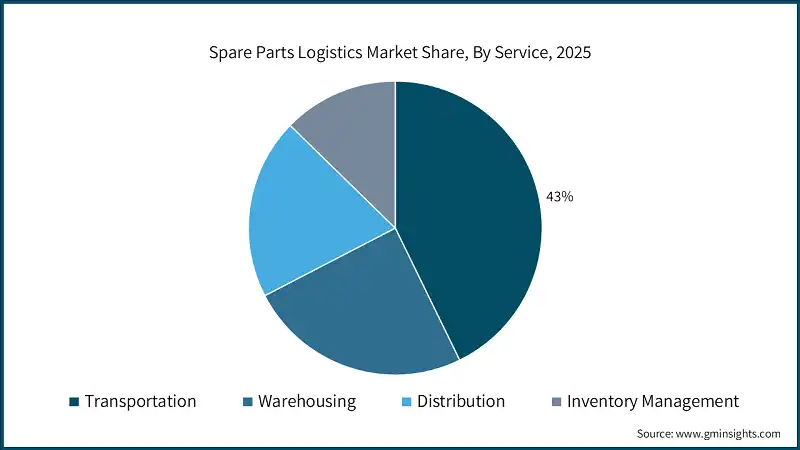
Based on service, the spare parts logistics market is fragmented as transportation, warehousing, distribution, inventory management. Transportation segment accounted for 43% market share in 2025 and is forecasted to grow at the CAGR of 6.4% from 2026 to 2035.
- Spare parts logistics are heavily dependent upon transportation services (i.e., truck, train, plane and ship). Supported by the growth of e-commerce, the faster demands of delivery and leaner inventory strategies, the need for transportation services to support spare-part logistics continues to expand. While various factors, including freight expense volatility and geopolitical disruption, present several challenges for service providers, providers continue to develop multimodal networks integrated with routing optimization software and capacity management systems to remain responsive and resilient.
- The warehousing sector is in the midst of a positive transformation through the use of new technology, such as robotics and automated material-handling systems and the addition of new types of storage. Automated systems create higher throughput rates along with improved accuracy and efficiency for employees, making them an attractive investment for global facilities. As a result of these changes, the rising demand for temperature-controlled, hazardous materials and other secure storage types will redefine operational processes for all providers. As service providers invest in state-of-the-art facilities, the operation of fast-paced and high-tech spare-part inventories will become more streamlined.
- Distribution is undergoing similar changes due to the increased expectations of e-commerce consumers for faster order processing. The competition between retailers has increased the reliance on third-party logistics providers as a competitive advantage, with third-party logistics providers now committed to offering next or same-day delivery. Distributed fulfilment networks, advanced order-management systems and innovative reverse-logistics solutions will play an important role in facilitating modern aftermarket and industrial-part flows.
- The complexity of an enterprise-wide inventory management solution is caused primarily by the multitude of network tiers and poor master data quality. In addition, inadequate visibility across all tiers of the supply chain has resulted in excess inventory, duplicate purchasing, or dramatically increased costs when stockouts occur. The integration of AI technology and advanced predictive maintenance capabilities are increasing accuracy and reducing inventory costing through improved stock positioning and assured availability of spare parts critical to the functioning of equipment.
Based on end-use, the spare parts logistics market is segmented into OEMs, aftermarket suppliers, dealerships, e-commerce platforms and others. OEMs accounted for 36% of the market share in 2025 and is forecasted to grow at the CAGR of 5% from 2026 to 2035.
- An OEM will use complex spare-parts supply chains to fulfill the requirements of their warranty and customers, authorized service centers, and end-users alike. The recognition of the potential profit from after-market parts sales is leading OEMs to invest heavily in integrated supply chain platforms, predictive analytics tools, and automated order replenishment systems. High-tech distribution centers are expanding as OEMs implement more advanced predictive maintenance systems to improve customer satisfaction and supply chain performance.
- After-market suppliers (including independents and remanufacturers) are benefiting from the aging global fleet of vehicles and equipment, the accelerating pace of digitalization, and the emergence of new distribution models due to the growing popularity of e-commerce. Many of these suppliers are working to develop and build out distributed fulfillment networks so they can increase their order fulfillment speed and compete directly with the OEMs. This segment of the market continues to grow due to the rapid increase in online sales and the global demand for automotive after-market parts.
- In addition to their importance as OEM service channels, dealerships must also ensure that they provide an ongoing supply of the required parts for ongoing maintenance activities. As OEMs have experienced increasing competition in e-commerce from online retailers, they have shifted their business models toward the adoption of digital ordering, offering consumers same-day delivery capabilities and mobile service options. Predictive maintenance for connected vehicle fleets allows OEMs to proactively plan for parts needs; however, OEM transition toward electric vehicle fleets has resulted in changes in the way dealerships service their customers.
- As e-commerce continues to expand, e-commerce platforms will continue to proliferate thanks to digital parts catalogs, direct-to-consumer sales channels, and international marketplace entry. Consumers' increasing expectations for same-day and next-day deliveries are creating demand for localized inventories and development of advanced last-mile delivery capabilities. Investment in infrastructure, such as developing a network of dense fulfillment centers, will enable continued growth while, at the same time, creating an increased volume of reverse-logistics, requiring an increased level of attention to processing and managing returns.
Based on transportation mode, the spare parts logistics market is segmented into road, rail, air, and sea. Road segment accounted for 44% of the market share in 2025 and is forecast to grow at the CAGR of 5.6% from 2026 to 2035.
- Utilizing road transportation for the delivery of regional and national spare parts provides an advantage in terms of flexibility, quick transit through use of door-to-door services, and last mile delivery due to eCommerce. Various types of land transport providers are now using electric vehicles, alternative fuel options (e.g., LPG), digital technologies for route optimization, and real time tracking to improve efficiencies, sustainability and reliability.
- Utilizing sea transport enables cost-effective, high-volume international transport of spare parts, especially for the automotive, industrial and energy sectors. Although sea freight is affected by issues such as capacity constraints, route disruptions and price volatility, it continues to serve as an essential element of intercontinental logistics. Strategic planning and risk management continue to provide assurance to maintain continuity in the global supply chain for the distribution of spare parts.
- Rail transport is an economical, sustainable transport method for inland transit over the medium and long haul in the same region. Rail transport serves important functions as part of the supply chain between manufacturers and distribution centers when transporting auto and industrial components. When combined with other modes such as trucking, can enable rail transport operators to offer coverage across a broader customer base. Investment into the rail transport infrastructure will provide a more reliable and longer reach for logistics of spare parts in developing countries.
- Air freight is the quickest form of international freight transportation, particularly for high value and urgent spare parts (i.e., aerospace, semiconductor, and emergency industrial parts). E-commerce growth is putting more pressure on air logistics operations to keep up. Therefore, companies are expanding their fleets and converting aircraft to dedicated cargo carriers and accommodating temperature-controlled handling, as well as leveraging their experience and knowledge of customs, to provide global, fast, and reliable delivery.
Looking for region specific data?
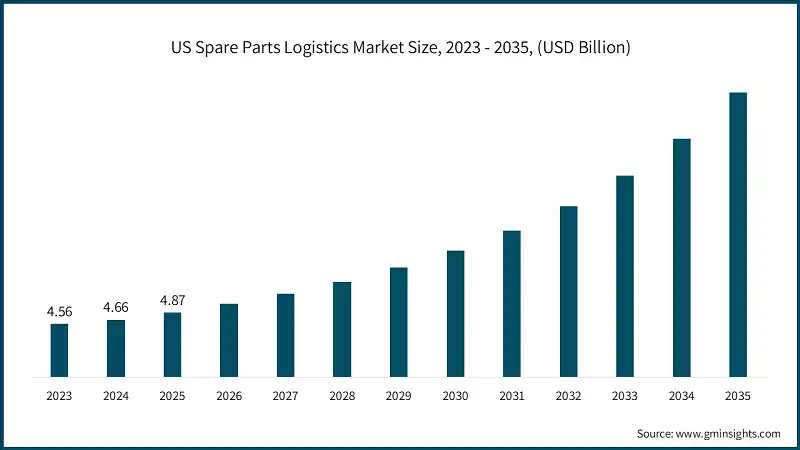
The spare parts logistics market in US dominates regional revenue with approximately 86% share in 2025. The market in US held a revenue of USD 4.87 billion in 2025.
- Rising E-commerce growth is creating a need for more fulfilment facilities across multiple cities and same day delivery of spare parts. To satisfy consumer expectations and strengthen aftermarket service capabilities, logistics companies are investing in urban micro fulfilment centers, route optimization technologies and advanced tracking systems that can be used across many different industries.
- In the US, logistics companies are deploying more electric and autonomous vehicles to reduce operating costs and emissions. The integration of AI-based fleet management systems will improve operational efficiency and safety while also enhancing sustainable practices and meeting regulatory requirements for the responsible shipping of spare parts.
- The US is also using artificial intelligence, machine learning and predictive analytics to enhance spare part logistics within the supply chain. This technology can improve the optimization of multi-tier inventory and demand forecasting, while also minimizing stock-outs. Real-time visibility and efficient replenishment capabilities, along with the ability to proactively meet aftermarket service delivery needs of OEM and industrial clients, are supported through digital platforms.
- To mitigate the impact of disruptions to the supply chain from natural disasters, labor strikes and global political volatility; companies are diversifying their supply sources, increasing their safety stocks and utilizing scenario planning strategies to proactively prepare for future events. Investments in flexible transportation and multimodal networks will ensure continuity of the flow of critical spare parts.
North America accounts for 24% market share in 2025 and is expected to reach 9.19 billion by 2035.
- The spare-parts logistics market in North America is uniquely positioned to take advantage of a significant fleet of older vehicles, an increasingly complex transportation network, and a high level of penetration of e-commerce into the marketplace; consequently, providers use the strong, established infrastructure to provide efficaciously for both return flow of products and for the cross-border movement of products. Thus, providers are optimizing their supply chain networks with respect to the provision of reliable aftermarket services and the fulfillment of industrial parts.
- Warehouse automation, robotics, and digital platforms are utilized extensively to improve throughput, accuracy, and inventories for providers of spare-parts logistics. Large logistics providers utilize these same technologies to enhance upon their temperature-controlled, high-value, and cross-border spare parts businesses and services as well as provide expedite fulfillment and enable predictive maintenance integration to customers, additionally, this technology enhances the providers' ability to provide a green reverse-logistics capability for their customers.
- Additionally, based upon economic growth through e-commerce, acquisitions, logistics network enhancements, and specialized reverse logistics and temperature-controlled capabilities, providers of spare-parts logistics are growing in North America. Conversely, providers of spare-parts logistics are impacted by significant volatility in transportation costs and significant capacity constraints as relates to the road and air freight transportation segments, therefore, providers of spare-parts logistics must develop a strategic plan and multi-modal flexibility to ensure continued service and competitiveness in the market for spare parts logistics.
The spare parts logistics market in Europe accounted for USD 4.12 billion in 2025. The region holds 18% market share in 2025 and is expected to grow at CAGR of 3.9% between 2026 to 2035.
- The spare parts logistics industry in Europe benefits from a well-established automotive and industrial manufacturing foundation, an advanced and sophisticated transportation network within Europe, and a high penetration of e-commerce. The combination of aging vehicle fleets and more advanced manufacturing processes continues to provide steady demand for spare parts, while stringent environmental regulations continue to push companies to adopt more sustainable logistics processes within their warehousing, transportation, and reverse logistics.
- As a result of these trends, providers in Europe continue to roll out electric trucks, zero emission fleets, and integrated automation technologies. The use of robotics, route optimization, and artificial intelligence-based inventory management is increasing efficiency, reducing carbon emissions, and positioning Europe as a leader in sustainable and high-precision spare parts logistics for the automotive, industrial, and high value component sectors.
- As well as continuing to be driven by the above trends, Europe is also seeing significant consolidation within the industry, i.e., DSV’s acquisition of DB Schenker. In addition, there is continuing development of large and integrated logistics networks with much more operational synergies between individual companies. However, Europe is experiencing strong growth in e-commerce and infrastructure development, while adverse economic conditions, Brexit related trade barriers, and disruptions to transportation networks continue to present challenges thus the need for flexible multimode strategies is critical to sustaining service continuity and competitiveness.
Germany leads European growth, accounting for approximately 33% of regional revenue in 2025.
- The German manufacturing industry is beginning to integrate smart sensors, IoT, and automated material handling systems into spare-parts supply chains. Devices enable real-time monitoring of production activities, predictive maintenance, and connected factories, which can improve inventory accuracy, reduce downtimes, and increase efficiency in the distribution of automotive and industrial components.
- The German logistics industry is focused on using low-emission transport vehicles, electrified fleet vehicles, and energy-efficient warehouses. The regulatory requirements concerning carbon emissions and the environmental, social, and governance (ESG) commitments made by companies are driving carbon-reduction strategies, the use of renewable energy, and eco-friendly packaging in order to create sustainable supply chains for spare parts distribution.
- The transition to electric vehicles requires new spare-parts logistics processes to handle specialized spare parts such as batteries, thermal management systems, and high-voltage components. To create distribution networks that can support e-mobility, both secure storage and temperature-controlled transportation will be needed, along with personnel with the technical expertise required to support these services.
- To address the higher complexity of their SKU set, Germany is investing heavily in using robots and automated picking systems, along with AI-driven warehouse operations. By implementing these systems, OEMs and aftermarket suppliers will be able to achieve higher levels of throughput and reduced reliance on manual labor while ensuring that their spare parts are delivered faster and with fewer errors.
Asia Pacific held a value of USD 10.08 billion in 2025 and is expected to grow at CAGR of 6.5% between 2026 to 2035.
- The spare-parts logistics market in Asia Pacific is now the largest in the world due to the rapidly increasing number of vehicles, expanding industrialization, and consumer demand for spare parts. The growth of this market primarily comes from China, India, and Southeast Asia while Japan and South Korea represent more mature, technologically advanced markets. These two different types of markets result in a significant collective demand for spare-parts distribution and aftermarket services in the region.
- Due to this growing need for spare-part logistics, the Asia Pacific is investing heavily in warehouse automation (including robotics) and digital logistics. The rate of adoption will continue to grow, and by 2027, many of the warehouses within the region will be partly or fully automated. Many logistics providers use predictive maintenance, AI-assisted inventory management, and Internet of Things-based real-time tracking to optimize efficiency, accuracy, and responsiveness within complicated spare-part networks.
- To meet the demand for new markets in Southeast Asia, many logistics providers are investing in acquiring companies and regional hubs. The investments are centered around developing multinational distribution networks, creating infrastructure within Southeast Asia and China, and implementing automated systems to facilitate same-day delivery, cross-border commerce, and the increasing need for e-mobility as well as industrial spare-part logistics.
The spare parts logistics market in China is estimated to hold market revenue of USD 4.57 billion in 2025 and is expected to experience significant and promising growth from 2026 to 2035.
- China's online parts sales are rapidly expanding. To keep pace with the increasing volume of aftermarket and industrial demand, various digital sales channels (digital marketplaces, direct-to-consumer) and cross-border e-commerce, will need to support a distributed fulfillment network, provide quicker last mile delivery solutions and incorporate integrated return solutions.
- To reduce lead times and reliance on long-distance supply chains, China is developing multi-node production hubs. By creating localized distribution networks, Chinese manufacturers are able to provide more rapid restocking and enhanced service levels for automotive, industrial, and electronics spare parts.
- With the use of automated sorting systems, robotic pickers, and AI-enabled inventory management systems, China's spare parts logistics are changing. Service providers are integrating intelligence and automation into a smart warehouse network to manage a higher volume of SKU diversity, improve accuracy, and provide a more rapid fulfilment of e-commerce and industrial parts.
- To further enhance the connectivity of the spare parts network, China continues to invest heavily in the development of expressway networks, high-speed rail freight, and inland ports, which will facilitate more efficient and timely transportation between regional manufacturing hubs while reducing overall transit times, subsequently strengthening both domestic and export supply chain resiliency.
Latin America held spare parts logistics market revenue of USD 2.5 billion in 2025 and is expected to experience significant and promising growth from 2026 to 2035.
- The trend of increasing online sales of Automotive Parts and Industrial Spare Parts requires companies to invest in distributed fulfillment centers, last mile delivery operations, and integrated Order Management Systems (OMS). It also forces Logistics Providers to use Digital Platforms for better visibility to inventory levels as well as ease of use when shipping cross-border and being more responsive to growing consumer demand for both Industrial and Consumer products.
- Governments and Private Entities are investing in Building New Roads, Ports, and Intermodal Logistics Systems that connect various regions to each other. All of these improvements allow for Faster and More Reliable distribution of Spare Parts to end users, which reduces Transit Times and allows Original Equipment Manufacturers' (OEM) as well as Aftermarket Suppliers to continue to grow their businesses into Urban and Emerging Markets.
- The automotive manufacturing industry, as well as the aftermarket sector, are led by both Brazil and Mexico (the automotive manufacturing industries are concentrated in both countries; however, Brazil leads in the amount of automotive manufacturing, while Mexico leads in access to and use of the American market). This concentration of resources provides regional supply-chain opportunities for improved supply-chain efficiency, as well as opportunities for trade and distribution of spare parts across the US and Canada.
- There are several obstacles to the development of spare-parts logistics, including economic instability, complex regulations, and inadequate infrastructure. The market is growing at a rapid rate due to improved foreign direct investment into Latin America, increased trade agreements between the United States and Mexico, and improved logistics infrastructure across Latin America.
The MEA spare parts logistics market is projected to grow at a CAGR of 3.5% from 2026 to 2035 and held a market share of around 4% in 2025.
- MEA has a mix of mature GCC markets with large infrastructure investments and high levels of vehicle ownership, as well as African developing markets. As such, there are different logistical strategies required to meet the needs of both the established high-volume areas and developing regions where there is an increasing need for spare parts.
- The GCC region is primarily made up of the UAE and serves as a logistics hub for the greater Middle East and African markets. Ford has established facilities like their distribution center in Dubai that support customers throughout the region and utilizes technological advancements such as drone monitoring and WMS systems to enhance efficiency and coverage.
- The region's economy will be impacted by a number of factors including continued population growth, urbanization, and economic growth which will create many long-term opportunities for spare-parts logistical services. It is likely that money will be invested in building distribution networks, automating warehouses, and improving service levels.
Spare Parts Logistics Market Share
- The top 7 companies in the spare parts logistics industry are UPS Supply Chain Solutions, DHL Supply Chain, DSV, Kuehne + Nagel, XPO Logistics, DB Schenker, CEVA Logistics contributing around 15.9% of the market in 2025.
- UPS Supply Chain Solutions global network integrates all package delivery services, freight forwarding services, and contract logistics into one. Through an extensive number of field stocking locations, UPS provides one place to source end-to-end spare parts services: warehousing, transportation, inventory management, and distribution. Temperature-controlled logistics and advanced temperature control equipment are integrated to provide supply chain management using technology.
- DSV integrated new Partnership with DB Schenker has become one of the world's largest logistics providers with a combined global reach. Through their combined network of warehousing and distribution centers and their extensive use of technology, they have built a world-class operation that provides complete solutions for spare-part logistics via multiple modes of transport including sea, air, road, and rail. The integration of DSV and Schenker is primarily focused on improving operational synergies, optimizing the network, and providing more extensive service offerings within the industrial, automotive, and technology markets.
- XPO Logistics provides highly responsive spare-parts logistics through advanced warehousing, real-time tracking, and final-mile delivery capabilities. Its technology-driven network supports rapid replenishment, inventory optimization, and time-critical service parts distribution for industrial, automotive, and heavy-equipment manufacturers across North America and Europe.
- DB Schenker delivers end-to-end spare-parts logistics using its global network of warehouses, transport modes, and integrated digital platforms. Its capabilities include time-critical deliveries, vendor-managed inventory, and optimized replenishment, supporting OEMs and aftermarket customers in automotive, industrial machinery, and technology sectors worldwide.
- CEVA Logistics offers specialized spare-parts logistics through dedicated service-parts centers, global transport management, and rapid response solutions. Its expertise in aerospace, automotive, and industrial markets ensures reliable parts availability, reverse logistics efficiency, and technology-enabled visibility across global supply chains.
- DHL Supply Chain includes a large investment in Warehouse automation through technology using Robotics and AI. DHL also has a very well-established network for reverse logistics that eliminates waste that would otherwise go to landfills. Their Global reach, industry expertise, and use of innovative approaches to achieve cost reductions and productivity improvements continue to position DHL as a leader in Automotive, Industrial, and Technology spare parts logistics.
- Kuehne + Nagel operates one of the world’s largest global logistics networks supporting an extensive number of warehousing, cross-border services, and global shipping capabilities. Kuehne + Nagel has strengthened their inland transportation, marine drayage, and customs clearance service offerings through several strategic acquisitions in North America and Asia. Additionally, Kuehne + Nagel has a strong commitment to expanding their operations in their growth regions and providing integrated solutions to support spare parts logistics for Kuehne + Nagel's key growth markets.
Spare Parts Logistics Market Companies
Major players operating in the spare parts logistics industry are:
- CEVA Logistics
- DB Schenker
- DHL Supply Chain
- DSV Panalpina
- GXO Logistics
- Kuehne + Nagel
- Penske Logistics
- Ryder
- UPS Supply Chain Solutions
- XPO Logistics
- DHL Supply Chain's extensive spare parts logistics capabilities exist across industries like automotive, industrial and technological. Through investments in warehouse automation; robotics; and extensive digital platforms to improve overall efficiency. The return network allows for a multi-client strategy in the reverse logistics environment, and its ongoing efforts to reduce costs and optimize networks through greater reliance on automation and standardization have resulted in both increased levels of service and profitability.
- UPS Supply Chain Solutions now offers end-to-end spare parts logistics services as part of an integrated global network that includes package delivery via ground through freight forwarding to contract logistics. Additionally, UPS has many locations for field stocking across the globe and also manages temperature-sensitive distribution. UPS continues to enhance their capabilities in service lines for both healthcare industry and industrial supplies through strategic acquisitions and leveraging advanced technology platforms; to provide reliable, scalable, and technology enabled solutions; worldwide.
- Through the integration of DSV-DB Schenker as one of the largest global providers of logistics services for spare parts logistics, the logistics of spare parts is comprehensive, covering sea, air, road and rail; with logistics capabilities supported by an extensive global warehousing/distribution network; and continued presence in Europe and with a growing presence in Asia pacific and North America, as well as the continued integration of both companies to create synergies operationally with new service offerings.
Spare Parts Logistics Market Report Attributes
| Key Takeaway | Details |
|---|---|
| Market Size & Growth | |
| Base Year | 2025 |
| Market Size in 2025 | USD 23.2 Billion |
| Market Size in 2026 | USD 24 Billion |
| Forecast Period 2026-2035 CAGR | 5.2% |
| Market Size in 2035 | USD 37.9 Billion |
| Key Market Trends | |
| Drivers | Impact |
| Predictive Maintenance Adoption | Predictive maintenance creates earlier, more accurate parts-replacement triggers, stabilizing demand patterns and reducing emergency shipments. It pushes logistics providers to support proactive planning, enhance visibility platforms, and maintain strategically positioned inventory to meet uptime commitments across industrial, automotive, and aerospace environments. |
| E-commerce Parts Expansion | Accelerating online parts sales drive fragmented, high-frequency order patterns, demanding flexible fulfilment, micro-warehousing, and robust last-mile delivery. Logistics providers must adapt to smaller shipment batches, rapid delivery expectations, and complex SKU management to stay competitive in digital aftermarket channels. |
| OEM Vertical Integration | OEMs strengthening aftermarket control increase direct distribution, reduce reliance on intermediaries, and demand higher service-level performance. This shifts logistics contracts toward integrated, long-term partnerships and encourages investment in centralized hubs, field-stocking locations, and digital systems aligned with OEM service strategies. |
| Logistics Automation & Robotics | Automation improves throughput, accuracy, and labour efficiency across spare-parts networks. Its adoption enables faster order cycling, improved traceability, and reduced fulfilment errors, supporting the high urgency nature of service-parts logistics while lowering operational costs and enhancing overall supply-chain responsiveness. |
| Increasing Equipment Electrification & Component Complexity | Electrification in vehicles, machinery, and industrial systems introduces new high-value components and specialized parts with shorter service cycles. This increases demand for precise inventory management, temperature-controlled logistics, and skilled handling, creating new revenue streams and elevating the strategic importance of specialized spare-parts networks. |
| Pitfalls & Challenges | Impact |
| High Inventory Complexity | Large SKU counts, irregular demand patterns, and long-tail items raise holding costs and complicate forecasting. This strains warehouse capacity, increases obsolescence risk, and pushes logistics providers to adopt advanced planning tools or risk service gaps and elevated operational inefficiencies. |
| Transportation Cost Volatility | Fuel price swings, capacity shortages, and geopolitical disruptions inflate transportation costs and reduce delivery reliability. These pressures limit margins, force pricing adjustments, and require ongoing optimisation of mode selection, routing, and consolidated networks to stabilize service performance. |
| Opportunities: | Impact |
| Additive Manufacturing for Localized Production | On-demand 3D printing reduces reliance on long global chains, shortens lead times, and lowers safety-stock requirements. Logistics providers can reposition capabilities toward last-mile distribution, digital spare-parts libraries, and high-value rapid manufacturing partnerships with OEMs and industrial customers. |
| AI-Driven Demand Forecasting | AI enhances prediction accuracy for irregular parts consumption, reducing stockouts and excess inventory. Better visibility supports optimized inventory placement and improves service-level performance, enabling logistics players to differentiate through reliability and lower working capital burdens for customers. |
| Expansion of Digital Marketplaces | Growing B2B/B2C platforms create opportunities for logistics providers to integrate fulfilment, visibility, reverse logistics, and SLA-based delivery options. This supports new revenue streams and deepens provider roles across the value chain as digital channels capture larger aftermarket shares. |
| Sustainability and Green Logistics | Demand for low-emission transport and energy-efficient warehouses opens opportunities for providers adopting EV fleets, route optimization, reusable packaging, and carbon-tracking tools. These capabilities strengthen competitive positioning as customers increasingly prioritize environmentally responsible supply-chain partners. |
| Market Leaders (2025) | |
| Market Leaders |
held 5.5% market share in 2025 |
| Top Players |
Collective market share in 2024 is Collective market share in 2025 is 14.6% |
| Competitive Edge |
|
| Regional Insights | |
| Largest Market | Asia Pacific |
| Fastest Growing Market | North America |
| Emerging Country | India, Mexico, Brazil, Thailand |
| Future Outlook |
|
What are the growth opportunities in this market?
Spare Parts Logistics Industry News
- In April 2025, DSV completed its purchase of DB Schenker to create one of the most prominent logistics companies worldwide with an extensive international footprint and multi-modal logistics capabilities. Efforts to combine the two companies will concentrate on providing operational synergies and improving spare parts logistics services in Europe, North America and Asia Pacific. Implementation of these integrations will be staggered through 2028.
- UPS Supply Chain Solutions acquired Andlauer Healthcare Group in April 2025. The transaction will improve temperature-controlled logistics and distribution of healthcare spare parts. The added resources that UPS has gained from this acquisition will give them the capability to help pharmaceutical, biotechnology and medical device manufacturers manage the specialized handling, reliable delivery and all-inclusive management of high-value and/or sensitive products throughout their entire supply chain.
- In April 2025, XPO Logistics achieved a major milestone for its European operations when it surpassed 2 million kilometers driven using electric trucks, indicating large-scale deployment of zero-emissions vehicles in the warehousing and transportation sectors. Success shows that XPO is dedicated to sustainable logistics through the implementation of electric vehicles into their commercial supplies and industrial transportation networks.
- DHL Supply Chain launched the ReTurn Network in North America in October 2025. The ReTurn Network is a reverse logistics platform that enables multi-client usage of specialized facilities along with proprietary processing of returned goods through a ReSKU identification method. This network provides the opportunity to increase operational efficiency while diverting waste from landfills and lowering costs for its customers through the shared use of facilities and optimization of reverse logistics process capabilities.
The spare parts logistics market research report includes in-depth coverage of the industry with estimates & forecasts in terms of revenue ($Bn) from 2021 to 2034, for the following segments:
Market, By Spare Part
- Automotive parts
- Engine components
- Pistons
- Filters
- Others
- Transmission and drivetrain parts
- Brakes
- Suspension
- Steering systems
- Body and exterior components
- Electrical and electronic systems
- Aftermarket consumables
- Engine components
- Industrial machinery & equipment components
- Manufacturing machinery parts
- Motors
- Gears
- Belts
- Construction equipment components
- Excavators
- Loaders
- Agricultural machinery parts
- Tractors
- Harvesters
- Material handling and logistics equipment components
- Hydraulic, pneumatic, and mechanical subsystems
- Manufacturing machinery parts
- Aerospace & defense spare parts
- Aircraft components
- Defense vehicle parts
- Ground support and maintenance equipment
- Electronics & semiconductor components
- Semiconductor devices
- Telecommunications equipment components
- Energy & utilities parts
- Others
Market, By Service
- Transportation
- Warehousing
- Distribution
- Inventory management
Market, By End Use
- OEMs
- Aftermarket suppliers
- Dealerships
- E-commerce platforms
- Others
Market, By Transportation mode
- Road
- Rail
- Air
- Sea
The above information is provided for the following regions and countries:
- North America
- US
- Canada
- Europe
- Germany
- UK
- France
- Italy
- Spain
- Russia
- Nordics
- Netherlands
- Asia Pacific
- China
- India
- Japan
- ANZ
- Singapore
- Thailand
- Vietnam
- South Korea
- Latin America
- Brazil
- Mexico
- Argentina
- MEA
- South Africa
- Saudi Arabia
- UAE
Frequently Asked Question(FAQ) :
What was the market size of the spare parts logistics in 2025?
The market size was USD 23.2 billion in 2025, with a CAGR of 5.2% expected through 2035. The growth is driven by the increasing demand for reliable logistics networks to support expanding fleets in automotive, industrial, and electronic sectors.
What is the projected value of the spare parts logistics market by 2035?
The market is poised to reach USD 37.9 billion by 2035, fueled by advancements in automation, AI-based inventory management, and the growing need for time-sensitive deliveries.
What is the expected size of the spare parts logistics industry in 2026?
The market size is projected to reach USD 24 billion in 2026.
What is the expected size of the automotive parts segment in 2025?
The automotive parts segment accounted for USD 9.23 billion in 2025, with a projected CAGR of 4.5% from 2026 to 2035.
How much market share did the transportation segment hold in 2025?
The transportation segment held a 43% market share in 2025 and is forecasted to expand at a CAGR of 6.4% till 2035.
What was the market share of OEMs in 2025?
OEMs accounted for 36% of the market share in 2025, with a projected growth rate of 5% up to 2035.
Which region dominated the spare parts logistics sector?
The U.S. dominated the regional market with an 86% revenue share in 2025, amounting to USD 4.87 billion. The growth is attributed to rising e-commerce demand, investments in urban micro-fulfillment centers, and advancements in route optimization technologies.
What are the key trends in the spare parts logistics market?
Trends include automation with AS/RS, mobile robots, and AI tools, growing use of 3D printing, AI/ML-driven forecasting, rising same-day delivery, and stronger supply chain resilience efforts.
Who are the major players in the spare parts logistics industry?
Major players include CEVA Logistics, DB Schenker, DHL Supply Chain, DSV Panalpina, GXO Logistics, Kuehne + Nagel, Penske Logistics, Ryder, UPS Supply Chain Solutions, and XPO Logistics.
Spare Parts Logistics Market Scope
Related Reports