Summary
Table of Content

Space lander and Rover Market
Get a free sample of this report
Form submitted successfully!
Error submitting form. Please try again.
Thank you!
Your inquiry has been received. Our team will reach out to you with the required details via email. To ensure that you don't miss their response, kindly remember to check your spam folder as well!
Request Sectional Data
Thank you!
Your inquiry has been received. Our team will reach out to you with the required details via email. To ensure that you don't miss their response, kindly remember to check your spam folder as well!
Form submitted successfully!
Error submitting form. Please try again.
Space lander and Rover Market Size
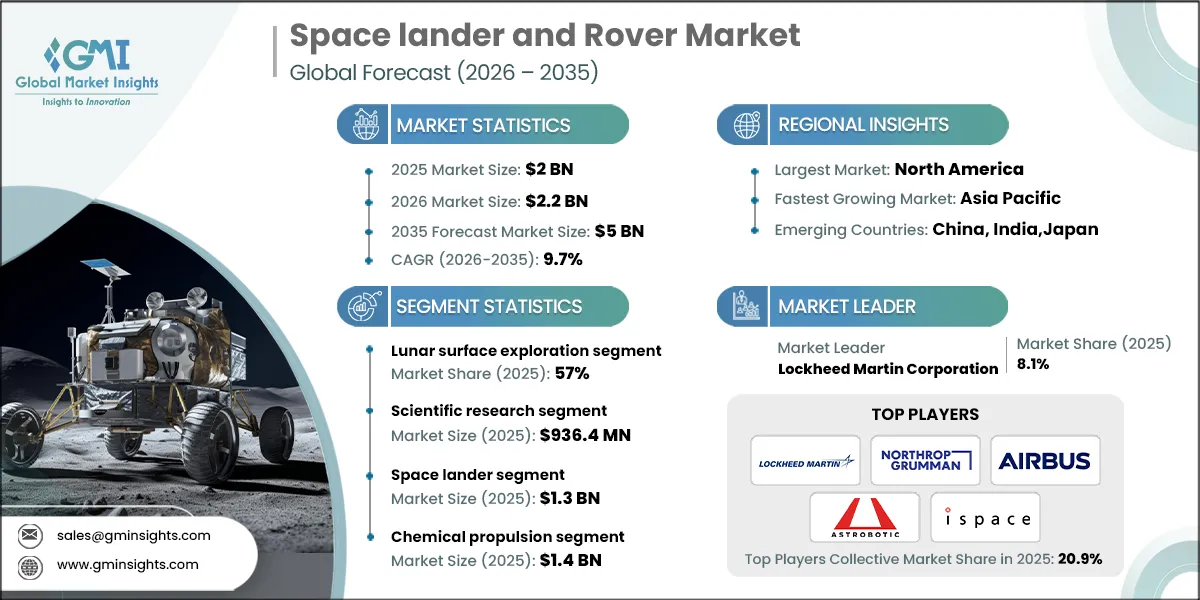
The global space lander and rover market was valued at USD 2 billion in 2025. The market is expected to grow from USD 2.2 billion in 2026 to USD 3.4 billion in 2031 and USD 5 billion in 2035, at a value CAGR of 9.7% during the forecast period according to the latest report published by Global Market Insights Inc.
Space lander and Rover Market Key Takeaways
Market Size & Growth
- 2025 Market Size: USD 2 Billion
- 2026 Market Size: USD 2.2 Billion
- 2035 Forecast Market Size: USD 5 Billion
- CAGR (2026–2035): 9.7%
Regional Dominance
- Largest Market: North America
- Fastest Growing Region: Asia Pacific
Key Market Drivers
- Surging Global Interest in Lunar and Martian Exploration Missions.
- Technological Advancements in Autonomous Navigation and Mobility Systems.
- Private Sector Investment and Expansion in Space Exploration Technologies.
- Governmental Commitments to Long-Term Lunar and Mars Colonization Plans.
- Development of In-Situ Resource Utilization (ISRU) Capabilities for Space Exploration.
Challenges
- High Development Costs and Technological Complexity.
- Risks of Mission Failures Due to Harsh Extraterrestrial Environments.
Opportunity
- Development of Sustainable Space Habitats.
- Advancements in Autonomous Technology for Exploration.
Key Players
- Market Leader: Lockheed Martin Corporation led with over 8.1% market share in 2025.
- Leading Players: Top 5 players in this market include Lockheed Martin Corporation, Northrop Grumman Corporation, Airbus SE, Astrobotic Technology, ispace, inc., which collectively held a market share of 20.9% in 2025.
Get Market Insights & Growth Opportunities
The space lander and rover market are expected to benefit from several factors which will result in a significant increase in market size; these include accelerating global interest in lunar and mars exploration mission, the advancement of technology in autonomous navigation and mobility systems, increased investment and expansion of new technologies by private industry for space exploration and long-term commitments from governments to establish permanent colonies on the moon and Mars and develop in-situ resource utilization (ISRU) capabilities for space exploration.
The increasing global commitment towards lunar and Mars exploration, whether from governmental space agencies or private companies, has resulted in an increase in demand for advanced landers and rovers. This increased demand ultimately drives the growth of the overall market by encouraging innovation in spacecraft design and the development of new mobility systems. For example, NASA's budget for the Artemis Program will increase from USD 7,666 million in FY 2025 to USD 8,313 million in FY 2026, representing a significant increase in investment for lunar and Mars exploration that will further stimulate the demand for space landers and rovers.
Commercial investment in space exploration technology is fostering rapid innovation. New, lower-cost and improved performing landers and rovers will result from the growing knowledge base created by this continued support from private companies such as SpaceX and Blue Origin. Furthermore, as the space industry grows through private sector investment, companies will develop additional capability to provide newer technology on spacecraft. NASA also reports that global private investments in space technology increased by USD 7.4 billion in 2024, an increase of about 6 percent from 2023, and demonstrates an increased level of confidence in and funding for the future exploration of space and expanding opportunities for the lander and rover industries.
Between 2022 and 2024, the space lander and rover market witnessed considerable growth, increasing from USD 1.5 billion in 2022 to USD 1.8 billion in 2024. In addition, the new technologies developed based on artificial intelligence (AI), machine learning (ML), and autonomous navigation systems are improving both space landers and rovers. A prime example is NASA's most recent Mars rover called Perseverance, which uses AI and ML to autonomously identify minerals within Martian rocks. This will represent the first real-time AI analysis performed on Mars. Using AI and ML will allow for increased capabilities for landers and rovers to operate in a more efficient manner by requiring less by Human Interface for navigation of complex geological landscapes.
To get key market trends
Space lander and Rover Market Trends
- Miniaturization is an increasing trend within the space lander / rover area. The objective of this trend is to create smaller and lighter systems that not only reduce the cost of launching a lander/rover but also increase the efficiency of space exploration missions. This trend was initiated by NASA, ESA and many private industry companies in the early 2010s, and as a result, they are aware of the potential for frequent and low-cost planetary exploration of their lands/rovers. ESA states that micro-rovers weighing less than 10 kg provide an optimal mass-to-cover ratio that allows for optimal scientific operations. It is expected that this trend will reach its maximum benefit around the mid-2030s, with future advances in technology.
- The trend of in situ resource utilization (ISRU) gained momentum during the 2010s, due to the Artemis program by NASA and Mars programs. The objective of ISRU is to use the local resources of oxygen, water and fuel to reduce the number of supplies that need to come from Earth. NASA states that ISRU on Artemis will produce multiple tons of oxygen and hydrogen propellant during its first year of operation on the lunar surface. These resources will help to create a self-sufficient and reduced-cost environment for human growth. It is expected that this trend will also reach its maximum benefit in the 2030s as the basis for building long-term lunar bases and preparing for human missions to Mars.
- The trend of energy efficiency in space rovers gained momentum in the late 2010s, driven by missions like NASA's Perseverance rover. An increasing emphasis has been placed on developing a system in these tough environments, where reliable, low-energy use will be critical for longer mission duration. With NASA's Artemis and Mars programs, advanced solar panels, lightweight batteries, and nuclear sources have all been incorporated. As stated by NASA's Jet Propulsion Laboratory, currently, one viable way of powering long-duration rover missions is by way of the Multi-Mission Radioisotope Thermoelectric Generator (MMRTG) system, which can generate 110 watts and weigh 45 kilograms, and is expected to be more widely used for future missions by the early 2030s.
Space lander and Rover Market Analysis
Learn more about the key segments shaping this market
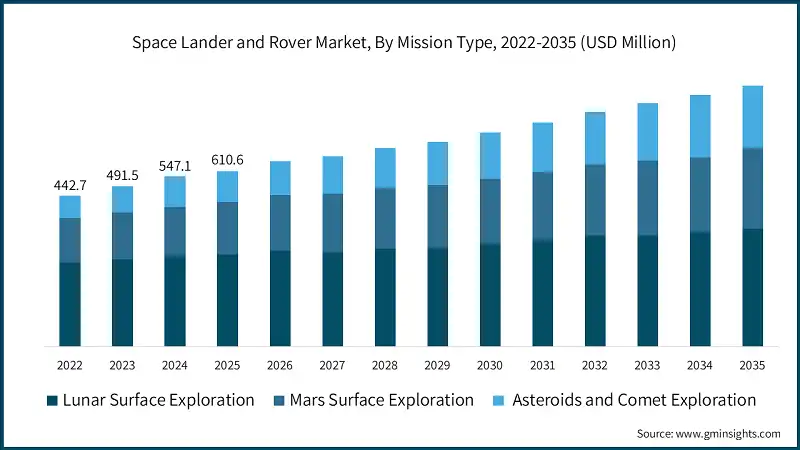
The global market was valued at USD 1.5 billion and USD 1.7 billion in 2022 and 2023, respectively. The market size reached USD 2 billion in 2025, growing from USD 1.8 billion in 2024.
Based on the mission type, the global space lander and rover market is divided into lunar surface exploration, mars surface exploration & asteroids and comet exploration. The lunar surface exploration segment accounted for 57% of the market in 2025.
- The exploration of the Moon has many different mission types. Primarily government-sponsored (e.g., NASA's Artemis Program), but also growing participation from the private sector, and increasing technological capabilities of autonomous landers, rovers, and systems for extracting and utilizing lunar resources.
- Manufacturers of the lunar surface exploration mission type should focus their attention on the development of advanced autonomous landers, rovers, and technology for extracting and utilizing lunar resources to support lunar exploration missions, such as those developed by NASA's Artemis Program, in a manner that is efficient, cost-effective, and sustainable for the challenging extreme environments found on the lunar surface.
- The mars surface exploration segment was valued at USD 610.6 million in 2025 and is anticipated to grow at a CAGR of 11.9% over the forecast years, driven by ambitious NASA Mars surface exploration missions (e.g., Perseverance), by advances in technology for producing and supporting autonomously operated vehicles, and by interest in using the resources of Mars to establish a human presence on Mars.
- Manufacturers of Mars surface exploration mission types should be focusing their efforts on the development of durable, reliable autonomous landers and rovers that possess improved mobility, energy efficiency, and in-situ resource utilization capabilities, to ensure the long-term success of Mars long-term exploration missions and future human settlements on Mars.
Learn more about the key segments shaping this market
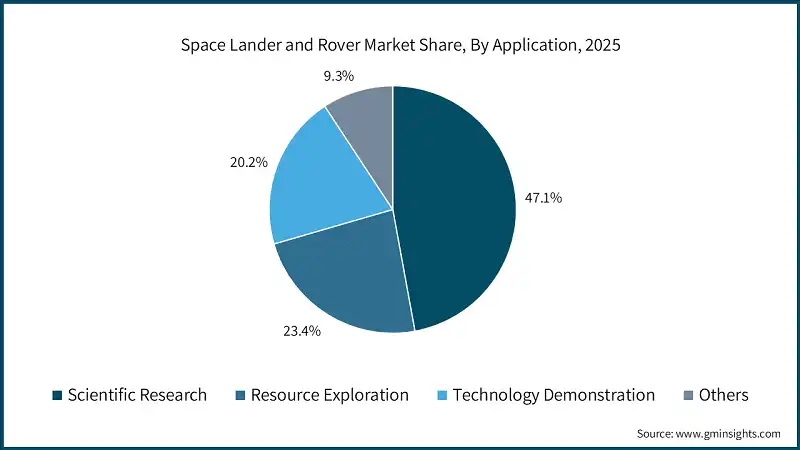
Based on the application, the space lander and rover market is segmented into scientific research, resource exploration, technology demonstration & others. The scientific research segment is driven by dominating the market in 2025 with a revenue of USD 936.4 million.
- Increased investments in space exploration, the development of new space-based tools, and the need for scientific knowledge from planned future lunar, Martian and beyond planetary missions are responsible for growth in the scientific research sector.
- Manufacturers need to be committed to manufacturing very high-quality scientific devices, providing systems for obtaining information and having strong technology built for performing exploration missions. All three areas will be essential to provide high-accuracy, dependable performance and flexibility for use in the exploration of both the Moon, Mars and beyond.
- On the other hand, the resource exploration segment is expected to witness growth at a CAGR of 12.5% during the forecasted period.
- The demand for in-situ resource utilisation technologies for extracting water, oxygen and minerals from both the Moon and Mars is fueling growth in the resource exploration segment.
- Manufacturers must focus on developing advanced in-situ resource utilisation technology, robust extraction methods and efficient processing systems for minerals and raw materials.
Based on vehicle type, the space lander and rover market is segmented into space landers & space rovers. The space lander segment dominated the market in 2025 with a revenue of USD 1.3 billion.
- The segment of space exploration that involves landers is increasing due to the growing government budgets for the exploration of space, the increasing number of companies interested in the commercial sector becoming involved in the exploration of space, the increasing development of autonomous landing systems, and the increasing need for supporting the lunar and Mars exploration missions.
- Manufacturers of lunar and Mars exploration landers should focus on the development of advanced autonomous landing systems, the most reliable propulsion technology available today, and durable structures for the lunar surface exploration to ensure success of future lunar and Mars exploration missions.
- The space rover is expected to witness growth at a CAGR of 11.8% over the analysis period, reaching USD 2.2 billion by 2035.
- The space rover segment is driven by advancements in autonomous navigation, increased mission duration requirements, demand for high-performance sensors, and the need for robust mobility solutions for lunar and Mars exploration.
- Manufacturers need to focus on creating high-performance sensors, advanced autonomous navigation systems, durable mobility solutions, and energy efficient solar/wind power supply systems.
Based on the propulsion type, the space lander and rover market is segmented into chemical propulsion, electric/ion propulsion & hybrid propulsion systems. The chemical propulsion segment is driven by dominating the market in 2025 with a revenue of USD 1.4 billion.
- The need for efficient, high thrust propulsion for unmanned and manned missions to the Moon, Mars and other places is driving the growth of the chemical propulsion market.
- Manufacturers should focus on developing high-efficiency, high-thrust chemical propulsion systems that will support optimal performance during lunar and Mars missions by minimizing fuel usage.
- On the other hand, the electric/ion propulsion segment is expected to witness growth at a CAGR of 13.6% during the forecasted period.
- The requirements to be fuel-efficient and provide long-duration propulsion for interplanetary or deep space operations is driving the growth of the electric/ion propulsion market.
- To enable cost-effective deep space missions, satellite constellation positioning and interplanetary travel, manufacturers need to focus on developing high-efficiency electric/ion propulsion systems with higher thrust levels.
Looking for region specific data?
North America Space lander and Rover Market
North America dominated the global market with a market share of 48% in 2025.
The North American space lander and rover industry is significantly impacted by both NASA’s Lunar Gateway Initiative and the growing amount of funding from the U.S. government for space projects in addition to working closely with many start-up space companies, helping to create new innovations in space exploration and development.
The North American market is heavily influenced by a rise in commercial space activities in conjunction with developing autonomy-oriented technology-related advantages to enhance mission capabilities and decrease operation costs.
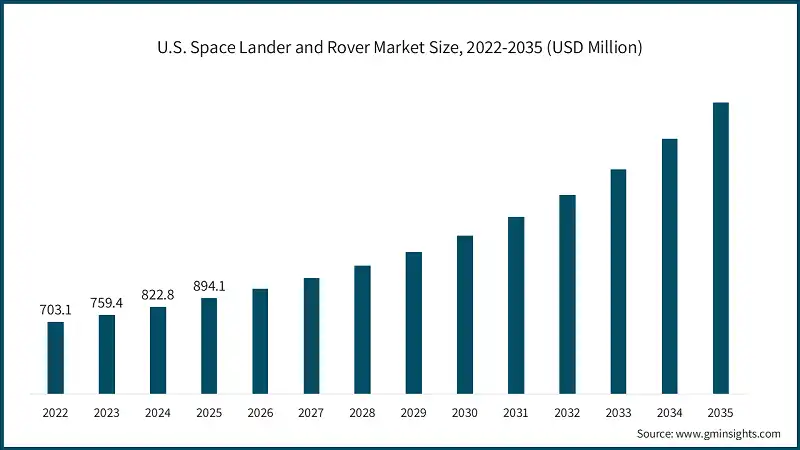
The U.S. space lander and rover market was valued at USD 703.1 million and USD 759.4 million in 2022 and 2023, respectively. The market size reached USD 894.1 million in 2025, growing from USD 822.8 million in 2024.
The U.S. market is driven by the funds available through NASA's Artemis program, the acceleration of lunar and Mars lander and rover missions, increasing private sector activity in the space exploration sector, continued availability of innovative solutions, and advances in the use of AI integrated into autonomous rover systems.
To meet evolving space exploration needs, U.S.-based manufacturers need to align with NASA's Artemis initiatives, helping the commercial sector to grow through leveraging the opportunities presented by having commercially supported innovations. Manufacturers could create new capabilities by integrating AI technologies with traditional means of manufacturing.
Europe Space lander and Rover Market
Europe market accounted for USD 470.2 million in 2025 and is anticipated to show lucrative growth over the forecast period.
The European Space Agency (ESA) sustains Europe’s Lander/Rover Market through its Mars Exploration Program, EU-funded Space Research Projects, and exciting collaboration between private sector companies and ESA. It will drive continued innovation and provide a collaborative effort from both private and government sectors in Europe in launch and rocket systems.
ESA's continued investment in the development of a lunar infrastructure and its natural leadership in robotics technologies enhances its capabilities to explore and enhance the ability of Europe to play an important role in the future of space exploration.
Germany space lander and rover market dominates the Europe space lander and rover industry, showcasing strong growth potential.
Germany represents the largest portion of the Europe space lander/rover Market due to its leadership in aerospace engineering, its partnership with ESA on Mars missions, and its investment in robotic systems technology.
As a result, therefore, manufacturers have an excellent opportunity to capitalize on the German aerospace industry's leadership and maximize its relationship with ESA to ensure competitive advantages around space exploration.
Asia Pacific Space lander and Rover Market
The Asia Pacific market is anticipated to grow at the highest CAGR of 11.2% during the analysis timeframe.
The Asia Pacific Region’s space lander/rover market is driven by the ambition to utilize the lander/rover to develop lunar and Mars capabilities, and the rapidly increasing amount of funding from the government to create new technologies for the benefit of the country’s citizens.
New technologies for space robotics are advancing rover capabilities in the region to perform autonomous exploration and very precise tasking on lunar & Martian surfaces.
China space lander and rover market is estimated to grow with a significant CAGR, in the Asia Pacific market.
China dominates the Asia Pacific space lander and rover industry, driven by the current and future government investment in the space program, continuing exploratory missions to both the moon and mars and the development of long-duration space Rovers.
There is market growth resulting from the growth of China's space research institutions, which enhances technological innovation related to space and assists in advancing space missions.
Manufacturers should work closely with the China space program; aligning their R&D and production programs with upcoming lunar and Mars missions; creating partnerships to take advantage of government funded programs to develop long durations rovers and to promote the development of autonomous navigation technologies.
Latin American Space lander and Rover Market
Brazil leads the Latin American market, exhibiting remarkable growth during the analysis period.
In Brazil, the agency for Brazilian space (AEB) has been growing a lot recently, and there are an increasing number of companies in Brazil focusing on satellite and earth observation space and developing their commercial space industry.
Manufactures should align their manufacturing, research and development efforts with what AEB is working on and what AEB is growing for the Brazilian market to take advantage of the growth opportunities offered in the commercial satellite and earth observation market and commercialization of the developing Brazilian commercial space industry.
Middle East and Africa Space lander and Rover Market
South Africa space lander and rover industry to experience substantial growth in the Middle East and Africa market in 2025.
In the Middle East and Africa, South Africa is a prime candidate for developing the African Space Industry through investments into satellite and rover R&D, as well as its growing Commercial Space Industry.
Advancements in satellite and rover technologies are driving the South African market, providing more opportunities for exploration and scientific discovery.
Manufacturers must focus their efforts on the South African market by directly aligning their business strategies with the ongoing development of the African space program and supporting the growth of satellite and rover technologies, as well as taking advantage of the expansion of the commercial space industry across the continent.
Space lander and Rover Market Share
The competitive landscape of the space lander and rover industry is characterized by intense competition. Common Industry Leaders like Lockheed Martin Corporation, Northrop Grumman Corporation, Airbus SE, Astrobotic Technology, ispace, inc. have over 20.9% of the total market share collectively in 2025. These companies maintain a competitive advantage through constant investment in research and development. Key areas of emphasis will be innovations such as autonomous navigation systems, developing new technologies to propel spacecraft through the cosmos, and robotics in situ resource utilisation capabilities. Coupled with the development of strong partnerships with government-funded space agencies, many of these companies will continue to build strong alliances with private firms to support their activities around space exploration.
In addition, smaller niche businesses are supporting the market by developing innovative, specialized technologies such as advanced sensors, lightweight materials, and autonomous systems, contributing to the diversification and expansion of space exploration capabilities.
Space lander and Rover Market Companies
Prominent players operating in the market are as mentioned below:
Lockheed Martin Corporation
Northrop Grumman Corporation
NASA
Roscosmos
Airbus SE
Blue Origin
Canadian Space Agency
European Space Agency
Airbus SE
Spacebit Technologies
ISRO
Japan Aerospace Exploration Agency (JAXA)
China Academy of Space Technology
Astrobotic Technology
ispace, inc.
Lockheed Martin has a strategic competitive advantage in the space exploration industry because of their highly developed space-related technologies, significant government contracts, and expertise with autonomous systems. This puts Lockheed Martin in a position of leadership in the space exploration industry, primarily in the development of landers and rovers.
Northrop Grumman has a unique competitive advantage based on their skill set, which includes innovative, high-performance propulsion systems, autonomous robotic capabilities, and experience around space exploration, allowing Northrop Grumman to build high-performance space landers and rovers for both government and commercial customers.
Airbus SE’s competitive advantage in the lander and rover market is due to their strong expertise and experience in satellite systems, space robotic systems, and successful collaboration with ESA in the development of lunar missions.
NASA
NASA has an existing competitive edge in the space exploration sector because of their unparalleled leadership in space exploration, unmatched R&D capabilities, and extensive funding levels. This funding allows NASA to develop world-class landers and rovers for both lunar and Mars missions.
Space lander and Rover Market Report Attributes
| Key Takeaway | Details |
|---|---|
| Market Size & Growth | |
| Base Year | 2025 |
| Market Size in 2025 | USD 2 Billion |
| Market Size in 2026 | USD 2.2 Billion |
| Forecast Period 2026 - 2035 CAGR | 9.7% |
| Market Size in 2035 | USD 5 Billion |
| Key Market Trends | |
| Drivers | Impact |
| Surging Global Interest in Lunar and Martian Exploration Missions | Drives 27% growth as both governmental space agencies and private companies ramp up efforts for lunar and Mars missions, increasing demand for advanced landers and rovers for exploration and resource utilization. |
| Technological Advancements in Autonomous Navigation and Mobility Systems | Contributes 24% growth by improving rover performance in navigation, obstacle avoidance, and terrain adaptability, enabling more efficient exploration of planetary surfaces. |
| Private Sector Investment and Expansion in Space Exploration Technologies | Supports 22% growth as private companies like SpaceX, Blue Origin, and others invest heavily in space exploration, driving innovations in lander and rover design, mobility systems, and cost reduction. |
| Governmental Commitments to Long-Term Lunar and Mars Colonization Plans | Contributes 18% growth with long-term goals for lunar and Mars bases pushing for the development of advanced landers and rovers capable of supporting colonization efforts through transportation and resource extraction. |
| Development of In-Situ Resource Utilization (ISRU) Capabilities for Space Exploration | Adds 9% growth by driving the need for landers and rovers capable of extracting and utilizing local resources (e.g., water, minerals) on lunar and Martian surfaces, reducing dependence on Earth-based supplies. |
| Pitfalls & Challenges | Impact |
| High Development Costs and Technological Complexity | Restrains 19% of market growth due to the significant costs and technical challenges in developing advanced lander and rover systems, limiting accessibility for smaller firms and reducing widespread market adoption. |
| Risks of Mission Failures Due to Harsh Extraterrestrial Environments | Limits 15% of market growth as the extreme conditions of space, such as radiation, dust storms, and extreme temperatures increase the risk of mission failure, adding complexity and uncertainty to development and deployment. |
| Opportunities: | Impact |
| Development of Sustainable Space Habitats | The push for sustainable lunar and Martian habitats requires advanced landers and rovers for resource extraction and infrastructure development, creating new opportunities for market growth in space exploration. |
| Advancements in Autonomous Technology for Exploration | The development of autonomous systems enables landers and rovers to perform more complex tasks independently, reducing operational costs and enhancing mission efficiency, driving market growth. |
| Market Leaders (2025) | |
| Market Leaders |
8.1% market share |
| Top Players |
|
| Competitive Edge |
|
| Regional Insights | |
| Largest Market | North America |
| Fastest growing market | Asia Pacific |
| Emerging countries | China, India, Japan |
| Future outlook |
|
What are the growth opportunities in this market?
Space lander and Rover Industry News
In October 2024, Bridgestone partnered with Astrobotic Technology to develop a lunar rover tire, leveraging 90 years of expertise and extreme-condition innovations to enhance mobility on the Moon’s challenging surface.
In August 2024, as a follow-up to its Chandrayaan-3 mission, ISRO released multiple images of the Pragyan rover as of 08/31/2024, which include NavCam and Lander Imager images of the rover’s descent from the Vikram lander and the rover's ability to traverse across the Moon’s surface.
In 2025, Airbus was chosen by ESA and Thales Alenia to develop the ExoMars Rosalind Franklin rover’s lander platform, integrating propulsion, thermal, structural systems, and dual ramps for the 2030 Mars mission.
The space lander and rover market research report includes in-depth coverage of the industry with estimates and forecast in terms of revenue in USD Million from 2022 – 2035 for the following segments:
Market, By Mission Type
- Lunar surface exploration
- Mars surface exploration
- Asteroids and comet exploration
Market, By Vehicle Type
- Space landers
- Space rovers
Market, By Propulsion Type
- Chemical propulsion
- Electric/Ion propulsion
- Hybrid propulsion systems
Market, By Application
- Scientific research
- Resource exploration
- Technology demonstration
- Others
Market, By End Use
- Government and defense
- Space exploration organizations
- Private aerospace companies
- Research institutions
The above information is provided for the following regions and countries:
- North America
- U.S.
- Canada
- Europe
- Germany
- UK
- France
- Spain
- Italy
- Netherlands
- Asia Pacific
- China
- India
- Japan
- Australia
- South Korea
- Latin America
- Brazil
- Mexico
- Argentina
- Middle East and Africa
- South Africa
- Saudi Arabia
- UAE
Frequently Asked Question(FAQ) :
What is the space lander and rover market size in 2025?
The space lander and rover industry was valued at USD 2 billion in 2025. Market growth is supported by increasing lunar and Mars exploration missions led by government space agencies and private aerospace companies.
What is the market size of the space lander and rover industry in 2026?
The market is projected to reach USD 2.2 billion in 2026. Expansion is driven by rising investments in autonomous navigation technologies and growing commercialization of space exploration activities.
What is the projected value of the space lander and rover market by 2035?
The market is expected to reach USD 5 billion by 2035, growing at a CAGR of 9.7% from 2026 to 2035. Long-term growth is fueled by sustained lunar and Mars exploration programs, private-sector participation, and development of in-situ resource utilization capabilities.
Which mission type dominates the space lander and rover market?
The lunar surface exploration segment dominated the market with a 57% share in 2025. Industry demand is driven by large-scale government initiatives such as NASA’s Artemis program and increasing private-sector lunar missions.
Which vehicle type holds the largest share in the market?
The space lander segment dominated the space lander and rover industry with revenue of USD 1.3 billion in 2025. Growth is supported by rising government budgets, advancements in autonomous landing systems, and increasing demand for lunar and Mars mission support.
What is the growth outlook for the space rover segment?
The space rover segment is expected to grow at a CAGR of 11.8% through 2035, reaching USD 2.2 billion by the end of the forecast period. Market expansion is driven by advancements in autonomous navigation, longer mission durations, and demand for high-performance mobility systems.
Which propulsion type leads the space lander and rover market?
Chemical propulsion dominated the market with revenue of USD 1.4 billion in 2025. Industry growth is driven by the need for high-thrust and reliable propulsion systems for lunar, Mars, and deep-space missions.
Which application segment held the largest share in 2025?
The scientific research segment led the space lander and rover industry with revenue of USD 936.4 million in 2025. Demand is driven by increased investments in planetary science, space research programs, and data-driven exploration missions.
Which region leads the space lander and rover market?
North America dominated the market with a 48% share in 2025, while the U.S. market reached USD 894.1 million. Regional growth is driven by strong NASA funding, the Artemis program, expanding commercial space activity, and rapid adoption of AI-enabled autonomous systems.
What are the key trends shaping the space lander and rover industry?
Key trends include miniaturization of landers and rovers, increased adoption of autonomous navigation using AI and machine learning, expansion of in-situ resource utilization technologies, and improvements in energy-efficient power systems for long-duration missions.
Who are the key players in the space lander and rover market?
Major players in the industry include Lockheed Martin Corporation, Northrop Grumman Corporation, Airbus SE, Astrobotic Technology, and ispace, inc. These companies focus on advanced propulsion, autonomous systems, robotics, and strategic partnerships with government space agencies to strengthen their market position.
Space lander and Rover Market Scope
Related Reports