Summary
Table of Content

Space Heater Market
Get a free sample of this report
Form submitted successfully!
Error submitting form. Please try again.
Thank you!
Your inquiry has been received. Our team will reach out to you with the required details via email. To ensure that you don't miss their response, kindly remember to check your spam folder as well!
Request Sectional Data
Thank you!
Your inquiry has been received. Our team will reach out to you with the required details via email. To ensure that you don't miss their response, kindly remember to check your spam folder as well!
Form submitted successfully!
Error submitting form. Please try again.
Space Heater Market Size
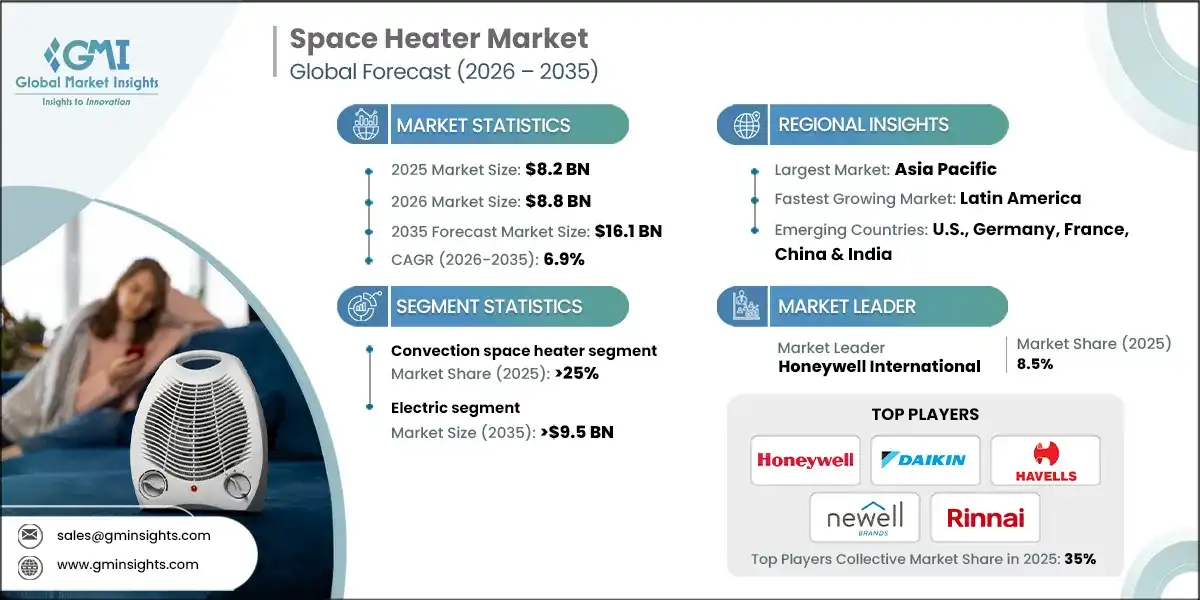
According to a recent study by Global Market Insights Inc., the space heater market was estimated at USD 8.2 billion in 2025. The market is expected to grow from USD 8.8 billion in 2026 to USD 16.1 billion by 2035, at a CAGR of 6.9%.
Space Heater Market Key Takeaways
Market Size & Growth
- 2025 Market Size: USD 8.2 Billion
- 2026 Market Size: USD 8.8 Billion
- 2035 Forecast Market Size: USD 16.1 Billion
- CAGR (2026–2035): 6.9%
Regional Dominance
- Largest Market: Asia Pacific
- Fastest Growing Region: Latin America
Key Market Drivers
- Increase in cold climate occurrences and winter weather events.
- Flourishing real estate sector.
- Government incentives & regulations.
- Shifting focus toward energy efficiency and sustainability.
Challenges
- Safety concerns.
Opportunity
- Smart home integration.
- Energy-efficient heating.
- Portable and flexible solutions.
- Safety-enhanced designs.
Key Players
- Market Leader: Honeywell International led with over 8.5% market share in 2025.
- Leading Players: Top 5 players in this market include Honeywell International, DAIKIN INDUSTRIES, Havells India, Newell Brands, Rinnai Corporation, which collectively held a market share of 35% in 2025.
Get Market Insights & Growth Opportunities
- The growing demand for spot heating amid fluctuating temperatures coupled with advancements in fan forced heating technology will enhance the industry landscape. The manufacturers introduce smart, energy-efficient appliances equipped with motion sensors, programmable logic controllers, and Wi-Fi connectivity features that will significantly boost product adoption.
- Space heater technology represents a refined convergence of engineering innovation and operational efficiency, designed to deliver consistent, high-performance heating solutions for modern environments. These systems prioritize superior thermal output through optimized heat distribution, advanced safety mechanisms, and precision in airflow dynamics.
- Government-backed incentives and rebates for energy-efficient appliances along with rising consumer demand for quiet heating solutions will strengthen the business outlook. Additionally, the surge in construction and home renovation activities in conjunction with the integration of smart technologies will foster the business growth.
- For instance, in December 2024, U.S. construction spending climbed to a seasonally adjusted annual rate of nearly USD 2 trillion, marking an increase over November levels and a 4.3% rise year over year. Public construction expenditure grew 9.3% annually to USD 492.7 billion, supported by a strong 8.5% increase in educational construction, which reached USD 105.2 billion.
- The space heater market was valued at USD 6.8 billion in 2022 and grew at a CAGR of 4% through 2025. Tighter energy efficiency standards for heaters combined with a growing transition toward emission-free heating technologies will positively influence the business scenario.
- The growth of e-commerce platforms and online marketplaces has significantly enhanced regional access to space heaters. Rising disposable incomes, steady GDP expansion, and easier credit availability for premium appliances in association with an increasing demand for cost-effective heating solutions will further escalate the business potential.
- The integration of advanced features including dual heating elements, self-regulating ceramic plates, and cutting-edge infrared technology significantly improves heat distribution while enhancing overall energy efficiency, driving deeper industry penetration. Furthermore, safety innovations, mainly child-lock systems, smart thermostat connectivity and tip-over protection will accelerate adoption of these units.
- For instance, U.S. GDP maintained its upward trajectory, expanding by more than 2.5% in real terms during 2024 compared to the previous year. This sustained growth in purchasing power is driven by robust business activity, strong consumer spending, and increased investments across key industries.
To get key market trends
Space Heater Market Trends
- The growing unpredictability of global weather patterns has led to more frequent and intense cold spells, making heating solutions an essential part of everyday living. Space heaters are increasingly viewed as practical, cost-effective options for combating sudden temperature drops, especially in regions where central heating systems are not common or feasible.
- Their portability and ability to provide targeted warmth make them indispensable during harsh winters, ensuring comfort without the need for extensive infrastructure changes. Ongoing customization of space heaters for specific applications in association with evolving consumer lifestyle trends will elevate the business dynamics.
- The rapid expansion of residential and commercial real estate sector is creating a strong foundation for the space heater market. Newly built homes and offices often prioritize modern, energy-efficient appliances, and space heaters fit perfectly into this evolving landscape.
- For instance, according to Invest India, housing demand through 2034 is projected to drive over USD 906 billion in new residential construction, creating significant investment opportunities in the real estate sector. This growth is expected to accelerate infrastructure development, improve housing affordability, and advance urbanization, attracting both domestic and global investors.
- The expansion of commercial real estate, including offices, retail outlets, and hospitality spaces, is elevating the demand for these units. Moreover, the designed for commercial use often emphasize durability, energy efficiency, and safety, aligning with the operational needs of these spaces.
- Government initiatives aimed at promoting energy efficiency and reducing carbon emissions are playing a pivotal role in shaping the industry. Incentives such as rebates and tax benefits for energy-efficient appliances are encouraging consumers to upgrade to advanced heating solutions.
- This regulatory push is not only fostering sustainability but further creating a competitive advantage for brands that prioritize green technologies. Consumers are becoming increasingly aware of these policies and are actively seeking products that align with both personal and environmental goals.
- For citation, in March 2024, the UK implemented heat network regulations under the Energy Security Bill to advance heat zoning initiatives. The Climate Change Committee projects that reliance on heat networks could account for approximately 18% of total national energy consumption by 2050, reinforcing the country’s energy efficiency and decarbonization targets.
- The industry is experiencing strong growth driven by increased investment in research and development for sustainable heating technologies. Rising demand among small businesses for localized heating solutions in line with continuous product innovations that improve efficiency, safety, and user convenience will further stimulate business scenario.
- The adoption of blockchain for tracking energy consumption coupled with international trade agreements that simplify heater imports and exports will strengthen the business landscape. Furthermore, the introduction of compact designs featuring wall-mounted configurations, ergonomic handles, and foldable units is set to accelerate product deployment.
Space Heater Market Analysis
Learn more about the key segments shaping this market
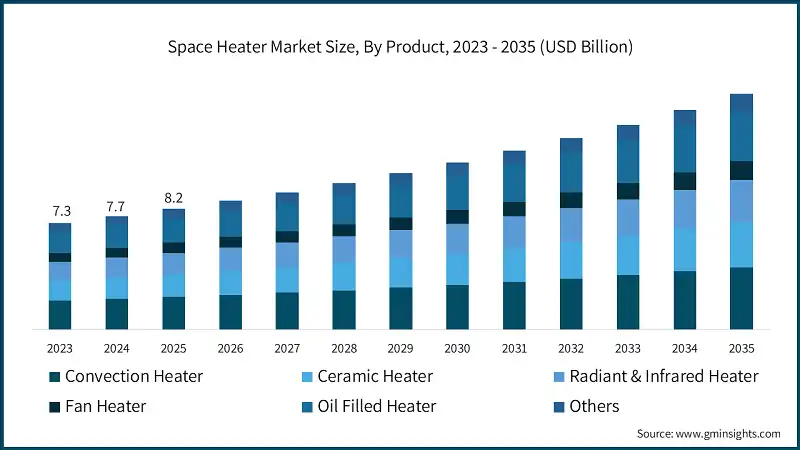
- Based on product, the industry is bifurcated into convection heater, radiant & infrared heater, ceramic heater, oil filled heater, fan heater and others. The convection space heater industry holds a share of over 25% in 2025 and is set to grow at a CAGR of 6.5% from 2026 to 2035.
- The ceramic space heater market is set to exceed USD 3 billion by 2035. These heaters are recognized for their rapid heating capabilities and superior energy efficiency, making them a preferred choice for consumers seeking quick warmth. Moreover, these units utilize ceramic plates that retain heat effectively, allowing for consistent temperature maintenance while minimizing power consumption.
- Radiant and infrared heaters offer a unique approach to heating by directly warming objects and people rather than the surrounding air. This targeted heating method ensures immediate comfort, making these units ideal for outdoor spaces, garages, and areas with high ventilation where conventional heaters may struggle.
- For illustration, the U.S. Department of Energy has allocated USD 23.4 million to 16 projects across 14 states to strengthen community engagement and technical support for carbon management technologies. These university and private sector initiatives aim to connect developers with local communities to advance carbon capture, transportation, and storage solutions.
- The fan space heater market will witness a CAGR of over 6% by 2035. Consumers are increasingly opting for models featuring built-in handles, customizable airflow controls, and whisper-quiet performance, making them perfect for bedrooms, offices, and dorm rooms. This growing preference for convenience and comfort will additionally improve the business opportunities.
- The oil filled space heater market was valued at USD 1.7 billion in 2025. The long-lasting durability and minimal maintenance requirements of these heaters position them as an appealing solution for extended heating needs. The integration of motion sensors for automatic activation in conjunction with advancements in ultra-low voltage heating technologies will amplify the industry penetration.
- For instance, in 2024, the International Energy Agency projected global energy spending to reach USD 2.8 trillion in the near term, with USD 1.6 trillion earmarked for modern energy solutions, including renewables, nuclear power, super grids, and low-carbon initiatives.
Learn more about the key segments shaping this market
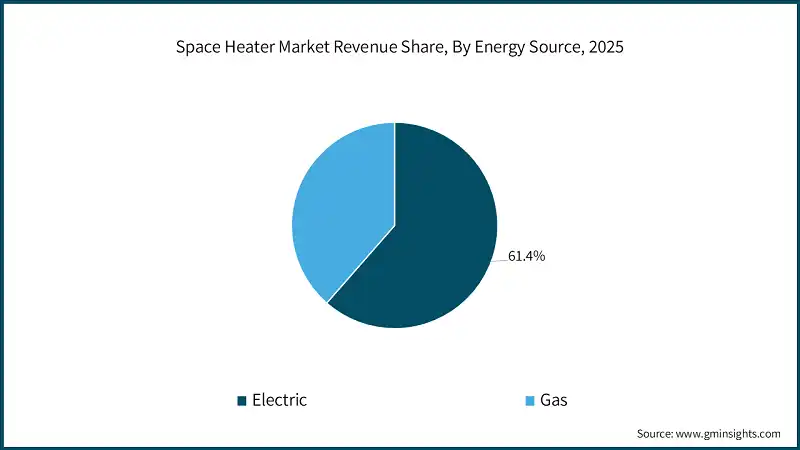
- Based on energy source, the industry is divided into electric and gas. The electric space heater industry holds a share of 61.4% in 2025 and is set to surpass USD 9.5 billion by 2035. These heaters are widely favored for their ability to deliver instant warmth without requiring complex infrastructure, making them ideal for urban households and small businesses.
- Compact designs and aesthetics cater to consumers who prioritize style alongside functionality, making electric heaters a preferred choice for modern interiors. Rising urbanization coupled with the expansion of electricity infrastructure will further accelerate the demand for these units.
- For citation, in November 2024, the European Commission projected that approximately USD 600 billion in investments will be required by 2030 to meet growing electricity demand. This capital will be directed toward grid expansion, renewable energy integration, and advanced power infrastructure, ensuring a resilient and sustainable energy transition.
- The gas fired space heater market will witness a CAGR of over 7% by 2035. These heaters continue to hold relevance in regions where natural gas is abundant and cost-effective, offering powerful heating capabilities for larger spaces. These systems are preferred for their ability to deliver consistent warmth over extended periods, making them suitable for various application areas.
- The adoption of advanced low-NOx and clean combustion technologies, coupled with the expansion of natural gas pipeline networks, is set to enhance market prospects. Additionally, the growing focus on maximizing heat output efficiency, along with the rising demand for cost-effective heating solutions will escalate the business outlook.
- For instance, gas represented 21.5% of the EU’s primary energy consumption and remained the leading household energy source at 32.1%. Around 40% of households were connected to gas networks, with average annual spending of approximately USD 700 equivalent to 2.5% of average income.
Looking for region specific data?
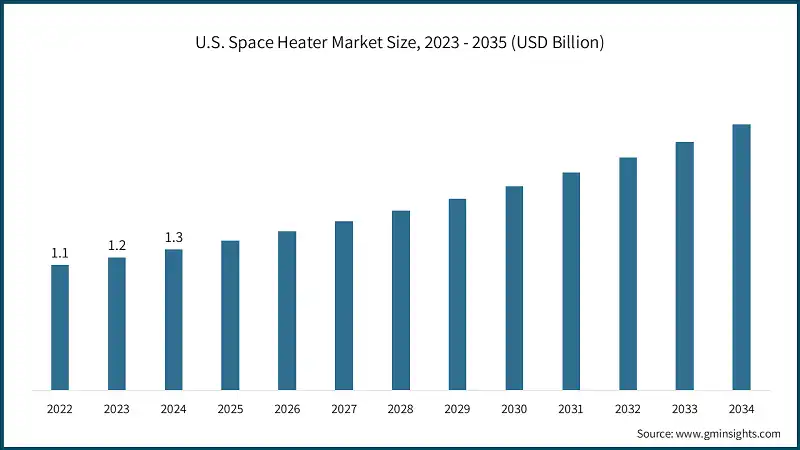
- The U.S. dominated the space heater market in North America with over 70% share in 2025 and generated above USD 1.3 billion in revenue. The rollout of progressive policies such as subsidies, tax incentives, and grant programs focused on energy conservation and carbon emission reduction is set to significantly accelerate business growth.
- For instance, in September 2024, Tom Vilsack and Joe Biden announced USD 7.3 billion in funding for rural electric cooperatives through the Empowering Rural America program, an initiative designed to accelerate clean energy deployment and modernize energy infrastructure across rural areas of the U.S.
- The North America space heater market is projected to hit USD 3 billion by 2035, driven by the expansion of government-backed heater replacement programs. Additionally, the increasing adoption of localized manufacturing to optimize costs combined with the rise of home security-integrated heating systems will fuel the industry landscape.
- The Europe space heater market is set to grow at a rate of over 6.5% by 2035. Rising heater usage in high-altitude residential areas coupled with the growing adoption of eco-label-certified systems will boost the business momentum. Additionally, increasing consumer awareness of heaters featuring anti-microbial coatings will escalate product deployment across the region.
- The Asia Pacific space heater market reached USD 3.2 billion in 2025. Stricter energy efficiency standards and increasingly stringent emission regulations are curbing the adoption of inefficient heating systems. At the same time, rising investments in HVAC-integrated and high-performance space heaters are reshaping purchasing preferences.
- For instance, in January 2025, European Investment Bank plans to provide approximately USD 73 million in financing to Stadtwerke Reutlingen, backing its long-term investment strategy aimed at upgrading energy networks and strengthening power infrastructure throughout the region.
- The Middle East & Africa space heater market will gain an appreciable momentum, supported by accelerating urbanization and the rising adoption of premium and smart residential developments. Increasing consumer preference for personalized, efficient, and technologically advanced heating solutions is further strengthening regional demand, enhancing overall market attractiveness, and reinforcing long-term growth prospects.
- For illustration, energy investments in the Middle East reached approximately USD 175 billion in 2024, with clean energy accounting for nearly 15% of total spending. Under the Announced Pledges Scenario, clean energy investments are set to be more than triple by 2030, underscoring the region’s accelerating shift toward sustainable energy solutions.
- The Latin America space heater market is poised for substantial growth, driven by increasing demand for energy-efficient heating solutions across regions with highly variable climate conditions. Strategic collaborations between appliance manufacturers and technology providers, alongside innovation-focused partnerships, are expected to accelerate product development.
Space Heater Market Share
- The top 5 players in space heater industry are Honeywell International, DAIKIN INDUSTRIES, Havells India, Newell Brands and Rinnai Corporation contribute around 35% of the market share in 2025.
- The companies are channeling investments into R&D for advanced heating solutions, including IoT-enabled, infrared, and ceramic technologies. Strategic collaborations with e-commerce platforms and retail expansion into new markets are enhancing product visibility.
- The industry is highly competitive and innovative-driven, shaped by rising demand for energy-efficient, safe, and smart heating solutions. Leading manufacturers are focusing on advanced heating technologies including ceramic, infrared, and IoT-enabled designs, while integrating smart controls for enhanced user convenience.
- Honeywell International offered smart space heating solutions integrating IoT-enabled controls and advanced ceramic heating technology. Its portfolio emphasized energy efficiency, remote connectivity, and adaptive heating modes, supported by safety features and digital platforms for real-time monitoring.
- DAIKIN INDUSTRIES delivered premium space heaters engineered for high performance and energy savings. The range incorporated intelligent temperature control systems, eco-friendly designs, and compatibility with smart home ecosystems to enhance user convenience and sustainability.
- Havells India focused on stylish and compact space heaters featuring advanced ceramic and infrared heating elements. Its products combined rapid heating capability with multi-layer safety protection and intuitive digital interfaces, catering to modern households seeking efficiency and reliability.
- Newell Brands introduced versatile space heating solutions under its consumer-focused portfolio, integrating smart connectivity, programmable thermostats, and energy-saving modes. The designs prioritized user-friendly operation and compliance with global energy standards.
- Rinnai Corporation specializes in high-performance space heaters designed for consistent warmth and operational safety. Its offerings featured advanced combustion and ceramic heating technologies, complemented by smart control options and eco-conscious engineering to meet evolving sustainability goals.
Space Heater Market Companies
Major players operating in the space heater industry are:
- Cambridge Air Solutions
- Crane USA
- DAIKIN INDUSTRIES
- EHEAT
- ELMESS Thermosystemtechnik
- Glen Dimplex Deutschland
- Havells India
- Honeywell International
- Lasko Products
- Midea
- Newell Brands
- OPOLAR
- Pelonis
- Rinnai Corporation
- SUNHEAT International
- Tansun
- Tempco Electric Heater
- Twin Star
- Vornado
- Wayfair
- Honeywell reported net sales of USD 30.6 billion during the first nine months of 2025. Of this total, product sales contributed USD 20.9 billion, while service sales accounted for USD 9.7 billion. The data reflects a stronger revenue share from products compared to services over the period.
- Daikin Industries reported net sales of USD 15.8 billion in the first six months of 2025. Operating profit during the same period stood at USD 1.6 billion. This performance reflects the company’s ability to maintain profitability while navigating market dynamics. The figures also highlight a strong contribution from core operations, reinforcing their financial stability in the mid-year results.
- Newell Brands reported net sales of USD 5.3 billion during the first nine months of 2025. Gross profit for the same period stood at USD 1.8 billion, reflecting the company’s ability to maintain margins amid market conditions. The figures highlight the contribution of core product categories to overall performance and provide insight into profitability trends across their portfolio.
Space Heater Market Report Attributes
| Key Takeaway | Details |
|---|---|
| Market Size & Growth | |
| Base Year | 2025 |
| Market Size in 2025 | USD 8.2 Billion |
| Market Size in 2026 | USD 8.8 Billion |
| Forecast Period 2026 - 2035 CAGR | 6.9% |
| Market Size in 2035 | USD 16.1 Billion |
| Key Market Trends | |
| Drivers | Impact |
| Increase in cold climate occurrences and winter weather events | The rising frequency of severe winter conditions and prolonged cold spells is driving the demand for reliable heating solutions. Heating solutions capable of delivering rapid, localized warmth are increasingly becoming essential for both households and businesses, as they seek reliable comfort amid fluctuating weather conditions. |
| Flourishing real estate sector | Rapid growth in residential and commercial construction is creating a strong market for heating appliances. As new homes and office spaces emerge, the need for efficient and aesthetically appealing space heaters is increasing, making them a preferred choice for modern interiors. |
| Government incentives & regulations | Supportive government policies promoting energy-efficient appliances, along with rebates and incentives, are encouraging consumers to adopt advanced space heaters. Regulatory frameworks focused on reducing energy consumption and emissions further strengthen the business outlook. |
| Shifting focus toward energy efficiency and sustainability | Consumers and manufacturers alike are prioritizing eco-friendly heating solutions that minimize power usage and environmental impact. Space heaters equipped with smart controls and energy-saving technologies are gaining traction as sustainability becomes a key purchasing criterion. |
| Pitfalls & Challenges | Impact |
| Safety concerns | Safety concerns remain a significant challenge for space heater adoption. Risks related to overheating, fire hazards, and improper usage often deter consumers, prompting manufacturers to invest in advanced safety features and compliance with stringent standards. |
| Opportunities: | Impact |
| Smart home integration | Growing adoption of connected devices creates opportunities for IoT-enabled space heaters with app and voice control, offering convenience and energy optimization. |
| Energy-efficient heating | Demand for eco-friendly appliances is driving innovation in space heaters with advanced ceramic and infrared technology to reduce energy consumption. |
| Portable and flexible solutions | Urban living and smaller spaces are increasing the need for compact, portable heaters that deliver targeted warmth without heavy infrastructure. |
| Safety-enhanced designs | Consumers are prioritizing safety, creating opportunities for heaters with advanced protection features like tip-over switches, cool-touch housing, and overheat sensors. |
| Market Leaders (2025) | |
| Market Leaders |
8.5% market share |
| Top Players |
|
| Competitive Edge |
|
| Regional Insights | |
| Largest Market | Asia Pacific |
| Fastest Growing Market | Latin America |
| Emerging Country | U.S., Germany, France, China & India |
| Future outlook |
|
What are the growth opportunities in this market?
Space Heater Industry News
- In January 2026, Crane USA completed the acquisition of Precision Sensors & Instrumentation (PSI), as previously announced. PSI is recognized for its advanced sensor-based technologies serving aerospace, nuclear, and process industries. The acquisition strengthens Crane’s technology portfolio, expands its precision sensing capabilities, and enhances its position in high-reliability and mission-critical industrial applications.
- In October 2025, Daikin Industries Limited signed a significant memorandum of understanding (MoU) with the Government of Haryana in Osaka on Wednesday, committing an investment of USD 110.9 million to set up a new research and development (R&D) center in the state. The proposed facility is expected to strengthen Daikin’s innovation capabilities while creating substantial employment opportunities for local youth.
- In October 2024, Lasko introduced two new ceramic space heaters at Sam’s Club expanding its range of home heating solutions. The models featured advanced safety elements such as tip-over switches, overheat protection, and cool-touch housing. The 32" Digital Ceramic Tower Heater delivered 1500 W of power with customizable heat settings, an adjustable thermostat, and advanced remote-control functionality.
- In March 2024, Midea unveiled its Cir QHP product line at MCE, positioning it as a comprehensive solution for household temperature control in Europe. Designed with advanced technology for rapid temperature adjustment and reliable performance, the system delivers high efficiency while reducing energy costs. Cir QHP promises exceptional comfort and optimized energy usage, catering especially to homeowners in colder regions.
The space heater market research report includes in-depth coverage of the industry with estimates & forecast in terms of revenue (USD Million) & volume (Units) from 2022 to 2035, for the following segments:
Market, By Product
- Convection heater
- Ceramic heater
- Radiant & infrared heater
- Fan heater
- Oil filled heater
- Others
Market, By Technology
- Portable
- Surface-mounted
Market, By Energy Source
- Electric
- Gas
Market, By Application
- Residential
- Commercial
Market, By Power Rating
- ≤ 1,000 W
- > 1,000 W - 1,500 W
- > 1,500 W - 2,000 W
- > 2,000 W
The above information has been provided for the following regions and countries:
- North America
- U.S.
- Canada
- Mexico
- Europe
- Germany
- Italy
- France
- Netherlands
- Spain
- Norway
- UK
- Sweden
- Asia Pacific
- China
- Japan
- India
- Australia
- South Korea
- Thailand
- Singapore
- Malaysia
- Philippines
- Vietnam
- Indonesia
- Middle East & Africa
- Saudi Arabia
- UAE
- Iran
- Iraq
- Turkey
- South Africa
- Latin America
- Brazil
- Argentina
- Chile
Frequently Asked Question(FAQ) :
What is the market size of the space heater in 2025?
The market size was USD 8.2 billion in 2025, with a CAGR of 6.9% expected through 2035 driven by growing demand for spot heating amid fluctuating temperatures and advancements in fan forced heating technology.
What is the projected value of the space heater market by 2035?
The space heater market is expected to reach USD 16.1 billion by 2035, propelled by government incentives for energy-efficient appliances, smart technology integration, and surge in construction activities.
What is the current space heater market size in 2026?
The market size is projected to reach USD 8.8 billion in 2026.
How much revenue did the convection heater segment generate in 2025?
Convection heaters held over 25% market share in 2025 and are set to grow at a CAGR of 6.5% from 2026 to 2035.
What was the valuation of the electric space heater segment in 2025?
Electric space heaters held 61.4% market share in 2025 and are set to surpass USD 9.5 billion by 2035.
What is the growth outlook for gas-fired space heaters from 2026 to 2035?
Gas-fired space heaters are projected to grow at over 7% CAGR by 2035, driven by adoption of advanced low-NOx and clean combustion technologies.
Which region leads the space heater market?
The U.S. dominated the space heater market in North America with over 70% share in 2025 and generated above USD 1.3 billion in revenue.
What are the upcoming trends in the space heater market?
Key trends include smart home integration with IoT-enabled controls, energy-efficient heating with ceramic and infrared technology, portable and flexible solutions for urban spaces, and safety-enhanced designs with tip-over switches and overheat sensors.
Who are the key players in the space heater market?
Key players include Honeywell International, DAIKIN INDUSTRIES, Havells India, Newell Brands, Rinnai Corporation, Cambridge Air Solutions, Crane USA, EHEAT, ELMESS Thermosystemtechnik, Glen Dimplex Deutschland, Lasko Products, Midea, OPOLAR, Pelonis, SUNHEAT International, Tansun, Tempco Electric Heater, Twin Star, Vornado, and Wayfair.
Space Heater Market Scope
Related Reports