Summary
Table of Content

Southeast Asia Sorting and Grading Machines Market
Get a free sample of this report
Form submitted successfully!
Error submitting form. Please try again.
Thank you!
Your inquiry has been received. Our team will reach out to you with the required details via email. To ensure that you don't miss their response, kindly remember to check your spam folder as well!
Request Sectional Data
Thank you!
Your inquiry has been received. Our team will reach out to you with the required details via email. To ensure that you don't miss their response, kindly remember to check your spam folder as well!
Form submitted successfully!
Error submitting form. Please try again.
Southeast Asia Sorting & Grading Machines Market Size
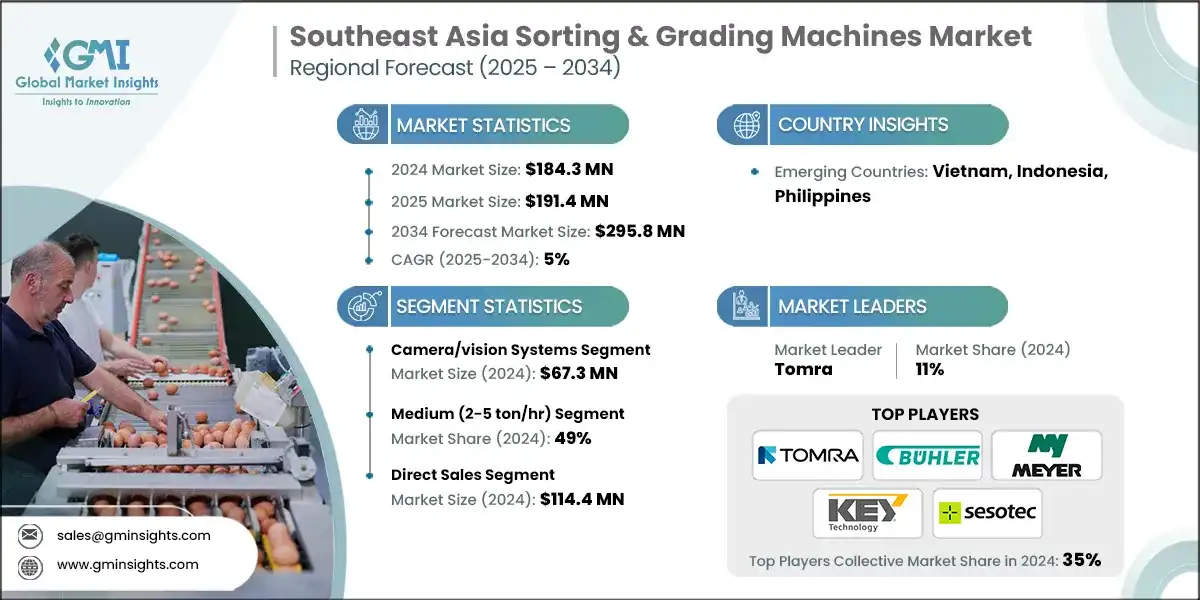
The Southeast Asia sorting & grading machines market was estimated at USD 184.3 million in 2024. The market is expected to grow from USD 191.4 million in 2025 to USD 295.8 million in 2034, at a CAGR of 5% according to latest report published by Global Market Insights Inc.
To get key market trends
Automation is changing the sorting and grading machines sector by decreasing labor dependency and increasing efficiency. Complex systems with robotics and automated conveyors help decrease processing time while creating consistency in quality. The movement toward automation will be important in parts of the world facing labor shortages and rising wage rates; U.S. agriculture is confronting such a shift. Automation is also helpful in reducing human error and should allow for consistency and uniform grading standards and applications across large volumes of produce or packaged products.
Technology developments, like AI, machine vision technology, and hyperspectral imaging, are increasing the capacity of sorting machines. As a newly developing technology, precise and measured size, color, shape, and even internal quality traits, like moisture or sugar, can be determined. When technologies are integrated with IoT platforms, machines can monitor real time and perform predictive maintenance to reduce downtime and operating costs.
The expanding urban population and shifts in consumer habits in Southeast Asia are leading to increased demand for processed and packaged food. Consumers are increasingly demanding convenience, cleanliness, and consistent quality - and this more often requires more stringent sorting and grading when the products are processed. This trend is also amplified by the growth of modern retail and e-commerce retailers, where the appearance and uniformity of products impact the purchase of the products.
To comply with safety and quality requirements related to consumer demand for processed and packaged foods, food processors are investing in new sorting and grading machines. Fully automated systems when feasible help ensure consistency of size, color, and texture in packaged goods. Furthermore, there is an understanding that food waste can be reduced, and resource usage can be optimized through the adoption of machines that provide these benefits; together, these trends imply that the food sorting and grading machine market will see exceptional growth in the next few years.
Southeast Asia Sorting and Grading Machines Market Report Attributes
| Key Takeaway | Details |
|---|---|
| Market Size & Growth | |
| Base Year | 2024 |
| Market Size in 2024 | USD 184.3 Million |
| Market Size in 2025 | USD 191.4 Million |
| Forecast Period 2025 - 2034 CAGR | 5% |
| Market Size in 2034 | USD 295.8 Million |
| Key Market Trends | |
| Drivers | Impact |
| Automation and technological advancements | Automation minimizes reliance on manual employment and enhances efficiencies in sorting, whereas emerging technologies such as AI, machine vision, and IoT improve accuracy and enable predictive maintenance. |
| Rising demand for processed and packaged foods | Urbanization and changing lifestyles continue to drive demand for packaged foods, which require reliable grading and quality assurance. |
| Sustainability and waste management initiatives | Governments and corporations are pushing them to achieve ESG goals, which can create opportunities for other machines to reduce food waste and maximize recycling. |
| Pitfalls & Challenges | Impact |
| High initial costs | Optical and AI-enabled equipment typically requires a sizable capital investment, which limits adoption by smaller or mid-sized processors. Moreover, this slows adoption by industrializing barriers to enter cost-sensitive, emerging markets. |
| Complex maintenance and operational challenges | The need for expert technicians to calculate and maintain these machines incurs downtime, which can be expensive. The low levels of technical expertise in rural areas exacerbate the complicated context and yield an overall operational inefficiency. |
| Opportunities: | Impact |
| Advanced technology integration | Utilizing AI, hyperspectral imaging, and IoT within sorting systems can access premium markets and enhance traceability twenty-fold. |
| Waste reduction & sustainability | Machines aimed at reducing food waste and facilitating recycling are often in demand as sustainability becomes an aspect of core business practice. |
| Market Leaders (2024) | |
| Market Leaders |
11% market share |
| Top Players |
Collective market share in 2024 is 35% |
| Competitive Edge |
|
| Emerging countries | Vietnam, Indonesia, Philippines |
| Future outlook |
|
What are the growth opportunities in this market?
Southeast Asia Sorting & Grading Machines Market Trends
The market for sorting and grading machines in Southeast Asia is gradually moving toward automation and smart technology due to the region’s expanding food processing sector and agriculture sector focused on exports. Rising consumer demand for high-quality packaged foods and the implementation of tougher and more regulated international standards are causing manufacturers to adopt new systems capable of precision, efficiency, and conformity.
- The market is quickly rallying behind new technologies such as artificial intelligence (AI), machine vision, and hyperspectral imaging for the accurate detection of size, color, shape, and internal characteristics (e.g. sugar levels, moisture levels, etc.). IoT connectivity adds additional value through real-time monitoring, predictive maintenance, and data analytics to optimize processes. These technologies not only offer speed, but also provide accuracy, traceability, and compliance with required food safety standards.
- As such, automation is becoming commonplace in the sorting and grading process within Southeast Asia. As labor costs continue to rise and the need for efficiency increases in large-scale food processing operations, the trend toward automation is expected to continue growing. Automation also eliminates human error, providing for consistent grading averages and minimizing product loss, which is important when considering domestic and export compliance.
- The trend towards urbanization and lifestyle changes is driving demand for processed and packaged foods throughout Southeast Asia. Consumers are increasingly focused on convenience, good hygiene and consistent quality, which requires several sorting and grading systems in food processing. The rise of modern retail and e-commerce has compounded this trend, as the appearance and uniformity of products have become even more important to consumers' buying choices. Consequently, food processors are investing in precise machinery and equipment to maintain their brand identity and meet consumer expectations.
- Southeast Asia is a significant exporter of agricultural products, including fruits, vegetables, and grains. To stay competitive in global markets, producers must adhere to international quality standards and certifications. Automated grader systems can assist in minimizing the rejection rate of exported products by ensuring uniformity and identifying defects earlier in the process. Additionally, more stringent requirements by importing countries are forcing exporters to incorporate more advanced sorting technologies in their operation, it is becoming more of a necessity than an option.
Southeast Asia Sorting & Grading Machines Market Analysis
Learn more about the key segments shaping this market
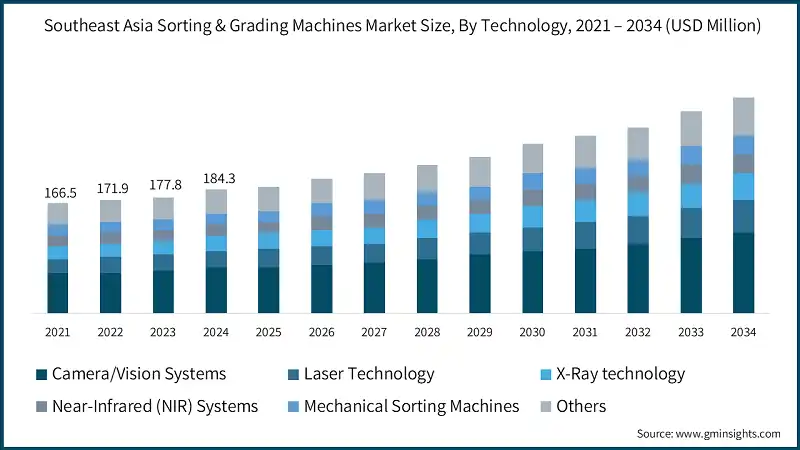
Based on technology, the Southeast Asia sorting & grading machines market is divided into camera/vision systems, laser technology, X-ray technology, near-infrared systems, mechanical sorting machines and others. The camera/vision systems generated a revenue of USD 67.3 million in 2024.
- Vision systems using cameras are increasingly being relied on for accurate grading based on size, shape, and color. Vision systems utilize high-resolution cameras with a light-emitting diode (LED) lighting system to produce high-quality images of products in motion at high speeds. Vision systems promote consistent quality and reduce human error, which is desirable for food processing and agricultural export industry quality standards.
- Modern vision systems in Southeast Asia are now incorporating artificial intelligence (AI) and machine learning algorithms, or other technologies, to detect subtle defects such as bruises, discoloration, or contamination that traditional methods would miss. AI and machine learning or other technologies can process thousands of images per second. This process allows the system to make real-time decisions, including automatically rejecting products that are defective. This is necessary for the fresh produced and packaged food sectors, where visual appearance and food safety are associated with consumer trust and ability to be compliant with export.
- Hyperspectral imaging technology is emerging as a method of internal quality assessment, in addition to external examination. These systems acquire information at multiple wavelengths, and have the capability to evaluate moisture, sugar content, and ripeness levels, all without the need to destroy the product. This technology, in particular, is timely in the context of higher-value crops, and it will also enter the processed food value chain where internal/external quality alignment is important for delivering value and acceptance in overseas markets.
Learn more about the key segments shaping this market
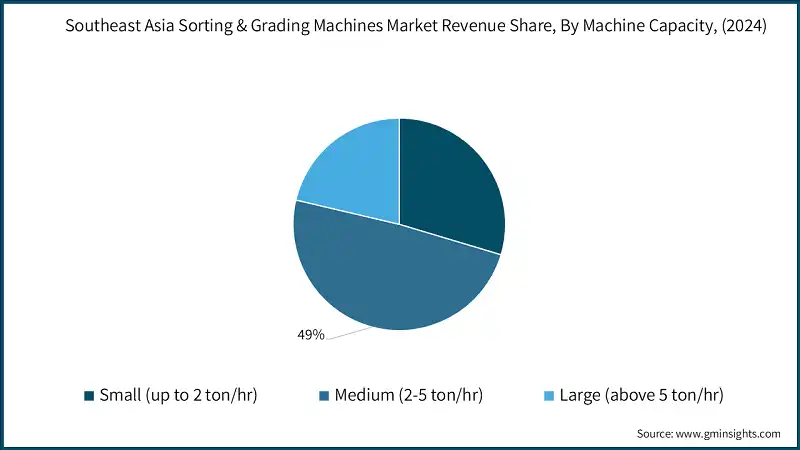
Based on machine capacity, the Southeast Asia sorting & grading machines market is segmented into small (up to 2 ton/hr), medium (2-5 ton/hr), large (above 5 ton/hr). The medium segment held around 49% of the market share in 2024.
- Medium-sized machines (2-5 ton/hr) are a good fit for mid-sized (Southeast Asian) food processors and agricultural cooperatives; these operate at good capacities, while also being more affordable than larger machinery units. These are suited for businesses handling mid-sized volumes of fruits, vegetables, grains, or packaged goods.
- These mediums have a range of capacities that provide flexibility for many product types of fresh items, nuts, grains, as well as frozen or packaged products. Many medium-capacity machinery have modular capacity and settings which enable processors to easily change one product for another with minimal downtime. Flexibility like this is essential in Southeast Asia where the amount of the product to be processed can fluctuate with seasons or even during processing when different products can be mixed.
- As new regional food hubs and export-oriented SMEs grow, medium-capacity machinery often meets their needs best. They offer the type of scalability that meets the demand for a higher output of processed and packaged foods yet don't tie up operational budgets the same way as higher capacity options. Medium-capacity machines often come with features used in higher capacity machines such as camera-based vision and AI-driven defect detection/defect identification, that provide very high precision during the processing phase while coming at an accessible price, suitable for businesses that may likely not have the operator experience in transitioning from manual or semi-automated practices.
Based on the distribution channel, the Southeast Asia sorting & grading machines market is segmented into direct sales and indirect sales. The direct sales distribution channel generated a revenue of USD 114.4 million in 2024.
- Direct sales provide manufacturers with opportunities to foster close connections with end users, such as food processors, agricultural cooperatives, and exporters. Such engagement provides insight into operation-specific requirements to support manufacturers in formulating targeted solutions. In Southeast Asia's diverse culture and economy, the need for customized solutions is significant due to the variations in crop types and processing capacity. Therefore, the direct sales approach allows agricultural manufacturers to enhance customer satisfaction and loyalty in the region.
- Direct sales channel enables manufacturers to maximize the complexity of the after-sales service, which can include Installation, operational training, and maintenance. This can be particularly important for sorting machines equipped with AI and vision components first with thorough training which will help maximize the machine's potential and minimize downtime. Additionally, having strong technical support creates a pathway for trust and repeat purchases.
Looking for region specific data?
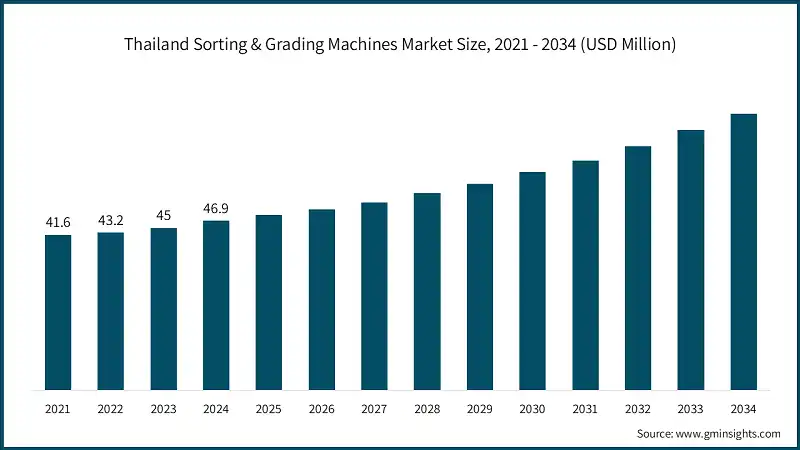
The Thailand dominated the Southeast Asia sorting & grading machines market, accounting for around 25.4% share and generating around USD 46.9 million revenue in 2024.
- Among Southeast Asia’s top exporters of fruits, vegetables, and seafood, Thailand has a major market for sorting and grading systems. Fruits such as mangoes and durians, and products like rice have strict international standards for size, color, and quality. This focus on exports is putting pressure on processors in Thailand to adapt technologies for sorting to decrease the rate of rejections and increase their competitiveness in global markets.
- The Thai government is actively supporting the promotion of agricultural mechanization, and subsidizing programs for modernization. The government’s Thailand 4.0 initiative is supporting development in smart farming and post-harvest automation. Additionally, this initiative is promoting investment in sorting and grading equipment. These government initiatives are expected to improve efficiency, reduce post-harvest losses, and improve compliance with food safety programs through enabling an ecosystem for technology.
- In Thailand, the processed food industry is experiencing tremendous growth, driven in part by urbanization and growing demand from consumers for packaged products. This growth has led to the need for consistency of quality and grading of processed food, including ready-to-eat products and frozen food products. This growth is seeing more mid-sized processors experiment with new medium capacity machines and technological components like vision-based systems to support their costs but also processes and quality.
Southeast Asia Sorting & Grading Machines Market Share
Tomra are leading with 11% market share. Tomra, Bühler Group, Hefei Meyer, Key Technology, Sesotec collectively hold around 35%, indicating moderately fragmented market concentration. These prominent players are proactively involved in strategic endeavors, such as mergers & acquisitions, facility expansions & collaborations, to expand their product portfolios, extend their reach to a broad customer base, and strengthen their market position.
Bühler Group is a leading company in food processing and optical sorting technology, most closely associated with its global SORTEX brand. In Southeast Asia, Bühler is well established with a regional hub in Singapore and branch offices in Thailand, Vietnam, and Indonesia, serving the rice, grain, and food processing sectors. Bühler has the latest technology in optical sorters that have accuracy and international quality assurance requirements that are recognized worldwide, making Bühler a suitable choice for major processors and exporters.
CP Manufacturing, with the MSS division, is an optical sorting system provider for recycling and material recovery facilities. Its core strength is in waste management and sustainable solutions, but because of developing environmental regulations and a drive toward a circular economy, MSS technology is increasingly relevant in the Southeast Asia market. MSS optical sorters are known for high-speed sorting of plastics, metals, and other recyclables. MSS sorters support developing recycling infrastructure in regional countries.
Southeast Asia Sorting & Grading Machines Market Companies
Major players operating in the Southeast Asia sorting & grading machines industry are:
- Anhui Jiexun (Anysort)
- Anhui Vsee
- Bühler Group
- CP Manufacturing
- Hefei Meyer
- Key Technology
- NDPL (Navasasyam Dandekar Pvt Ltd)
- Satake Asia
- Sesotec
- Shibuya Seiki
- Spectrum Industries
- STEINERT
- Techik Instrument
- TOMRA
- Xinxiang KARP
Meyer is a top optical sorting machine producer in China that is providing a solution for food, grain, and industrial applications. Meyer exports products to Southeast Asia, marketing its systems as competitively priced but advanced alongside mid- and large- processors. Meyer’s product line of color sorters and X-ray inspection systems incorporate flexibility and precision, and this strongly positions Meyer in markets emphasizing food safety and agricultural modernization.
Key Technology is a worldwide leader in food processing automation and digital sorting, recently introducing the VERYX and Zephyr optical sorting systems. In Southeast Asia, Key Technology is engaged in the growing industry of processed foods in providing systems that improve efficiencies, less dependence on labor, and increase product consistency. Its systems integrate AI and machine vision for defect detection, which is relevant in high volume processing of snacks, frozen foods, and fresh produce.
Southeast Asia Sorting & Grading Machines Market News
- In September 2025, TOMRA launched its newest product, the TOMRA 4C optical sorter specifically for the nut and IQF (Individually Quick Frozen) food sectors. The launch represents a major advancement in precision sorting based on advanced optical technology to meet the demand for precise, quality products without defects in the region and globally. This technology achieves precision detection of fine imperfections, increases yield, and reduces waste, and is the prime solution for the continent's growing processed and export-dependent food industry.
- In September 2025, Key Technology launched a specialized version of its COMPASS line intended for chips and snack applications. The new version features leading machine vision and AI-based programming that can help ensure product uniformity and reduce waste, making it well-suited to Southeast Asia's burgeoning processed food industry, requiring consistency and safety standards.
- In July 2025, Key Technology presented its COMPASS optical sorter at global exhibitions, featuring a belt-fed design for rapid, precise sorting - a significant technological advance in the automation of food processing because it adds a new level of defect detection and efficiency improvements for processers of frozen foods and raw commodities.
- In June 2025, the Bühler Group unveiled its next-generation optical sorting technology, SORTEX AI700, which was a worldwide launch aimed and focused on transforming efficiency and quality in food processing. Although the launch was global, Bühler mentioned its relevance to grain and rice processors in Southeast Asia and has a very strong position in the region due to its Singapore base and local offices, and this allows for expeditious adoption of the AI technology driven solutions derived from AI, throughout the region's agricultural and food landscape.
- In November 2024, Shibuya Seiki introduced its AI sensor-based grading machine at Asia Fruit Logistica in Singapore the Southeast Asian market debut for this machine. The grading machine showed off agricultural sorting applications for apples, mandarins, and potatoes, reflecting Shibuya Seiki's investment in precision-grade and automated machines with processors in regional markets.
The Southeast Asia sorting & grading machines market research report includes in-depth coverage of the industry with estimates & forecasts in terms of revenue (USD Million) and volume (Thousand Units) from 2021 to 2034, for the following segments:
Market, By Technology
- Camera/vision systems
- Laser technology
- X-ray technology
- Near-infrared (NIR) systems
- Mechanical sorting machines
- Others
Market, By Machine Capacity
- Small (up to 2 tons/hr)
- Medium (2-5 tons/hr)
- Large (above 5 tons/hr)
Market, By End Use
- Weight sorters
- Size sorters
- Color sorters
- Quality sorters
- Shape sorters
- Material detect sorters
- Specialty sorters and graders
- Others
Market, By Application
- Agriculture
- Food & beverage
- Mining & minerals
- Recycling
- Pharmaceuticals
- Others (textiles, timber, etc.)
Market, By Distribution Channel
- Direct sales
- Indirect sales
The above information is provided for the following regions and countries:
- Southeast Asia
- Thailand
- Malaysia
- Singapore
- Indonesia
- Vietnam
- Philippines
- Rest of Southeast Asia
Frequently Asked Question(FAQ) :
What are the upcoming trends in the Southeast Asia sorting & grading machines market? Key
trends include integration of AI and machine vision, adoption of hyperspectral imaging for internal quality assessment, IoT-enabled predictive maintenance, and focus on waste reduction and sustainability.
Who are the key players in the Southeast Asia sorting & grading machines market?
Key players include Anhui Jiexun (Anysort), Anhui Vsee, Bühler Group, CP Manufacturing, Hefei Meyer, Key Technology, NDPL (Navasasyam Dandekar Pvt Ltd), Satake Asia, Sesotec, Shibuya Seiki, Spectrum Industries, STEINERT, Techik Instrument, TOMRA, and Xinxiang KARP.
Which country leads the Southeast Asia sorting & grading machines market?
Thailand held the largest share with 25.4% and generated around USD 46.9 million revenue in 2024. Strong agricultural exports and government support for mechanization fuel the country's dominance.
What is the growth outlook for direct sales distribution channel in 2024?
Direct sales distribution channel generated USD 114.4 million in 2024, dominating the market due to close customer relationships, customized solutions, and comprehensive after-sales service support.
What is the current Southeast Asia sorting & grading machines market size in 2025?
The market size is projected to reach USD 191.4 million in 2025.
How much revenue did the camera/vision systems technology segment generate in 2024?
Camera/vision systems generated USD 67.3 million in 2024, leading the technology segment with advanced AI and machine learning capabilities for precise grading.
What was the market share of the medium machine capacity segment in 2024?
Medium capacity machines (2-5 ton/hr) held around 49% market share in 2024, serving mid-sized food processors and agricultural cooperatives effectively.
What is the market size of the Southeast Asia sorting & grading machines in 2024?
The market size was USD 184.3 million in 2024, with a CAGR of 5% expected through 2034 driven by automation that reduces manual labor and by AI, machine vision, and IoT technologies that improve accuracy and enable predictive maintenance.
What is the projected value of the Southeast Asia sorting & grading machines market by 2034?
The Southeast Asia sorting & grading machines market is expected to reach USD 295.8 million by 2034, propelled by technological advancements, rising demand for processed foods, and sustainability initiatives.
Southeast Asia Sorting and Grading Machines Market Scope
Related Reports