Summary
Table of Content

South-East Asia Two-wheeler E-Axle Market
Get a free sample of this report
Form submitted successfully!
Error submitting form. Please try again.
Thank you!
Your inquiry has been received. Our team will reach out to you with the required details via email. To ensure that you don't miss their response, kindly remember to check your spam folder as well!
Request Sectional Data
Thank you!
Your inquiry has been received. Our team will reach out to you with the required details via email. To ensure that you don't miss their response, kindly remember to check your spam folder as well!
Form submitted successfully!
Error submitting form. Please try again.
South-East Asia Two-wheeler E-Axle Market Size
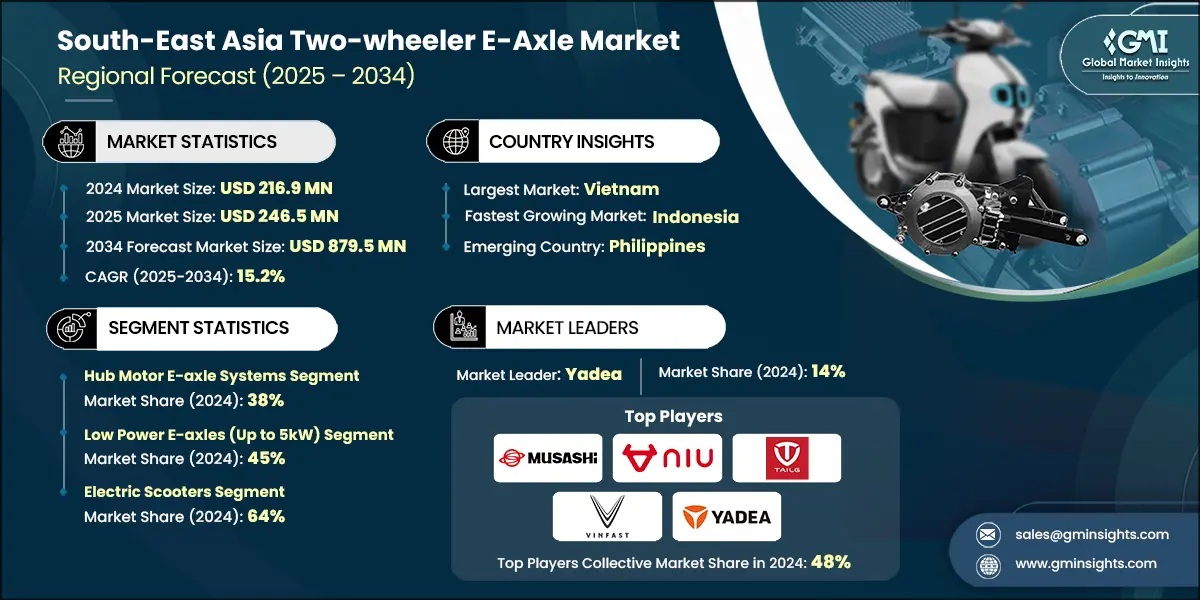
The South-East Asia two-wheeler e-axle market size was estimated at USD 216.9 million in 2024. The market is expected to grow from USD 246.5 million in 2025 to USD 879.5 million in 2034, at a CAGR of 15.2%, according to latest report published by Global Market Insights Inc.
South-East Asia Two-wheeler E-Axle Market Key Takeaways
Market Size & Growth
- 2024 Market Size: USD 216.9 Million
- 2025 Market Size: USD 246.5 Million
- 2034 Forecast Market Size: USD 879.5 Million
- CAGR (2025–2034): 15.2%
Regional Dominance
- Largest Market: Vietnam
- Fastest Growing Country: Indonesia
Key Market Drivers
- Electrification of urban two-wheelers.
- Government incentives and conversion programs in Indonesia and Vietnam.
- Rise of e-commerce and last-mile delivery.
- Regional urban mobility policies and city EV pilots.
Challenges
- Limited charging and swapping infrastructure outside Tier-I cities.
- High upfront costs of e-axle systems.
Opportunity
- Fleet electrification programs.
- Battery swapping and modular platform adoption.
- Local manufacturing and assembly expansion.
Key Players
- Market Leader: Yadea led with over 14% market share in 2024.
- Leading Players: Top 5 players in this market include Musashi, NIU Technologies, TAILG, VinFast, Yadea, which collectively held a market share of 48% in 2024.
Get Market Insights & Growth Opportunities
- Electrification of two-wheelers in Southeast Asia is moving from testing phase to everyday use. Daily commuters, delivery riders, and ride-hailing operators are drawn to low running costs and quick turnaround times. Hub motors remain common, but integrated e-axles are becoming more popular for heavier use. Regional programs for light electric vehicles are standardizing components, improving maintenance, and encouraging the adoption of compact, modular drive units for busy city streets.
- The Indonesian government is actively fostering the adoption of electric motorcycles through a system of financial encouragement. Specifically, prospective buyers of new electric motorcycles are eligible for a subsidy of approximately USD 427, while individuals converting existing gasoline-powered models can receive roughly USD 610 for certified alterations. This support is scheduled to persist until 2025.
- Vietnam has extended a full first-time registration fee waiver for battery-electric vehicles through February 2027. This measure lowers costs for households and fleets, supporting a steady shift toward electric mobility. Policy updates, legal guidance, and city-level initiatives are helping local brands grow while clarifying registration, taxation, and compliance rules that matter for financing, leasing, and resale confidence.
- In Indonesia, collaboration between mobility platforms and technology providers is putting plans into practice. A Jakarta pilot started with 250 battery-swapping scooters and four swap stations, with plans to scale 5,000 vehicles. Using major fuel station forecourts and logistics routes, the pilot has shown fast battery swaps, high vehicle availability, and predictable operating costs important for delivery services and ride-hail operations in busy areas.
To get key market trends
South-East Asia Two-wheeler E-Axle Market Trends
- Manufacturing capacity and local production are creating stronger supply chains and faster delivery times for Southeast Asian programs. Musashi, Delta, and Toyota Tsusho began full-scale production of two-wheeler electric axles targeting ASEAN markets, moving from test models to large-scale supply for complete drive systems. Chinese manufacturers setting up local operations, including TAILG's Vietnamese facility, are expanding hub-drive assembly and regional parts sourcing for scooters.
- Government policies are driving more people to buy electric motorcycles, especially in Indonesia and Vietnam. These countries offer money back to buyers, making electric bikes cheaper and helping people switch from gas-powered motorcycles. Indonesia brought back its support program. New electric motorcycle buyers get about 7 million rupiah back, while people who convert their old bikes get around 10 million rupiah. The conversion program will keep running until 2025 to help build up the electric bike market.
- Battery replacement goes from pilot projects to small networks and supports frequent use cases such as delivery and ride-hailing. In Jakarta, a pilot launched 250 swaps of scooters and four stations, with a plan of 5,000 vehicles using retail and fleet routes. Thailand opened a smart swap in Phuket for a taxi and ride-hail fleet, where several sites were planned in Bangkok and other areas.
- Production and local assembly are increasing to reduce the lead time for Southeast Asia. Musashi-Delta-Toyota began mass production of two-wheel e-axles to ASEAN markets and moved from prototypes to regular supply of integrated drive units. In Vietnam, Chinese OEMs are expanding, including TAILG, with local content for hub-drive assembly and scooters.
- Thailand is recalibrating its incentive strategies to foster domestic production and bolster export activities, all while maintaining price stability for consumers. The Electric Vehicle 3 (EV3) and Electric Vehicle 3.5 (EV3.5) schemes have been amended to incorporate less stringent production stipulations and extend fiscal benefits to exported goods. This strategic redirection prioritizes the establishment of robust local manufacturing and comprehensive supply networks throughout the 2025-2026 timeframe. Furthermore, modifications to the tax framework are being implemented to harmonize expenditures with the overarching objectives of the manufacturing sector.
South-East Asia Two-wheeler E-Axle Market Analysis
Learn more about the key segments shaping this market
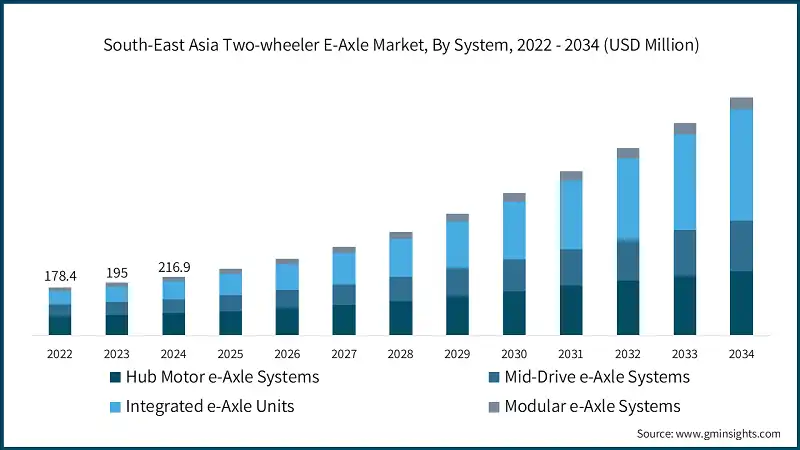
Based on system, the South-East Asia two-wheeler e-axle market is divided into hub motor e-axle systems, mid-drive e-axle systems, integrated e-axle units, modular e-axle systems. The hub motor e-axle systems segment dominated the market accounting for 38% in 2024 and is expected to grow at a CAGR of 11.3% through 2034.
- Hub motor e-axles is first choice for basic scooters and light motorcycles across Southeast Asia. Consumers want them because they're simple, cheap, and don't break down much. Hub motor e-axles connect right to the wheel, so less energy gets wasted, and they work great in busy city traffic. Indonesia, Vietnam, and Thailand use them the most since people take short trips around crowded cities, making these small, reliable hub motors most used by manufacturers.
- Mid-drive e-axles are used in faster scooters and motorcycles. It fits in the middle of the bike between the frame and wheels, giving more power and better hill climbing. This works well in hilly areas and for delivery trucks carrying heavy stuff. Bike makers use mid-drive systems in medium-powered motorcycles and delivery bikes because they give good performance, save energy, and are easy to fix.
Integrated e-axles put the motor, gears, and electronics all in one piece. You see these more in expensive bikes and business fleets. Putting everything together makes them lighter, saves more battery power, and makes them easier to build. Several companies in Vietnam and Thailand started making lots of these, mostly for city fleets that need their bikes running all the time with fewer repairs.
- Modular e-axles are systems that manufacturers can change the motor power and electronics for scooters, motorcycles, or cargo bikes without starting over from scratch. This helps fleet companies that need different types of performance while keeping costs down. These modular systems are growing because local factories in Indonesia and Vietnam are making them, plus more fleets are switching to electric.
Learn more about the key segments shaping this market
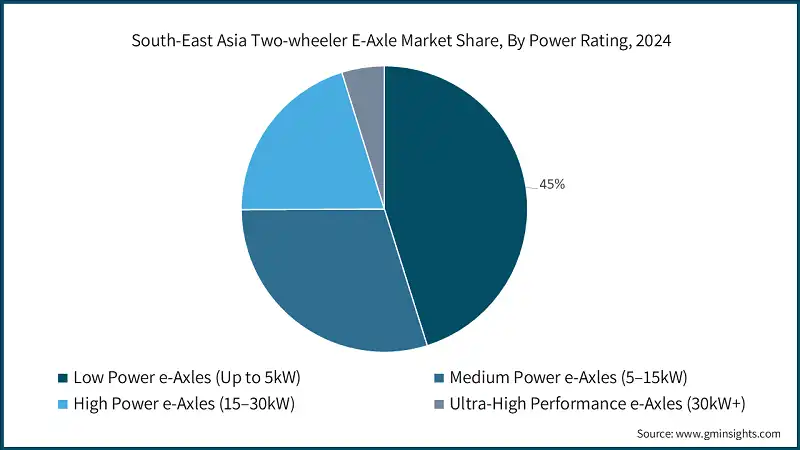
Based on power rating, the South-East Asia two-wheeler e-axle market is segmented into low power e-axles (Up to 5kW), medium power e-axles (5–15kW), high power e-axles (15–30kW), ultra-high performance e-axles (30kW+). The low power e-axles (Up to 5kW) segment dominates the market with 45% share in 2024, and the segment is expected to grow at a CAGR of over 8.4% from 2025 to 2034.
- Electric axles with lower power ratings, generally up to 5kW, are predominantly implemented in foundational scooter and light motorcycle designs. Their cost-effectiveness, straightforward maintenance requirements, and suitability for brief urban excursions make them a pragmatic choice. These systems deliver sufficient performance for daily commutes, concurrently minimizing energy expenditure and operational costs. Their integration is most prevalent in heavily populated urban environments where vehicular velocities are typically restrained.
- E-axles within the medium power band, ranging from 5 to 15kW, find application in intermediate scooters, motorcycles, and cargo-oriented bicycles. Exhibiting superior torque output and enhanced velocity capabilities when contrasted with lower-powered counterparts, these units are well-adapted to handling moderate payloads and facilitating extended journeys. Fleet management entities and transportation network companies often demonstrate a preference for these axles, owing to their commendable equilibrium between operational capabilities and resource optimization.
- High power e-axles are applied in premium scooters, motorcycles, and cargo bikes carrying heavier loads. They deliver strong torque and acceleration, which helps on hilly routes and busy urban roads. OEMs include these axles in performance-focused and commercial two-wheelers to meet tougher operational needs.
- Ultra-high-performance e-axles are used in specialized or heavy-duty two-wheelers, such as high-speed motorcycles and larger cargo bikes. They provide high torque and consistent power for demanding commercial and industrial use. Because of their higher cost and complexity, they are mainly used by premium fleets or in high-demand operations.
Based on application, the South-East Asia two-wheeler e-axle market is segmented into electric scooters, electric motorcycles, cargo & delivery bikes. The electric scooters segment dominates the market with 64% share in 2024, and the segment is expected to grow at a CAGR of 11% from 2025 to 2034.
- Electric scooters are currently dominating the market and enjoying broad adoption for daily transport in the urban environment. Their low dimensions, affordable value points and easy operation give them a preferred selection for individual passengers. The entrance to the market in nations such as Vietnam, Indonesia and Thailand is particularly strong, where the widespread short -distance travel and congested traffic patterns increase its use.
- Electric motorcycles experience popularity as the demand for high performance two -wheelers is intensified. These machines are often employed for expanded visits and require better speed and torsion forces of riders than their scooter colleagues. In addition, they find pages between young demographics and commercial fleet operators in metropolis with different road surfaces. This extension is inspired by the growth of charging infrastructure and encouraging government rules.
- Cargo and delivery bikes appear to be important components in logistics and the e-commerce industry. Engineers to accommodate enough payload, they are often distributed by bid and food distribution services. Their adoption is with a clear demand for the final phase delivery in urban centers. Governments and private enterprises encourage the implementation of reduced fuel costs and reduce emissions within urban logistical frameworks.
Looking for region specific data?
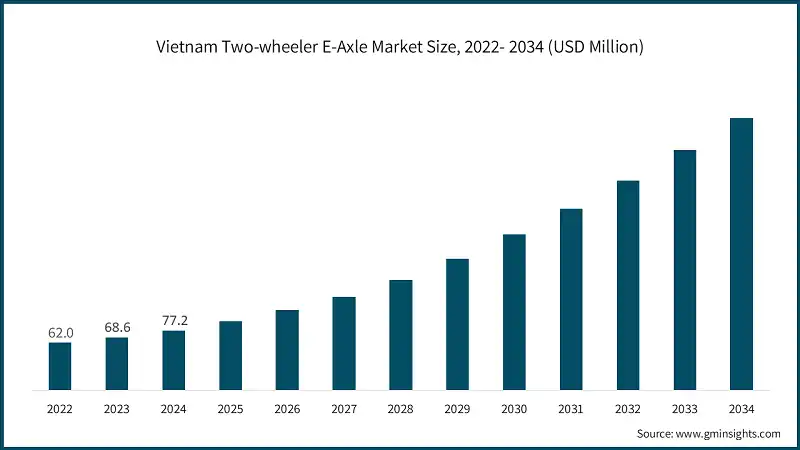
Vietnam dominated the two-wheeler e-axle market with around 36% share and generated USD 77.2 million in revenue in 2024.
- Vietnam’s two-wheeler e-axle market is gaining pace as consumer interest rises, government policies stay supportive, and local brands expand their role in the supply chain. Companies like VinFast, PEGA, and Dat Bike are cutting import reliance by making motors and controllers locally, keeping costs down for buyers. VinFast announced in April 2024 that it aims to source up to 70% of its e-powertrain parts domestically by 2025, strengthening supply chain resilience.
- The continued robustness of market expansion remains a paramount consideration. Both DAT Bike and PEGA are strategically directing their efforts toward the commuter and cost-effective segments, addressing the everyday transportation requirements of a broad user base. In March of 2025, DAT Bike unveiled its third iteration of electric motorcycles, featuring an enhanced hub motor that provides greater accessibility, demonstrably improved operational efficiency (approximately 25%), and extended range capabilities designed to serve both commercial fleets and delivery services.
- Concurrently, PEGA introduced adaptable scooter architectures, incorporating domestically produced power conversion components, specifically targeting economically minded riders who primarily undertake short-distance journeys. These initiatives serve to diminish reliance on imported goods and empower domestic manufacturers to effectively fulfill the specific demands of their consumer base.
- Charging limitations are being addressed through large-scale battery-swapping projects. VinFast outlined plans to roll out 150,000 swapping stations by 2028, starting with 1,000 points in October. The model allows users to rent batteries at affordable monthly fees, swap them within minutes, and access new scooter designs built for quick exchange. By removing long charging times, this approach aims to make electric scooters more practical and speed up the shift away from petrol motorcycles.
The two-wheeler e-axle market in Indonesia is expected to experience strong growth from 2025 to 2034.
- Indonesia's two-wheelers change in response to subsidies to e-axle, conversion programs, battery swap pilot projects and local content mandates. These schemes are pushing the market toward low-cost and locally sourced drive units, which are for fleet and commuter applications. While hub motors are common in cost-sensitive scooters, integrated e-axles are increasingly sought as operators require more efficiency and reliability for regular use.
- The government has again shown support by providing Rp 7 million for each new electric motorcycle and up to Rp 10 million for certified conversions, with incentives extended to 2025. These measures reduce the upfront cost and encourage adoption in commuter and delivery fleets and support the workshop network that handles conversions and maintenance.
- Jakarta tests mass adoption with around 250 battery swap scooters and four GoStation sites, which are supported by Gogoro, Gojek and Pertamina. It is a plan to scale up to 5,000 vehicles. The pilot benefits from the existing forecourts and fleet routes to show how quickly swapping can support delivery and ride-hailing. Operators can also achieve high uptime in congested traffic. The company's report claims the approach is an open ecosystem designed to scale based on demand.
The market in Thailand is expected to experience steady growth from 2025 to 2034.
- Thailand's two-wheeled e-axle market under EV3.5 moves behind the procurement incentive, fast battery swap pilots and a policy mix, which invests in localized, serviceable drive units for the use of commuters and fleets in urban corridors. The combination of consumer grants, import support and ecosystem partnerships corresponds to e-axle suppliers integrating compact solutions for delivery and ride-hail duty cycles.
- Thailand's EV3.5 program (2024–2027) includes 10,000 BAHT subsidies for electric motorcycles priced less than 150,000 BAHT with at least 3 kWh of battery capacity and supports cars and pickups as well as two-wheelers alongside cars and pickups. Additional measures include tax cuts for qualified EVs in 2024-2025 and create a clear path of costs for population adoption, domestic demand and local production.
- EV3.5 and BOI adaptation measures are structured to promote local assembly and development of the supply chain manufacturers are encouraged to operate drive units and components in Thailand. Emphasis on support related to government communication and production that can be utilized by two-wheelers, in accordance with e-axle integration and improvement when it comes to activities for articles.
- The exchange unit of the PTT group targeted expansion of 100+ service points in 2024, indicating the density of the infrastructure that benefits high-utilization fleets and rapid turnover for e-motorcycles. AP Honda has promoted battery swap pilots for delivery applications, in line with Honda's Mobile Power Pack battery sharing initiative and strengthened standardized packaging formats for scalable operations.
South-East Asia Two-wheeler E-Axle Market Share
- The top 7 companies in the South-East Asia two-wheeler e-axle industry are Yadea, VinFast, Musashi, NIU Technologies, TAILG, Bosch, and Vitesco Technologies, contributing around 56% of the market in 2024.
- Yadea has a leading place in the market through its high sales volumes, extensive product range and strong distribution channels. The company produces many of its own engines and controllers for entry-level and mid-range scooters, which help to reduce costs and speed up delivery. With its wide model lineup and strong dealer presence, Yadea has become a preferred option for both fleet and individual customers looking for affordable and reliable hub-drive solutions.
- VinFast gains an advantage by focusing on local production and fleet demand. The company emphasizes the high-powered, integrated e-axle designed for scooters and two-wheelers, creating close ties with fleet operators. By localizing component production and assembly, VinFast reduces import costs and delivery time, allowing it to secure large fleet contracts and expand rapidly in Vietnam and nearby markets.
- Musashi Delta e-Axle, a joint venture, brings scale and engineering expertise that meets automaker standards. The company produces integrated e-axles manufactured to OEM specifications and is able to handle large production runs. Its strong industry links and commitment to quality make it a reliable partner for manufacturers launching new vehicle lines and requiring ready-to-deploy drive units.
- NIU Technologies leverages its reputation as a smart-scooter brand and its in-house drive development, serving both retail customers and fleets. Its strengths include connected features, reliable hub motors, and the ability to quickly customize models based on customer feedback. NIU’s strong brand recognition and dealer network help meet urban demand and ensure a stable share of the e-axle market.
- TAILG benefits from the regional production presence and cost-effective assembly. By establishing production in Vietnam and other parts of Southeast Asia, the company improves local content and shortens supply chains for hub-drive scooters. This allows TAILG to offer lower-priced models, making it particularly competitive in the entry-level segment where affordability is important.
- Bosch acts as a Tier-1 supplier, providing advanced motors, inverters, and control software manufactured to meet stringent safety and reliability standards. The company is a preferred partner for OEMs that require technical expertise, certification support, and strong aftermarket service. Bosch solutions are well suited for premium models and fleet operators who prioritize uptime, diagnostics, and performance stability.
- Vitesco Technologies is an expert in power electronics and integrated drive systems for medium- and high-power two-wheelers. Its strengths include high-efficiency inverters, thermal management, and advanced system integration, making it a strong fit for scooters and cargo bikes that require higher performance. OEMs seeking efficient and reliable mid- to upper-tier solutions turn to Vitesco as a trusted partner.
South-East Asia Two-wheeler e-Axle Market Companies
Major players operating in the South-East Asia two-wheeler e-axle industry are:
- Bosch
- Gogoro
- Musashi
- NIU Technologies
- TAILG
- Vitesco Technologies
- VinFast
- Yadea
- Yamaha
- ZF Friedrichshafen
- NIU is strong in technologies and TAILG in entry-level segments, by combining smart features, reliable hub motors and regional production. NIU's in-house drive development and dealer networks allow rapid model adaptation for urban demand, while in Vietnam the low-cost assembly and other SEA locations are supported by TAILG. Both companies are aimed at cost-sensitive customers and small fleets.
- Bosch and Vitesco Technologies act as Tier-1 technology partners for performance, efficiency and technical depth of OEMs. Bosch offers motors, inverters and control software with high reliability and safety standards and supports premium scooters and fleet operations. Vitesco focuses on high-efficiency integrated e-axles with advanced inverters, thermal management and system integration, catering for scooters and cargo bikes, which require high performance. Together, these seven companies have most of the market, leaving space for local assemblers and niche suppliers.
South-East Asia Two-wheeler E-Axle Market Report Attributes
| Key Takeaway | Details |
|---|---|
| Market Size & Growth | |
| Base Year | 2024 |
| Market Size in 2024 | USD 216.9 Million |
| Market Size in 2025 | USD 246.5 Million |
| Forecast Period 2025 - 2034 CAGR | 15.2% |
| Market Size in 2034 | USD 879.5 Million |
| Key Market Trends | |
| Drivers | Impact |
| Electrification of urban two-wheelers | Promotes adoption of hub motors and integrated e-axles for delivery, ride-hailing, and commuter fleets across dense city centers |
| Government incentives and conversion programs in Indonesia and Vietnam | Encourages new purchases, conversions, and fleet trials, strengthening supplier and workshop ecosystems |
| Rise of e-commerce and last-mile delivery | Increases demand for medium- and high-power e-axles on cargo and delivery bikes, boosting OEM adoption of modular systems |
| Regional urban mobility policies and city EV pilots | Supports standardization of light electric vehicles, interoperability of drive units, and expansion of battery swapping and charging infrastructure |
| Pitfalls & Challenges | Impact |
| Limited charging and swapping infrastructure outside Tier-I cities | Restricts electric two-wheeler operations and slows broader adoption in secondary urban areas |
| High upfront costs of e-axle systems | Delays adoption for low-income consumers and smaller fleet operators |
| Opportunities: | Impact |
| Fleet electrification programs | Drives growth of high-power e-axles and integrated modular solutions for delivery and ride-hail fleets |
| Battery swapping and modular platform adoption | Reduces downtime, improves total cost of ownership, and supports sustainable urban mobility models |
| Local manufacturing and assembly expansion | Strengthens regional supply chains, reduces dependency on imports, and accelerates mass adoption |
| Market Leaders (2024) | |
| Market Leaders |
14% Market Share |
| Top Players |
Collective market share in 2024 is Collective market share is 48% |
| Competitive Edge |
|
| Regional Insights | |
| Largest Market | Vietnam |
| Fastest growing market | Indonesia |
| Emerging countries | Philippines |
| Future outlook |
|
What are the growth opportunities in this market?
South-East Asia Two-wheeler E-Axle Industry News
- In March 2025, VinFast opened a new assembly and e-axle production facility in Ho Chi Minh City, Vietnam. The factory spans 12 hectares and is capable of producing 50,000 two-wheeler e-axles annually. This move strengthens VinFast’s local production, supports fleet electrification programs, and reduces reliance on imported components for the Vietnamese and regional markets.
- In May 2025, TAILG expanded its Vietnamese assembly operations to include modular e-axle units for entry-level scooters. This allows TAILG to increase local content, shorten supply chains, and offer lower-cost scooters to price-sensitive urban customers across Southeast Asia.
- In February 2025, NIU Technologies rolled out a new connected hub-motor e-axle for urban fleets in Vietnam and Thailand. The system features enhanced energy efficiency, rapid battery swaps, and real-time monitoring for fleet operators. The launch is aimed at delivery and ride-hailing companies seeking cost-effective, high-uptime solutions.
- In October 2024, Musashi Delta e-Axle began mass production of integrated e-axles for OEM two-wheelers in Thailand. The units are designed for both commercial fleets and premium scooters, emphasizing reliability, high torque, and reduced maintenance. The venture marks a shift from prototype to volume supply in Southeast Asia.
- In July 2024, Yadea launched its first locally assembled integrated e-axle scooters in Indonesia. The initiative focuses on mid-range urban scooters with hub-drive and integrated units, targeting delivery fleets and urban commuters. The program also includes partnerships with regional dealers to expand after-sales support and service networks.
The South-East asia two-wheeler e-axle market research report includes in-depth coverage of the industry with estimates & forecasts in terms of revenue ($ Mn/Bn) and volume (units) from 2021 to 2034, for the following segments:
Market, By System
- Hub Motor e-Axle Systems
- Mid-Drive e-Axle Systems
- Integrated e-Axle Units
- Modular e-Axle Systems
Market, By Power Rating
- Low Power e-Axles (Up to 5kW)
- Medium Power e-Axles (5–15kW)
- High Power e-Axles (15–30kW)
- Ultra-High Performance e-Axles (30kW+)
Market, By Application
- Electric Scooters
- Electric Motorcycles
- Cargo & Delivery Bikes
The above information is provided for the following regions and countries:
- Brunei
- Cambodia
- East Timor
- Indonesia
- Laos
- Malaysia
- Myanmar
- Philippines
- Singapore
- Thailand
- Vietnam
Frequently Asked Question(FAQ) :
What is the market size of the South-East Asia two-wheeler e-axle in 2024?
The market size was estimated at USD 216.9 million in 2024, with a CAGR of 15.2% expected through 2034. The growing adoption of electric two-wheelers, driven by cost efficiency and government incentives, is fueling market growth.
What is the projected value of the South-East Asia two-wheeler e-axle market by 2034?
The market is poised to reach USD 879.5 million by 2034, supported by advancements in integrated e-axle systems and increasing demand for light electric vehicles in urban areas.
What is the expected size of the South-East Asia two-wheeler e-axle market in 2025?
The market size is projected to reach USD 246.5 million in 2025.
How much revenue did the hub motor e-axle systems segment generate in 2024?
The hub motor e-axle systems segment accounted for 38% of the market share in 2024 and is expected to witness over 11.3% CAGR through 2034.
What was the market share of the low power e-axles (up to 5kW) segment in 2024?
The low power e-axles segment dominated the market with a 45% share in 2024 and is set to expand at a CAGR of over 8.4% till 2034.
Which country leads the South-East Asia two-wheeler e-axle sector?
Vietnam leads the market with a 36% share, generating USD 77.2 million in revenue in 2024, supported by strong local manufacturing and government incentives.
What are the upcoming trends in the South-East Asia two-wheeler e-axle market?
Trends include a shift to integrated e-axles, government incentives, battery swapping expansion, and increased local production.
Who are the key players in the South-East Asia two-wheeler e-axle industry?
Key players include Bosch, Gogoro, Musashi, NIU Technologies, TAILG, Vitesco Technologies, VinFast, Yadea, Yamaha, and ZF Friedrichshafen.
South-East Asia Two-wheeler E-Axle Market Scope
Related Reports