Summary
Table of Content

Solvent Recovery Systems Market
Get a free sample of this report
Form submitted successfully!
Error submitting form. Please try again.
Thank you!
Your inquiry has been received. Our team will reach out to you with the required details via email. To ensure that you don't miss their response, kindly remember to check your spam folder as well!
Request Sectional Data
Thank you!
Your inquiry has been received. Our team will reach out to you with the required details via email. To ensure that you don't miss their response, kindly remember to check your spam folder as well!
Form submitted successfully!
Error submitting form. Please try again.
Solvent Recovery Systems Market Size
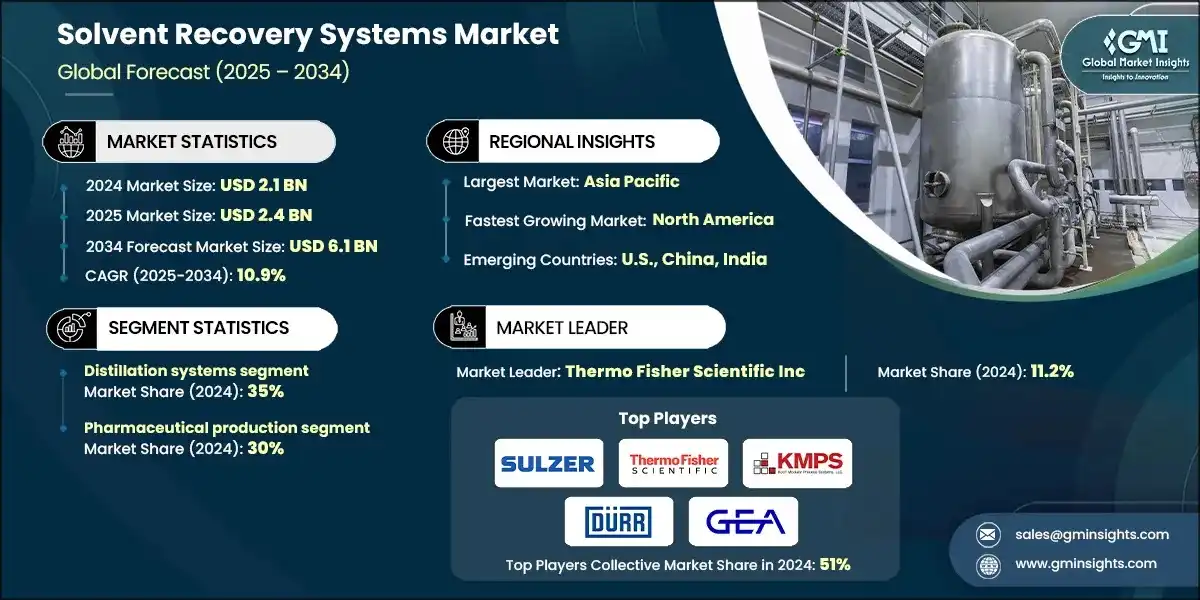
The global solvent recovery systems market was estimated at USD 2.1 billion in 2024. The market is expected to grow from USD 2.4 billion in 2025 to USD 6.1 billion in 2034, at a CAGR of 10.9%, according to latest report published by Global Market Insights Inc.
Solvent Recovery Systems Market Key Takeaways
Market Size & Growth
- 2024 Market Size: USD 2.1 Billion
- 2025 Market Size: USD 2.4 Billion
- 2034 Forecast Market Size: USD 6.1 Billion
- CAGR (2025–2034): 10.9%
Key Market Drivers
- Regulatory Compliance.
- Technological Innovation.
- Industrial Expansion.
Challenges
- Capital Investment Barriers.
Opportunity
- Energy-Efficient Technology Adoption.
Key Players
- Market Leader: Thermo Fisher Scientific Inc led with over 11.2% market share in 2024.
- Leading Players: Top 5 players in this market include Thermo Fisher Scientific Inc, Sulzer, Koch Modular Process Systems, Dürr Group, GEA Group, which collectively held a market share of 51% in 2024.
Get Market Insights & Growth Opportunities
- There is a strong growth trajectory for the market for global solvent recovery systems. Such growth greatly outstrips many traditional industrial equipment markets, and reflects an increasing desire for environmental compliance and operational efficiency across industries.
- The other driving force behind market size increase is the ever-increasing regulatory pressure with respect to VOC emissions and hazardous waste management. The MACT standards under EPA's Clean Air Act compel industries to adopt Best Available Control Technologies for VOC emissions, thereby directly mandating the adoption of solvent recovery systems in several industries. Likewise, the Industrial Emissions Directive of the European Union has defined very stringent limit values for emissions, making it incumbent upon manufacturers to invest in advanced solvent recovery technologies.
- The economic rationale of solvent recovery systems significantly contributes to the market increase. Industries employing these systems enjoy savings of 50% on solvent purchase and disposal cost and have reported payback periods varying from 12 to 24 months depending on the volume of solvent used. The economic advantage is enhanced for advanced membrane separation technologies with the savings of 40% in capital expenditure as well as energy consumption when compared to the conventional distillation methods.
To get key market trends
Solvent Recovery Systems Market Trends
- Energy Efficiency and Advanced Technology Integration- Among membrane separation processes, organic solvent nanofiltration technology is growing remarkably, with a CAGR of 18% against conventional distillation systems. This process, which operates at room temperature, uses an MWCO range of 200-1000 Da, allowing for temperature-sensitive solvent recovery with energy consumption reduced by 40% compared to conventional distillation processes. In particular, pharmaceuticals or fine chemicals would be attracted to this technology for making >99% pure solvents with catalytically active components.
- An emerging technology trend currently is microwave-enhanced recovery systems, These systems apply selective heating principles to accelerate the evaporation of solvents while keeping the product intact and beneficially applicable to some heat-sensitive pharmaceutical compounds. The technology is far more effective in energy efficiency than the traditional ways of heating, with industrial implementation timelines rarely taking about 6-12 months.
- Environmental Sustainability and Regulatory Compliance- The competitive differentiators have become driver factors for complete adoption of solvent recovery systems besides being compliance requirements. A new technical VOC emission limit value under the UNECE Gothenburg Protocol will be ratified by all the 51 countries that will have obligatory monitoring and reporting of the same, thereby requiring solvent recovery systems. It sets forward demand growth that will continue through the years, particularly in states in Europe and North America, where mechanisms for enforcement are well established.
- Digitalization and Process Optimization- The adoption of innovative digital technologies is regarded as a major trend in radically transforming solvent recovery operations. It is to enable real-time tracking of solvent purity, recovery efficiency, and machine health through an Internet-of-Things (IoT) sensor in predictive maintenance and process optimization. Recovery efficiencies can reach up to 95% and consume lower amounts of energy through advanced controlling system usage through its machine learning algorithms, optimally setting recovery parameters to solvent composition and quality needs.
Solvent Recovery Systems Market Analysis
Learn more about the key segments shaping this market
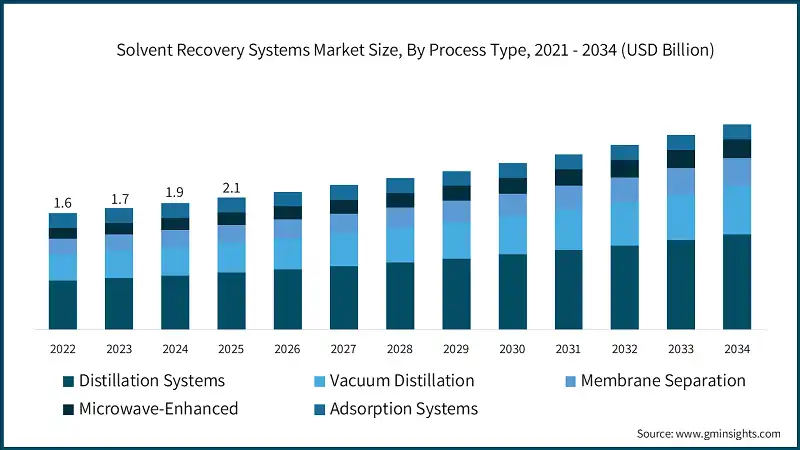
In 2024, distillation systems held dominant market share of 35%, thus marking the oldest and most well-established solvent recovery technologies available. Such systems use thermal separatory principles to effect solvent purification, but the current best systems contain superior automation and process control capabilities. Fractional distillation systems are mostly useful in recovering multi-component solvent mixtures with recoveries of up to 95% of the solvent whilst maintaining solvent specifications for reuse. The maturity of this process means reliability in operations, well-defined protocols for maintenance, thus being favored in large-scale industrial applications, where proven performance is preferable to energy efficiency considerations.
Growth of the distillation system will reflect technological refinements without any new innovations. Advancements in heat integration, better designs for columns, and more automated systems drive continued acceptance of this resource, especially in chemical processing applications where great solvent recovery cost justifies capital investment. The automotive sector is one major area driving demand, given that surface coating operations will require reliable solvent recovery to assure compliance with VOC emission limits of EPA Clean Air Act regulations.
Vacuum distillation systems have a 25% market share in the market in 2024; all geared to performing better at temperature-sensitive solvent recovery applications. Operating under reduced pressure conditions allow these systems to separate solvents at lower temperatures, improving recovery while keeping the quality of the product. It demonstrates excellent value in the pharmaceutical manufacturing scene in which requirements for stability in an API high place limit processed heat. Most vacuum distillation systems achieve recovery efficiencies of 90-95% while ensuring to meet specifications of purity with respect to solvents used for pharmaceutical applications.
Production in the pharmaceutical industry is expanding by leaps and bounds, and the focus continues to catch up with market value growth for vacuum distillation systems. This process becomes inseparable for specialty chemical and pharmaceutical applications since its use is for compounds that are heat sensitive. Conventional distillation, which has the capacity to degrade products, should not be used in these kinds of applications at all. Therefore, investments in vacuum distillation systems cost high capital investment, but the serious operational benefits that show improvement in product quality and less energy consumption make the price worthy enough to pay.
Learn more about the key segments shaping this market
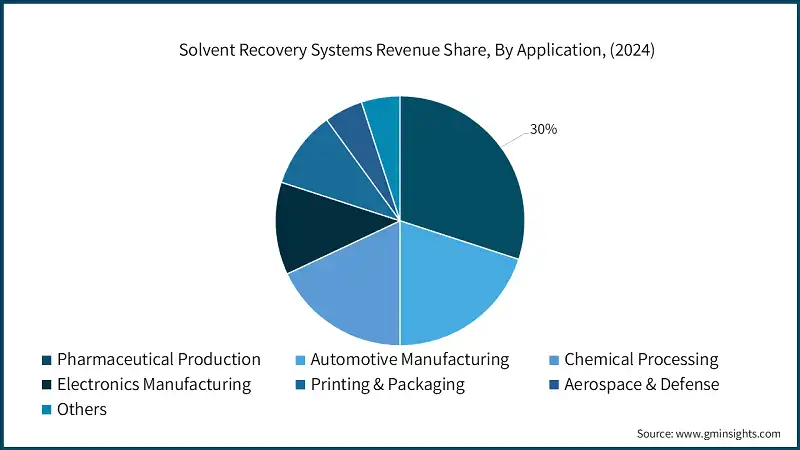
The pharmaceutical production industry is the foremost application field, which represents 30% market share in 2024, with a very stringent purity requirement along with adherence to Good Manufacturing Practice (GMP), driving its growth. The demand for very efficient solvent recovery systems is currently greater than 99% purity required for API production, driven by environmental sustainability and cost savings. Sophisticated recovery technologies such as organic solvent nanofiltration and vacuum distillation systems have emerged as necessary tools in the need to produce temperature-sensitive APIs. These technologies recovery solvents very effectively while maintaining the product integrity. In addition, the regulatory framework requiring process validation and documentation gives value to automated recovery systems because they can also provide total audit trails and real-time monitoring features.
Automotive manufacturing represents 20% of the market share in 2024, where surface coating operations are mainly the application that needs solvent recovery systems. VOC emission regulations under EPA Clean Air Act Maximum Achievable Control Technology (MACT) standards require auto manufacturers to use Best Available Control Technology for emissions control-with solvent recovery systems being an unequivocal choice for implementation. By fully implementing solvent recovery, the industry could reduce VOC emissions by about 50%, and it also saves solvent recovery costs.
The major force driving growth in automotive applications is the increasing buoyancy in vehicle production in emerging markets and the increasing demand for environmental compliance. In fact, high cost and environmental effects of specialized solvents used for electrode production favor their recovery, hence creating opportunities for solvent recovery systems in battery manufacturing processes for electric vehicle production. This segment growth profile is expected to continue as the automotive sector itself continues to expand along with the increasingly stringent global environmental regulations.
Looking for region specific data?
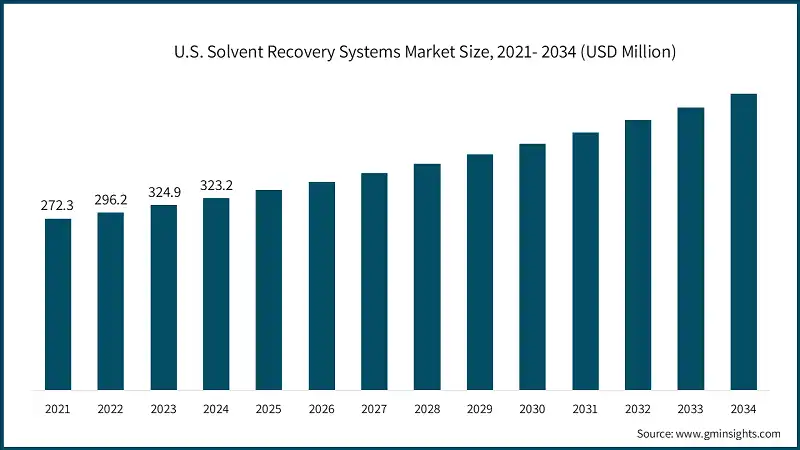
- The U.S. solvent recovery systems market reached USD 323.2 million in 2024 and estimated to grow to almost USD 930 million by 2034. North America comprises 19.8% of the market share in 2024, powered by increasingly stringent EPA regulations and the tendency towards environmental compliance. Clean Air Act MACT Standards becoming the leading market in the U.S. require controlling the emissions of VOC thoroughly across industrial sectors. The pharmaceutical industry has concentrated in this northeastern region of the country and has continuously expected demand for specialized recovery systems that meet FDA validation requirements and GMP compliance standards.
- Electrification shifts in the automotive sector have introduced further prospects in the solvent recovery systems that are deployed in battery manufacturing processes for recoveries of expensive solvents of environmental concern through electrode production. The pull towards the regional technological innovation triggers adoption of greater advanced manufacturing processes over the forecasting timeframe.
- Asia-Pacific leads the market with a 35.6% market share in 2024 fuelled by rapid industrialization and environment regulation strengthening. China is the largest country market where the growing pharmaceutical and chemical manufacturing sectors are generating continuous demand for solvent recovery solutions. The strengthening standards for industrial emissions under the Environmental Protection Law (2015) of the country are forcing manufacturers to invest in more advanced technologies of pollution control, including solvent recovery systems.
- The pharmaceutical industry in India, contributing a sizable proportion to the regional market for solvent recovery systems, is recognized as a global hub for generic drug production. The call of the pharmaceutical industry for cost reduction and environmental compliance is driving the adoption of energy-efficient recovery technologies, particularly membrane separation systems that reduce operational costs and also meet regulatory requirements. The major growth driver is electronics manufacturing in Japan, where advanced solvent recovery systems for handling high-purified chemicals in the semiconductor fabrication processes are required.
- Europe solvent recovery systems market accounts for 25.7% of the market share in 2024 with stable growth indicative of mature market conditions with an established regulatory framework. Europe's Industrial Emissions Directive specifies detailed requirements of VOC emission control and requires that best available techniques be implemented across all industrial sectors. Germany leads demand in the regional market on strong automotive and chemical manufacturing requirements for advanced solvent recovery technologies in order to comply with regulations and operational efficiencies.
- The regional pharmaceutical sector, covering Switzerland, Germany, and the UK, is expected to drive demand for high-technology recovery systems with stringent purity and validation requirements. Increased sustainability and circular economy principles among European manufacturers create openings for advanced recovery technologies, allowing for complete resource recovery and minimizing waste emanating from productions.
Solvent Recovery Systems Market Share
Global solvent recovery systems industry is moderately consolidated, wherein the combined market share of the top five players Sulzer, Thermo Fisher Scientific, Koch Modular Process Systems, Dürr Group, GEA Group which comprises of around 51% market share in 2024, evidently translating into a competitive system based on technological differentiation and focus on a specialized application. The market leadership accounts established companies manufacturing industrial equipment and commercialized recovery technology providers, each resorting to varying competitive advantages to avail the market coverage over many civil applications.
Thermo Fisher Scientific Inc. holds the leading position on the market with 11.2% market share in 2024, capitalizing on its engorged laboratory and industrial equipment production arrays for pharmaceutical and chemical processing applications. The success of the brand, the reach of a broad service network, and these integrated solution offerings from analytical instrumentation to process equipment are how Thermo Fisher has acquired its competitive position in the market. Further enriched by acquisition-based strategies, Thermo Fisher bolstered its capacity in solvent recovery through strategic acquisitions and associated innovations in membrane separation and automated recovery systems intended for pharmaceutical manufacturing applications.
Sulzer Ltd. thrives in this market by its portfolio of next-generation separation technologies that range from high-performance distillation to membrane systems all strictly in line with chemical processing applications. Expertise in engineering inspires process optimization and custom system design equips the company with competitive benefits in complicated industrial applications that require more specialized and tailored services for recovery solutions. Sulzer's marketing strategy is based on technological innovation and excellence in service, covering the full life cycle of system design, installation, and maintenance support services.
Solvent Recovery Systems Market Companies
Major players operating in the solvent recovery systems industry are:
- Sulzer
- Thermo Fisher Scientific
- Koch Modular Process Systems
- Dürr Group
- GEA Group
- Hydrite Chemical
- Maratek Environmental
- OFRU Recycling
- HongYi Environmental Equipment
- Spooner AMCEC
- CBG Biotech
- Sulzer Ltd
- With specialization in diverse separation technology portfolio and engineering skill set in process optimization, Sulzer Ltd. occupies a paramount status in the marketplace. Suffice the solvent recovery systems as advanced distillation, membrane separation, or an integrated process design feature for chemical processing and pharmaceutical industries. Proven industrial track records, global service network, and custom system design addressing complex recovery needs are their competitive advantages. Sulzer's latest investments in membrane technology and digitalization initiatives suit it for continued development in applications devoted to energy-efficient recovery.
- With specialization in diverse separation technology portfolio and engineering skill set in process optimization, Sulzer Ltd. occupies a paramount status in the marketplace. Suffice the solvent recovery systems as advanced distillation, membrane separation, or an integrated process design feature for chemical processing and pharmaceutical industries. Proven industrial track records, global service network, and custom system design addressing complex recovery needs are their competitive advantages. Sulzer's latest investments in membrane technology and digitalization initiatives suit it for continued development in applications devoted to energy-efficient recovery.
- Thermo Fisher Scientific Inc
- Built on the solid foundation of its market leadership in analytical instrumentation and laboratory equipment, Thermo Fisher Scientific Inc. offers high-quality solvent recovery products to the pharmaceutical chemicals and specialty chemical industries. The integrated approach of their equipment combines the recovery equipment and analytical capabilities that facilitate real-time monitoring and process optimization. In terms of strategy, Thermo Fisher targets the pharmaceutical markets, where regulation and validation issues are sources of opportunities for high-value specialty offerings. The world presence of the company and its established relationships with customers in pharmaceutical manufacturing give the company competitive advantages when it comes to this market segment of great value.
- Built on the solid foundation of its market leadership in analytical instrumentation and laboratory equipment, Thermo Fisher Scientific Inc. offers high-quality solvent recovery products to the pharmaceutical chemicals and specialty chemical industries. The integrated approach of their equipment combines the recovery equipment and analytical capabilities that facilitate real-time monitoring and process optimization. In terms of strategy, Thermo Fisher targets the pharmaceutical markets, where regulation and validation issues are sources of opportunities for high-value specialty offerings. The world presence of the company and its established relationships with customers in pharmaceutical manufacturing give the company competitive advantages when it comes to this market segment of great value.
- Koch Modular Process Systems LLC
- Koch Modular Process Systems LLC specializes in design and rapid deployment of modular systems, chiefly for pharmaceutical and biotechnology applications. Their standardized modular approach considerably reduces installation time frames and capital costs while ensuring compliance with good manufacturing practices and required system performance specifications. Koch's competitive positioning focuses on market delivery time and proven expertise in the pharmaceutical industry, along with total support for validation and regulatory compliance. The company's modular design philosophy unlocks scalable solutions addressing wide-ranging capacity needs, from pilot-scale to full production applications.
- Koch Modular Process Systems LLC specializes in design and rapid deployment of modular systems, chiefly for pharmaceutical and biotechnology applications. Their standardized modular approach considerably reduces installation time frames and capital costs while ensuring compliance with good manufacturing practices and required system performance specifications. Koch's competitive positioning focuses on market delivery time and proven expertise in the pharmaceutical industry, along with total support for validation and regulatory compliance. The company's modular design philosophy unlocks scalable solutions addressing wide-ranging capacity needs, from pilot-scale to full production applications.
- Dürr Group
- Dürr Group inherits solvent recovery applications along with comprehensive automotive industry situational experience, especially in surface coating and painting. The Environmental Technologies unit provides total VOC emission control solutions including solvent recovery systems geared towards automotive manufacturing applications. Förs competitive strengths allow for deep automotive know-how, established emission control expertise, and integrated solutions from application equipment to recovery systems; an infinite set of interplay between each giant brand.
- Dürr Group inherits solvent recovery applications along with comprehensive automotive industry situational experience, especially in surface coating and painting. The Environmental Technologies unit provides total VOC emission control solutions including solvent recovery systems geared towards automotive manufacturing applications. Förs competitive strengths allow for deep automotive know-how, established emission control expertise, and integrated solutions from application equipment to recovery systems; an infinite set of interplay between each giant brand.
- GEA Group AG
- GEA Group AG uses its process technology expertise and worldwide industrial reach to serve various solvent recovery applications in the sectors of food processing, pharmaceutical, and chemical industries. Their separation technology portfolio includes distillation, membrane, and hybrid systems tailored to meet specific industrial requirements. GEA's competitive positioning focuses on process optimization and energy efficiency, emphasizing full engineering and life-cycle support. The diversified nature of GEA's industrial customer base provides stability and growth opportunities across multi-market sectors.
- GEA Group AG uses its process technology expertise and worldwide industrial reach to serve various solvent recovery applications in the sectors of food processing, pharmaceutical, and chemical industries. Their separation technology portfolio includes distillation, membrane, and hybrid systems tailored to meet specific industrial requirements. GEA's competitive positioning focuses on process optimization and energy efficiency, emphasizing full engineering and life-cycle support. The diversified nature of GEA's industrial customer base provides stability and growth opportunities across multi-market sectors.
Solvent Recovery Systems Market Report Attributes
| Key Takeaway | Details |
|---|---|
| Market Size & Growth | |
| Base Year | 2024 |
| Market Size in 2024 | USD 2.1 Billion |
| Market Size in 2025 | USD 2.4 Billion |
| Forecast Period 2025 - 2034 CAGR | 10.9% |
| Market Size in 2034 | USD 6.1 Billion |
| Key Market Trends | |
| Drivers | Impact |
| Regulatory Compliance | Ensures market growth by driving adoption of solvent recovery systems to meet environmental and safety standards. |
| Technological Innovation | Enhances efficiency and cost-effectiveness of solvent recovery, fostering industry advancement. |
| Industrial Expansion | Increases demand for solvent recovery systems as industries grow and require sustainable waste management solutions. |
| Pitfalls & Challenges | Impact |
| Capital Investment Barriers | Limited access to funding may slow deployment of advanced solvent recovery technologies. |
| Opportunities: | Impact |
| Energy-Efficient Technology Adoption | Reduces operational costs and environmental footprint, encouraging industries to upgrade to advanced systems. |
| Market Leaders (2024) | |
| Market Leaders |
11.2% market share |
| Top Players |
Collective market share is 51% in 2024 |
| Competitive Edge |
|
| Regional Insights | |
| Largest Market | Asia Pacific |
| Fastest Growing Market | North America |
| Emerging Country | U.S., China, India |
| Future Outlook |
|
What are the growth opportunities in this market?
Solvent Recovery Systems Industry News
- In January 2025, Thermo Fisher Scientific Inc. announced the expansion of its solvent recovery system manufacturing facility in Germany, which aims to meet the growing European demand for pharmaceutical-grade recovery solutions through USD 25 million investment aimed at supporting advanced membrane separation technology production along with GMP-compliant system assembly capabilities.
- In May 2024, Donaldson Company, Inc., and PolyPeptide Group AG, announced their collaboration on the development of a production scale solvent recovery system for use in peptide purification. Peptides are used as the active pharmaceutical ingredient (API) in therapeutic areas, which continue to broaden and include metabolic disorders, oncology, infectious diseases, orphan diseases, cardiovascular, neurology or gastroenterology applications.
- In October 2022, Beaker & Wrench carved out its place among distillation specialists and now, the introduction of its Solvent Recovery System makes it a powerhouse in industry. The addition of solvent recovery equipment to its product line touts the company's commitment to science and the cannabis extraction industry.
The solvent recovery systems market research report includes in-depth coverage of the industry, with estimates & forecast in terms of revenue (USD Billion) and volume (Kilo Tons) from 2021 to 2034, for the following segments:
Market, By Process Type
- Distillation systems
- Vacuum distillation systems
- Membrane separation systems
- Microwave-enhanced recovery systems
- Adsorption systems
Market, By Application
- Automotive manufacturing
- Paint shop & coating operations
- Parts cleaning & degreasing
- Solvent blending & recycling in assembly
- Battery manufacturing (EVs & hybrids)
- Others
- Pharmaceutical production
- Active pharmaceutical ingredient (API) manufacturing
- Laboratory solvent recovery
- Others
- Printing & packaging
- Flexographic printing
- Gravure printing
- Lithographic printing
- Others
- Electronics manufacturing
- PCB manufacturing & cleaning
- Semiconductor wafer processing
- Others
- Aerospace & defense
- Composite material fabrication
- Surface treatment & preparation
- Maintenance, repair & overhaul (MRO)
- Others
- Chemical processing
- Others
Market, By Installation Type
- On-site systems
- Off-site systems
The above information is provided for the following regions and countries:
- North America
- U.S.
- Canada
- Europe
- UK
- Germany
- France
- Italy
- Spain
- Rest of Europe
- Asia Pacific
- China
- India
- Japan
- South Korea
- Australia
- Rest of Asia Pacific
- Latin America
- Brazil
- Mexico
- Argentina
- Rest of Latin America
- Middle East & Africa
- UAE
- Saudi Arabia
- South Africa
- Rest of Middle East & Africa
Frequently Asked Question(FAQ) :
What is the market size of the solvent recovery systems industry in 2024?
The market size solvent recovery systems was valued at USD 2.1 billion in 2024, with a CAGR of 10.9% expected through 2034, driven by technological innovation and rising regulatory focus on VOC emission control.
What is the current solvent recovery systems market size in 2025?
The market size is projected to reach USD 2.4 billion in 2025, supported by industrial expansion and increasing adoption of energy-efficient solvent recovery solutions.
What is the projected value of the solvent recovery systems market by 2034?
The market size for solvent recovery systems is anticipated to reach USD 6.1 billion by 2034, fueled by stringent emission norms, sustainability mandates, and rapid industrial modernization.
How much revenue did the distillation systems segment generate in 2024?
Distillation systems accounted for 35% of the solvent recovery systems market in 2024, making them the leading process type due to their proven reliability and widespread use in large-scale industrial applications.
What was the valuation of the vacuum distillation systems segment in 2024?
Vacuum distillation systems held 25% market share in 2024, driven by their ability to recover high-purity solvents at lower temperatures for temperature-sensitive applications in pharmaceuticals and specialty chemicals.
Which region leads the solvent recovery systems market?
The U.S. solvent recovery systems industry reached USD 323.2 million in 2024 and is estimated to grow to nearly USD 930 million by 2034. Growth is driven by stringent EPA Clean Air Act MACT standards and strong adoption across pharmaceutical and automotive manufacturing sectors.
What are the upcoming trends in the solvent recovery systems industry?
Key trends include the rise of organic solvent nanofiltration, microwave-enhanced recovery systems, and IoT-based process optimization for real-time monitoring, predictive maintenance, and improved recovery efficiency up to 95%.
Who are the key players in the solvent recovery systems market?
Leading companies include Sulzer, Thermo Fisher Scientific, Koch Modular Process Systems, Dürr Group, GEA Group, Hydrite Chemical, Maratek Environmental, OFRU Recycling, HongYi Environmental Equipment, Spooner AMCEC, and CBG Biotech.
Solvent Recovery Systems Market Scope
Related Reports