Summary
Table of Content

Solid-State Battery for Electric Vehicle Market
Get a free sample of this report
Form submitted successfully!
Error submitting form. Please try again.
Thank you!
Your inquiry has been received. Our team will reach out to you with the required details via email. To ensure that you don't miss their response, kindly remember to check your spam folder as well!
Request Sectional Data
Thank you!
Your inquiry has been received. Our team will reach out to you with the required details via email. To ensure that you don't miss their response, kindly remember to check your spam folder as well!
Form submitted successfully!
Error submitting form. Please try again.
Solid-State Battery for Electric Vehicle Market Size
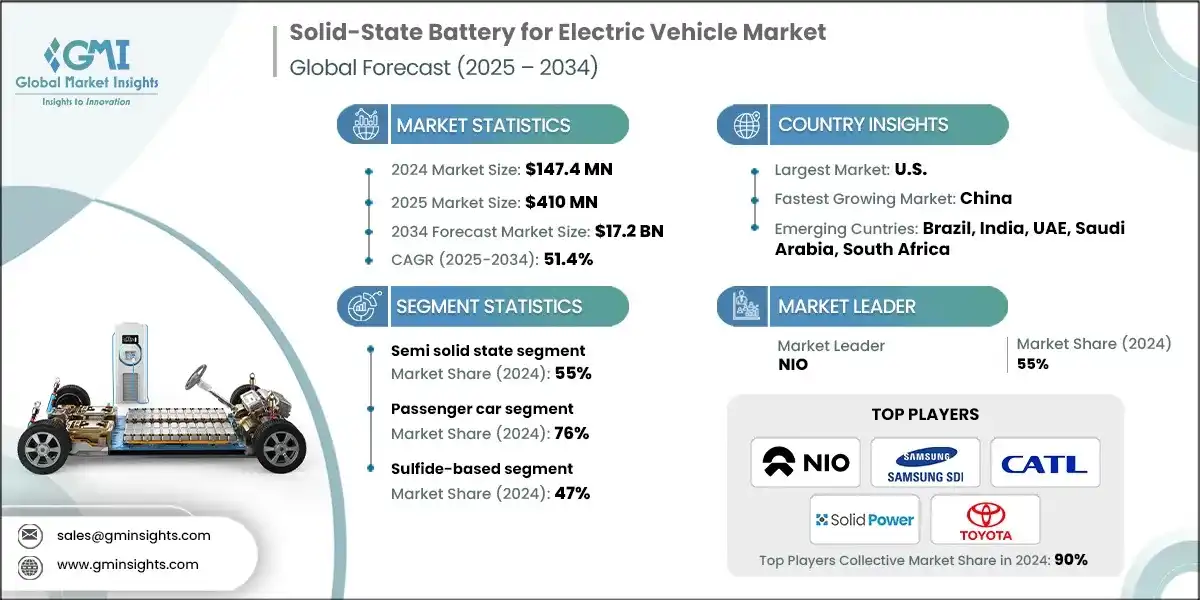
The global solid-state battery for electric vehicle market size was estimated at USD 147.4 million in 2024. The market is expected to grow from USD 410 million in 2025 to USD 17.2 billion in 2034, at a CAGR of 51.4% according to latest report published by Global Market Insights Inc.
Solid-State Battery for Electric Vehicle Market Key Takeaways
Market Size & Growth
- 2024 Market Size: USD 147.4 Million
- 2025 Market Size: USD 410 Million
- 2034 Forecast Market Size: USD 17.2 Billion
- CAGR (2025–2034): 51.4%
Regional Dominance
- Largest Market: US
- Fastest Growing Region: China
Key Market Drivers
- Breakthroughs in high-energy-density solid electrolytes.
- Rising global demand for safer EV battery technologies.
- Heavy OEM & government investments in pilot lines.
- Shift toward long-range EVs with ultra-fast charging.
- Strategic partnerships & material innovations.
Challenges
- High manufacturing costs & complex processing.
- Scalability & yield issues in gigafactories.
- Limited supply chain maturity.
- Durability issues during fast charging.
Opportunity
- Growing global EV penetration.
- Advances in lithium-metal & silicon-anode design.
- Premium & performance EV commercialization.
- Recycling & circular economy pathways.
Key Players
- Market Leader: NIO led with over 55% market share in 2024.
- Leading Players: Top 5 players in this market include NIO, Solid Power, CATL, Samsung SDI, Toyota, which collectively held a market share of 90% in 2024.
Get Market Insights & Growth Opportunities
Growing concerns over thermal runaway, EV fire incidents, and limitations to liquid-electrolyte lithium-ion batteries are forcing car manufacturers to look at much safer battery chemistries. Solid-state batteries remove flammable electrolytes and provide better stability under extreme temperatures. As the government intensifies its battery safety standards and manufacturing companies work toward mitigating risks, increasing demand for safe, crash-resistant solid-state battery packs is propelling the market at a scorching pace.
For instance, in November 2025, BMW teamed up with Korean battery company Samsung SDI to develop solid-state batteries. Under the new partnership, Samsung SDI will help BMW and Solid Power develop and test the cells. Solid Power will provide its sulfide-based solid electrolyte, the main material, while Samsung SDI will integrate it into the separator and build the battery cells.
Automakers are heavily investing in new battery technologies to extend driving ranges without adding extra weight to EVs. Solid-state batteries allow much higher energy density, thinner cell designs, and faster charging times. Large-scale manufacturers are establishing pilot lines and forming supply partnerships. The move toward lightweight, compact, long-range EV design is accelerating commercialization and adoption of solid-state batteries.
Governments in the US, Europe, China, Japan, and South Korea are allocating billions to accelerate solid-state battery research, development, and manufacturing. Incentives for local cell manufacturing, sourcing critical materials, and scaling prototypes reduce commercialization risks for startups and manufacturers. These policy initiatives will help transition from pilot projects to mass production and will boost the global market of solid-state EV batteries.
With the increasing rate of EV adoption worldwide, consumers are looking forward to ultra-fast charging. The ability of solid-state batteries to accept charges quicker with less degradation, along with improved thermal stability, allows EVs to charge much faster than traditional lithium-ion batteries. This serves commercial fleets, ride-hailing, and intercity transport systems more efficiently due to reduced downtime, which will increase the demand for EVs that use solid-state batteries.
With a well-developed ecosystem of battery manufacturing, generous government support, and ambitious EV adoption targets in China, Japan, and South Korea, the Asia-Pacific region leads the development of solid-state battery pilot lines with highly efficient supply chains for electrolytes, anodes, and ceramic materials. Quick scale-up of production, high research and development efforts, and increasing domestic EV production make APAC the fastest-growing market for solid-state batteries.
North America has also emerged as the second significant regional market, with its robust cluster of solid-state innovators, large-scale federal funding programs, and solid partnerships between automakers and battery startups. Energy security, local production, and advanced manufacturing issues dear to the regional administration-all contribute to early adoption. Moreover, the introduction of solid-state battery prototypes for both premium and commercial vehicle models by leading EV brands enhances their market position.
To get key market trends
Solid-State Battery for Electric Vehicle Market Trends
Growing concerns about thermal runaway, fire hazards, and safety failures in liquid-electrolyte lithium-ion batteries are speeding up the shift toward solid-state chemistries. Solid electrolytes remove flammable components and provide better thermal stability, making them ideal for high-voltage electric vehicle architectures. Stricter safety regulations and original equipment manufacturer requirements for crash-resistant, non-flammable battery systems strongly encourage the adoption of solid-state batteries.
Consumers now expect electric vehicles to achieve a range of 600 to 1,000 kilometers without compromising weight or design. Solid-state batteries provide much higher energy density with lithium-metal and advanced silicon anodes. This allows automakers to create lighter electric vehicles with longer driving ranges. The global effort to eliminate range anxiety reinforces solid-state batteries as a key technology for next-generation electric vehicle platforms.
Automakers, battery startups, and material suppliers are teaming up to speed up solid-state battery development. Companies are investing billions into pilot plants, prototype testing, and high-volume manufacturing lines. These partnerships reduce technological risk, improve electrolyte compatibility, and hasten commercialization. The growth of integrated electric vehicle-battery ecosystems boosts the market for solid-state batteries in both premium and mass-market segments.
Governments in the US, EU, China, Japan, and South Korea are providing significant funding, tax incentives, and regulatory support to bring next-generation battery production to local markets. These initiatives promote research and development, strengthen supply chains, and encourage large-scale solid-state manufacturing. Policies that support decarbonization, electric vehicle adoption, and local battery independence greatly drive growth in the solid-state battery market worldwide.
The global rise of high-power charging networks is creating a demand for battery technologies that can handle fast, repeated charging without damage. Solid-state batteries can handle higher charge currents and offer better heat resistance than conventional lithium-ion cells. Their compatibility with ultra-fast charging stations makes them suitable for commercial fleets, long-distance travel, and next-generation electric vehicle designs aimed at rapid energy replenishment.
Advancements in sulfide, oxide, and polymer solid electrolytes, along with improvements in lithium-metal anode stabilization, are increasing the durability and manufacturability of solid-state batteries. Better ionic conductivity, interface engineering, and dendrite suppression are addressing past limitations. As these developments progress, solid-state batteries are becoming more suitable for mass production, driving broad industry adoption over the next decade.
Solid-State Battery for Electric Vehicle Market Analysis
Learn more about the key segments shaping this market
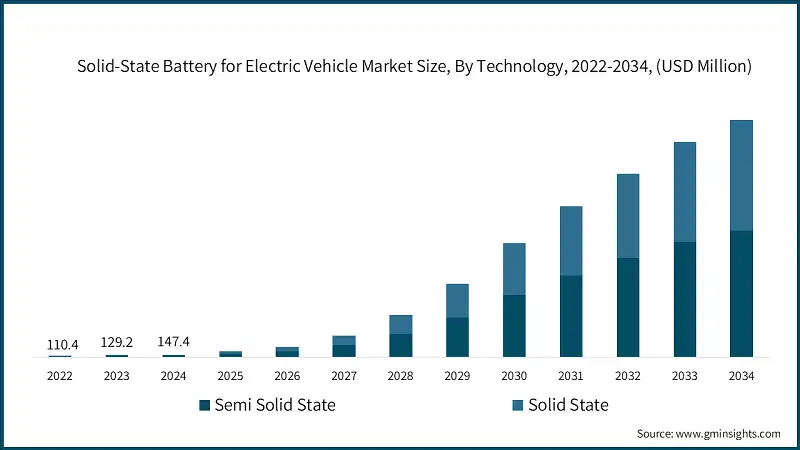
Based on technology, the solid-state battery for electric vehicle market is divided into semi-solid state and solid state. The semi solid state segment dominated the market accounting for around 55% in 2024 and is expected to grow at a CAGR of over 50% from 2025 to 2034.
- Semi-solid-state batteries connect today’s liquid-electrolyte lithium-ion cells and fully solid-state designs. They improve safety and energy density while being compatible with current manufacturing lines. This cuts costs, shortens production timelines, and helps automakers introduce next-generation battery performance to the market sooner, speeding up adoption in the mid-range and premium EV segments.
- By reducing the amount of flammable liquid electrolyte, semi-solid-state batteries provide better thermal stability and a lower risk of fire compared to conventional lithium-ion cells. This safer chemistry appeals to regulators, fleet operators, and OEMs focused on minimizing thermal runaway incidents. The ability to enhance safety without needing a complete redesign of EV platforms sparks strong market interest.
- Semi-solid-state batteries enable the use of silicon-rich anodes and high-capacity cathodes while keeping stable interfaces. Their hybrid electrolyte structure allows for higher ionic conductivity and reduces degradation, helping EVs achieve a longer range without significant weight increases. This small but important increase in energy density makes semi-solid batteries appealing for mass-market and long-distance electric vehicles.
- The semi-solid electrolyte system offers better structural support and uniform ion transport. This lowers stress on the anode and cathode during rapid charging, which results in less resistance growth, slower degradation, and a longer battery lifespan. As fast-charging networks expand worldwide, semi-solid-state batteries provide EV manufacturers with a more durable option that works well with high-power charging infrastructure.
- Semi-solid batteries overcome many manufacturing challenges associated with rigid ceramic electrolytes, like cracking, poor interface contact, and high-temperature sintering. Their gel-like electrolyte simplifies stacking and coating processes, making them easier to scale. This leads to fewer defects, improved yield, and lower costs, attracting major OEMs looking for immediate pathways to solid-state technology.
- Automakers are increasingly using semi-solid-state batteries in prototype and early-stage EV platforms. They can be manufactured with modified lithium-ion equipment, which allows companies to test next-generation chemistries, confirm performance improvements, and speed up real-world deployment. Growing commitments from OEMs and supply agreements boost market momentum for semi-solid-state batteries.
Learn more about the key segments shaping this market
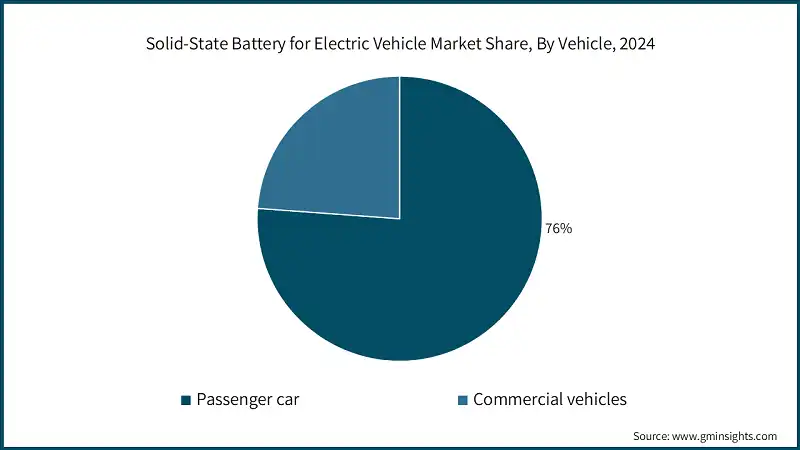
Based on vehicle, the solid-state battery for electric vehicle market is segmented into passenger car and commercial vehicle. The passenger car dominates the market with 76% share in 2024, and the segment is expected to grow at a CAGR of over 51% from 2025 to 2034.
- Passenger car buyers now expect EVs to travel long distances without needing frequent charges. Solid-state batteries offer much higher energy density, enabling ranges beyond 700 to 1,000 km on a single charge. As range anxiety decreases, more average customers are choosing EVs, creating strong demand for SSB-powered passenger cars in compact, mid-size, and premium categories.
- Urban and suburban EV users want minimal downtime and fast charging during their daily travels. Solid-state batteries support higher charge rates with less heat, allowing 10 to 15-minute recharge cycles. This makes passenger EVs more convenient than traditional lithium-ion options, especially in cities where quick charging is crucial. This convenience boosts the demand for SSBs in personal mobility.
- Major automakers are quickly shifting their passenger car lines to electric-only models. They are seeking next-generation batteries to improve efficiency, safety, and acceleration. Solid-state batteries make vehicles lighter, provide more power, and allow for better design flexibility. Their compatibility with performance-focused EV models encourages investments by OEMs, making SSBs central to future passenger car electrification plans.
- Safety is a top concern for passenger car buyers, particularly regarding the risk of EV fires. Solid-state batteries eliminate flammable liquid electrolytes, which significantly reduces the chances of thermal runaway incidents. As safety-conscious consumers and regulators demand more stable battery systems, automakers are adopting SSB technology to build brand trust, improve crash safety ratings, and meet demanding future standards.
- Many governments provide subsidies, tax breaks, and research funding for battery technologies that support sustainability and lower lifecycle emissions. Solid-state batteries help create longer-lasting passenger cars that need fewer battery replacements, generate less raw material waste, and are easier to recycle. These policy-driven benefits accelerate the integration of SSBs into mainstream passenger EV models, driving SSB for EVs market growth.
- High-end EV brands are increasingly opting for solid-state batteries to stand out with better range, safety, acceleration, and charging speed. Adoption in the premium segment sets performance standards and builds consumer confidence, which could prompt mass-market car manufacturers to follow suit. Early use in luxury sedans and SUVs accelerates technological development, lowers costs, and encourages wider SSB adoption across various passenger car categories.
Based on propulsion, the solid-state battery for electric vehicle market is segmented into BEV, HEV, and PHEV. BEVs with solid-state batteries have much higher energy density. This leads to longer driving ranges. As a result, it reduces range anxiety and encourages more people to try electric vehicles. SSB-powered BEVs are therefore ideal for long trips, luxury options, and fleet use. Since range is a key factor in competition, automakers are using SSB technology to make BEVs more appealing and boost their market presence.
- Solid-state batteries charge faster due to better thermal stability and improved ion transport. For BEVs, this means shorter charging times. It makes electric vehicles more practical for daily commuting and long-distance travel. Faster charging meets consumer demands for convenience and strengthens public charging infrastructure. This helps speed up the adoption of BEVs worldwide.
- SSBs lower the risks of thermal runaway, fire hazards, and electrolyte leaks. This addresses one of consumers’ biggest concerns about BEVs. Their solid electrolytes improve safety, especially in extreme temperatures. As regulators push for stricter safety standards for EVs, SSB-powered BEVs are becoming more popular. This encourages manufacturers to invest and builds consumer trust in the next generation of electric vehicles.
- Solid-state batteries have a longer cycle life and experience slower capacity loss. This reduces long-term maintenance and replacement costs for BEV owners. The extended lifespan increases resale value, making BEVs more attractive to private buyers, shared mobility services, and logistics fleets. Better durability helps BEVs compete more effectively against traditional internal combustion engines and standard lithium-ion EVs.
- The compact and lightweight design of solid-state batteries greatly improves BEV efficiency by lowering the overall weight of the vehicle. Less weight leads to longer ranges, better performance, and improved energy use. Automakers are using lightweight SSB packs to develop more aerodynamic and high-performance BEVs. This advantage boosts adoption in the luxury, sports, and high-efficiency BEV markets.
- Leading automotive manufacturers and battery innovators are speeding up commercialization through partnerships, pilot production lines, and developments focused on solid-state platforms ready for BEVs. These significant investments help reduce manufacturing costs, strengthen the supply chain, and encourage early adoption in passenger BEVs. As production increases, BEVs will gain the most from advancements in SSB technology, driving rapid growth in electrification.
Based on material, the solid-state battery for electric vehicle market is segmented into polymer-based, sulfide-based, oxide-based, and others. Sulfide-based segment is leading the market with 47% share in 2024.
- Sulfide-based solid-state batteries are known for their high ionic conductivity. This feature allows faster ion movement during charging and discharging. As a result, these batteries provide higher power output and better energy storage. This increased efficiency improves electric vehicle (EV) performance, offering better driving range, acceleration, and overall experience. Therefore, sulfide-based SSBs are perfect for the next generation of electric vehicles.
- Sulfide-based electrolytes offer better stability at the interface when used with lithium metal anodes. This prevents dendrite growth and extends battery life. This combination leads to higher energy densities and more efficient energy storage, making them well-suited for EV applications that require long range, fast charging, and high energy performance. Their effectiveness is a key reason for their use in premium EVs.
- Sulfide-based SSBs also provide excellent thermal stability. They function well across a wide range of temperatures, handling both high and low conditions. This versatility makes them suitable for various EV applications, from high-performance sports cars to electric trucks that work in extreme environments. Their ability to maintain stable performance in different conditions drives strong demand in automotive markets worldwide.
- In contrast to oxide-based solid-state batteries, sulfide-based SSBs have simpler manufacturing processes. This makes them cheaper to produce. Their easier scalability allows manufacturers to use existing lithium-ion production systems, lowering the barriers to mass production. This advantage speeds up the commercialization of sulfide-based batteries for EVs, promoting faster adoption and reducing costs for consumers.
- Sulfide-based solid-state batteries can achieve higher energy densities compared to traditional liquid-electrolyte lithium-ion batteries. This is crucial for EVs because it enables longer driving ranges while keeping vehicle weight down. Extended ranges attract consumers, especially in areas where longer trips are common. This factor increases the demand for EVs powered by sulfide-based SSBs.
- Sulfide-based solid-state batteries work efficiently in high-voltage systems, which are essential for the extended range and fast-charging capabilities needed for future EV models. This makes them an excellent choice for next-generation EVs that require high-voltage battery setups. Their compatibility with these systems positions sulfide-based SSBs as a strong option for both passenger and commercial electric vehicles.
Looking for region specific data?
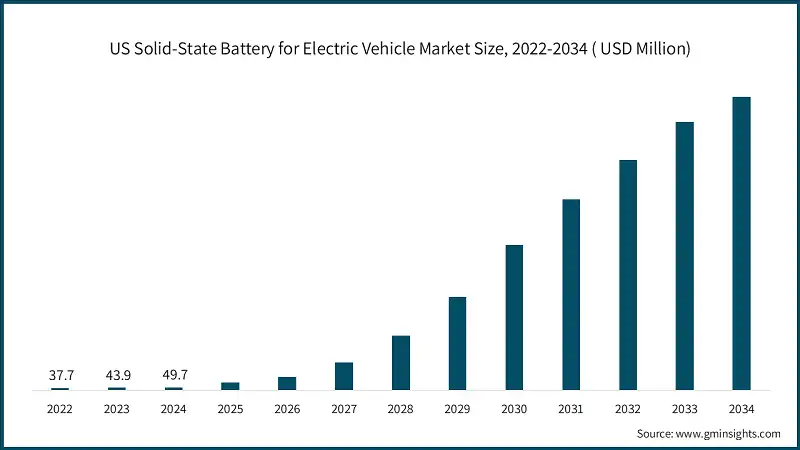
US dominated the solid-state battery for electric vehicle market in North America with around 86% share and generated USD 49.7 million in revenue in 2024.
- US government is committed to heavy investment in the adoption of electric vehicles and innovation in batteries through initiatives such as the IRA and ARPA-E. These programs facilitate research, development, and large-scale manufacturing of solid-state batteries, thus guaranteeing a swift transition to the next generation of EVs with the power of more efficient and safer battery technologies.
- US SSB for EVs market is driven by consumer demand for premium, high-performance, long-range EVs. Solid-state batteries enable an EV to achieve over a range of 500 miles on a single charge. This ability caters to the needs of US consumers to undertake long-distance travel without a loss in vehicle performance, thereby accelerating the domestic market's adoption of electric vehicles powered by solid-state batteries.
- US is actively pursuing its battery supply chain development process and reducing dependence on foreign materials. Much emphasis has been placed on manufacturing solid-state batteries, with several gigafactories currently under construction across the nation. As original equipment manufacturers and battery suppliers ramp up their production quantities, solid-state batteries will become cheaper and more widely available, further enhancing the competitiveness of the US SSB for EVs market in the global EV landscape.
- A growing commitment by the US to sustainability and clean energy through renewable energy sources, carbon reduction goals, and environmental policies raises demand for eco-friendly and efficient battery technologies. Solid-state batteries support these objectives with a lower environmental impact and improved energy efficiency. This need drives significant investment and innovation in the solid-state battery sector, especially for EVs.
- Major players in the US automotive sector such as Tesla, General Motors, and Ford are racing to develop solid-state batteries and integrate them into their electric vehicle models. These companies are amongst the forefront of research and development in testing and developing the adoption of solid-state batteries. This includes improving performance, charging speed, and sustainability of battery technologies. The participation of these companies has put the United States in a better position within the global electric vehicle market.
- The expansion of infrastructure for EV charging in the US is important for the broad-based adoption of electric vehicles. At the same time, solid-state batteries-with their capability for fast charging-will be integral in enabling ultra-fast charging at both public and private stations. Such infrastructure, backed by federal funding, would make EVs more convenient to use for consumers, thus driving higher demand for EVs based on solid-state batteries.
The solid-state battery for electric vehicle market in Germany is expected to experience robust growth between 2025 and 2034.
- Germany’s leading automotive industry, driven by BMW, Mercedes-Benz, Volkswagen, and Porsche, is promoting rapid adoption of advanced battery technologies. These manufacturers focus on high-performance electric vehicles (EVs) with long ranges, safety, and fast-charging capabilities. They benefit from solid-state battery (SSB) advantages. Their engineering prowess and dedication to premium products enhance SSB research and development, as well as commercialization in the passenger and luxury EV markets.
- Germany’s ambitious energy transition framework, Energiewende, and its aggressive decarbonization targets generate strong policy support for EV and battery advancements. Subsidies, research grants, and investments in green infrastructure motivate automakers and battery companies to embrace solid-state technologies. This favorable regulatory environment speeds up market readiness, pilot production, and long-term commercialization of advanced SSBs within the German EV market.
- Germany is quickly building large-scale battery production through partnerships with companies like CATL, Northvolt, and local battery technology firms. These investments strengthen national battery independence while prioritizing the development of next-generation chemistries like solid-state. Increasing gigafactory capacity leads to cost reductions, stable supply, and quicker industrialization of SSBs, enhancing Germany’s competitive edge in EV production.
- Germany’s robust research ecosystem, which includes universities, Fraunhofer institutes, and dedicated battery innovation centers, drives advancements in solid electrolytes, lithium-metal integration, and manufacturing methods. This research strength speeds the development of safer, longer-lasting, and more scalable SSB solutions. Collaboration between academic institutions and automakers accelerates prototyping, field testing, and early deployment, positioning Germany as a leader in solid-state battery innovation.
- German consumers prioritize quality, safety, and performance in their vehicles. Solid-state batteries, known for their non-flammable electrolytes, higher energy density, and improved durability, meet these demands effectively. As the need for safer, longer-range EVs rises, automakers are focusing more on developing SSB-powered models. This consumer preference boosts market momentum and promotes quicker industrial adoption of solid-state technologies.
- Germany’s dedication to renewable energy and circular manufacturing supports the use of eco-friendly battery technologies. Solid-state batteries need fewer safety measures, have longer lifespans, and create a smaller environmental impact compared to traditional lithium-ion batteries. As manufacturers emphasize sustainable EV platforms and carbon-neutral factories, SSBs stand out as a long-term solution that fits Germany’s sustainability-driven automotive approach.
The solid-state battery for electric vehicle market in China is expected to experience rapid growth between 2025 and 2034.
- Rising consumer interest in leisure boating, family outings, and weekend water activities is creating strong demand for outboard engines. Higher disposable incomes, changes in urban lifestyles, and the growing appeal of marine leisure experiences are boosting sales of small and mid-powered boats in coastal and inland waterways.
- Governments and private investors are growing marina networks, waterfront resorts, and boating clubs to support leisure marine activities. Better docking facilities, storage, and maintenance services are making it easier for recreational boat owners to access these resources. This is leading to greater use of outboard engines in the leisure boating segment.
- With affordable models, increasing consumer adoption, and high urban demand, the rapidly expanding EV market in China is the driver of strong momentum for SSB integration. As buyers look for longer range, safety, and faster charging, automakers are shifting to next-generation battery platforms. This large market is perfect for scaling SSB technologies and lowering costs through wide deployment.
- China has control over significant parts of the global lithium, nickel, and rare-earth material refining industries. The output from this competitive edge ensures reliability in the supply for the production of solid-state batteries at low cost. Local availability of advanced ceramic and sulfide electrolytes further boosts the position of China. A fully integrated supply chain reduces reliance on imports, allowing for quicker commercialization and competitive pricing of SSB technologies.
The solid-state battery for electric vehicle market in Argentina is expected to experience significant and promising growth from 2025 to 2034.
- Argentina is one of the largest lithium producers in the world and is part of the "Lithium Triangle." Increased investments in lithium extraction and refining strengthen the country’s role in the electric vehicle (EV) supply chain. This abundance of resources encourages international battery companies to seek partnerships in solid-state batteries and downstream processing. These efforts speed up Argentina’s involvement in next-generation EV battery technology.
- Argentina is working to lower emissions, increase renewable energy, and support cleaner transportation. This sets the stage for the early rollout of new battery technologies. Incentives for EV imports, tax benefits for green investments, and long-term plans for reducing carbon emissions create a supportive environment for adopting solid-state batteries. These policies motivate local automakers and foreign investors to develop solid-state EV solutions.
- Global automotive and battery companies are increasingly looking at Latin America for future EV expansion. Argentina’s growing urban population and improving economic stability make it a key market for testing new energy storage technologies. As foreign companies consider local assembly, lithium processing, and battery research and development, Argentina becomes an appealing place for early solid-state battery deployment and partnerships.
- Argentina’s varied landscape, which includes mountains, deserts, and long intercity routes, fuels the demand for EVs that offer longer ranges, greater durability, and improved thermal stability. Solid-state batteries provide higher energy density, safer operation, and better performance in extreme temperatures, making them well-suited for these needs. This presents a strong case for solid-state battery-powered EVs, especially in commercial fleets and long-distance passenger travel.
The solid-state battery for electric vehicle market in UAE is expected to experience significant and promising growth from 2025 to 2034.
- The UAE's national sustainability plan, including its Net Zero 2050 initiative, is accelerating the move to electric mobility. Strong incentives for EV adoption, big investments in green energy, and supportive regulations encourage the early use of new battery technologies. Solid-state batteries align with national goals for safer, more efficient, and low-emission transport solutions.
- With a robust luxury vehicle market and wealthy consumers, the UAE sees rising demand for high-performance EVs that offer long range, ultra-fast charging, and improved safety. Solid-state batteries deliver these features, making them ideal for premium EV segments. Automakers targeting the UAE increasingly view SSB integration as an advantage to meet changing customer needs.
- The UAE is rapidly building EV charging networks, smart mobility corridors, and digital infrastructure as part of its smart city initiatives, including Dubai Smart City and Abu Dhabi's sustainable mobility programs. Solid-state battery EVs, which support ultra-fast charging and longer operational efficiency, benefit significantly from these developments, enhancing consumer readiness and speeding up adoption.
- The UAE's goal to become a global center for energy innovation draws major investments in next-generation technologies, including solid-state batteries. Free zones, partnerships in research and development, involvement from sovereign wealth funds, and collaboration with global automakers and battery companies create a favorable environment for pilot projects, localized testing, and early commercialization of SSB technologies in the region.
Solid-State Battery for Electric Vehicle Market Share
- The top 7 companies in the solid-state battery for electric vehicle industry are NIO, Solid Power, CATL, Samsung SDI, Toyota, BYD, and LG Energy Solution, contributing around 93% of the market in 2024.
- NIO stays competitive by leading in semi-solid-state battery integration through its partnership with WeLion. This allows its electric vehicles to have ranges of up to 1,000 km. The company prioritizes battery swapping, premium EV platforms, and long-range battery packs for differentiation. By combining new chemistry with large-scale deployment, NIO positions itself as a leader in adopting next-generation batteries for high-performance electric vehicles.
- Solid Power remains competitive by focusing on sulfide-based all-solid-state battery technology. Its licensing model lets major partners like BMW and Samsung SDI adopt and scale its electrolyte technology. By emphasizing material innovation, pilot production, and partnerships with top OEMs, Solid Power speeds up commercialization while reducing manufacturing risks. This strengthens its role as a key SSB technology provider.
- CATL reinforces its leadership by investing in sulfide-based and semi-solid-state battery technologies while using its large-scale manufacturing. The company takes a multi-chemistry approach and works with global automakers to integrate early solid-state solutions. By securing raw materials, building gigafactories, and speeding up research and development, CATL positions itself to lead in SSB production when commercialization is ready for the mass market.
- Samsung SDI competes by developing all-solid-state batteries through its dedicated SSB research division and S-Line pilot facility. Partnerships with BMW and Solid Power help accelerate testing, validation, and early commercialization. By aiming for mass production by 2027 and focusing on high-energy-density, safer cells, Samsung SDI combines deep materials knowledge with strong OEM relationships to strengthen its competitive edge.
- Toyota stays competitive by leading long-term research and development in solid-state batteries. It focuses on lithium-sulfide electrolytes and next-generation cathode materials. Collaborations with Idemitsu Kosan and Sumitomo Metal Mining enhance its material supply and scaling capabilities. Toyota aims for commercial deployment by 2027–2028, positioning itself as a frontrunner in SSB-powered EVs with a focus on durability, range, and reliable manufacturing.
- BYD boosts its competitiveness through strong vertical integration. This gives it control over materials, cell production, and EV manufacturing. The company is speeding up the development of sulfide-based solid-state batteries and preparing for early deployment in premium EV models. By leveraging its Blade Battery expertise, global demand growth, and large-scale production capacity, BYD aims to commercialize safer, high-performance SSBs before most global competitors.
- LG Energy Solution stays competitive with a diverse SSB roadmap. It plans to develop polymer-based solid-state batteries by 2026 and sulfide-based cells by 2030. The company invests in anode-free designs, solid electrolyte innovation, and expanding global manufacturing. Strategic partnerships and a Battery-as-a-Service ecosystem strengthen LG’s role as a long-term solutions provider across EV platforms and next-generation battery technologies.
Solid-State Battery for Electric Vehicle Market Companies
Major players operating in the solid-state battery for electric vehicle industry are:
- BYD
- CATL
- Enovix
- Gotion High-Tech
- LG Energy Solution
- NIO
- Nissan
- Samsung SDI
- Solid Power
- Toyota
- The solid-state battery (SSB) market for EVs is very competitive. Key players like NIO, CATL, Samsung SDI, Toyota, and BYD are leading the way. These companies focus on battery types like sulfide-based, semi-solid, and all-solid-state batteries. Each type has unique benefits, such as higher energy density, quicker charging, and better safety.
- Partnerships and investments in research and development are essential for speeding up commercialization. Automakers and battery manufacturers aim to scale production, boost performance, and offer cost-effective, next-generation solutions.
- The competition grows with strong partnerships and new technologies. NIO and BYD use semi-solid-state batteries for better performance. Solid Power and Samsung SDI work on solid-state electrolytes to improve energy storage and battery life. Toyota takes a different approach, concentrating on lithium-sulfide electrolytes and integrating materials for scalable manufacturing. As companies strive to lower costs and enhance battery efficiency, the global supply chain for SSB materials like lithium, sulfide, and ceramics will be vital for defining market leaders.
Solid-State Battery for Electric Vehicle Market Report Attributes
| Key Takeaway | Details |
|---|---|
| Market Size & Growth | |
| Base Year | 2024 |
| Market Size in 2024 | USD 147.4 Million |
| Market Size in 2025 | USD 410 Million |
| Forecast Period 2025 – 2034 CAGR | 51.4% |
| Market Size in 2034 | USD 17.2 Billion |
| Key Market Trends | |
| Drivers | Impact |
| Breakthroughs in high-energy-density solid electrolytes | Advancements in ceramic, sulfide, and polymer electrolytes enable higher energy density, faster charging, and enhanced safety accelerating OEM adoption for next-generation EV architectures requiring long range and compact battery designs. |
| Rising global demand for safer EV battery technologies | Growing concerns over thermal runaway in Li-ion batteries push automakers to solid-state platforms. Non-flammable electrolytes deliver superior safety, boosting adoption across premium and mass-market EVs. |
| Heavy OEM & government investments in pilot lines | Automakers and governments invest billions into SSB pilot lines, supply chain development, and giga-scale expansion, reducing commercialization risks and accelerating mass production readiness. |
| Shift toward long-range EVs with ultra-fast charging | Increasing EV demand for >700 km range and <15-minute charging drives SSB adoption. Their high charge acceptance supports next-gen EVs while reducing range anxiety and downtime. |
| Strategic partnerships & material innovations | Battery makers, OEMs, and material suppliers collaborate to improve electrodes, solid electrolytes, and manufacturability, enhancing durability and performance while speeding commercialization. |
| Pitfalls & Challenges | Impact |
| High manufacturing costs & complex processing | Ceramic and sulfide electrolyte production requires expensive materials and precision environments, raising per-kWh cost and slowing mass-market adoption. |
| Scalability & yield issues in gigafactories | Maintaining uniform electrolyte thickness and defect-free production reduces yields, creating bottlenecks and delaying commercialization. |
| Limited supply chain maturity | Supply shortages for solid electrolytes, lithium metal, and advanced separators hamper large-scale production and increase risk for OEM adoption. |
| Durability issues during fast charging | Interface degradation, dendrite risks, and cycle-life reduction under high currents remain major engineering challenges. |
| Opportunities: | Impact |
| Growing global EV penetration | Strong EV adoption in APAC, Europe, and North America boosts demand for safer, longer-range battery technologies, positioning SSBs as a core enabler of next-gen EVs. |
| Advances in lithium-metal & silicon-anode design | Improvements in lithium-metal stability and silicon-rich anodes unlock 2–3× higher energy density, enabling lightweight, long-range EVs. |
| Premium & performance EV commercialization | High-end EVs and commercial fleets adopt SSBs early due to fast charging, extended range, and long lifecycle, driving high revenue opportunities. |
| Recycling & circular economy pathways | Innovations in reclaiming lithium, solid electrolytes, and critical minerals support sustainability and reduce supply constraints. |
| Market Leaders (2024) | |
| Market Leaders |
55% market share |
| Top Players |
Collective Market Share is 90% |
| Competitive Edge |
|
| Regional Insights | |
| Largest Market | US |
| Fastest growing market | China |
| Enter metric name | Brazil, India, UAE, Saudi Arabia, South Africa |
| Future outlook |
|
What are the growth opportunities in this market?
Solid-State Battery for Electric Vehicle Industry News
- In October 2025, Sumitomo Metal Mining and Toyota Motor Corporation signed a joint development agreement, on the mass production of cathode materials of all-solid-state batteries to be installed in battery electric vehicles. With this agreement, both firms will further develop various fields, improvement of the performance, quality, and safety of cathode materials for all-solid-state batteries, and cost reduction for mass production.
- In August 2025, Nissan collaborated with LiCAP Technologies for the development of technology related to all-solid-state battery electrode production processes. Nissan started operation of its all-solid-state battery pilot line in January 2025. The company intends to launch EVs equipped with in-house developed all-solid-state batteries by fiscal year 2028 and is accelerating its R&D efforts toward this goal.
- In July 2025, QuantumScape Corporation, a global technology leader in solid-state lithium-metal batteries, announced that it is expanding the strategic collaboration and licensing agreement with PowerCo SE, the battery company of the Volkswagen Group. The updated collaboration agreement is intended to accelerate the QSE-5 battery development pilot line in San Jose and marks another major step in the industrialization of solid-state battery technology.
- In April 2025, Shanghai Putailai New Energy Technology signed a "Joint-Development Agreement" (JDA) with Blue Solutions. By combining the strengths of Putailai in raw material supply and production equipment with strong technological expertise from Blue Solutions in the field of solid-state batteries, the two parties will develop optimized materials and process equipment jointly for next-generation (4th-generation) solid-state batteries.
The solid-state battery for electric vehicle market research report includes in-depth coverage of the industry with estimates & forecasts in terms of revenue ($ Mn/Bn) from 2021-2034, and shipment (units) from 2024 to 2034, for the following segments:
Market, By Material
- Polymer-based
- Sulfide-based
- Oxide-based
- Others
Market, By Propulsion
- BEV
- PHEV
- HEV
Market, By Application Stage
- Prototype / R&D
- Pilot-Scale Deployment
- Commercial Production
Market, By Technology
- Semi-solid state
- Solid state
Market, By Vehicle
- Passenger car
- Hatchback
- Sedan
- SUV
- Commercial vehicle
- Light duty
- Medium duty
- Heavy duty
The above information is provided for the following regions and countries:
- North America
- US
- Canada
- Europe
- UK
- Germany
- France
- Italy
- Spain
- Russia
- Nordics
- Asia Pacific
- China
- India
- Japan
- South Korea
- ANZ
- Singapore
- Vietnam
- Thailand
- Latin America
- Brazil
- Mexico
- Argentina
- MEA
- South Africa
- Saudi Arabia
- UAE
Frequently Asked Question(FAQ) :
What is the market size of the solid-state battery for electric vehicles in 2024?
The market size was USD 147.4 million in 2024, with a CAGR of 51.4% expected through 2034. Increasing concerns over thermal runaway, EV fire incidents, and limitations of liquid-electrolyte lithium-ion batteries are driving market growth.
What is the projected value of the solid-state battery for electric vehicles market by 2034?
The market is poised to reach USD 17.2 billion by 2034, driven by advancements in battery chemistries, government safety regulations, and the demand for crash-resistant, high-energy-density batteries.
What is the expected size of the solid-state battery for electric vehicles industry in 2025?
The market size is projected to reach USD 410 million in 2025.
How much revenue did the semi-solid state segment generate in 2024?
The semi-solid state segment accounted for approximately 55% of the market share in 2024 and is expected to witness over 50% CAGR till 2034.
What was the valuation of the sulfide-based segment in 2024?
The sulfide-based segment held a 47% market share in 2024, led by its high ionic conductivity, which enhances EV performance through better driving range, acceleration, and energy storage.
What is the growth outlook for the passenger car segment from 2025 to 2034?
The passenger car segment, which dominated with a 76% market share in 2024, is set to expand at a CAGR of over 51% up to 2034.
Which region leads the solid-state battery for electric vehicles sector?
The United States leads the North American market with an 86% share, generating USD 49.7 million in revenue in 2024. This growth is supported by government initiatives like the IRA and ARPA-E, promoting EV adoption and battery innovation.
What are the upcoming trends in the solid-state battery for electric vehicles market?
Trends include improved sulfide, oxide, and polymer electrolytes, stabilized lithium-metal anodes, ultra-fast charging capability, and supportive decarbonization and local manufacturing policies.
Who are the key players in the solid-state battery for electric vehicles industry?
Key players include BYD, CATL, Enovix, Gotion High-Tech, LG Energy Solutions, NIO, Nissan, Samsung SDI, Solid Power, and Toyota.
Solid-State Battery for Electric Vehicle Market Scope
Related Reports