Summary
Table of Content

Solid State Battery Electrolyte Market
Get a free sample of this report
Form submitted successfully!
Error submitting form. Please try again.
Thank you!
Your inquiry has been received. Our team will reach out to you with the required details via email. To ensure that you don't miss their response, kindly remember to check your spam folder as well!
Request Sectional Data
Thank you!
Your inquiry has been received. Our team will reach out to you with the required details via email. To ensure that you don't miss their response, kindly remember to check your spam folder as well!
Form submitted successfully!
Error submitting form. Please try again.
Solid State Battery Electrolyte Market Size
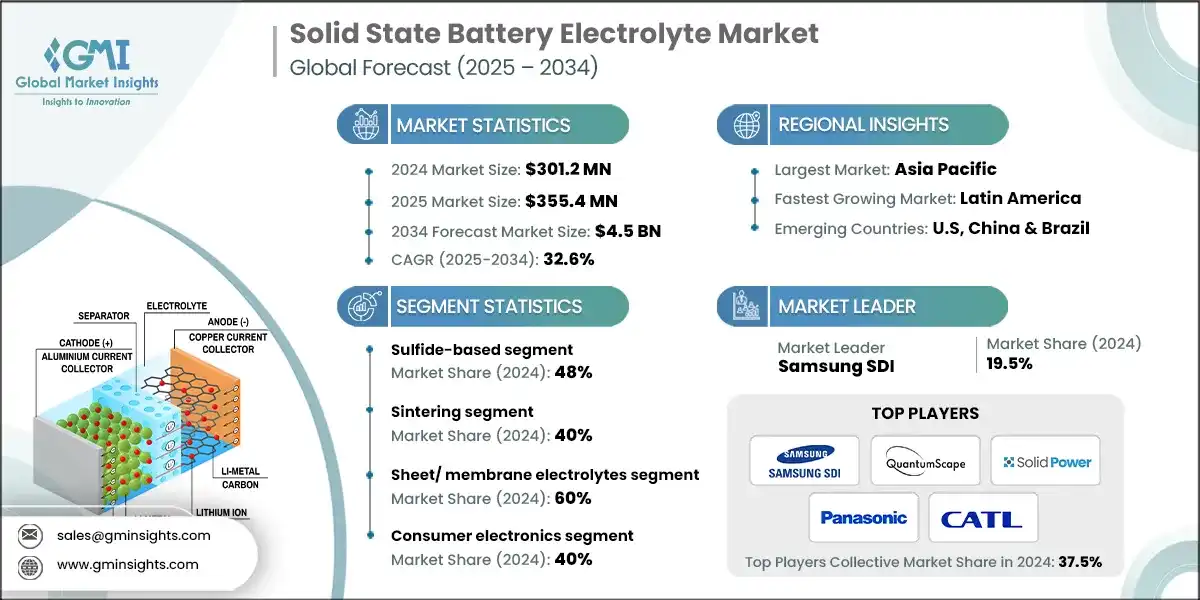
The global solid state battery electrolyte market was valued at USD 301.2 million in 2024. The market is expected to grow from USD 355.4 million in 2025 to USD 4.5 billion in 2034, at a CAGR of 32.6%, according to latest report published by Global Market Insights Inc.
Solid State Battery Electrolyte Market Key Takeaways
Market Size & Growth
- 2024 Market Size: USD 301.2 Million
- 2025 Market Size: USD 355.4 Million
- 2034 Forecast Market Size: USD 4.5 Billion
- CAGR (2025–2034): 32.6%
Regional Dominance
- Largest Market: Asia Pacific
- Fastest Growing Region: Latin America
Key Market Drivers
- Automotive OEMs accelerating adoption of solid-state batteries globally.
- Non-flammable solid electrolytes enhance safety and reduce thermal risks.
- Lithium metal anodes enable higher energy density and extended EV range.
Challenges
- Solid-solid interface resistance limits power density and cycling performance.
- Manufacturing scale-up from lab to GWh production remains complex.
Opportunity
- Energy storage systems demand growth drives stationary solid-state applications.
- Consumer electronics miniaturization creates high-value, compact battery applications.
Key Players
- Market Leader: Samsung SDI led with over 19.5% market share in 2024.
- Leading Players: Top 5 players in this market include Samsung SDI, QuantumScape Corporation, Solid Power Inc., Panasonic Holdings Corporation, Contemporary Amperex Technology Co., Limited (CATL), which collectively held a market share of 37.5% in 2024.
Get Market Insights & Growth Opportunities
- The global solid state battery electrolyte market is growing rapidly as new materials follow manufacturing advancements and application expansion.
- Sulfide-based electrolytes led with 48% share in 2024 by material type and possess high ionic conductivity and deformability, although oxide-based electrolytes possess high mechanical strength and stability, but with high sintering temperatures. Polymer electrolytes are also suitable for low- to moderate-temperature applications to wearables and halide or hybrid electrolytes emerge and exhibiting high conductivity and large electrochemical windows.
- PVD/ALD are used to manufacture thin films (<10 μm), tape casting/screen printing is used for sheet/membrane electrolytes (10-100 μm), while sintering/hot pressing method is used to manufacture dense oxide and sulfide electrolytes, and solution casting is used for polymers. Sintering still accounted for 40% market share in 2024.
- By form factor, sheet/membrane electrolytes dominated at 60% in 2024, as they are favorable for electric vehicle (EV) applications and energy storage, thin films have applicability in microbatteries and internet-of-things (IoT) applications, and bulk/pellets would be used for large-format capacity in stationary storage applications.
- Geographically, the most activity growth is forecasted in the APAC region, with the majority of investment coming from China focused on sulfide and polymer electrolytes, followed by North America and Europe. Both Latin America and MEA has high promise due to available lithium resources, electric vehicle (EV) adoption rates and domestic projects in renewable energy, which will create demand for fresh capacity. In conclusion, the increasing size of advancements in technology, the scale of battery manufacturing and regulations will continue to speed up the adoption of solid-state electrolytes globally.
To get key market trends
Solid State Battery Electrolyte Market Trends
- Advances in computational screening and machine learning are also being utilized to help identify materials that plan to exhibit high-ionic conductivity as well as better remain electrochemically stable. Through the use of interface engineering, grain boundary optimization, and protective coatings, things are improving with lithium metal anodes. This innovation cycle of improvements around different types of materials improve the potential for higher energy density, and improved safety be experienced during prolonged cycle life. This will facilitate solid state battery use in electric vehicles, consumer electronics and energy storage systems.
- Manufacturers are moving onto commercial scale production (GWh-scale) after developing lab-scale prototypes and focusing on cost-effective processes such as ALD/PVD depositions, tape casting, or cold sintering for instance. Partnerships with automakers or government sponsored initiatives in China or the EU, Japan, and the US are pioneering and paving the way for industrialization to take place. The focus is on reproducible, quality control, and yield, in order to adhere to strict automotive and consumer electronics standards to allow for solid-state batteries a clear pathway moving forward for mainstream integration with market growth predicted over the next decade as it relates to electric vehicles and other applications.
Solid State Battery Electrolyte Market Analysis
Learn more about the key segments shaping this market
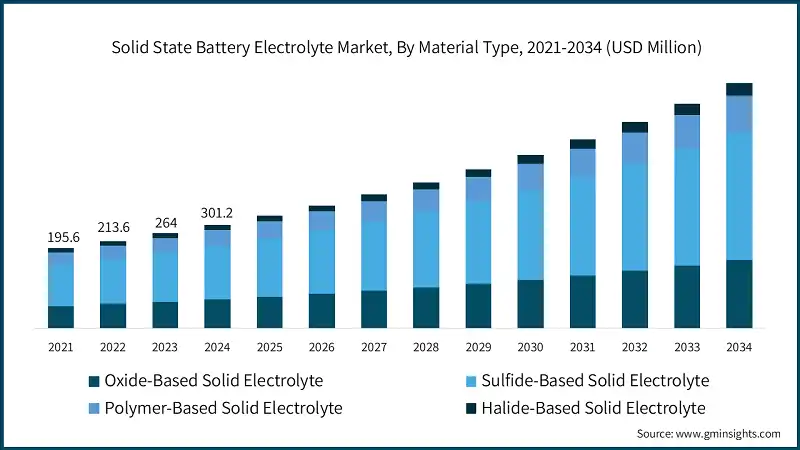
Based on material type, the market is segmented into oxide-based solid electrolyte, sulfide-based solid electrolyte, polymer-based solid electrolyte, and halide-based electrolytes solid electrolyte. Sulfide-based dominated the market with an approximate market share of 48% in 2024 and is expected to grow with a CAGR of 33.4% by 2034.
- In 2024, the market value for oxide electrolytes reached 84.3 million. They offer excellent mechanical strength, electrochemical stability, and compatibility with lithium metal anodes, making them ideal for automotive and consumer electronics applications. However, they require high sintering temperatures and form very brittle materials, making them challenging to produce.
- Sulfide electrolytes have very high ionic conductivity at room temperature as well as sufficient deformability, which facilitates thin interfacial structures. They could also prove problematic due to the moisture sensitivity of construction and handling.
- Polymer electrolytes are estimated to achieve an 18% share of the market in 2025. They are lighter, more flexible, and they are used at low to moderate temperatures in applications. However, their shortcomings come from ionic conductivity that is lower than ceramic materials.
- Halide electrolytes have recently emerged as a promising material choice for solid-state batteries, with many advantages such as high ionic conductivity and wide electrochemical stability windows, similar to sulfide electrolytes yet capable of successfully combining sulfide and oxide electrolyte advantages.
Learn more about the key segments shaping this market
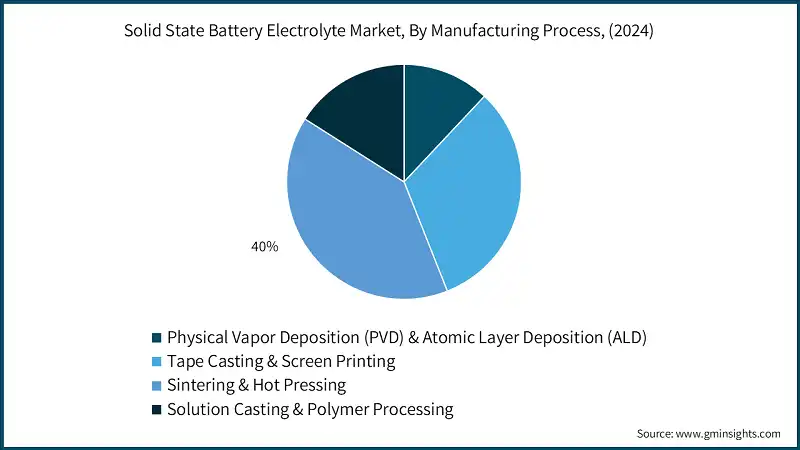
Based on manufacturing process, the solid state battery electrolyte market is segmented into physical vapor deposition (PVD) & atomic layer deposition (ALD), tape casting & screen printing, sintering & hot pressing, solution casting & polymer processing. Sintering held the largest market share of 40% in 2024 and is expected to grow at a CAGR of 34.3% during 2025-2034.
- Due to continuing innovation in areas such as spark plasma and cold sintering, hot pressing and sintering methods will continue to be the dominant method with an forecast CAGR of 34.3% until 2034.
- PVD and ALD will remain as niche market technologies for high-precision applications found in micro-batteries and sensors due to their limitations with scale-up. The introduction of new materials and processes such as tape casting, and screen printing will promote cost-effective roll-to-roll manufacturing processes for ceramic sheets used in the expansion of EV deployment.
- New processes such as solution and polymer casting have started to gain traction in the production of flexible electronics and semi-solid batteries because of their low temperatures and improvements in the performance of polymer electrolytes.
Based on form factor, the solid state battery electrolyte market is segmented into thin-film electrolytes (<10 μm), sheet/membrane electrolytes (10–100 μm), and bulk/pellet electrolytes (>100 μm). Sheet/ membrane electrolytes segment dominated the market with an approximate market share of 60% in 2024 and is expected to grow with the CAGR of 40.2% by 2034.
- In 2024, the value of thin film electrolytes (<10 μm) is 60.2 million and they are frequently used in wearables, microbatteries, and IoT devices due to their ultra-lightweight constructions, high volumetric energy density, and uniform ion transport. As these films are manufactured by physical vapor deposition (PVD) or atomic layer deposition (ALD) to create layers that are controlled, defect-free and homogeneous, scaling the production is complicated due to high machinery costs and low throughput.
- The value of a sheet or membrane electrolyte (10–100 μm) is appropriate for use in electric vehicles (EVs) and energy storage systems, with their film thickness, ionic conductivity, and mechanical robustness optimally sized around 20–50 μm, commonly manufactured by tape casting or screen printing.
- The bulk or pellet electrolytes (>100 μm) will occupy 28% of the market by 2034 and are used in high-capacity electric vehicles or stationary storage. Bulk electrolytes are produced using hot pressing or sintering to form a dense electrically conductive ceramic, while demonstrating mechanical stability, however, generally have higher internal resistance.
Based on application, the solid state battery electrolyte market is segmented into electric vehicles, consumer electronics, energy storage systems, medical devices, and aerospace & defense. Consumer electronics segment dominated the market with an approximate market share of 40% in 2024 and is expected to grow with the CAGR of 36.2% by 2034.
- In 2024, Electric Vehicles (EVs) are a large part of the market with a share of 30%, driven to obtain materials with higher energy density, greater safety, and longer cycle life. Solid electrolytes make lithium metal anodes possible, increasing energy density while decreasing the risk of thermal runaway.
- Consumer electronics, like smartphones, wearables, or Internet-of-Things (IoT) devices, take advantage of thin and flexible electrolyte materials such as polymer and thin-film electrolytes, which allow for small, lightweight designs while maintaining adequate ionic conductivity. By 2025, Energy Storage Systems (ESS) for both residential and grid-scale applications are expected to grow at a CAGR of 37.2% due to their long cycle life, thermal stability, and other safety benefits.
- For medical devices, biocompatible and reliable power sources are needed. Aerospace and defense applications require batteries with mechanical robustness and high-performance requirements.
Looking for region specific data?
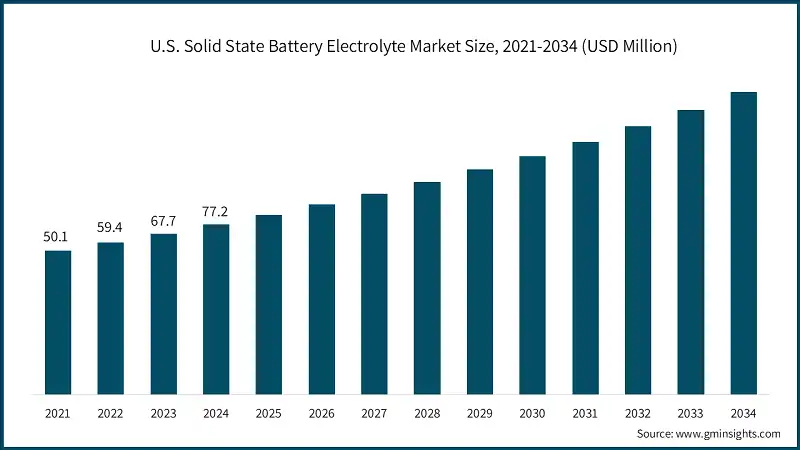
The North America solid state battery electrolyte industry is growing rapidly on the global level with a market share of 30% in 2024.
- The North America solid state market is supported through advancements in EV adoption, energy storage utility, and consumer electronics demand. The U.S. is supported through multiple government-backed investment opportunities such as the DOE ARPA-E IONICS funding, as well as corporate capital investment with companies such as QuantumScape, Solid Power, and Factorial Energy. Canada also contributes to piloting a prototype scale production facility with collaboration from multiple universities and public sector research.
U.S. dominates the North America solid state battery electrolyte market, showcasing strong growth potential.
- The North America solid-state market is majorly dominated by the U.S. market, with its robust R&D capabilities specializing in oxide and sulfide electrolyte formulations driven mainly by the EV, Aerospace, and Defense markets. Businesses leading the advancement of thin-film batteries and solid-state batteries include QuantumScape, Solid Power, and Factorial Energy. Commercialization of solid-state battery products is being supported in the U.S. through different grants and funding opportunities within various levels of government.
Europe solid state battery electrolyte Market leads the industry with revenue of USD 75.3 million in 2024 and is anticipated to show lucrative growth over the forecast period.
- The surge in the European market for solid-state battery electrolytes is being powered by the electrification of EVs, increasing safety standards, and government incentives, such as the IPCEI program. Germany, France, and the UK are the most advanced in pilot manufacturing and R&D of oxide, sulfide and halide electrolytes. Automotive OEMs including BMW and Volkswagen are teaming up with start-ups to commercialize the manufacturing of these electrolytes. Grid scaling storage, as well as residential energy storage are other avenues for growth.
Germany dominates the European solid state battery electrolyte market, showcasing strong growth potential.
- As a leading proponent of battery development in Europe in solid-state battery electrolytes, Germany is very focused on applications in automotive. OEMs like BMW and Volkswagen are teaming up with battery start-ups on oxide, sulfide and halides also. Again, government support for battery innovation and integration of renewable into grid storage opportunities are also quite significant. This still raises barriers for mass scale development.
The Asia Pacific solid state battery electrolyte market is anticipated to grow at a CAGR of 36.8% during the analysis timeframe.
- The Asia-Pacific (APAC) region leads the worldwide landscape due to high electric vehicle penetration, the wide adoption of large-scale energy storage, and increased demand for consumer electronics. China dominates the APAC market with considerable investments, particularly in sulfide and polymer electrolytes, by companies such as CATL, BYD, and WELION in support of government programs and the Ministry of Industry and Information Technology (MIIT) in the country. Japan and South Korea are currently focused on oxide and thin-film technologies.
China solid state battery electrolyte market is estimated to grow with a significant CAGR in the Asia Pacific region.
- China leads the charge in the region with significant investments in sulfide and polymer electrolytes, by companies such as CATL, BYD, and WELION in areas of interest in EV’s, energy storage systems, and consumer electronics applications. It is considered the driving force, with government and policies such as MIIT programs and subsidies supporting Research and Development (R&D) and manufacturing.
Latin America solid state battery electrolyte accounted for 3% market share in 2024 and is anticipated to show highest growth over the forecast period.
- Latin America is an emergent market characterized by increasing EV adoption, as well as consistent lithium resource availability in Chile, Argentina, and Bolivia. The deployment of solid-state electrolytes can be ascribed to the growing manufacturing of lithium-ion batteries and renewable energy storage projects. Both oxide and polymer electrolyte formulations are now being targeted for energy storage systems and projects. Key challenges being faced today include limited local infrastructure to manufacture solid-state electrolyte products and the absence of investment in local pilot-scale solid-state battery manufacturing facilities.
Brazil leads the Latin American solid state battery electrolyte market, exhibiting remarkable growth during the analysis period.
- Brazil is an emerging market driven by both lithium reserves and increasing EV adoption. In addition, oxide and polymer electrolytes are increasingly adopted in energy storage systems and pilot projects for EVs. Investment in local manufacturing for battery infrastructure is increasing, but the overall local capacity to scale production of solid-state battery electrolytes is somewhat limited. The Brazilian government supports structural barriers for renewable energy integration and implements incentives to support projects, and there are opportunities to create partnerships with international battery companies to enhance the local supply chain.
Middle East & Africa solid state battery electrolyte accounted for 2% market share in 2024 and is anticipated to show lucrative growth over the forecast period.
- The MEA region is a developing market for solid-state battery electrolytes and has the potential to grow alongside the adoption of renewable energy and electric vehicle initiatives in the UAE, Saudi Arabia, and South Africa. Lithium mining in some regions creates a prospective supply for producing electrolytes in the future. The demand exists in energy storage systems, stationary grid applications, and EV pilot programs. The primary challenges are manufacturing facilities not yet developed and the technical knowledge base is limited.
Saudi Arabia industry to experience substantial growth in the Middle East and Africa solid state battery electrolyte market in 2024.
- Saudi Arabia to be a developing MEA market with emphasis on renewable energy storages and EV pilot programs. The availability of lithium and strategies from the government such as Vision 2030 is supporting the development of solid-state battery electrolyte. Research centers and public-private partnerships for oxide electrolytes and polymer electrolytes are being pursued. The local manufacturing capacity, and availability of technical expertise remains limited.
Solid State Battery Electrolyte Market
The top 5 companies in solid state battery electrolyte industry include Samsung SDI, Quantumscape Corporation, Solid Power Inc., Panasonic Holdings Corporation, and Contemporary Amperex Technology Co., Limited (CATL). These are prominent companies operating in their respective regions covering approximately 37.5% of the market share in 2024. These companies hold strong positions due to their extensive experience in solid state battery electrolyte market. Their diverse product portfolios, backed by robust production capabilities and distribution networks, enable them to meet the rising demand across various regions.
- Samsung SDI is investing in oxide- and sulfide-based solid-state battery technologies with a focus on high-energy solid electrolytes for electric vehicles (EVs) and portable consumer electronics. Samsung SDI has pilot production lines in operation in Korea and is partnering with automotive OEMs to bring solid-state cells to market with improved safety, durability, and fast-charging performance in the latter half of the 2020s.
- QuantumScape develops solid-state lithium-metal batteries utilizing proprietary ceramic solid electrolytes. Its design is anode less, preserving energy density, fast charging, and cycle life. With support from Volkswagen, the company is ramping up to pre-pilot production through QS-0 and QS-1 production facilities and is working to optimize electrolyte performance and manufacturability for next-generation electric vehicles.
- Solid Power produces sulfide-based solid electrolytes and solid-state battery cells targeted for automotive applications. The company, supported by partnerships BMW and Ford, produces electrolyte materials at scale and supplies those materials for cell development. The company also has an ongoing focus to increase conductivity, improve interface stability, and prepare for mass production to support full commercialization.
- Panasonic continues its work on Research and Development of solid-state batteries with an eye towards energy density improvements, and safety. With their established partnerships with automotive manufacturers, and their expertise in many aspects of manufacturing, Panasonic incorporates the use of solid-state materials into batteries designed for next-generation electric vehicles and consumer electronics, and expects to commercialize their designs towards the end of the decade.
- CATL is focused on electrolyte development for high-performance electric vehicle batteries, including a drive toward sulfide, polymer, and hybrid solid-state solutions. The company has a strong supply chain and large-scale production capabilities for other types of batteries, and is focused on both semi-solid, as well as full solid-state solutions for their customers. The company aims to offer increased safety, extended range, and cost-effective mass production for its large automotive maker customers.
Solid State Battery Electrolyte Market Companies
Major players operating in the solid state battery electrolyte industry include:
- Ampcera Inc.
- Blue Solutions SAS
- Contemporary Amperex Technology Co., Limited (CATL)
- Idemitsu Kosan Co., Ltd.
- Ionic Materials Inc.
- Murata Manufacturing Co., Ltd.
- Panasonic Holdings Corporation
- QuantumScape Corporation
- SAMSUNG SDI
- Solid Power Inc.
Solid State Battery Electrolyte Market Report Attributes
| Key Takeaway | Details |
|---|---|
| Market Size & Growth | |
| Base Year | 2024 |
| Market Size in 2024 | USD 301.2 Million |
| Market Size in 2025 | USD 355.4 Million |
| Forecast Period 2025 - 2034 CAGR | 32.6% |
| Market Size in 2034 | USD 4.5 Billion |
| Key Market Trends | |
| Drivers | Impact |
| Automotive OEMs accelerating adoption of solid-state batteries globally | Mass production commitments by Toyota, BMW, and others drive rapid industry growth and scale-up of solid-state technologies. |
| Non-flammable solid electrolytes enhance safety and reduce thermal risks | Eliminates liquid electrolyte hazards, lowers thermal management costs, and increases regulatory preference for safer batteries. |
| Lithium metal anodes enable higher energy density and extended EV range | Facilitates energy density improvements, reducing battery weight and supporting longer EV driving ranges. |
| Pitfalls & Challenges | Impact |
| Solid-solid interface resistance limits power density and cycling performance | Poor electrode-electrolyte contact increases resistance, reducing efficiency, longevity, and critical current density in commercial cells. |
| Manufacturing scale-up from lab to GWh production remains complex | High-temperature sintering and controlled atmospheres require significant capital and technical expertise, slowing industrial adoption. |
| Opportunities: | Impact |
| Energy storage systems demand growth drives stationary solid-state applications | Rapid ESS demand offers less energy-density-constrained markets, enabling safer, long-life battery deployment. |
| Consumer electronics miniaturization creates high-value, compact battery applications | Wearables and IoT devices benefit from thin, high-energy-density solid-state batteries, supporting premium product differentiation. |
| Market Leaders (2024) | |
| Market Leaders |
19.5% market share |
| Top Players |
Collective market share in 2024 is 37.5% |
| Competitive Edge |
|
| Regional Insights | |
| Largest Market | Asia Pacific |
| Fastest growing market | Latin America |
| Emerging countries | U.S, China & Brazil |
| Future outlook |
|
What are the growth opportunities in this market?
Solid State Battery Electrolyte Industry News
- In November 2025, Toyota announced sulphide solid-state batteries with an energy density of 450–500 Wh/kg and a range of 1,200 km-possible in ten minutes of charging. Production will start in 2027 at a facility in Japan with a capacity of 10 GWh for the highest end Lexus vehicles. The production facility is attempting to lower costs and tackle issues related to material stability and manufacturing by 2030.
- In July 2025, ProLogium revealed its fourth-generation Superfluidized Inorganic Solid-State Electrolyte, there is now measured ionic conductivity of 57 mS/cm and was able to charge fast, while remaining stable at low temperature performance. The facility was established in Taoyuan, and began operating as a Giga Factory in 2024, with plans of construction on a facility in Dunkirk, France by 2028, which will lower the production cost for commercialization at the global level through strategic partners, licencing and modular battery manufacturing.
This solid state battery electrolyte market research report includes in-depth coverage of the industry, with estimates & forecasts in terms of revenue (USD Million) and volume (Kilo Tons) from 2025 to 2034, for the following segments:
Market, By Material Type
- Oxide-Based Solid Electrolytes
- Garnet-type (LLZO)
- NASICON-type (LATP, LAGP)
- Perovskite-type (LLTO)
- LiPON (Lithium Phosphorus Oxynitride)
- Sulfide-Based Solid Electrolytes
- Argyrodite Family (Li6PS5X)
- LGPS Family (Li10GeP2S12 & Derivatives)
- Thio-LISICON (Li3PS4, Li4-xGe1-xPxS4)
- Polymer-Based Solid Electrolytes
- PEO (Polyethylene Oxide)
- PC (Polycarbonate) & PAN (Polyacrylonitrile)
- Composite Polymer Electrolytes (CPEs)
- Hybrid Electrolytes (Polymer + Inorganic)
- Halide-Based Solid Electrolytes
- Chloride-based (Li3YCl6, Li3InCl6, Li2ZrCl6)
- Bromide-based (Li3YBr6)
- Mixed Halide Systems (Li3Y(Br3Cl3))
Market, By Manufacturing Process
- Physical Vapor Deposition (PVD) & Atomic Layer Deposition (ALD)
- Tape casting & screen printing
- Sintering & hot pressing
- Solution casting & polymer processing
- Physical Vapor Deposition (PVD) & Atomic Layer Deposition (ALD)
- Tape casting & screen printing
- Sintering & hot pressing
- Conventional sintering
- Hot pressing
- Spark Plasma Sintering (SPS)
- Cold sintering
- Solution casting & polymer processing
Market, By Form Factor
- Thin-film electrolytes (<10 μm)
- Sheet/membrane electrolytes (10–100 μm)
- Bulk/pellet electrolytes (>100 μm)
Market, By Application
- Electric vehicles
- Consumer electronics
- Energy storage systems
- Medical devices
- Aerospace & defense
The above information is provided for the following regions and countries:
- North America
- U.S.
- Canada
- Europe
- Germany
- UK
- France
- Spain
- Italy
- Rest of Europe
- Asia Pacific
- China
- India
- Japan
- Australia
- South Korea
- Rest of Asia Pacific
- Latin America
- Brazil
- Mexico
- Argentina
- Rest of Latin America
- Middle East and Africa
- Saudi Arabia
- South Africa
- UAE
- Rest of Middle East and Africa
Frequently Asked Question(FAQ) :
What is the market size of the solid state battery electrolyte industry in 2024?
The market size was USD 301.2 million in 2024, driven by growing industry interest in high-performance solid electrolytes.
What is the current solid state battery electrolyte market size in 2025?
The market size is projected to reach USD 355.4 million in 2025, reflecting rapid commercialization efforts across the battery materials industry.
What is the projected value of the solid state battery electrolyte market by 2034?
The market size for solid state battery electrolyte is expected to reach USD 4.5 billion by 2034, growing at a CAGR of 32.6%. This expansion is driven by EV electrification, safety-focused regulations, and advancements in sulfide, oxide, and polymer electrolyte chemistries.
How much revenue did the sulfide-based solid electrolyte segment generate in 2024?
Sulfide-based electrolytes accounted for 48% of the market in 2024, making them the dominant material category.
What was the valuation of the sintering & hot pressing segment in 2024?
Sintering and hot pressing held 40% market share in 2024, the highest among manufacturing processes.
What is the market share of the North America solid state battery electrolyte industry in 2024?
The North America solid state battery electrolyte market held a 30% share in 2024. Growth is supported by EV adoption, government-backed funding programs, and rising investments from key industry players such as QuantumScape, Solid Power, and Factorial Energy.
What are the upcoming trends in the solid state battery electrolyte industry?
Key trends include advancements in computational material screening, machine-learning-driven material discovery, and rapid innovation in interface engineering and thin-film deposition methods.
Who are the key players in the solid state battery electrolyte market?
Key players include Samsung SDI, QuantumScape Corporation, Solid Power Inc., Panasonic Holdings Corporation, and CATL, collectively accounting for 37.5% market share in 2024. Other notable companies include Ampcera Inc., Blue Solutions SAS, Idemitsu Kosan Co., Ltd., Ionic Materials Inc., Murata Manufacturing Co., Ltd., and Samsung SDI.
Solid State Battery Electrolyte Market Scope
Related Reports