Summary
Table of Content

Solar Photovoltaic (PV) Market
Get a free sample of this report
Form submitted successfully!
Error submitting form. Please try again.
Thank you!
Your inquiry has been received. Our team will reach out to you with the required details via email. To ensure that you don't miss their response, kindly remember to check your spam folder as well!
Request Sectional Data
Thank you!
Your inquiry has been received. Our team will reach out to you with the required details via email. To ensure that you don't miss their response, kindly remember to check your spam folder as well!
Form submitted successfully!
Error submitting form. Please try again.
Solar Photovoltaic Market Size
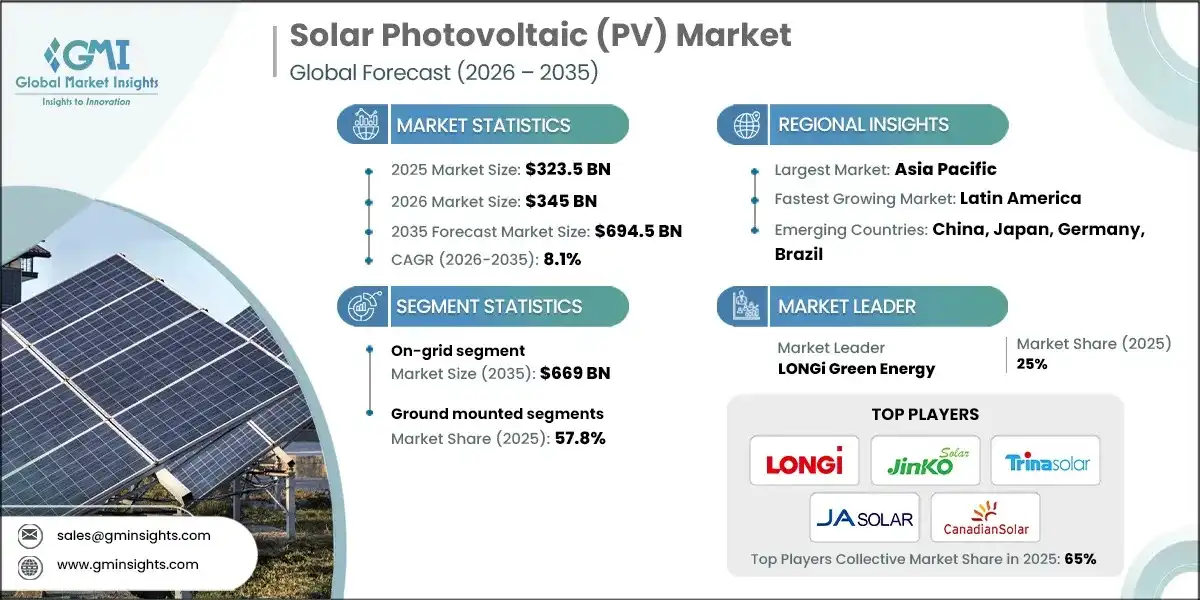
Solar Photovoltaic market was valued at USD 323.5 billion in 2025. The market is expected to grow from USD 345 billion in 2026 to USD 694.5 billion by 2035, at a CAGR of 8.1% from 2026 to 2035.
Solar Photovoltaic (PV) Market Key Takeaways
Market Size & Growth
- 2025 Market Size: USD 323.5 Billion
- 2026 Market Size: USD 345 Billion
- 2035 Forecast Market Size: USD 694.5 Billion
- CAGR (2026–2035): 8.1%
Key Market Drivers
- Increasing focus on clean electricity through various solar PV targets.
- Growing focus on net zero initiatives.
- Favorable government schemes.
Challenges
- Longer payback period.
Opportunity
- Increasing investments and government tenders to influence the costs.
- Growing demand for distributed and backup power systems.
Key Players
- Market Leader: LONGi Green Energy led with over 25% market share in 2025.
- Leading Players: Top 5 players in this market include LONGi Green Energy, JinkoSolar, Trina Solar, JA Solar, Canadian Solar, which collectively held a market share of 65% in 2025.
Get Market Insights & Growth Opportunities
- Integrating solar PV into agriculture and business operations is poised to drive product demand. Rooftop installations and agrivoltaic systems optimize land use while offering cost-effective solutions. This dual use approach not only generates electricity but also provides economic benefits, encouraging cross-sector adoption. The combined application of these technologies is expected to propel the growth of the solar PV market.
- Increasing corporate investments and capacity enhancement projects in the manufacturing of solar PV modules are anticipated to promote industry growth. In August 2023, First Solar declared a USD 1.1 billion investment to set up a 3.5 GW solar module manufacturing plant in Louisiana, raising its overall U.S. capacity to more than 10 GW by 2025. Additionally, such high scale investments will enhance domestic manufacturing capabilities and supply chain reliability, thus supporting market growth.
- Favorable land availability and decreasing installation prices are expected to drive utility scale solar installations. Lower levelized cost of electricity coupled with advancements in panel performance and design, will enhance large-scale solar deployments, making them economical. Further, the cost competitiveness of solar power compared to traditional sources will support the product penetration.
- Increased global funding and strategic investment in local solar production will support market growth. In September 2023, the U.S. International Development Finance Corporation signed off on USD 425 million funding for Tata Power's 4.3 GW solar cell and module facility in India. Further, these efforts will enhance the economy's solar production capacity, thereby supporting the industry growth.
To get key market trends
Solar Photovoltaic Market Trends
- The introduction of advanced solar technologies, including bifacial solar panels and thin-film solar modules, will complement the demand for solar PV systems. In April 2024, First Solar launched its Series 7 TR1 module, which recorded up to 550 watts and 19.7% efficiency with an annual degradation rate of 0.3%. This new technology will improve energy production and reliability, hence bolstering market growth.
- Next-generation solar inverters with higher grid integration qualities will support industry dynamics by promoting improved energy conversion efficiency, system dependability, and operating stability. Such state-of-the-art inverters will facilitate seamless interoperability with smart grids, supporting wider applications in utility-scale, commercial, and industrial applications, thereby fueling market growth.
- The floating offshore solar power system integration is anticipated to support the adoption of solar PV technologies. For instance, in November 2024, CHN Energy inaugurated China's first 1 GW floating offshore solar park in Dongying, Shandong Province. The project includes 2,934 solar platforms and is expected to produce 1.78 billion kWh per year. This will boost market growth by demonstrating the viability of offshore solar installations on large scales.
- The adoption of AI-driven solar performance optimization will augment solar PV market expansion. Advanced algorithms for predictive maintenance and real-time energy output adjustments will maximize system efficiency and longevity. This technological integration will streamline operations for large-scale installations and enhance energy yields, driving broader adoption across residential and commercial applications and further enhancing the market expansion.
Solar Photovoltaic Market Analysis
Learn more about the key segments shaping this market
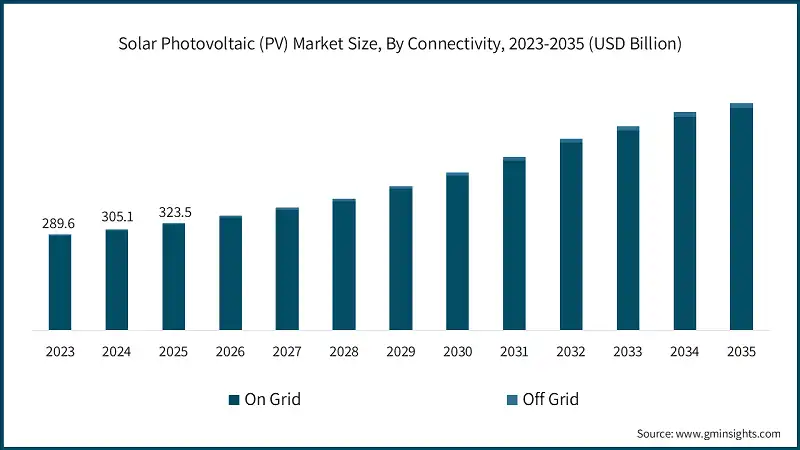
- Based on connectivity, the market is segmented into on grid and off grid. The on-grid market is estimated to reach USD 669 billion by 2035, driven by utility scale installations, favorable policies, and rising investments. For instance, in March 2024, Indian government introduced the 600 MW Lalitpur Solar Power Project in Uttar Pradesh, covering 2,700 acres. It is anticipated to produce 1,200 million units of electricity yearly and cut carbon emissions by 21.6 million tonnes over 25 years. Such initiatives will enhance the energy security and promoting sustainable development, leading to market growth.
- The off-grid solar PV market will grow at a CAGR of more than 13% from 2026 to 2035, driven by increasing demand for reliable electricity in remote regions. Expanding rural electrification programs, advancements in battery storage, growing affordability of solar components, and supportive government subsidies will augment the business landscape. Additionally, the rising integration of smart energy management systems will optimize power usage, further propelling market expansion in off-grid communities.
Learn more about the key segments shaping this market
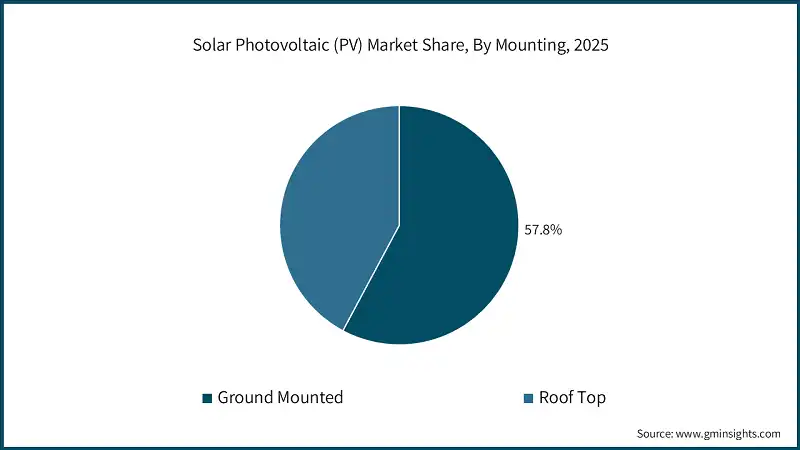
- Based on mounting, the market is segmented into ground mounted and rooftop categories. Ground mounted solar PV segment holds a 57.8% market share in 2025, driven by rising agrivoltaics adoption and optimized land use strategies. Integrating different solar projects with agriculture enhances the resource efficiency, fueling product growth. For instance, in November 2024, KPI Green Energy secured a 300 MW solar project from Coal India Ltd for EPC execution in Khavda, Gujarat, showcasing innovative designs. Additionally, this trend will propel market expansion and encourage versatile land utilization.
- The rooftop solar PV segment is projected to grow at a rate of more than 8.2% from 2026 to 2035, driven by expanding community solar initiatives and strategic energy provider partnerships. For instance, in April 2025, the GS Power Partners launched 8 MW rooftop community solar project in Maryland, providing low-cost power to households and supporting Maryland’s Renewable Portfolio Standard. Additionally, advancements in modular installation techniques will streamline deployments, thereby fueling the market expansion.
Looking for region specific data?
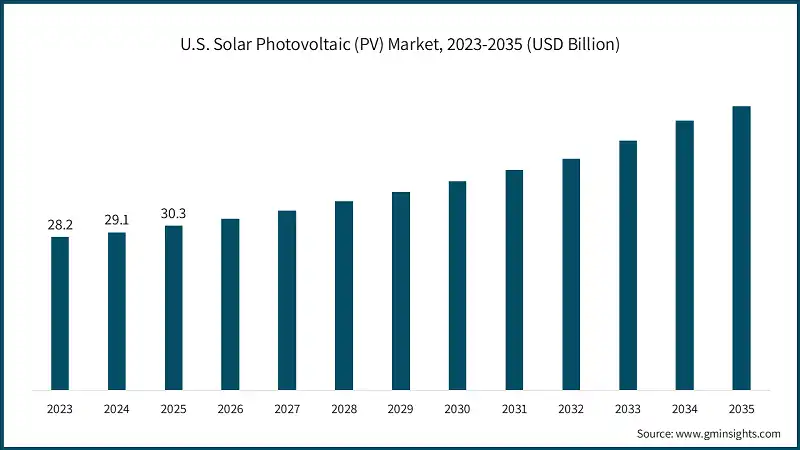
- The U.S. solar PV market was valued at USD 28.2 billion, USD 29.1 billion, and USD 30.3 billion in 2023, 2024, and 2025, respectively. As of 2025, North America holds a market share of 9.8% which is anticipated to improve further by 2035.
- The U.S. market is significantly enhanced by integrating energy storage solutions and attracting substantial financial investments. The rising demand for reliable renewable energy drives the adoption of solar-plus-storage projects. For instance, in April 2025, Sunraycer Renewables secured a USD 475 million project financing facility for two Texas solar-plus-storage projects, totaling 125 MW of battery energy storage and 241 MW of solar PV. In addition, advancements in grid modernization will propel the market growth.
- The European solar PV market is estimated to value more than USD 134.5 billion by 2035, augmented by accelerated adoption of smart grid technologies and robust corporate investments in renewable energy targets. Enhanced energy storage solutions and streamlined permitting processes for solar projects will drive market expansion. These factors will bolster grid resilience and foster broader integration of solar power across diverse sectors, advancing regional energy transitions.
- The Asia Pacific solar PV market is projected to grow at a CAGR of more than 9.3% from 2025 to 2034, driven by strong policy support, falling technology costs, rapid advancements in energy storage integration and rising electricity demand across emerging and developed economies. Countries such as India, Japan, Australia, and South Korea are also witnessing robust growth, with India accelerating utility-scale and rooftop installations under national solar missions, while Japan and Australia focus on distributed PV, storage integration, and grid resilience.
- For instance, in April 2025, the Himachal Pradesh Electricity Regulatory Commission approved a PPA for a 2 MW solar PV plant in rural area, with a tariff of INR 3.47 per kWh. This regulatory framework will catalyze similar initiatives, enhancing energy reliability and market expansion in remote regions. Additionally, the region is seeing increased adoption of high-efficiency and high-power modules, bifacial systems, and floating solar PV, supported by abundant solar resources and land constraints in densely populated areas.
- Middle East solar PV market is set to grow more than USD 21.5 billion by 2035, owing to strong solar irradiation, declining technology costs, and national strategies aimed at economic diversification and energy transition. Countries such as Saudi Arabia, the UAE, Oman, and Qatar are developing large-scale utility solar projects through competitive auctions, resulting in some of the world’s lowest solar power tariffs. Furthermore, government-led programs under initiatives comprising of Saudi Vision 2030 and the UAE Energy Strategy 2050 will support GW-scale solar parks, and increasing interest in hybrid projects combining solar PV with storage and green hydrogen production will strengthen the demand.
- Africa solar PV market will grow more than 5% CAGR by 2035, on account of energy access, grid expansion, and power reliability, particularly in regions with limited or unreliable electricity infrastructure. South Africa’s Renewable Energy Independent Power Producer Procurement Programme (REIPPPP) along with North Africa’s solar initiatives will play a crucial role in scaling installed capacity and attracting private investment.
- Solar PV adoption in Latin America is expanding steadily, supported by abundant solar resources, power market liberalization, and competitive renewable energy auctions. Countries including Brazil, Chile, Mexico, and Colombia are leading installations, with strong growth in utility-scale projects backed by long-term power purchase agreements (PPAs). Chile, in particular, has become a regional solar leader owing to favorable regulations, high irradiation levels, and increasing demand from mining and industrial sectors.
Solar Photovoltaic Market Share
- The top 5 players LONGi Green Energy, Jinko Solar, Trina Solar, JA Solar and Canadian Solar hold a 65% share in the global solar PV market. The global market is highly competitive and increasingly consolidated, characterized by the dominance of a few large, vertically integrated manufacturers alongside a long tail of regional and niche players. General strategies involve pushing the development of next-generation high-efficiency module technologies including n-type and TOPCon cells in pursuit of maximum energy production. Further, the top companies also focus on lowering costs through large-scale manufacturing and vertical integration, reaching competitive pricing and robust supply chains in a fast-growing global market.
- Industry players are concentrated on developing international manufacturing capacity to satisfy local demand and complement local regulations. They invest in developer and utility relationships to secure long-term contracts, increasing market penetration and enabling large-scale solar installations in various geographies. Technology differentiation and regional strategies are becoming key competitive levers. While Chinese manufacturers continue to dominate global shipments, non-Chinese players such as First Solar, Hanwha Qcells, and REC Group are strengthening their positions through domestic manufacturing expansion, policy support and a focus on low-carbon or premium modules.
- Dominant players invest significantly in R&D for developing new-generation solar products, such as heterojunction and back contact cells. They incorporate energy storage and intelligent monitoring solutions to provide end-to-end energy systems, enhancing reliability and addressing changing customer demands in an aggressive, technology-oriented solar PV market. Overall, the competitive landscape is shaped by rapid capacity expansion, declining module prices, strategic partnerships, and increasing localization of manufacturing to mitigate supply-chain risks and trade barriers.
Solar Photovoltaic Market Companies
Eminent players operating in the solar photovoltaic industry are:
- Asun Trackers
- Canadian Solar
- CsunSolarTech
- Emmvee Solar
- First Solar
- GCL-SI
- Jinko Solar
- JA Solar Technology
- LONGi
- Q CELLS
- LG Electronics
- Motech Industries
- Renesola
- REC Solar Holdings
- Risen Energy
- Solar Frontier
- SunPower Corporation
- Solaria Corporation
- Shunfeng International Clean Energy
- Shenzhen Shine Solar
- Su-vastika Solar
- Trina Solar
- Vikram Solar
- Yingli Solar
- First Solar is one of the global leaders in solar PV, specializing in module production and project development. In 2025, the company's net sales totaled USD 5.05 billion reflecting around a 31% year-over-year increase compared with 2024. The company continues to expand its Series 7 and Series 6 module manufacturing capacity, supported by long-term supply agreements with major developers and favorable policy support such as the U.S. Inflation Reduction Act.
- Trina Solar is one of the world leaders in solar PV technology with a vision towards module production and energy storage. Trina Solar is widely recognized for its strong focus on high-efficiency technologies, including TOPCon, bifacial, and ultra-high-power modules exceeding 700 W, catering primarily to utility-scale and large commercial & industrial (C&I) projects. The company has a strong global footprint, with manufacturing bases in China, Vietnam, Thailand, and Spain, and sales presence across Europe, Asia-Pacific, North America, Latin America, and the Middle East. In addition, the company reported revenue of USD 9.53 Billion in 2025, showing a decline from 2024 revenue.
- Vikram Solar Limited is a leading Indian photovoltaic module manufacturer and solar solutions provider. The company focuses on high-efficiency crystalline silicon PV modules, including mono facial and bifacial products, catering to utility-scale, commercial & industrial (C&I), and rooftop solar markets. The company has further strengthened its position in the domestic solar manufacturing ecosystem through capacity expansion, backward integration initiatives, and alignment with government programs including the Production Linked Incentive (PLI) scheme.
- REC Solar Holdings is a Norway-based solar company recognized for its vertically integrated solar manufacturing operations and has undergone a strategic transition shifting away from large-scale PV module manufacturing toward solar project development, asset ownership, and energy solutions, particularly in Europe and other mature solar markets. The company’s 2025 revenue is estimated to be below USD 300 million, reflecting its reduced manufacturing exposure and narrower operational focus compared to its historical peak.
Solar Photovoltaic (PV) Market Report Attributes
| Key Takeaway | Details |
|---|---|
| Market Size & Growth | |
| Base Year | 2025 |
| Market Size in 2025 | USD 323.5 Billion |
| Market Size in 2026 | USD 345 Billion |
| Forecast Period 2026-2035 CAGR | 8.1% |
| Market Size in 2035 | USD 694.5 Billion |
| Key Market Trends | |
| Drivers | Impact |
| Increasing focus on clean electricity through various solar PV targets | The increasing focus on clean electricity through solar PV targets is a major driver of growth in the global solar PV market, as governments worldwide set ambitious renewable energy and decarbonization goals to reduce dependence on fossil fuels and meet climate commitments. National and regional targets such as net-zero pledges, renewable portfolio standards, and capacity addition goals are accelerating large-scale investments in utility, commercial, and residential solar projects. |
| Growing focus on net zero initiatives | The growing global emphasis on net-zero initiatives is driving adoption of solar PV technologies as countries and corporations strive to decarbonize their energy systems. With commitments to achieve net-zero carbon emissions by mid-century, governments are implementing policies, incentives, and regulations to accelerate renewable energy deployment, including solar PV. |
| Favorable government schemes | These schemes include subsidies, tax incentives, feed-in tariffs, low-interest loans, and production-linked incentive programs, which reduce upfront capital costs and improve project viability for both developers and end-users. Additionally, governments are implementing policies such as renewable energy mandates, net-metering regulations, and auction-based procurement to encourage large-scale utility projects and distributed solar installations. |
| Pitfalls & Challenges | Impact |
| Longer payback period | Despite declining module and system costs, the initial capital investment for solar PV systems including modules, inverters, mounting structures, and, in some cases, energy storage can still be substantial, making adoption less attractive for cost-sensitive consumers. Extended payback periods, often ranging from 5 to 10 years depending on region, electricity tariffs, and financing options, can slow decision-making and limit market penetration. |
| Opportunities: | Impact |
| Increasing investments and government tenders to influence the costs | Government tenders, auctions, and competitive bidding programs further stimulate cost efficiency by encouraging developers to optimize project design, financing, and execution. These initiatives not only lower the levelized cost of electricity (LCOE) from solar PV but also attract new entrants and private-sector investment, thereby accelerating deployment, expanding market capacity, and supporting sustainable growth across regions. |
| Growing demand for distributed and backup power systems | Advances in high-efficiency modules, bifacial technology, and tracker systems have improved energy yields and economic viability, making both rooftop and large-scale deployments more attractive. Combined with supportive policies, net-metering, and corporate sustainability commitments, the growing adoption of these systems is expanding the overall solar PV market and reinforcing its role in global clean energy transition. |
| Market Leaders (2025) | |
| Market Leaders |
25% market share |
| Top Players |
|
| Competitive Edge |
|
| Regional Insights | |
| Largest Market | Asia Pacific |
| Fastest Growing Market | Latin America |
| Emerging Country | China, Japan, Germany, Brazil |
| Future Outlook |
|
What are the growth opportunities in this market?
Solar Photovoltaic Industry News
- In December 2025, the Tunisian government approved concession and authorization frameworks to accelerate the development of multiple solar PV projects. New market entrants, such as SoleCrypt, announced plans for additional plants, supporting capacity expansion, self-generation, and increased panel imports. Under the concession regime applicable to projects above 10 MW, the first tender, totaling 500 MW across five regions, achieved key implementation milestones.
- In September 2025, the Solar Energy Corporation of India Limited (SECI) laid the foundation stone for a 300 MW solar PV project at Ramagiri, in Andhra Pradesh. Spanning approximately 1,047 acres, the project is being developed under the CPSU Scheme Phase II, Tranche III, with power offtake secured by Madhya Pradesh Power Management Company Limited (MPPMCL).
- In December 2024, Juniper Green Energy entered into a two-year agreement with First Solar to supply 1 GW of Series 7 FT1 cadmium telluride thin-film photovoltaic modules. Manufactured at First Solar’s Chennai facility, the modules will be deployed across projects in Rajasthan, Gujarat, and Maharashtra. The agreement reflects Juniper Green’s strategic shift away from reliance on Chinese crystalline silicon supply chains while strengthening domestic sourcing.
- In October 2024, Trina Solar shipped more than 1 GW of its Vertex N 720W series modules to the China-based Jinsha River project. The project's high-altitude location, with heights reaching up to 4,800 meters, will produce about 5.1 TWh of electricity each year. The project will avoid approximately 1.67 million tons of standard coal and 3.74 million tons of CO2 equivalent emissions each year.
This solar photovoltaic market research report includes an in-depth coverage of the industry with estimates & forecasts in terms of revenue and volume in “USD Billion & MW” from 2023 to 2035, for the following segments:
Market, By Connectivity
- On grid
- Off grid
Market, By Mounting
- Ground mounted
- Rooftop
Market, By End Use
- Residential
- Commercial & industrial
- Utility
The above information has been provided for the following countries:
- North America
- U.S.
- Canada
- Mexico
- Europe
- Austria
- Norway
- Denmark
- Finland
- France
- Italy
- Switzerland
- Spain
- Sweden
- UK
- Netherlands
- Poland
- Belgium
- Ireland
- Baltics
- Portugal
- Asia Pacific
- China
- Japan
- South Korea
- India
- Australia
- Malaysia
- Singapore
- Thailand
- Philippines
- Vietnam
- Middle East & Africa
- Israel
- Saudi Arabia
- UAE
- Jordan
- Oman
- Kuwait
- Turkey
- Africa
- South Africa
- Egypt
- Algeria
- Nigeria
- Morocco
- Latin America
- Brazil
- Argentina
- Chile
- Peru
Frequently Asked Question(FAQ) :
What was the market size of the solar photovoltaic in 2025?
The market size was USD 323.5 billion in 2024, with a CAGR of 8.1% expected through 2034 driven by the integration of solar PV in agriculture and business operations.
What is the projected value of the solar photovoltaic market by 2035?
The solar photovoltaic market is expected to reach USD 694.5 billion by 2035, supported by advancements in solar technologies and increasing adoption across various sectors.
What is the current solar photovoltaic market size in 2026?
The market size is projected to reach USD 345 billion in 2026.
What is the estimated value of the on-grid solar PV market by 2035?
The on-grid solar PV market is projected to exceed USD 669 billion by 2035, driven by utility-scale installations, favorable policies, and rising investments.
What is the growth outlook for the off-grid solar PV market from 2026 to 2035?
The off-grid solar PV market is anticipated to grow at a CAGR of over 13% through 2035, fueled by rural electrification programs, advancements in battery storage, and government subsidies.
What was the market share of the ground-mounted solar PV segment in 2025?
The ground-mounted solar PV segment held a 57.8% market share in 2025, led by the adoption of agrivoltaics and optimized land use strategies.
Which region leads the solar PV market?
North America held a 9.8% market share in 2025, with the U.S. market valued at USD 30.3 billion that year, driven by energy storage integration and grid modernization.
Who are the key players in the solar photovoltaic market?
Key players include Asun Trackers, Canadian Solar, CsunSolarTech, Emmvee Solar, First Solar, GCL-SI, Jinko Solar, JA Solar Technology, LONGi, Q CELLS, LG Electronics, Motech Industries, Renesola, REC Solar Holdings, Risen Energy, Solar Frontier, SunPower Corporation, Solaria Corporation, Shunfeng International Clean Energy, Shenzhen Shine Solar, Su-vastika Solar, Trina Solar, Vikram Solar, and Yingli Solar
Solar Photovoltaic (PV) Market Scope
Related Reports