Summary
Table of Content

Solar Carport Market
Get a free sample of this report
Form submitted successfully!
Error submitting form. Please try again.
Thank you!
Your inquiry has been received. Our team will reach out to you with the required details via email. To ensure that you don't miss their response, kindly remember to check your spam folder as well!
Request Sectional Data
Thank you!
Your inquiry has been received. Our team will reach out to you with the required details via email. To ensure that you don't miss their response, kindly remember to check your spam folder as well!
Form submitted successfully!
Error submitting form. Please try again.
Solar Carport Market Size
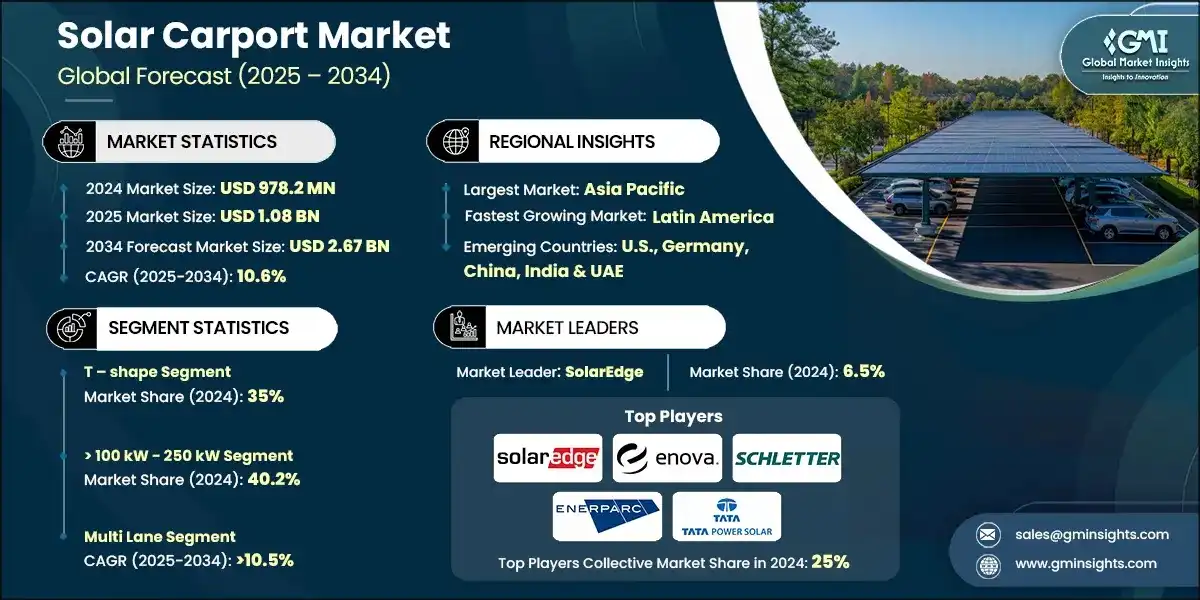
According to a recent study by Global Market Insights Inc., the solar carport market was estimated at USD 978.2 million in 2024. The market is expected to grow from USD 1.08 billion in 2025 to USD 2.67 million by 2034, at a CAGR of 10.6%.
Solar Carport Market Key Takeaways
Market Size & Growth
- 2024 Market Size: USD 978.2 Million
- 2025 Market Size: USD 1.08 Billion
- 2034 Forecast Market Size: USD 2.67 Billion
- CAGR (2025–2034): 10.6%
Regional Dominance
- Largest Market: Asia Pacific
- Fastest Growing Region: Latin America
Key Market Drivers
- Rising adoption of electric vehicles.
- Government incentives and renewable energy policies.
- Efficient land utilization and sustainability goals.
Challenges
- High initial installation and maintenance costs.
Opportunity
- Integration with Vehicle-to-Grid (V2G) Technology.
- Adoption in residential and community parking areas.
- Retrofit and redevelopment projects.
- Integration with energy storage and microgrids.
Key Players
- Market Leader: SolarEdge led with over 6.5% market share in 2024.
- Leading Players: Top 5 players in this market include SolarEdge, Enova, Schletter, Enerprac, Tata Power Solar Systems, which collectively held a market share of 25% in 2024.
Get Market Insights & Growth Opportunities
- The industry is witnessing strong growth as organizations pursue dual-purpose infrastructure that generates clean power and provides shaded parking. Land optimization, energy independence goals along with sustainability mandates will energize the business dynamics. These installations support net-zero ambitions, increase property value, and address the rising consumer demand for visibly integrated renewable energy solutions.
- A solar carport is a covered parking structure equipped with solar panels mounted on its roof to generate renewable electricity. It serves a dual purpose by providing shade and protection for vehicles while harnessing solar energy for on-site consumption or grid supply. It optimizes land use, supports electric vehicle charging, and contributes to sustainable infrastructure development.
- For illustration, in 2024, China continued to promote electric vehicle adoption through a 10% purchase tax exemption and a trade-in subsidy of CNY 20,000 for replacing old vehicles. Out of roughly 6.6 million applicants, 60% chose EVs. Although the average subsidy per vehicle dropped about 25% since 2022, China remains the largest spender globally on EV incentives.
- The solar carport market was valued at USD 825 million in 2021 and grew at a CAGR of approximately 5% through 2024. Integrated monitoring systems and smart inverters improve performance tracking. Pairing with battery storage ensures energy reliability, while automation and prefabrication shorten installation times, supporting wider adoption across wide tandem of application areas.
- Favorable government schemes in line with clean energy targets and financial incentives will favor the business scenario. Investment tax credits, renewable energy certificates, and low-interest green financing enhance the project viability. Streamlined permitting and standardized EV-ready codes are being introduced globally to reduce project barriers, fostering collaboration among utilities, developers, and municipalities for large-scale implementation.
- Vehicle-to-grid technology is becoming a complementary innovation within solar carports. This integration allows electric vehicles to discharge excess energy back into the grid or building network, creating bidirectional energy systems. Such configurations help balance power demand, enhance grid stability, and generate new revenue streams for carport operators, particularly in corporate or fleet-based parking facilities.
- For illustration, Europe enforced strict CO2 regulations, requiring a 15% reduction from 2021 levels on average between 2025 and 2027. To support electric mobility, the alternative fuels infrastructure regulation mandates fast-charging stations along the trans-European transport network, with 150 kW chargers installed every 60 km by 2025, ensuring widespread accessibility and promoting the transition to low-emission transport across the continent.
To get key market trends
Solar Carport Market Trends
- Flexible financing models such as power purchase agreements, green bonds, and third-party ownership are reshaping investment in solar carports. These options minimize upfront costs for property owners while ensuring predictable energy savings. Public-private partnerships and community funding platforms are increasingly driving municipal and educational institution projects.
- Manufacturing localization, modular steel structures, and vertical integration are improving cost stability in the supply chain. Price fluctuations in steel and PV materials remain a concern but are mitigated by domestic sourcing and efficient logistics. Sustainability certification of modules and recycled steel use are emerging procurement preferences among corporate buyers, which in turn will augment the industry landscape.
- For citation, in October 2024, India introduced the PM E-DRIVE program with a USD 1.3 billion budget running through March 2026, targeting electric two- and three-wheelers, buses, trucks, and charging infrastructure. Additionally, the Ministry of New and Renewable Energy offers residential solar subsidies of up to 40% for systems ≤3 kW and 20% for systems between 3 and 10 kW, encouraging clean energy adoption.
- Continuous declines in solar modules and inverter costs are improving the cost-effectiveness of solar carports. Economies of scale and advanced manufacturing techniques have lowered the levelized cost of energy, making carport installations more competitive. This trend is pushing wider adoption across urban, suburban, and commercial properties, particularly in cost-sensitive markets.
- The incorporation of Internet of Things (IoT) solutions, remote monitoring, and predictive maintenance systems is modernizing solar carport operations. Smart sensors optimize energy flow, track panel performance, and forecast maintenance schedules. Integration with cloud-based analytics platforms enhances system uptime and efficiency, enabling owners to maximize return on investment through data-driven performance optimization.
- Flexible financing arrangements such as power purchase agreements (PPAs), leasing, and public-private partnerships are reducing capital barriers. Developers increasingly offer turnkey solutions with zero upfront cost to property owners. These models ensure predictable long-term energy pricing, appealing to small businesses and municipalities, while improving investor confidence through stable, contract-based revenue streams.
- For citation, global electric vehicle sales surpassed 17 million units, accounting for over 20% of new car sales, while the total EV fleet reached around 58 million vehicles, roughly 4% of the global passenger fleet. This milestone highlights the growing mainstream acceptance of EVs, driving sustained demand for supporting infrastructure, including widespread deployment of charging solutions such as solar-powered carports.
Solar Carport Market Analysis
Learn more about the key segments shaping this market
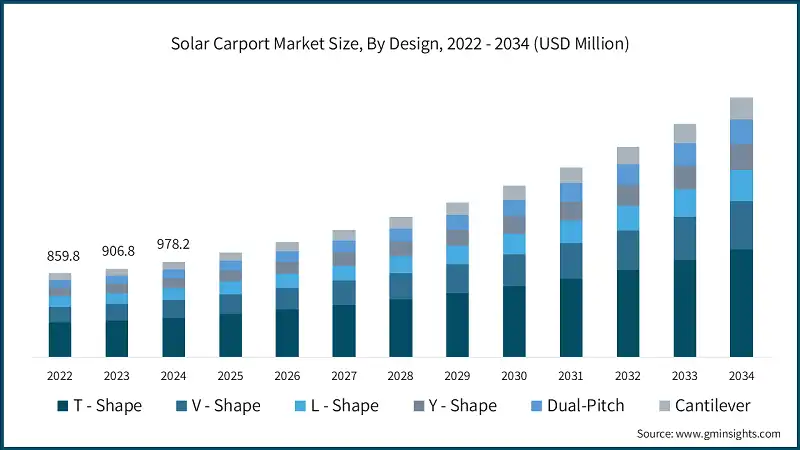
- Based on design, the industry is segmented into T – shape, V – shape, L – shape, Y – shape, dual-pitch and cantilever. The T – shape market holds a share of about 35% in 2024 and is projected to grow at a growth rate of over 10.5% through from 2025 to 2034.
- These carports combine streamlined aesthetics with efficient land use, providing single-column support and clear vehicular access. They simplify installation, reduce shading between rows, and support bifacial or mono facial modules. Popular for commercial parking lots, T-shapes balance structural strength with cost-effectiveness, enabling rapid deployment and straightforward maintenance.
- For instance, global solar PV capacity surpassed 2.2 terawatts, with new additions of 554 – 602 GW, reflecting about 30% growth. Solar accounted for over 72% of new renewable energy capacity and roughly 60% of electricity from newly installed renewables. Solar power generation now exceeds 10% of total global electricity, underscoring its rapidly expanding role in the clean energy transition.
- The V – shape segment is set to exceed USD 450 million by 2034. It features a distinctive dual-inclined roof design that optimizes sunlight capture and improves rainwater drainage. Their symmetrical structure offers superior stability and aesthetic appeal, making them suitable for large commercial and institutional parking areas. These designs enable easy cable management, efficient load distribution, and integration with EV charging systems, promoting sustainable infrastructure development.
- The L – shape solar carport industry was valued at USD 120.2 million in 2024. Their compact design supports efficient shading and vehicle protection while accommodating varying site constraints. These carports are increasingly adopted in urban environments, offering flexibility, cost efficiency, and enhanced aesthetics for residential, commercial, and small industrial installations.
- For instance, annual government spending on electric vehicles averaged around USD 38 billion, but its share of total EV expenditure fell from 20% to below 7% as consumer spending surged to USD 560 billion. This shift reflects a maturing market with reduced reliance on subsidies, signaling a more sustainable and self-sufficient growth trajectory for the global EV sector.
- Y-shape solar carports incorporate a branching support structure that enhances stability and wind resistance while offering a modern architectural look. The Y configuration allows optimal panel tilt for higher energy generation and uniform sunlight exposure. Widely used in commercial and public facilities, these carports combine efficient energy performance with visual appeal and durable, space-optimized design.
- Dual-pitch solar carports feature a symmetrical roof with two sloping surfaces, maximizing solar exposure throughout the day. This design enhances energy capture and improves water drainage, reducing structural strain. Common in large-scale parking areas, dual-pitch systems offer strong aesthetic value, easy maintenance, and adaptability for various climates, promoting efficient renewable energy integration in urban infrastructure.
- Cantilever solar carports utilize a single-sided support structure, providing unobstructed parking and streamlined vehicle movement. Their minimal column design enhances space efficiency and aesthetics while reducing installation complexity. These units support various panel technologies and integrate well with EV charging, offering durability, cost-effectiveness, and high generation efficiency.
Learn more about the key segments shaping this market
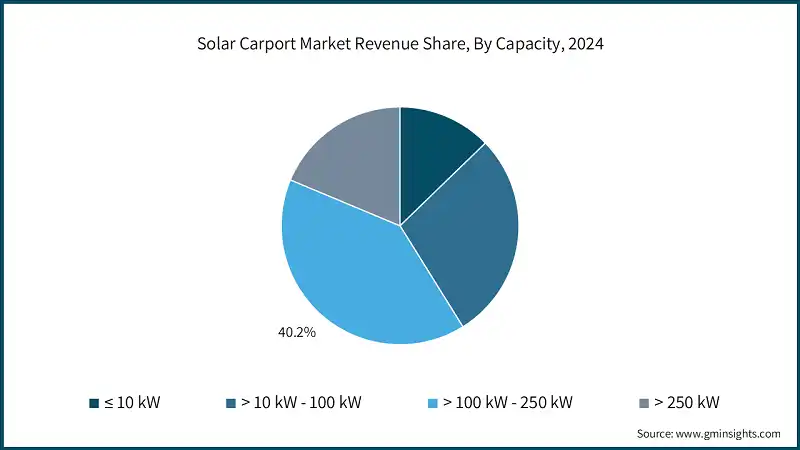
- Based on capacity, the industry is divided into ≤ 10 kW, > 10 kW - 100 kW, > 100 kW - 250 kW and > 250 kW. The > 100 kW - 250 kW solar carport market holds a share of 40.2% in 2024 and is set to reach over USD 1 billion by 2034.
- These systems are gaining traction as pragmatic commercial assets & businesses deploy them to meet ESG targets & cut site energy bills while adding visible sustainability and EV-charging capacity. These systems often qualify for larger-scale incentives or tradable certificates, making project economics stronger.
- > 250 kW solar carport industry was estimated at USD 182.8 million in 2024. This segment is rapidly shifting from one-off commercial installs to utility-scale canopy projects such as fleets, airports, malls and large campuses seek onsite generation to power operations and EV chargers. These larger carports bundle high-density PV arrays with battery storage and multiple fast chargers, delivering peak-time grid relief and improved self-consumption for hosts.
- For instance, in 2024, Asia’s monthly battery electric vehicle sales surpassed internal combustion engine sales beginning in July, marking a historic milestone in transportation electrification. This shift highlights the region’s rapid transition to electric mobility, underscoring the growing demand for expanded charging infrastructure to support the increasing number of EVs and facilitate a sustainable, low-emission transportation network.
- The ≤ 10 kW solar carport market is set to grow at a rate of over 11% from 2025 to 2034. These systems typically come as prefabricated kits or custom lightweight steel/aluminum canopies, offer easier permitting and quicker installs than ground arrays, but carry a higher cost-per-watt because of smaller scale.
- > 10 kW - 100 kW capacity systems are paired PV canopies with multiple level 2 chargers or modest battery packs, supporting daytime EV charging, demand-offset and local resilience including several university and municipal case studies demonstrate viability and replicability.
- Based on installation, the industry is bifurcated into single row, double row and multi lane. The multi lane solar carport industry will witness a CAGR of over 10.5% by 2034. These systems offer maximum energy generation density, economies of scale for very large installations, architectural impact and branding opportunities, and integration potential with comprehensive site amenities including lighting, signage, and EV charging.
- Single row systems provide several advantages including simplified structural engineering, reduced material costs compared to multi-row configurations, easier permitting due to lower height and smaller footprint, and flexibility in accommodating irregular parking layouts, driving the product penetration.
- Double row configurations feature two parallel rows of solar panels covering two adjacent parking spaces, typically supported by a central post structure with panels extending over both spaces. This design optimizes the balance between cost efficiency, energy generation capacity, and parking density, making it the preferred choice for commercial and industrial applications.
Looking for region specific data?
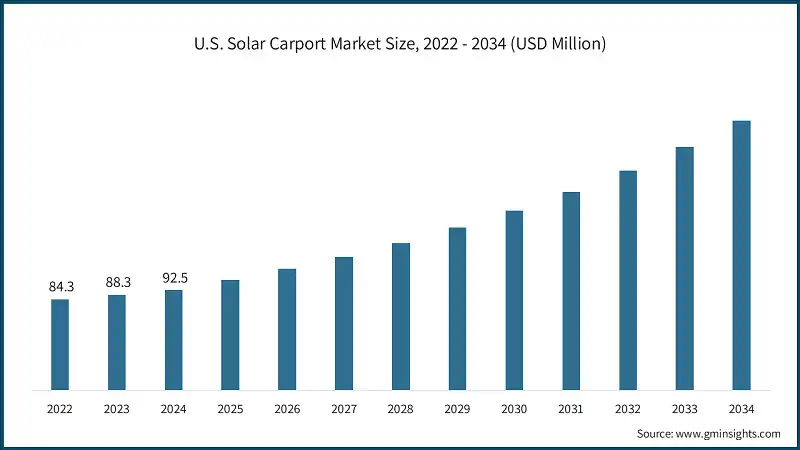
- The U.S. dominated the solar carport market in North America with around 85% share in 2024 and generated USD 92.5 million in revenue. The industry is expanding as commercial and institutional customers turn parking lots into dual-purpose assets shading vehicles while generating onsite solar and powering EV charging driven by rising EV adoption, corporate sustainability goals, and attractive tax incentives for solar and charging infrastructure.
- For instance, in 2024, the U.S. added 47.1 GW of new solar capacity, bringing total cumulative installations to 224.1 GW. This significant growth is driven by federal incentives, falling solar panel costs, and rising adoption across residential, commercial, and utility-scale projects, emphasizing solar energy’s increasingly critical role in advancing the country’s clean energy transition.
- The North America solar carport market is anticipated to reach over USD 250 million by 2034. The industry has been gaining significant traction, largely driven by the dual appeal of utilizing underused parking lots and integrating clean power generation with vehicle infrastructure.
- The Europe solar carport market is experiencing significant growth, driven by increasing electric vehicle adoption, ambitious carbon reduction targets, and government incentives for renewable energy integration. Advancements in bifacial panels, smart monitoring, and financing models are further accelerating deployment and market maturity across the region.
- For illustration, in 2024, about one in five new cars sold in Europe were electric, with projections of roughly 4 million EVs and a 25% sales share in 2025. The UK reached around 30% EV adoption, supported by zero emission vehicle mandates, while Norway achieved nearly 88% battery electric vehicle share, illustrating the potential for extremely high EV penetration in leading markets.
- The Asia Pacific solar carport market is set to grow at a rate of over 10% by 2034. The region’s rapidly expanding solar infrastructure along with growing adoption primarily across Southeast Asian markets will foster the business growth. Increasing electric vehicle uptake coupled with dense land and corporate sustainability mandates that favor on site renewable installations.
- For illustration, in 2024, China sold over 11 million EVs, accounting for roughly 50% of domestic sales and 60% of global EV sales. Battery electric vehicle sales surpassed internal combustion sales in July, with 2025 projections exceeding 14 million EVs.
- The Middle East accounts for about 4% of the solar carport market. The industry is driven by abundant sunlight, rising energy costs, and increasing commercial and industrial demand for reliable power. Businesses are adopting carports that provide shade while generating electricity, often with future EV charging readiness, which in turn will significant opportunities for industry expansion.
- The Latin America solar carport market is gaining traction as commercial and industrial property owners embrace rooftop alternative PV solutions and vehicle parking canopies to enhance sustainability. Improved distributed generation frameworks and corporate renewable targets are facilitating uptake of carport mounted solar, especially in retail centers and logistics parks.
Solar Carport Market Share
- The top 5 players in solar carport industry are SolarEdge, Enova, Schletter, Enerprac and Tata Power Solar Systems contribute around 25% of the market share in 2024.
- The market exhibits a moderately fragmented competitive landscape, comprising a combination of leading global technology companies, regional specialists, and vertically integrated engineering, procurement, and construction providers. This diverse mix fosters competition encourages innovation in design and installation, and allows tailored solutions across different markets, driving growth and adoption of solar carport systems worldwide.
- SolarEdge, one of the global leaders in inverters, power optimizers, and monitoring systems, enables solar carport installations by providing module-level optimization, enhanced safety, and energy monitoring. While it does not manufacture carport structures directly, its technology improves PV yield and system performance, supporting commercial and industrial solar carport projects worldwide.
- Enova, based in the Middle East, delivers turnkey solar carport solutions for commercial and institutional campuses. Its projects, including large-scale installations in Dubai, integrate thousands of PV panels over expansive parking areas, generating renewable energy while providing shading. The company focuses on sustainability and energy efficiency in urban and business community spaces.
- Schletter, a German solar mounting specialist, offers the modular SunRide solar carport system. Designed with central support for efficient parking layouts, it accommodates large-scale PV installations above 750 kWp. It’s portfolio emphasizes structural innovation, allowing flexible, durable, and high-performing carport systems suitable for commercial, industrial, and public parking applications.
- Enerparc, an Indian solar EPC and IPP firm, provides customized solar carport solutions for commercial and industrial clients. Its offerings optimize underutilized parking space for energy production, integrate battery storage options, and include flexible financing models. It focuses on delivering turnkey carport installations that combine functionality, sustainability, and cost efficiency.
- Tata Power Solar offers innovative solar carport solutions across India, combining modular design, high-efficiency PV modules, and advanced monitoring systems. Its projects serve industrial, commercial, and institutional clients, transforming parking areas into productive energy assets while promoting sustainability, reducing operational costs, and supporting India’s renewable energy and carbon reduction goals.
Solar Carport Market Companies
- In Q1 2025, SolarEdge reported revenues of USD 219.5 million (up from USD 196.2 million in Q 2024). It shipped 1,208 MW AC of inverters and 180 MWh of batteries for PV applications. While still unprofitable, the non GAAP net loss narrowed to USD 66.1 million, with free cash flow of approximately USD 19.8m illion.
- In 2024, Enova International reported full year 2024 revenues of USD 2.7 billion, up 26% from 2023, with a net revenue margin of 58%. Adjusted EBITDA reached USD 657 million, a 31% increase, highlighting its scalable operating model, credit discipline and diversified loan portfolio.
- In 2024, Tata Power Solar Systems Ltd., a subsidiary of Tata Power Company Limited, reported USD 7.4 billion in revenue and an EBITDA of USD 1.5 billion, driven by strong performance across its renewables and EPC segments. The company continues to expand its solar portfolio, emphasizing large-scale solar carports, rooftop projects, and sustainable energy innovation.
Major players operating in the solar carport industry are:
- ANTAI Solar
- Baja Carports
- Enerprac
- Enova
- EvoEnergy
- FlexiSolar
- Himzen
- KDC Solar
- Mahindra Solarize
- Mibet Energy
- Neosun
- New England Clean Energy
- Ornate Solar
- Phoenix Solar Panel Systems
- Positive Energy Solar
- RenEnergy UK
- Schletter
- Shanghai Chiko Solar Technology
- Solaire Generation
- SolarEdge
- SolarSense
- Sunlite Group
- Tata Power Solar Systems
- Xiamen Sunforson Power
Solar Carport Market Report Attributes
| Key Takeaway | Details |
|---|---|
| Market Size & Growth | |
| Base Year | 2024 |
| Market Size in 2024 | USD 978.2 Million |
| Market Size in 2025 | USD 1.08 Billion |
| Forecast Period 2025 - 2034 CAGR | 10.6% |
| Market Size in 2034 | USD 2.67 Billion |
| Key Market Trends | |
| Drivers | Impact |
| Rising adoption of electric vehicles | The increasing number of EVs is boosting demand for integrated solar carports that provide both parking and renewable charging solutions. |
| Government incentives and renewable energy policies | Subsidies, tax benefits, and renewable energy mandates are encouraging businesses and municipalities to invest in solar carport installations. |
| Efficient land utilization and sustainability goals | Solar carports enable dual land use—energy generation and vehicle parking supporting corporate sustainability and carbon neutrality targets. |
| Pitfalls & Challenges | Impact |
| High initial installation and maintenance costs | The substantial upfront investment required for structural support, solar panels, and electrical integration limits large-scale adoption. |
| Opportunities: | Impact |
| Integration with Vehicle-to-Grid (V2G) Technology | Solar carports can evolve into smart energy hubs by enabling two-way energy flow between EVs and the grid, improving grid stability and revenue potential. |
| Adoption in residential and community parking areas | Rising demand for decentralized solar solutions opens opportunities for compact, modular carports in gated communities, apartments, and housing societies. |
| Retrofit and redevelopment projects | Existing commercial parking lots, malls, and institutional campuses can be upgraded with solar carports, creating a major retrofit market opportunity. |
| Integration with energy storage and microgrids | Coupling solar carports with battery storage and localized microgrids offers energy resilience, load management, and peak-shaving benefits. |
| Market Leaders (2024) | |
| Market Leaders |
6.5% market share |
| Top Players |
Collective market share in 2024 is 25% |
| Competitive Edge |
|
| Regional Insights | |
| Largest Market | Asia Pacific |
| Fastest Growing Market | Latin America |
| Emerging Country | U.S., Germany, China, India & UAE |
| Future outlook |
|
What are the growth opportunities in this market?
Solar Carport Industry News
- In June 2024, Greenskies Clean Energy scaled its Drive-Up Beacon Program to more than 1,500 store locations across 49 U.S. states, installing 70 to 100 kW solar systems at each site. This expansion showcases a scalable model for large commercial portfolios, enabling cost efficiencies in design, procurement, and installation while accelerating the adoption of solar carports across widespread retail networks.
- In April 2024, SoliTek launched 370 W bifacial panels featuring 60 p-type monocrystalline M6 PERC cells, 19.57% efficiency, dual 3mm glass, and a 30-year warranty ensuring ≥ 87% output. Certified for DIBt overhead glazing, hail class 4, fire class A, 10,500 Pa snow load, and 5,400 Pa wind load, these panels meet rigorous standards for durable and reliable solar carport installations.
- In March 2024, SolarEdge completed notable reference projects, including a 1.8 MW installation in Bloemendaal, Netherlands, spanning over 800 parking spaces with around 5,000 modules and integrated EV charging, and a 1.3 MW project at Castle Plaza, South Australia, covering 430 parking spaces while testing bifacial modules, showcasing scalable solar carport solutions with combined energy generation and EV infrastructure.
- In February 2024, Tata Power Solar Systems delivered high-profile solar carport projects in India, including a 2.67 MW installation at Cochin International Airport with 27 structures, 8,472 panels, covering around 20,000 m² and offsetting 1,868 tons of CO2 annually, and a 335 kWp carport at Apollo Gleneagles Hospital, Kolkata, highlighting the growing maturity of the solar carport industry in the world.
The solar carport market research report includes in-depth coverage of the industry with estimates & forecast in terms of revenue (USD Million) from 2021 to 2034, for the following segments:
Market, By Installation
- Single row
- Double row
- Multi lane
Market, By Design
- T - shape
- V - shape
- L - shape
- Y - shape
- Dual-pitch
- Cantilever
Market, By Capacity
- ≤ 10 kW
- > 10 kW - 100 kW
- > 100 kW - 250 kW
- > 250 kW
Market, By Technology
- Monocrystalline
- Polycrystalline
- Thin-film
- Bifacial
Market, By Application
- Residential
- Commercial
- Industrial
Market, By Mounting
- Fixed
- Adjustable
The above information has been provided for the following regions & countries:
- North America
- U.S.
- Canada
- Mexico
- Europe
- Austria
- Norway
- Denmark
- Finland
- France
- Germany
- Italy
- Switzerland
- Spain
- Sweden
- UK
- Netherlands
- Poland
- Belgium
- Ireland
- Baltics
- Portugal
- Asia Pacific
- China
- Australia
- India
- Japan
- South Korea
- Thailand
- Philippines
- Vietnam
- Malaysia
- Singapore
- Middle East
- Israel
- Saudi Arabia
- UAE
- Jordan
- Oman
- Kuwait
- Turkey
- Africa
- South Africa
- Egypt
- Algeria
- Nigeria
- Morocco
- Latin America
- Brazil
- Chile
- Argentina
- Peru
Frequently Asked Question(FAQ) :
What is the market size of the solar carport in 2024?
The market size was USD 978.2 million in 2024, with a CAGR of 10.6% expected through 2034 driven by rising adoption of dual-purpose clean energy and shaded parking solutions.
What is the projected value of the solar carport market by 2034?
The solar carport market is expected to reach USD 2.67 billion by 2034, propelled by EV adoption, government incentives, and corporate sustainability goals.
What is the current solar carport market size in 2025?
The market size is projected to reach USD 1.08 billion in 2025.
How much revenue did the T-shape design segment generate in 2024?
T-shape design held approximately 35% market share in 2024, leading the design segment with its streamlined aesthetics and efficient land use.
What was the valuation of >100 kW - 250 kW capacity segment in 2024?
The >100 kW - 250 kW capacity segment held 40.2% market share and is set to reach over USD 1 billion by 2034.
What is the growth outlook for multi-lane installation from 2025 to 2034?
Multi-lane installations are projected to grow at over 10.5% CAGR till 2034, due to maximum energy generation density, economies of scale, and integration potential with comprehensive site amenities.
Which region leads the solar carport market?
Asia Pacific leads the solar carport market and is set to grow at over 10% CAGR by 2034. Rapidly expanding solar infrastructure and growing EV adoption fuel the region's dominance.
What are the upcoming trends in the solar carport market?
Key trends include integration with Vehicle-to-Grid (V2G) technology, IoT solutions for remote monitoring, flexible financing models like PPAs, and coupling with battery storage and microgrids for enhanced energy resilience.
Who are the key players in the solar carport market?
Key players include SolarEdge, Enova, Schletter, Enerparc, Tata Power Solar Systems, ANTAI Solar, Baja Carports, EvoEnergy, FlexiSolar, Himzen, KDC Solar, Mahindra Solarize, Mibet Energy, Neosun, New England Clean Energy, Ornate Solar, Phoenix Solar Panel Systems, Positive Energy Solar, RenEnergy UK, Shanghai Chiko Solar Technology, Solaire Generation, SolarSense, Sunlite Group, and Xiamen Sunforson Power.
Solar Carport Market Scope
Related Reports