Summary
Table of Content

Soft Starter Market
Get a free sample of this report
Form submitted successfully!
Error submitting form. Please try again.
Thank you!
Your inquiry has been received. Our team will reach out to you with the required details via email. To ensure that you don't miss their response, kindly remember to check your spam folder as well!
Request Sectional Data
Thank you!
Your inquiry has been received. Our team will reach out to you with the required details via email. To ensure that you don't miss their response, kindly remember to check your spam folder as well!
Form submitted successfully!
Error submitting form. Please try again.
Soft Starter Market Size
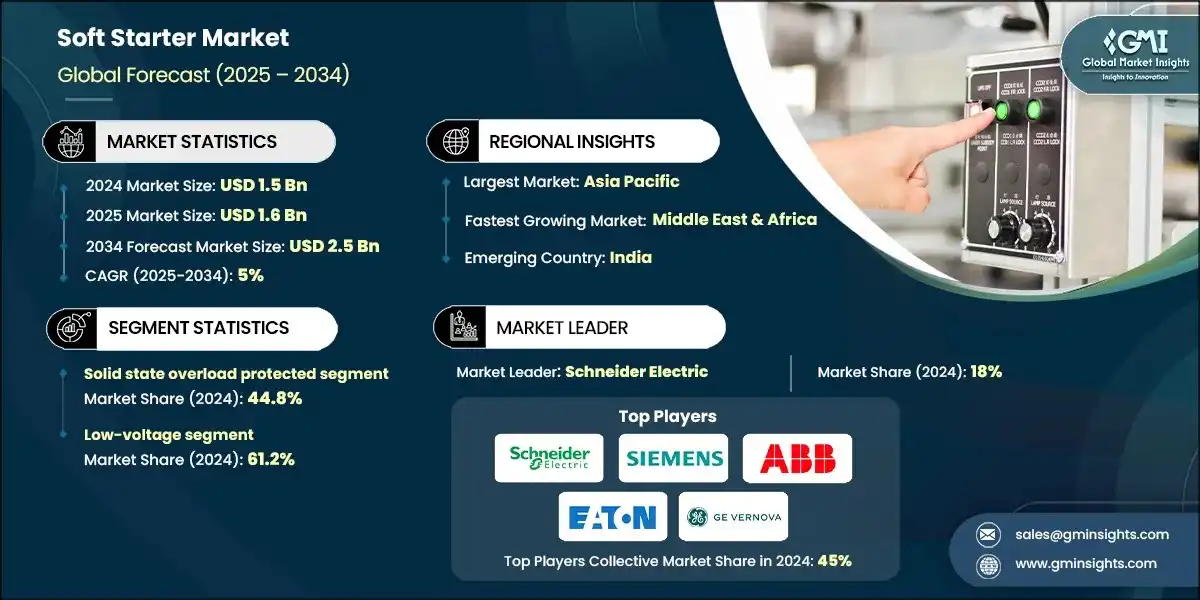
The soft starter market was valued at USD 1.5 billion in 2024 and is projected to grow from USD 1.6 billion in 2025 to USD 2.5 billion by 2034, reflecting a 5% CAGR, according to Global Market Insights Inc.
To get key market trends
- Energy-efficiency mandates for industrial motors are accelerating demand for soft starters that reduce inrush current, protect assets, and help meet system-level efficiency goals. In Europe, Step 2 of Regulation (EU) 2019/1781 took effect in July 2023, raising minimum efficiency to IE4 for many 75–200 kW motors and expanding scope—prompting upgrades of pumps, fans and compressors where soft starters are standard accompaniments to reliable starts and grid-friendly operations.
- Large public investments in water infrastructure are boosting orders for pump centric motor controls, including soft starters. In the United States, EPA’s Bipartisan Infrastructure Law programs are distributing multi year funding through State Revolving Funds, with FY2024 memoranda and allotments guiding billions toward drinking water and wastewater upgrades—projects deploying high horsepower pumps requiring controlled starting to protect pipes and electrical networks. The law dedicates USD 50 billion for water infrastructure—sustaining demand through 2026.
- In North America, industrial decarbonization grants and R&D support are modernizing plant electrification and motor systems, a tailwind for soft starters across conveyors, compressors and process pumps. The U.S. Department of Energy’s Industrial Efficiency and Decarbonization FOA selected 40 projects for USD 135 million to cut energy use and emissions in heavy industry—driving replacements and retrofits where improved motor controls are integral to reliability and efficiency.
- Europe’s shift to electrification and efficiency under REPowerEU is catalyzing investments in industrial equipment upgrades, including motor control solutions like soft starters. The Commission’s 2022 plan—and progress updates—set higher targets: 45% renewables by 2030, a 13% binding energy savings goal, and a drive to double heat pump deployment to 10 million units by 2027, all of which push factories to modernize pumps and compressors while minimizing grid stress during starts.
- Asia Pacific growth is underpinned by large water programmes and manufacturing expansion requiring robust pump and motor control. India’s Jal Jeevan Mission reported more than 15 crore rural households benefiting from tap water by August 2024, implying hundreds of new and upgraded pumping stations where soft starters help reduce mechanical stress, voltage dips and maintenance costs. The mission’s dashboard shows coverage above 80% in 2025, reinforcing procurement momentum.
- In the Middle East, desalination capacity additions drive substantial procurement of heavy duty pumps and motor controls. Saudi Arabia’s Saline Water Conversion Corporation set a daily production record of 6.3 million m³ in January 2023 and is advancing new RO plants, increasing the need for reliable soft starting to manage high inertia loads and minimize electrical transients.
- In Latin America, Brazil’s Novo PAC is channeling federal resources into urban water, drainage and sanitation—expanding and rehabilitating pump stations where controlled motor starts are required. In July 2024, the government announced USD 7.63 billion for mobility, drainage, sanitation and urban water, including USD 1.08 billion for municipal water supply, with selections spanning 27 states and 710 municipalities—programmes that typically specify soft starters to mitigate hydraulic shock and reduce downtime.
Soft Starter Market Report Attributes
| Key Takeaway | Details |
|---|---|
| Market Size & Growth | |
| Base Year | 2024 |
| Market Size in 2024 | USD 1.5 Billion |
| Market Size in 2025 | USD 1.6 Billion |
| Forecast Period 2025 - 2034 CAGR | 5% |
| Market Size in 2034 | USD 2.5 Billion |
| Key Market Trends | |
| Drivers | Impact |
| Growing industrial automation | Growing industrial automation is propelling the soft starter market by increasing demand for efficient motor control, energy savings, and reduced mechanical stress in automated systems across manufacturing, oil & gas, and water treatment industries. |
| Rising demand for energy efficiency | Rising demand for energy efficiency is driving growth in the soft starter market, as industries seek solutions that reduce power consumption, optimize motor performance, and lower operational costs while supporting sustainability goals and regulatory compliance. |
| Large scale integration of renewable energy | Large-scale integration of renewable energy is boosting the soft starter market, as utilities and industries adopt advanced motor control solutions to manage variable loads, enhance grid stability, and support sustainable energy infrastructure with improved efficiency and reliability. |
| Pitfalls & Challenges | Impact |
| Rapid technological changes | Rapid technological changes pose a pitfall for the soft starter market by making existing products obsolete, increasing R&D costs, and challenging manufacturers to keep pace with evolving standards, customer expectations, and integration needs in increasingly complex industrial environments. |
| Opportunities: | Impact |
| Integration with Smart Grid Infrastructure | Integration with smart grid infrastructure presents a key opportunity for the soft starter market, enabling advanced motor control, real-time monitoring, and load optimization. This supports grid reliability, energy efficiency, and seamless communication between industrial systems and power networks. |
| Electrification of Transportation and Logistics | Electrification of transportation and logistics drives demand for soft starters by requiring efficient motor control in electric vehicles, charging stations, and automated logistics systems. This shift supports sustainability, reduces emissions, and creates new applications across mobility and supply chain sectors. |
| Market Leaders (2024) | |
| Market Leaders |
18% market share |
| Top Players |
Collective market share in 2024 is 45% |
| Competitive Edge |
|
| Regional Insights | |
| Largest Market | Asia Pacific |
| Fastest Growing Market | Middle East & Africa |
| Emerging Country | India |
| Future outlook |
|
What are the growth opportunities in this market?
Soft Starter Market Trends
- Energy-efficiency regulation is tightening, pushing end users toward motor control solutions—including soft starters—to meet compliance and reduce electrical stress on grids. In Europe, ecodesign rules now require higher efficiency classes for motors and drives, with IE4 mandatory for certain 75–200 kW motors since July 2023. This regulatory step strengthens the business case for upgrading motor systems alongside smarter starting methods to protect assets and improve uptime.
- Water and wastewater modernization is accelerating purchases of medium-voltage pump starters that mitigate water hammer and reduce mechanical wear. In 2024, EPA announced USD 11.5 billion in SRF funding for states to upgrade water mains, pumps, and treatment facilities—projects where controlled motor starting is standard practice to improve reliability and grid friendliness. This capital cycle favors rugged soft starters in high-inertia pump applications.
- Desalination buildout in the Middle East is expanding demand for large pump motor controls. Saudi Arabia’s SWPC named a preferred bidder for Jubail4 & 6 IWP (potable water capacity 600,000 m³/day), a scale that typically requires controlled acceleration to limit mechanical stress and inrush current on MV pumps—applications well served by soft starters. Such projects create multi year procurement pipelines for starting equipment.
- Industrial motor system efficiency is a boardroom priority, underpinning investments in safer, smoother starting methods that cut downtime. The IEA’s 4E EMSA platform notes electric motors in industrial and infrastructure applications account for ~53% of global electricity consumption, highlighting the opportunity in optimizing motor systems, including start/stop strategies. This efficiency focus supports retrofits where soft starters reduce mechanical shocks and extend equipment life.
- Renewables expansion drives auxiliary equipment demand—cooling fans, circulation pumps, and balance of plant systems—where controlled starting reduces wear and harmonics. IRENA’s Renewable Capacity Statistics 2024 reports a record year in 2023, with renewables reaching 3,870GW and accounting for 86% of capacity additions. As projects scale, operators standardize on robust motor controls, with soft starters offering cost effective reliability in fixed speed duties.
- Mining and minerals processing remain strong end markets for heavy duty soft starters on conveyors, crushers, and slurry pumps. Australia’s government reported in December 2024 that iron ore exploration expenditure hit its highest level in a decade, signaling sustained investment in plant upgrades where controlled motor starting is critical for mechanical protection and grid stability. This pipeline underpins demand for rugged, serviceable soft starters over multi shift operations.
- Building decarbonization mandates are retooling HVAC plants, favoring motor controls that manage inrush on chillers, compressors, and large fans. The EU’s Energy Performance of Buildings Directive (recast) adopted in April 2024 sets trajectories for non residential upgrades and requires zero emission performance for new buildings by 2030, intensifying modernization of technical systems. Soft starters help meet electrical integration and reliability objectives during phased retrofits.
Soft Starter Market Analysis
Learn more about the key segments shaping this market
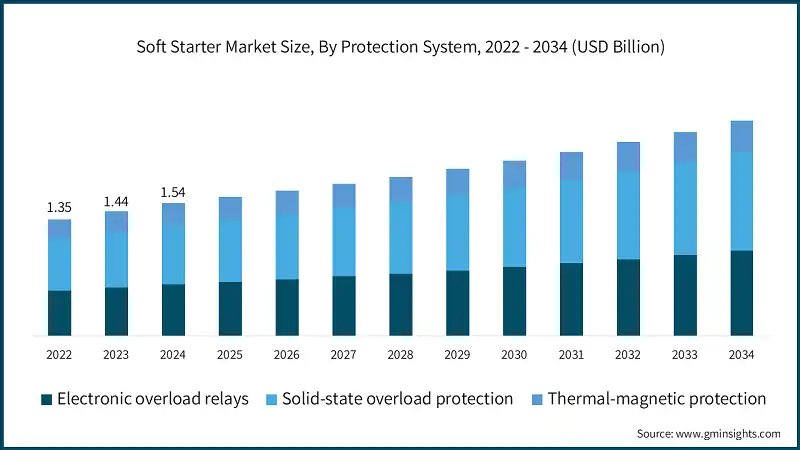
- Based on protection system, the market is segmented in to thermal magnetic protection, solid-state overload protection, and electronic overload relays. The market was valued at USD 1.35 billion in 2022, rising to USD 1.44 billion in 2023, and further to USD 1.54 billion in 2024. Among these, solid state overload protected soft starters dominated with a 44.8% market share in 2024 and is forecasted to witness about 5.1% CAGR through 2034.
- Solid-state overload protection delivers precise thermal modeling and rapid fault response, reducing downtime in critical operations. Its programmability and diagnostic features align with digitalization trends, enabling predictive maintenance and integration with SCADA systems. This technology is increasingly adopted in HVAC retrofits and industrial automation, where energy efficiency and reliability are paramount.
- The European Commission’s Ecodesign review for electric motors and drives, launched in late 2024, aims to tighten efficiency and reliability standards across motor systems. Solid-state overload protection supports these objectives by ensuring accurate thermal monitoring and reducing energy waste in compliance-driven installations.
- Thermal magnetic protection remains a cornerstone for motor safety in rugged environments, offering dual defense against overload and short-circuit faults. Its mechanical simplicity and proven reliability make it indispensable for sectors like water treatment and municipal pumping, where operational continuity is critical. These systems are often paired with soft starters to minimize inrush currents while ensuring compliance with safety codes in large-scale infrastructure projects.
- In 2025, Minnesota’s Clean Water Revolving Fund Intended Use Plan prioritized wastewater and stormwater upgrades under the Bipartisan Infrastructure Law, emphasizing resilient electrical systems for treatment plants. Thermal magnetic protection integrated with soft starters provides cost-effective compliance for these projects, safeguarding motors against unpredictable load conditions.
- Electronic overload relays offer advanced protection with real-time monitoring of current, phase imbalance, and temperature, often featuring remote communication capabilities. These relays are ideal for smart grids and renewable energy plants, where predictive analytics and remote diagnostics minimize unplanned outages and optimize asset life cycles.
- IRENA’s Renewable Energy Statistics 2025 highlights a record global renewable capacity increase of 585 GW in 2024, driving auxiliary system demand in solar and wind projects. Electronic overload relays integrated with soft starters ensure operational reliability for pumps and cooling fans in these installations, supporting grid stability and predictive maintenance strategies.
Learn more about the key segments shaping this market
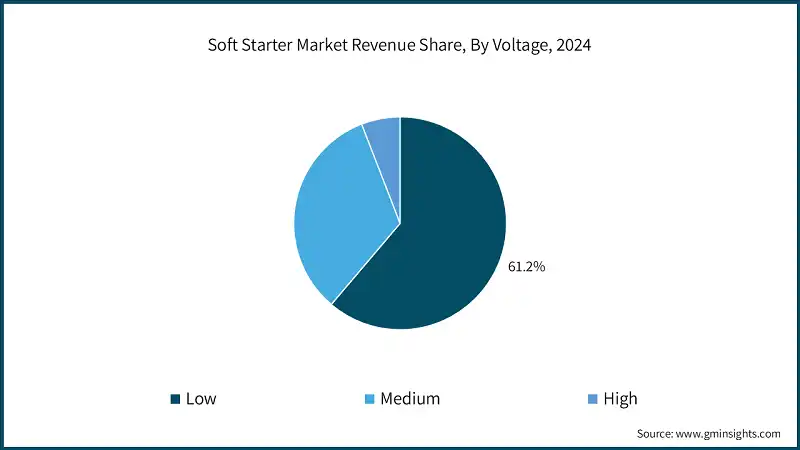
- Low-voltage soft starters dominate the global market, representing 61.2% of total share in 2024. This leadership is driven by their widespread use in commercial and industrial applications such as HVAC systems, pumps, and conveyors, where motors typically fall under 690 V. Their cost-effectiveness, compact design, and ease of integration into existing electrical infrastructure make them the preferred choice for energy-efficient motor control in small to medium-scale operations.
- Low-voltage soft starters are extensively deployed in sectors like building automation, food processing, and water treatment, where motor ratings generally range from 0.75 kW to 500 kW. These starters provide smooth acceleration, reducing mechanical stress and extending equipment life. Their affordability and compatibility with standard low-voltage networks make them ideal for retrofit projects and new installations in commercial facilities.
- The growing emphasis on energy efficiency and compliance with building codes further accelerates adoption of low-voltage soft starters. They help minimize peak demand charges and improve system reliability, aligning with sustainability goals in HVAC and pumping systems. Their integration with smart controllers also supports predictive maintenance, making them a strategic choice for modern infrastructure upgrades.
- Medium-voltage soft starters cater to heavy-duty applications such as mining, oil and gas, and large-scale water pumping, where motor ratings typically exceed 500 kW. These starters ensure controlled acceleration for high-inertia loads, reducing torque shocks and protecting mechanical components. Their robust design and ability to handle frequent starts make them essential for mission-critical operations.
- Infrastructure projects like desalination plants and wastewater treatment facilities increasingly specify medium-voltage soft starters to manage large pump motors. Their role in reducing inrush currents helps maintain grid stability, especially in regions with weak electrical networks. This segment benefits from rising investments in industrial modernization and water security initiatives worldwide.
- High-voltage soft starters serve specialized applications in power generation, petrochemicals, and large-scale industrial plants, where motor ratings can exceed several megawatts. They provide controlled motor starting for compressors, blowers, and large pumps, mitigating electrical and mechanical stress during startup. Their advanced protection features make them indispensable for high-value assets.
- Although niche, demand for high-voltage soft starters is supported by expansion in renewable energy and grid infrastructure projects. These starters enable reliable operation of auxiliary systems in high-capacity plants, ensuring compliance with stringent safety and performance standards. Their adoption is expected to grow in tandem with mega-projects in energy and heavy industry.
Looking for region specific data?
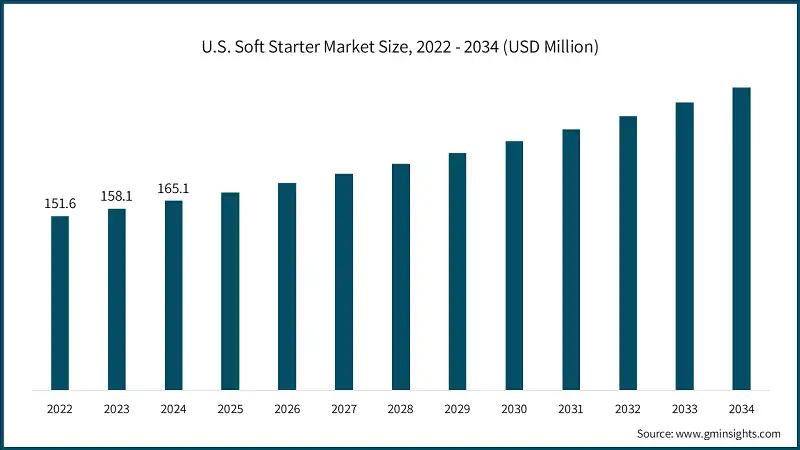
- The U.S. soft starter market expanded from USD 151.6 million in 2022 to USD 158.1 million in 2023, reaching USD 165.1 million in 2024, representing 63% of North America’s total share. Growth is fueled by federal infrastructure investments under the Bipartisan Infrastructure Law, which prioritize energy-efficient motor systems for water treatment, HVAC, and industrial automation. These initiatives encourage adoption of soft starters to reduce energy waste, improve grid stability, and extend equipment life in critical municipal and industrial applications.
- North America’s soft starter market benefits from strong regulatory frameworks and infrastructure modernization. In October 2024, the U.S. EPA allocated USD 6.2 billion for water infrastructure upgrades under the Bipartisan Infrastructure Law, targeting wastewater and drinking water systems. These projects require reliable motor control for pumps and compressors, creating sustained demand for soft starters. Canada’s clean energy programs also promote advanced motor technologies, supporting industrial electrification and efficiency improvements across manufacturing and resource sectors.
- Europe’s soft starter market is driven by stringent energy-efficiency mandates and industrial electrification initiatives. The EU’s Clean Industrial Deal, launched in 2024, mobilizes over €100 billion to decarbonize energy-intensive sectors, accelerating adoption of motor control technologies like soft starters for compressors, pumps, and fans. Additionally, mandatory IE4 motor standards under EU Regulation 2019/1781 encourage system upgrades, where soft starters complement high-efficiency motors by reducing mechanical stress and improving reliability. These policies position Europe as a leader in sustainable industrial modernization.
- France is accelerating industrial electrification and energy efficiency, creating strong demand for motor control solutions like soft starters. In May 2024, the European Commission approved a USD 4.62 billion French State aid scheme to support decarbonization in manufacturing, including electrification of processes and advanced motor systems. These investments aim to cut emissions by 40% and energy use by 20%, driving modernization of motor-driven equipment in sectors such as chemicals, food, and automotive.
- Asia-Pacific’s soft starter market growth is propelled by industrial automation and sustainability programs. India’s Industry 4.0 roadmap, announced in 2024, promotes smart manufacturing and energy-efficient motor systems, creating opportunities for soft starters in automotive, electronics, and process industries. Similarly, Japan’s Energy Efficiency Technology Strategy 2024 prioritizes advanced motor controls to achieve carbon neutrality by 2050. These initiatives drive adoption of soft starters for optimized motor performance, reduced downtime, and compliance with stringent energy targets across diverse industrial applications.
- China dominates Asia-Pacific’s soft starter market, fueled by rapid industrial automation and smart manufacturing initiatives. In 2024, China installed 295,000 industrial robots, accounting for 54% of global deployments, as part of its strategy to modernize factories and reduce energy waste. This surge in automation includes advanced motor control systems, where soft starters ensure smooth operation of pumps, compressors, and conveyors in high-tech manufacturing hubs. Government incentives and localization policies further strengthen adoption across automotive and electronics sectors.
- The Middle East’s desalination and water infrastructure projects are major drivers for medium- and high-voltage soft starters. In 2025, Saudi Arabia launched USD 533 million worth of water and sewerage projects under Vision 2030, requiring robust motor control for large pumps and compressors to ensure operational reliability and energy efficiency. Additionally, renewable-powered desalination plants, such as Shuaibah 3, demand advanced motor starting solutions to manage high-inertia loads and maintain grid stability, reinforcing regional demand for soft starters.
- Saudi Arabia leads MEA’s market, driven by giga-projects under Vision 2030. In 2025, the Kingdom announced USD 47.8 billion worth of water infrastructure projects, including desalination and transmission systems requiring robust motor control for large pumps and compressors. These projects, coupled with green hydrogen initiatives like the Yanbu Hub, create significant opportunities for medium- and high-voltage soft starters to ensure operational reliability and grid stability in critical infrastructure.
- Latin America’s mining sector modernization drives demand for rugged soft starters in conveyors, crushers, and slurry pumps. In 2025, WEG supplied IE5 efficiency synchronous motors with advanced control systems to a Peruvian mine at 4,600 meters altitude, highlighting the region’s shift toward energy-efficient motor solutions in challenging environments. Copper and lithium production growth in Chile, Peru, and Argentina underpins investments in motorized equipment for mineral processing, where soft starters protect mechanical assets and maintain grid stability in heavy-duty operations.
- Brazil is the largest market in Latin America, supported by industrial modernization and mining expansion. The Nova Indústria Brasil policy, launched in 2024, allocates USD 54.6 billion for sustainable industrial upgrades, including energy-efficient motor systems. Simultaneously, Brazil’s mining sector exported USD 45.3 billion in 2024, with growing investments in lithium and iron ore projects requiring rugged motor controls for crushers and conveyors. These dual drivers position Brazil as a key growth hub for soft starters.
Soft Starter Market Share
- The leading companies in the global soft starter industry include ABB, Siemens, Schneider Electric, Eaton, and GE Vernova, collectively accounting for over 45% of the market share in 2024. These players dominate due to their extensive product portfolios, strong global presence, and continuous investment in energy-efficient motor control technologies.
- ABB commands a significant share through its advanced motor control solutions integrated with digital platforms. Its focus on industrial automation and energy efficiency aligns with global sustainability goals, making ABB a preferred choice for large-scale projects. Strategic investments in smart factories and renewable energy infrastructure further strengthen its position, ensuring compatibility with Industry 4.0 standards and predictive maintenance capabilities.
- Siemens leverages its strong presence in industrial electrification and smart infrastructure to lead the soft starter segment. Its portfolio includes highly efficient starters integrated with IoT-enabled systems, catering to sectors like water treatment, mining, and manufacturing. Siemens’ ability to deliver turnkey solutions and compliance with stringent European energy regulations reinforces its dominance in high-value industrial applications.
- Schneider Electric excels by offering compact, cost-effective soft starters tailored for commercial and industrial applications. Its emphasis on sustainability and digital energy management solutions positions it as a leader in low-voltage segments. Schneider’s EcoStruxure platform enables seamless integration with automation systems, driving adoption in building automation and HVAC projects worldwide.
Soft Starter Market Companies
Major players operating in the soft starter industry are:
- ABB
- C&S Electric
- CG Power & Industrial Solutions
- CHINT Group
- CORDYNE
- Danfoss
- Eaton
- Emerson Electric
- GE Vernova
- Jayashree Electron
- Lauritz Knudsen Electrical & Automation
- LOVATO ELECTRIC
- LS ELECTRIC
- Mitsubishi Electric
- Omron Corporation
- Phoenix Contact
- Rockwell Automation
- Schneider Electric
- Siemens
- WEG
- CHINT Group offers the NJR2-T series soft starters, designed for three-phase AC induction motors with ratings from 7.5 kW to 160 kW. Featuring advanced dual-CPU control and SCR technology, these starters provide smooth acceleration and comprehensive protection, including overload, phase failure, and voltage anomalies. Widely used in sectors like metallurgy, water supply, and petrochemicals, Chint leverages its strong presence in emerging markets and compliance with IEC standards to position itself as a cost-effective solution provider for industrial motor control. [www.chintglobal.com]
- Lovato Electric’s ADXT series soft starters deliver three-phase control for heavy-duty applications such as crushers, conveyors, and compressors. Covering 34A to 554A and operating at 380–690 VAC, these starters integrate bypass relays for energy efficiency and offer advanced features like inside-delta connection and optional communication ports. Lovato’s focus on compact design and global certifications, including cULus, strengthens its market presence in Europe and North America, catering to industries demanding reliability and flexibility in motor starting solutions.
- Siemens maintains a dominant position in the soft starter market through its SIRIUS 3RW series, which spans low- to high-voltage applications. These starters feature modular designs, integrated communication for automation systems, and energy-saving functionalities, making them ideal for sectors like water treatment, mining, and manufacturing. Siemens’ global reach, combined with its emphasis on digitalization and IoT-enabled solutions, ensures strong adoption in smart infrastructure projects and compliance-driven industries, reinforcing its leadership in advanced motor control technologies.
Soft Starter Industry News
- In January 2025, Lovato Electric introduced the ADXT series, a new line of soft starters designed to handle demanding motor applications with greater efficiency and control. For motor starter businesses, this launch represents a significant step forward in managing high-inertia loads such as crushers, conveyors, and compressors. The ADXT series features full three-phase control, offering higher starting torque and smoother acceleration compared to traditional two-phase designs. With built-in bypass relays, adjustable current settings, and compatibility with both in-line and inside-delta configurations, these starters are engineered for flexibility and energy efficiency. Their compact design, wide voltage range, and optional communication capabilities make them well-suited for modern industrial environments seeking smarter motor control solutions.
- In September 2024, WEG unveiled a multi-year investment plan totaling approximately USD 122 million to scale its operations in Mexico and Brazil. The initiative includes the construction of a new wire production facility in Atotonilco de Tula, Mexico, aimed at strengthening supply chain integration and supporting regional demand. In Brazil, WEG will expand its manufacturing footprint in Itajaí and Guaramirim, enhancing capacity and modernizing infrastructure for electric motors and transformers. This strategic move supports WEG’s long-term growth in the Americas and aligns with broader trends in nearshoring and industrial sustainability.
- In July 2024, Danfoss announced an investment of approximately USD 15.4 million to upgrade its facilities and introduce new technologies across its Brazilian operations. This expansion supports modernization of production lines and integration of smart control systems tailored for industries such as food processing, heavy machinery, and water management. With Brazil serving as Danfoss’ largest market in Latin America, the investment reinforces its commitment to localized innovation and positions its motor starter solutions to meet rising demand for energy-efficient and digitally enabled industrial equipment.
The soft starter market research report includes in-depth coverage of the industry with estimates & forecast in terms of revenue (USD Million) and volume (Units) from 2021 to 2034, for the following segments:
Market, By Protection System
- Electronic Overload Relays
- Solid-State Overload Protection
- Thermal-Magnetic Protection
Market, By Control System
- PLC
- Fieldbus
Market, By Voltage
- Low
- Medium
- High
Market, By Current
- > 9 A – 27 A
- > 27 A – 90 A
- > 90 A – 270 A
- > 270 A – 810 A
- > 810 A
Market, By Application
- Distributed Architecture
- Control Cabinet
- Hybrid Configuration
Market, By End Use
- Residential
- Commercial
- Industrial
The above information has been provided for the following region and countries:
- North America
- U.S.
- Canada
- Mexico
- Europe
- Germany
- France
- Russia
- UK
- Italy
- Spain
- Netherlands
- Austria
- Asia Pacific
- China
- Japan
- South Korea
- India
- Australia
- New Zealand
- Indonesia
- Middle East & Africa
- Saudi Arabia
- UAE
- Qatar
- Egypt
- South Africa
- Nigeria
- Latin America
- Brazil
- Argentina
Frequently Asked Question(FAQ) :
Who are the key players in the soft starter market?
Key players include ABB, C&S Electric, CG Power & Industrial Solutions, CHINT Group, CORDYNE, Danfoss, Eaton, Emerson Electric, GE Vernova, Jayashree Electron, Lauritz Knudsen Electrical & Automation, LOVATO ELECTRIC, LS ELECTRIC, Mitsubishi Electric, Omron Corporation, Phoenix Contact, Rockwell Automation, Schneider Electric, Siemens, and WEG.
What are the upcoming trends in the soft starter market?
Key trends include tightening energy-efficiency regulations, integration with smart grid infrastructure, electrification of transportation and logistics, desalination buildout in the Middle East, and building decarbonization mandates driving HVAC plant modernization.
Which region leads the soft starter market?
The U.S. soft starter market held 63% share with USD 165.1 million in 2024, supported by federal infrastructure investments promoting energy-efficient motor systems.
What is the growth outlook for medium-voltage soft starters from 2025 to 2034?
Medium-voltage soft starters are set for steady growth through 2034, driven by heavy-duty applications in mining, oil and gas, and large-scale water pumping, where motor ratings typically exceed 500 kW.
What was the valuation of low-voltage soft starters segment in 2024?
Low-voltage soft starters held 61.2% of total market share in 2024, supported by widespread use in commercial and industrial applications such as HVAC systems, pumps, and conveyors.
How much market share did the solid-state overload protection segment hold in 2024?
Solid-state overload protection dominated with 44.8% market share in 2024, fueled by precise thermal modeling and rapid fault response capabilities.
What is the current soft starter market size in 2025?
The market size is projected to reach USD 1.6 billion in 2025.
What is the market size of the soft starter in 2024?
The market size was USD 1.5 billion in 2024, with a CAGR of 5% expected through 2034 driven by energy-efficiency mandates for industrial motors and expanding industrial automation.
What is the projected value of the soft starter market by 2034?
The soft starter market is expected to reach USD 2.5 billion by 2034, propelled by stricter energy efficiency regulations, integration with smart grid infrastructure, and the global shift toward electrification.
Soft Starter Market Scope
Related Reports