Summary
Table of Content

Soft Drinks Packaging Market
Get a free sample of this report
Form submitted successfully!
Error submitting form. Please try again.
Thank you!
Your inquiry has been received. Our team will reach out to you with the required details via email. To ensure that you don't miss their response, kindly remember to check your spam folder as well!
Request Sectional Data
Thank you!
Your inquiry has been received. Our team will reach out to you with the required details via email. To ensure that you don't miss their response, kindly remember to check your spam folder as well!
Form submitted successfully!
Error submitting form. Please try again.
Soft Drinks Packaging Market Size
The growth of the market is attributed to rising carbonated beverage consumption in Asia-Pacific, increasing premiumization of beverage formats, expansion of aluminum can manufacturing capacity, growing demand for convenient single-serve packaging, and the implementation of recycled-content and circular packaging mandates across Europe and North America.
Soft Drinks Packaging Market Key Takeaways
Market Size & Growth
- 2025 Market Size: USD 53.4 Billion
- 2026 Market Size: USD 54.8 Billion
- 2035 Forecast Market Size: USD 75.4 Billion
- CAGR (2026–2035): 3.6%
Regional Dominance
- Largest Market: North America
- Fastest Growing Region: Asia Pacific
Key Market Drivers
- Rising carbonated beverage consumption in Asia-Pacific.
- Shift toward lightweight PET bottle formats.
- Growth of single-serve, on-the-go packaging.
- Expansion of aluminum can capacity globally.
- E-commerce-ready secondary packaging demand.
Challenges
- Volatile resin and aluminum price fluctuations.
- Recycling infrastructure gaps in emerging economies.
Opportunity
- 100% recyclable mono-material packaging development.
- Smart packaging with QR traceability integration.
Key Players
- Market Leader: Ball Corporation led with over 18.7% market share in 2025.
- Leading Players: Top 5 players in this market include Ball Corporation, Crown Holdings Inc., Amcor Limited, Tetra Pak International S.A, Berry Global Group Inc, which collectively held a market share of 57.8% in 2025.
Get Market Insights & Growth Opportunities
The soft drinks packaging market is driven by rising carbonated beverage consumption across Asia-Pacific, supported by robust official consumption trends and economic expansion. According to a U.S. Department of Agriculture report quoting China’s National Bureau of Statistics, China's beverage market which includes carbonated drinks reached a value of USD 170 billion in 2024 because of urban demand and retail development which created a 6 percent annual growth rate. This robust, government-registered growth in the beverage market fuels the demand for PET bottles, aluminum packaging, and secondary packaging types in the key Asia-Pacific economies, fueling the growth in soft drinks packaging demand in the Asia-Pacific region through 2025 and beyond.
The market is further supported by the shift toward lightweight PET bottle formats as governments tighten packaging sustainability rules. In January 2025, the European Union published the Packaging and Packaging Waste Regulation (PPWR), which includes stronger provisions to reduce excessive packaging and improve recyclability across the bloc, encouraging lighter designs and reduced material intensity in plastic bottles. This government-issued regulation is prompting beverage producers to adopt lightweight PET bottle formats, accelerating demand for optimized preforms and high-performance PET resins to comply with sustainability targets.
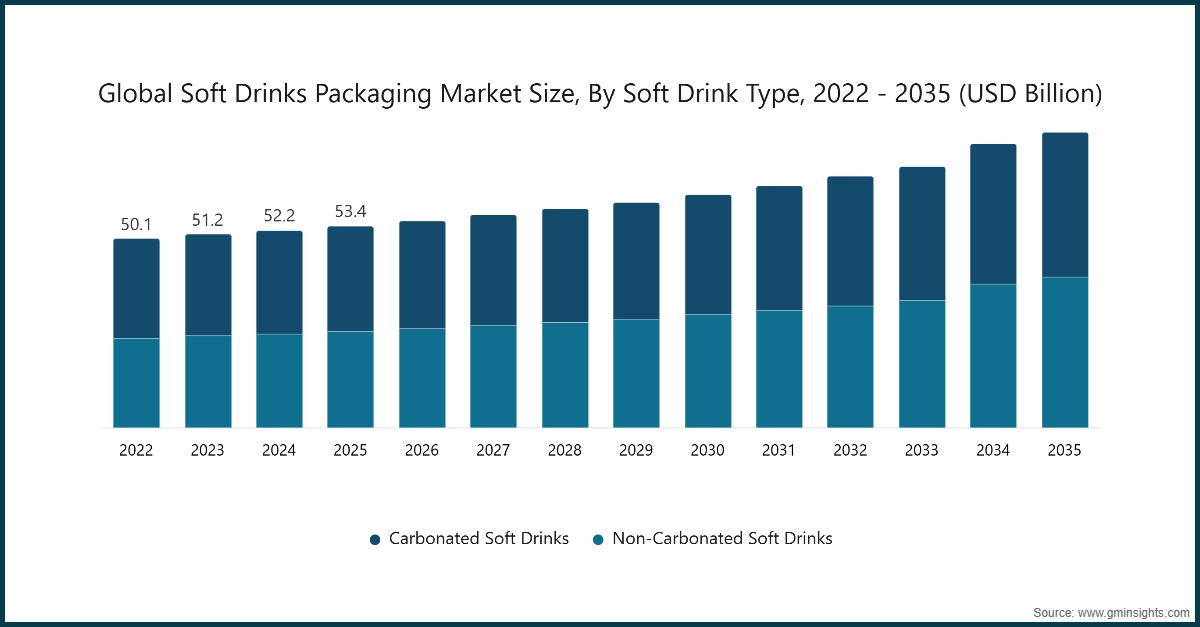
The market increased steadily from USD 50.1 billion in 2022 and reached USD 52.2 billion in 2024, driven by the revival of consumption patterns in the foodservice sector, capacity expansion in aluminum beverage cans, and the rapid development of Recycled PET processing lines. The market experienced growth because sustainability regulations became stricter, lightweight packaging designs gained popularity and high-speed filling line technology advanced. During this phase, the growth of online beverage sales and the launch of premium products further improved the diversification of packaging formats and production volumes worldwide.
The global soft drinks packaging market was valued at USD 53.4 billion in 2025. The market is expected to grow from USD 54.8 billion in 2026 to USD 64 billion in 2031 & USD 75.4 billion in 2035, at a CAGR of 3.6% during the forecast period according to the latest report published by Global Market Insights Inc.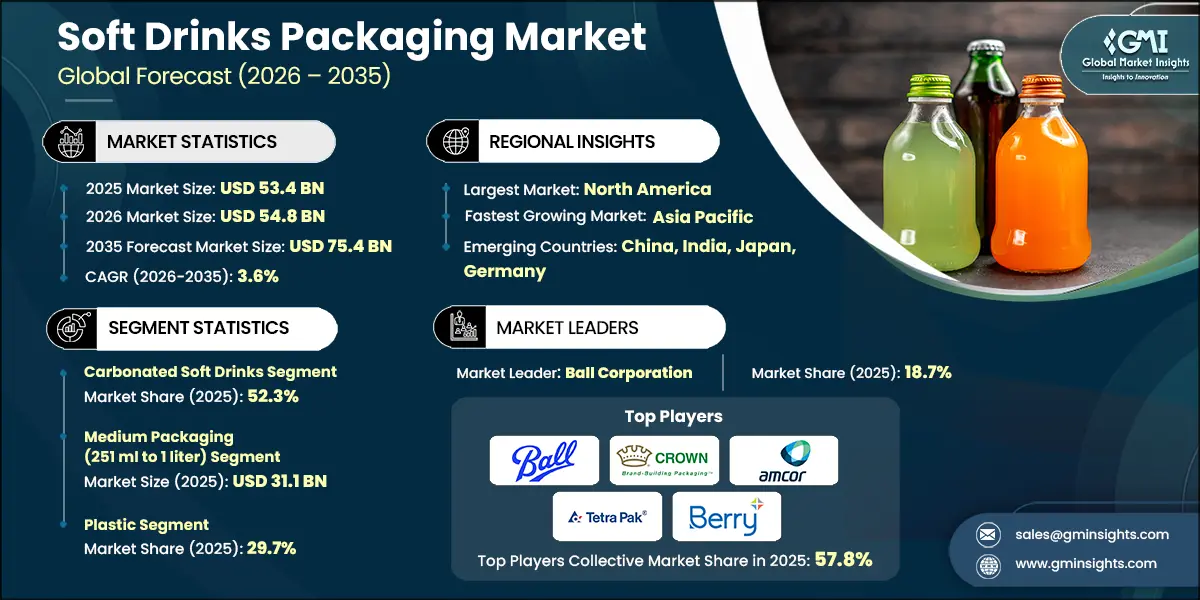
To get key market trends
Soft Drinks Packaging Market Trends
- The rapid integration of recycled content into beverage packaging is forcing a change in material sourcing approaches worldwide. The trend received legislative support in 2022 with the implementation of the EU Single-Use Plastics Directive and corresponding legislation in the UK and various U.S. states. It will persist through 2030 as the tightening of mandatory rPET content levels and the fulfillment of brand commitments continue.
- Premiumization via specialty can packaging and high-impact decorative printing is revolutionizing brand differentiation approaches. The shift began around 2021 as beverage brands intensified competition in flavored carbonates and limited-edition launches post-pandemic recovery. The trend will remain active until 2028 because consumers show preference for packaging that enables them to display their collections. This trend improves point-of-sale visibility, justifies premiumization, and enables more short-run production.
- The use of tethered caps and design-for-recycling closures is redefining packaging regulatory requirements in Europe. The movement quickened in 2023 in advance of the EU regulation requiring the use of tethered caps on single-use beverage packaging by July 2024. It will extend into other regulated regions through 2029 as governments address litter concerns. The effects include investments in cap redesign and tooling enhancements which lead to better material recovery results.
- Automation systems together with digital twin technology are being used in beverage packaging systems to enhance manufacturing productivity. Beverage manufacturers increased their operational capacity during supply chain interruptions because they wanted to make their businesses more resilient while reducing their labor expenses. The trend is expected to continue through 2030 with growing Industry 4.0 investments. This will improve line speed accuracy, minimize downtime, and optimize packaging quality consistency worldwide.
Soft Drinks Packaging Market Analysis
Learn more about the key segments shaping this market
Based on soft drink type, the soft drinks packaging market is divided into carbonated soft drinks and non-carbonated soft drinks.
- The carbonated soft drinks segment led the market in 2025, holding a 52.3% share, as carbonated beverages demand high-performance packaging that resists carbonation pressure. The global demand for colas and flavored sparkling beverages continues to drive high production volumes of PET bottles and aluminum cans. The market segment maintains its leading position because customers demand packaging solutions that combine pressure resistance with lightweight design and recycling capability in both developed and emerging markets.
- The non-carbonated soft drinks segment is anticipated to grow at a CAGR of 4.8% over the forecast period. The increase results from people drinking more juices, sports drinks, flavored water and health-oriented functional beverages. These products utilize diverse packaging formats including PET, aseptic cartons, and recyclable bottles. Expanding product innovation and premium hydration categories are accelerating packaging demand in this segment.
Based on packaging capacity, the soft drinks packaging market is divided into small packaging (up to 250 ml), medium packaging (251 ml to 1 liter), and large packaging (above 1 liter.
- The medium packaging (251 ml to 1 liter) segment dominated the market in 2025 and valued at USD 31.1 billion, as it represents the most widely consumed beverage size across retail, supermarkets, and foodservice channels. This format balances portability and value, making it ideal for single and multi-occasion consumption. Its compatibility with PET bottles and aluminum cans ensures strong manufacturing efficiency and consistent demand from high-volume carbonated and non-carbonated beverage brands.
- The small packaging (up to 250 ml) segment is expected to witness growth at a CAGR of 3.5% during the forecast period due to increasing preference for portion control, premium mini-cans, and convenience-driven consumption. Growth in vending, travel retail, and quick-service restaurant channels further supports demand. This segment enables higher per-liter pricing strategies and aligns with evolving consumer trends toward moderation and mobility.
Learn more about the key segments shaping this market
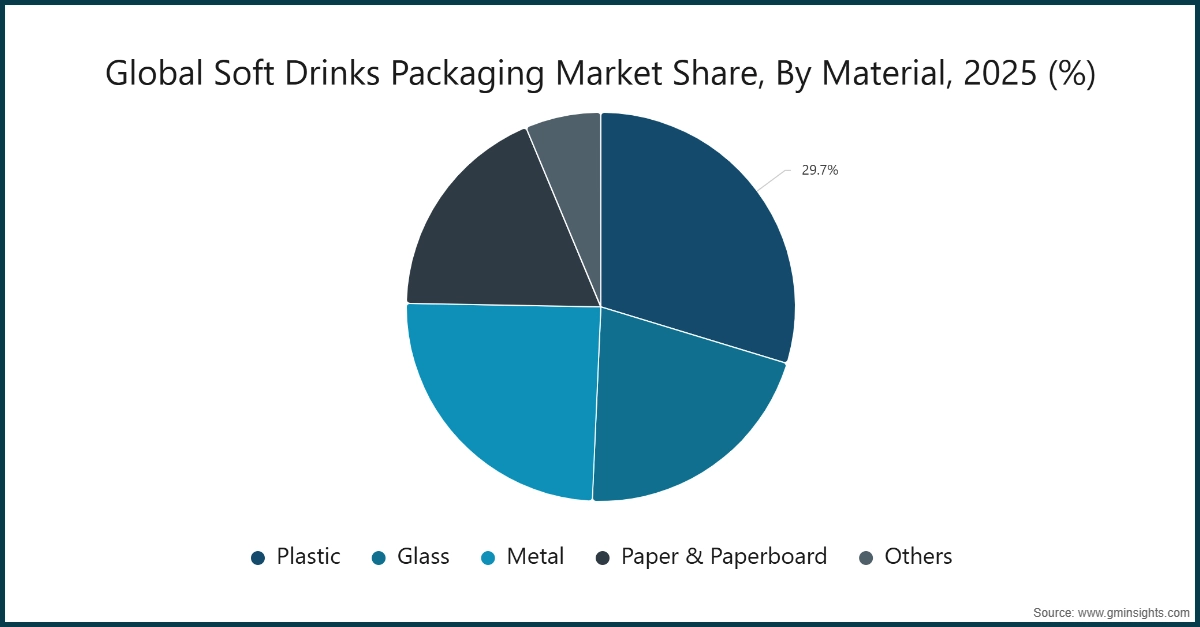
Based on packaging material, the global soft drinks packaging market is divided into plastic, glass, metal, paper & paperboard, and others.
- The plastic segment led the market in 2025 with a market share of 29.7%, primarily because PET bottles serve as the primary packaging method for both carbonated and non-carbonated beverages. Plastic packaging is lightweight, economical, and compatible with fast-moving filling lines. The dominance of plastic packaging in emerging and mature markets will continue despite the sustainability-driven transformation of packaging designs.
- The paper & paperboard segment is expected to grow at a CAGR of 6.4% during the forecast period, mainly due to the rising adoption of carton-based soft drink packaging and the need to minimize plastic waste. Advances in barrier coating and recyclable paper designs are broadening its usage in soft drinks. The sustainability pledge of soft drink manufacturers and consumer demand for low-carbon packaging options are fueling this shift.
Looking for region specific data?
North America Soft Drinks Packaging Market
North America held a share of 35.3% of market in 2025.
- In North America, the market is experiencing steady growth due to the demand for aluminum cans, the need for increased recycled content, and stable carbonated beverage consumption. The Aluminum Association states that aluminum beverage cans are one of the most recycled beverage containers in North America, which supports brand preference for metal packaging.
- Additionally, investments in domestic aluminum can manufacturing capacity across the U.S. and Mexico are strengthening supply security. PET bottle demand also remains stable, supported by recycled-content mandates in select U.S. states and brand-level sustainability targets. Growth in convenience retail, foodservice recovery, and multipack sales through warehouse clubs further supports packaging volume demand. Ongoing modernization of high-speed filling lines and lightweighting initiatives are expected to enhance production efficiency and material optimization, ensuring continued market expansion across North America through 2035.
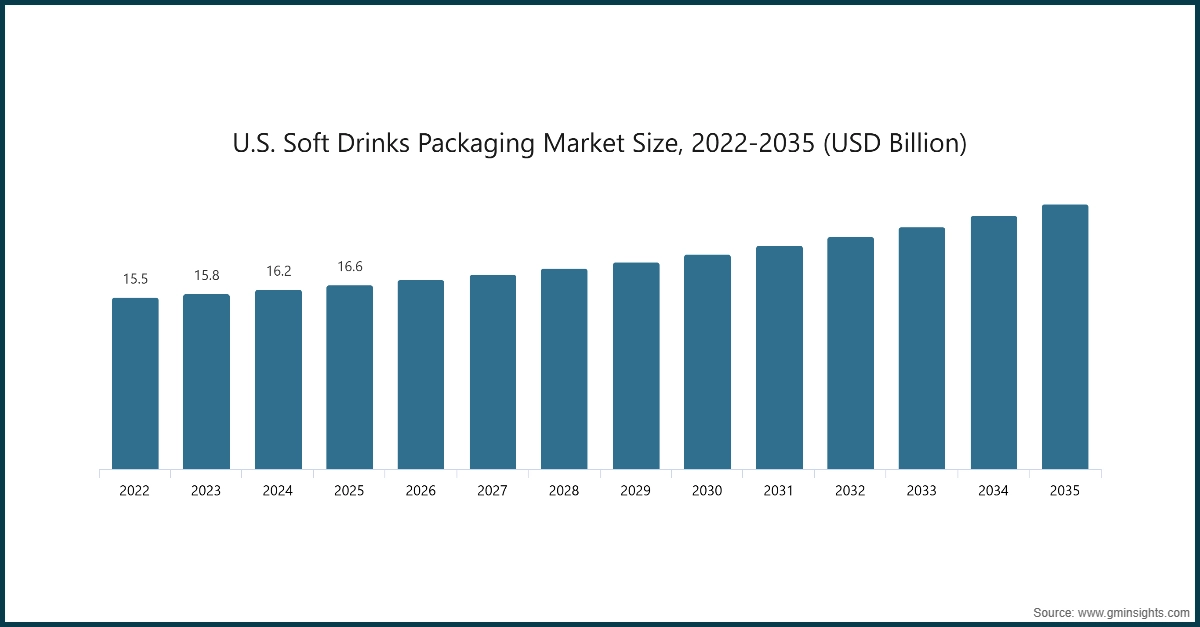
The U.S. soft drinks packaging market was valued at USD 15.5 billion and USD 15.8 billion in 2022 and 2023, respectively. The market size reached USD 16.6 billion in 2025, growing from USD 16.2 billion in 2024.
- Growth in the U.S. market is strongly supported by enforced recycled-content mandates and verified recycling performance metrics. The California Department of Resources Recycling and Recovery (CalRecycle) confirms that under AB 793, plastic beverage containers were required to contain 25% post-consumer recycled (PCR) content starting January 1, 2025, with the next compliance threshold set at 50% by 2030. This active mandate is materially increasing rPET procurement and long-term supply contracts.
- In addition, the Aluminum Association indicated that about 43% of aluminum beverage cans sold in the U.S. were recycled in 2023, underscoring continued demand for recycled aluminum in can production. At the same time, announced capacity expansions by major manufacturers such as Ball Corporation in the Southwest and Midwest regions have improved domestic manufacturing capabilities. These factors have firmly established the U.S. as the leading market in North America.
Europe Soft Drinks Packaging Market
Europe market accounted for USD 11.8 billion in 2025 and is anticipated to show lucrative growth over the forecast period.
- Europe’s market is evolving under legally binding circular economy legislation and material transition targets. The EU Packaging and Packaging Waste Regulation (PPWR) in 2025 is forcing beverage companies to enhance the use of recycled materials, recyclability, and minimize light packaging weights. Deposit Return Schemes (DRS) are already operational in several EU member states, and this has led to a substantial increase in PET bottle recycling rates and ensured the supply of high-quality rPET materials.
- Notably, the market for aluminum beverage cans is also set to remain strong because of the high recycling rates in the region and the preference for infinitely recyclable packaging. Western Europe is also seeing the development of food-grade rPET processing capacity as a result of the tighter regulations on the use of recycled content. The combination of these new regulations and the existing infrastructure changes will drive European soft drink companies to adopt new material sourcing methods while they speed up their recycling design development process.
Germany dominates the Europe soft drinks packaging market, showcasing strong growth potential.
- Germany is the most organized market in Europe because of its well-developed deposit return system and strict packaging regulations. The German Packaging Act (VerpackG) requires beverage manufacturers to register their packaging quantities and engage in national collection schemes, which ensures transparency in compliance. The deposit return system in Germany has PET bottle return rates of over 90%, ensuring a consistent supply of high-quality recycled PET for the production of closed-loop bottles.
- One of the most efficient aluminum beverage can recycling rates in Europe is also maintained by the country, which promotes circular metal use. High retail concentration, especially in the form of discount supermarket chains, ensures high sales volumes of multipacks, which in turn supports the use of lightweight PET bottles and aluminum cans. Germany’s advanced sorting infrastructure and regulatory enforcement mechanisms position it as a benchmark circular packaging economy within Europe.
Asia Pacific Soft Drinks Packaging Market
The Asia Pacific market is anticipated to grow at the highest CAGR of 4.7% during the forecast period.
- The Asia Pacific market is expanding rapidly due to high-volume beverage production and structural shifts in retail distribution. The region accounts for the largest share of global carbonated beverage consumption, with multinational bottlers continuously expanding filling capacity across India, Southeast Asia, and South Korea. Growth in modern trade, convenience chains, and e-commerce grocery platforms is accelerating demand for lightweight PET bottles and sleek aluminum cans.
- Additionally, several Southeast Asian nations are strengthening extended producer responsibility (EPR) frameworks, prompting investment in domestic recycling and food-grade rPET production. Japan and South Korea continue to emphasize high-quality packaging aesthetics and vending-machine-compatible formats, reinforcing demand for durable, compact beverage packaging. These regional consumption dynamics and regulatory transitions are positioning APAC as the fastest-scaling production hub for soft drinks packaging through the forecast period.
China soft drinks packaging market is estimated to grow with a significant CAGR, in the Asia Pacific market.
- China represents the largest market in Asia Pacific due to its massive domestic beverage manufacturing base and vertically integrated packaging supply chain. The country is home to extensive PET preform production capacity and some of the world’s largest aluminum can manufacturing facilities, ensuring cost-efficient large-scale output. China’s national plastic pollution control policy is accelerating the development of food-grade recycled PET infrastructure, strengthening circular packaging adoption among domestic beverage brands.
- Rapid expansion of convenience retail networks and ready-to-drink beverage innovation continues to support high packaging turnover volumes. Furthermore, strong domestic consumption combined with export-oriented beverage production enhances demand for standardized, high-speed compatible packaging formats. China’s scale advantage, manufacturing depth, and policy-driven recycling expansion firmly position it as the dominant packaging market within APAC.
Middle East and Africa Soft Drinks Packaging Market
UAE market to experience substantial growth in the Middle East and Africa market.
- The United Arab Emirates market is expanding due to high per-capita beverage consumption and a strong hospitality-driven retail ecosystem. The country’s hot climate sustains consistent demand for bottled carbonated drinks, flavored beverages, and energy drinks, supporting steady PET bottle and aluminum can production volumes. The UAE’s Federal Circular Economy Policy and single-use plastic reduction regulations are encouraging beverage producers to adopt recyclable and lightweight packaging formats.
- In addition, large-scale beverage manufacturing clusters in Dubai and Abu Dhabi serve both domestic consumption and re-export markets across the GCC and Africa, strengthening demand for high-quality, export-compliant packaging solutions. The rapid growth of modern retail chains, convenience stores, and international events further reinforces demand for premium, visually distinctive beverage packaging in the UAE.
Soft Drinks Packaging Market Share
The market is led by players such as Ball Corporation, Crown Holdings, Inc., Amcor Limited, Tetra Pak International S.A, and Berry Global Group, Inc. These five companies collectively accounted for 57.8% share of the global market in 2025. Their key strengths are in aluminum beverage cans, PET bottles, carton packaging systems, closures, and flexible packaging solutions for carbonated and non-carbonated soft drinks.
Their strong global presence in North America, Europe, Asia-Pacific, and Latin America helps them supply their packaging solutions to global soft drinks brands. Their constant efforts in lightweight packaging, recycled materials, high-speed filling compatibility, and circular economy solutions further enhance their market positioning in a scenario where sustainability regulations are becoming increasingly stringent and the global soft drinks market is witnessing growing demand. Their long-term supply contracts with the world's leading soft drinks manufacturers and constant capacity expansions also help them maintain their leading market position and thus a strong barrier to entry for local players.
Soft Drinks Packaging Market Companies
Prominent players operating in the soft drinks packaging industry are as mentioned below:
- Amcor Limited
- AptarGroup
- Ardagh Group
- Ball Corporation
- Berry Global Group, Inc.
- CAN-PACK SA
- CPMC Holdings Limited
- Crown Holdings, Inc.
- Graham Packaging Company
- Graphic Packaging International, LLC
- Novelis Inc.
- Plastipak Holdings, Inc.
- SIG
- Silgan Holdings Inc.
- Smurfit Kappa
- Tetra Pak International S.A
- Visy Industries
- WestRock Company
- Ball Corporation
Ball Corporation develops lightweight two-piece cans which contain high amounts of recycled material. The company develops its sustainable business practices through innovative research work which produces new can designs and printing decorative technologies. Its extensive manufacturing facilities produce carbonated soft drinks and energy drinks through advanced manufacturing methods which ensure dependable supply chains and fulfill global circular economy requirements.
Crown Holdings develops advanced aluminum beverage cans together with specialized packaging products which meet the needs of high-end soft drink manufacturers. The company focuses on improving operational performance through better metal recycling methods and superior graphic design capabilities. The company continues to invest in capacity development while building smart manufacturing systems which will help its business operations in both established and developing markets for beverages.
The company offers a comprehensive selection of rigid PET bottles and flexible packaging solutions for beverages. The company develops packaging solutions which use recyclable materials together with rPET-based elements and lightweight bottles to meet its environmental goals which follow international recycled-content regulations. The company develops advanced R&D capabilities which enable it to create high-performance packaging solutions for different beverage categories through its partnerships with beverage companies.
Tetra Pak International S.A provides a complete system which combines carton-based beverage packaging with processing solutions and filling machines. The company uses low-carbon packaging solutions which include plant-based polymers and fully recyclable carton products. Its aseptic technology and strong presence in emerging markets support diversification within non-carbonated and functional soft drink segments.
Berry Global offers PET bottles, closures, and shrink film solutions optimized for cost efficiency and high-volume beverage production. The company emphasizes lightweight design, post-consumer recycled resin integration, and customization capabilities. Its vertically integrated manufacturing model enhances supply security and responsiveness to evolving sustainability requirements in global soft drinks packaging.
Soft Drinks Packaging Market Report Attributes
| Key Takeaway | Details |
|---|---|
| Market Size & Growth | |
| Base Year | 2025 |
| Market Size in 2025 | USD 53.4 Billion |
| Market Size in 2026 | USD 54.8 Billion |
| Forecast Period 2026-2035 CAGR | 3.6% |
| Market Size in 2035 | USD 75.4 Billion |
| Key Market Trends | |
| Drivers | Impact |
| Rising carbonated beverage consumption in Asia-Pacific | Drives 24% growth by increasing demand for high-volume packaging formats, particularly PET bottles and aluminum cans, supported by urbanization, rising disposable income, and expanding retail penetration. |
| Shift toward lightweight PET bottle formats | Supports 21% growth through enabling beverage manufacturers to reduce resin usage, lower transportation costs, and meet sustainability targets while maintaining product integrity and carbonation performance. |
| Growth of single-serve, on-the-go packaging | Contributes 18% growth as demand for single-serve, on-the-go packaging accelerates across convenience stores, quick-service restaurants, and vending channels, driving higher production of small-format bottles and sleek cans tailored to urban lifestyles. |
| Expansion of aluminum can capacity globally | Adds 20% growth via global expansion of aluminum can manufacturing capacity, particularly in North America and Europe, where investments in new can lines respond to strong demand for infinite recyclable packaging and premium beverage formats. |
| E-commerce-ready secondary packaging demand | Accounts for 17% growth through the rise of e-commerce-ready secondary packaging, requiring stronger corrugated solutions, shrink bundles, and transit-resistant multipacks designed to withstand last-mile delivery and direct-to-consumer distribution models. |
| Pitfalls & Challenges | Impact |
| Volatile resin and aluminum price fluctuations | Restrains market growth as volatile resin and aluminum prices directly impact packaging production costs. Fluctuations in crude oil derivatives and global metal markets compress margins for converters and beverage brands, complicate long-term procurement contracts, and limit pricing flexibility in highly competitive soft drink segments. |
| Recycling infrastructure gaps in emerging economies | Limits expansion due to recycling infrastructure gaps in emerging economies, where inadequate collection systems, low segregation rates, and limited rPET processing capacity reduce circularity efficiency and challenge compliance with sustainability commitments set by multinational beverage producers. |
| Opportunities: | Impact |
| 100% recyclable mono-material packaging development | Presents strong growth potential by enabling 100% recyclable mono-material packaging development, simplifying waste sorting and improving recycling yields. Transitioning to single-polymer structures in bottles, labels, and closures enhances circular economy compliance and supports brand commitments toward fully recyclable packaging portfolios. |
| Smart packaging with QR traceability integration | Offers strategic opportunity through smart packaging with QR traceability integration, allowing brands to provide product authentication, recycling instructions, promotional engagement, and supply chain transparency. This enhances consumer interaction, supports regulatory traceability requirements, and strengthens data-driven marketing strategies. |
| Market Leaders (2025) | |
| Market Leader |
18.7% market share in 2025 |
| Top Players |
Collective Market Share for top 5 players is 57.8% in 2025 |
| Competitive Edge |
|
| Regional Insights | |
| Largest Market | North America |
| Fastest growing market | Asia Pacific |
| Emerging countries | China, India, Japan, Germany |
| Future outlook |
|
What are the growth opportunities in this market?
Soft Drinks Packaging Industry News
- In December 2025, Tetra Pak International S.A launched the world’s first aseptic beverage carton with a paper-based barrier for juice packaging in collaboration with Spanish beverage producer García Carrión. The new packaging uses up to 92 % renewable content and cuts carbon footprint by ~43 % compared with traditional aseptic cartons, advancing low-carbon solutions for beverage cartons.
- In November 2025, Ball Corporation announced a USD 60 million investment to expand its aluminum can manufacturing capacity at the Sri City facility in Andhra Pradesh, India, reinforcing supply for growing beverage can demand and sustainable packaging formats in Asia-Pacific. This expansion supports annual market growth exceeding 10 % in the region.
- In February 2025, Tetra Pak International S.A introduced ISCC PLUS-certified recycled polymer packaging material in India, becoming the first in the region’s beverage packaging sector to integrate certified recycled polymers into carton packaging. This supports compliance with India’s Plastic Waste Management Amendment Rules and enables higher recycled content in food-grade beverage cartons.
The soft drinks packaging market research report includes in-depth coverage of the industry with estimates and forecast in terms of revenue (USD Million) from 2022 – 2035 for the following segments:
Market, By Material
- Plastic
- Glass
- Metal
- Paper & paperboard
- Others
Market, By Product Type
- Bottles
- Cans
- Cartons
- Pouches
- Others
Market, By Capacity
- Small packaging (up to 250 ml)
- Medium packaging (251 ml to 1 liter)
- Large packaging (above 1 liter)
Market, By Soft Drink Type
- Carbonated soft drinks
- Non-carbonated soft drinks
The above information is provided for the following regions and countries:
- North America
- U.S.
- Canada
- Europe
- Germany
- UK
- France
- Spain
- Italy
- Netherlands
- Asia Pacific
- China
- India
- Japan
- Australia
- South Korea
- Latin America
- Brazil
- Mexico
- Argentina
- Middle East and Africa
- South Africa
- Saudi Arabia
- UAE
Frequently Asked Question(FAQ) :
What is the market size of the soft drinks packaging market in 2025?
The global market was valued at USD 53.4 billion in 2025, growing at a CAGR of 3.6% during the forecast period.
What is the projected value of the soft drinks packaging market by 2035?
The market is expected to reach USD 75.4 billion by 2035.
What is the projected size of the soft drinks packaging market in 2026?
The market is projected to reach USD 54.8 billion in 2026.
Which soft drink type segment led the market in 2025?
The carbonated soft drinks segment led the market with a 52.3% share in 2025, driven by demand for pressure-resistant PET bottles and aluminum cans.
What was the valuation of the medium packaging capacity segment?
The medium packaging segment (251 ml to 1 liter) was valued at USD 31.1 billion in 2025, making it the largest capacity category.
Which region leads the soft drinks packaging market?
North America led the market with a 35.3% share in 2025, supported by high recycling rates and strong aluminum can demand.
Who are the key players in the soft drinks packaging market?
Key players include Ball Corporation, Crown Holdings, Inc., Amcor Limited, Tetra Pak International S.A., and Berry Global Group, Inc., collectively holding 57.8% market share in 2025.
Soft Drinks Packaging Market Scope
Related Reports