Summary
Table of Content

Snow Removal Equipment Market
Get a free sample of this report
Form submitted successfully!
Error submitting form. Please try again.
Thank you!
Your inquiry has been received. Our team will reach out to you with the required details via email. To ensure that you don't miss their response, kindly remember to check your spam folder as well!
Request Sectional Data
Thank you!
Your inquiry has been received. Our team will reach out to you with the required details via email. To ensure that you don't miss their response, kindly remember to check your spam folder as well!
Form submitted successfully!
Error submitting form. Please try again.
Snow Removal Equipment Market Size
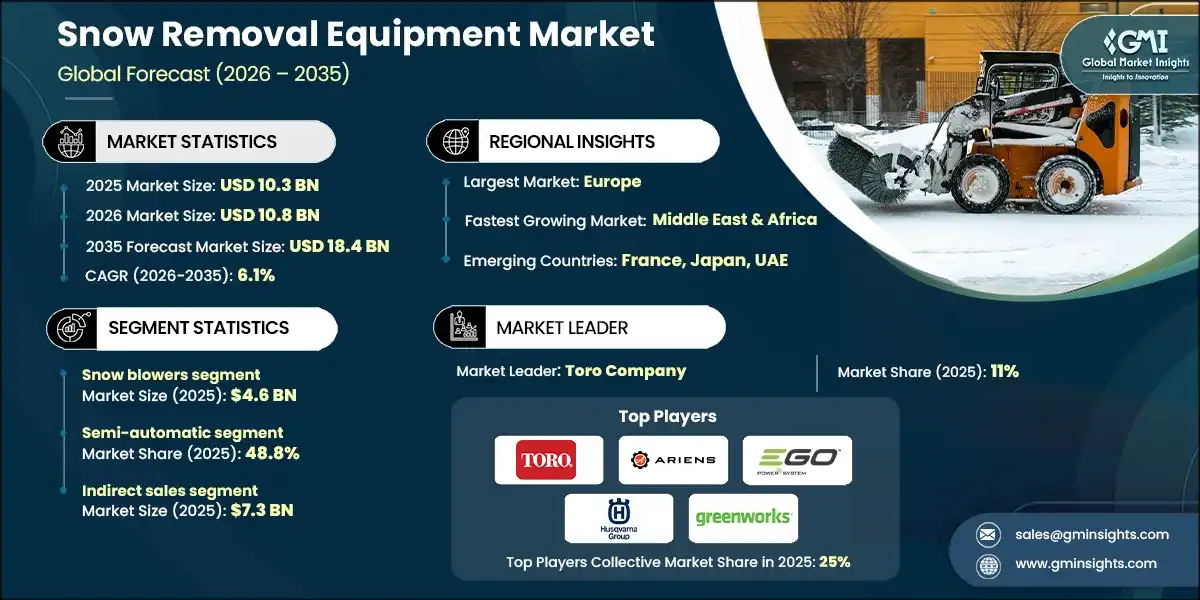
The global snow removal equipment market size was estimated at USD 10.3 billion in 2025. The market is expected to grow from USD 10.8 billion in 2026 to USD 18.4 billion in 2035, at a CAGR of 6.1% according to latest report published by Global Market Insights Inc.
Snow Removal Equipment Market Key Takeaways
Market Size & Growth
- 2025 Market Size: USD 10.3 Billion
- 2026 Market Size: USD 10.8 Billion
- 2035 Forecast Market Size: USD 18.4 Billion
- CAGR (2026–2035): 6.1%
Regional Dominance
- Largest Market: Europe
- Fastest Growing Region: Middle East & Africa
Key Market Drivers
- Increasing snowfall & extreme weather conditions.
- Urbanization & infrastructure expansion.
- Rising safety & accessibility requirements.
Challenges
- Seasonal dependency & revenue volatility.
- Performance limitations in extreme cold.
Opportunity
- Lithium‑battery powered & fully automated snow blowers.
- Smart, connected snow equipment.
Key Players
- Market Leader: Toro Company led with over 11% market share in 2025.
- Leading Players: Top 5 players in this market include Toro Company, Ariens Company, EGO Power+, Husqvarna, Greenworks, which collectively held a market share of 25% in 2025.
Get Market Insights & Growth Opportunities
The increasing unpredictability of winter weather is raising the demand for dependable snow removal equipment. Areas of the country are now seeing many different types of snowfall, which may include limited amounts of snowfall with a very short duration, followed by higher amounts of snowfall for longer periods. This change puts even greater pressure on municipalities, businesses, and property managers to utilize machines that will allow them the necessary means for snow removal, ensuring safety and continued access to all areas. Therefore, large quantities of snow-clearing vehicles will continue to be needed, where users require these vehicles to be able to work effectively in low temperature conditions for extended periods without excessive mechanical strain.
Additionally, the impact of extreme weather patterns such as abrupt blizzards, freeze-thaw cycles, and powerful winter storms on transportation networks increase the potential risks of operation; therefore, these weather patterns require a comprehensive approach for dealing with the potential use of snow removal vehicles that must not only be powerful but must also have the ability to handle a wider scope of operational needs from clearing roadways, pathways, parking lots and industrial locations, to working under different ground surface topographies and varying degrees of snow density. Thus, due to an increased emphasis placed on resilience and responsive capability in the snow removal industry, many users will continue to upgrade and utilize snow removal systems that are made of higher-quality durable materials and incorporate more advanced technology providing for continuing demand in both the commercial and municipal marketplace segments.
Urban growth has required public-sector and private-sector management of the built environment, which in turn has created a larger quantity of built environment infrastructure exposed to winter weather. Therefore, effective snow management is required to enable cities to continue to function successfully in daily activities, supply chain management and service delivery. This has resulted in increased use of snow removal equipment in urban planning and maintenance practices for cities. The types of equipment most used for snow removal in urban areas are designed for narrow streets, high traffic areas and mixed-use development.
Urban development also requires consistent wintertime maintenance of large-scale infrastructure projects such as new residential zones, commercial hubs, and transit corridors. Many construction and property management services provide the ability to clear snow during the winter months as part of their planning process for year-round access to the built environment. The demand for snow removal equipment with high-performance and low emission will continue to grow as urban development continues.
To get key market trends
Snow Removal Equipment Market Trends
The market is slowly moving toward snow removal vehicles that offer a versatile, efficient, and technology-friendly system because there’s a growing demand for superior winter maintenance dependability and quicker incident response times. As equipment manufacturers place more emphasis on designing products that provide consistent performance during all types of snow conditions, consumers are increasingly interested in purchasing equipment that will allow for easier operation, maintenance, and integration into a comprehensive winter-service plan. Additionally, growing environmental awareness and advances in technology are leading both public and private organizations to consider smart fleet management strategies when upgrading their snow clearing capabilities.
- Customers are increasingly satisfied with their equipment and are beginning to show interest in the additional benefits of equipment that utilizes technology to improve productivity and reduce fatigue on operators. In addition, the trend toward automation in the design of new products is evident in the increased number of mid-range and compact products being offered by many of today's manufacturers. In addition, this trend is evident in the continued improvement of designs to enhance operator efficiency and increase the consistency of results during winter weather emergencies.
- The increased use of machines capable of performing multiple functions provides municipalities and businesses the opportunity to maximize fleet productivity throughout the year, which creates a need for features that provide versatility and flexibility for customers. As a result, many manufacturers are designing machines with more adaptable designs to better cater to customer needs.
- With many areas experiencing extreme winter weather, there has been an increased interest in products built to last hold up to the elements such as moisture or cold for prolonged periods. Manufacturers are responding to this trend by making sure their products are built better, have better quality materials, and allow for easier maintenance access points.
- Users are becoming more conscious when selecting equipment where fuel consumption, emissions, and noise levels are reduced, particularly in residential/urban environments. This trend is leading to a gradual acceptance of greener technologies, better engine efficiency, as well as resources developed to optimize efficiencies of material waste (salt or deicing), and therefore aligning snow management with a larger sustainability message.
Snow Removal Equipment Market Analysis
Learn more about the key segments shaping this market
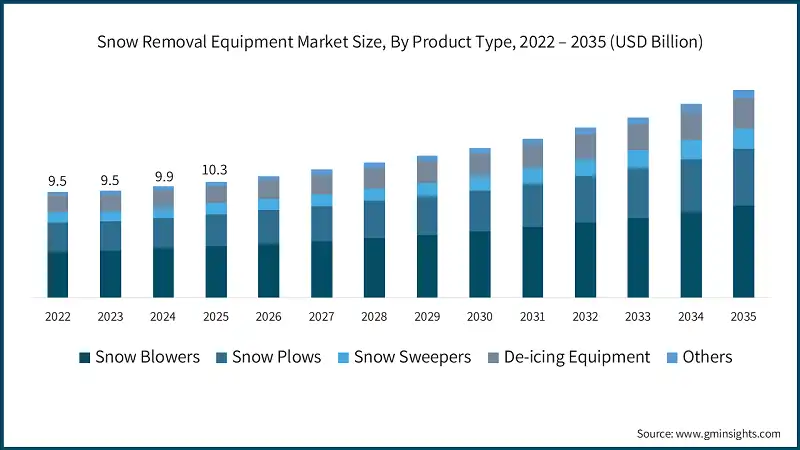
Based on product type, the market is divided into snow blowers, snow plows, snow sweepers, de-icing equipment and others. In 2025, snow blowers held the major market share, generating a revenue of USD 4.6 billion.
- A snow blower is a winter-maintenance machine that helps users clear snow quickly and effectively from their driveways, sidewalks, parking lots, and other areas of their property. Snow blowers are powered by electricity or gas engines and use a series of augers to lift and throw snow away from your work area. Snow blowers also provide quick and easy access to areas of your property during many winter conditions. For all these reasons, snow blowers are often the most popular choice for residents and businesses located in areas with regular snowfall.
- Snow blowers are available in three basic formats: single stage, two stage, and three stages. Each will provide different levels of performance depending on the type of snowfall/treatment needed on the area to be cleared. Single-stage snow blowers are smaller and are best for clearing small, paved areas (driveways, sidewalks) Only two stage and three stage units can have the capability to clear a larger/wider area with a heavier/deeper/compact snow load combined with higher power levels. Snow blowers today have many great features that make using them very easy, including an electric starter, adjustable chute, warm grip handles, better traction, and other user-friendly improvements.
- Snow blowers have seen advances over the last few years in the power supply and design features. Many users prefer gas-powered units because of their durability; however, battery and hybrid models are becoming increasingly attractive due to their lower noise levels, reduced emissions and more affordable maintenance needs. In addition, improvements in design features, including lightweight frames, increased balance and more intuitive controls, allow for easier operation by a more diverse group of users. These developments highlight the increase in efficiency, convenience and sustainability of winter clearing equipment.
Learn more about the key segments shaping this market
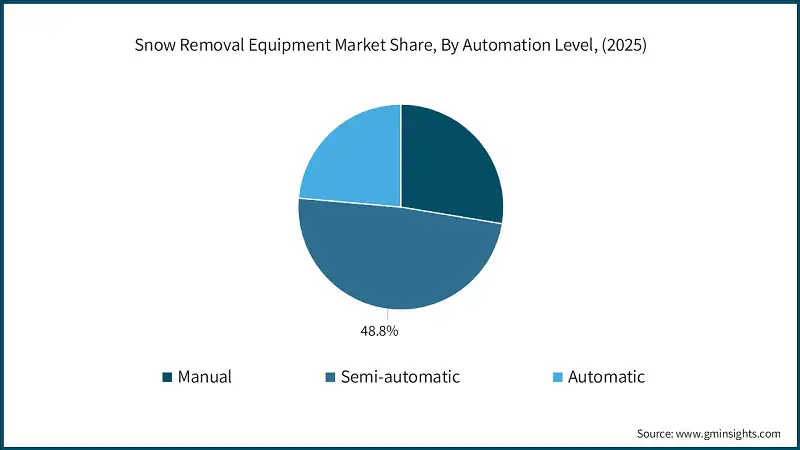
Based on automation level, the snow removal equipment market is segmented into manual, semi-automatic and automatic. The semi-automatic segment held the largest share, accounting for 48.8% of the global market in 2025.
- Semi-automatic automation refers to systems where the machine operates independently at times but will still require the operator for all decisions, oversight, and any final setup of the main control inputs. This does not eliminate the requirement for the operator; however, it decreases the amount of manual effort from a repetitive task, enabling them to apply their time to other more positive tasks. Semi-automatic systems are usually suitable for industries when all tasks cannot be automated, or a person's judgement would add to the benefit of the task being performed.
- With semi-automated systems, the machine will perform many of the operations associated with automation speed adjustments, path corrections, load sensing, etc. without need of the operator's assistance, except for the initiation and ability to supervise the operation. With the use of sensors, basic control algorithms, and other assistive devices, these automated functions operate in a highly consistent manner and reduce operator fatigue. Semi-automatic systems also provide operators with an opportunity to become accustomed to the digital interface and use partially automated systems before providing them with higher levels of autonomy.
- Semi-automatic methods of automation typically rely on 3 main advantages; reliability, savings, and adaptability, as opposed to the complexity of fully automated systems including regulation and overall architecture risks. The semi-automatic model is typically a great middle ground between high automation levels and human control, allowing for improved performance and safety outcomes while providing human control over varying and/or unpredictable climates. With continuous improvement within technologies, increasing levels of Intelligent features will continue to allow for greater similarity to higher automation levels while remaining accessible and easy to use.
Based on distribution channel, the snow removal equipment market is segmented into direct sales and indirect sales. In 2025, indirect sales segment held a major market share, generating a revenue of USD 7.3 billion.
- The indirect sales channel greatly enhances the sale of snow removal equipment by allowing manufacturers to expand their market reach via distributors, dealers, retail outlets and e-commerce channels. Indirect sales allow manufacturers to reach customers that they may not otherwise be able to reach directly. In addition to providing local access to products, indirect sales also provide after-sales support and advice to customers on which products to purchase based on their individual winter usage needs. The indirect sales channel are also beneficial in areas where winter weather conditions and snow removal demand vary greatly throughout the season. Distributors that utilize the indirect channel can manage their inventory levels at peak demand and get products to end users quickly when needed.
- Indirect sales channels do more than increase the size of a market; they also improve a customer’s experience by allowing customers to view products through demonstrations, obtain financing options, purchase spare parts, and receive maintenance support. Dealers and retail partners create and maintain long-term relationships with municipalities, commercial and institutional customers, and residential customers to assist each sort of customer with selecting the right type of equipment and configuration. The way this relationship approach increases the brand's visibility and builds customer loyalty allows manufacturers to concentrate on innovations and product development while not managing all sales locations directly.
Looking for region specific data?
North America Snow Removal Equipment Market
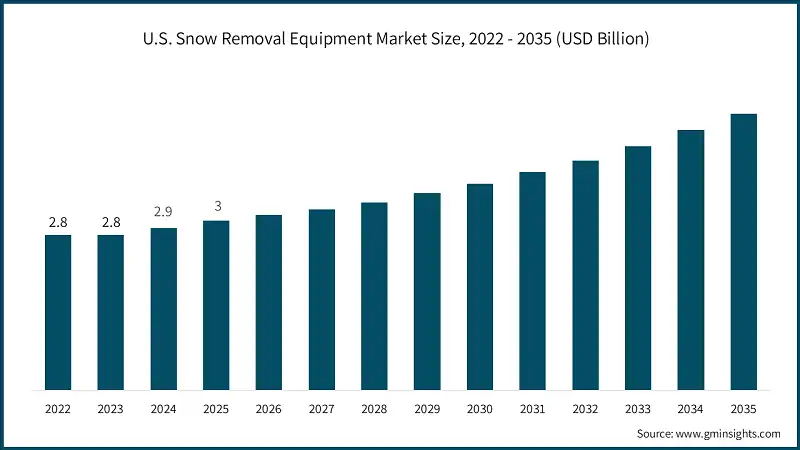
In 2025, the U.S. dominated the North America market, accounting for around 74.6% and generating around USD 3 billion revenue in the same year.
- The distribution of snow removal equipment throughout the U.S. reflects the wide range of climatic conditions in our country. In the Midwest and Northeast, we experience significant lake-effect snow with higher amounts of snowfall, while the Mountainous Region and Areas in the Northern States generally have light but still significant snowfall that requires the use of a snow blower to clear their paths. The demand for snow removal equipment is steady across all customer segments: municipal, commercial operator, and homeowner. The demand stems from the need for municipal customers to use power; because they are underfunded, they typically have limited funds available to build up their fleet of snow clearing equipment.
- The emerging trends of a faster response to extreme winter weather, improved road safety, and increased reliance on technology are driving municipal customers to invest in modern snow clearing equipment such as snow blowers, snow plows, and sophisticated tools for clearing snow from roads. Additionally, as more consumers become aware of their carbon footprint and place greater emphasis on sustainability, it is not surprising that there is an increased interest in battery-powered and other low-maintenance snow clearing equipment.
- A wide range of climate in North America brings an expanding snow removal equipment industry and increasing winter maintenance needs throughout the U.S. and Canada. With many areas experiencing long, cold winter months, municipalities and industries have begun investing in larger capacity machines for the snow-removal process, while residential and suburban areas typically purchase more compact and efficient snow-removal equipment. However, due to an increased emphasis on infrastructure sustainability and operational efficiencies, many municipalities are purchasing snow-removal machines that incorporate a variety of advanced technologies aimed at increasing equipment performance, improving operator ergonomics, and providing for various configurations of the snow-removal machine.
Europe Snow Removal Equipment Market
Europe market held the largest market share of 43% in 2025 and is expected to grow at 5.9% during the forecast period.
- The snow removal machinery market in Europe is a result of many different winter conditions across the continent. There are areas with extreme levels of winter precipitation such as the Nordic countries, the Alps and Eastern Europe, while areas centrally and westerly experience sporadic or light winter precipitation. This variation in climates results in a mixed demand environment across Europe, where many municipal authorities are heavily dependent upon high-capacity municipal equipment, while other municipalities are more reliant on compact, flexible snow-removing equipment for residential houses and commercial buildings. The increasing emphasis on safety on the road and winter preparedness have contributed to the growing attractiveness of investing in upgraded, dependable fleets by municipalities.
- The emphasis on sustainable development and operational efficiency is also beginning to define the European market. Increasing interest in low-emission, electric and hybrid technological solutions, and compliance with municipal noise restrictions, are all contributing factors to the growing number of manufacturers who develop region-specific products that meet safety and performance standards. The modernization of urban infrastructure, coupled with an ever-increasing mobility requirement, is further driving interest in adopting new snow-removal technologies.
Asia Pacific Snow Removal Equipment Market
The Asia Pacific held market share of around 12.4% in 2025 and is anticipated to grow with a CAGR of around 6.4% from 2026 to 2035.
- Extreme climatic variation has an impact on the snow removal equipment industry within the Asia-Pacific region. For example, northern and high-altitude regions such as: northern China; Japan; southern Korea; etc. consistently receive winter snowfall, resulting in a continuing need for snow blowers, plows, and compact vehicles designed for narrow city streets and congested urban areas. Moreover, regional tourism surrounding the ski industry or the existence of mountain transportation needs requires that consistent access can be maintained to these areas with durable snow removal products throughout the winter months.
- As cities become more densely populated, many cities and businesses are beginning to use machines instead of human workers to remove snow. With the introduction of user-friendly machines and upgrading equipment with technology, these machines have gained popularity among both professionals and individuals. The demand for snow-removal equipment is high in many areas of the country, but as the economy continues to improve and more people become aware of the importance of winter safety, there will be an even broader market for snow-removal equipment across Asia-Pacific (APAC).
Latin America Snow Removal Equipment Market
Latin America market is growing at a CAGR of 6.3% during the forecast period.
- The market in LATAM is mainly concentrated in areas with colder climates such as southern Chile and Argentina, and cities located at high altitude in the Andes. Customers in these regions require equipment that is heavy-duty, reliable, and able to handle their heavy snowfall during weekends as well as during peak ski season. Many customers are also looking to have equipment that can access remote mountain communities as well as be able to provide a link for ski resorts to transport skiers and other tourists to their locations. As a result, companies focus on manufacturing high-quality durable equipment that can provide superior performance in extreme conditions, including steep inclines and quick changing weather.
- Expansion of winter tourism and the development of infrastructure within cold weather belts, and the increasing awareness of the advantages of mechanized snow removal versus manual snow removal has resulted in gradual market growth opportunities as the overall demand is relatively low in relation to North America and Europe. Municipalities, hospitality companies and transportation providers are all increasingly investing in the development of reliable, user-friendly equipment, which will allow for more extensive access to a wide variety of product options and the ability to develop equipment specifically designed for the rugged winter climates found throughout the region.
Snow Removal Equipment Market Share
Toro Company is leading with 11% market share. Toro Company, Ariens Company, EGO Power+, Husqvarna, and Greenworks collectively hold around 25%, indicating moderately fragmented market concentration. These prominent players are proactively involved in strategic endeavors, such as mergers & acquisitions, facility expansions & collaborations, to expand their product portfolios, extend their reach to a broad customer base, and strengthen their market position.
Toro snow removal machines are recognized for being reliable, long-lasting products, yet also easy to use, which makes them attractive to both homeowners and commercial operators alike. Toro emphasizes the ability of its snow removal machines to provide excellent snow clearing power to customers in a compact, easy-to-move snow removal machine. Many Toro snow removal machines have ergonomic controls and have easy-to-use start features. Toro snow removal machines are usually sought after by customers who need reliable equipment with minimal maintenance that can perform well in a variety of winter environments.
Ariens makes heavy-duty snow blowers that are built for strength and durability. The brand is popular among both residential and commercial customers for its snow removal machines' ability to handle deep, heavy, and repeated snowfall. Ariens snow removal machines are typically recognized for having good traction, wide clearing widths, and for having components that are made for the rigors of winter. Therefore, they are a popular choice for customers who live in regions affected by a lot of snow.
Snow Removal Equipment Market Companies
Major players operating in the snow removal equipment industry are:
- Ariens Company
- BOSS Snowplow
- EGO Power+
- Greenworks
- Husqvarna AB
- Kobalt
- Kobi
- Makita
- Roborock
- Simplicity
- Snoquip
- Snow Joe + Sun Joe
- Stanley Black & Decker
- Techtronic Industries - TTI
- Toro Company
Simplicity's emphasis on uncompromised quality and performance together with comfort provides customers with snow removal equipment that not only works well but that also has a high level of reliability and superior components. Snow removal equipment manufactured by Simplicity delivers a uniform snow clearing performance while offering a user-friendly operation. Nowhere is this importance on ease of use more important than in residential environments where user comfort plays an important role in making good choices when purchasing new equipment.
EGO Power+ has quickly established itself as a leader among other companies in the snow removal industry by producing battery-operated snow blowers as an eco-friendly alternative to traditional gas-powered machines. These cordless machines provide the user with a great deal of conveniences that appeal to homeowners looking for environmentally sustainable, modern solutions for weekly snow clearing throughout the winter months. Additionally, EGO Power+’s unique platform for batteries allows users to use the same batteries across different tools, providing additional versatility and sustainability benefits.
Snow Removal Equipment Market Report Attributes
| Key Takeaway | Details |
|---|---|
| Market Size & Growth | |
| Base Year | 2025 |
| Market Size in 2025 | USD 10.3 Billion |
| Market Size in 2026 | USD 10.8 Billion |
| Forecast Period 2026 - 2035 CAGR | 6.1% |
| Market Size in 2035 | USD 18.4 Billion |
| Key Market Trends | |
| Drivers | Impact |
| Increasing snowfall & extreme weather conditions | Therefore, there will be an increase in demand for durable, high-capacity snow removal equipment, with purchasers emphasizing rapid clearing; this has been seen due to the increase in severe weather events. |
| Urbanization & infrastructure expansion | Additionally, the expanding road networks, commercial areas, and dense residential areas will drive the need for effective equipment to clear snow. |
| Rising safety & accessibility requirements | The investments into more efficient equipment to clear snow quicker and more completely is driven largely by stricter safety standards and increased expectations for an American ADA compliant. |
| Pitfalls & Challenges | Impact |
| Seasonal dependency & revenue volatility | Manufacturers and contractors face unpredictable sales cycles, leading to inconsistent demand levels each year. |
| Performance limitations in extreme cold | The performance of engines, batteries, and electronics is compromised in terms of reliability due to lower operating efficiencies and shorter service lives caused by extreme conditions. |
| Opportunities: | Impact |
| Lithium‑battery powered & fully automated snow blowers | The development of low-maintenance, quieter, and more environmentally friendly options that require less labor to maintain is progressing rapidly. |
| Smart, connected snow equipment | Utilizing features of remote monitoring, route optimization, diagnostics, and real-time performance tracking, Operational Efficiency is increased. |
| Market Leaders (2025) | |
| Market Leaders |
11% market share |
| Top Players |
|
| Competitive Edge |
|
| Regional Insights | |
| Largest market | Europe |
| Fastest growing market | Middle East & Africa |
| Emerging countries | France, Japan, UAE |
| Future outlook |
|
What are the growth opportunities in this market?
Snow Removal Equipment Industry News
- In November 2025, Boss Snowplow product managers will roll out a redesigned Trip Edge V-Plow in with a stronger cutting-edge reinforcement, an upgraded trip mechanism designed to absorb impacts, and mounting geometry changes designed to expedite attachment of the trip edge plow. Boss Snowplow product managers will also introduce the new Boss Cold Front product line which has improved hydraulic response speed and wing angle performance due to the use of better hydraulic components than used in previous products.
- In October 2025, Ariens Company upgraded several of its snow product engines before the winter with enhanced torque stability, upgraded fuel tank capacities, cold-start performance improvements, and easier engine service due to standardized engine components. Ariens’ Hydro Power Brush 36 will soon feature an upgraded 301 cc engine that enhances load-handling capabilities as well as delivers greater efficiency when used for more extreme Winter applications.
- In September 2025, Makita announced a new cordless snowblower model powered by a 40-volt battery pack with a clearing width of 530 mm (21 inches), an intake height of 300 mm (11.8 inches), a high output brushless DC electric motor that can produce a maximum output of 2100 RPMs, electric chute rotation with 180-degree chute rotation control, and nine different positions to adjust the discharge angle, plus integrated LED lights.
- In February 2025, Makita has unveiled a 12" snow shovel attachment for their Power Head range of snow shovels, which has a clearing width of 12 inches, an intake depth of 6 inches, ranges up to 30 feet in throwing distance, adjustable angle of discharge as well as a steel shaft that provides the longevity needed to withstand harsh winters, and is compatible with multiple 40-volt and 18-volt power heads.
- In 2025, Toro introduced a 26" Two Stage Snow Blower Model with a 252cc engine, 20" intake height; 6 forward and 2 reverse speeds; 26" cleaning width; trigger-free steering; anti-clog intake system; heated handles; LED lights; and reinforced steel chute assembly.
The snow removal equipment market research report includes in-depth coverage of the industry with estimates & forecasts in terms of revenue (USD Billion) & volume (Thousand Units) from 2022 to 2035, for the following segments:
Market, By Product Type
- Snow blowers
- Snow plows
- Snow sweepers
- De-icing equipment
- Others
Market, By Power Source
- Battery-powered
- Lithium-ion battery powered
- Lead-acid battery-powered
- Nickel-based battery-powered
- Others (sodium-ion batteries, etc.)
- Gas-powered
- Electric corded
- Hybrid gas-electric
Market, By Application
- Residential/household
- Commercial
- Municipal/government
Market, By Automation Level
- Manual
- Semi-automatic
- Automatic
Market, By Distribution Channel
- Direct sales
- Indirect sales
The above information is provided for the following regions and countries:
- North America
- U.S.
- Canada
- Europe
- Germany
- UK
- France
- Italy
- Spain
- Asia Pacific
- China
- India
- Japan
- Australia
- South Korea
- Latin America
- Brazil
- Mexico
- Argentina
- Middle East and Africa
- South Africa
- Saudi Arabia
- UAE
Frequently Asked Question(FAQ) :
What is the market size of the snow removal equipment market in 2025?
The global market for snow removal equipment was valued at USD 10.3 billion in 2025, driven by increasing snowfall variability, extreme winter weather events, and rising safety and accessibility requirements across urban and commercial infrastructure.
What is the projected value of the snow removal equipment market by 2035?
The market is expected to reach USD 18.4 billion by 2035, growing at a CAGR of 6.1% from 2026 to 2035, supported by urbanization, infrastructure expansion, and adoption of advanced and automated snow-clearing technologies.
What will the market value of the market in 2026?
The market is projected to reach USD 10.8 billion in 2026, reflecting steady demand growth from municipal, commercial, and residential end users.
Which product type segment generated the highest revenue in 2025?
Snow blowers dominated the market, generating USD 4.6 billion in revenue in 2025, due to their versatility, ease of operation, and widespread adoption across residential and commercial applications.
Which automation level segment leads the market?
The semi-automatic segment led the market with a 48.8% share in 2025, as it offers a balance between operator control, efficiency, and cost-effectiveness.
Which region leads the snow removal equipment market?
Europe held the largest market share at 43% in 2025, supported by stringent winter safety regulations, well-established municipal infrastructure, and high adoption of advanced snow management equipment.
Who are the key players in the snow removal equipment market?
Major players include Toro Company, Ariens Company, EGO Power+, Husqvarna AB, Greenworks, BOSS Snowplow, Makita, Snow Joe + Sun Joe, Stanley Black & Decker, and Techtronic Industries.
Snow Removal Equipment Market Scope
Related Reports