Summary
Table of Content

Smart Rings Market
Get a free sample of this report
Form submitted successfully!
Error submitting form. Please try again.
Thank you!
Your inquiry has been received. Our team will reach out to you with the required details via email. To ensure that you don't miss their response, kindly remember to check your spam folder as well!
Request Sectional Data
Thank you!
Your inquiry has been received. Our team will reach out to you with the required details via email. To ensure that you don't miss their response, kindly remember to check your spam folder as well!
Form submitted successfully!
Error submitting form. Please try again.
Smart Rings Market Size
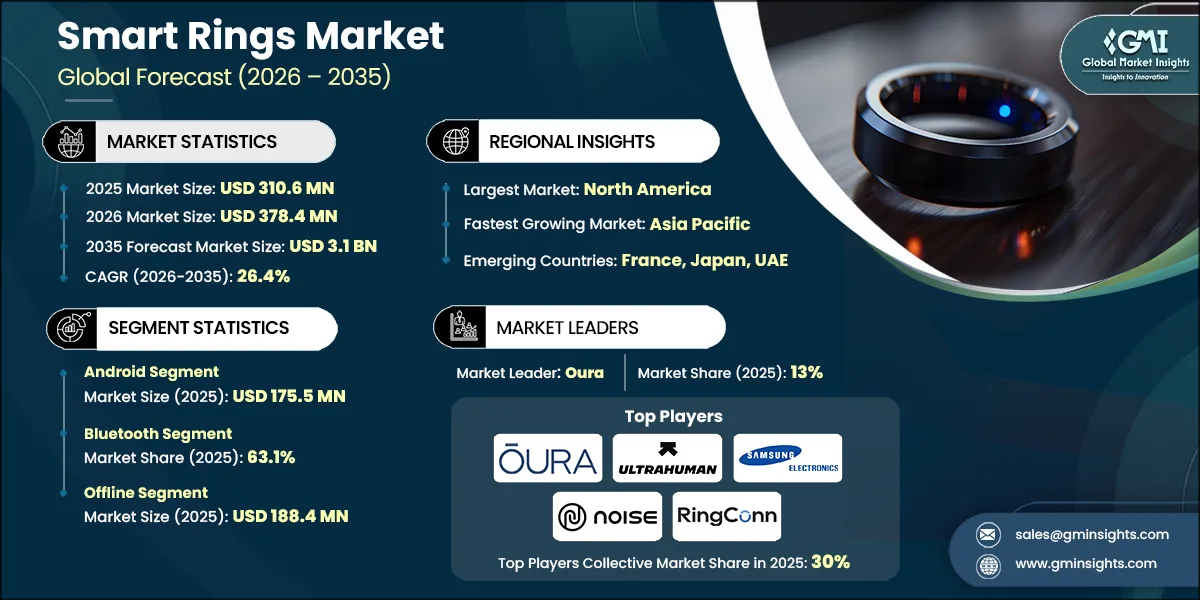
The global smart rings market size was estimated at USD 310.6 million in 2025. The market is expected to grow from USD 378.4 million in 2026 to USD 3.1 billion in 2035, at a CAGR of 26.4% according to latest report published by Global Market Insights Inc.
To get key market trends
The growing demand for personal wellness supplements and the increased interest in wearable technologies to continuously monitor our health and fitness levels is causing a change in how we live our lives and therefore the way consumers choose to spend their money. As such, smart rings represent an answer to this demand by allowing users to track their heart rate, sleep quality, and blood oxygen levels in a fashion that is discreet and easy enough to wear daily. Unlike traditional Wearables, smart rings provide users with a hybrid of ease of use and convenience associated with fitness devices and the more advanced medical capabilities associated with technology, thereby enabling consumers to proactively manage their health without sacrificing any aspect of the way they want to present themselves personally.
Additionally, the increased prevalence of consumers who are struggling with the ill effects associated with inactive lifestyles has further increased the urgency associated with a shift toward being initiative-taking in managing one's health using real-time data. The COVID-19 pandemic has increased the need for remote medical monitoring types of technologies, which demonstrate the importance of being able to have access to current and relevant information to maintain healthy lifestyles. Further integration of smart rings into consumers' daily lives is possible due to the expectation of users that smart ring apps provide users with access to analytical insight and recommend customized wellness-affecting changes based on the data collected from smart rings. The growth of the smart ring market has become a viable business model since the perspective that wellness is becoming an established way of living instead of a passing fad will only allow the smart ring market to continue its expansion from a more grounded perspective.
The rapid advances in sensor technology and power efficient electronics have had a significant impact on the growth of the smart ring market. The new generation of sensors include advanced types of photoplethysmography, accelerometers and temperature sensors that can now be miniaturized with no drop-off of accuracy, thereby making it possible to fit these sensors into an apollo space capsule size product. These advances in sensor size combined with enhancements to Bluetooth and NFC technologies allow a smart ring to provide a truly seamless experience for health monitoring, contactless payment and smart home control.
In addition, through the implementation of ML/AI technologies, smart rings will also provide increased value to customers since users will benefit from the predictive analysis of their health and be able to receive targeted insights. Companies today are focusing on using more durable and comfortable materials to create a higher-quality product that can withstand daily usage.
Smart Rings Market Report Attributes
| Key Takeaway | Details |
|---|---|
| Market Size & Growth | |
| Base Year | 2025 |
| Market Size in 2025 | USD 310.6 Million |
| Market Size in 2026 | USD 378.4 Million |
| Forecast Period 2026-2035 CAGR | 26.4% |
| Market Size in 2035 | USD 3.1 Billion |
| Key Market Trends | |
| Drivers | Impact |
| Rising health and wellness awareness | As people become increasingly aware of maintaining good health and fitness, they are increasingly interested in purchasing smart rings to help them track their health metrics such as heart rate, sleep quality, and stress levels. |
| Technological advancements | Advancements in sensor technology, AI, and low-power wireless communications have allowed smart rings to be used for multiple applications, making them true health-tracking devices. |
| Smartphone ubiquity | Inherent compatibility with existing digital ecosystems has led many tech-savvy consumers to perceive smart rings as desirable additions to their collections of personal electronic devices. |
| Pitfalls & Challenges | Impact |
| High cost of ownership | Due to the subscription fees associated with smart rings, the relatively high retail price of smart rings will likely restrict their availability to consumers on a limited budget, therefore limiting access to a growing number of consumers looking to purchase wearable technology in price-sensitive markets. |
| No display feedback | Increasing customer expectations for individualized, quality delivery of products and services will create competition among businesses, increasing the need for companies to develop programs that cultivate consumer loyalty and create engaging customer experiences. |
| Opportunities: | Impact |
| Contactless payments & authentication | Smart rings utilize NFC technology to create new possibilities for secure payments & identity verification as they become versatile tools for both personal and corporate use. |
| AI-driven personalized insights | Smart Rings are equipped with AI to provide personalized health recommendations, predictive analysis and message interpretation based on user input as part of the total wellness ecosystem. Personalization of data improves user engagement in the wellness ecosystem and increases the value proposition of smart rings through unique offerings. |
| Market Leaders (2025) | |
| Market Leader |
13% market share |
| Top Players |
The collective market share in 2025 is 30% |
| Competitive Edge |
|
| Regional Insights | |
| Largest market | North America |
| Fastest growing market | Asia Pacific |
| Emerging countries | France, Japan, UAE |
| Future Outlook |
|
What are the growth opportunities in this market?
Smart Rings Market Trends
The smart ring market is changing rapidly because of the merging of health monitoring, connection to other devices, and personalization of lifestyle. Smart rings are no longer just for fitness tracking; they have advanced sensors, enable payments and allow people to control their homes through smart devices. Consumers want stylish, discreet wearables, and the growing trend towards preventive healthcare is a large influence on how these products are developed. Advances in technology, including smaller sensors, new ways of connecting devices and improved ability to use AI technology, are creating more and more options for how smart rings will function within the larger ecosystem of wearable technology.
- Smart rings are becoming increasingly recognized as sophisticated health companions instead of simply basic fitness trackers. These devices can track a number of important metrics including heart rate variability, sleep stage, blood oxygen levels and stress levels. As the world continues to shift toward a greater emphasis on preventive care and individualized health, consumers want to use these devices to gain insights into their lifestyle behaviors, to improve their health and to find potential red flags prior to the onset of an illness. Smart rings allow users to continue to do what they normally do while wearing a ring, thereby providing for continual monitoring of their health without interrupting their daily activities unlike bulky smartwatches.
- The number of people using NFC-enabled smart rings for contactless payments and secure authentication is increasing. These types of smart rings enable users to make purchases, unlock devices, and enter restricted areas without having to use their cards or smartphones, thus providing convenience and increased security. As cashless economies continue to emerge around the world, smart rings also offer a unique alternative to traditional payment methods and digital identity solutions. For businesses, smart rings will allow them to implement multi-factor authentication as a means of decreasing their dependence on passwords while increasing their ability to maintain cybersecurity.
- Artificial Intelligence is changing the way users interact with their smart ring devices. With the use of Machine Learning algorithms, smart rings can move beyond passive data collection and become active health consultants for users. By studying their users’ behavior patterns and physiological measurements, smart rings will provide their users with individualized recommendations about sleep, identifying abnormal heart rates, or predicting when a user may feel stressed. The customized recommendations that come from the use of smart rings enhance user engagement and establish smart rings as valuable components of a business’s overall health management strategy.
- Smart rings are becoming the latest trend of being seen as jewelry. To attract customers who consider style when purchasing products, many manufacturers are using higher-end materials titanium, ceramic, and gold-plated options to create a premium feel. Through partnerships with luxury designers and adding customization options to their smart ring designs, these manufacturers have developed a growing segment of technology products that provide consumers with an aesthetically pleasing product while still being functional. In addressing the need for wearable technology to be appealing in terms of style, smart rings remove one of the largest barriers for consumers that prevents them from adopting wearable technology.
Smart Rings Market Analysis
Learn more about the key segments shaping this market
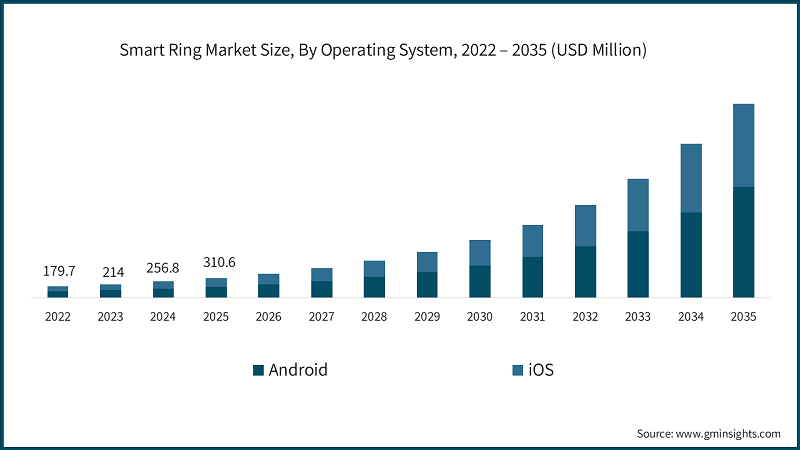
Based on operating system, the market is divided into day Android & iOS. In 2025, Android held the major market share, generating a revenue of USD 175.5 million.
- Android plays a leading role in making it easier for companies to create applications that work together with smart rings. Smart rings can connect and communicate with several types of devices and therefore require it to be compatible with most of them for optimal usage. Because of Android's many applications, manufacturers who want to reach as many potential customers as possible will consider building their smart rings to collaborate with Android.
- Due to Android's open-source model, many manufacturers can continuously add features and functions, keeping their products fresh and providing an opportunity for customers to further customize their smart rings. Smart ring manufacturers take advantage of this by using Android APIs to connect their products to other devices via Bluetooth Low Energy (BLE), accept payments using Near Field Communication (NFC), and sync with Google fit users' health information.
- As such, Android provides manufacturers with the ability to produce more versatile products; this is especially true now since owners of smart rings can use them in many different environments, giving them complete control of their data. Smart rings offered on the Android platform can also be enhanced through the continued use of third-party applications. This capability provides users of smart rings with the opportunity to monitor other parts of their lives. In addition, developing this capability ensures that users of smart rings can remain connected, as well as allowing them to use these products for reasons involving IoT.
Learn more about the key segments shaping this market
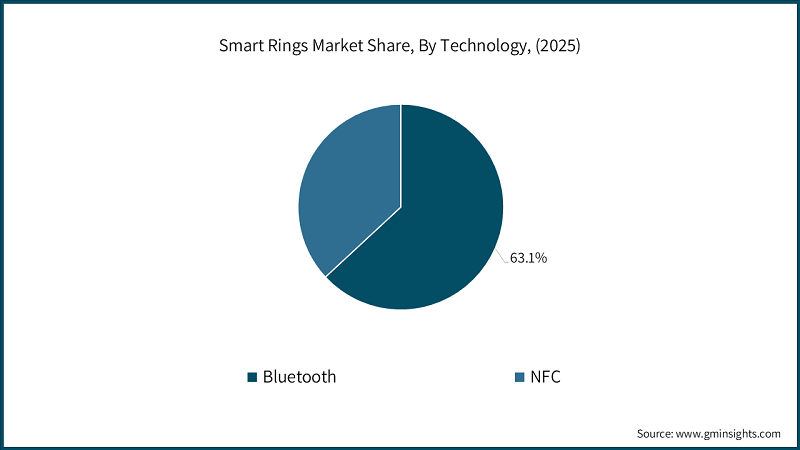
Based on technology, the smart rings market is segmented into Bluetooth and NFC. The Bluetooth segment held the largest share, accounting for 63.1% of the global market in 2025.
- The technology that allows a smart ring to operate is Bluetooth, connecting the ring to other companion devices like smartphones, tablets or IoT systems. Most smart rings are designed around the Bluetooth Low Energy (BLE) protocol that facilitates fast data transfer at exceptionally low power which is important because of the small batteries needed to fit into a ring. This connectivity gives users the ability to sync their health stats, get notifications, and control their smart home devices, all of which can be done without physically touching anything, so Bluetooth has become an essential component of the smart ring ecosystem.
- The introduction of Bluetooth Low Energy (BLE) technology into Smart Rings has greatly improved the end-user experience through dependable and low-latency connectivity as well as extended battery life. BLE allows smart rings to continuously send and receive data without using a lot of energy. This allows for features such as real-time health monitoring, gesture-based controls and other functions that utilize continual data exchange. Additionally, Bluetooth's compatibility with both Android and iOS devices provides a wide range of market access and eliminates barriers for customers to purchase smart rings, as many manufacturers will innovate to offer cross-platform products. The interoperability of BLE smart rings with other devices is a leading factor in the mass adoption of those products by users.
- Bluetooth is not simply a way to connect different devices; it is a key building block in helping expand the capabilities of smart rings. Bluetooth's continuing trend toward low power, always-on operation allows for many smart ring applications to gain added functionality, such as remote login or sensor data collection, and it opens up opportunities for advanced features like gesture control, continuous fitness tracking and seamless integration into the smart home ecosystem. In the future, Bluetooth's ongoing technical improvements will enable smart rings to transfer data faster, be able to work with more than one device at the same time and provide a richer user experience. Bluetooth represents a key driver in the development of future versions of smart rings, making them more efficient and better able to support a variety of uses in the connected world.
Based on distribution channel, the smart rings market is segmented into online and offline. In 2025, offline segment held a major market share, generating a revenue of USD 188.4 million.
- Retail outlets, including brick-and-mortar stores, specialty electronics retailers and brand-specific showrooms, play an essential role in promoting the use of smart rings. Providing customers with the opportunity to interact directly with products allows them to assess the appearance, feel and quality of their smart rings, all of which are critical factors for successful use of wearable electronics. By demonstrating products in-store and providing in-store consultations, stores can help alleviate skepticism about new products and build customer confidence in them. Stores provide manufacturers with essential visibility for their brand while catering to consumers who choose to shop traditionally.
- Premium positioning and upselling can be achieved by offline channels as a strategic platform. High-end smart rings are often marketed to those with a focus on fashion and technology, who prefer exclusivity and personalized service over mass-market products. Physical stores can provide those types of services by utilizing curated displays and luxury retail environments. In addition, offline distribution encourages impulse buys while enhancing the potential for cross-selling complementary products. With the increasing popularity of smart rings in emerging markets, partnering with established electronics retailers and lifestyle boutiques will enhance both access and confidence among consumers, which will drive growth in the overall business opportunity.
Looking for region specific data?
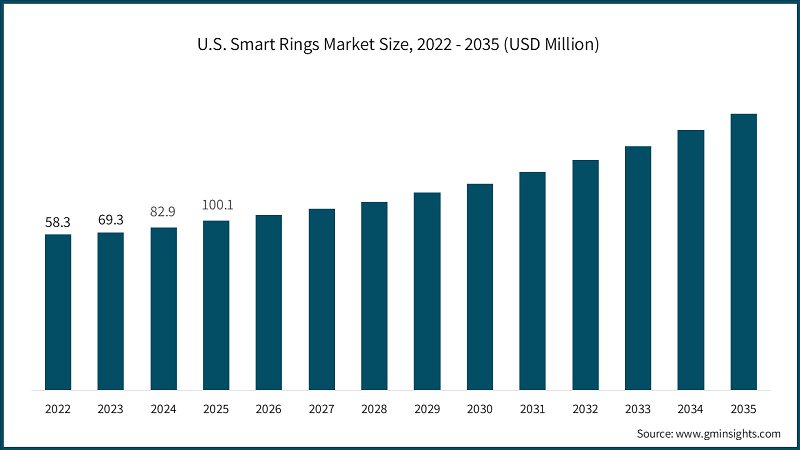
North America Smart Rings Market In 2025, the U.S dominated the North America market, accounting for around 80.1% and generating around USD 100.1 million revenue in the same year. Europe market held 30.4% share in 2025 and is expected to grow at 23.5% during the forecast period. The Asia Pacific held market share of around 21.8% in 2025 and is anticipated to grow with a CAGR of around 25.4% from 2026 to 2035. Latin America market is growing at a CAGR of 24.5% during the forecast period. Oura is leading with 13% market share. Oura, Ultrahuman, Samsung Electronics, Noise and RingConn collectively hold around 30%, indicating moderately fragmented market concentration. These prominent players are proactively involved in strategic endeavors, such as mergers & acquisitions, facility expansions & collaborations, to expand their product portfolios, extend their reach to a broad customer base, and strengthen their market position. Circular is a French- based Company, innovating the smart ring sector, utilizing health and lifestyle optimization through cutting edge technology and an attractive design. Circular rings include many different sensors to record heart rates, track sleep quality and measure activity levels combined with AI driven insights using the Circular App. In contrast to their competitors, Circular has placed a major focus on personalization; it also does not charge for a subscription. Therefore, it is very appealing to customers who want the best possible features without having to pay for subscriptions on a regular basis. The company’s minimalist and sleek aesthetic combined with user-centric design has positioned it well within the European and International marketplace. Noise is one of the leading wearable brands in the Indian market. The company has launched its Luna Ring, a smart ring product, to cater to the health and technology-savvy consumers in the country. The brand has established a reputation for providing stylish and affordable products, along with the additional capabilities of sleep analysis, heart rate monitoring, and activity tracking through the use of its app, which provides users with the ability to interpret their health data and act. Noise's extensive distribution network, along with its competitive pricing, positions it as a significant player in helping drive wearable technology adoption in emerging market. Major players operating in the market are: Samsung Electronics' Galaxy Ring was an important event in the market for smart rings. The ring is intended to fit within the larger Galaxy ecosystem of products offered by Samsung and include ways to monitor health such as sleep tracking and heart rate monitoring, as well as to work with Samsung Health, which will provide Android users with seamless experience. In addition to this integration, Samsung offers a wide range of premium-brand products, as well as the latest in technology, giving them an advantage over their competition by having a global reach through their marketing strategy. By providing an integrated ecosystem for users and innovative product designs, Samsung is likely to lead the smart ring marketplace. Amazfit have transferred some of the expertise gained through the manufacture of those products into creating a new category of wearable technology; namely, a smart ring with features designed to assist users in tracking both physical exercise and their overall health status. The Rings use an app (the Zepp application) that integrates seamlessly with the Rings to collect data for analysis and provide users with a holistic approach to managing health through advanced technology and artificial intelligence-based suggestions. The Rings will benefit from Amazfit's ability to create an environment conducive to effective marketing and selling to numerous markets around the world.
than any other nation. American consumers are often considered to be some of the earliest adopters of innovative fitness devices, and therefore there is a great deal of growth in the introduction and evolving of new smart ring products from several of the world's leading technology firms and start-ups that are focused on this emerging product category.Europe Smart Rings Market
Asia Pacific Smart Rings Market
Latin America Smart Rings Market
Smart Rings Market Share
Smart Rings Market Companies
Smart Rings Industry News
The smart rings market research report includes in-depth coverage of the industry with estimates & forecasts in terms of revenue (USD Million) & volume (Thousand Units) from 2022 to 2035, for the following segments:
Market, By Operating System
- Android
- iOS
Market, By Technology
- Bluetooth
- NFC
Market, By Consumer Group
- Men
- Women
- Unisex
Market, By Price Range
- Low
- Medium
- High
Market, By Distribution Channel
- Online
- E-commerce
- Brand websites
- Offline
- Supermarkets
- Specialty stores
- Others (departmental stores, etc.)
The above information is provided for the following regions and countries:
- North America
- U.S.
- Canada
- Europe
- Germany
- UK
- France
- Italy
- Spain
- Asia Pacific
- China
- India
- Japan
- Australia
- South Korea
- Latin America
- Brazil
- Mexico
- Argentina
- Middle East and Africa
- South Africa
- Saudi Arabia
- UAE
Frequently Asked Question(FAQ) :
Who are the key players in the smart rings market?
Key players include Oura, Ultrahuman, Samsung Electronics, Noise, RingConn, Amazfit, Circular, Garmin, Xiaomi, and Go2Sleep.
Which region leads the smart rings market?
North America dominated the market in 2025, driven by high consumer awareness, strong digital infrastructure, early adoption of wearable technologies, and widespread acceptance of contactless payments.
Which distribution channel generated the highest revenue in 2025?
The offline segment led the market, generating USD 188.4 million in 2025, supported by specialty electronics stores, brand showrooms, and consumer preference for hands-on product evaluation.
Which technology segment leads the market?
Bluetooth technology led the market with a 63.1% share in 2025, driven by low-energy connectivity, real-time data synchronization, extended battery life, and cross-platform compatibility.
What will be the market value of the market in 2026?
The market is projected to reach USD 378.4 million in 2026, reflecting accelerated adoption of next-generation smart rings across health monitoring, lifestyle, and authentication applications.
Which operating system segment generated the highest revenue in 2025?
The Android segment dominated the market in 2025, generating USD 175.5 million in revenue, due to its open-source ecosystem, broad device compatibility, and seamless integration with health and IoT platforms.
What is the market size of the smart rings market in 2025?
The global market was valued at USD 310.6 million in 2025, driven by rising health and wellness awareness, increasing adoption of discreet wearable devices, and advancements in sensor and connectivity technologies.
What is the projected value of the smart rings market by 2035?
The market is expected to reach USD 3.1 billion by 2035, growing at a strong CAGR of 26.4% from 2026 to 2035, supported by AI-driven health insights, contactless payment adoption, and integration with digital ecosystems.
Smart Rings Market Scope
Related Reports