Summary
Table of Content

Smart Inverter Market
Get a free sample of this report
Form submitted successfully!
Error submitting form. Please try again.
Thank you!
Your inquiry has been received. Our team will reach out to you with the required details via email. To ensure that you don't miss their response, kindly remember to check your spam folder as well!
Request Sectional Data
Thank you!
Your inquiry has been received. Our team will reach out to you with the required details via email. To ensure that you don't miss their response, kindly remember to check your spam folder as well!
Form submitted successfully!
Error submitting form. Please try again.
Smart Inverter Market Size
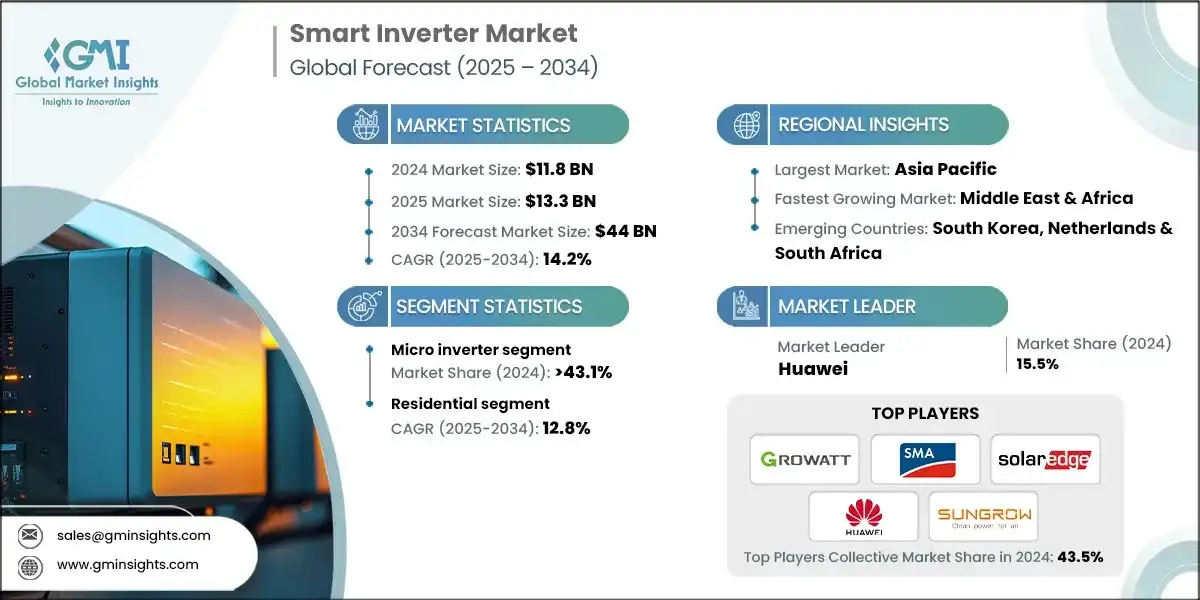
The global smart inverter market was estimated at USD 11.8 billion in 2024. The market is expected to grow from USD 13.3 billion in 2025 to USD 44 billion in 2034, at a CAGR of 14.2% according to Global Market Insights Inc.
Smart Inverter Market Key Takeaways
Market Size & Growth
- 2024 Market Size: USD 11.8 Billion
- 2025 Market Size: USD 13.3 Billion
- 2034 Forecast Market Size: USD 44 Billion
- CAGR (2025–2034): 14.2%
Regional Dominance
- Largest Market: Asia Pacific
- Fastest Growing Region: Middle East & Africa
Key Market Drivers
- Grid modernization initiatives.
- Rising Demand for Energy Independence.
Challenges
- High initial investment costs.
- Technical integration challenges.
Opportunity
- Expansion of smart grids and digital utilities.
- Growth of off-grid and remote energy systems.
Key Players
- Market Leader: Huawei led with over 15.5% market share in 2024.
- Leading Players: Top 5 players in this market include Growatt, SMA Solar Technology, Solar Edge, Huawei, Sungrow, which collectively held a market share of 43.5% in 2024.
Get Market Insights & Growth Opportunities
- Rising investments in grid advancements propel smart inverters' adoption to enhance grid stability by offering advanced functionalities such as voltage regulation, frequency response, and reactive power control. Growing penetration of solar energy fosters product demand as traditional inverters struggle to maintain grid balance and smart inverters can communicate with utility systems and respond dynamically to grid conditions. This helps prevent voltage fluctuations and supports grid resilience during peak demand or disturbances, leading to improve business landscape.
- A smart inverter is an advanced power conversion device used in solar energy systems that not only converts DC to AC but also interacts intelligently with the grid. It supports grid stability, enables remote monitoring, and complies with evolving regulations, making solar systems more efficient, reliable, and responsive to grid demands.
- Emerging companies' rising focus on introducing new product lines is set to influence the industry growth. For instance, in August 2025, MaxVolt introduced its Smart Inverter Series with multiple voltage and power configurations. The series offers three voltage options (12V, 24V, and 48V) and four power specifications (1200W, 3000W, 5000W, and 6200W) to address power requirements across residential, small business, and commercial applications. Additionally, ongoing public-private partnerships among key players are expected to create lucrative opportunities for the product's growth.
- Increasing concerns over energy security, power outages, and rising electricity costs are encouraging consumers to seek greater energy independence. Smart solar inverters, especially when paired with battery storage, enable users to store excess solar energy and use it during peak hours or outages. This capability enhances energy resilience and reduces reliance on the grid, leading to foster the product growth. Additionally, in disaster-prone or remote areas, smart inverters can operate in island mode, providing uninterrupted power. This growing desire for self-sufficiency is a major factor propelling the adoption of smart solar inverter systems.
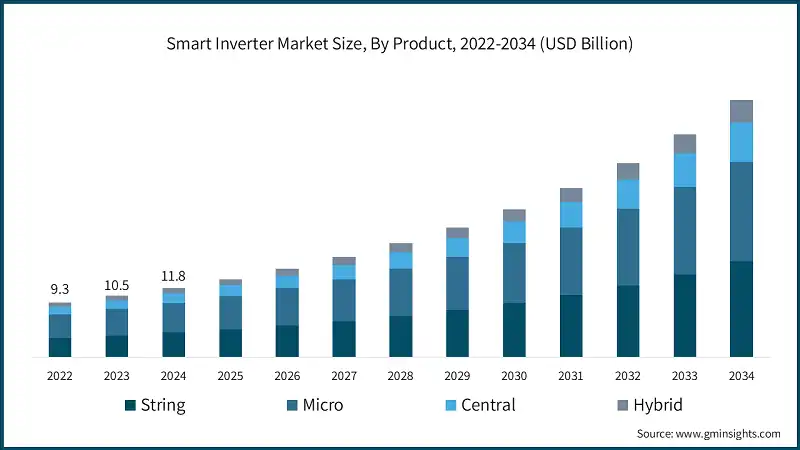
- The smart inverter market was valued at USD 8.3 billion in 2021 and grew at a CAGR of 12.5% through 2024. Governments and regulatory bodies around the world are encouraging the adoption of smart solar inverters through updated standards and financial incentives. Additionally, companies are showcasing their product line in exhibitions to improve their customer targets. For instance, in May 2025, At Intersolar Europe 2025, Solis launched the S6-EH3P hybrid inverter (up to 125kW) for commercial storage and the Solis AI assistant for smart, automated solar energy management across sectors.
- Asia Pacific is among the dominant regions on account of rising countries such as China, India, and Japan investments in smart grid infrastructure to modernize aging power systems and improve energy efficiency. Additionally, government mandates, pilot programs, and funding support are accelerating deployment, especially in urban and industrial areas. These efforts aim to reduce transmission losses, curb electricity theft, and support renewable integration, making smart meters a strategic priority in the region’s energy transition.
- Middle East & Africa is the fastest growing region in the smart inverter market, due to nations' growing shift from fossil fuel dependency to more sustainable energy systems. Smart meters support this transition by enabling efficient energy monitoring, reducing losses, and integrating renewable sources such as solar. Countries such as the UAE and Saudi Arabia have launched national energy strategies that include smart grid rollouts. These meters help utilities manage demand, reduce peak loads, and promote energy conservation key to achieving long-term sustainability and carbon reduction targets.
To get key market trends
Smart Inverter Market Trends
- Growing companies' efforts in integrating smart inverters with energy storage systems to allow users to store excess solar energy for use during peak demand or outages, enhancing energy independence and grid resilience, will complement the product growth. Hybrid inverters, which combine solar and battery management in one unit, are gaining popularity in both residential and commercial sectors. This trend is driven by the growing demand for uninterrupted power supply and the need to optimize self-consumption.
- Increasing companies' efforts in integrating AI & the Internet of Things (IoT) enabled energy management systems in inverters is set to transform the smart inverters into intelligent energy hubs. These technologies enable real-time monitoring, predictive maintenance, and automated energy optimization. Companies such as Huawei, Sungrow are at the forefront in adopting the advanced features. For instance, Huawei's SUN2000 series is the recommended product line for residential and commercial use, offering AI-powered optimization, advanced safety features, and integration with the FusionSolar app for monitoring.
- Furthermore, governments and regulatory agencies worldwide are promoting the adoption of smart inverters through updated grid codes, incentives, and mandatory standards. For instance, many regions now require inverters to have advanced grid-support features and communication capabilities. These regulations aim to ensure grid reliability, enhance consumer protection, and accelerate the transition to clean energy. Standardization also facilitates interoperability between devices and systems, making installations more scalable and cost-effective. Thus, as policy frameworks evolve to support decarbonization and digitalization, regulatory momentum will continue to drive innovation and widespread deployment of smart solar inverters.
- Increasing deployment of large-scale solar projects, particularly in industrial and utility sectors, necessitates smart solar inverters penetration. These projects demand high-capacity smart inverters (20A, 25A and above) capable of handling greater loads with advanced grid integration features. This shift is further driven by the need for cost-effective, scalable, and efficient energy solutions to meet rising electricity demand and sustainability goals, leading to foster the product growth.
- The growing evolution of smart solar inverters from passive devices to active grid citizens drives the product growth. These inverters now support advanced grid services including voltage regulation, frequency control, and demand response. Countries such as Germany and Australia are even considering regulations that require smart inverters to provide such services in exchange for grid access. This shift is crucial for managing decentralized energy systems and ensuring grid stability as renewable penetration increases, thereby improving the business scenario.
Smart Inverter Market Analysis
Learn more about the key segments shaping this market
Based on the product, the industry is segmented into string, micro, central and hybrid. The micro inverter segment accounted over 43.1% market share in 2024 and is expected to grow at a CAGR of 13% through 2034.
- Increasing demand for inverters offering superior energy harvesting and efficiency compared to alternative technology is set to drive micro inverters adoption. In smart solar systems, this panel-level optimization is crucial for maximizing return on investment and ensuring consistent performance across varying conditions. Additionally, these inverters' potential to convert DC to AC at the panel itself, eliminating high-voltage DC wiring across rooftops, uplifts their adoption. This significantly reduces the risk of electrical fires and makes installations safer, especially in residential and school environments.
- The string inverter market will grow at a CAGR of 14.8% through 2034. Growing demand for affordable and simplified inverter technology, especially for medium to large-scale installations, drives string inverters adoption. Their centralized design reduces the number of components, making installation and maintenance simpler and more cost-efficient. This makes them a preferred choice for commercial and utility-scale projects where budget and scalability are critical. Additionally, rising companies' efforts in adopting modern string inverters offering high conversion efficiencies, often exceeding 98.5%, make them highly effective at converting solar energy into usable electricity.
- The hybrid inverter market is expected to reach USD 3.5 billion by 2034, on account of its combination of solar inverter and battery inverter into a single device, allowing users to manage both solar generation and energy storage efficiently. This integration simplifies system design, reduces installation costs, and enhances energy independence by enabling users to store excess solar energy for use during peak hours or outages. It’s especially valuable in regions with unreliable grids or high electricity tariffs.
Learn more about the key segments shaping this market
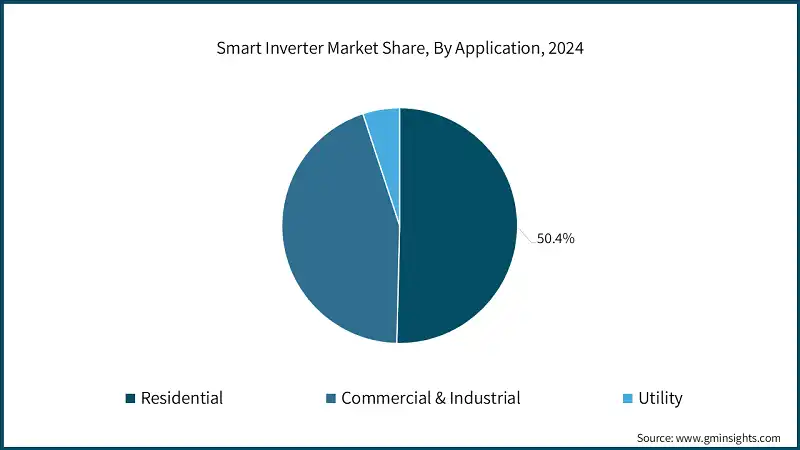
- Rising electricity prices across the developing regions have accelerated the demand for smart technology. According to the U.S. EIA, residential electricity prices rose by 13% from 2022 to 2025, outpacing the general rate of inflation. These rising bills are encouraging homeowners to seek ways to reduce reliance on the grid and lower their electricity bills. Smart inverters enable better self-consumption by optimizing solar energy usage and integrating with battery storage systems. This allows households to store excess solar power for use during peak hours or outages, enhancing energy autonomy. Thus, as energy prices rise globally, this capability becomes even more attractive to residential users, leading to foster the industry scenario.
- Commercial & industrial application is set to grow at a CAGR of 15.2% through 2034, driven by rising energy costs and operational savings. Growing government policies such as the U.S. Inflation Reduction Act (IRA), which offers 30% tax credits for solar projects, significantly reduce payback periods for C&I solar systems, leading to the growth of smart inverters growth. Additionally, global sustainability initiatives such as RE100 and the EU’s Carbon Border Adjustment Mechanism (CBAM) are pushing corporations and their suppliers to adopt renewable energy solutions, including smart inverters, to meet carbon neutrality goals and regulatory compliance.
Looking for region specific data?
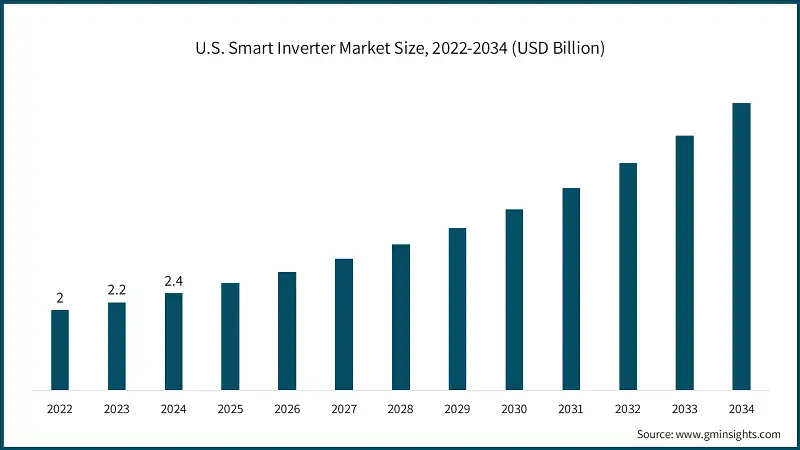
- The U.S. dominated the smart inverter market in North America with around 91.5% share in 2024 and is expected to generate over USD 2.4 billion by 2034, driven rapid increase in solar-plus-storage systems, especially in regions prone to power outages and high energy costs. Smart inverters are essential for managing these systems, enabling seamless integration between solar panels, batteries, and the grid.
- Additionally, frequent extreme weather events and aging grid infrastructure have increased the demand for energy resilience, boosting smart inverters' adoption, especially hybrid models, which allow users to maintain power during outages and manage energy loads efficiently. This is particularly valuable for critical infrastructure and businesses that require uninterrupted operations.
- Growing government initiatives, including the Inflation Reduction Act (IRA), provide up to 30% tax credits for solar and energy storage systems, significantly reducing the financial barrier for smart inverter adoption. These incentives, combined with state-level rebates and net metering policies, are encouraging homeowners and businesses to invest in advanced inverter technologies that meet regulatory and grid-interactive requirements.
- The North America smart inverter market accounted for a over USD 2.6 billion in 2024, driven by the rapid expansion of renewable energy infrastructure. In 2024, the U.S. installed more than 32 GW of new solar capacity, representing a 28% increase compared to the previous year, according to the Solar Energy Industries Association. These growing statistics escalate smart inverters' adoption, enabling efficient DC-to-AC conversion, grid synchronization, and real-time energy management. Their ability to support grid services such as voltage regulation and frequency response makes them indispensable in modern solar deployments.
- The Asia Pacific smart inverter market is anticipated to reach over USD 20.8 billion by 2034, driven by government policies and renewable energy targets, boosting product adoption for meeting grid compliance and enabling efficient integration of solar into national grids. Additionally, the presence of key players in the region and their ongoing efforts in developing cost-effective production in countries such as China and South Korea will complement the business outlook. Moreover, increasing local production also reduces costs and improves accessibility, making smart inverters more viable for mass deployment across residential, commercial, and utility-scale projects.
Smart Inverter Market Share
- The top 5 companies, including Growatt, SMA Solar Technology, Solar Edge, Huawei and Sungrow, account for around 43.5% market share. Companies are heavily investing in R&D to develop high-efficiency, AI-enabled, and hybrid inverters. These innovations support energy storage and grid services, helping brands stay competitive and meet evolving customer needs.
- Additionally, to capture emerging markets, key players are localizing manufacturing, customizing products for regional grid codes, and forming strategic alliances with local EPCs, utilities, and distributors. This approach reduces costs, improves service delivery, and accelerates market penetration. For instance, companies such as Sungrow and Growatt have established regional hubs in India, Southeast Asia, and Latin America to meet rising demand and regulatory requirements efficiently.
- Growing global emphasis on decarbonization and grid modernization, companies are aligning their products with evolving standards such as IEEE 1547 and EU grid codes. They are also pursuing certifications and participating in government-led programs to ensure compliance and gain market trust. This proactive approach not only ensures regulatory readiness but also opens doors to incentive-backed projects and public-private partnerships, especially in regions with aggressive renewable energy targets.
Smart Inverter Market Companies
- SMA Solar Technology Germany-based company known for its engineering excellence, offering robust, high-performance inverters for residential to utility-scale projects. Its competitive edge lies in reliability, advanced grid support, and proactive monitoring via Sunny Portal. SMA’s long-standing reputation and global service network make it a trusted brand, especially in markets prioritizing quality and compliance.
- Solar Edge revolutionized the market with its power optimizer-based architecture, enabling panel-level monitoring and enhanced safety. Its smart inverters offer up to 99.5% efficiency and seamless integration with EV chargers and batteries. The company’s U.S. manufacturing and SafeDC technology give it a strong edge in safety, performance, and domestic content incentives.
- Growatt leads the residential inverter market with cost-effective, high-efficiency hybrid and string inverters. Its edge lies in smart monitoring, global reach, and seamless battery integration. With a significant user base and strong R&D, it offers scalable, AI-enabled solutions for homes and businesses, making it a top choice for value-driven solar adopters.
- Huawei dominates the global inverter market with AI-powered, high-efficiency smart string inverters. Its unique partial optimizer deployment reduces costs while maintaining performance. With high efficiency, plug-and-play battery compatibility, and advanced monitoring via FusionSolar, Huawei’s edge lies in innovation, scalability, and future-ready energy management for both residential and commercial sectors.
- Sungrow stands out with its modular inverter designs, high durability, and advanced MPPT algorithms. It offers flexible, high-capacity solutions for all scales, including utility-grade systems. Its 1+X modular inverter and PowerTitan storage platform showcase its innovation. Sungrow’s edge is its blend of performance, reliability, and adaptability across diverse environmental and grid conditions.
Eminent players operating in the smart inverter market are:
- Eastman Auto & Power Ltd
- EnerTech UPS
- Growatt
- Huawei
- Luminous
- MaxVolt Energy
- Servotech Renewable Power System Limited
- SMA Solar Technology
- Solar Edge
- Solis
- Sungrow
- Unique Sun Power PVT.
- Ushva Clean Technology Pvt. Ltd
- Vsole Solar Private Limited
Smart Inverter Market Report Attributes
| Key Takeaway | Details |
|---|---|
| Market Size & Growth | |
| Base Year | 2024 |
| Market Size in 2024 | USD 11.8 Billion |
| Market Size in 2025 | USD 13.3 Billion |
| Forecast Period 2025 - 2034 CAGR | 14.2% |
| Market Size in 2034 | USD 44 Billion |
| Key Market Trends | |
| Drivers | Impact |
| Grid modernization initiatives | Smart inverters support grid stability and integration of renewables, accelerating modernization and enabling smarter, more resilient energy networks. |
| Rising Demand for Energy Independence | Consumers adopt smart inverters to manage energy use, store solar power, and reduce reliance on traditional utility grids. |
| Pitfalls & Challenges | Impact |
| High initial investment costs | Upfront costs for smart inverters deter adoption, especially in price-sensitive markets with limited financial incentives or subsidies. |
| Technical integration challenges | Compatibility issues with existing infrastructure and a lack of skilled workforce hinder the seamless deployment and operation of smart inverters. |
| Opportunities: | Impact |
| Expansion of smart grids and digital utilities | Smart inverters enhance grid intelligence, enabling real-time data exchange, remote control, and advanced energy services for utilities and consumers. |
| Growth of off-grid and remote energy systems | Growth of off-grid and remote energy systems |
| Market Leaders (2024) | |
| Market Leaders |
15.5% market share |
| Top Players |
Collective market share in 2024 is 43.5% |
| Competitive Edge |
|
| Regional Insights | |
| Largest Market | Asia Pacific |
| Fastest Growing Market | Middle East & Africa |
| Emerging Countries | South Korea, Netherlands & South Africa |
| Future outlook |
|
What are the growth opportunities in this market?
Smart Inverter Industry News:
- In May 2025, at Intersolar Europe 2025, Solis unveiled two major innovations: a high-capacity wall-mounted hybrid inverter, currently the largest of its kind, and Solis AI, an intelligent energy management platform. These solutions are designed to enhance solar energy utilization for both residential and commercial users by enabling smarter control, improved efficiency, and seamless integration with energy systems.
- In February 2025, Eastman Auto & Power Ltd unveiled the Solar Access LIB, a compact 1,000-VA solar inverter integrated with a 150-Ah lithium-ion battery. Designed to optimize space and energy use, the system intelligently switches between grid and solar sources. It features built-in protection against reverse connections and supports remote monitoring through the Eastman Solar app. Users can choose from three operational modes: solar-only, smart/PCU, and hybrid, to enhance performance and minimize electricity expenses.
This smart inverter market research report includes an in-depth coverage of the industry with estimates & forecast in terms of revenue in “USD Billion” from 2021 to 2034, for the following segments:
Market, By Product
- String
- Micro
- Central
- Hybrid
Market, By Application
- Residential
- Commercial & industrial
- Utility
Market, By Communication
- Wired
- Wireless
- Cloud/IoT enabled
The above information has been provided for the following regions and countries:
- North America
- U.S.
- Canada
- Europe
- Germany
- Netherlands
- UK
- France
- Asia Pacific
- China
- India
- Japan
- South Korea
- Middle East & Africa
- Saudi Arabia
- UAE
- South Africa
- Latin America
- Brazil
- Mexico
Frequently Asked Question(FAQ) :
What is the market size of the smart inverter in 2024?
The market size was USD 11.8 billion in 2024, with a CAGR of 14.2% expected through 2034 driven by grid modernization initiatives and rising demand for energy independence.
What is the projected value of the smart inverter market by 2034?
The smart inverter market is expected to reach USD 44 billion by 2034, propelled by renewable energy integration, AI-enabled systems, and expansion of smart grids.
What is the current smart inverter market size in 2025?
The market size is projected to reach USD 13.3 billion in 2025.
How much revenue did the micro inverter segment generate in 2024?
Micro inverters accounted for over 43.1% market share in 2024, leading the product segment with superior energy harvesting capabilities.
What was the valuation of residential application segment in 2024?
Residential application dominated with 50.4% market share in 2024, led by rising electricity prices and demand for energy autonomy.
What is the growth outlook for commercial & industrial application from 2025 to 2034?
Commercial & industrial application is projected to grow at a CAGR of 15.2% till 2034, due to government incentives, sustainability initiatives, and operational cost savings.
Which region leads the smart inverter market?
The U.S. led the North America smart inverter market with a 91.5% share in 2024 and is projected to surpass USD 2.4 billion by 2034.
What are the upcoming trends in the smart inverter market?
Key trends include integration with energy storage systems, AI and IoT-enabled energy management, deployment in Virtual Power Plants (VPPs), and regulatory momentum supporting grid-interactive capabilities.
Who are the key players in the smart inverter market?
Key players include Growatt, SMA Solar Technology, SolarEdge, Huawei, Sungrow, Eastman Auto & Power Ltd, EnerTech UPS, Luminous, MaxVolt Energy, Servotech Renewable Power System Limited, Solis, Unique Sun Power PVT., Ushva Clean Technology Pvt. Ltd, and Vsole Solar Private Limited.
Smart Inverter Market Scope
Related Reports