Summary
Table of Content

Smart Industrial Lighting Fixtures Market
Get a free sample of this report
Form submitted successfully!
Error submitting form. Please try again.
Thank you!
Your inquiry has been received. Our team will reach out to you with the required details via email. To ensure that you don't miss their response, kindly remember to check your spam folder as well!
Request Sectional Data
Thank you!
Your inquiry has been received. Our team will reach out to you with the required details via email. To ensure that you don't miss their response, kindly remember to check your spam folder as well!
Form submitted successfully!
Error submitting form. Please try again.
Smart Industrial Lighting Fixtures Market Size
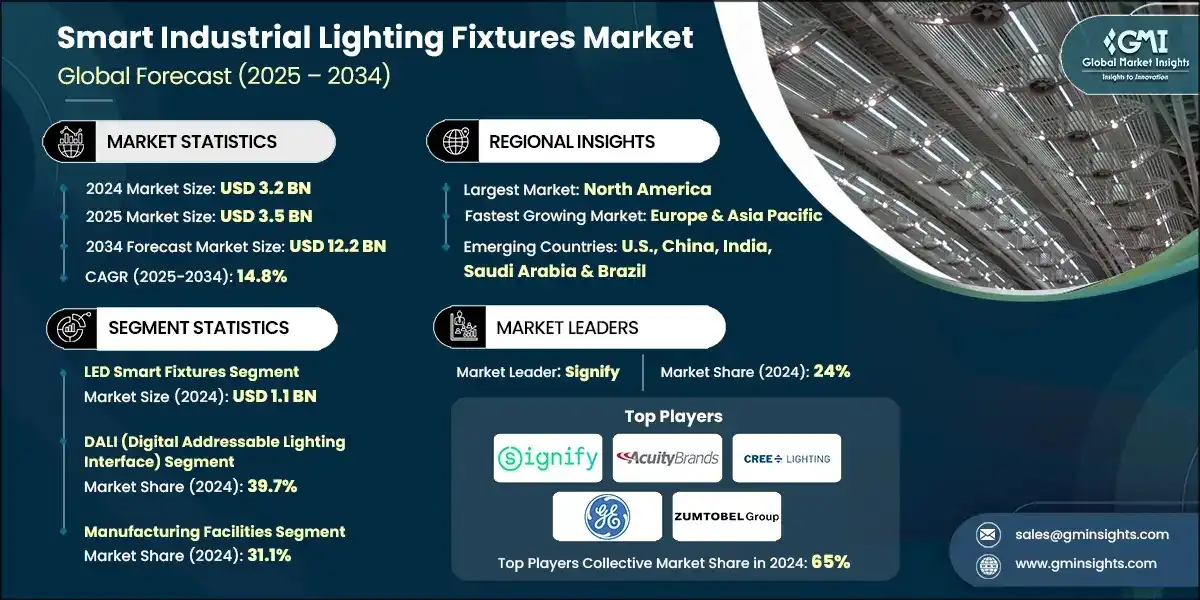
The smart industrial lighting fixtures market was estimated at USD 3.2 billion in 2024. The market is expected to grow from USD 3.5 billion in 2025 to USD 12.2 billion in 2034, at a CAGR of 14.8% according to latest report published by Global Market Insights Inc.
To get key market trends
- The smart industrial lighting fixtures market is experiencing substantial growth, driven by the increasing need for energy efficiency, cost reduction, and sustainability. Industrial facilities are under greater pressure to reduce operational costs and carbon emissions, and smart LED lighting systems are the solution. Smart light fittings deliver a host of technologies (such as motion sensing, daylight harvesting, and automated dimming) as a premium lighting selection that translates to significant energy savings. Energy prices are likely to continue their upward trajectory, making sustainability an increasingly important business objective. These factors will motivate businesses toward expanding their use of smart lighting systems to achieve cost savings over the long haul, while avoiding unnecessary environmental impacts.
- Government regulations and sustainability policies are contributing to the rapid development of smart industrial lighting. Regulatory agencies in various parts of the world are creating stringent energy efficiency standards, banning the manufacture of inefficient lighting systems, and incentivizing the use of smart lighting. These policies create a unique impact in industrial settings where some operational processes cannot run without meeting environmental standards. This trend is compounded by the expansion of smart city programs, and modern urbanization, which both provide opportunities to create new environments for smart industrial lighting systems. As urban centers modernize their infrastructures, the industrial facilities located in, and around urban areas are increasingly incorporating intelligent lighting solutions to improve safety and operational capabilities and provide connectivity to integrated smart ecosystems.
- Retrofitting and infrastructure modernization are becoming the prime driver of growth for the market. Many industrial facilities still depend upon legacy systems that are energy inefficient and expensive to maintain. The trend to retrofit or modernize these systems with smart fixtures is gaining traction, aided by advances in modular and plug-and-play systems to support installation and minimize downtime. Retrofitting will not only improve energy performance, but it will offer the ability to link the lighting systems with existing industrial automation ecosystems. As industry embraces digital transformation and the tenets of Industry 4.0, smart lighting is emerging as a fundamental platform for modern, integrated, and sustainable industrial settings. As such, smart lighting systems are increasingly viewed as essential to achieving operational excellence, reducing energy consumption, and meeting ever-evolving environmental compliance requirements.
Smart Industrial Lighting Fixtures Market Report Attributes
| Key Takeaway | Details |
|---|---|
| Market Size & Growth | |
| Base Year | 2024 |
| Market Size in 2024 | USD 3.2 Billion |
| Market Size in 2025 | USD 3.5 Billion |
| Forecast Period 2025 – 2034 CAGR | 14.8% |
| Market Size in 2034 | USD 12.2 Billion |
| Key Market Trends | |
| Drivers | Impact |
| Energy efficiency & cost savings | Drives widespread adoption as industries seek to reduce operational costs and meet sustainability goals. |
| Smart city & urbanization initiatives | Expands market demand by integrating industrial zones into broader smart infrastructure projects. |
| Government regulations & sustainability mandates | Accelerates transition to smart lighting through compliance pressure and incentive programs. |
| Retrofit trends & infrastructure modernization | Opens large-scale replacement opportunities in aging industrial facilities seeking modernization. |
| Pitfalls & Challenges | Impact |
| Complex installation & retrofit challenges | Slows adoption due to technical barriers and the need for specialized labor and planning. |
| High upfront costs & ROI concerns | Limits investment from cost-sensitive sectors despite long-term savings potential. |
| Opportunities: | Impact |
| Integration with IIoT & edge analytics | Enhance operational intelligence and efficiency by turning lighting into a data-rich asset. |
| Technical innovations & new use-cases | Creates differentiation and value through AI, Li-Fi, human-centric lighting, and modular designs. |
| Market Leaders (2024) | |
| Market Leaders |
24% market share |
| Top Players |
Collective market share of 65% |
| Competitive Edge |
|
| Regional Insights | |
| Largest Market | North America |
| Fastest growing market | Europe & Asia Pacific |
| Emerging countries | U.S., China, India, Saudi Arabia & Brazil |
| Future outlook |
|
What are the growth opportunities in this market?
Smart Industrial Lighting Fixtures Market Trends
- The smart industrial lighting fixtures industry is experiencing major changes, mainly thanks to the integration of Internet of Things (IoT) technology. Smart lighting ultimately allows the fixture to communicate seamlessly with sensors, controllers and cloud platforms. This connectivity in turn allows for monitoring the lighting issues in real time and automatic adjustments, based on a variety of factors such as occupancy, levels of daylight and work schedules. In either case, this intelligence allows organizations to improve their energy efficiency significantly while allowing predictive maintenance and/or remote diagnostics that minimize downtime, lower operational costs and keep the lights running. As industrial facilities adopt these smart systems, they can continue to optimize lighting performance while enhancing safety and continuously improving their industrial automation efforts compliant with Industry 4.0. Increasingly, smart lighting is acquiring significance as a component within the modern infrastructure of industrial settings.
- Beyond IoT-enabled solutions, the market is also experiencing growing demand for human-centric and artificial-intelligence (AI)-enabled lighting solutions. Human-centric lighting (HCL) refers to lighting that seeks to mimic the patterns of natural light and thus support the circadian rhythms of employees, as well as their alertness and well-being. Such systems are particularly valuable in 'shift-based' environments where it is critical to promote focus and sustained productivity. AI algorithms can enhance and automate these systems by analyzing usage and behaviors, environmental conditions, and operational data, to optimize the lighting conditions continuously. This optimally supports employee comfort and satisfaction, ensuring energy savings. These advancements are truly reconstructing industrial lighting from a passive utility to an adaptive and intelligent infrastructural asset that provides value to both the business and the employees. By offering a combination of health-oriented and adaptive lighting solutions, industries can advance into a relatively high-performance and sustainable operational system and create a pathway to long-term ability to serve as a leading organization.
Smart Industrial Lighting Fixtures Market Analysis
Learn more about the key segments shaping this market
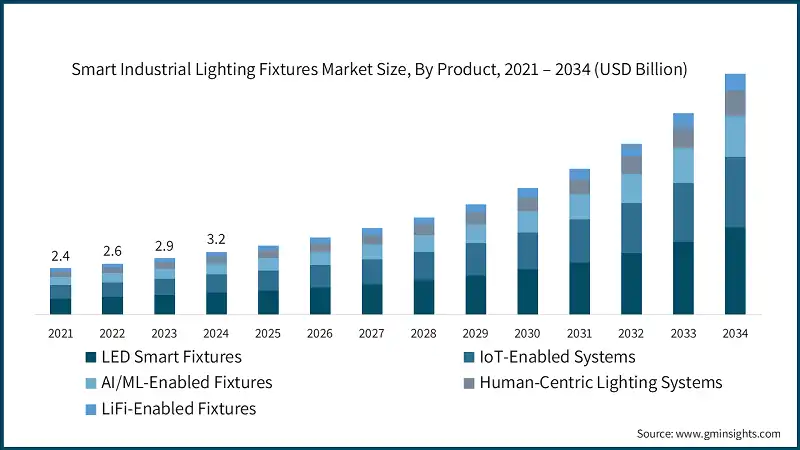
Based on product, the market is categorized into LED smart fixtures, IoT-enabled systems, AI/ML-enabled fixtures, human-centric lighting systems and LiFi-enabled fixtures. The LED smart fixtures accounted for revenue of around USD 1.1 billion in 2024 and is anticipated to grow at a CAGR of 15.1% from 2025 to 2034.
- LED technology has matured significantly, offering superior lumen output, reduced heat generation, and minimal maintenance requirements compared to traditional lighting solutions. These fixtures are increasingly being integrated with smart sensors and controllers, enabling features such as motion detection, daylight harvesting, and automated dimming, which collectively contribute to substantial energy savings and operational cost reductions. Additionally, the declining cost of LED components and manufacturing has made these fixtures more accessible to a wider range of industrial users, including small and medium enterprises.
Based on control protocol & connectivity of smart industrial lighting fixtures market consists of DALI (digital addressable lighting interface), wireless protocol, power over ethernet (PoE) and matter/thread universal standard. The DALI (digital addressable lighting interface) emerged as leader and held 39.7% of the total market share in 2024 and is anticipated to grow at a CAGR of 15.3% from 2025 to 2034.
- DALI is a well-established protocol that allows for granular control of individual lighting fixtures, enabling dimming, switching, and status monitoring across complex industrial environments. Its two-way communication system ensures that lighting can be both controlled and monitored, which is essential for predictive maintenance and energy optimization. Unlike many wireless alternatives, DALI operates on a dedicated wired network, minimizing interference and ensuring consistent performance in harsh industrial settings where wireless signals may be unreliable.
Learn more about the key segments shaping this market
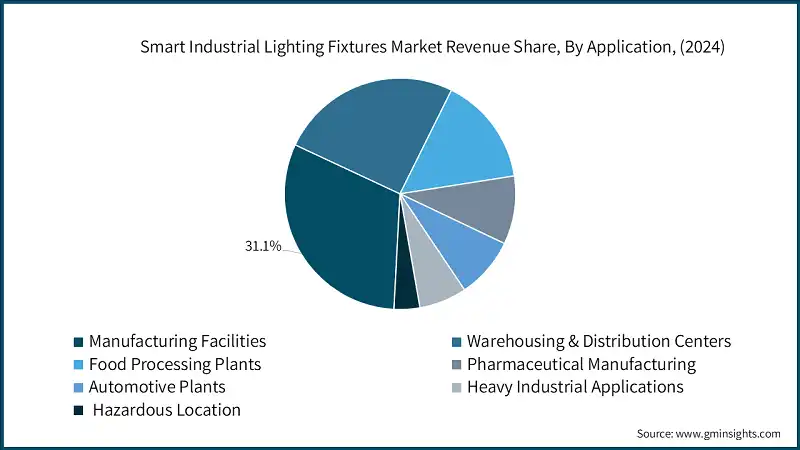
Based on application of smart industrial lighting fixtures market consists of manufacturing facilities, warehousing & distribution centres, food processing plants, pharmaceutical manufacturing, automotive plants, heavy industrial applications and hazardous location. The manufacturing facilities emerged as leader and held 31.1% of the total market share in 2024 and is anticipated to grow at a CAGR of 15.5% from 2025 to 2034.
- Manufacturing environments demand high-performance lighting systems that can withstand harsh conditions, operate continuously, and adapt to dynamic workflows. Smart lighting solutions, particularly those integrated with sensors and control systems, offer significant advantages in these settings by enabling automated lighting adjustments based on occupancy, task requirements, and ambient light levels. This not only reduces energy consumption but also enhances worker productivity and safety by ensuring optimal illumination at all times.

Looking for region specific data?
The U.S. dominates an overall North America smart industrial lighting fixtures market and valued at USD 1 billion in 2024 and is estimated to grow at a CAGR of 15.3% from 2025 to 2034.
- U.S. manufacturers and facility operators are increasingly investing in intelligent lighting systems to enhance energy efficiency, reduce operational costs, and comply with stringent environmental regulations. The country’s emphasis on sustainability and carbon reduction targets has accelerated the shift from conventional lighting to smart LED and IoT-enabled fixtures. Additionally, the presence of key market players, robust R&D activities, and government incentives for energy-efficient upgrades have created a favorable environment for market growth.
In the European smart industrial lighting fixtures market, Germany is expected to experience significant and promising growth from 2025 to 2034.
- As a hub for automotive, machinery, and chemical production, Germany has a high concentration of industrial facilities that demand efficient, reliable, and intelligent lighting solutions. The country’s commitment to sustainability and energy transition driven by initiatives like “Energiewende” has accelerated the adoption of smart LED and IoT-enabled lighting systems that reduce energy consumption and support carbon neutrality goals. Additionally, Germany’s advanced infrastructure and widespread implementation of Industry 4.0 technologies create a favorable environment for integrating smart lighting with broader automation and data-driven systems.
In the Asia Pacific smart industrial lighting fixtures market, the China held 34.3% share in 2024 and is anticipated to grow at a CAGR of 15.9% from 2025 to 2034.
- As the world’s largest manufacturing hub, China has a high concentration of factories, warehouses, and industrial zones that require efficient, scalable, and intelligent lighting solutions. The government’s initiatives such as “Made in China 2025” and its commitment to carbon neutrality are driving widespread adoption of smart technologies, including IoT-enabled lighting systems that support energy savings, automation, and real-time monitoring. Additionally, China’s rapid urbanization and expansion of smart cities are creating spillover demand for smart lighting in adjacent industrial areas.
In the Middle East and Africa smart industrial lighting fixtures market, Saudi Arabia held 18.9% share in 2024 promising growth from 2025 to 2034.
- Under its Vision 2030 initiative, the country is investing heavily in transforming its economy beyond oil, with a focus on expanding manufacturing, logistics, and industrial zones. These developments are driving demand for advanced lighting solutions that enhance energy efficiency, operational safety, and automation. Smart lighting fixtures, particularly those integrated with IoT and AI technologies, are being adopted across new and retrofitted facilities to support intelligent control, real-time monitoring, and predictive maintenance.
Smart Industrial Lighting Fixtures Market Share
- In 2024, the prominent manufacturers in smart industrial lighting fixtures industry are Signify, Acuity Brands, Cree Lighting, Current (GE), Zumtobel Group collectively held the market share of ~65%.
- Signify (formerly Philips Lighting) maintains its leadership by focusing on sustainability, digital transformation, and connected lighting ecosystems. It offers platforms like Interact, enabling cloud-based lighting management, data analytics, and remote control for industrial facilities. Signify invests in circular lighting solutions, including 3D-printed luminaires and modular designs that promote reuse and recycling. Its innovations prioritize energy efficiency, smart integration, and environmental responsibility, aligning with global sustainability goals and industrial automation trends.
- Acuity Brands leads by providing comprehensive smart building solutions that integrate lighting with building controls, sensors, and software platforms. Through its “Intelligent Spaces” strategy, Acuity creates unified environments and expands its capabilities in IoT, AI, and automation through strategic acquisitions. Its products focus on adaptive lighting, wireless controls, and cloud-based management systems, helping industrial clients optimize energy use, improve safety, and streamline operations.
Smart Industrial Lighting Fixtures Market Companies
Major players operating in the smart industrial lighting fixtures industry include:
- Acuity Brands
- AGC Lighting
- Cima Lighting
- Cree Lighting
- Dialight
- Eaton
- GE Current
- Holophane
- Hubbell Lighting
- LSI Industries
- Lumefficient
- Luminis Lighting
- Osram (ams OSRAM)
- Panasonic Lighting
- PureLiFi
- Signify
- SuperBrightLEDs
- Zumtobel Group
Cree Lighting specializes in high-performance modular LED systems for industrial environments. Its fixtures offer flexibility with multiple lumen outputs, optical configurations, and smart sensor integration. Cree emphasizes thermal management and durability, ensuring long-lasting performance in demanding conditions. Its customizable, energy-efficient lighting solutions are easy to retrofit and maintain, making them ideal for large-scale industrial applications.
Current (formerly GE Lighting) leverages its industrial technology expertise to deliver intelligent lighting systems that integrate with facility management platforms. It focuses on wireless controls, sensor networks, and open software ecosystems, transforming lighting into a data-rich infrastructure. Current develops systems that support energy optimization, real-time monitoring, and interoperability with HVAC and security systems, positioning lighting as a key component of smart industrial environments.
Smart Industrial Lighting Fixtures Industry News
- In January 2025, Acuity Brands finalized its acquisition of QSC, strengthening its leadership in intelligent and data-driven built environments.
- In 2025, Current, a subsidiary of GE, introduced its latest innovations, including Cync outdoor café lights, advanced smart switches, and Proseo smart shades, highlighting GE's commitment to expanding its smart ecosystem.
- In March 2025, Signify launched its "Race to Growth" initiative, presenting the SmartBright All-In luminaire series with selectable color temperatures and lumen packages, enhancing contractor flexibility and improving inventory management.
- In August 2025, Eaton introduced the CEAG VLL Ex LED series along with B-Line support systems, focusing on explosion-proof and sensor-integrated industrial lighting designed for exceptional durability and reliability.
The smart industrial lighting fixtures market research report includes in-depth coverage of the industry, with estimates & forecast in terms of revenue (USD Billion) and volume (Thousand Units) from 2021 to 2034, for the following segments:
Market, By Product
- LED smart fixtures
- IoT-enabled systems
- AI/ML-enabled fixtures
- Human-centric lighting systems
- LiFi-enabled fixtures
Market, By Control Protocol & Connectivity
- DALI (Digital addressable lighting interface)
- Wireless protocol
- Power over Ethernet (PoE)
- Matter/thread universal standard
Market, By Smart Features & Capabilities
- Occupancy sensing & motion detection
- Daylight harvesting systems
- Energy monitoring & analytics
- Predictive maintenance capabilities
- Emergency & safety integration
Market, By Application
- Manufacturing facilities
- Warehousing & distribution centres
- Food processing plants
- Pharmaceutical manufacturing
- Automotive plants
- Heavy industrial applications
- Hazardous location
The above information is provided for the following regions and countries:
- North America
- U.S.
- Canada
- Europe
- Germany
- UK
- France
- Italy
- Spain
- Asia Pacific
- China
- Japan
- India
- South Korea
- Australia
- Indonesia
- Malaysia
- Latin America
- Brazil
- Mexico
- Argentina
- MEA
- Saudi Arabia
- UAE
- South Africa
Frequently Asked Question(FAQ) :
Who are the key players in the smart industrial lighting fixtures market?
Key players include Signify, Acuity Brands, Cree Lighting, Current (GE), Zumtobel Group, AGC Lighting, Cima Lighting, Dialight, Eaton, Holophane, Hubbell Lighting, LSI Industries, Lumefficient, Luminis Lighting, Osram (ams OSRAM), Panasonic Lighting, PureLiFi, and SuperBrightLEDs.
What are the upcoming trends in the smart industrial lighting fixtures market?
Key trends include integration with IIoT and edge analytics, AI-driven adaptive lighting, human-centric lighting systems, Li-Fi technology adoption, and seamless integration with Industry 4.0 automation platforms.
Which region leads the smart industrial lighting fixtures market?
North America is the largest market, with the U.S. valued at USD 1 billion in 2024 and estimated to grow at a CAGR of 15.3% from 2025 to 2034, driven by sustainability initiatives and government incentives.
What was the market share of DALI (Digital Addressable Lighting Interface) segment in 2024?
DALI held 39.7% of the total market share in 2024 and is anticipated to grow at a CAGR of 15.3% from 2025 to 2034.
What is the growth outlook for manufacturing facilities application from 2025 to 2034?
Manufacturing facilities held 31.1% market share in 2024 and are projected to grow at a CAGR of 15.5% till 2034, due to demand for high-performance lighting systems and integration with automation ecosystems.
What is the market size of the smart industrial lighting fixtures in 2024?
The market size was USD 3.2 billion in 2024, with a CAGR of 14.8% expected through 2034 driven by rising demand for energy efficiency, cost savings, and sustainable industrial operations.
How much revenue did the LED smart fixtures segment generate in 2024?
LED smart fixtures generated around USD 1.1 billion in 2024 and is anticipated to grow at a CAGR of 15.1% from 2025 to 2034.
What is the current smart industrial lighting fixtures market size in 2025?
The market size is projected to reach USD 3.5 billion in 2025.
What is the projected value of the smart industrial lighting fixtures market by 2034?
The smart industrial lighting fixtures market is expected to reach USD 12.2 billion by 2034, propelled by IoT integration, AI-enabled systems, and government sustainability mandates.
Smart Industrial Lighting Fixtures Market Scope
Related Reports