Summary
Table of Content

Smart Fleet Management Market
Get a free sample of this report
Form submitted successfully!
Error submitting form. Please try again.
Thank you!
Your inquiry has been received. Our team will reach out to you with the required details via email. To ensure that you don't miss their response, kindly remember to check your spam folder as well!
Request Sectional Data
Thank you!
Your inquiry has been received. Our team will reach out to you with the required details via email. To ensure that you don't miss their response, kindly remember to check your spam folder as well!
Form submitted successfully!
Error submitting form. Please try again.
Smart Fleet Management Market Size
The growing demand for instant vehicle position tracking as well as an increasing number of businesses wishing to obtain complete transparency around their operational processes has fueled the implementation of smart fleet management systems among companies that manage any kind of fleet business, the ability of fleet managers to monitor vehicle and driver locations, driver behavior, vehicle usage, and performance metrics will allow them to become more operationally efficient with a reduction in delays due to improved decision making through actionable data insights.
Smart Fleet Management Market Key Takeaways
Market Size & Growth
- 2025 Market Size: USD 61.4 Billion
- 2026 Market Size: USD 64.8 Billion
- 2035 Forecast Market Size: USD 139.5 Billion
- CAGR (2026–2035): 8.9%
Regional Dominance
- Largest Market: North America
- Fastest Growing Region: Asia Pacific
Key Market Drivers
- Real-time fleet visibility.
- Fuel cost optimization.
- Safety & compliance regulations.
- E-commerce & last-mile delivery growth.
Challenges
- High initial deployment costs.
- Data privacy & cybersecurity risks.
Opportunity
- EV charging infrastructure integration.
- Emerging market expansion.
- Usage-based insurance (UBI).
- Public sector fleet digitization.
Key Players
- Market Leader: Robert Bosch led with over 3.6% market share in 2025.
- Leading Players: Top 5 players in this market include Robert Bosch, IBM, Verizon Connect, Geotab, Continental, which collectively held a market share of 12.7% in 2025.
Get Market Insights & Growth Opportunities
With the recent spike in fuel prices over the last few years, there has been an increase in demand for fleet operators to implement smart fleet management systems that enable them to reduce their idling time and better monitor their driving patterns, and in consequence, reduce their fuel consumption. When fleet operators use route planning algorithms, those operators can reduce both operational costs and increase the operational productivity of their entire fleet by using data-driven fuel management strategies and analytics tools. In June 2025, to address the rising cost of fuel, some regional transportation operators implemented more advanced route optimization algorithms that enabled the operators to reduce their fuel consumption and to reduce their total fleet fuel expense by more than 10%.
The increased number of federal mandates governing driver safety, emissions control, and vehicle diagnostics have resulted in the implementation of telematics-enabled fleet management systems by fleets that are governed by these regulations. Telematics-enabled fleet management systems assist fleet managers in maintaining compliance with government mandates, improving the road safety of fleet vehicles, and increases the ability of fleet managers to monitor driver behavior as it relates to compliance with operational specifications. In September 2025, new national safety mandates required commercial fleets to install advanced driver monitoring systems, accelerating compliance‑focused smart fleet deployments ahead of regulatory deadlines.
The explosive growth of e-commerce and on-demand delivery services has generated unprecedented demand for more efficient fleet operations. Smart fleet management systems provide the ability to use real-time tracking tools to determine delivery schedules as well as the overall route optimization capacity to maximize the success of any delivery.
The global smart fleet management market was valued at USD 61.4 billion in 2025. The market is expected to grow from USD 64.8 billion in 2026 to USD 139.5 billion in 2035 at a CAGR of 8.9%, according to latest report published by Global Market Insights Inc.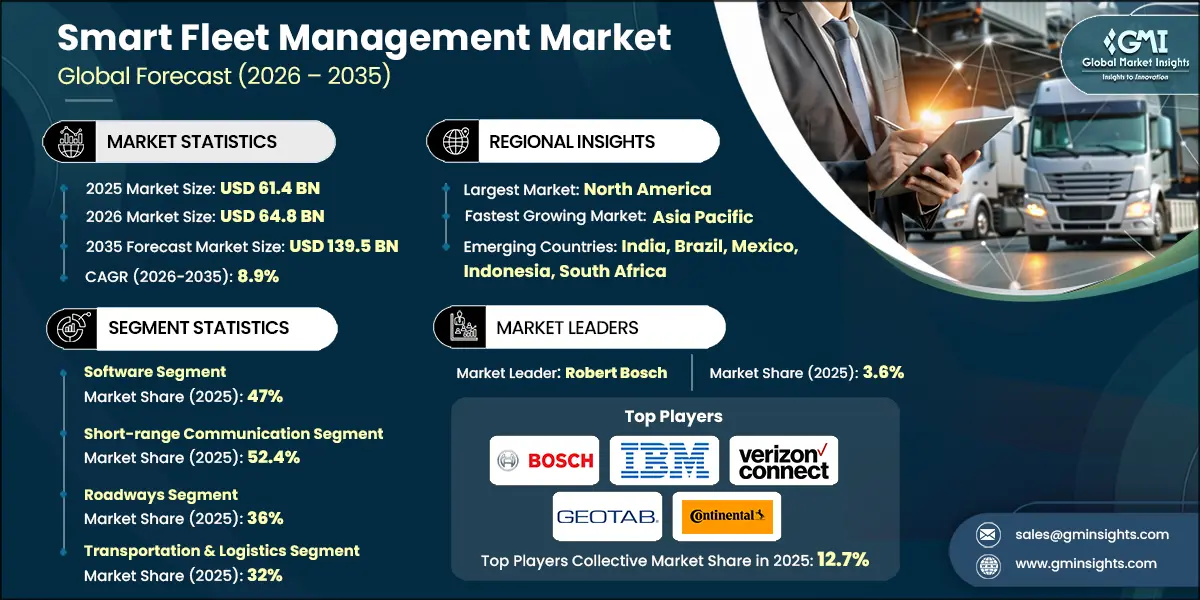
To get key market trends
Smart Fleet Management Market Trends
Due to their ability to scale easily, to be flexible and cost-effective, cloud-based fleet management systems are becoming increasingly popular among fleet managers. With cloud-based fleet management systems, fleet managers can access real-time information; monitor their fleet remotely; integrate into existing systems seamlessly; and manage fleet operations without having to make a large investment in a complex on-premises infrastructure or resources for maintaining that infrastructure. In March 2025, Verizon Connect migrated a multinational delivery company’s legacy fleet system to a cloud-native platform in March 2025, enabling real-time performance dashboards and remote operational oversight.
Fleet managers use more predictive maintenance tools powered by artificial intelligence (AI) to predict when vehicle components will fail before they actually break down. These predictive maintenance tools use real-time telematics data to determine when to schedule maintenance for each vehicle so that fleet managers can reduce vehicle downtime; extend the life of each vehicle; and improve overall fleet performance through intelligent diagnostics and automated alerts.
Because of increased focus on driver safety and preventing accidents, there has also been an increased use of video telematics systems. Video telematics systems allow fleet managers to observe how their drivers are driving; identify unsafe driving behaviors; and improve overall safety for everyone using the roadway through real-time alerts about unsafe driving behaviors, documentation of incidents and coaching drivers based on these incidents.By September 2025, new national safety mandates required commercial fleets to install advanced driver monitoring systems, accelerating compliance‑focused smart fleet deployments ahead of regulatory deadlines.
As commercial fleets transition to using electric vehicles (EVs), they are beginning to implement smart fleet management systems. Smart fleet management systems allow fleet managers to monitor their EVs’ batteries; optimize their battery charging; and analyze the energy consumption of their EVs. This will assist fleet managers to efficiently manage their EVs while encouraging sustainable practices and maintaining compliance with applicable environmental regulations.
Smart Fleet Management Market Analysis
Learn more about the key segments shaping this market
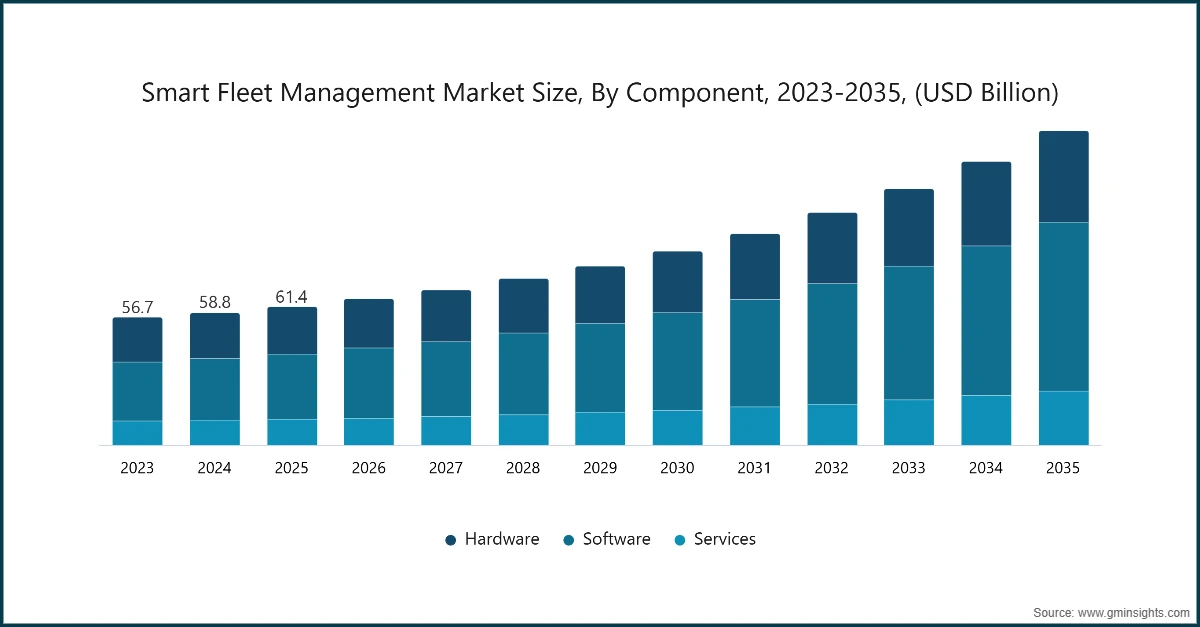
Based on component, the market is divided into hardware, software and services. Software dominated the market, accounting for 47% share in 2025 and is expected to grow at a CAGR of 10.3% through 2026 to 2035.
- Telematics hardware is becoming smaller, cheaper and more standardized through advanced levels of sensor integration, edge computing and plug-and-play connectivity. The introduction of AI-enabled cameras and modular upgrades also enhances safety, with the ongoing commodity price decline of devices will result in lower total cost of ownership for fleets.
- Fleet management is being delivered through cloud-native platforms that provide AI/ML analytics, predictive insights and real-time dashboards. The integration of third-party systems and mobile applications will provide enhanced decision support to fleets, while the subscription and API ecosystem will increase scalability, user-friendliness and the ability to exchange data seamlessly across fleet operations.
- Services are being adopted by fleets to outsource deployment, support and optimisation. With the utilisation of remote monitoring, SLA based maintenance, and analytical advisory services; Operators will have the ability to reduce their down time and increase their operational performance while transitioning to an Opex business model, leading to increased long-term service contracts and customer retention.
Learn more about the key segments shaping this market
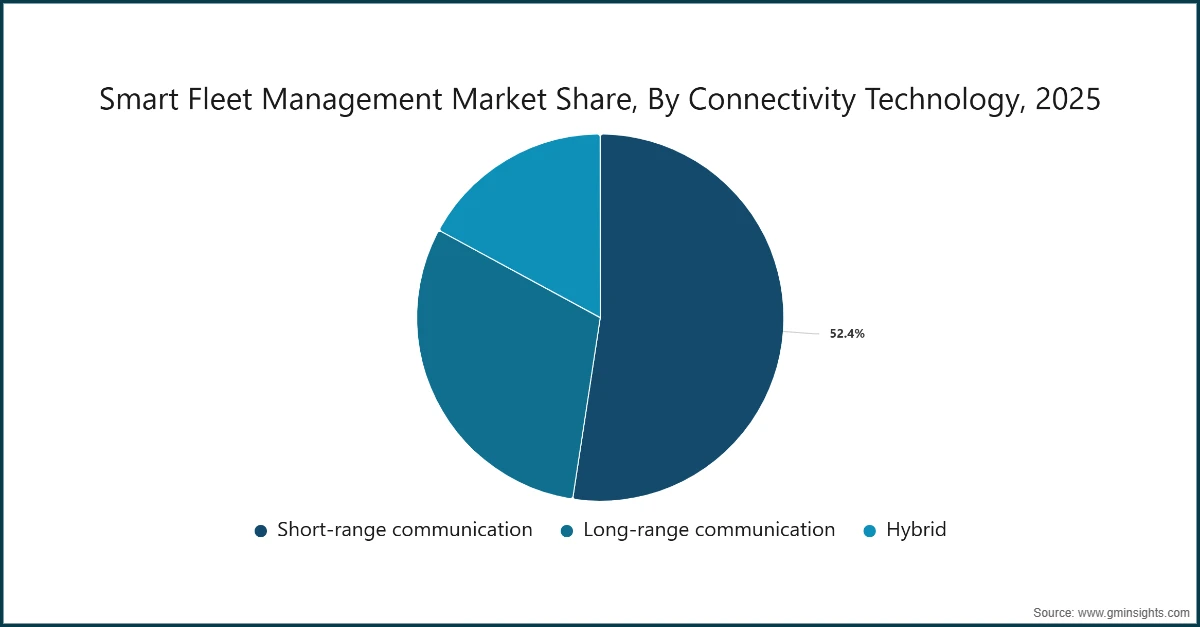
Based on connectivity technology, the smart fleet management market is segmented into short-range communication, long-range communication and hybrid. Short-range communication segment dominates the market with 52.4% share in 2025, and the segment is expected to grow at a CAGR of 8% from 2026 to 2035.
- Bluetooth, RFID and Wi-Fi represent a subset of short-range communication technologies that permit a limited distance to exchange data between vehicles, or between a vehicle and a local point of infrastructure (V2V / V2I).
- These types of technologies allow for coordination across a fleet of vehicles, allow for localized monitoring (i.e., condition of payload), allow for very rapid updates via sensors, and allow for fleet operations based out of depots, loading dock/point locations, and fleet operations at campus facilities.
- Long-range communication, including cellular networks (2G/3G/4G/5G) and satellite, facilitates continuous, real-time data transfer from vehicles to cloud platforms across wide geographic areas, enabling fleet tracking, route optimization, driver monitoring, and remote diagnostics for national and international fleet operations.
- The hybrid approach combines the best of both short-distance and long-distance communications technologies, allowing for lower cost, better reliability, and greater coverage; thereby providing a vehicle with the ability to utilize local wireless networks for intra-fleet information exchange.
Based on transport mode, the smart fleet management market is segmented into roadways, marine, airways and railways. The roadways segment dominates the market with 36% share in 2025, and the segment is expected to grow at a CAGR of 9.4% from 2026 to 2035.
- The management of fleets on land is done using smart technology, which consists of GPS, telematics and sensors that can be connected via the Internet of Things. These technologies help with the optimization of routes, behavior monitoring for drivers, fuel tracking, regulatory compliance and increased safety and efficiency in operation for commercial vehicles such as trucks, buses and delivery vans.
- Fleet management for marine vessels uses satellite-sourced tracking systems, as well as IoT and predictive analytics tools to monitor vessel location, fuel usage, cargo conditions and maintenance schedule. This combined solution provides improved safety, efficiency of routes and operational performance for shipping entities, ports and logistics companies.
- Air traffic operations use avionics data, GPS tracking and predictive analytics to manage aircraft fleets. This provides air carriers (commercial airlines, cargo carriers and private aviation companies) with a more efficient means of scheduling flight operations, managing the maintenance of aircraft, minimizing the amount of fuel consumed by aircraft and ensuring compliance with regulations.
- The management of railway fleets is accomplished by means of GPS, IoT devices and analytics tools. These technologies are used to determine where locomotives and rolling stock are located; manage the scheduling of locomotives and rolling stock; track fuel and cargo, predict maintenance costs and improve both safety and efficiency in operation on freight or passenger rail networks.
Based on end use industry, the smart fleet management market is segmented into transportation & logistics, retail & e-commerce, healthcare & emergency services, oil & gas, construction & mining, field services, government & public sector and others. The transportation & logistics segment is expected to dominate the market with a share of 32% in 2025.
- Fleet management solutions optimize route planning, vehicle utilization, driver behavior, and fuel efficiency for transportation and logistics operators. Real-time tracking, predictive maintenance, and analytics improve operational efficiency, reduce costs, and ensure timely deliveries across regional and international networks.
- E-commerce and retail companies use smart fleet systems for last-mile delivery, inventory tracking, and route optimization. Real-time vehicle monitoring, predictive scheduling, and analytics enhance delivery speed, customer satisfaction, and cost efficiency while managing seasonal demand surges effectively.
- Smart fleet management enables healthcare and emergency fleets to track vehicles, optimize routes, monitor equipment, and ensure timely responses. Telemetry, predictive maintenance, and real-time alerts enhance operational efficiency, reliability, and patient or public safety outcomes.
Looking for region specific data?
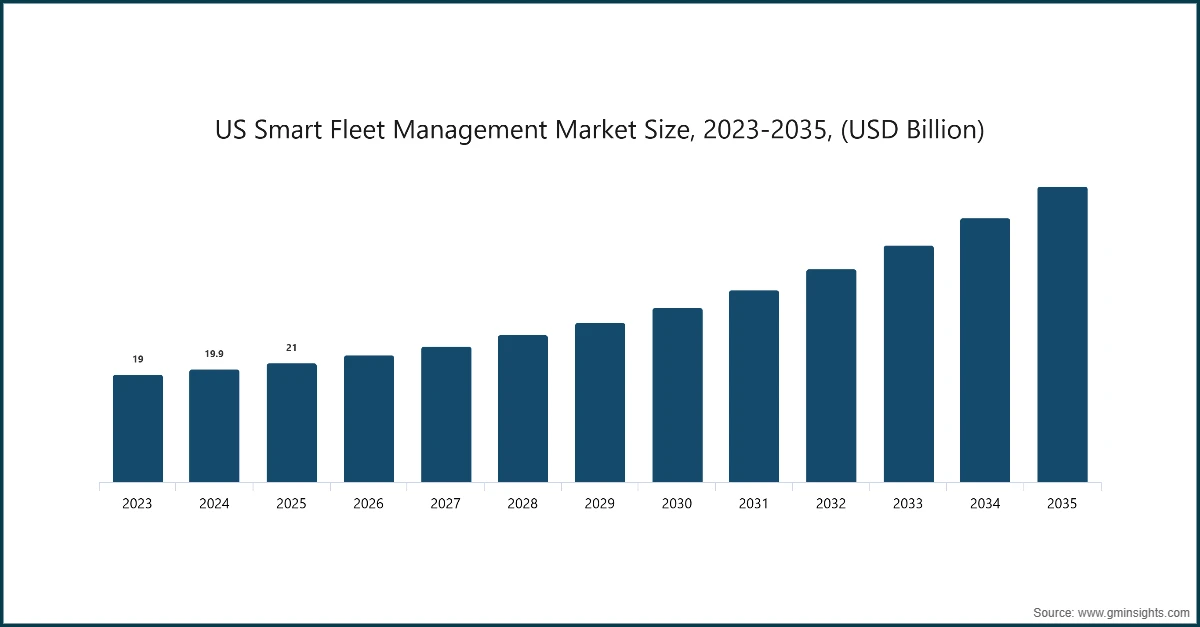
U.S. smart fleet management market reached USD 21 billion in 2025, growing from USD 19.9 billion in 2024.
- US. commercial fleet sector leverages advanced telematics to optimize delivery routes, monitor fuel consumption, and track driver behavior, supporting e-commerce growth and large-scale logistics operations while integrating cloud platforms and AI-based predictive maintenance solutions across diverse vehicle types.
- ELD compliance and regulatory oversight drive systematic digital logging, enabling real-time reporting and performance benchmarking across fleets, improving operational safety, accountability, and efficiency for operators managing extensive trucking networks.
- Innovation hubs in Silicon Valley provide AI, analytics, and connected vehicle solutions, allowing fleet operators to adopt scalable software, data-driven optimization, and IoT integration to enhance fleet reliability and reduce total operational costs.
North America dominated the smart fleet management market with a market size of USD 25.5 billion in 2025.
- Mature logistics infrastructure and widespread telematics adoption support operational efficiency, regulatory compliance, and fleet optimization across commercial trucking and delivery networks.
- Federal mandates, such as the ELD requirement, established a baseline for electronic logging device integration in large fleets.
- US dominates regional adoption due to extensive e-commerce logistics networks, a large commercial truck population, and advanced technology solutions from Silicon Valley software providers.
Europe smart fleet management market accounted for a share of 25.6% and generated revenue of USD 15.7 billion in 2025.
- Stringent emissions regulations drive fleet optimization and digital telematics adoption across commercial vehicles for environmental and operational efficiency.
- Labor cost pressures incentivize investment in fleet management systems and efficiency-enhancing technologies.
- Germany leads adoption, supported by headquarters of global logistics providers and automotive OEMs integrating embedded telematics solutions in commercial vehicles.
Germany dominates the smart fleet management market, showcasing strong growth potential, with a CAGR of 9.1% from 2026 to 2035.
- Germany’s fleet landscape integrates embedded telematics within trucks and commercial vehicles from leading OEMs, supporting urban and intercity logistics efficiency while reducing emissions and meeting stringent European environmental standards.
- German logistics providers leverage predictive analytics and route optimization technologies to address labor shortages, traffic management, and infrastructure constraints, ensuring timely deliveries across high-density transport corridors.
- The country’s commercial fleet market benefits from advanced digital tachographs, connectivity solutions, and automotive software innovations, facilitating real-time monitoring, regulatory compliance, and operational intelligence for global logistics operators headquartered in Germany.
The Asia Pacific smart fleet management market is anticipated to grow at the highest CAGR of 11% from 2026 to 2035 and generated revenue of USD 12.4 billion in 2025.
- Rapid industrialization and expanding logistics demand drive increasing adoption of smart fleet management systems.
- Government initiatives promoting intelligent transportation systems and IoT integration accelerate fleet digitization.
- China and India lead adoption, with domestic technology firms and government programs fostering autonomous vehicle and digital infrastructure integration.
China smart fleet management market is estimated to grow with a CAGR of 11.4% from 2026 to 2035.
- IoT initiatives by the Chinese government are moving the fleet management industry forward through increased investment in digital infrastructures such as with smart transportation systems, new construction projects for commercial trucks and expanded supply chains within China and across the country.
- China’s domestic companies (Baidu, Alibaba, Tencent) are at the forefront of developing new technologies that utilize artificial intelligence for advanced fleet optimization, autonomous vehicle integration, and predictive analytics, which will improve overall efficiency, safety, and urban traffic management.
- Commercial vehicle production continues to rise rapidly, which presents opportunities for original equipment manufacturers (OEMs) to provide embedded telematics, connected sensors, and cloud-based platforms to fleet operators throughout China. These fleets will enable fleet operators to manage their Cargo, Maintenance, and Energy Usage in a more efficient manner in both regional-based or long-haul operations.
Latin America smart fleet management market shows lucrative growth over the forecast period.
- In Latin America, several factors influence fleet management adoption such as transportation of agricultural commodities, cold chain logistics, and operational efficiency at the industry level.
- The economic volatility exhibited through fluctuations in currency also influences investments in fleet management and telematics infrastructure.
- Brazil is the leader in regional fleet management and telematics infrastructure because of the need to optimize logistics for harvesting sugarcane and other agricultural commodities.
Brazil smart fleet management market is estimated to grow with a CAGR of 7% from 2026 to 2035 and reach USD 3.1 billion in 2035.
- Brazil’s fleet management adoption focuses on agricultural logistics, including cold chain monitoring and commodity transport, using telematics to improve route planning, vehicle utilization, and cargo security in geographically dispersed and infrastructure-challenged regions.
- Operators deploy smart fleet solutions to reduce operational risks, optimize fuel consumption, and enhance driver behavior monitoring while addressing fluctuating commodity demand and rural connectivity limitations.
- Technology adoption supports integration with supply chain platforms, predictive maintenance systems, and local compliance requirements, helping Brazilian logistics companies modernize fleet operations and maintain competitiveness in domestic and export markets.
Middle East and Africa smart fleet management market accounted for USD 3.4 billion in 2025 and is anticipated to show lucrative growth over the forecast period.
- The Gulf Cooperation Council countries (UAE in particular) are also leaders in fleet management adoption, due to their drive for smart cities, logistics hubs and the use of highly advanced technologies.
- Wider markets in Africa have many barriers to fleet management adoption due to poor infrastructure, limited resources and unstable political systems.
- UAE utilizes its position as the country's primary logistics hub to connect manufacturers in Asia to markets in Europe and Africa.
UAE market is expected to experience substantial growth in the Middle East and Africa smart fleet management market, with a CAGR of 4.2% from 2026 to 2035.
- In UAE, telematics is used for commercial fleet operation efficiencies in multiple locations (ports, urban hubs, and cross-border logistics routes) between Asia, Europe, and Africa. Companies are now tracking their cargo more effectively than before, using optimized routes to improve efficiency, and tracking asset utilization to better understand how they are using fleet resources.
- Government initiatives in smart city environments, intelligent transportation systems, and adoption of high-tech infrastructure across both public and private sectors create opportunities for real-time fleet analytics, predictive maintenance, and fleet performance monitoring.
- Logistics firms operating within the UAE have successfully integrated IoT-enabled vehicles, cloud-based fleet management systems / technologies, and analytics based on AI insights to improve operational agility, reduce downtime, and build regional supply chain resiliency within an expanding logistics market.
Smart Fleet Management Market Share
- The top 7 companies in the smart fleet management industry are Robert Bosch, IBM, Verizon Connect, Geotab, Continental, General Motors (OnStar) and Siemens contributing 13% of the market in 2025.
- Bosch offers end-to-end telematics solutions, combining in-vehicle hardware, sensors, and software platforms for fleet optimization. Its strong OEM relationships and embedded automotive expertise enable predictive maintenance, driver monitoring, and regulatory compliance across commercial and passenger fleets globally.
- IBM leverages AI, cloud computing, and analytics-driven platforms for smart fleet management. Its solutions focus on predictive maintenance, real-time operational insights, and data integration, helping fleet operators optimize efficiency, reduce costs, and improve safety through scalable, enterprise-grade software solutions.
- Verizon Connect provides cloud-based fleet management and GPS tracking solutions for commercial vehicles. Its platform enables real-time vehicle monitoring, route optimization, driver performance analytics, and compliance management, supporting large-scale logistics, last-mile delivery, and multi-region fleet operations.
- Geotab specializes in telematics solutions for fleet tracking, predictive analytics, and data-driven optimization. Its open-platform architecture allows third-party integration, enabling fleet operators to manage vehicle utilization, fuel efficiency, maintenance schedules, and compliance with safety and environmental standards.
- Continental offers embedded telematics and vehicle electronics solutions, integrating sensors, connectivity, and fleet management software. Its expertise in automotive components allows real-time monitoring, predictive maintenance, and operational optimization for commercial fleets and OEM-connected vehicle deployments.
- GM’s OnStar platform provides connected vehicle services including fleet tracking, remote diagnostics, driver assistance, and telematics-based maintenance alerts. Its integration with GM vehicles ensures operational efficiency, safety, and compliance for commercial and corporate fleet operations.
- Siemens delivers IoT-enabled fleet management solutions, leveraging smart infrastructure, predictive analytics, and automation technologies. Its platforms support real-time vehicle monitoring, route optimization, and energy-efficient operations, targeting logistics providers, municipal fleets, and large commercial vehicle operators globally.
Smart Fleet Management Market Companies
Major players operating in the smart fleet management industry are:
- Cisco Systems
- Continental
- Denso
- General Motors
- IBM
- Infineon Technologies
- Magellan and Trimble Navigation
- Robert Bosch
- Siemens
- Zonar Systems
- The smart fleet management market features a wide range of competitive strategies, including sector-specific differentiation, geographic differentiation, customer segmentation, differentiation in technology, differentiation in business models, and differentiation in distribution channels. Businesses that target a vertical market such as trucking, construction, utilities, field service work, or public sector may employ a global, regional, or local strategy. Differentiating with AI/ML capabilities, video telematics, and electric vehicle support, while utilizing either premium-priced or low-priced business models provides a way to service either enterprise or small-and-medium-sized businesses.
- Consolidation within the market is driven by the increased understanding of the high-margin recurring revenue of fleet management software as compared to the lower-margin, one-time revenue produced from supplying hardware, which leads financial investors & manufacturers who are hoping to grow by investing in this space. Large companies also enjoy significant market share through scale advantages with AI/ML predictive model creation due to the amount of data being collected from the millions of vehicles that these companies currently manage, therefore making it difficult for smaller companies to compete due to the high barriers to entry.
Smart Fleet Management Market Report Attributes
| Key Takeaway | Details |
|---|---|
| Market Size & Growth | |
| Base Year | 2025 |
| Market Size in 2025 | USD 61.4 Billion |
| Market Size in 2026 | USD 64.8 Billion |
| Forecast Period 2026-2035 CAGR | 8.9% |
| Market Size in 2035 | USD 139.5 Billion |
| Key Market Trends | |
| Drivers | Impact |
| Real-time fleet visibility | Organizations are increasingly adopting GPS-enabled telematics to monitor vehicle location, driver behavior, and route performance in real time. |
| Fuel cost optimization | Fleet operators are deploying smart fleet platforms to reduce fuel consumption through route optimization and idle-time monitoring. |
| Safety & compliance regulations | Mandates related to driver safety, emissions monitoring, and vehicle diagnostics are accelerating telematics integration in commercial fleets. |
| E-commerce & last-mile delivery growth | Expansion of logistics and on-demand delivery services is boosting adoption of connected fleet solutions for operational efficiency. |
| Pitfalls & Challenges | Impact |
| High initial deployment costs | Upfront investment in telematics devices and installation can hinder SME adoption. |
| Data privacy & cybersecurity risks | Increased connectivity exposes fleet systems to data breaches and cyber threats. |
| Opportunities: | Impact |
| EV charging infrastructure integration | Integration of fleet management platforms with EV charging networks presents new growth avenues. |
| Emerging market expansion | Rapid digitalization of transportation and logistics fleets in Asia Pacific and Latin America offers untapped demand. |
| Usage-based insurance (UBI) | Telematics-driven insurance solutions are creating new revenue streams for fleet service providers. |
| Public sector fleet digitization | Government adoption of telematics in municipal and emergency vehicle fleets is opening new deployment opportunities. |
| Market Leaders (2025) | |
| Market Leader |
3.6% market share |
| Top Players |
Collective market share in 2025 is 12.7% |
| Competitive Edge |
|
| Regional Insights | |
| Largest Market | North America |
| Fastest growing market | Asia Pacific |
| Emerging countries | India, Brazil, Mexico, Indonesia, South Africa |
| Future outlook |
|
What are the growth opportunities in this market?
Smart Fleet Management Industry News
- In January 2025, Bosch and Mercedes-Benz Trucks integrated AI-powered predictive maintenance into Fleetboard, analyzing 8M+ vehicles to forecast failures, automate service scheduling, and reduce downtime 35-40% for European logistics fleets.
- In January 2025, Geotab unveiled its Unified Platform at CES 2025 to simplify mixed fleet management across 157 OEM data sources, providing real‑time insights and broad OEM support for diverse commercial operations.
- In November 2025, North America’s installed base of active fleet management systems reached millions, with continued telematics adoption driving efficiency and compliance improvements across commercial fleets.
- In December 2024, Verizon Connect launched Video Analytics Pro using AI to detect distracted driving in real time, issuing audio alerts; early adopters report 60–65% reduction in unsafe behaviors and 45% fewer collisions.
The smart fleet management market research report includes in-depth coverage of the industry with estimates & forecasts in terms of revenue ($ Mn/Bn) and shipments (units) from 2022 to 2035, for the following segments:
Market, By Component
Hardware
Tracking devices
- Telematic devices
- Sensors
- Remote diagnostics
- Communication devices
- Others
- Software
- Vehicle tracking
- Route optimization
- Compliance & reporting
- Others
- Services
- Professional services
- Consulting & integration
- Customization
- System deployment
- Managed services
- Remote monitoring
- Support & maintenance
- Professional services
Market, By Connectivity Technology
- Short-range communication
- Long-range communication
- Hybrid
Market, By Transport Mode
- Roadways
- Marine
- Airways
- Railways
Market, By End Use Industry
- Transportation & Logistics
- Retail & E-commerce
- Healthcare & Emergency Services
- Oil & Gas
- Construction & Mining
- Field Services
- Government & Public Sector
- Others
The above information is provided for the following regions and countries:
- North America
- US
- Canada
- Europe
- Germany
- UK
- France
- Italy
- Spain
- Russia
- Nordics
- Poland
- Romania
- Asia Pacific
- China
- India
- Japan
- South Korea
- ANZ
- Vietnam
- Indonesia
- Philippines
- Latin America
- Brazil
- Mexico
- Argentina
- MEA
- South Africa
- Saudi Arabia
- UAE
Frequently Asked Question(FAQ) :
What is the market size of the smart fleet management in 2025?
The market size was USD 61.4 billion in 2025, with a CAGR of 8.9% expected through 2035, driven by rising demand for real-time vehicle tracking, safety and compliance regulations, and rapid growth in e-commerce and last-mile delivery operations.
What is the projected value of the smart fleet management industry by 2035?
The smart fleet management market is expected to reach USD 139.5 billion by 2035, propelled by integration with electric and autonomous vehicle ecosystems, expanding EV charging infrastructure, and accelerating fleet digitization across emerging markets.
What is the current smart fleet management industry size in 2026?
The smart fleet management market size is projected to reach USD 64.8 billion in 2026, supported by growing telematics-based regulatory compliance mandates, increasing usage-based insurance (UBI) solutions, and rising public sector fleet digitization across government and municipal vehicle fleets.
How much market share did the software segment hold in 2025?
The software segment dominated the smart fleet management market with a 47% share in 2025, growing at a CAGR of 10.3% through 2035, driven by predictive maintenance tools, and expanding third-party system integrations across fleet operations.
What was the market share of the short-range communication segment in 2025?
The short-range communication segment dominated the smart fleet management market with a 52.4% share in 2025, driven by widespread adoption of Bluetooth, RFID, Wi-Fi technologies for V2V and V2I data exchange at depots, loading docks, and campus fleet operations.
What is the growth outlook for the roadways transport mode segment?
The roadways segment dominated the smart fleet management market with a 36% share in 2025, growing at a CAGR of 9.4% through 2035, driven by GPS and IoT-enabled telematics for route optimization.
Which region leads the smart fleet management market?
North America dominated the smart fleet management market with USD 25.5 billion in 2025, supported by widespread telematics adoption, federal ELD mandates, extensive e-commerce logistics networks, and advanced AI solutions from Silicon Valley technology providers.
What are the key trends shaping the smart fleet management market?
Key trends include rising adoption of cloud-based fleet management platforms, AI-powered predictive maintenance, video telematics for driver safety monitoring, and integration with EV battery and energy analytics.
Who are the key players in the smart fleet management market?
Key players include Robert Bosch, IBM, Verizon Connect, Geotab, Continental, General Motors (OnStar), Siemens, Cisco Systems, Denso, Zonar Systems, Infineon Technologies, Magellan, and Trimble Navigation.
Smart Fleet Management Market Scope
Related Reports