Summary
Table of Content

Smart Faucet Market
Get a free sample of this report
Form submitted successfully!
Error submitting form. Please try again.
Thank you!
Your inquiry has been received. Our team will reach out to you with the required details via email. To ensure that you don't miss their response, kindly remember to check your spam folder as well!
Request Sectional Data
Thank you!
Your inquiry has been received. Our team will reach out to you with the required details via email. To ensure that you don't miss their response, kindly remember to check your spam folder as well!
Form submitted successfully!
Error submitting form. Please try again.
Smart Faucet Market Size
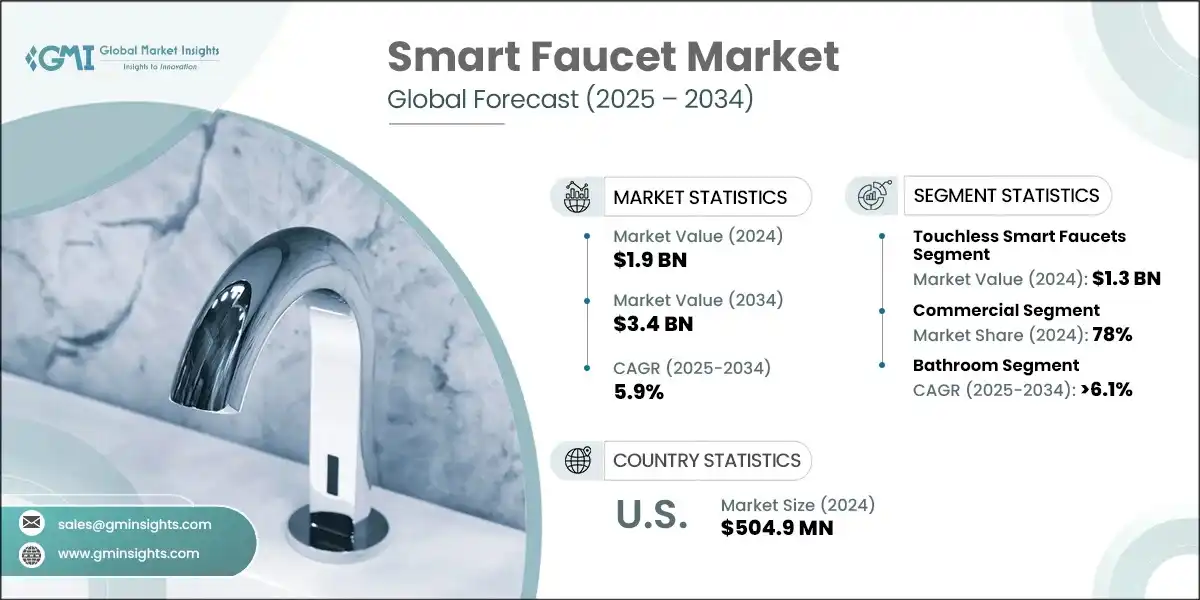
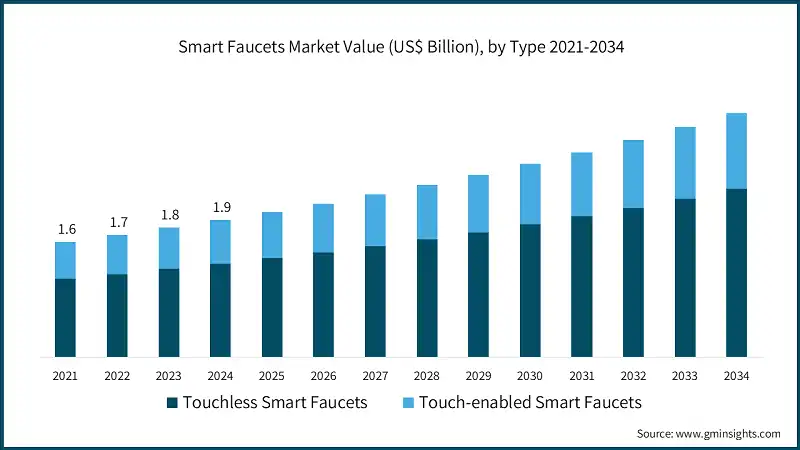
The global smart faucet market was estimated at USD 1.9 billion in 2024 and is expected to grow from USD 2 billion in 2025 to USD 3.4 billion by 2034, at a CAGR of 5.9%, according to Global Market Insights Inc.
Smart Faucet Market Key Takeaways
Market Size & Growth
- 2024 Market Size: USD 1.9 Billion
- 2034 Forecast Market Size: USD 3.4 Billion
- CAGR (2025–2034): 5.9%
Key Market Drivers
- Rising hygiene awareness & health concerns.
- Water conservation regulations.
Challenges
- High initial costs.
- Infrastructure compatibility issues.
Opportunity
- Rising smart home adoption worldwide.
- Expansion in the hospitality and healthcare sectors.
Key Players
- Market Leader: Moen led with over 8% market share in 2024.
- Leading Players: Top 5 players in this market include Moen, Kohler, Roca Sanitario, LIXIL, TOTO, which collectively held a market share of 28% in 2024.
Get Market Insights & Growth Opportunities
- The global smart faucet market is emerging due to the strong push for water conservation and water efficiency. People and companies are looking for ways to reduce water waste, and the trend of growing environmental awareness has made consumers and businesses aware of their impact, which has jump-started the demand for water-conserving solutions.
- Smart faucets with control of flow and sensor technology are an increasing option to optimize water use therefore, they are becoming popular in areas where there is still a surplus of water, regions suffering from water scarcity, and eco-conscious places. According to the UN World Water Development Report 2024, half of the world’s population experiences severe water scarcity for at least part of the year.
- The development of technology is another significant driver for market growth. Improvements in IoT, AI, touchless technology, and voice-controlled devices are making faucets connected, intelligent devices. They add not only capabilities and ease of use but also strengthen the smart home trend for progressive users.
- Increasing hygiene and health concerns are also driving demand, particularly in a post-pandemic environment. Touchless smart faucets help reduce contact with surfaces and enable safer and more sanitary surroundings. Demand is growing in healthcare facilities, commercial, and residential spaces, where hygiene, cleanliness, and the ability to control water and temperature without having to touch things are priorities.
- Urbanization and infrastructure development are also important market drivers. Increasing construction and renovation activity, particularly in residential, hospitality, and commercial areas, requires premium, water-saving fixtures. Rising disposable income and preference for the modern, sophisticated, and high-tech continue to ensure widespread use of smart faucets. As per the Government of India Press Information Bureau, India's total investment in infrastructure has grown strongly, with private and public sectors' investments defining the trend. India's total infrastructure outlay has grown manifold, with budgetary expenditure going up to USD 119.2 billion in 2023-24.
- According to the US Department of Transportation, USD 1.8 billion in infrastructure grants were announced in 2024. Large-scale investment in transport infrastructure, metro rail development, airports, smart cities, and office buildings is generating an ever-increasing demand for smart and water-saving technologies, including smart faucets.
- With infrastructure and development focusing on modern, accessible, and high-efficiency systems, smart faucets are now being introduced into the commercial and residential sectors beyond being just convenient, for promoting hygiene, enabling automation, and meeting the ever-changing sustainability expectations.
- Additionally, Europe is the fastest-growing region in the global smart faucet market. Growth of the market in Europe is influenced by more rigid environmental regulations, the pursuit of more sustainability, and a greater push for smart city development. European consumers are driven to continually implement water-efficient and automated solutions with the support of government incentives and prominent levels of technological readiness of countries such as Germany, the UK, and the Nordic countries.
To get key market trends
Smart Faucet Market Trends
- The market is changing quickly, with emerging trends unveiling ever-changing consumer choices, technological innovation, and heightened sanitary and sustainable concerns. One significant upward trend is the increasing integration of voice control and artificial intelligence into faucet systems.
- Smart faucets are being developed with the ability to be activated through voice commands, allowing the consumer to turn the water on or off, adjust temperatures, and measure use, all without touching the faucet. The AI-driven features provide enhanced convenience and are demonstrative of the broader trend towards intelligent, connected homes & devices. With voice-enabled features, faucets will experience wider adoption, especially as they become much more prevalent in kitchens and bathrooms of the future, appealing to consumers looking for touchless control and customization.
- Also, a major trend currently occupying the market is the adoption of touchless technology. With the heightened focus on hygiene and health awareness, consumers and businesses are investing in motion-sensor faucets to minimize physical contact. These faucets minimize the germ transmission risk and are easier to use, especially in hospitals, restaurants, public restrooms, and for households with kids or elderly individuals. The significant interest in touchless technology highlights an emphasis on smarter and more hygienic living spaces.
- One developing trend is the creation of hybrid smart faucet styles with both touchless and manual use. These dual-mode faucets give users more choice, so individuals can use the faucet in an automatic or a traditional manner depending on the circumstance. This trend corresponds to the market trying to cater to more consumer preferences and giving more versatile, practical, use cases to improve the user experience overall.
- The rise of smart faucets and their integration into the more connected world of smart home systems is becoming a major theme. With connected living being a greater part of people’s lives, consumers want devices that are connected to other devices, voice assistants, mobile apps, and water management systems. Smart faucets are now being designed to be able to monitor water use, detect leaks in usage, and even provide insights for use, all aimed at creating more eco-friendly and efficient use of households.
- Together, these trends are moving smart faucets from just functional devices to sophisticated tools that integrate convenience, hygiene, technology, and environmental responsibility, fulfilling the needs of consumers and the smart infrastructure of the future.
Smart Faucet Market Analysis
Learn more about the key segments shaping this market
Based on the type, the market is divided into touchless smart faucets and touch-enabled smart faucets. In 2024, touchless smart faucets dominated the market, generating revenue of USD 1.3 billion and are expected to grow at a CAGR of 6.1% during the forecast period.
- Touchless smart faucets remain dominant in the category due to the strong hygiene and health benefits. In a world that is increasingly focused on cleanliness and the reduction of germs, especially in the world health crisis, touchless technology provides a hands-free option that reduces the likelihood of cross-contamination. These kinds of faucets eliminate the need to touch handles or knobs, putting the user in a more sanitary and safer place
- One of the major elements of touchless smart faucets' dominance is their greater water conservation capability. Touchless smart faucets deliver water only when hands are present, using sensors and intelligent algorithms or settings to achieve less water usage. When hands are removed from the sensor, flow is easily stopped and is automatically controlled to prevent excess water usage. This control not only promotes water sustainability but also helps users save money. It encourages awareness of utility costs, making it an attractive option for both residential and commercial use.
Learn more about the key segments shaping this market
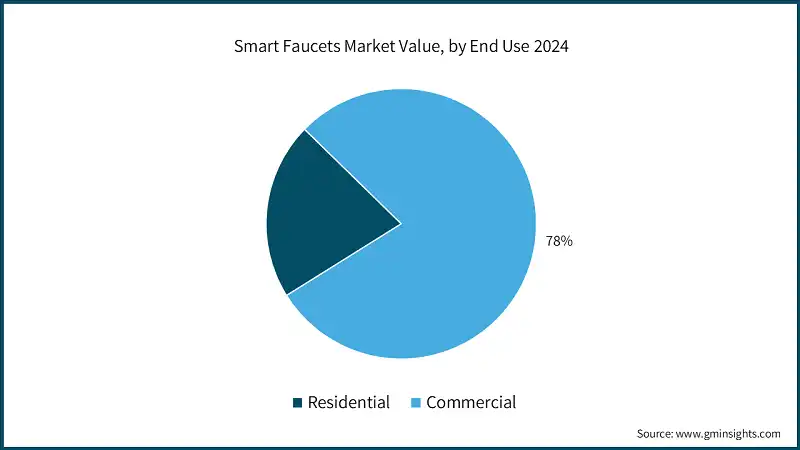
Based on end users, the smart faucet market is segmented into residential and commercial. In 2024, the commercial segment dominates the market with 78% market share and the segment is expected to grow at a CAGR of 5.8% from 2025 to 2034.
- The commercial sector is the biggest segment of growth in the market due to the high volume of usage and focus on efficiency of its operations. Commercial faucets are used in office buildings, hotels, hospitals, and public spaces with increased volume often exceeding hundreds and thousands of users per day. With so many users a day, it is an effortless way to save water and energy and maximize return on investment. Water waste is reduced, and automation helps quickly offset initial costs. The ability to streamline usage, prevent water leakage, and reduce manual maintenance makes smart faucets a practical and cost-effective solution for commercial environments.
- Another significant component is hygiene standards and regulatory compliance requirements. Commercial facilities, notably in the healthcare, hospitality, and food service sectors, are required to meet water efficiency laws and ensure hygiene. Touchless smart faucets help mitigate exposure to contamination, while also being compliant with sustainability requirements and certifications such as LEED. Touchless smart faucets facilitate a safer environment while continuing to exhibit a potent commitment toward public health and environmental awareness. This also adds to the value of smart faucets in commercial settings.
Based on applications, the smart faucet market is segmented into bathroom and kitchen. In 2024, the bathroom segment dominates the market and is expected to grow at a CAGR of over 6.1% from 2025 to 2034.
- The bathroom segment is the largest in the market, mainly because it meets hygiene needs while being universally applicable in any market. Bathrooms are considered high-risk areas for germ transmission. In these environments, touchless is extremely valuable. This is especially relevant in the commercial and public restroom segments, where many people pass through in a single day. This hygiene advantage continues to be a major market driver, particularly in areas with strict cleanliness standards such as healthcare, hospitality, and education.
- Another big aspect is that bathroom sinks are widely used and standardized across buildings. While kitchens can have customized faucet options that vary in layouts and functional needs, bathroom fixtures are more standardized and less complicated to install. Combined with frequent daily usage, whether for hand washing, brushing, or face washing, bathrooms offer ideal conditions for smart faucet technologies to demonstrate their value through water savings and convenience. With motion sensing/auto shut-off motion technology, it not only reduces water waste but also enhances the user experience, contributing to the segment's sustained growth.
Looking for region specific data?
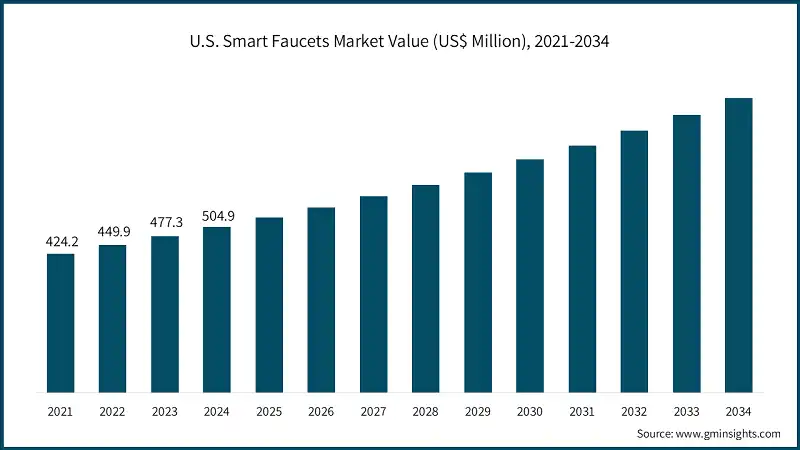
In terms of country, the United States led the smart faucet market with 77% of the North American market share and estimated USD 504.9 million in revenue during 2024.
- The expansion of the U.S. market is fueled by robust consumer demand, regulatory assistance, and infrastructure readiness. The most significant driver is the country's high adoption rate of smart homes. U.S. consumers are embracing connected living to embrace the efficiency and automation of their daily routines. This demonstrates high consumer adoption of smart faucets, which integrates wider smart home systems and provides additional value from hand-free operations, including voice control and app-based monitoring.
- Water conservation is another major driver. According to the United States Environmental Protection Agency, Household leaks can waste approximately 900 billion gallons of water annually nationwide. That's equal to the annual household water use of 11 million homes.
- With the growing awareness of the environment and regulations to encourage water savings like the EPA's Water Sense program, U.S. consumers and businesses are now highly invested in water-saving solutions. Smart faucets advance this objective by significantly reducing water use with innovative features such as motion sensor activation and automatic shut-off. These savings support sustainability initiatives while offering future cost savings and tremendous advantages, making smart faucets an appealing upgrade for homeowners and commercial businesses alike.
- In addition, strong construction and renovation activity across the United States is driving market growth. Homeowners are investing in upgrades to kitchens and bathrooms, typically with modern, high-tech fixtures, which elevate the room's features and functionality.
- The U.S. commercial sector, dominated by hotels, hospitals, offices, and public buildings, is also implementing smart technologies to increase cleanliness, minimize maintenance, and stay within compliance. With well-known retail channels and strong consumer acceptance, the U.S. is the biggest market in North America for smart faucet adoption and will continue to experience growth in the near term.
The Europe smart faucet market was valued at USD 563.6 million in 2024 and is projected to grow at a CAGR of 5.6% between 2025 and 2034.
- A blend of regulatory pressure, sustainability aspirations, and changing consumer preferences is driving the European market. A significant driver is the strong water conservation ambitions in the region. The European Water Label program and the Water Efficiency First Recommendation promote reducing water consumption and improving efficiency by 2030. These policies, backed by the EU Water Framework Directive, create a regulatory environment that strongly favors the adoption of water-saving technologies like smart faucets across residential, commercial, and public sectors.
- Furthermore, the increasing embrace of smart home technology in Europe is driving demand for connected and automated water fixtures. Smart faucets are being designed with increasing integration into home automation systems, often with touchless operation, voice-activated controls, and usage tracking. In addition to the region's well-established commercial infrastructure particularly in hospitality, health care, and office, these trends suggest continued, consistent growth through the European market.
The Asia Pacific smart faucet market was valued at USD 495.9 million in 2024 and is projected to grow at a CAGR of 6.4% between 2025 and 2034.
- The Asia Pacific market relies primarily on strong economic growth, investment in infrastructure, and increased adoption of smart technologies. One of the most significant drivers is rapid urbanization and the construction boom across the region. There is a lot of development in residential and commercial properties in China, India, and Southeast Asian countries.
- Urbanized areas, like cities, are increasingly densified. According to the UN-Habitat report, the Asia Pacific region already accounts for over 60% of the world’s urban population, with approximately 2.1 billion people now living in cities and this figure is projected to rise to about 3.4 billion by 2050. With an expanding population and increased per capita disposable income, growing segments of consumers are willing to spend money on modern smart home upgrades, including smart faucets, that provide convenience and sustainability.
- Smart city initiatives and overall technology adoption are fuelling growth in connected faucets. Asia Pacific includes some of the most ambitious smart city projects in the world China, Japan, India, and Singapore. Smart city programs involve technology infusion, particularly utility management, into urban infrastructure and smart water management systems. As part of these smart city ecosystems, smart faucets can also now be found in public and private buildings to support resource efficiency, hygiene, and digital connectivity. The combination of technology push and the growing connected living trend is accelerating the adoption of smart faucets across the Asia Pacific.
The Middle East and Africa smart faucet market was valued at USD 109.6 million in 2024.
- Although the Middle East and Africa market is the smallest by value, it has significant potential for growth based on several region-specific factors. The increasing emphasis on luxury real estate and tourism in the region is leading to the demand for high-end, intelligent fittings. Hotels, resorts, and high-end residential projects are starting to use smart faucets that align with international standards around guest experience, hygiene, and sustainability.
- Smart faucet uptake is particularly strong in Gulf countries, where investment in hospitality and lifestyle infrastructure continues to increase. Government-led smart water management initiatives and economic diversification initiatives are beneficial in the Middle East and Africa, as smart faucet adoption continues to develop.
Smart Faucet Market Share
- The top 7 companies in the market are Moen Incorporated, Hansgrohe, Delta Faucet, Kohler, Roca Sanitario, LIXIL, and TOTO, collectively holding a share of 28% in the market.
- These companies continue to acquire and merge with others, expand facilities, and make various collaborations to increase their product offerings, access customer bases, and secure their market positions.
- Moen Incorporated is increasing its market share by combining smart technology and user-friendly design with the introduction of voice-activated and app-controlled faucets under its branded line of "U by Moen." This large company first launched the product line nationally in the United States. Voice-activated and app-controlled on/off operation can be linked with Amazon Alexa and Google Assistant.
- Kohler is gaining market share in traditional bathrooms and kitchens while establishing itself as a luxury smart home brand. Kohler promotes connected ecosystems of bathrooms and kitchens. The Kohler Konnect smart platform enables voice activation, app personalization, and water usage reports, appealing to environmentally conscious homeowners, as well as homeowners who value technology.
- Roca Sanitario, S.A. is increasing its market share by focusing on water efficiency, designing innovative products, utilizing its strong European presence, and emerging market enthusiasm. The brand focuses on sustainable bathroom products, including smart faucet features that meet developing regulatory requirements and green building codes.
Smart Faucet Market Companies
Major players operating in the smart faucet industry are:
- ASSA ABLOY
- BRIZO Kitchen & Bath
- Delta Faucet
- Gessi
- Hansgrohe
- House of Rohl
- Kohler
- KWC
- LIXIL
- Masco
- Moen
- Oras
- Roca Sanitario
- TOTO
- Villeroy & Boch
To improve the product and market share key players are constantly investing in technological activities and are also entering into partnerships to provide improved and better solutions for the customers. These investments are benefiting both companies and customers as they help develop and offer solutions as per the changing technological trends and thus the customer requirements.
Moen Incorporated is the best-known and largest manufacturer of kitchen and bathroom fixtures in the USA, acclaimed for design and innovation in smart water solutions. By balancing design and technology with a commitment to sustainability, Moen has seamlessly created a collection of smart faucets that work and integrate with digital assistants and mobile applications. Moen is a member of the Fortune Brands Innovations family of brands and has a strong retail footprint in North America.
Hansgrohe SE is a premium brand originating from Germany and is dedicated to its premium bathroom and kitchen fixtures. Hansgrohe is serious about its focus on design, technology, and sustainability. Hansgrohe SE focuses on the aesthetic while providing utility. Hansgrohe is part of the Hansgrohe Group and operates on a worldwide scale, especially in Europe and Asia, in residential, commercial, and hospitality sectors.
Kohler is a leader in kitchen and bath design and manufacturing, based in the United States of America. Kohler has a history of craftsmanship and global brand innovation. Recently, Kohler has launched smart faucets that are connected to the Kohler Konnect smart home suite of products. Kohler is recognized as a luxury brand in the residential and hospitality environments. Kohler is widely used in premium residential projects and international hospitality projects.
Smart Faucet Market Report Attributes
| Key Takeaway | Details |
|---|---|
| Market Size & Growth | |
| Base Year | 2024 |
| Market Size in 2024 | USD 1.9 Billion |
| Forecast Period 2025 - 2034 CAGR | 5.9% |
| Market Size in 2034 | USD 3.4 Billion |
| Key Market Trends | |
| Drivers | Impact |
| Rising hygiene awareness & health concerns | There is increasing demand for touchless, sensor-based faucets that reduce surface contact and improve sanitation. |
| Water conservation regulations | Global initiatives and regulations like EPA Water Sense and EU Water Label encourage smart faucet adoption for efficient water usage. |
| Pitfalls & Challenges | Impact |
| High initial costs | Smart faucets are more expensive than traditional options, limiting adoption in price-sensitive markets or budget-constrained projects. |
| Infrastructure compatibility issues | Older plumbing infrastructure in many buildings makes retrofitting with smart faucets complex and costly. |
| Opportunities: | Impact |
| Rising smart home adoption worldwide | Increasing consumer interest in home automation creates strong demand for integrated smart water fixtures like faucets. |
| Expansion in the hospitality and healthcare sectors | Hotels, resorts, and hospitals are upgrading to touchless smart faucets to enhance hygiene and user experience. |
| Market Leaders (2024) | |
| Market Leaders |
8% market share |
| Top Players |
Collective market share in 2024 is 28% |
| Competitive Edge |
|
| Regional Insights | |
| Largest Market | North America |
| Fastest Growing Market | Europe |
| Emerging Country | India, UAE, Germany |
| Future Outlook |
|
What are the growth opportunities in this market?
Smart Faucet Industry News
- In April 2025, Gessi launched its Vita digital faucet system, which is an award-winning multifaceted kitchen wellness solution that offers still water, including sparkling and hot, boiling water, and espresso from a digital interface.
- In March 2025, at KBIS 2025, Brizo launched its newest Le Beauclere faucet line and its SensoriPlus digital shower that utilizes smart sensors and Chroma therapy technology. Also, Brizo continues to bring kitchen touch tech to the next level with new products like Smart Touch and a TempID LED-temperature-display faucet.
- In March 2024, ASSA ABLOY announced a 23% reduction in absolute carbon emissions and a 51% reduction in water intensity since 2019, exemplifying its sustainability performance as an effort across its plumbing and fixtures business.
- In February 2024, Delta Faucet Company unveiled its Touch2O line with touchless technology at the 2024 Kitchen & Bath Industry Show, and in addition, recently acquired luxury brand Newport Brass, which indicates that they are more seriously looking to penetrate premium markets.
The smart faucet market research report includes in-depth coverage of the industry with estimates & forecasts in terms of revenue (USD Billion) and volume (Million Units) from 2021 to 2034, for the following segments:
Market, By Type
- Touchless smart faucets
- Touch-enabled smart faucets
Market, By Material
- Metallic
- Plastic
- Others
Market, By Application
- Bathroom
- Kitchen
Market, By End use
- Residential
- Commercial
- Hotels & restaurants
- Hospitals
- Corporate offices
- Public washrooms
- Others
Market, By Distribution Channel
- Online
- E-commerce
- Company websites
- Offline
- Supermarkets/hypermarket
- Specialty retail stores
- Others (independent retailer etc.)
The above information is provided for the following regions and countries:
- North America
- U.S.
- Canada
- Europe
- Germany
- UK
- France
- Spain
- Italy
- Netherlands
- Asia Pacific
- China
- Japan
- India
- Australia
- South Korea
- Latin America
- Brazil
- Mexico
- Argentina
- MEA
- South Africa
- Saudi Arabia
- UAE
Frequently Asked Question(FAQ) :
What is the market size of the smart faucet in 2024?
The market size was USD 1.9 billion in 2024, with a CAGR of 5.9% expected through 2034. Increasing integration of voice control, AI features, and demand for touchless solutions are driving market growth.
What is the projected value of the smart faucet market by 2034?
The market is projected to reach USD 3.4 billion by 2034, fueled by advancements in AI, voice-enabled features, and the growing adoption of smart home technologies.
What is the growth outlook for the commercial segment from 2025 to 2034?
The commercial segment is expected to grow at a CAGR of 5.8% from 2025 to 2034, driven by increasing adoption in public and commercial spaces prioritizing hygiene and sustainability.
What is the growth outlook for the bathroom segment from 2025 to 2034?
The bathroom segment is projected to grow at a CAGR of over 6.1% from 2025 to 2034, supported by rising demand for touchless and customizable solutions in residential and commercial bathrooms.
Which country leads the smart faucet market in 2024?
The United States leads the market, accounting for 77% of the North American market share and generating an estimated USD 504.9 million in revenue in 2024.
What are the upcoming trends in the smart faucet industry?
Trends include the integration of voice control and AI, touchless activation, water usage monitoring, and the growing adoption of smart home ecosystems. These features align with consumer preferences for convenience, hygiene, and sustainability.
Who are the key players in the smart faucet market?
Key players include ASSA ABLOY, BRIZO Kitchen & Bath, Delta Faucet, Gessi, Hansgrohe, House of Rohl, Kohler, and KWC.
Smart Faucet Market Scope
Related Reports