Summary
Table of Content

Smart Electric Panel Market
Get a free sample of this report
Form submitted successfully!
Error submitting form. Please try again.
Thank you!
Your inquiry has been received. Our team will reach out to you with the required details via email. To ensure that you don't miss their response, kindly remember to check your spam folder as well!
Request Sectional Data
Thank you!
Your inquiry has been received. Our team will reach out to you with the required details via email. To ensure that you don't miss their response, kindly remember to check your spam folder as well!
Form submitted successfully!
Error submitting form. Please try again.
Smart Electric Panel Market Size
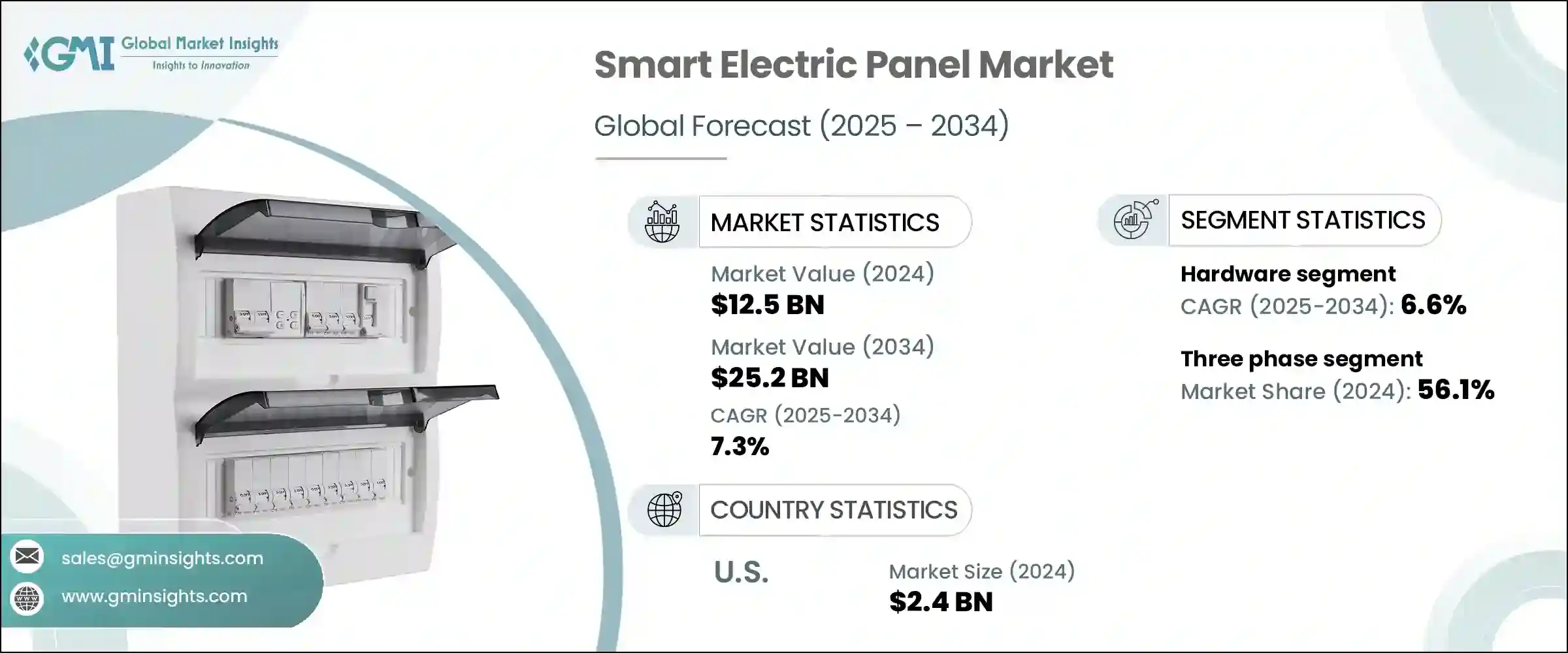
The global smart electric panel market size was valued at USD 12.5 billion in 2024 and is expected to reach USD 25.2 billion by 2034, growing at a CAGR of 7.3% from 2025 to 2034. Increasing deployment of smart panels featuring embedded artificial intelligence and machine learning for real-time energy analytics, predictive maintenance, and load forecasting will create favorable business scenario.
Smart Electric Panel Market Key Takeaways
Market Size & Growth
- 2024 Market Size: USD 12.5 Billion
- 2034 Forecast Market Size: USD 25.2 Billion
- CAGR (2025–2034): 7.3%
Key Market Drivers
- Growing adoption of renewable energy systems.
- Paradigm shift toward the development of smart buildings.
- Surging modernization of smart grids.
Challenges
- Increasing expansion of EV infrastructure.
- High initial cost.
Get Market Insights & Growth Opportunities
A shift toward local data processing capabilities in panel enhances decision-making speed and reduces dependency on cloud latency will energize industry momentum. Substantial demand for compact and scalable modular design which are gaining traction owing to easy integration & future expansion of smart home and industrial infrastructure will positively sway business growth.
The widespread adoption of Zigbee, Z-Wave, Wi-Fi, and Bluetooth Low Energy (BLE) in smart panels which support enhanced interoperability across smart devices will drive product demand. Increasing cybersecurity risks, key industry manufacturers are integrating various features into their smart panels including encrypted firmware updates, user authentication layers, and secure gateways for grid interconnection, which will strengthen business growth.
Surging consumer demand for smart thermostats, lightning, and appliances in residential settings will escalate industry trajectory. Homeowners are seeking solutions that enable time-of-use management and energy cost visualization to reduce bills will foster business potential. Additionally, rising EV adoption has led to smart panels with built-in Level 2 charging circuit compatibility.
Growing incorporation of these systems with Building Energy Management Systems and HVAC systems primarily in commercial application which will proliferate industry trend. Moreover, construction firms and telecom operators benefit from remote control and monitoring in distributed word environments, thereby propelling business dynamics.
To get key market trends
Smart Electric Panel Market Trends
The industry is poised for substantial growth owing to these systems increasingly supporting distributed energy resources including EV chargers, home batteries, and solar inverters. Continuous modernization and retrofitting of older homes with smart panels to enable energy code compliance and support modern loads, which will boost product expansion.
These panels are designed with user-friendly interfaces for easier installation and remote diagnostics along with industrial users are adopting these units that can switch between utility, storage, and generator sources for uninterrupted operations, which will fuel industry potential. Furthermore, rapid deployment of these systems to avoid peak charges by automatically shedding non-critical loads will accelerate business expansion.
For reference, in July 2023, the strategic collaboration between NREL and SPAN aims to deliver an advanced home energy management system integrated within SPAN’s smart electrical panel platforms with total funding accounted USD 710,000.
Increased regulatory scrutiny and ESG reporting require smart panels to provide extensive data logs and diagnostic will spur industry penetration. These systems play a critical role in grid modernization by enabling two-way communication with utilities for load balancing will augment business outlook.
Surging integration with smart meters to dynamically manage voltage and reduce grid losses will amplify product demand. These panels with real-time outage alert supports faster grid restoration and customer notification, which will fortify industry growth. The growth in smart homes is simulating consumer interest in whole-home energy dashboards and digital circuit controls will proliferate business expansion.
Key industry manufacturers are offering digital twins of their panels for predictive modeling and maintenance planning which will propel the product demand. In addition, these panels are facilitated by OpenADR, CTA-2045, and UL 916 certification to ensure they meet universal compatibility and safety standards, thereby fostering business landscape.
Smart Electric Panel Market Analysis
Learn more about the key segments shaping this market
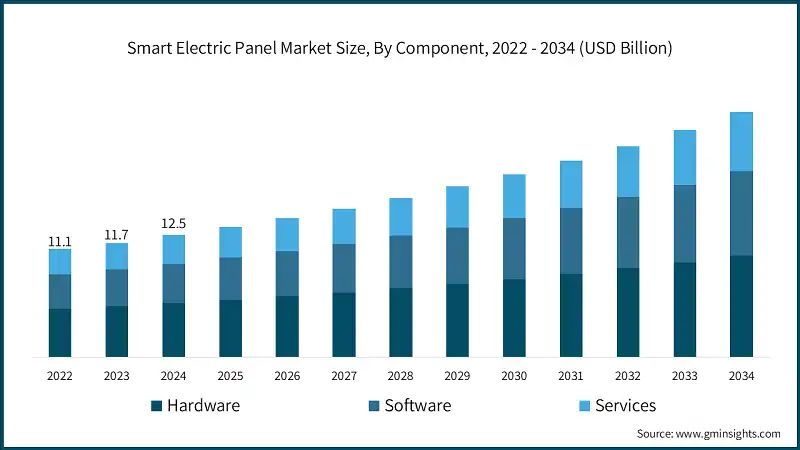
- The smart electric panel industry was valued at USD 11.1, 11.7 & 12.5 billion in 2022, 2023 and 2024 respectively. Surging adoption of these panels which simplify net metering calculations and allow homeowners to view their exported and imported energy data in real time, thereby propelling industry trends.
- Based on component, the market is segmented into hardware, software, and services. The hardware smart electric panel market will grow at a CAGR of 6.6% through 2034. Increasing shifts toward compact, high density circuit boards to enable more features in smaller enclosures will sway the industry landscape.
- For illustration, in 2025, PSEG Long Island proposed a 2025 Utility 2.0 budget of USD 27.6 million, comprising USD 13.24 million in capital expenditure and USD 14.36 million for operations and maintenance to support ongoing and expanded initiatives.
- The software smart electric panel market was valued at USD 4.1 billion in 2024. The widespread adoption of cloud platforms for remote access, analytics, and control of energy usage will energize business growth. Moreover, integration of machine learning algorithms to analyze consumption patterns and optimize circuit behavior autonomously will accelerate industry trend.
- The services smart electric panel market will exceed USD 6 billion by 2034. Service providers are offering bundled installation, configuration, and system commissioning tailored to user needs, which in turn will proliferate business dynamics. Growing demand for expert audits to optimize panel performance, especially in commercial and industrial buildings will augment service demand.
Learn more about the key segments shaping this market
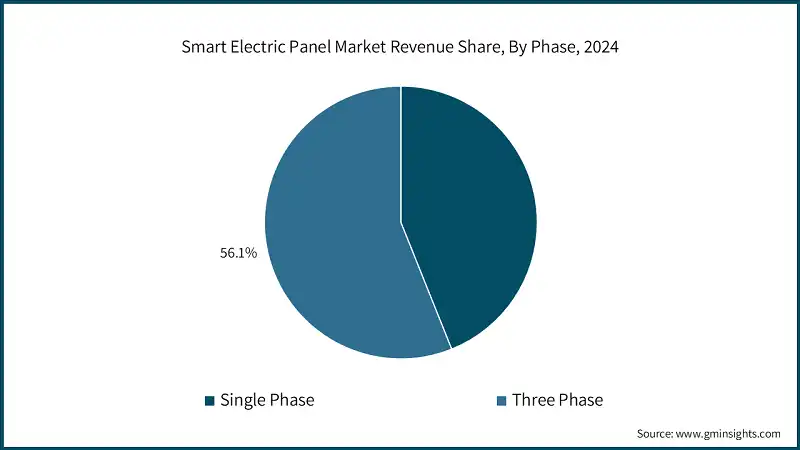
- Based on phase, the industry is segmented into single phase and three phase. The three phase smart electric panel holds a market share of 56.1% in 2024. These panels are used in facilities with high power demand including factories, hospitals, and data centers. In addition, Modern panels offer expanded circuit capacity with higher current ratings to manage complex loads, thereby driving industry growth.
- For instance, in November 2023, the European Union launched a USD 4.61 billion grant funding initiative to support a wide range of clean energy projects across both upstream and downstream value chains.
- The single phase smart electric panels market will exceed USD 10 billion by 2034. Single phase panels are predominantly used in homes and small-scale commercial buildings where loads requirements are modest, further driving the product penetration.
- Homeowners are upgrading legacy panels with smart alternatives to gain energy insights and automation benefits, which will fuel the product demand. Flourishing real estate sector along with increasing investments toward the development of multi family apartments will positively sway the business growth.
Looking for region specific data?
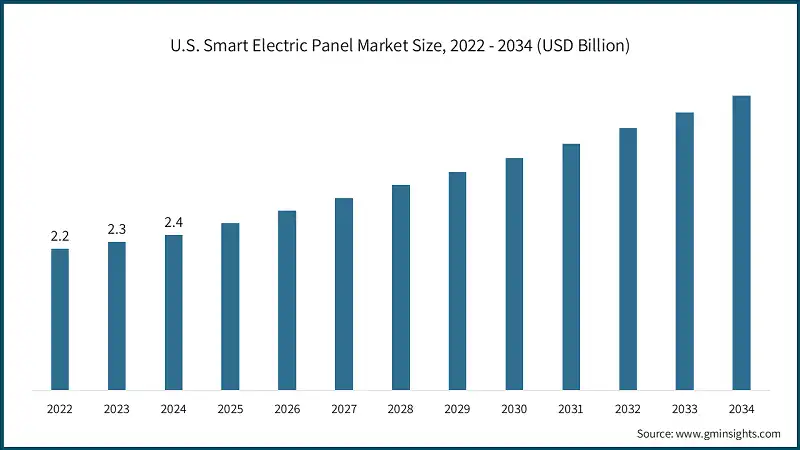
- The U.S. smart electric panel market was valued at USD 2.2, 2.3 & 2.4 billion for 2022, 2023 and 2024, respectively. Growing consumer demand for electric vehicles, heat pumps, and induction cooking is accelerating the shift toward smarter residential panels. Furthermore, utilities are incentivizing smart panel installations as part of broader grid-interactive efficient building programs.
- North America smart electric panel market is projected to surpass USD 6 billion by 2034. Strong emphasis on wildfire prevention in key geographies is pushing the use of smart panels with remote disconnect capabilities will escalate industry momentum. Increasing demand from suburban homes owing to storm resilient power backup integration will foster business expansion.
- For instance, in October 2024, the Minister of Energy and Natural Resources announced up to USD 500 million in funding under the Smart Renewable and Electrification pathways utility support system.
- The Asia Pacific smart electric panel market share will witness an upsurge owing to increasing urbanization growth and rising energy consumption in key emerging economies are driving the demand for these systems. Moreover, supportive government mandates for smart building infrastructure will positively impact industry growth.
- The Europe smart electric panel market was evaluated at USD 2.8 billion in 2024. Supportive EU directives focusing on carbon neutrality and digital energy meters are strengthening industry landscape. Growing interest in integrating panels with heat pumps and home automation systems will fortify business growth.
- For citation, in June 2025, the European Commission released a guidance document focused on anticipatory investments to support the development of future ready electricity networks. With projected infrastructure, it needs to reach USD 840.23 billion for distribution and USD 549.03 billion for transmission by the year 2040.
- The Middle East & Africa smart electric panel market is set to reach over USD 2.5 billion by 2034. Energy diversification programs in Gulf countries are accelerating the adoption of smart energy infrastructure, which will augment business landscape. Moreover, these systems are being deployed in large-scale development projects and smart cities will strengthen industry development across the region.
- The Latin America smart electric panel market is poised to grow at a CAGR of 8.2% till 2034. Power instability and grid outages are the key parameters that are driving the demand for smart panels with automatic transfer switch features. In addition, public-private partnerships are fostering digital energy infrastructure in metro areas, which has led the business penetration.
Smart Electric Panel Market Share
- The top 5 players including Schneider Electric, Siemens, ABB, General Electric, and Legrand together hold a share of about 40% in the smart electric panel industry. Rockwell’s edge lies in deep integration with its FactoryTalk software suite and PLC control, offering seamless data connectivity and automation capabilities.
- ABB faces intensifying competition in the smart electrical panel market, driven by rapid innovation, evolving regulatory standards, and increasing demand for home energy automation. The market is characterized by technology-driven differentiation, with a strong emphasis on user-friendly interfaces, real-time monitoring, and energy optimization.
- Siemens differentiates through its focus on industrial IoT integration, cyber-secure grid-edge solutions, and modular panel designs including SENTRON PAC4200, which enable advanced features including arc-fault detection, load balancing, and peer-to-peer energy trading.
Smart Electric Panel Market Companies
- In 2024, ABB recorded USD 32.9 billion revenue which was a 2% increase from last year along with an investment of USD 1.5 billion in research and development. The company also recorded an Operational EBITA margin of 18%.
- In the second quarter of 2025, Siemens reported a 10% year-over-year increase in orders, reaching USD 24.9 billion, while revenue grew 7% to USD 22.6 billion, resulting in a book-to-bill ratio of 1.10. On a comparable basis, which excludes the impact of currency fluctuations and portfolio changes, orders rose by 9% and revenue increased by 6%.
- Eaton has delivered record first quarter earnings per share of USD 2.45, marking a 20% increase over Q1 in 2024, along with record adjusted EPS of USD 2.72, up 13% year-over-year. Organic sales grew by 9%, exceeding the upper end of guidance, reflecting robust operational performance.
Major players operating in the smart electric panel industry are:
- ABB
- Accu Panels
- Chint Group
- Eaton
- EcoFlow Technology
- Emerson Electric
- General Electric
- Hager Group
- Havells India
- Honeywell International
- Legrand
- Leviton Manufacturing
- Lumin
- Qmerit Electrification
- Rockwell Automation
- Schneider Electric
- Siemens
- SPAN
Smart Electric Panel Market Report Attributes
| Key Takeaway | Details |
|---|---|
| Market Size & Growth | |
| Base Year | 2024 |
| Market Size in 2024 | USD 12.5 Billion |
| Forecast Period 2025 – 2034 CAGR | 7.3% |
| Market Size in 2034 | USD 25.2 Billion |
| Key Market Trends | |
| Growth Drivers |
|
| Pitfalls & Challenges |
|
What are the growth opportunities in this market?
Smart Electric Panel Industry News
- In February 2025, Schneider Electric introduced an innovative solution designed to meet the rising demand for home electrification while minimizing reliance on expansive and complex traditional electrical service upgrades. Unveiled at the 2025 NAHB International builders’ Show in Las Vegas, the new Smart Power Manger, a key feature within the Square D QO Smart Panel Solution enhanced residential energy control and efficiency.
- In December 2024, Legrand announced the acquisition of Power Bus Way, a Toronto-based leader in custom-engineered cable bus systems for data centers, industrial facilities, and commercial projects. This strategic acquisition strengthens Legrand’s position in the high-growth North American Market, where demand for digital infrastructure continue to surge.
- In June 2024, ABB launched the ReliaHome Smart Panel, its first residential energy management software platform for the U.S. and Canada market. Developed in partnership with Lumin, a prominent player in responsive load management technology, this advanced solution delivers superior user experience and seamless energy efficiency through an intuitive, easy-to-use interface.
- In March 2024, Rockwell Automation announced the regional rollout of its CUBIC product line. Specializing in IEC-61439-compliant modular enclosure systems, CUBIC enables efficient and flexible construction of power distribution and electrical panels. This product line is strategically positioned to support high-growth sectors including renewable energy, data centers, mining, food and beverage, chemical processing, and infrastructure development.
The smart electric panel market research report includes in-depth coverage of the industry with estimates & forecast in terms of revenue (USD Million) from 2025 to 2034, for the following segments:
Market, By Component
- Hardware
- Software
- Services
Market, By Phase
- Single phase
- Three phase
Market, By Technology
- Wired
- Wireless
Market, By Application
- Residential
- Commercial
- Industrial
Market, By Sales Channel
- Online
- Dealer
- Retail
The above information has been provided for the following regions and countries:
- North America
- U.S.
- Canada
- Mexico
- Europe
- UK
- France
- Germany
- Italy
- Russia
- Spain
- Netherlands
- Austria
- Asia Pacific
- China
- Japan
- South Korea
- India
- Australia
- New Zealand
- Malaysia
- Indonesia
- Middle East & Africa
- Saudi Arabia
- UAE
- Qatar
- Egypt
- South Africa
- Nigeria
- Kuwait
- Oman
- Latin America
- Brazil
- Peru
- Argentina
Frequently Asked Question(FAQ) :
How big is the smart electric panel market?
The smart electric panel market was valued at USD 12.5 billion in 2024 and is expected to reach around USD 25.2 billion by 2034, growing at 7.3% CAGR through 2034.
What is the size of software segment in the smart electric panel industry?
The software segment generated over USD 4.1 billion in 2024.
How much is the U.S. smart electric panel market worth in 2024?
The U.S. smart electric panel market was worth over USD 2.4 billion in 2024.
Who are the key players in smart electric panel market?
Some of the major players in the smart electric panel industry include Eaton, EcoFlow Technology, Emerson Electric, General Electric, Hager Group, Havells India, Honeywell International, Legrand, Leviton Manufacturing, Lumin, Qmerit Electrification, Rockwell Automation, Schneider Electric, Siemens, SPAN.
Smart Electric Panel Market Scope
Related Reports