Summary
Table of Content

Smart Electric Food Waste Composting Machine Market
Get a free sample of this report
Form submitted successfully!
Error submitting form. Please try again.
Thank you!
Your inquiry has been received. Our team will reach out to you with the required details via email. To ensure that you don't miss their response, kindly remember to check your spam folder as well!
Request Sectional Data
Thank you!
Your inquiry has been received. Our team will reach out to you with the required details via email. To ensure that you don't miss their response, kindly remember to check your spam folder as well!
Form submitted successfully!
Error submitting form. Please try again.
Smart Electric Food Waste Composting Machine Market Size
The global smart electric food waste composting machine market was estimated at USD 1.02 billion in 2025. The market is expected to grow from USD 1.10 billion in 2026 to USD 2.54 billion in 2035, at a CAGR of 9.7%, according to latest report published by Global Market Insights Inc.
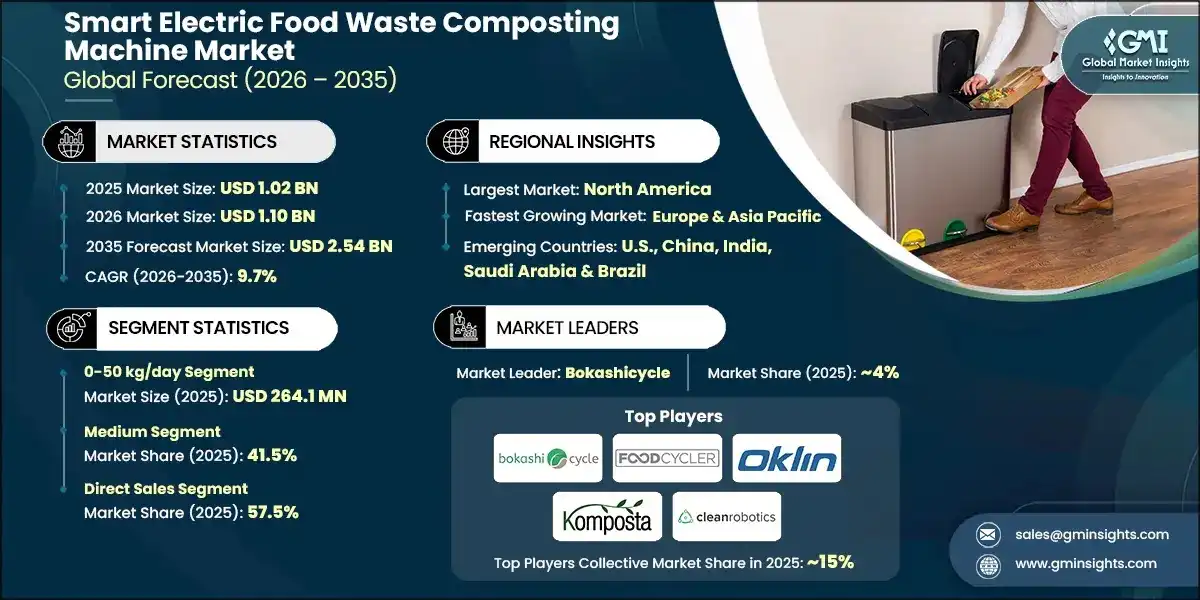
To get key market trends
- The smart electric food waste composting machine industry continues to see expansive growth due to the escalating levels of food waste being produced around the world. The food and agriculture organization (FAO) estimates that an estimated 1.3 billion tons of food are wasted each year, representing nearly one-third of total food production globally. Therefore, it is important for governments to establish stricter legislative/regulatory controls on waste management and require diversion of waste from landfills to meet these challenges through legislation and regulation.
- In conjunction with the development of the circular economy framework, there has been a significant rise in government regulations and legislation mandating sustainable practices as well as diversion of waste from landfills, so the demand for advanced composting equipment capable of reducing greenhouse gases and complying with environmental regulations has dramatically increased as a direct result of these government initiatives.
- The market is shifting as the consumer understands the effect their consumption has on the environment, and as companies embed waste reduction practices into environmental social and governance (ESG) policy as a method to accomplish their initiatives, develop a more robust brand perception, therefore driving demand for smart composting appliances. The result of this collective focus on sustainable practices and sustainable technologies within the marketplace is driving adoption of these machines as innovative, cost-effective and measurable methods for supporting environmental initiatives. A report produced by the environmental protection agency (EPA) describes how composting can reduce landfill methane emissions by 50% or more, resulting in considerable greenhouse gas reduction potential.
- A trend in technology and innovative products is creating even greater demand for modern composting machines with AI-driven automation, IoT connectivity, and advanced odor control technology making them much smarter and easier to use than ever before. The ability to rapidly convert organic waste to compost using enzymes and/or microorganisms provide a significant reduction in processing time as well as an increase in speed for what traditionally may have taken weeks or months to compost. Also, due to their compact size, low energy consumption, and suitability for use in both residential and commercial settings increase access and user-friendliness. For example, the following compost machines can process food waste and be ready for application in less than 24 hours from the time of collection until it can be applied to the field or garden because of its nutrient-rich content.
- This continuing increase in technology and innovation in composting is now taking composting out of the niche markets and making it an acceptable and viable solution for the sustainable management of organic waste today. With continued growth in regulatory requirements and increased attention to the importance of sustainability throughout the globe, it is expected that the smart electric food waste composting machine industry will experience significant growth over the next several years with increased and expanding product offerings that will now be able to assist in meeting the critical environmental challenges facing the world today.
Smart Electric Food Waste Composting Machine Market Report Attributes
| Key Takeaway | Details |
|---|---|
| Market Size & Growth | |
| Base Year | 2025 |
| Market Size in 2025 | USD 1.02 Billion |
| Market Size in 2026 | USD 1.10 Billion |
| Forecast Period 2026-2035 CAGR | 9.7% |
| Market Size in 2035 | USD 2.54 Billion |
| Key Market Trends | |
| Drivers | Impact |
| Rising global food waste and regulatory pressure | Creates strong demand for smart composting solutions as governments enforce landfill bans and sustainability mandates. |
| Increasing consumer and corporate sustainability initiatives | Boosts adoption across households and businesses aiming to meet zero-waste and ESG goals. |
| Advancements in composting technology and product innovation | Improves efficiency, convenience, and affordability, making smart composting machines more attractive to a wider audience. |
| Pitfalls & Challenges | Impact |
| High initial capital investment and maintenance costs | Restricts penetration among small businesses and households, slowing adoption in price-sensitive markets. |
| Limited awareness and adoption in developing regions | Hampers market growth due to lack of education on benefits and insufficient infrastructure for waste segregation. |
| Opportunities: | Impact |
| Expanding urban populations | Drives demand for compact, smart composting units in space-constrained urban households and commercial kitchens. |
| Growing governmental incentives and regulations | Encourages faster adoption through subsidies, tax benefits, and compliance requirements for sustainable waste management. |
| Market Leaders (2025) | |
| Market Leaders |
Market share of ~4% |
| Top Players |
Collective market share in 2024 is Collective market share of ~15% |
| Competitive Edge |
|
| Regional Insights | |
| Largest Market | North America |
| Fastest Growing Market | Europe & Asia Pacific |
| Emerging Country | U.S., China, India, Saudi Arabia & Brazil |
| Future Outlook |
|
What are the growth opportunities in this market?
Smart Electric Food Waste Composting Machine Market Trends
The smart electric food waste composting machines market is also experiencing a large amount of market growth due to an increase in the global population and awareness of the need for environmental protection, combined with new government regulations that promote waste diversion from landfills.
- Technological advances are also a contributing factor in this market's growth. Today's composting machines utilize technology and features such as AI-based automatic controls, internet of things (IoT)-based connectivity, and sophisticated odor control systems that allow them to monitor their performance in real-time, increase operational efficiency, and increase user convenience. Additionally, the development of rapid composting technologies with specially formulated enzymes and microbiological activity has dramatically reduced time to complete the composting process, and the development of compact, energy-efficient composting machinery has created solutions to the challenges faced by urban households and businesses due to space and energy usage.
- Increasingly, restaurants, hotels, educational institutions and several commercial establishments are beginning to invest in on-site composting solutions as they seek to enhance their environmental, social and governance (ESG) commitments, whilst reducing operational costs.
- Homeowners are also increasingly adopting residential composting solutions, largely because of the trending concept of Zero Waste and the increasing presence of technological innovations such as smart kitchen appliances in the home.
- With the convergence of increased focus on environmental issues and incorporation of technological innovations, combined with the changing behaviors of consumers and organizations towards sustainability, the commercial composting market is poised to experience rapid and significant growth over the next several years.
Smart Electric Food Waste Composting Machine Market Analysis
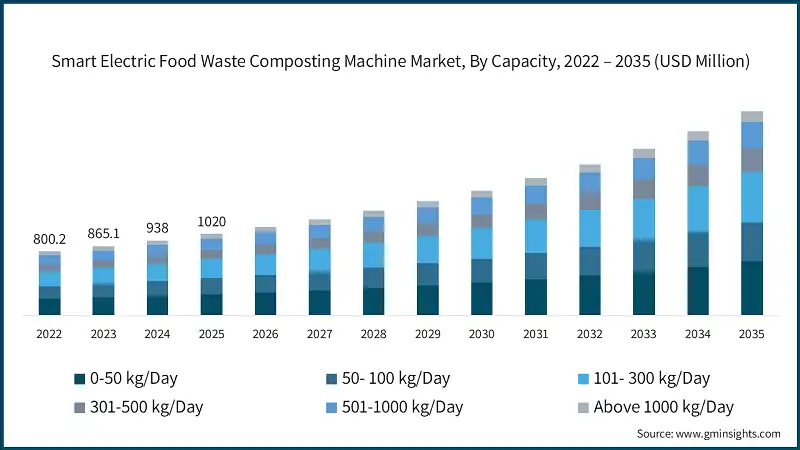
Learn more about the key segments shaping this market
Based on capacity, the smart electric food waste composting machine industry is categorized into 0-50 kg/day, 50-100 kg/day, 101-300 kg/day, 301-500 kg/day, 501-1000 kg/day and above 1000 kg/day. the 0-50 kg/day accounted for revenue of around USD 264.1 million in 2025 and is anticipated to grow at a CAGR of 10% from 2026 to 2035.
- The growth is due to its strong appeal among residential users, small businesses, and institutions seeking compact, cost-effective, and easy-to-operate composting solutions. Urbanization and the rise of apartment living have created a demand for space-saving appliances that can handle household food waste efficiently without requiring large infrastructure.
- Additionally, growing consumer awareness about zero-waste lifestyles and sustainability is driving adoption of these smaller units, which are ideal for kitchens, cafes, and small restaurants. Technological advancements such as AI-enabled automation, odour control systems, and rapid composting using enzymes have made these machines more convenient and user-friendly, further boosting their popularity.
Based on price of smart electric food waste composting machine market consists of low, medium, and high. The medium priced emerged as leader and held 41.5% of the total market share in 2025 and is anticipated to grow at a CAGR of 11.1% from 2026 to 2035.
- Consumers are increasingly seeking machines that offer smart features such as IoT connectivity, automated composting cycles, odor control, and energy efficiency without the premium cost associated with high-end models. Medium-priced units typically provide these essential features while maintaining durability and ease of use, which appeals to eco-conscious households, small businesses, and institutions looking for reliable solutions within a reasonable budget.
- Additionally, this segment benefits from strong demand in urban areas where space constraints and sustainability initiatives drive adoption of compact yet technologically advanced machines. Government incentives and rebates for sustainable appliances further enhance the value proposition of medium-priced models, positioning them as the most practical choice for a wide range of users.
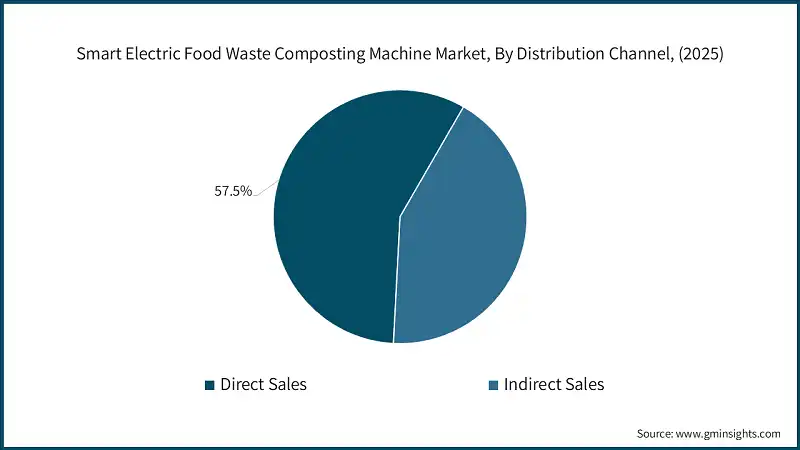
Learn more about the key segments shaping this market
Based on distribution channel of smart electric food waste composting machine market consists of direct and indirect sales. The direct sales channel emerged as leader and held 57.5% of the total market share in 2025 and is anticipated to grow at a CAGR of 10% from 2026 to 2035.
- Direct sales provide greater control over pricing, product customization, and after-sales service, which is crucial for high-value, technology-driven products like smart composting machines. Businesses and institutions often prefer direct engagement with manufacturers to ensure proper installation, training, and maintenance support, which enhances reliability and long-term performance.
- Additionally, direct sales channels enable companies to showcase advanced features such as IoT connectivity, AI-driven automation, and rapid composting technologies through personalized demonstrations, creating higher trust and conversion rates.
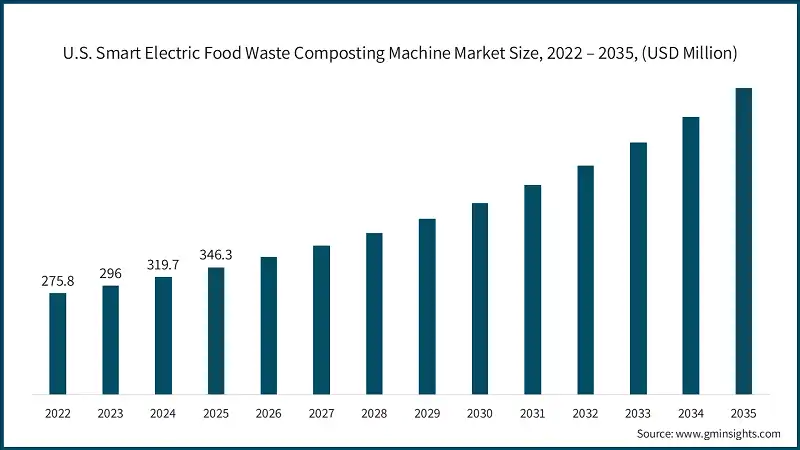
Looking for region specific data?
North America Smart Electric Food Waste Composting Machine Market The U.S. dominates an overall North America market and valued at USD 346.3 million in 2025 and is estimated to grow at a CAGR of 9.3% from 2026 to 2035. In the European market, Germany is expected to experience significant and promising growth from 2026 to 2035. In the Asia Pacific market, the China held 22% market share in 2025 and is anticipated to grow at a CAGR of 12.3% from 2026 to 2035. In the Middle East and Africa market, Saudi Arabia held 41.1% market share in 2025 promising growth from 2026 to 2035. Major players operating in the smart electric food waste composting machine industry include: Oklin caters to commercial and institutional clients with high-capacity composting solutions designed for rapid processing. Their machines utilize proprietary microbial technology, automated mixing systems, and precise thermal control to complete composting cycles in as little as 24 hours. Built with durable stainless-steel construction and energy-efficient designs, these machines operate without producing odors, making them ideal for large-scale food service operations, municipalities, and other high-volume environments. Komposta differentiates itself with advanced electromechanical composting systems that feature IoT-enabled remote monitoring and automation capabilities. Their machines are equipped with integrated shredders for efficient waste breakdown, heaters for maintaining optimal composting temperatures, and biofilters to ensure odor-free operation. Komposta further innovates by integrating its composting units into smart kitchen ecosystems and offering modular designs that cater to both residential and commercial users. These systems promote circular economic practices by enabling seamless waste-to-resource conversion.Europe Smart Electric Food Waste Composting Machine Market
Asia Pacific Smart Electric Food Waste Composting Machine Market
Middle East and Africa Smart Electric Food Waste Composting Machine Market
Smart Electric Food Waste Composting Machine Market Share
Smart Electric Food Waste Composting Machine Market Companies
Smart Electric Food Waste Composting Machine Industry News
The smart electric food waste composting machine market research report includes in-depth coverage of the industry, with estimates & forecast in terms of revenue (USD Million) and volume (Thousand Units) from 2022 to 2035, for the following segments:
Market, By Technology
- Microbial systems
- Hybrid microbial-heat systems
- Dehydration/grinding systems
Market, By Capacity
- 0-50 kg/day
- 50-100 kg/day
- 101-300 kg/day
- 301-500 kg/day
- 501-1000 kg/day
- Above 1000 kg/day
Market, By Price
- Low
- Medium
- High
Market, By End Use
- Residential
- Commercial
- Offices
- Restaurants
- Hotels
- Food processing centres
- Composting facilities
- Others (supermarkets, military/mining camps, etc.)
Market, By Distribution Channel
- Direct sales
- Indirect sales
The above information is provided for the following regions and countries:
- North America
- U.S.
- Canada
- Europe
- Germany
- UK
- France
- Italy
- Spain
- Asia Pacific
- China
- Japan
- India
- South Korea
- Australia
- Indonesia
- Malaysia
- Latin America
- Brazil
- Mexico
- Argentina
- MEA
- Saudi Arabia
- UAE
- South Africa
Frequently Asked Question(FAQ) :
What is the market size of the smart electric food waste composting machine industry in 2025?
The market size was USD 1.02 billion in 2025. The industry is expanding due to rising global food waste volumes and stronger regulatory pressure on sustainable waste management.
What is the current smart electric food waste composting machine market size in 2026?
The market size is estimated at USD 1.10 billion in 2026.
What is the projected value of the smart electric food waste composting machine market by 2035?
The market is expected to reach USD 2.54 billion by 2035. Growth is driven by regulatory mandates, sustainability adoption, and rapid advancements in IoT-enabled composting technologies.
How much revenue did the 0–50 kg/day capacity segment generate in 2025?
The 0–50 kg/day segment generated USD 264.1 million in 2025. Its demand is fueled by strong adoption in urban households, small cafés, and institutions needing compact, easy-to-operate units.
What was the market share of the medium-priced segment in 2025?
The medium-priced segment held 41.5% share in 2025. Growth is supported by rising demand for affordable smart features like IoT connectivity, odor control, and energy-efficient operation.
What is the growth outlook for direct sales distribution from 2026 to 2035?
Direct sales are projected to grow at a 10% CAGR through 2035. The increase is supported by stronger demand for customized installation, after-sales support, and OEM-led product demonstrations.
Which region leads the smart electric food waste composting machine market?
The U.S. led the regional market with USD 346.3 million in 2025. Growth is driven by strict landfill diversion mandates, high sustainability awareness, and adoption of IoT-enabled composting systems across commercial sectors.
What are the upcoming trends in the smart electric food waste composting machine industry?
Key trends include AI-driven automation, rapid composting technologies, IoT monitoring, odor-control innovations, and rising adoption across residential and commercial environments.
Who are the key players in the smart electric food waste composting machine market?
Major companies include Bokashicycle, FoodCycler, Oklin, Komposta, CleanRobotics, Mitsubishi Electric, Tidy Planet, EcoRich, NatureMill, Green Planet, HotBin, Ridan, Bhor, Earth Care, Fornnax, and Full Circle.
Smart Electric Food Waste Composting Machine Market Scope
Related Reports