Summary
Table of Content

Smart Agriculture Market
Get a free sample of this report
Form submitted successfully!
Error submitting form. Please try again.
Thank you!
Your inquiry has been received. Our team will reach out to you with the required details via email. To ensure that you don't miss their response, kindly remember to check your spam folder as well!
Request Sectional Data
Thank you!
Your inquiry has been received. Our team will reach out to you with the required details via email. To ensure that you don't miss their response, kindly remember to check your spam folder as well!
Form submitted successfully!
Error submitting form. Please try again.
Smart Agriculture Market Size
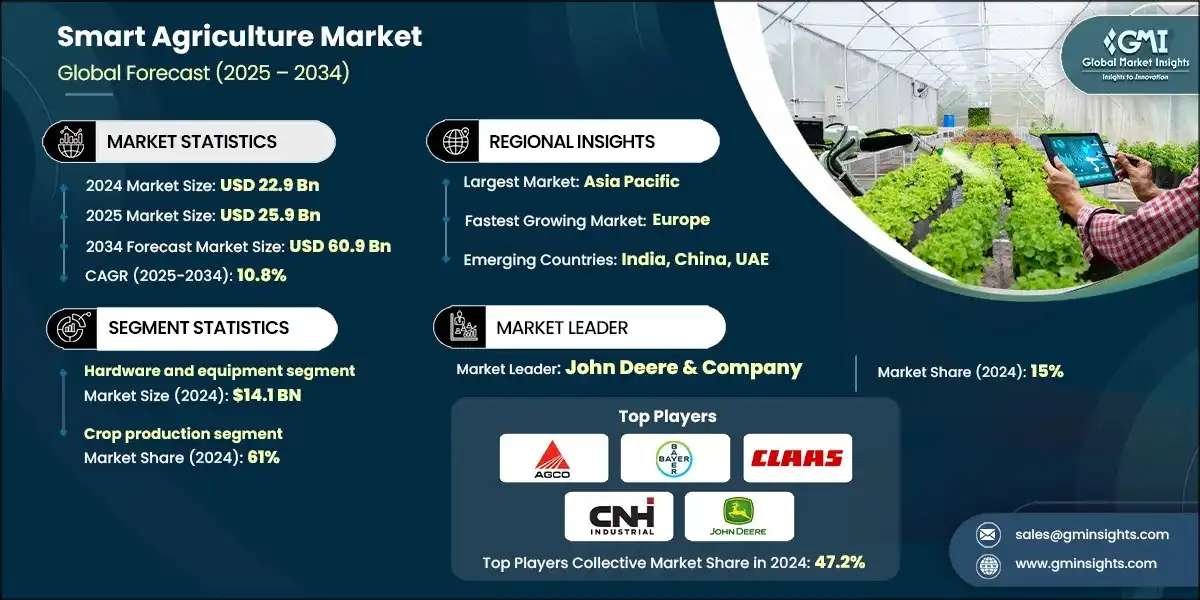
The global smart agriculture market was estimated at USD 22.9 billion in 2024. The market is expected to grow from USD 25.9 billion in 2025 to USD 60.9 billion in 2034, at a CAGR of 10.8%, according to Global Market Insights Inc.
To get key market trends
The smart agriculture market is being driven by major global challenges, including the growing demand for food due to population growth, a labor shortage, and the need to adapt to climate change. Government entities and industry stakeholders are putting innovative programs and policies in place to deal with these issues, and advance agricultural productivity, sustainability, and resilience.
Global population is estimated to surpass 9 billion by the year 2050 with a 60% increase in demand for food. To feed this population, agricultural productivity must advance significantly to sustainably feed people. According to the Food and Agriculture Organization (FAO), significantly higher crop yields, along with improvements in distribution of food, will be necessary to feed this confirmed increasing population.
As a consequence, governments are realizing the importance of more pervasive agricultural productivity. The FAO's 2023 report recommends 600 adaptation measures for governments to enhance agriculture's capacity to feed people in the future. These adaptations emphasize improved resilience and sustainability in agriculture.
The agricultural industry in the United States is experiencing major labor problems that have been affecting productivity and food security in the country. To tackle these issues, in September of 2023, the U.S. Department of Agriculture (USDA) announced the Farm Labor Stabilization and Protection Pilot Program, which allocates up to $ 65 million to support agricultural employers in helping resolve their labor workforce challenges. This initiative has two primary objectives, improving working conditions for farm workers and increasing legal migration options, including the H-2A visa program, to ensure a stable labor supply in support of the agriculture sector.
Moreover, the Advancing Automation Research and Development in Agriculture Act (AARDA), introduced in June 2023, directs the USDA to create a competitive grant program in order to increase the competitiveness of specialty crop producers through mechanization and automation. The aim of the bill is to develop cost-efficient technologies that will decrease the demand for manual labor and improvement crop production and management practices, while harvesting, processing, and packaging.
Climate change is impacting agricultural output as increased temperature, unpredictable rainfall, and extreme weather changes pose risks to crop output and food safety. To counter this, the U.S. Department of Agriculture (USDA) released its revised Climate Adaptation and Resilience Plan in June 2024. The Climate Adaptation and Resilience Plan presented strategies to build more resilience in agricultural production, management of natural resources, and rural development to respond to climate risks to the nation's food systems.
Furthermore, the USDA's Climate-Smart Agriculture and Forestry initiative aims to promote practices to improve productivity, build resilience, and reduce greenhouse gas emissions. The USDA plans to support the profitability of producers and sustainability through investments in climate-smart solutions. This initiative is aimed at strengthening rural wealth by opening new market opportunities.
Smart Agriculture Market Report Attributes
| Key Takeaway | Details |
|---|---|
| Market Size & Growth | |
| Base Year | 2024 |
| Market Size in 2024 | USD 22.9 Billion |
| Market Size in 2025 | USD 25.9 Billion |
| Forecast Period 2025 - 2034 CAGR | 10.8% |
| Market Size in 2034 | USD 60.9 Billion |
| Key Market Trends | |
| Drivers | Impact |
| Rising global food demand & population growth | The growing demand for food is catalyzing the uptake of smart-agriculture technologies that can improve farm productivity and food security. |
| Labor shortage & automation need | Labor shortages speed up the transition toward automation that provides yield and productivity while decreasing reliance on human capital. |
| Climate change adaptation requirements | Smart-agriculture permits farmers to implement precision-farming practices that allow better resource management and alter their practices to continual changes in varying climates. |
| Pitfalls & Challenges | Impact |
| High initial investment & implementation costs | High initial costs prevent small and medium farmers from embracing smart-agriculture technologies. |
| Limited rural connectivity infrastructure | Limited internet and network access to rural areas impedes the utility of IoT-based practices on the farm. |
| Return on Investment Uncertainty | Uncertain or delayed practice returns discourage farmers and financial sponsors to implement smart agriculture technologies. |
| Opportunities: | Impact |
| Carbon credit & environmental service markets | Farmers can generate additional income from adopting some smart-agriculture practices that can minimize their emissions to acquire carbon credits. |
| AI & machine learning integration | Enhancing decision-making, AI- and machine-learning technologies set the stage for more accurate management of crops and overall efficiencies in their operations. |
| Autonomous farming systems development | Advances in autonomy, such as drones and robots, scale solutions to agricultural productivity, labor independence, and financial returns. |
| Market Leaders (2024) | |
| Market Leaders |
15% market share |
| Top Players |
Collective market share in 2024 is 47.2% |
| Competitive Edge |
|
| Regional Insights | |
| Largest Market | Asia Pacific |
| Fastest Growing Market | Europe |
| Emerging Country | India, China, UAE |
| Future Outlook |
|
What are the growth opportunities in this market?
Smart Agriculture Market Trends
The smart agriculture sector is advancing in technology and initiatives from the government that will lead to increased productivity, sustainability, and resilience to climate-related risks in farming practices.
- U.S. Department of Agriculture (USDA) announced the Climate Adaptation and Resilience Plan (2024), which identifies strategies to enhance agricultural production and management of natural resources in light of climate risks. As a complementary approach, the USDA’s Climate-Smart Agriculture and Forestry Initiative is designed to innovate practices that promote productivity, climate-resilience, and the reduction of greenhouse gas emissions for sustainable practices and new market opportunities.
- Through the USDA’s Partnerships for Climate-Smart Commodities program, the USDA has invested in 135 opportunities, committing USD 3.03 billion since the program’s launch in September 2022. More than 21,000 farms have been enrolled across over 5.2 million acres to advance climate-smart practices and produce climate-smart commodities including beef, coffee, almonds, rice, and dairy products.
- Due to persistent drought conditions, the U.S. Department of Agriculture announced a $400 million investment via the Water Savings Commodity Program. The investment helps irrigation districts and producers adopt new on-farm water savings technologies and practices and hopes to conserve up to 50,000 acre-feet of water across 250,000 acres of irrigated land.
- The USDA has put more than $3 billion toward the Partnerships for Climate-Smart Commodities program to help farmers transition to sustainable farm management practices that build soil health and reduce greenhouse gas emissions. Almost half of the farmers participating in the program are small or underserved farmers, which indicates an emphasis on serving all types of producers.
- Smart agriculture quickly adapts to change, spurred on by demonstrating government support and growing acceptance of sustainable practices. Investment and practices in climate-smart, water-saving technologies, and a mix of innovation programs enable farmers to manage productivity and environmental challenges. They also highlight an enhanced focus on inclusivity and resilience and feature a more efficient, sustainable, and future-ready agricultural sector globally.
Smart Agriculture Market Analysis

Learn more about the key segments shaping this market
Based on product type, the market is segmented into hardware & equipment, software & digital platforms, and services & connectivity. The hardware and equipment segment dominated the smart agriculture industry accounting for USD 14.1 billion in 2024 and is expected to grow at a CAGR of 10.9% through 2034.
- The hardware and equipment side of smart agriculture is on a steady growth trajectory. The US Department of Agriculture (USDA) supports initiatives to allow farmers to upgrade machinery to devote time to productivity and sustainability. Large companies like John Deere are on the forefront of introducing autonomous tractors and smart farming equipment that utilize sensors and artificial intelligence.
- Digital techniques and software programs are becoming a more prominent part of farming in the new age of agriculture. The National Institute of Food and Agriculture funded by the USDA is also developing apps and platforms aimed at helping farmers manage their crops more effectively. Several states are also reaching out to local agritech firms to develop digital tools and resources to serve their local farmers. The shift towards digital farming enables farmers to make more informed, tactical decisions when managing inputs like water and fertilizers and delivering those services at lower costs.
- Reliable internet access is a vital component that allows smart farming to be effective. The USDA and Federal Communications Commission (FCC) are funding expansion of broadband in rural areas with funds such as the Rural Digital Opportunity Fund. Their investments are valuable to farmers who are using devices such as sensors and drones to connect their equipment to the internet for real-time data. Companies such as CNH Industrial are partnering with satellite providers to establish internet service access on rural farms while farmers can continue to use digital tools that are beneficial for them even in remote, hard to reach places.
Learn more about the key segments shaping this market
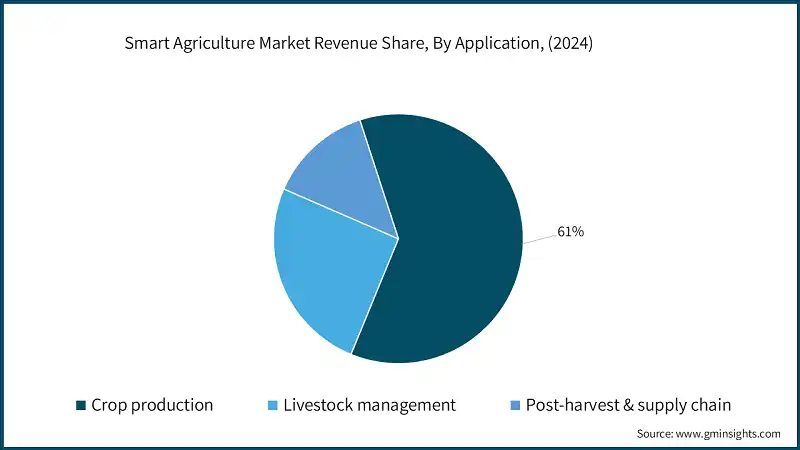
Based on application, the smart agriculture market is categorized into crop production, livestock management, and post-harvest & supply chain. The crop production segment dominates the market with 61% share in 2024, and the segment is expected to grow at a CAGR of 10.6% from 2025 to 2034.
- The field of smart agriculture includes emerging technologies that are completely transforming crop production. Smart agriculture refers to the implementation of newer technologies to increase the precision and efficiency of farming. The U.S. Department of Agriculture, as well as other government programs, is further supporting the use of these technologies by promoting the use of sensors, drones, and satellite images to monitor the health of crops and soil quality. The best-laid plans make no difference if there is not enough water, fertilizer, or optimum pest control, at the right time, to ensure your crop reaches its highest potential. Data and data-driven crop management is helping crops adapt to changing weather patterns while improving overall sustainability.
- Smart agriculture technologies in livestock management are soliciting new advancements in health and productivity for the farm. The U.S. Department of Agriculture, and other government programs, are encouraging the use of IoT devices and health monitoring systems, allowing livestock to be monitored constantly and remotely in real-time. These devices and systems allow farmers to monitor their livestock's behavior, routine, nutritional intake, and environment. Smart agriculture technologies are changing farm management, allowing farmers to continually monitor animal health status, rapidly detect illness, manage feeds more efficiently, and even monitor welfare. Smart agriculture systems are reducing production risks and reducing losses while improving the eating quality of meat, milk, and other dairy products.
- Smart agriculture is also achieving impactful changes in the postharvest period that includes food handling, storage, and distribution. Along with postharvest processing, state programs are supporting investment in cold storage, automated sorting, and traceability systems, and mediums just entering the farm and food systems. Farmers, processors, distributors, and retailers are ordering supplies, cold storage, and sorting, and tracking food for quality-control purposes in real-time.
Looking for region specific data?
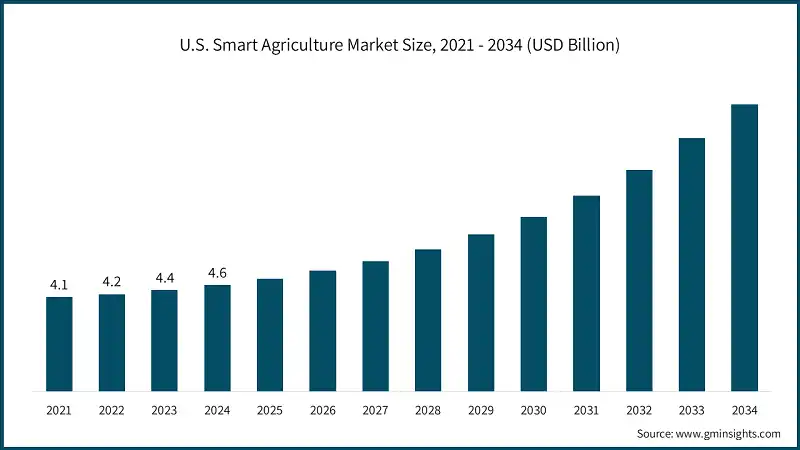
U.S. Smart Agriculture Market US dominated the market in North America with around 76% share in 2024 and generated USD 4.6 billion in revenue. The smart agriculture industry in the Germany is expected to experience significant and promising growth from 2025 to 2034. The market in China is expected to experience significant and promising growth from 2025 to 2034. The smart agriculture industry in Saudi Arabia is expected to experience significant and promising growth from 2025 to 2034. The market in Brazil is expected to experience significant and promising growth from 2025 to 2034. Major players operating in the smart agriculture industry are:Germany Smart Agriculture Market
China Smart Agriculture Market
Saudi Arabia Smart Agriculture Market
Brazil Smart Agriculture Market
Smart Agriculture Market Share
Smart Agriculture Market Companies
Smart Agriculture Industry News
The smart agriculture market research report includes in-depth coverage of the industry with estimates & forecasts in terms of revenue (USD Billion) from 2021 to 2034, for the following segments:
Market, By Product Type
- Hardware & equipment
- GNSS guidance & steering systems
- IoT sensors & monitoring devices
- Autonomous & robotic systems
- Precision application equipment
- Software & digital platforms
- Farm management information systems (FMIS)
- Decision support systems
- Supply chain & traceability platforms
- Services & connectivity
- Connectivity solutions
- Cloud computing & data analytics
- Professional services
Market, By Application
- Crop production
- Precision planting & seeding
- Nutrient management
- Crop protection
- Irrigation management
- Livestock management
- Animal health monitoring
- Automated feeding systems
- Breeding & reproduction management
- Post-harvest & supply chain
- Yield monitoring & analysis
- Storage & handling optimization
- Traceability & compliance
The above information is provided for the following regions and countries:
- North America
- U.S.
- Canada
- Europe
- Germany
- UK
- France
- Spain
- Italy
- Netherlands
- Asia Pacific
- China
- Japan
- India
- Australia
- South Korea
- Latin America
- Brazil
- Mexico
- Argentina
- Middle East and Africa
- South Africa
- Saudi Arabia
- UAE
Frequently Asked Question(FAQ) :
What are the upcoming trends in the smart agriculture industry?
Key trends include AI-driven decision support, autonomous tractors, satellite-enabled IoT, water-saving technologies, and blockchain-based traceability.
Who are the key players in the smart agriculture market?
Leading players include John Deere & Company, AGCO, Bayer, CLAAS Group, CNH Industrial, Kubota, Trimble, Mahindra & Mahindra, Topcon, and Yara International.
Which region leads the smart agriculture market?
The U.S. led the market with USD 4.6 billion in 2024, accounting for 76% of North America’s share. Growth is driven by USDA’s multi-billion-dollar funding for climate-smart practices and widespread adoption of precision agriculture.
What was the valuation of the crop production application segment in 2024?
Crop production accounted for 61% share in 2024, and is set to grow at a CAGR of 10.6% through 2034.
How much revenue did the hardware & equipment segment generate in 2024?
The hardware & equipment segment generated USD 14.1 billion in 2024, with a CAGR of 10.9% through 2034.
What is the market size of the smart agriculture industry in 2024?
The global market size for smart agriculture was valued at USD 22.9 billion in 2024, with a CAGR of 10.8% through 2034, driven by rising food demand, labor shortages, and climate adaptation needs.
What is the current smart agriculture market size in 2025?
The market is projected to reach USD 25.9 billion in 2025, supported by automation adoption and government-backed sustainability initiatives.
What is the projected value of the smart agriculture market by 2034?
The market is expected to reach USD 60.9 billion by 2034, led by AI integration, autonomous farming systems, and carbon credit opportunities.
Smart Agriculture Market Scope
Related Reports