Summary
Table of Content

Small Forklift Market
Get a free sample of this report
Form submitted successfully!
Error submitting form. Please try again.
Thank you!
Your inquiry has been received. Our team will reach out to you with the required details via email. To ensure that you don't miss their response, kindly remember to check your spam folder as well!
Request Sectional Data
Thank you!
Your inquiry has been received. Our team will reach out to you with the required details via email. To ensure that you don't miss their response, kindly remember to check your spam folder as well!
Form submitted successfully!
Error submitting form. Please try again.
Small Forklift Market Size
The increasing sustainable and efficient material handling demands are contributing to the growth of the market. As a result, many organizations are introducing battery-operated forklifts into their operations, allowing them to reduce emissions and cut down on noise within their facilities. The anticipated growth from the increasing number of users of battery-powered forklifts will help facilitate the global transition from traditional gasoline-powered forklifts to electric-powered forklifts, which will continue to contribute to the growth of the small forklift industry.
Small Forklift Market Key Takeaways
Market Size & Growth
- 2025 Market Size: USD 24.7 Billion
- 2026 Market Size: USD 27.1 Billion
- 2035 Forecast Market Size: USD 42.6 Billion
- CAGR (2026–2035): 5.2%
Regional Dominance
- Largest Market: Asia Pacific
- Fastest Growing Region: Asia Pacific
Key Market Drivers
- Expansion of e-commerce and fulfillment infrastructure.
- Transition toward electrification and sustainable operations.
- Integration of smart technologies and automation.
Challenges
- High capital investment for advanced forklift systems.
- Skilled labor shortage and training gaps.
Opportunity
- Growth in emerging economies and infrastructure development.
- Rise of micro-fulfillment and urban warehousing models.
Key Players
- Leading Players: Top 5 players in this market include Toyota Industries Corporation, KION Group AG, Jungheinrich AG, EP Equipment, Doosan Bobcat, which collectively held a market share of 38.7% in 2025.
Get Market Insights & Growth Opportunities
Moreover, government incentives have also assisted small forklift markets. For instance, the U.S. Environmental Protection Agency (EPA) has aided numerous eligible businesses by providing them with monetary assistance to aid the transition from traditional gas-powered forklifts to electric forklifts as a method of purchasing environmentally friendly equipment.
The European Union's (EU) Green Deal has set forth specific greenhouse gas emission reduction targets for the year 2030, aiming to reduce emissions by 55% compared to 1990 levels; this has motivated companies within the EU to invest in environmentally friendly machinery, including electric forklifts. Manufacturers are constantly investigating how they can innovate within the small forklift market and what type of new technologies they can introduce within the small forklift category.
Hyster-Yale Materials Handling and Crown Equipment Corporation have both been expanding the capabilities of battery-powered lift trucks. Hyster-Yale is concentrating on enhancing battery efficiency to provide longer operating times, whereas Crown is concentrating on developing ergonomic designs for operator comfort and creating advanced wireless telematics systems.
The rapid expansion of the e-commerce industry is also increasing demand for compact and efficient forklift trucks, which will help improve the efficiency of warehouse operations. In addition, innovation and government support continue to provide an environment conducive to substantial growth of small forklift trucks during the period.
The small forklift market was valued at USD 24.7 billion in 2025. The market is expected to grow from USD 27.1 billion in 2026 to USD 42.6 billion in 2035, at a CAGR of 5.2%, according to latest report published by Global Market Insights Inc.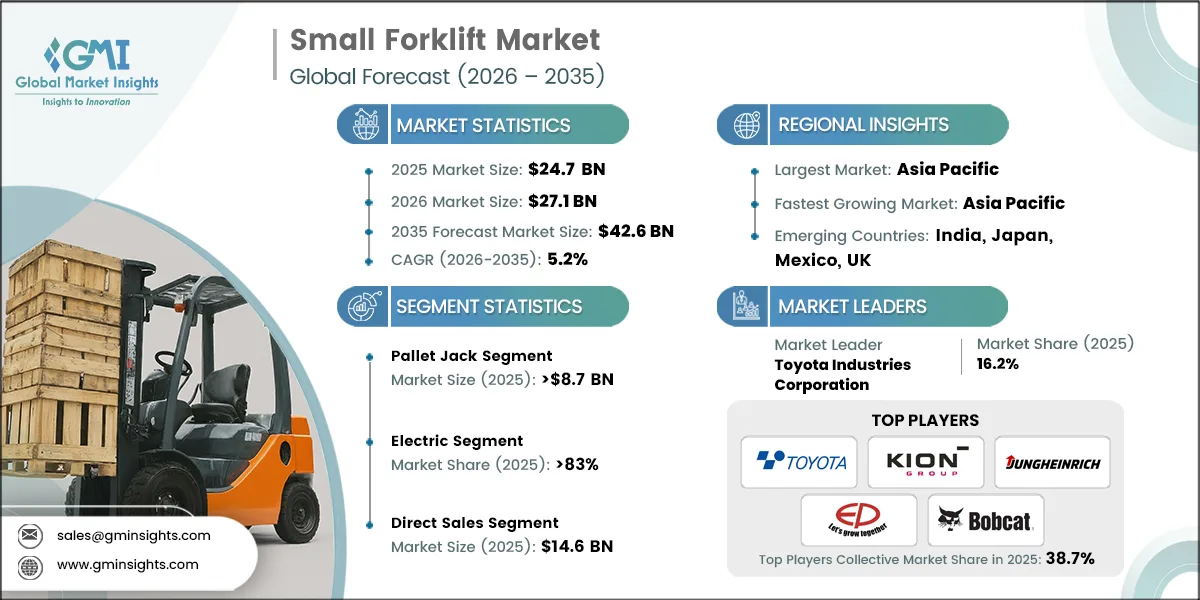
To get key market trends
Small Forklift Market Trends
Changing innovation and technology transformation are important for the growth of the global small forklift industry.
- Current developments within the small forklift industry relate primarily to advances in technology, along with changes in customer requirements. One of the primary drivers of innovation is the increased demand for electric forklifts because of their energy efficiency, quieter operation characteristics, and greater maneuverability compared to their traditional counterparts within tight surroundings.
- Governments around the world are promoting sustainable forms of industrial equipment. For example, the "Fit for 55" initiative from the European Union and the U.S. Overview of the Inflation Reduction Act ,enacted in 2022, provide financial incentives to businesses that convert to energy-efficient machinery, including electric forklifts.
- In addition to helping to make the conversion to cleaner technologies a reality, these initiatives are allowing for the advancement of new technologies within the material handling industry. Toyota Material Handling and the Hyster-Yale Group are the two major manufacturers of innovative small forklifts.
- Toyota’s 3-Wheel Electric Forklift provides customers with several features related to safety through advanced technologies, as well as a more comfortable experience due to its ergonomic design. Hyster-Yale Focuses its product development on providing customers with durable electric machinery that meets their material handling needs quickly and accurately.
- Another emerging trend is the integration of IoT and telematics in forklifts. These technologies enable real-time performance monitoring, reducing downtime and optimizing fleet management. Thus, small forks industry is rapidly changing and is focused on the sustainability of product design, as well as an emphasis on innovation and improving operational efficiency.
Small Forklift Market Analysis

Learn more about the key segments shaping this market
Based on type, market is divided into reach truck, order picker, turret truck, pallet jack, pallet stacker, tow tractor, walkie pallet truck, rider pallet truck. The pallet jack segment crossed USD 8.7 billion in 2025.
- There’s steady growth in the small forklift sector with pallet jacks driving the way in terms of cost-effectiveness and productivity. In addition, electric pallet jacks are being used extensively in warehouses to support the expanding e-commerce industry and for efficient ground-level material handling. The U.S. Census Bureau (2023) shows that e-commerce sales rose 7.8% from the previous year, leading to increased demand for cost-efficient warehouse equipment like pallet jacks.
- Pallet jacks are often selected for their low first cost and ergonomic advantages. For example, electric pallet jacks are attributed to having less employee fatigue while performing work tasks and enhancing employee productivity through less fatigue. Examples of manufacturers producing updated electric pallet jacks for modern warehouses include Toyota Material Handling and Crown Equipment Corporation.
- Pallet stackers are another important segment within the small forklift marketplace that provides the mobility of pallet jacks combined with vertical lifting ability. Many warehouses are adopting pallet stackers as they look to optimize their use of space and create narrow aisle operations. Manufacturers like Jungheinrich and Hyster-Yale Group produce stackers that are energy-efficient and can accurately handle loads to meet the demand for advanced material handling solutions.
- The warehouse automation and infrastructural development initiatives that the government has created will help the market. According to the U.S. Department of Commerce, the warehouse construction industry increased by 5.1% in 2023, creating additional business opportunities for forklift manufacturers.
- Thus, in the small forklift segment, the pallet jack segment grows and dominates, with projections indicate significant growth within the forecast period. Rapid growth in e-commerce and the development of ergonomic product designs that save space will further accelerate this growth opportunity..
Learn more about the key segments shaping this market
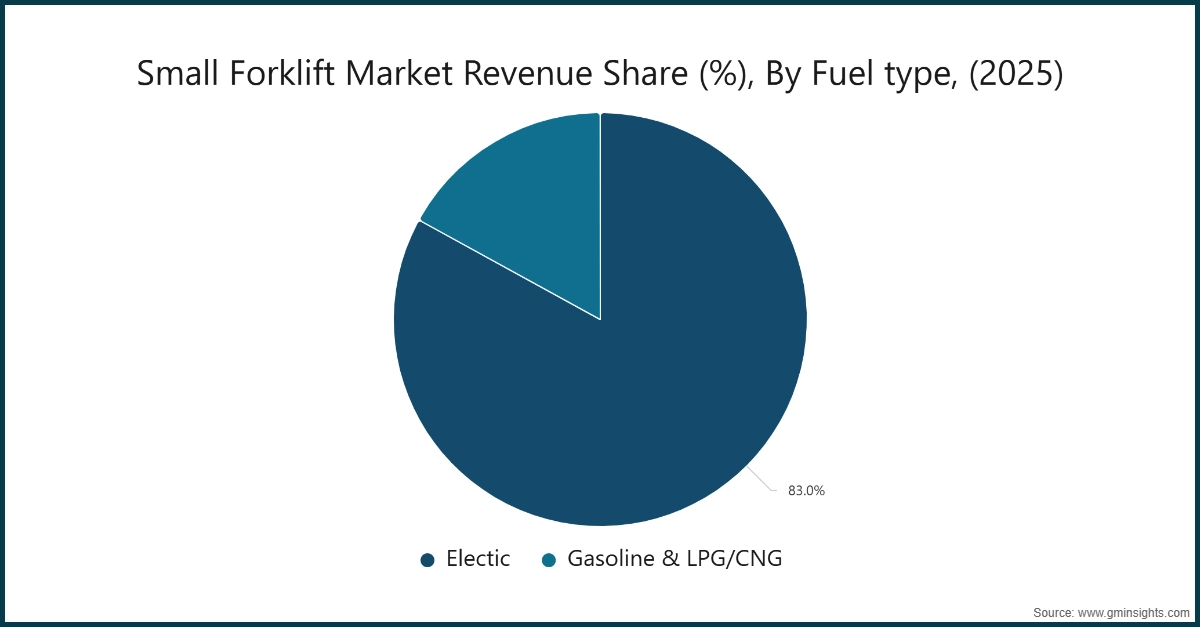
Based on fuel, the market is segmented into electric, gasoline and LPG/CNG. The electric segment accounted for over 83% of the global small forklift market share in 2025.
- The small forklift industry is growing substantially, with the electric segment being the leading fuel type segment. The increased use of electric forklifts is the main factor for this market development due to their low carbon footprint, low cost of maintenance and suitability to operate inside. According to data from the U.S. Department of Energy, over 60% of all forklifts sold in the U.S. are electric forklifts, driven primarily by increasing emission regulations and incentives for using cleaner technologies.
- Government programs, including incentives for using electric vehicles such as rebates and tax benefits, will continue to support growth in the electric forklift market. The European Union's "Fit for 55" package is a major initiative aimed at reducing greenhouse gas emissions by 55% by 2030, and one of the package's objectives is to encourage the use of electric power equipment in lieu of diesel-powered equipment. This is particularly relevant, as many companies are being encouraged to replace diesel-powered forklifts with electric alternatives, particularly for use in warehouses and manufacturing.
- Toyota Materials Handlings and Jungheinrich AG are some of the leading manufacturers of small forklifts; they both have expanded their electric forklift offerings to meet this rapidly growing market. Toyota's 3-Wheel Electric Forklift and Jungheinrich's EFG Series are both very popular with small businesses due to their small size and overall energy efficiency.
- Electric forklifts are seen within many industries, including retail, logistics, food and beverage. Due to having operational advantages such as having lower operational noise levels, zero emissions, and reduced vibrations than IC or diesel counterbalanced forklift trucks in closed environments, many companies are adopting electric forklifts in these types of applications as part of their sustainable development initiatives.
- Although diesel forklifts remain relevant in outdoor applications, it is expected that electric fork lift trucks will have a superior growth path than the other types of fuel, including propane, as a result new technologies being developed and supportive regulatory programs during the period.
Based on the distribution channel, the small forklift market is segmented into direct sales and indirect sales. In 2025, direct sales held a major market share, generating a revenue of USD 14.6 billion.
- The small forklift sector is driven mainly by sales directly to the customer on distribution channels, which represents the largest share of the market. This is due to the fact that there are many distinct requirements when using small forklifts and a need for the manufacturer/supplier to provide customer support that meets these specialized needs.
- Through direct sales, manufacturers can help their customers decide on the best product for their particular application, set it up as required and maintain it properly. According to the U.S. Census Bureau, the material handling equipment market - including forklifts has experienced consistent growth during the past five years,with annual sales increasing by 4.5% on average each of those five years.
- This growth demonstrates how important it is for companies to utilize direct sales channels to meet the customer demand for purchases of specialized equipment, such as small forklifts, for example- Hyster-Yale Group places high importance on working directly with their clients to deliver customized solutions for small forklifts.
- The demand for small forklifts has increased due to government efforts focused on improving industrial automation and warehouse productivity. According to the U.S. Department of Commerce, warehouse automation is growing at 6% per year, producing new opportunities for manufacturers to use their direct sales channels better.
- Thus, customer demands for suitable solutions and reliable after-sales service have led to a strong preference for direct sales in the small forklift market and leveraging direct sales channels can drive both customer satisfaction and market expansion.
North America Small Forklift Market
 Looking for region specific data?
Looking for region specific data?
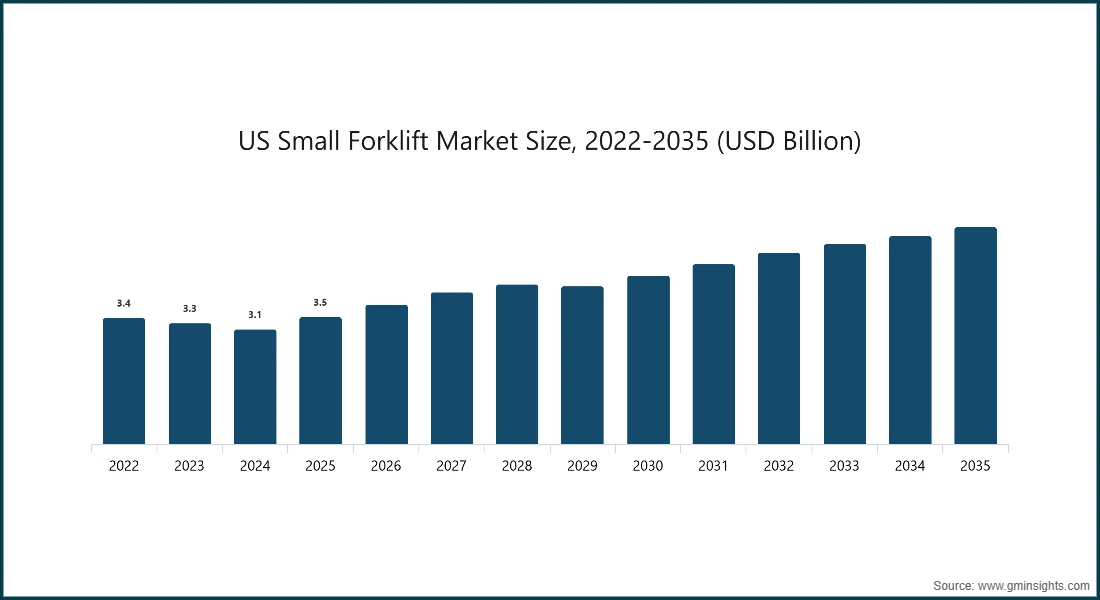
In 2025, the U.S. dominated the small forklift industry growth in North America, accounting for 83.9% of the share in the region.
- The U.S. leads the North American small forklift market due to strong warehousing expansion driven by e‑commerce, retail distribution centers, and third‑party logistics operators. High adoption of electric and lithium‑ion forklifts, supported by sustainability policies and warehouse automation investments, strengthens national demand. Industrial modernization in automotive, food & beverage, and packaging industries also fuels recurring replacement cycles.
- Additionally, the presence of major OEMs, extensive dealer networks, and advanced financing/leasing models accelerates equipment penetration across SMEs. U.S. companies are increasingly shifting toward compact forklifts for last‑mile logistics, micro‑fulfillment centers, and indoor handling tasks, enabling higher operational efficiency in smaller spaces. Cross‑border trade through Canada and Mexico boosts demand for material‑handling equipment in manufacturing corridors.
Asia Pacific Small Forklift Market
Asia Pacific small forklift market is expected to grow at 5.8% during the forecast period.
- Asia Pacific’s growth is driven by rapid industrialization in China, India, and Southeast Asia, boosting demand for compact forklifts in manufacturing and logistics hubs. Expanding e‑commerce ecosystems and urban warehousing support sustained adoption of electric small forklifts. Government initiatives promoting smart factories and green mobility further accelerate the shift toward lithium‑ion technology
Europe Small Forklift Market
Europe small forklift market is expected to grow at 4.5% during the forecast period.
- Europe’s growth is shaped by strong environmental regulations that encourage adoption of electric and energy‑efficient small forklifts across warehouses and factories. Automation in logistics, food processing, pharmaceuticals, and automotive production fuels demand for maneuverable compact units. Increasing investments in cold‑chain logistics and urban distribution networks further stimulate equipment modernization.
Middle East and Africa Small Forklift Market
Middle East and Africa small forklift market is expected to grow at 4.2% during the forecast period.
- MEA growth is supported by rising construction activities, industrial diversification, and logistics investments in GCC economies. Expanding retail distribution networks and free‑trade zones are increasing demand for small material‑handling equipment. Adoption of compact forklifts is rising in ports, warehouses, and light‑manufacturing clusters. Urban development programs and increased private‑sector logistics activity maintain stable regional growth momentum.
Small Forklift Market Share
The top companies in the small forklift market include Toyota Industries Corporation, KION Group AG, Jungheinrich AG, EP Equipment and Doosan Bobcat and collectively hold a share of 38.7% of the market in 2025. These prominent players are proactively involved in strategic endeavors, such as mergers & acquisitions, facility expansions & collaborations, to expand their product portfolios, extend their reach to a broad customer base, and strengthen their market position.
- Toyota Industries Corporation maintains a strong presence in the small forklift market with its electric and IC cushion‑tire models engineered for maneuverability, energy efficiency, and safety within confined warehouse environments. Its forklifts integrate advanced system controls, industry‑leading reliability, and ergonomic operator interfaces to support high‑cycle material handling.
- KION Group participates in the small forklift segment through its Linde and STILL brands, offering compact electric and diesel forklifts known for precision handling, robust construction, and operator‑assistance technologies. The company emphasizes hydrostatic drive systems, advanced energy solutions, and intelligent fleet management tools that enhance productivity in warehousing and light‑industrial settings.
- Jungheinrich AG is a leading player in small electric forklifts, delivering compact, high‑efficiency models optimized for tight‑aisle maneuverability, low energy consumption, and digital fleet connectivity. Its machines incorporate AC drive technology, advanced safety systems, and ergonomic controls designed for demanding intralogistics operations.
Small Forklift Market Companies
Major players operating in the small forklift industry are:
- Anhui Heli Co., Ltd.
- BYD Forklift
- Crown Equipment Corporation
- Doosan Bobcat
- EP Equipment
- Godrej & Boyce
- Hangcha Group Co., Ltd.
- Hyster-Yale, Inc.
- Hyundai Material Handling
- Jungheinrich AG
- KION Group AG
- Komatsu
- Lonking Machinery
- Mitsubishi Logisnext Co. Ltd
- Toyota Industries Corporation
EP Equipment specializes in value‑driven small electric forklifts that prioritize simplicity, compact design, and lithium‑ion efficiency for modern warehouse applications. Its portfolio includes lightweight, maintenance‑friendly models tailored for SMEs seeking cost‑effective, high‑uptime solutions. EP’s focus on modular components, battery innovation, and affordability strengthens its position as a competitive alternative brand in global small forklift deployments.
Doosan Bobcat participates in the small forklift market with rugged, performance‑oriented IC and electric forklifts engineered for dependable operation across manufacturing, logistics, and light‑construction environments. The machines offer strong lifting capability, predictable handling, and protective operator features designed for durability and daily high‑load cycles.
Small Forklift Market Report Attributes
| Key Takeaway | Details |
|---|---|
| Market Size & Growth | |
| Base Year | 2025 |
| Market Size in 2025 | USD 24.7 Billion |
| Market Size in 2026 | USD 27.1 Billion |
| Forecast Period 2026-2035 CAGR | 5.2% |
| Market Size in 2035 | USD 42.6 Billion |
| Key Market Trends | |
| Drivers | Impact |
| Expansion of e-commerce and fulfillment infrastructure | The rapid growth of online retail and omnichannel logistics is producing demand for smaller highly sturdy forklifts in warehouse and distribution centers. |
| Transition toward electrification and sustainable operations | Electric forklifts are rising in popularity due to lower emissions, lower operating costs, and the ramping global sustainability movements. The advances in lithium-ion and hydrogen fuel cells will only increase this trend. |
| Integration of smart technologies and automation | The implementation of telematics, IoT sensors, and semi-autonomous navigation systems are now supplementing the productivity and safety of maximum throughput operations. |
| Pitfalls & Challenges | Impact |
| High capital investment for advanced forklift systems | The cost of electric and automated forklifts does come with a premium upfront expense, which may be prohibitive for small-to-medium enterprise (SME) customers, especially in emerging markets. |
| Skilled labor shortage and training gaps | The shortage of qualified operators, trainers, and maintenance personnel for electric and automated forklifts could impede productivity once in operation and create uncertainty with the potential for disruption and safety impacts. |
| Opportunities: | Impact |
| Growth in emerging economies and infrastructure development | Nations like China, Brazil, and Saudi Arabia are pouring significant money into logistics, manufacturing, and smart city infrastructure development, which is generating demand for small forklifts in various end markets. |
| Rise of micro-fulfillment and urban warehousing models | Urban logistics hubs and micro-fulfillment centers need small and agile forklifts for last mile logistics operations, and this presents a compelling opportunity for manufacturers. |
| Market Leaders (2025) | |
| Market Leader |
16.2 % market share |
| Top Players |
Collective market share in 2025 is 38.7% |
| Competitive Edge |
|
| Regional Insights | |
| Largest Market | Asia Pacific |
| Fastest growing market | Asia Pacific |
| Emerging countries | India, Japan, Mexico, UK |
| Future outlook |
|
What are the growth opportunities in this market?
Small Forklift Industry News
- In February 2026, Bobcat Company announced the launch of its new high‑performance lithium‑ion battery line engineered for Class I electric sit‑down forklifts, marking a major expansion of its electric‑power portfolio. The new 48‑volt and 80‑volt battery packs—available in 400Ah and 600Ah configurations—are designed for cushion‑tire, pneumatic‑tire and three‑wheel forklifts, delivering consistent output, faster charging and improved uptime.
- In January 2026, BYD Forklift launched the world’s first mass‑produced sodium‑ion electric counterbalance forklift, marking a major breakthrough in industrial vehicle power technology. The new model features reliable performance in extreme temperatures ranging from –40°C to 60°C, making it ideal for cold‑storage and harsh‑climate operations.
- In November 2025, Hala Equipment Trading introduced the new HELI 10‑ton diesel forklift with a container‑spec mast, showcasing it as the most compact model in its class at just 2 meters wide, making it exceptionally suitable for maneuvering inside standard 20‑ and 40‑foot containers. The launch highlighted its low‑height, wide‑view container mast that improves operational safety and visibility during confined‑space handling.
- In September 2025, Crown Equipment announced the launch of its new “Build My Truck” online feature, a self‑service configuration tool that enables crown.com users to identify, customize, and request quotes for lift trucks based on precise application needs. Integrated with Crown’s Forklift Product Selector, the tool allows buyers to streamline their selection process using filters such as capacity and lift height before choosing individual options or curated packages.
- In May 2025, EP Equipment and Jungheinrich announced a strategic global partnership under the motto “Shaping the Future of Material Handling Together,” marking a significant step toward accelerating industry‑wide electrification. Jungheinrich confirmed the launch of a new Mid‑Tech brand, “AntOn by Jungheinrich,” supported by EP’s electric counterbalance and warehouse‑truck expertise, enabling both companies to expand their product coverage across the growing mid‑tech segment.
The small forklift market research report includes in-depth coverage of the industry, with estimates & forecasts in terms of revenue (USD Billion) and volume (Thousand Units) (from 2022 to 2035), for the following segments:
Market, By Type
- Reach truck
- Order picker
- Turret truck
- Pallet jack
- Pallet stacker
- Tow tractor
- Walkie pallet truck
- Rider pallet truck
Market, By Load Capacity
- Micro capacity (<2,200 lbs)
- Low capacity (2,200-4,400 lbs)
- Medium capacity (4,400-7,700 lbs)
- High capacity (7,700-11,000 lbs)
Market, By Motor Power Output
- Below 19 HP
- 20 HP- 34 HP
- 35 HP - 44 HP
- 45 HP - 50 HP
Market, By Fuel
- Electric
- Below 24V
- 24V-36V
- 36V-48V
- Above 48V
- Gasoline & LPG/CNG
Market, By End-use
- Warehousing & logistics
- Retail & e-commerce fulfilment centres
- Manufacturing (light industry, electronics, food & beverage)
- Construction & building materials
- Automotive components handling
- Ports & distribution terminals
Market, By Distribution Channel
- Direct sales
- Indirect sales
The above information is provided for the following regions and countries:
- North America
- U.S.
- Canada
- Europe
- Germany
- France
- UK
- Italy
- Spain
- Asia Pacific
- China
- Japan
- India
- Australia
- South Korea
- Latin America
- Brazil
- Mexico
- Argentina
- MEA
- Saudi Arabia
- UAE
- South Africa
Frequently Asked Question(FAQ) :
What is the market size of the global small forklift in 2025?
The global small forklift market was valued at USD 24.7 billion in 2025, with a CAGR of 5.2% expected through 2035, driven by growing adoption of electric forklifts, and increasing government incentives for sustainable industrial equipment.
What is the projected value of the global small forklift industry by 2035?
The global small forklift market is expected to reach USD 42.6 billion by 2035, propelled by rising demand for compact and energy-efficient material handling solutions, and the global transition from gasoline-powered to battery-operated forklifts.
What is the current small forklift industry size in 2026?
The market size is projected to reach USD 27.1 billion in 2026.
What was the market size of the pallet jack segment in 2025?
The pallet jack segment crossed USD 8.7 billion in 2025, driven by its cost-effectiveness, ergonomic advantages, and widespread adoption in warehouses supporting the expanding e-commerce industry.
What was the market share of the electric fuel segment in the small forklift market in 2025?
The electric segment accounted for over 83% of the global small forklift market share in 2025, driven by stringent emission regulations, government incentives for cleaner technologies, and operational advantages including zero emissions.
How much revenue did the direct sales distribution channel generate in 2025?
The direct sales segment generated USD 14.6 billion in 2025, driven by the need for customized solutions, specialized technical support, and after-sales services that manufacturers provide directly to industrial buyers.
Which region leads the small forklift market?
North America leads the small forklift market, with the U.S. accounting for 83.9% of the regional share in 2025, supported by strong warehousing expansion driven by e-commerce, high adoption of electric forklifts, industrial modernization, and extensive OEM dealer networks.
What are the key trends shaping the small forklift market?
Key trends include integration of IoT and telematics for real-time fleet monitoring, growing warehouse automation investments, and increasing demand for compact forklifts in micro-fulfillment and last-mile logistics operations.
Who are the key players in the small forklift market?
Key players include Anhui Heli Co., BYD Forklift, Crown Equipment Corporation, Doosan Bobcat, EP Equipment, Godrej & Boyce, Hangcha Group, Hyster-Yale, Hyundai Material Handling, Jungheinrich AG, KION Group AG, Komatsu, Lonking Machinery, Mitsubishi Logisnext, and Toyota Industries Corporation.
Small Forklift Market Scope
Related Reports